Disclosure: Vital Signs Today may earn a commission if you buy through links on this page, at no extra cost to you. This does not influence our evidence-based assessments. We are not a medical provider; talk to a clinician before acting on test results.
Your blood test came back, and tucked inside the white blood cell section is a line for lymphocytes flagged “low.” Maybe the absolute number reads under 1,000, or the percentage dipped below the reference range. Either way, you are staring at a flag on the part of your blood that fights infection, and the obvious question lands hard: should you be worried?
Here is the honest answer. A low lymphocyte count is common, frequently temporary, and very often means nothing more than that you were recently sick or stressed. But it can also be the first quiet trace of something that deserves attention. Knowing which camp you are in is the whole game.
Part of our Complete Blood Count guide.

What does low lymphocytes mean in a blood test?
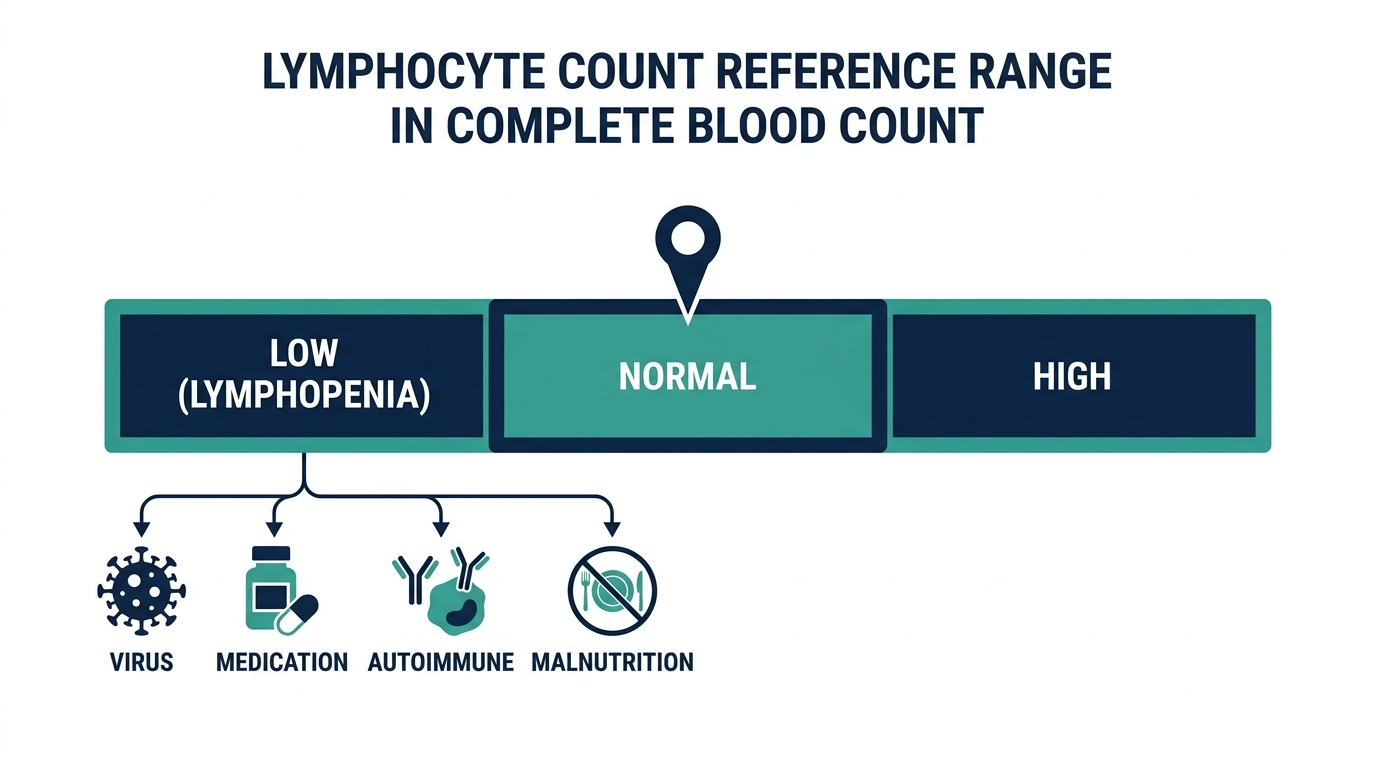
Low lymphocytes in a blood test means you have fewer of these infection-fighting white blood cells than expected. The medical name is lymphopenia, also written as lymphocytopenia. In adults, the normal range runs from roughly 1,000 to 4,800 lymphocytes per microliter of blood, and the formal cutoff for lymphopenia is an absolute lymphocyte count below 1,000 per microliter (Cleveland Clinic). In children under age 2, the threshold is lower, below 3,000 per microliter (Merck Manual).
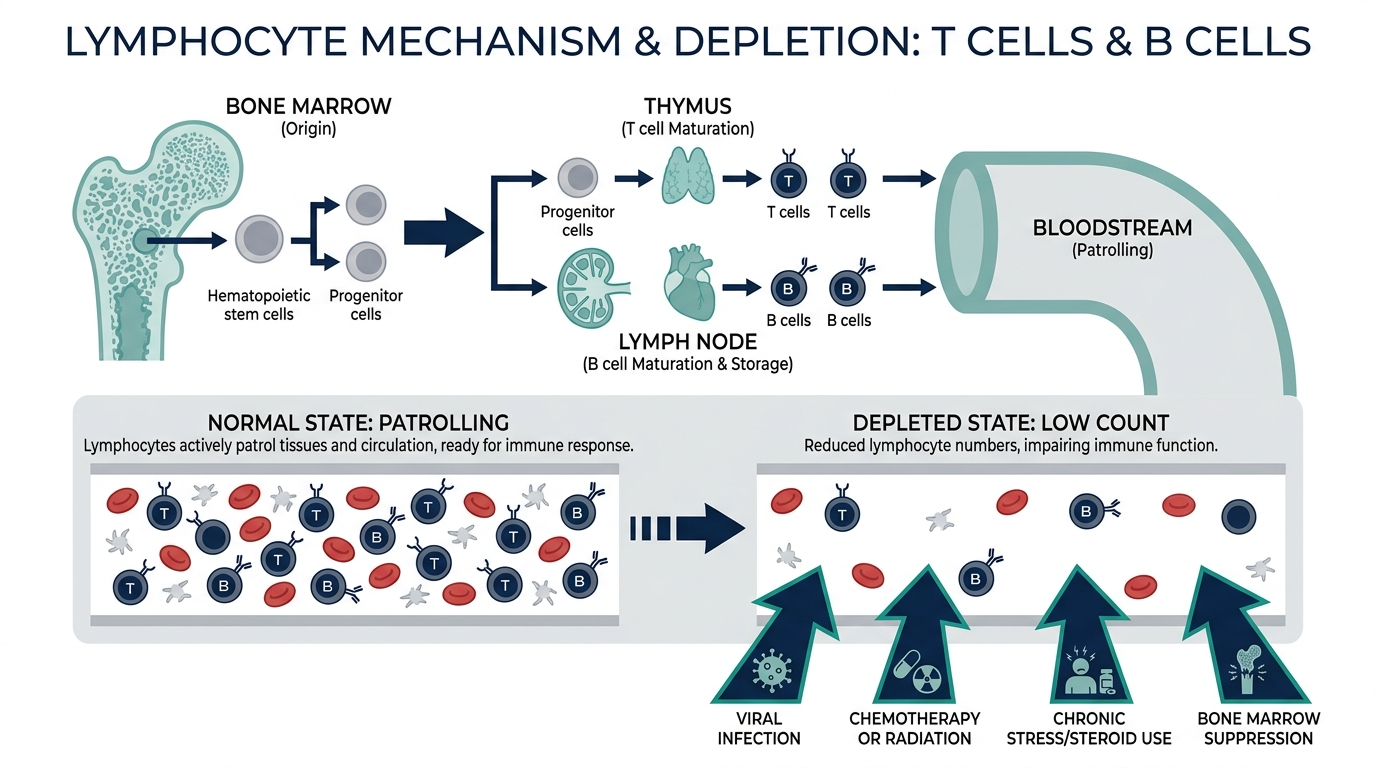
Lymphocytes are the specialist arm of your immune system. They make up about 20 to 40 percent of your white blood cells and include T cells, which attack infected and abnormal cells directly, and B cells, which produce antibodies (Cleveland Clinic). When the count drops, the part of your defense that remembers and targets specific invaders is running thinner than usual.
One detail trips people up constantly. Your report may show a lymphocyte percentage and an absolute lymphocyte count, and they are not the same thing. The percentage is the share of white cells that are lymphocytes. The absolute count is the actual number, calculated by multiplying your total white cell count by that percentage (Cleveland Clinic). The absolute count is what clinicians care about. A low percentage can simply mean another cell type rose, not that your lymphocytes truly fell.

What causes low lymphocytes?
Most low lymphocyte counts are acquired, meaning something temporarily or chronically pushed the number down, rather than a condition you were born with (Merck Manual). Here is the real differential, roughly in order of how often it shows up:
- Recent infection. This is the big one. Many common viral and bacterial infections, including the flu, COVID-19, and Epstein-Barr virus, temporarily drop your lymphocyte count while your body redirects them to fight (Merck Manual). The count usually rebounds on its own.
- Stress and steroids. Physical stress, sepsis, surgery such as cardiac bypass, and corticosteroid medications all suppress lymphocytes, and the effect is often transient (Merck Manual).
- Nutritional shortfalls. Low protein, vitamin B12, folate, or zinc can lower the count. Protein-energy undernutrition is the most common cause of lymphopenia worldwide (Merck Manual).
- Medical treatments. Chemotherapy, radiation, and immunosuppressant drugs deliberately or unavoidably knock lymphocytes down (Cleveland Clinic).
- Chronic infections and immune disease. HIV/AIDS, tuberculosis, viral hepatitis, and autoimmune conditions such as lupus and rheumatoid arthritis can produce a persistent low count (MedlinePlus).
- Blood and bone marrow disorders. Less commonly, lymphoma, leukemia, and aplastic anemia interfere with how lymphocytes are made (Cleveland Clinic).
- Aging. Lymphocyte counts tend to drift down slowly with age, which is a normal part of an aging immune system (MedlinePlus).
The pattern worth internalizing: a single mildly low reading taken around the time you were unwell almost always lands in the benign, temporary half of that list. A persistently low count across repeat tests is what pushes the investigation toward the serious half.
What are the symptoms of low lymphocytes?
Here is the part that surprises most people: low lymphocytes by themselves cause no symptoms at all. Lymphopenia is silent. You cannot feel it, and the vast majority of people only learn about it because a routine blood test flagged it (Cleveland Clinic).
What you might notice are symptoms of whatever is causing the low count, or symptoms that appear when the count has been low enough, for long enough, to weaken your defenses. Those include fever, cough, swollen lymph nodes, skin rash, mouth ulcers, or infections that keep coming back or refuse to clear (Cleveland Clinic). The signal is not the low number itself. It is the pattern of getting sick more easily or staying sick longer than you should.
So if you feel completely fine and your lymphocytes are slightly under the line, that combination is reassuring. A dangerously compromised immune system tends to announce itself through repeated or unusual infections, not through a quiet number on an otherwise normal day.

When is low lymphocytes dangerous or a medical emergency?
A mildly low count just under 1,000 per microliter, especially a one-off after an illness, is rarely an emergency. Risk climbs as the count falls further and as it stays down. Severe and persistent lymphopenia, particularly when it strips out the CD4+ T cells that coordinate your immune response, is what raises the real danger of opportunistic infections, the kind that healthy immune systems normally shrug off (Merck Manual).
Treat these as reasons to seek prompt care:
- A fever of 100.4 F (38 C) or higher when you already know your immune count is low or you are on chemotherapy or immunosuppressants.
- Infections that recur, spread, or do not respond to normal treatment.
- An unusual or opportunistic infection, such as a serious fungal infection or shingles, especially in someone not expected to get one.
- A very low count combined with symptoms like drenching night sweats, unexplained weight loss, or persistently swollen lymph nodes, which can point to an underlying blood disorder (Cleveland Clinic).
The number alone does not declare an emergency. The number plus infection symptoms does. If you are immunosuppressed and you spike a fever, that is not a wait-and-see situation, it is a same-day call.
What should you do about low lymphocytes?
The single most important next step is also the simplest: repeat the test. Because so many low counts are transient infection or stress effects, a confirmatory complete blood count after a few weeks, once you are well, sorts most cases (Merck Manual). If the count has normalized, the chase usually ends there.
If it stays low, the work shifts to finding the cause rather than treating the number. Depending on your history, your clinician may:
- Review your medications, since steroids and immunosuppressants are frequent culprits.
- Check nutrition, including protein status, B12, folate, and zinc (Cleveland Clinic).
- Order targeted tests for infections such as HIV or hepatitis, or screen for autoimmune disease, when the picture fits.
- Order lymphocyte subset testing to see whether T cells, B cells, or NK cells specifically are depleted, which narrows the differential sharply.
Mild lymphopenia with no symptoms and no worrying cause often needs no treatment at all. When treatment is warranted, it targets the underlying problem, for example correcting a nutritional deficiency, adjusting a medication, or treating an infection. In severe immune deficiency, immunoglobulin therapy can help bolster defenses (Cleveland Clinic). There is no pill that simply raises lymphocytes on its own, which is exactly why finding the cause matters more than the count.

When should you see a doctor?
Book a visit if your low lymphocyte count shows up on more than one test, if it came with symptoms like recurring infections, fever, night sweats, or unexplained weight loss, or if you have a known condition or medication that affects your immune system and want to understand your numbers. A single slightly low reading while you were recovering from a cold, with no symptoms now, is usually fine to flag at your next routine appointment rather than rush in for.
Bring the actual report. The difference between a low percentage and a genuinely low absolute count, and the trend across any prior blood tests, tells your clinician far more than the word “low” ever could.
The part most people miss: percentage versus absolute, and the post-viral dip
Two clinical nuances quietly cause most of the needless worry over low lymphocytes, and almost no patient version explains them.
First, the percentage trap. Many people see “lymphocytes 18 percent, low” and assume their lymphocytes crashed. Often they did not. If your neutrophils surged during an infection, they enlarge their share of the white cell pie, which mechanically shrinks everyone else’s percentage even when the actual lymphocyte number is normal. This is why the absolute lymphocyte count, the true headcount, is the figure that matters, and why a low percentage with a normal absolute count is frequently a non-event (Cleveland Clinic). Always find the absolute number before you panic.
Second, timing is everything. Lymphopenia is famously transient after viral and bacterial infections, sepsis, steroids, and stress (Merck Manual). A blood test drawn while you are fighting the flu or in the week after COVID-19 can show a real but temporary dip that means very little about your baseline immunity. The single most common misread in primary care is treating a low count drawn during or just after an illness as if it were your steady state. The fix is not a referral. It is a repeat test once you are well.
One more point. A persistently low count is not always harmless. In certain lymphomas, lymphopenia at diagnosis has been linked to worse survival, which is part of why doctors take a stubbornly low count seriously (American Journal of Hematology, lymphopenia in T-cell lymphoma). The lesson is not alarm. A low count that refuses to recover earns a proper look, while a one-time post-viral dip earns a repeat test and a shrug.

The three lymphocyte types, and why the subset matters more than the total
The word lymphocyte hides three very different cell populations, and a low total count means something different depending on which subset is depleted. Understanding the split is what turns a vague “low lymphocytes” into a real answer.
- T cells. The largest share of your lymphocytes. They include CD4+ helper cells, which coordinate the immune response, and CD8+ killer cells, which destroy infected and abnormal cells. A selective loss of CD4+ T cells is the pattern seen in HIV and is the one most tied to opportunistic infection risk (Merck Manual).
- B cells. These produce antibodies. When B cells are low, the body struggles to mount lasting, targeted protection and to respond fully to vaccines.
- Natural killer (NK) cells. A rapid-response arm that attacks virus-infected and tumor cells without needing prior exposure.
A standard complete blood count reports only the combined lymphocyte number. It cannot tell you which of these three fell. That is why, when a low count persists, clinicians often order lymphocyte subset testing (also called flow cytometry or a lymphocyte panel) to see whether the loss is in T cells, B cells, or NK cells (Cleveland Clinic). The subset that is missing points directly at the likely cause, which is why the breakdown often matters more than the headline total.
Reading low lymphocytes alongside the rest of your CBC
Lymphocytes never appear alone. They sit inside the white blood cell differential, and the behavior of their neighbors reframes what a low reading means. Here is how the surrounding numbers help you interpret it.
| Marker | What it adds to low lymphocytes |
|---|---|
| Neutrophils | If neutrophils are high during an infection, they inflate their share of the differential and mechanically lower the lymphocyte percentage, even when the absolute lymphocyte count is normal. |
| Total white blood cell count | A low lymphocyte count with a normal total WBC is often a redistribution effect. A low lymphocyte count together with a low overall WBC (leukopenia) points more toward marrow or systemic causes. |
| Hemoglobin and platelets | If red cells and platelets are also low, a bone marrow or systemic process becomes more likely than a simple post-viral dip. |
| Neutrophil-to-lymphocyte ratio | A high ratio is a general marker of physiological stress or inflammation, and helps explain a temporarily suppressed lymphocyte count. |
Want to check your blood count?
Three ways to get it measured. Pick whichever fits you.
Affiliate links: we may earn a commission at no extra cost to you. A lab test does not replace a visit with your clinician.
The single most useful habit is to read the absolute lymphocyte count next to the total white cell count and the other two cell lines. An isolated low lymphocyte count with everything else normal is a very different situation from low lymphocytes as one part of a broad drop across the blood count.
Sample interpretations: putting a low count in context
Because the same low number can be benign or meaningful, walking through realistic patterns helps. These are illustrative, not diagnoses, and none replaces the clinician who ordered your test.
- Low count drawn during or just after an illness, now feeling well. An absolute lymphocyte count of 900 during a bout of flu, in someone otherwise healthy. This is the classic transient dip. The right move is a repeat test a few weeks later, once recovered (Merck Manual).
- Low percentage, normal absolute count. A report reads “lymphocytes 17 percent, low,” but the absolute number sits inside range because neutrophils rose. This is often a non-event driven by the percentage math, not a true fall in lymphocytes (Cleveland Clinic).
- Persistent low count with recurring infections. An absolute count stuck under 1,000 across several tests, in someone who keeps catching infections that linger. This pattern earns a real workup, potentially including HIV testing, nutritional assessment, and subset testing.
- Low lymphocytes on a corticosteroid. A count that dropped after starting prednisone or a similar steroid. Here the medication is the likely driver, and the count often recovers when the drug is tapered or stopped (Merck Manual).
How the test is done, and what can skew your result
Lymphocytes are measured as part of a complete blood count with differential, a routine blood draw that needs no special preparation and no fasting. Even so, several factors can push the reading around, and knowing them keeps you from over-reading a single value.
- Timing relative to illness. This is the biggest one. A draw during or in the days after a viral or bacterial infection can show a real but temporary dip that says little about your baseline (Merck Manual).
- Recent stress, surgery, or trauma. Physical stress and major procedures such as cardiac surgery transiently suppress lymphocytes.
- Medications. Corticosteroids, chemotherapy, and immunosuppressants lower the count, sometimes sharply. Always tell your clinician what you take.
- Time of day. Lymphocyte counts show mild diurnal variation, so a borderline value is best confirmed rather than treated as fixed.
The practical rule is the same one clinicians use: a single borderline low count, especially one drawn around an illness or a course of steroids, is a reason to repeat the test, not a reason to panic.
Everyday levers that support a healthy lymphocyte count
There is no supplement that reliably raises lymphocytes, and chasing the number for its own sake is not the goal. But because nutrition and general health influence the count, a few grounded habits support the immune cells you have. None of these replaces medical evaluation of a persistently low count.
- Adequate protein and micronutrients. Protein-energy undernutrition is the most common cause of lymphopenia worldwide, and shortfalls in B12, folate, and zinc can lower the count. Eating enough protein and correcting deficiencies is the most evidence-backed lever (Merck Manual).
- Sleep and stress management. Since physiological stress suppresses lymphocytes, consistent sleep and managing chronic stress support a steadier count.
- Treating the root cause. If a medication, infection, or autoimmune condition is driving the number down, addressing that is what actually moves the count, not any single food or pill.
Frequently asked questions
What is considered a low lymphocyte count?
In adults, lymphopenia is an absolute lymphocyte count below 1,000 cells per microliter of blood, against a normal range of about 1,000 to 4,800. In children under 2, the cutoff is below 3,000 per microliter (Cleveland Clinic). Compare your result to the reference range printed on your own report, and check the absolute count rather than only the percentage.
Should I worry about a slightly low lymphocyte count?
Usually not, especially if it was a one-time result around the time you were sick or stressed and you feel well now. Many low counts are transient effects of infection, steroids, or stress and recover on their own (Merck Manual). A repeat test once you are healthy is the standard next step.
What is the most common cause of low lymphocytes?
Recent infection is the most frequent reason in everyday practice, since many viral and bacterial illnesses temporarily lower the count. Worldwide, protein-energy undernutrition is the single most common cause of lymphopenia overall (Merck Manual).
Do low lymphocytes cause symptoms?
No, lymphopenia itself causes no symptoms. Any symptoms come from the underlying cause or from infections that develop when the count is low enough for long enough, such as fevers, recurring infections, swollen lymph nodes, or mouth ulcers (Cleveland Clinic).
Can low lymphocytes go back to normal on their own?
Yes, frequently. Lymphopenia caused by infections, stress, or a short course of steroids is often transient and rebounds once the trigger passes (Merck Manual). A count that stays low across repeat tests is the one that warrants a closer search for a cause.
This article is for general educational purposes and is not medical advice. It cannot diagnose or treat you and does not replace your clinician. Always discuss your lab results and any health decisions with a qualified healthcare professional.
Vital Signs Today may earn a commission if you buy through links on this page. It does not affect our editorial assessments.