
Disclosure: Vital Signs Today may earn a commission if you buy through links on this page, at no extra cost to you. This does not influence our evidence-based assessments. We are not a medical provider; talk to a clinician before acting on test results.
Part of our Complete Blood Count guide.
You scanned your complete blood count, found a line labeled “lymphocytes” with a number and a percentage, and either it was flagged or it was not. If it was flagged high, your mind probably jumped straight to the word nobody wants to read on a lab report. If it was flagged low, you may have shrugged and scrolled on. Both reactions miss what this number is actually telling you.
Lymphocytes are the part of your blood test that reports on the state of your immune system in real time. Read correctly, the line tells you whether your body is fighting something, recovering from something, or quietly under strain. Here is how to read it the way a clinician does.
What is lymphocytes in blood test?
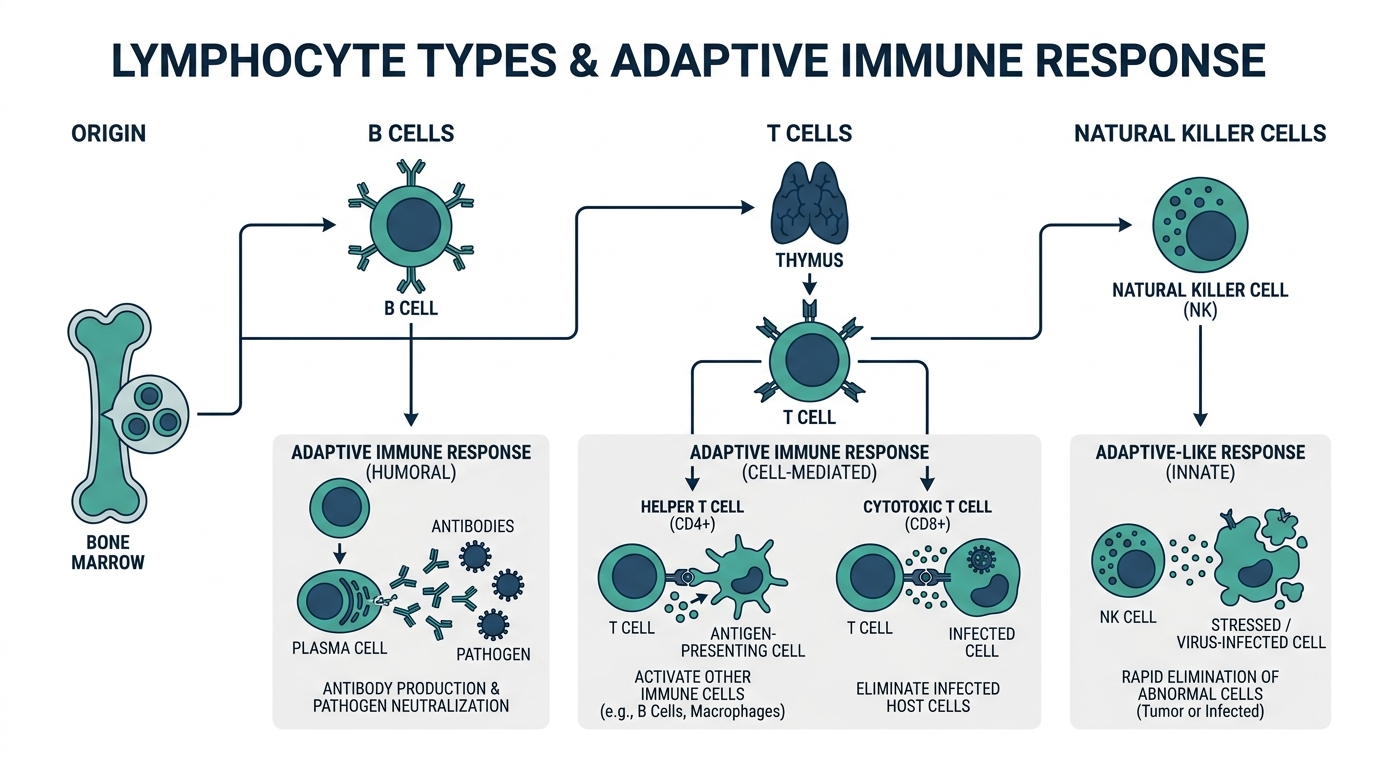
In a blood test, lymphocytes are a type of white blood cell counted as part of your complete blood count (CBC) with differential, and the result reflects how your immune system is currently doing. Lymphocytes are the immune cells that fight infection and cancer, made up mainly of T cells, which directly attack infected and tumor cells, and B cells, which produce antibodies (Cleveland Clinic). When people search for what is lymphocytes in blood test, this is the short answer: it is a snapshot of your infection-fighting cells.
Your report usually shows the lymphocyte result in two ways. There is an absolute count, the actual number of lymphocytes per microliter of blood, and there is a percentage, the share of your total white blood cells that are lymphocytes. The absolute count is the one that matters most, and we will come back to why.

What do lymphocytes mean in a blood test?
When you ask what do lymphocytes mean in a blood test, the answer is that they measure the strength and activity of your adaptive immune system. In healthy adults, lymphocytes make up roughly 20 to 40 percent of white blood cells (Cleveland Clinic). They are the cells with memory: once they meet a virus or a vaccine, some of them remember it for years, which is why you do not catch chickenpox twice.
So what does lymphocytes mean in a blood test in practical terms? A normal result suggests your immune defenses are stocked and steady. A result that is too high or too low is a signal that something is pushing on that system, and the direction it moves narrows down the likely cause. This is also why people phrase the same question as what does lymphocytes mean on a blood test or what are lymphocytes in a blood test. The marker is the same, and the interpretation below applies to all of those.
What is a normal lymphocyte level?
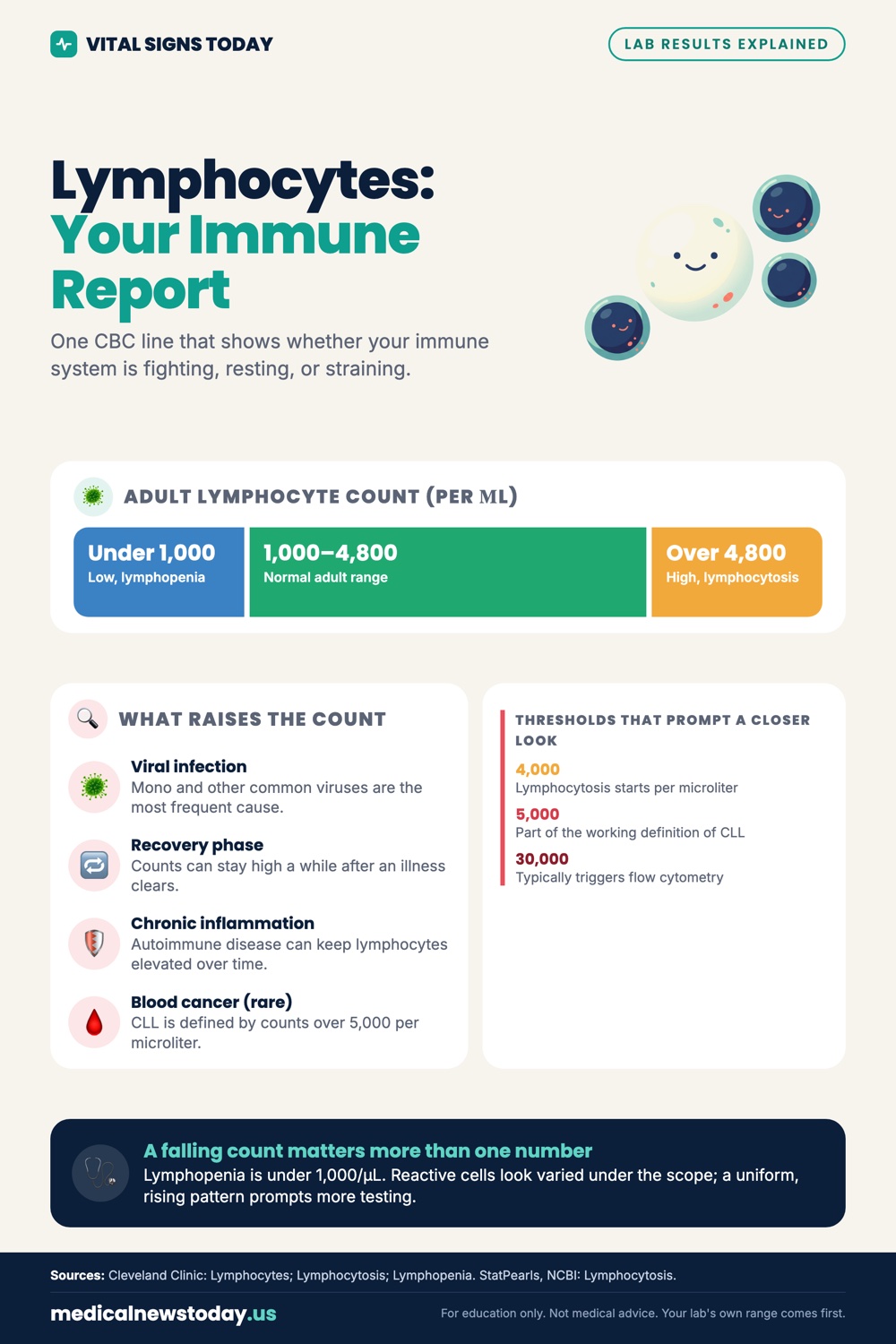
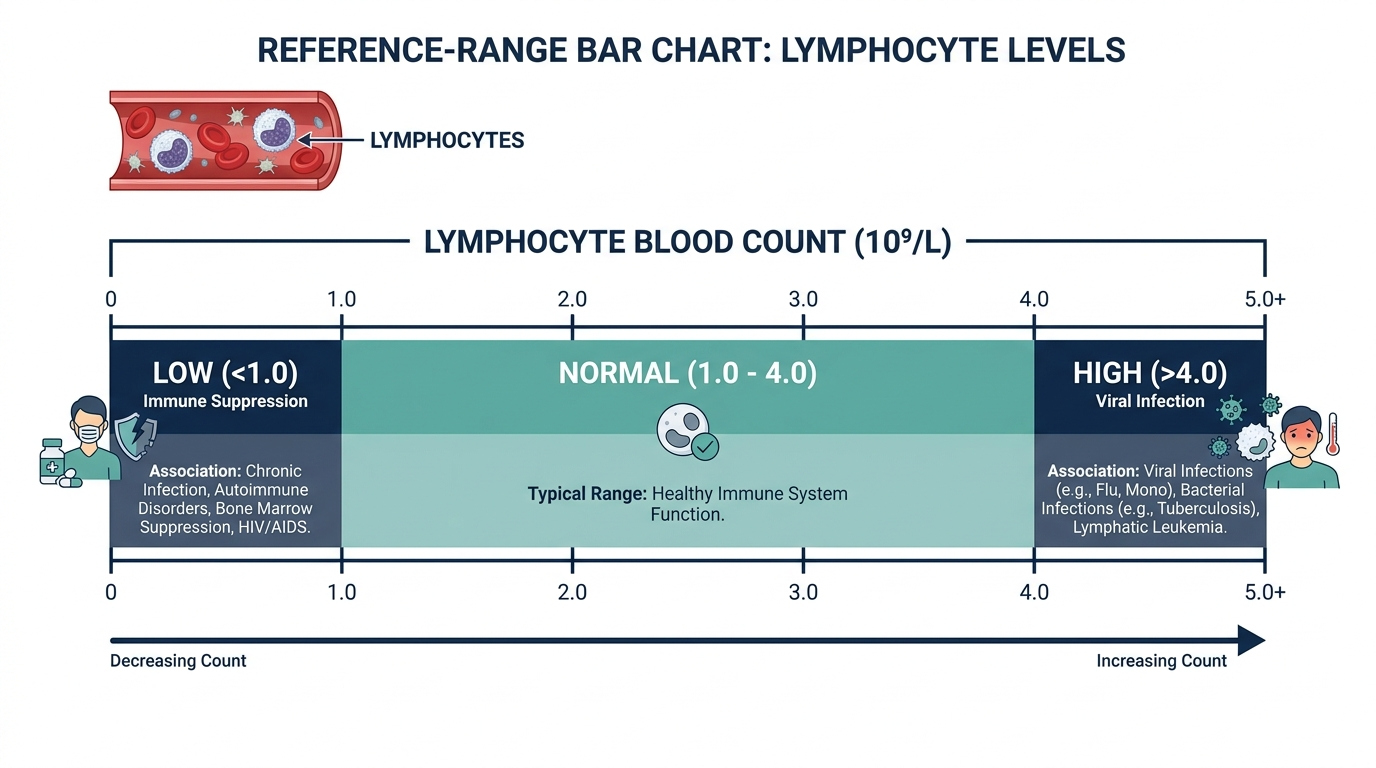
A normal absolute lymphocyte count in adults is generally between about 1,000 and 4,800 lymphocytes per microliter of blood (Cleveland Clinic). Children run much higher, with a normal range of roughly 3,000 to 9,500 per microliter, which is completely expected and not a cause for alarm.
The percentage range, about 20 to 40 percent of total white blood cells, is the other figure your lab may print. Reference ranges vary slightly by laboratory and instrument, so the single most reliable comparison is the range listed on your own report next to your result. That is the range your lab actually calibrated for its equipment.
What does a high lymphocyte count mean?
A high lymphocyte count, called lymphocytosis, most often means your body is mounting an immune response, usually to an infection. In adults, lymphocytosis is defined as an absolute lymphocyte count above 4,000 per microliter (NCBI StatPearls). The common causes break down like this:
- Viral infections. Things like mononucleosis, viral hepatitis, and many common viruses drive lymphocytes up as the body fights back (Cleveland Clinic).
- Chronic inflammation. Long-running conditions, including some autoimmune disease, can keep lymphocytes elevated over time.
- Recovery and recent illness. Counts can stay up for a while after an infection clears.
- Blood cancers. Less commonly, a persistently high count can reflect chronic lymphocytic leukemia (CLL) or lymphoma (Cleveland Clinic).
Here is the distinction that calms most people down and that rarely makes it into a patient summary. Clinicians separate reactive lymphocytosis from clonal lymphocytosis. Reactive means the cells look varied under the microscope, which is the normal, expected pattern when your immune system is responding to an infection. Clonal means the cells look uniform, all stamped from one abnormal line, which is the pattern that points toward malignancy (NCBI StatPearls). A mild elevation during or after an illness is almost always reactive. The thresholds that genuinely prompt a deeper look are higher: a count above 5,000 per microliter is part of the working definition of CLL, and a count above 30,000 per microliter typically triggers flow cytometry to characterize the cells (NCBI StatPearls). A single reading of, say, 4,300 right after a cold is a very different thing from a stable reading of 20,000.

What does a low lymphocyte count mean?
A low lymphocyte count, called lymphopenia, means your infection-fighting reserves are running thin, and in adults it is defined as fewer than 1,000 lymphocytes per microliter (Cleveland Clinic). A transient dip is common and often harmless, but the causes worth knowing include:
- Active infections. Many viral and bacterial infections, including influenza, COVID-19, hepatitis, and tuberculosis, temporarily drop lymphocytes (Cleveland Clinic).
- Nutritional deficiency. Inadequate protein, vitamin B12, folate, or zinc is described as the most common cause of lymphopenia worldwide (Cleveland Clinic).
- Medications and treatments. Corticosteroids, chemotherapy, radiation, and immunosuppressants all lower the count.
- Autoimmune disease. Lupus and rheumatoid arthritis, among others, can drive lymphocytes down.
- Physical stress. Surgery, severe illness, and even a recent hard period for the body can cause a short-lived drop.
One transiently low reading, especially during a cold or right after a stressful event, is usually nothing to chase. A persistently low count is what earns a workup, because it can leave you more vulnerable to infection and occasionally points to a deeper immune problem.
Why is the absolute count read instead of the percentage?
The absolute lymphocyte count is read over the percentage because the percentage can mislead you when the total white cell count shifts. This is the technical point that quietly confuses a lot of patients reading their own reports. Your lymphocyte percentage only describes the share of white cells that are lymphocytes, so if your neutrophils crash, your lymphocyte percentage can look high even when the actual number of lymphocytes has not changed at all.
That gap has a name. A real rise in the number of cells is absolute lymphocytosis, defined by an absolute count above 4,000 per microliter, while a high percentage with a normal total count is relative lymphocytosis (NCBI StatPearls). They are not the same thing, and only one of them usually warrants concern. So when you read your own result, find the absolute number, the one written as cells per microliter, and compare that against the reference range. If your report only shows a percentage that looks off, that alone is rarely the full story.
The part most people never hear: a falling lymphocyte count is a warning sign
This is where lymphocytes go from a routine line item to a number clinicians genuinely watch. A low or falling lymphocyte count is not just a marker of a current infection. During the COVID-19 pandemic, lymphopenia became one of the most studied prognostic markers in hospital medicine, and the findings were striking. Patients who arrived at the hospital with low lymphocytes had markedly worse outcomes, with higher rates of ICU admission, mechanical ventilation, and death (PMC, lymphopenia in hospitalized COVID-19 patients).
The trajectory mattered even more than the single snapshot. In one analysis, lymphocyte levels that stayed low after the first week of symptoms were highly predictive of in-hospital death, and the more severe the lymphopenia, the worse the survival, with mortality rising sharply across mild, moderate, and severe groups (PMC, persistently low lymphocytes predict COVID-19 death). The lesson generalizes beyond one virus. A lymphocyte count that keeps dropping, rather than recovering, tells a clinician the immune system is losing ground. That is why a single number on one day matters less than the direction it moves across repeated tests. If you have serial blood counts, the trend line is often more informative than any one result.

The rest of the white cell differential, and why it matters
Lymphocytes are one of five white blood cell types the differential counts, and their meaning sharpens when you read them next to the others. A clinician looks at the whole white cell profile, because the mix often points to the type of problem more precisely than any single line.
- Neutrophils. The most abundant white cells and the front line against bacteria. High neutrophils with normal lymphocytes leans toward a bacterial infection, while high lymphocytes with normal neutrophils leans more viral. This split is one of the oldest reading tricks in the book.
- Monocytes. Clean-up and long-term defense cells that can rise in chronic infections and some inflammatory conditions.
- Eosinophils. Often elevated with allergies, asthma, or parasitic infections, so a rise here points in a very different direction than a lymphocyte rise.
- Basophils. The rarest type, involved in allergic and inflammatory responses.
A widely used derived number, the neutrophil-to-lymphocyte ratio, is calculated by dividing the neutrophil count by the lymphocyte count. It has drawn interest as a general marker of physiological stress and inflammation, precisely because it captures the balance between these two cell lines rather than either one alone. The practical lesson is that a lymphocyte value is most informative as part of the differential, not extracted from it.
What lymphocytes are actually made of
The single lymphocyte line on your report hides three distinct cell populations, and understanding them explains why a specialist sometimes orders more detailed testing.
- T cells directly attack infected and abnormal cells and coordinate the wider immune response. The CD4 subset of T cells is the specific population tracked in HIV care.
- B cells produce antibodies, the proteins that lock onto specific pathogens and give you lasting immunity after infection or vaccination.
- Natural killer (NK) cells provide a faster, more general defense against virus-infected and tumor cells.
A standard CBC differential lumps all three into one lymphocyte count. When a clinician needs to know which population is off, they order specialized tests such as flow cytometry or lymphocyte subset panels, which is how conditions affecting a specific cell line are pinned down. This is also why a flagged lymphocyte count is a starting point for further characterization, not an end point.
What can shift your lymphocyte count on the day
Before reading too much into a single value, it helps to know how many everyday factors move it, often temporarily and harmlessly.
- A recent or current infection, which can push the count up during a viral illness or transiently down with certain infections.
- Physical or emotional stress, including surgery, trauma, or an acutely stressful event, which can lower lymphocytes for a short period.
- Medications, especially corticosteroids, which reliably drop the count, along with chemotherapy and immunosuppressants.
- Recent vaccination, which can transiently stimulate the immune system.
- Intense exercise, which causes short-lived shifts in circulating white cells.
- Time and recovery, since counts can stay elevated for a while after an infection has cleared.
You do not typically fast for a CBC, and no special preparation is usually required. The most useful habit is context: note whether you were recently ill, stressed, or started a new medication, because that background often explains a mildly abnormal result without any deeper cause.

Symptoms and red flags to bring to your clinician
Because a mildly abnormal lymphocyte count is usually silent and temporary, symptoms are what help separate a benign blip from something that needs attention.
- With a low count that matters, the main concern is vulnerability to infection, so frequent, recurrent, or unusually severe infections alongside persistent lymphopenia deserve evaluation.
- With a high count that matters, the classic red flags are drenching night sweats, unexplained weight loss, persistent fatigue, and swollen lymph nodes, especially if the elevation is marked and stable rather than a mild bump during a cold.
- A count that does not normalize, staying abnormal on repeat testing weeks after any illness has passed, is more meaningful than a one-time flag.
- Any abnormality paired with feeling genuinely unwell, as opposed to feeling fine, raises the priority of a closer look.
The guiding principle is that an isolated, mild abnormality in someone who feels well is usually watched or rechecked, while an abnormality that is large, persistent, or paired with those systemic symptoms is what prompts a workup. Reporting how you feel gives your clinician half the information they need.
Worked examples: reading lymphocytes in context
Seeing the number inside real patterns makes it far less frightening. These illustrate the reasoning, not a self-diagnosis.
- Lymphocytes mildly high, neutrophils normal, recent sore throat and fatigue: a classic reactive picture during a viral illness, often simply monitored and expected to settle.
- Lymphocytes high and stable over months, no infection, swollen nodes: the pattern that warrants further characterization of the cells rather than reassurance.
- Lymphocytes low during an acute flu, everything else fitting an infection: a common transient dip that typically recovers as you do.
- Lymphocyte percentage high but absolute count normal, neutrophils low: relative lymphocytosis, where the share looks high only because neutrophils fell, often not concerning on its own.
- Lymphocytes trending steadily downward across serial tests without recovery: the trajectory clinicians watch, since a count that keeps dropping rather than rebounding is more telling than any single low value.
Across all of these, the constant is the same: read the absolute count, read it beside the rest of the differential, and read the trend over time rather than fixating on one dot on one day.
Who gets a lymphocyte count and how often
Most people receive a lymphocyte count without ever asking for it, because it rides along inside the CBC with differential that accompanies routine physicals, pre-operative checks, and the evaluation of almost any illness. It is one of the most frequently generated numbers in all of medicine.
Certain situations call for closer or more frequent attention to the count:
- People on immunosuppressive therapy, such as chemotherapy or steroids, where a dropping count signals reduced defenses and may change treatment timing.
- People being evaluated for a suspected infection, where the lymphocyte pattern helps distinguish viral from bacterial causes.
- People with a known blood or immune condition, who are monitored serially so the trend can be tracked.
- Anyone with unexplained systemic symptoms, such as persistent fatigue, weight loss, or swollen nodes, in whom the count is one input to a broader workup.
For a healthy person with no risk factors, the count that appears on routine labs at a normal checkup interval is usually sufficient. As with the rest of this marker, the value of repeat testing is the trend it reveals, not any single reading. A number that has been stable and normal for years carries a very different weight than one that has just started to move.
Want to check your blood count?
Three ways to get it measured. Pick whichever fits you.
Affiliate links: we may earn a commission at no extra cost to you. A lab test does not replace a visit with your clinician.
Frequently asked questions
What is a lymphocytes blood test?
It is not usually a standalone test. Lymphocytes are counted automatically as part of a complete blood count (CBC) with differential, which reports both the absolute number of lymphocytes and their percentage of white blood cells (Cleveland Clinic). A specialized version, the CD4 lymphocyte count, is ordered separately to monitor immune function in HIV (MedlinePlus).
What is a normal lymphocyte count?
In adults, a normal absolute lymphocyte count is generally about 1,000 to 4,800 per microliter, or roughly 20 to 40 percent of white blood cells. Children normally run higher, around 3,000 to 9,500 per microliter (Cleveland Clinic). Compare your result to the reference range on your own report.
Should I worry about high lymphocytes?
Usually not. A mild, temporary rise most often reflects your body fighting an infection. Lymphocytosis is defined as a count above 4,000 per microliter, but the levels that prompt a deeper look for blood cancer are higher, above 5,000 and especially above 30,000 per microliter (NCBI StatPearls). Your clinician interprets it alongside the rest of your CBC.
What does a low lymphocyte count mean?
A low count, or lymphopenia, is fewer than 1,000 lymphocytes per microliter in adults and can be caused by infections, nutritional deficiency, certain medications, autoimmune disease, or physical stress (Cleveland Clinic). A single low reading is often temporary, while a persistently low count warrants evaluation.
What does lymphocytes mean on a blood test if both high and low are flagged over time?
The trend matters more than one value. A count that keeps falling rather than recovering is a meaningful warning sign, since persistently low lymphocytes have been linked to worse outcomes in serious illness (PMC, persistently low lymphocytes predict COVID-19 death). Bring serial results to your clinician so they can read the direction, not just the dot.
This article is for general educational purposes and is not medical advice. It cannot diagnose or treat you and does not replace your clinician. Always discuss your lab results and any health decisions with a qualified healthcare professional.
Vital Signs Today may earn a commission if you buy through links on this page. It does not affect our editorial assessments.