Disclosure: Vital Signs Today may earn a commission if you buy through links on this page, at no extra cost to you. This does not influence our evidence-based assessments. We are not a medical provider; talk to a clinician before acting on test results.
Related: TSH normal range by age (full chart)
You opened your lab report, scanned past the cholesterol and the blood counts, and landed on three letters with a number next to them that sits below the reference range: TSH. Maybe it is flagged with an L, maybe your doctor’s office left a voicemail saying it is “a little low.” Either way you are here because a low TSH has a way of sounding more alarming than the rest of the page, and the explanations you find tend to either hand-wave it away or jump straight to scary words.
Here is the part that trips most people up, and it is worth getting straight before anything else. A low TSH usually means your thyroid is doing too much, not too little. That feels backwards until you understand what TSH actually is, so let us start there.
Part of our Thyroid Panel guide.
What does low TSH mean in a blood test?
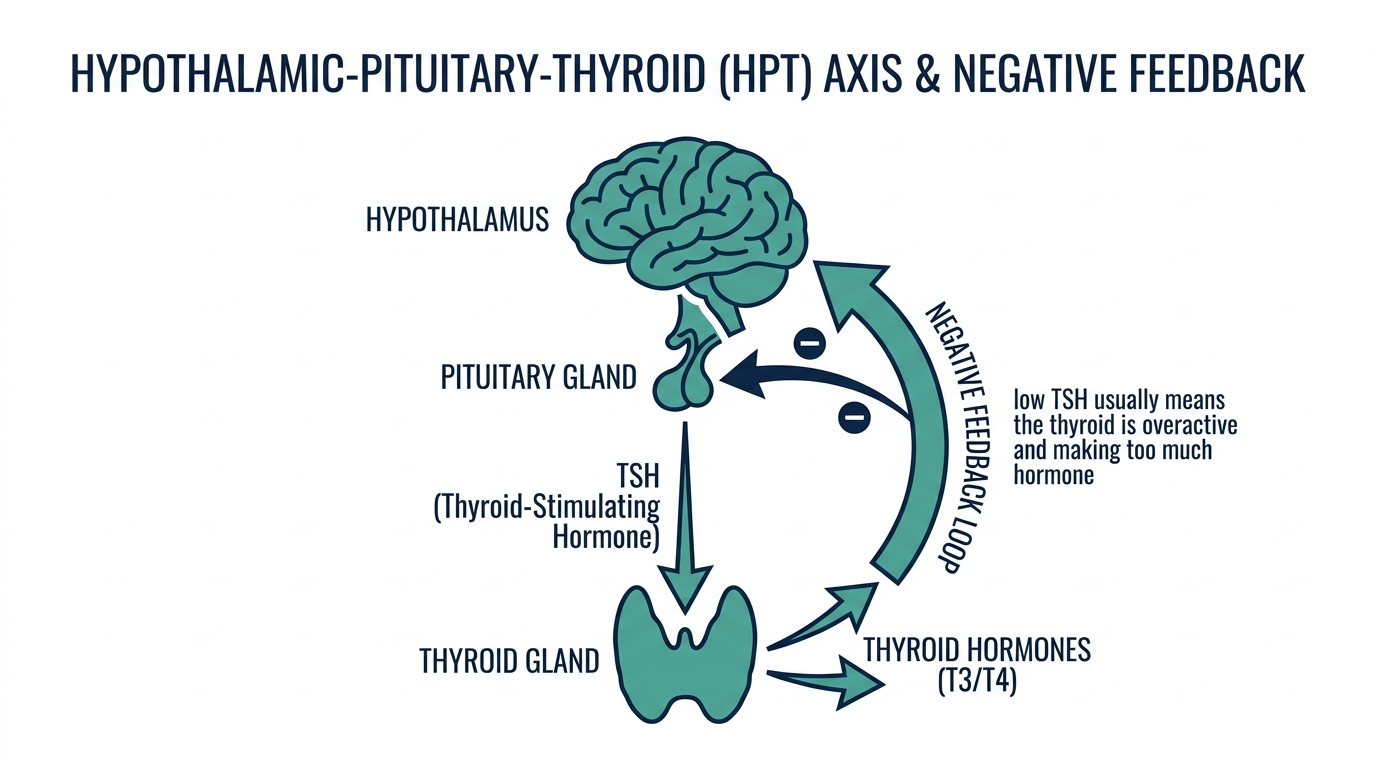
TSH stands for thyroid-stimulating hormone, and it does not come from your thyroid at all. It comes from your pituitary gland, the small control center at the base of your brain. The pituitary uses TSH like a thermostat sending heat to a furnace. When thyroid hormone in your blood runs low, the pituitary cranks out more TSH to push the thyroid harder. When thyroid hormone runs high, the pituitary backs off and TSH falls (MedlinePlus).
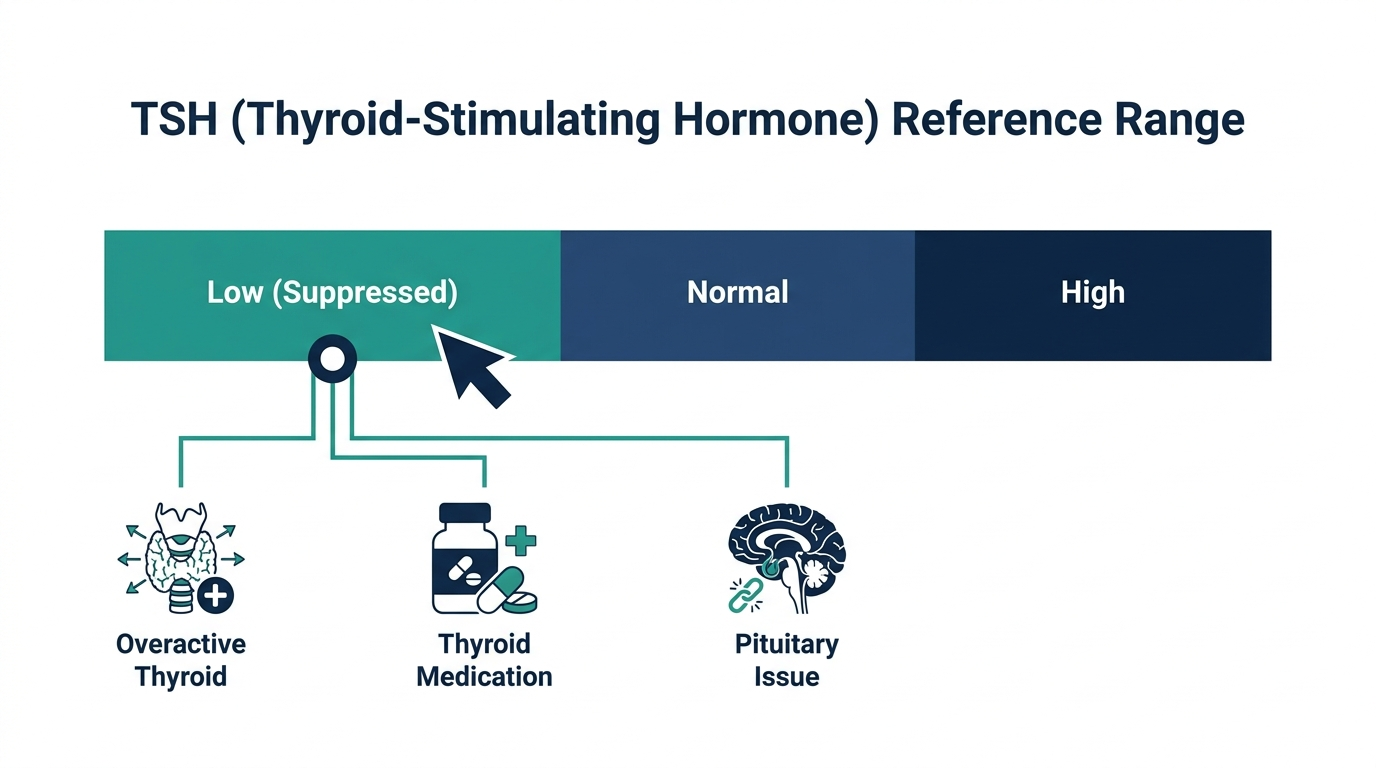
So a low TSH on a blood test most often means the opposite of what people fear. It points to an overactive thyroid, called hyperthyroidism, where the gland is pumping out more thyroid hormone than your body needs, and the pituitary has shut off its TSH signal in response (Cleveland Clinic).
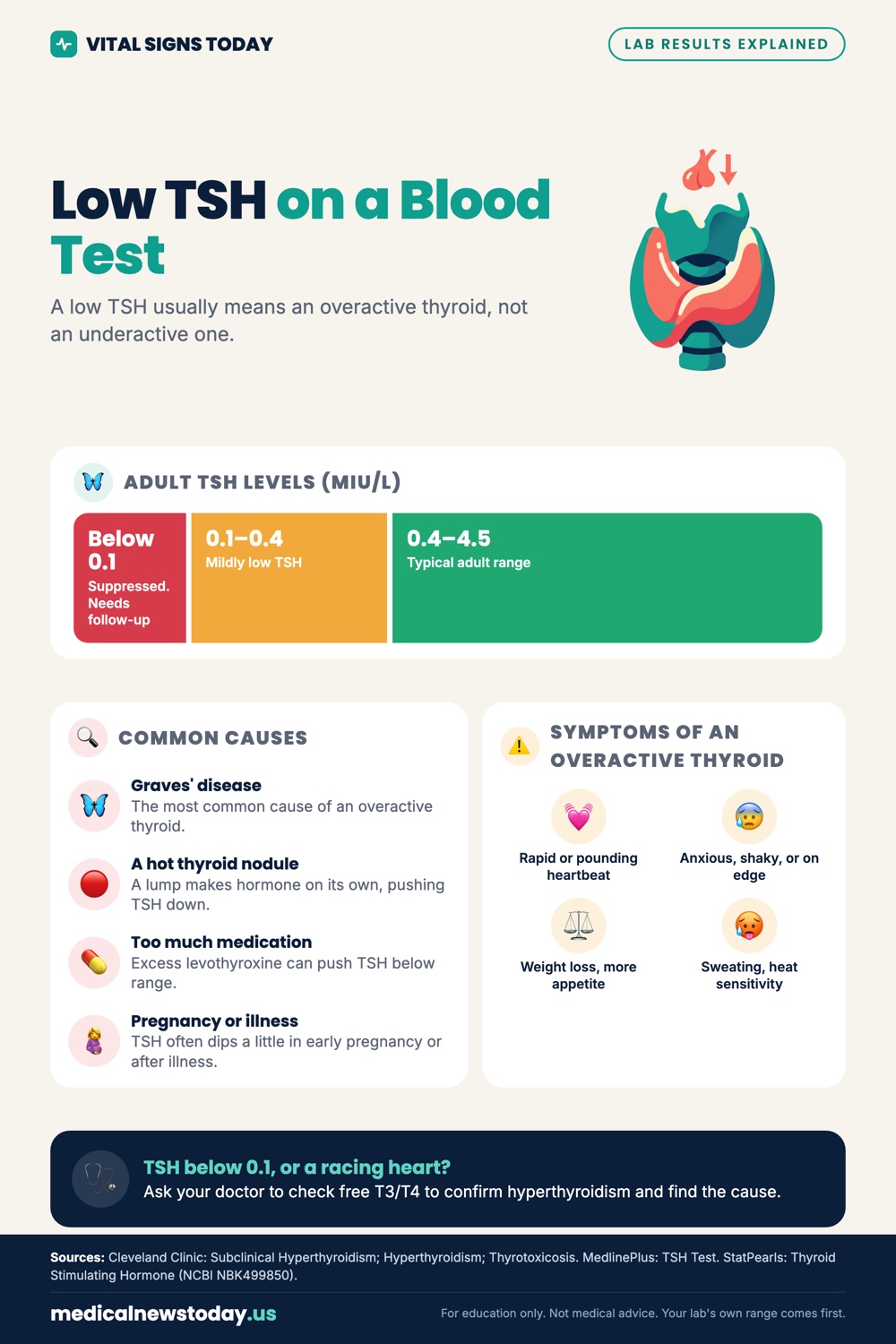
As for the cutoff, most labs put the normal adult range at roughly 0.4 to 4.5 mIU/L, with some reporting from about 0.27 up to 4.2 uIU/mL (Cleveland Clinic). Anything below the bottom of your lab’s range counts as low. Clinicians often split it into two tiers: a mildly low TSH between about 0.1 and 0.4 mIU/L, and a clearly suppressed TSH below 0.1 mIU/L, which carries more weight (Cleveland Clinic). Always read your number against the range printed on your own report, because that is the range your lab calibrated its machine to.
How low is low, and why the scale is deceptive
Not every low TSH carries the same weight, and the reason is buried in how the number behaves. TSH moves on a logarithmic scale against your actual thyroid hormone, which means a small-looking drop in TSH reflects a much larger swing in hormone than the digits suggest. A TSH sliding from 1.5 to 0.3 is a bigger deal than the modest change on paper implies.
That is why clinicians separate a mildly low TSH, roughly 0.1 to 0.4 mIU/L, from a fully suppressed or undetectable TSH below 0.1 mIU/L. The suppressed group is where the real risk to the heart and bones concentrates, and where treatment gets considered even without symptoms. A number that reads “0.00” is not a lab quirk to shrug at, it usually means the pituitary has gone completely silent because thyroid hormone is running high.
What causes a low TSH?
A low TSH is a signal, not a diagnosis. The job after seeing it is to find out why. Here are the real causes, most common first.
- Graves’ disease. This is the leading cause of an overactive thyroid. It is an autoimmune condition in which your own antibodies switch the thyroid on and keep it running, which floods the blood with hormone and drives TSH down (Cleveland Clinic).
- Thyroid nodules. One or more lumps in the gland can become “hot,” meaning they make hormone on their own without listening to the pituitary, again pushing TSH low (Cleveland Clinic).
- Too much thyroid medication. If you take levothyroxine for an underactive thyroid and the dose is a touch high, your TSH can drop below range. This is one of the most common and most fixable reasons for a low TSH, and it is simply a dosing adjustment.
- Early pregnancy. TSH is often a little low during the first three months of pregnancy, and this can be completely normal (MedlinePlus).
- Recent serious illness. Some serious illnesses that have nothing to do with your thyroid can push TSH low for a short time, then it recovers (MedlinePlus).
- A pituitary problem. Rarely, the issue is upstream. A pituitary that is not working, such as one affected by a non-functioning adenoma, can fail to make TSH even when thyroid hormone is low. This is uncommon, but it is the reason a low TSH is never read in isolation (MedlinePlus).
Notice the spread. The same low number can mean an autoimmune disease, a single overactive nodule, a slightly heavy pill, a normal pregnancy, or a recovering illness. That is exactly why a low TSH is the start of a conversation, not the end of one.
What are the symptoms of a low TSH?
A low TSH itself causes nothing. You cannot feel a hormone level. What you feel are the effects of the excess thyroid hormone that drove the TSH down, because thyroid hormone is your body’s accelerator pedal. When it runs high, everything speeds up.
The classic signs of an overactive thyroid include (Cleveland Clinic):
- A rapid or pounding heartbeat, sometimes felt as palpitations
- Shakiness, anxiety, and feeling wired or on edge
- Unexplained weight loss even though your appetite has gone up
- Frequent loose stools or diarrhea
- Warm, thin, moist skin and sweating more than usual
- Trouble sleeping
- Irregular menstrual periods
- Bulging eyes or vision changes, which are specific to Graves’ disease
- Swelling at the front of the neck from an enlarged thyroid
Here is the catch that surprises people. Plenty of low TSH results come with no symptoms at all. When TSH is low but the actual thyroid hormones, T4 and T3, are still in the normal range, the condition is called subclinical hyperthyroidism, and it typically causes no symptoms in the early stages (Cleveland Clinic). Feeling fine does not mean a low TSH should be ignored, which brings us to the part that actually matters for your long game.
How does low TSH connect to your other thyroid markers?
TSH is the screening number, but it never works alone. Once it comes back low, a clinician reaches for the markers that explain the why, and each one answers a different question.
- Free T4 and free T3 are the actual thyroid hormones. They confirm whether the gland is truly overactive, both high in overt hyperthyroidism, or quietly borderline, both normal in the subclinical form. In some overactive thyroids only T3 runs high, a pattern called T3 toxicosis, which a T4-only check would miss.
- TSH receptor antibodies (TRAb), also called TSI, are the fingerprint of Graves’ disease. A positive result points straight to the autoimmune cause that keeps the gland switched on.
- TPO antibodies show autoimmune thyroid activity more broadly, and can appear in both overactive and underactive thyroid disease.
- A radioactive iodine uptake scan separates the causes when antibodies are not enough. Graves’ disease lights up the whole gland, a hot nodule lights up one spot, and thyroiditis shows low uptake because the gland is leaking stored hormone rather than making extra.
That last distinction changes everything about treatment. Graves’ disease and a hot nodule are the thyroid making too much and usually call for active treatment. Thyroiditis is the gland spilling its existing stores during inflammation, which typically settles on its own over weeks to months. All three can start with the same low TSH, which is exactly why the number is never the whole story.
When is a low TSH dangerous or a medical emergency?
Most of the time a low TSH is not an emergency. It is a reason to investigate, on a normal timeline, with your doctor. But there are two situations where it earns real concern.
The slow danger: a persistently suppressed TSH. Even without symptoms, a chronically low TSH, especially one below 0.1 mIU/L, is linked to atrial fibrillation, heart failure and coronary heart disease, bone loss and fractures, and dementia, with the risk concentrated in people over 65 (Cleveland Clinic). This is the reason a low TSH matters even when you feel perfectly well. The excess thyroid hormone is quietly taxing your heart and your bones over time.
The fast danger: thyroid storm. This is the rare, life-threatening extreme of an overactive thyroid, and it is a true emergency. Warning signs include a heart rate that can exceed 140 beats per minute, a fever commonly between 104 and 106 degrees Fahrenheit, and a sharp change in mental state such as agitation, delirium, or loss of consciousness (Cleveland Clinic). If you or someone you are with shows these signs, do not wait for them to get worse. Get to the nearest emergency room (Cleveland Clinic).
To be clear, thyroid storm is uncommon and usually builds on long-untreated hyperthyroidism plus a trigger like infection or surgery. A low TSH on a routine panel is almost never an emergency. But knowing the red flags is worth more than the worry it replaces.
Want to check your TSH?
Three ways to get it measured. Pick whichever fits you.
Affiliate links: we may earn a commission at no extra cost to you. A lab test does not replace a visit with your clinician.
How should you prepare for a TSH test?
TSH does not require fasting, but a few things can nudge the result enough to matter, and one of them fools labs into mimicking an overactive thyroid.
- Pause high-dose biotin first. Biotin, the popular hair, skin, and nail supplement, can interfere with the lab machinery and produce a falsely low TSH alongside falsely high T4 and T3, an exact look-alike for Graves’ disease. Many labs advise stopping biotin for at least 2 days before a thyroid draw. If you take a hair or nail supplement, say so.
- Mind the time of day. TSH follows a daily rhythm, running higher overnight and in the early morning and dipping in the afternoon. For borderline results, drawing at a consistent time makes repeat tests comparable.
- Report your medications. Thyroid hormone pills, high-dose steroids, and certain other drugs can lower TSH. If you take levothyroxine, when you took your last dose can matter, so mention it.
- Flag recent illness or a contrast scan. A recent serious illness can suppress TSH for a while, and an iodine-based contrast dye from imaging can disturb thyroid tests for weeks.
What should you do about a low TSH?
The single most useful thing to understand is that a low TSH alone does not tell your doctor enough to act. The standard next move is to measure the actual thyroid hormones, free T4 and often T3, because the TSH test on its own cannot explain why your level is off (MedlinePlus). Those two results together sort you into a clear bucket.
- Low TSH with high T4 or T3: overt hyperthyroidism, which is generally treated.
- Low TSH with normal T4 and T3: subclinical hyperthyroidism, which is often watched rather than treated right away (Cleveland Clinic).
- Low TSH with low T4: the unusual pattern that points upstream to the pituitary and needs a different workup (MedlinePlus).
For subclinical hyperthyroidism, treatment is not automatic. Many people do best with a “wait and see” approach and a repeat test in a few weeks to months. Treatment is more strongly considered when TSH is persistently below 0.1 mIU/L and you are 65 or older, or you are younger but have heart disease, osteoporosis, or symptoms (Cleveland Clinic). If you take thyroid medication, the fix may be as simple as lowering your dose. The point is that the right action depends entirely on the full picture, not the single low number.
Two low-TSH stories that end differently
Picture a woman ten weeks into a pregnancy whose routine panel shows a TSH of 0.2 mIU/L. She feels fine. In early pregnancy the hormone hCG rises steeply and gently stimulates the thyroid, which nudges TSH down as a normal part of the first trimester. With a normal free T4 and no symptoms, this is often physiology, not disease, and the move is to recheck rather than treat.
Now picture a 68-year-old man taking levothyroxine for a longstanding underactive thyroid, whose latest TSH comes back at 0.05 mIU/L. He has no dramatic symptoms, but that suppressed number in an older adult on thyroid medication is a warning that his dose is too high. Left alone, the excess hormone raises his odds of atrial fibrillation and bone loss. The fix is usually the simplest one in this whole article: lower the dose and retest. Same low TSH, opposite meaning, opposite action.
When should you see a doctor?
If your lab report shows a low TSH, book a visit to talk it through, even if you feel fine, because the test on its own cannot tell you the cause (MedlinePlus). Make it sooner rather than later if you also have the symptoms of an overactive thyroid: a racing heart, unexplained weight loss, tremor, anxiety, or neck swelling (Cleveland Clinic).
Go to an emergency room immediately, not a regular appointment, if you have a very high fever with a racing heart and confusion or agitation, because those are the warning signs of thyroid storm (Cleveland Clinic).
The insider read: the low TSH that fools people
Here is the nuance that gets missed in the patient version, and it is the reason experienced clinicians never treat a TSH number on its own. TSH is exquisitely sensitive but slow to settle. After a bout of thyroiditis, a recent severe illness, or even in the recovery phase of one, TSH can read low for weeks before drifting back to normal on its own (MedlinePlus). That is why a single low TSH is so often repeated a few weeks later rather than acted on at once. A transient dip and a genuine overactive thyroid can look identical on day one, and only time, plus the T4 and T3, tells them apart.
The second trap is age. TSH naturally runs lower in some healthy people and shifts with age, and the normal range is different in pregnancy (MedlinePlus). A pregnant woman with a slightly low TSH in her first trimester may be entirely normal, while the same number in a 70-year-old with palpitations deserves a closer look. The number is the same. The meaning is not. This is the whole reason a low TSH belongs in the hands of a clinician who can see the rest of you, not just the rest of your lab page.
Frequently asked questions
Does a low TSH mean I have hyperthyroidism?
Usually, yes. A low TSH most often means your thyroid is overactive and making too much hormone, which signals the pituitary to switch off its TSH (Cleveland Clinic). But it is not automatic. A low TSH can also come from early pregnancy, a recent serious illness, too much thyroid medication, or rarely a pituitary problem, so it is confirmed with T4 and T3 testing (MedlinePlus).
What TSH level is considered low?
A low TSH is any value below the bottom of your lab’s range, which is generally around 0.4 mIU/L, with some labs starting at about 0.27 uIU/mL (Cleveland Clinic). Clinicians often distinguish a mildly low TSH of 0.1 to 0.4 mIU/L from a clearly suppressed TSH below 0.1 mIU/L, which carries more risk (Cleveland Clinic).
Can a low TSH be normal?
Sometimes. TSH is often a little low during the first three months of pregnancy, and a serious unrelated illness can lower it briefly before it recovers (MedlinePlus). This is why a single low TSH is frequently repeated before any decision is made.
Is a low TSH dangerous if I feel fine?
It can still matter. A persistently low TSH, especially below 0.1 mIU/L, is linked to atrial fibrillation, heart failure, bone loss and fractures, and dementia, with the risk highest in people over 65, even without symptoms (Cleveland Clinic). That is why it is worth investigating rather than ignoring.
When is a low TSH an emergency?
A routine low TSH is not an emergency. The exception is thyroid storm, a rare and life-threatening flare with a heart rate that can exceed 140 beats per minute, a fever often between 104 and 106 degrees Fahrenheit, and confusion or agitation. Those signs mean go to the nearest emergency room right away (Cleveland Clinic).
Can biotin supplements cause a falsely low TSH?
Yes. High-dose biotin, common in hair and nail supplements, can interfere with the lab immunoassay and produce a falsely low TSH with falsely high T4 and T3, mimicking hyperthyroidism. Many labs recommend stopping biotin for at least 2 days before a thyroid test, and telling your clinician you take it.
Can a low TSH cause weight loss?
The low TSH itself does not, but the excess thyroid hormone behind it can. An overactive thyroid speeds up metabolism, so unexplained weight loss despite a healthy or increased appetite is one of the classic signs. If that is happening alongside a low TSH, it is a reason to be seen sooner (Cleveland Clinic).
How soon should a low TSH be repeated?
Often within a few weeks to a couple of months. Because a transient dip from illness, thyroiditis, or pregnancy can look identical to true hyperthyroidism at first, a single low TSH is usually rechecked with free T4 and T3 before any treatment decision (MedlinePlus).
This article is for general educational purposes and is not medical advice. It cannot diagnose or treat you and does not replace your clinician. Always discuss your lab results and any health decisions with a qualified healthcare professional.
Related: test your thyroid and hormones from home.
Vital Signs Today may earn a commission if you buy through links on this page. It does not affect our editorial assessments.