
Disclosure: Vital Signs Today may earn a commission if you buy through links on this page, at no extra cost to you. This does not influence our evidence-based assessments. We are not a medical provider; talk to a clinician before acting on test results.
Related: WBC blood test: the full guide · See the WBC reference chart by age and sex
You opened your blood work, scanned past the cholesterol and the glucose, and stopped on the line marked WBC. Maybe it had a little H next to it, or a number that looked higher than the range printed beside it. The first thing most people do is type that number into a search bar at 11pm and start imagining the worst. Take a breath. A high WBC is one of the most common abnormal results in all of lab medicine, and the great majority of the time it is your immune system doing exactly what it was built to do.
That said, the WBC is also one of the few blood numbers that can occasionally point to something serious, so it is worth understanding properly rather than guessing. Here is what a high white blood cell count actually means, what pushes it up, and the specific situations where it stops being routine.
Part of our Complete Blood Count guide.
What does a high WBC mean in a blood test?
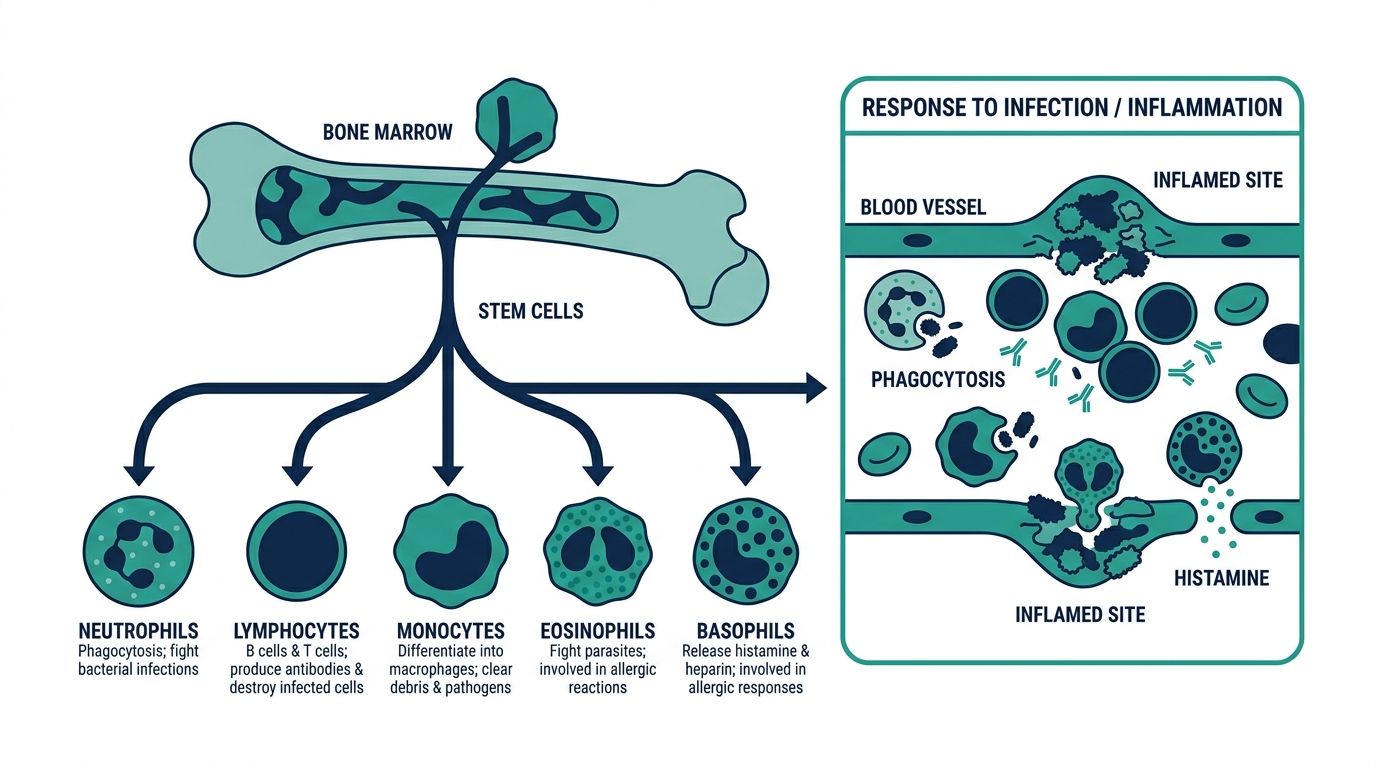
A high WBC means your blood is carrying more white blood cells than usual, and the medical term for it is leukocytosis. White blood cells are your immune system’s response force, so when their count rises it almost always means that force has been called into action by an infection, inflammation, stress on the body, or less often a problem in the bone marrow where the cells are made (MedlinePlus).
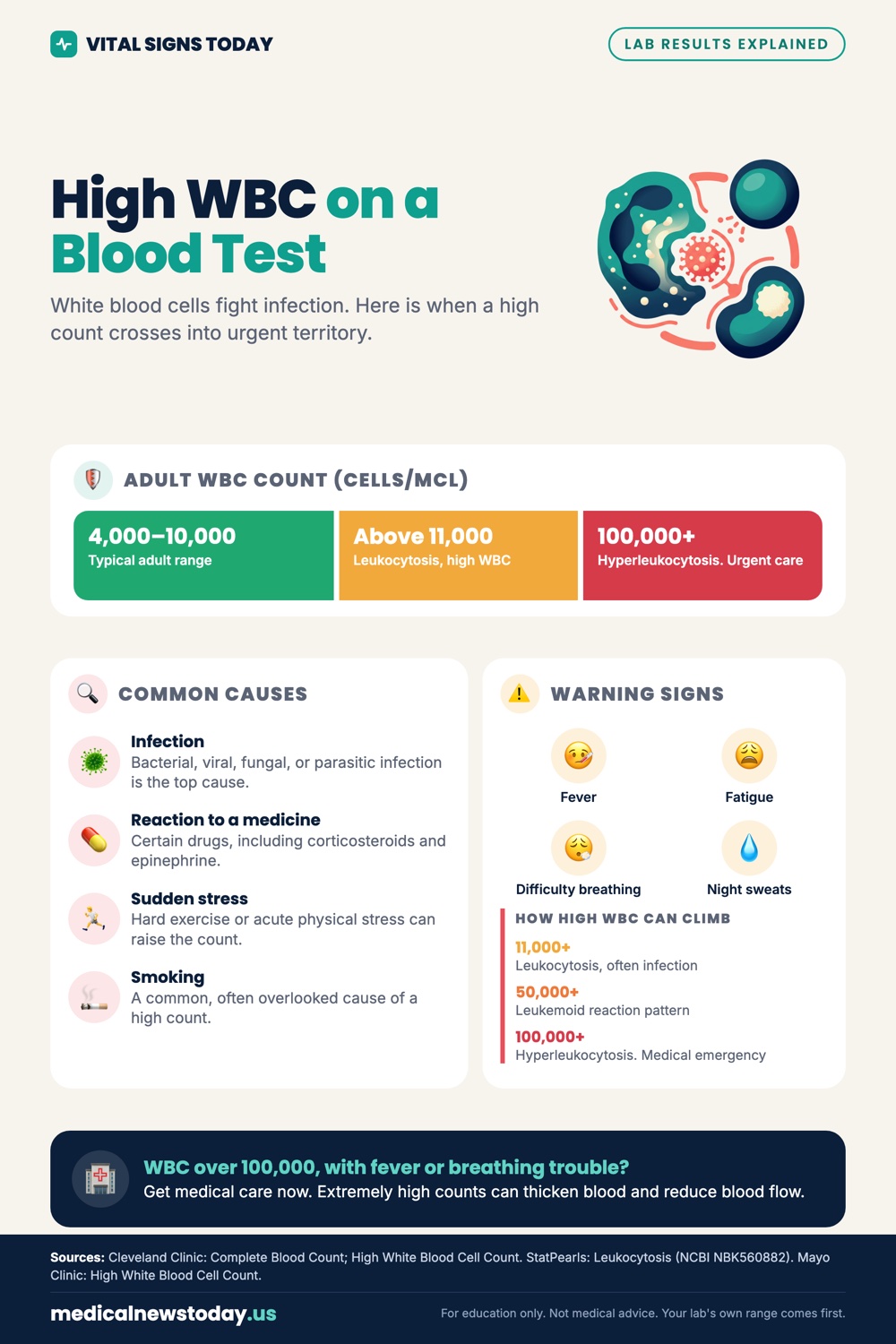
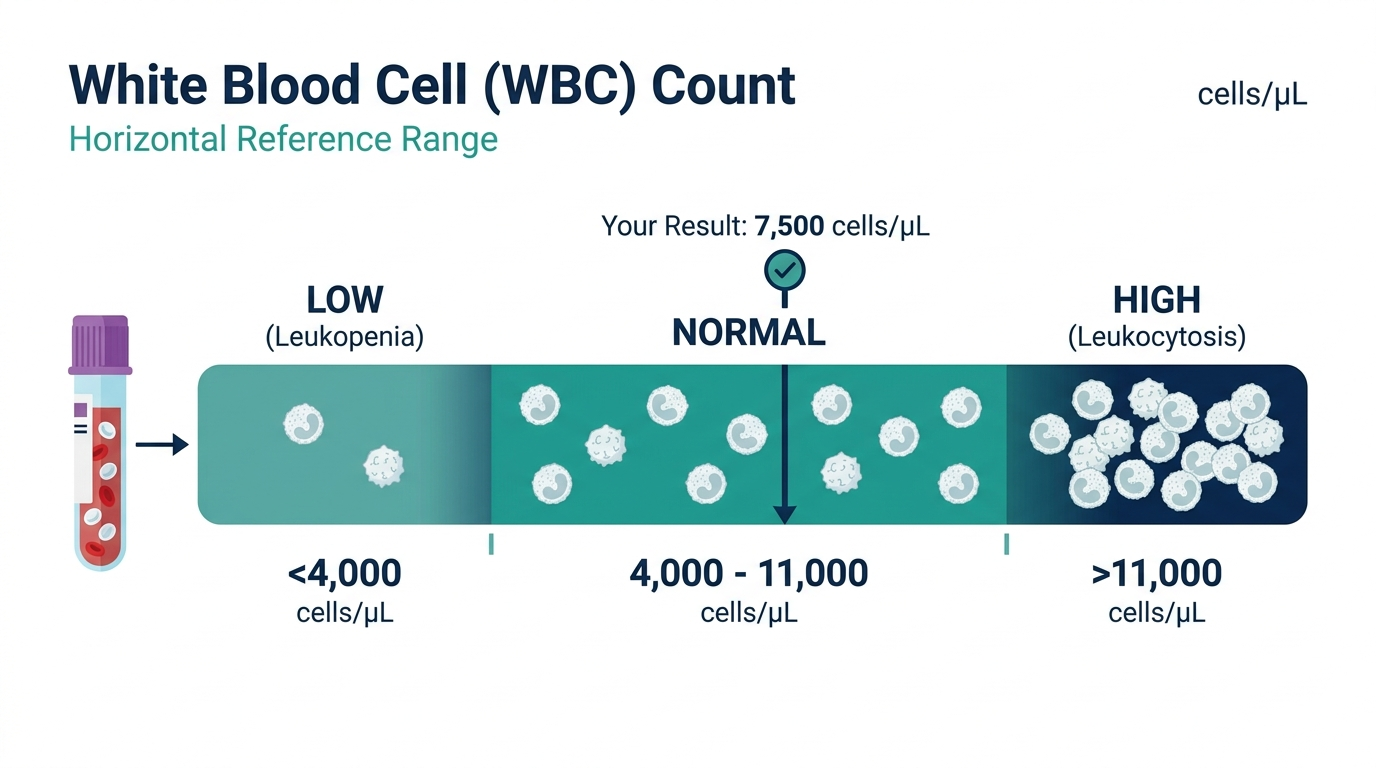
The number that counts as high is fairly standardized. A normal adult WBC sits roughly between 4,000 and 11,000 cells per microliter of blood, and anything above about 11,000 per microliter is generally called leukocytosis (Cleveland Clinic). One important caveat: the cutoff shifts with age. Newborns run far higher counts naturally, and children sit above adult levels, so the threshold for high is not a single universal number (StatPearls). Always read your value against the reference range printed on your own report.
Here is the part that reframes the whole result. A high total WBC does not tell you why on its own. The differential, the breakdown of which type of white cell is elevated, is where the real meaning lives. That is the next thing to look at.

What causes a high WBC?
The differential splits leukocytosis into five named types depending on which cell is up, and each type points toward a different short list of causes (Cleveland Clinic). Working from most common to least:
- Infection and inflammation (neutrophilia). This is the headline cause. Bacterial infections, abscesses, and inflammatory flares drive up neutrophils, the most abundant white cell, and that is the single most frequent reason a WBC comes back high (Cleveland Clinic).
- Physical or emotional stress on the body. Fever, recent surgery, injury, burns, intense exercise, and even acute anxiety can transiently raise the count. So can pregnancy and smoking (Mayo Clinic).
- Allergies and parasites (eosinophilia). When the eosinophil line is the one that is up, the usual suspects are allergic conditions, asthma, or parasitic infection (Cleveland Clinic).
- Viral infections (lymphocytosis). A rise driven by lymphocytes more often reflects a viral process, including things like mononucleosis (StatPearls).
- Medications. Corticosteroids are a classic offender, along with lithium, beta-agonist inhalers, and epinephrine-type drugs, all of which can lift the count without any disease present (Cleveland Clinic).
- Immune and marrow disorders. Autoimmune conditions like lupus and rheumatoid arthritis, and far less commonly blood cancers such as leukemia or lymphoma, can also raise the WBC (MedlinePlus).
Notice the order. Infection and stress sit at the top because that is genuinely where most cases land. Leukemia sits at the bottom of the list for a reason, even though it is the diagnosis that drives the most fear. The differential plus your symptoms usually sorts these out quickly.
What are the symptoms of a high WBC?
Here is the honest answer that surprises people: a high WBC itself usually causes no symptoms at all. The count is a sign, not a disease, so what you feel comes from whatever is driving the count up, not from the white cells themselves (Cleveland Clinic).
That means the symptoms worth tracking are the ones pointing at the underlying cause. Cleveland Clinic flags fever, fatigue, pain, difficulty breathing or wheezing, night sweats, unexplained weight loss, and rash as the signals that accompany meaningful leukocytosis (Cleveland Clinic). Fever with a high neutrophil count suggests infection. Night sweats and weight loss with no obvious infection are the cluster that earns a closer look, because that combination can show up in blood disorders. In other words, do not read the WBC in isolation. Read it next to how you actually feel.
When is a high WBC dangerous or a medical emergency?
Most leukocytosis is mild and self-limiting. The danger zone is defined by sheer magnitude. When the count climbs to 100,000 cells per microliter or above, it has a name of its own, hyperleukocytosis, and at that altitude the blood can become thick enough that white cells start clogging small vessels (StatPearls). The dangerous downstream event is called leukostasis, where that sludging starves tissues of oxygen and produces an oncologic emergency with confusion, stroke-like symptoms, shortness of breath, and kidney injury.
A crucial nuance lives here: the raw number is not the whole story. Whether leukostasis actually develops depends heavily on the type of cells flooding the blood, not just the count, which is why two people with the same sky-high WBC can have very different risk (StatPearls).
You do not need to memorize thresholds. What you need are the red flags. MedlinePlus and Cleveland Clinic both point to the same emergency signals: stroke symptoms, chest pain, difficulty breathing, sudden severe back pain, tingling in the hands or feet, or uncontrolled bleeding all warrant calling 911, not waiting for a follow-up appointment (Cleveland Clinic).

What should you do about a high WBC?
The single most useful thing to understand is that a high WBC is a starting point for investigation, not a result to treat by itself. The white blood count cannot confirm a diagnosis on its own and is meant to be interpreted alongside other tests (MedlinePlus). Practical next steps usually look like this:
- Look at the differential first. Which cell type is elevated tells your clinician whether to think infection, allergy, virus, or something marrow-related (StatPearls).
- Repeat the test. Because exercise, stress, and a recent illness can all spike the count temporarily, a borderline high WBC is often simply rechecked after a couple of weeks to see if it settles (StatPearls).
- Treat the cause, not the number. Treatment depends entirely on what is driving the count, so antibiotics for a bacterial infection, antihistamines for an allergy, and so on. Counts driven by infection typically normalize within about two to four weeks once the trigger resolves (Cleveland Clinic).
- Order deeper tests only if needed. A persistently or markedly high count may prompt a peripheral blood smear, and in some cases a bone marrow exam, to look at the cells directly (MedlinePlus).
When should you see a doctor?
Any abnormal lab result deserves a conversation with the clinician who ordered it, even a mild one. But push for a prompt review rather than a routine one if your high WBC comes with fever you cannot explain, drenching night sweats, unexplained weight loss, easy bruising or bleeding, or a count that stays elevated on a repeat test (Cleveland Clinic). And as covered above, the emergency signals, stroke symptoms, chest pain, severe breathlessness, or uncontrolled bleeding, mean calling 911 immediately rather than scheduling anything.
The insider read: why a high WBC is not always a high WBC
Here is the detail that separates a careful clinician from a panicked patient, and it rarely makes it into the patient-facing version. A meaningful share of high WBC results are not what they appear to be.
First, false and transient elevations are everywhere. A hard workout, a stressful morning, a cigarette, or a recent dose of steroids can all lift the count on their own, no illness required (StatPearls). Even the specimen itself can lie. Certain blood proteins called cryoglobulins can fool an automated analyzer into reporting an artificially high white count, a true false positive that disappears the moment a human looks at the slide (StatPearls). This is why an experienced clinician does not flinch at a single borderline reading taken right after you sprinted to the lab.
Second, and more importantly, even a dramatically high count is not automatically leukemia. There is a well-described phenomenon called a leukemoid reaction, a transient surge that can push neutrophils past 50,000 cells per microliter in response to a severe infection or inflammation, with no blood cancer present at all (StatPearls). The way the two are told apart is elegant and cheap. In a leukemoid reaction the blood smear shows a flood of mature, normal-looking neutrophils, whereas leukemia shows immature blast cells that should never be circulating. A glance down a microscope often answers the question that a number alone cannot. So the most commonly misread scenario is treating the raw WBC as a verdict when it is really just the first sentence of a longer story.
The five white cell types, and what each one points to
The single most useful move with a high WBC is to stop looking at the total and read the differential, the breakdown of which cell type is elevated. Each of the five main white cells fights a different kind of threat, so the one that is up tells you where to look.
| Cell type | Main job | What a rise usually suggests |
|---|---|---|
| Neutrophils | First responders to bacteria and acute inflammation | Bacterial infection, inflammation, stress, steroids |
| Lymphocytes | Targeted immunity against viruses | Viral infection such as mononucleosis, some chronic leukemias |
| Monocytes | Cleanup and chronic infection defense | Chronic infection, recovery phase, some inflammatory conditions |
| Eosinophils | Allergy and parasite response | Allergies, asthma, parasitic infection, drug reactions |
| Basophils | Allergic and inflammatory signaling | Allergic reactions, less commonly certain marrow disorders |
Want to check your white blood cells?
Three ways to get it measured. Pick whichever fits you.
Affiliate links: we may earn a commission at no extra cost to you. A lab test does not replace a visit with your clinician.
This is why two people with the same total WBC of 14,000 can have completely different situations. One with a neutrophil-driven rise likely has a bacterial infection, while another with a lymphocyte-driven rise more likely has a virus. The total is the headline. The differential is the actual story (StatPearls).
Absolute counts, left shift, and why the smear matters
A subtlety that trips people up is the difference between a percentage and an absolute count. Your report may show each cell type as a percentage of the total and as an absolute number per microliter. The absolute count is what clinicians act on, because a high percentage of one cell type can be misleading if the total is unusual. A neutrophil percentage of 80 means something different when the total WBC is 5,000 versus 25,000.
Two more clues live in this part of the report. A left shift means the marrow is releasing immature neutrophils, called bands, into the blood because demand is high, which typically signals a brisk bacterial infection. Immature blast cells, by contrast, should never circulate in a healthy adult, and their presence is what shifts concern toward a marrow problem. This is exactly why a blood smear, a human looking down a microscope, can answer a question the automated number cannot: it distinguishes a flood of mature neutrophils fighting infection from the abnormal cells of a blood cancer (StatPearls).
One derived number worth knowing is the neutrophil to lymphocyte ratio, calculated from the differential. A rising ratio is a general marker of physiological stress and inflammation, and clinicians increasingly use it as a quick gauge of how hard the body is working, though it is a trend indicator rather than a diagnosis.
How to read your high WBC: three scenarios
- High WBC, neutrophil predominant, with fever and a clear infection. This is the everyday pattern. The count is doing its job, and it should normalize within two to four weeks once the infection is treated (Cleveland Clinic).
- High WBC, lymphocyte predominant, in a young adult with sore throat and fatigue. This leans viral, mononucleosis being a classic example. The plan is supportive care and confirmation rather than antibiotics.
- Persistently high WBC with night sweats, weight loss, easy bruising, or immature cells on the smear. This is the combination that earns a prompt, deeper look, because it is where a marrow disorder can hide. Here the number is not to be watched and waited on.

Test preparation and what can distort the result
Before treating a high WBC as meaningful, rule out the many everyday things that lift it.
- Exercise and stress. A hard workout or a stressful, adrenaline-filled morning can transiently raise the count with no illness present, which is why the timing of your draw matters (StatPearls).
- Smoking and pregnancy. Both raise the baseline WBC as a normal state, not a disease (Mayo Clinic).
- Medications. Corticosteroids are the classic driver, along with lithium and beta-agonist inhalers, all of which can lift the count without infection (Cleveland Clinic).
- Recent illness. A count can stay elevated for a while after an infection has passed, so a value taken during recovery may still be settling.
- Lab artifacts. Certain blood proteins such as cryoglobulins can trick an analyzer into an artificially high count that vanishes when a human reviews the slide (StatPearls).
Because so many benign factors move the number, a borderline high WBC in a well person is often simply rechecked in a couple of weeks. A count that settles was reacting to something transient. A count that persists earns a closer look.
Who should track this, and how often to recheck
Most people meet their WBC only as part of a routine CBC, and for a single mildly high value with an obvious cause like a recent cold, no special monitoring is needed beyond a recheck once you have recovered. Closer attention is warranted for a few groups: people with autoimmune conditions such as lupus or rheumatoid arthritis, in whom the count reflects disease activity; people on long term steroids or other count-raising drugs, where a baseline helps interpret changes; and anyone whose count stays elevated across more than one draw without an explanation, which is the signal to move from watchful waiting to investigation.
The value of rechecking is the trend. One reading during a busy, stressful, or recently unwell week is a snapshot that may not represent your baseline. A short series of readings, ideally taken when you are well and rested, tells you whether the elevation is a passing reaction or a stable finding that deserves a differential, a smear, and a real conversation with your clinician.
Common misconceptions about a high WBC
- “A high WBC means I probably have leukemia.” Rarely. Infection, inflammation, and stress account for the overwhelming majority, and even a very high count is more often a leukemoid reaction than a cancer (StatPearls).
- “The total number tells me what is wrong.” It does not. The differential, which cell type is up, carries the meaning. The total alone cannot distinguish a bacterial infection from a virus or an allergy.
- “I need treatment to lower the number.” You treat the cause, not the count. The WBC falls on its own once the underlying trigger is resolved (MedlinePlus).
- “One high reading is my true level.” A single value drawn after exercise, stress, or a recent illness may not reflect your baseline. A repeat when you are well settles the question.
Frequently asked questions
What number counts as a high WBC?
In adults, a white blood cell count above roughly 11,000 cells per microliter is generally considered high, a condition called leukocytosis, with a normal range of about 4,000 to 11,000 (Cleveland Clinic). The threshold is higher in newborns and children, so always compare your value to the reference range on your own report.
Is a high WBC always serious?
No. The most common reasons for a high WBC are infection, inflammation, and physical or emotional stress, all of which are routine, and the count usually settles within two to four weeks once the cause resolves (Cleveland Clinic). Serious causes like leukemia are far less common and are sorted out with further testing.
Can stress or exercise raise my white blood cell count?
Yes. Vigorous exercise, severe emotional stress, cigarette smoking, and certain medications such as corticosteroids can all transiently raise the WBC with no underlying disease, which is why a borderline result is often simply rechecked (StatPearls).
When is a high WBC a medical emergency?
A count of 100,000 cells per microliter or higher, called hyperleukocytosis, can cause leukostasis with stroke-like symptoms, confusion, breathlessness, and organ injury (StatPearls). Seek emergency care for stroke symptoms, chest pain, severe difficulty breathing, or uncontrolled bleeding (Cleveland Clinic).
Does a high WBC mean I have leukemia?
Usually not. Even a very high count is more often a leukemoid reaction to severe infection than leukemia, and the two are distinguished on a blood smear by whether the cells are mature or immature blast cells (StatPearls). The white blood count cannot diagnose leukemia on its own (MedlinePlus).
This article is for general educational purposes and is not medical advice. It cannot diagnose or treat you and does not replace your clinician. Always discuss your lab results and any health decisions with a qualified healthcare professional.
Vital Signs Today may earn a commission if you buy through links on this page. It does not affect our editorial assessments.