
Disclosure: Vital Signs Today may earn a commission if you buy through links on this page, at no extra cost to you. This does not influence our evidence-based assessments. We are not a medical provider; talk to a clinician before acting on test results.
Related: WBC levels by age: chart
You scanned your blood work, found the row marked WBC, saw a number that sat inside the reference range, and moved on. Fair enough. But WBC is not just one more line on the page. It is the closest thing routine bloodwork has to a live readout of your immune system, and the number, plus what sits underneath it, tells a story most people never bother to read.
Here is what almost no explainer says out loud. The single WBC value is the headline. The real information is in the breakdown beneath it, and in the ratio between two of those parts. Let us walk through both.
Part of our Complete Blood Count guide.
What is WBC in a blood test?
WBC in a blood test stands for white blood cell count, the total number of infection-fighting cells in a measured volume of your blood. It is reported as part of a standard complete blood count, or CBC, and a typical adult result falls between 4,500 and 11,000 cells per microliter (MedlinePlus). White blood cells, also called leukocytes, are the mobile units of your immune system. They patrol your bloodstream and tissues looking for bacteria, viruses, fungi, parasites, and damaged cells, then move in to destroy them (Cleveland Clinic).
So when someone asks what does WBC mean in a blood test, the short answer is this. It is a head count of your immune army. Too few soldiers and you are exposed. Too many and something has called them to battle.

What does WBC actually measure?
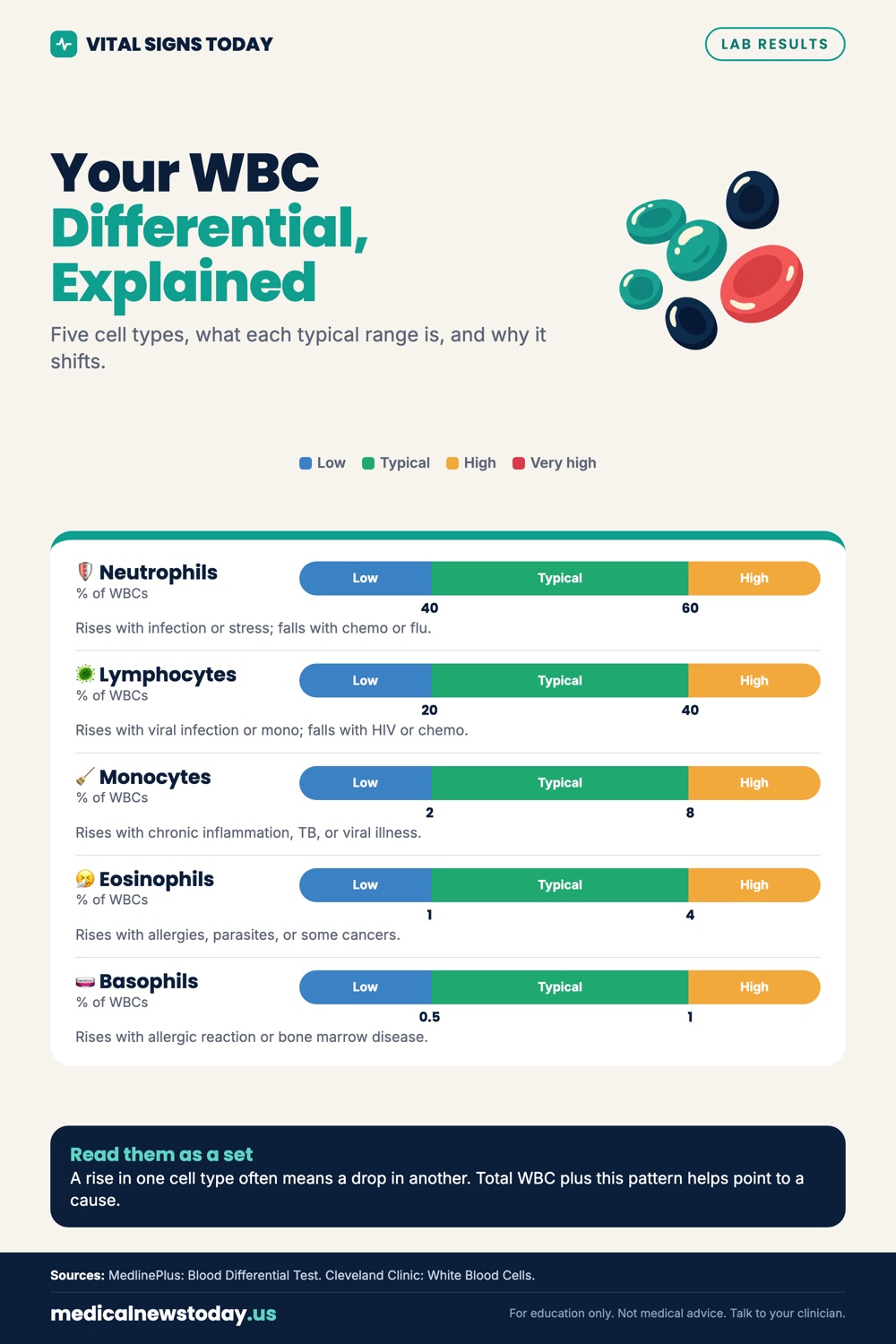
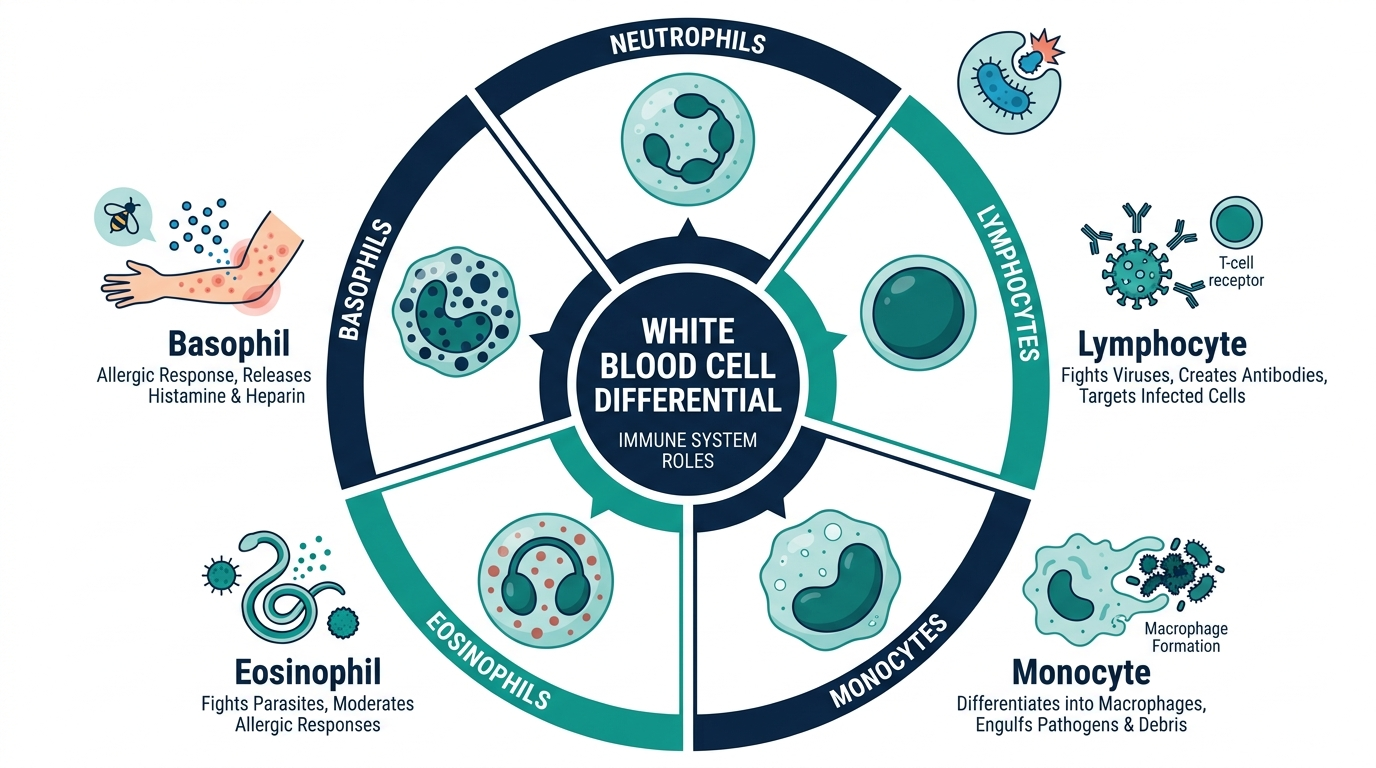
The WBC count measures how many white blood cells are circulating, but it is really a snapshot of five different cell types lumped into one total. Your lab does not just count leukocytes as a single crowd. A test called the differential breaks the total into its parts, because each type does a different job (Cleveland Clinic):
- Neutrophils. The largest share. They attack bacteria, fungi, and foreign debris, and they are usually the first cells on the scene of an infection.
- Lymphocytes. The T cells, B cells, and natural killer cells that fight viral infections and make antibodies.
- Monocytes. The cleanup crew that clears damaged cells and helps coordinate the longer immune response.
- Eosinophils. They target parasites and play a role in allergic reactions.
- Basophils. The smallest share, involved in allergic responses like sneezing and a runny nose.
This is why the same WBC number can mean two completely different things. A total of 12,000 driven by neutrophils suggests a bacterial fight. The same 12,000 driven by lymphocytes points more toward a viral one. The headline number alone cannot tell you which.
What is a normal WBC level?
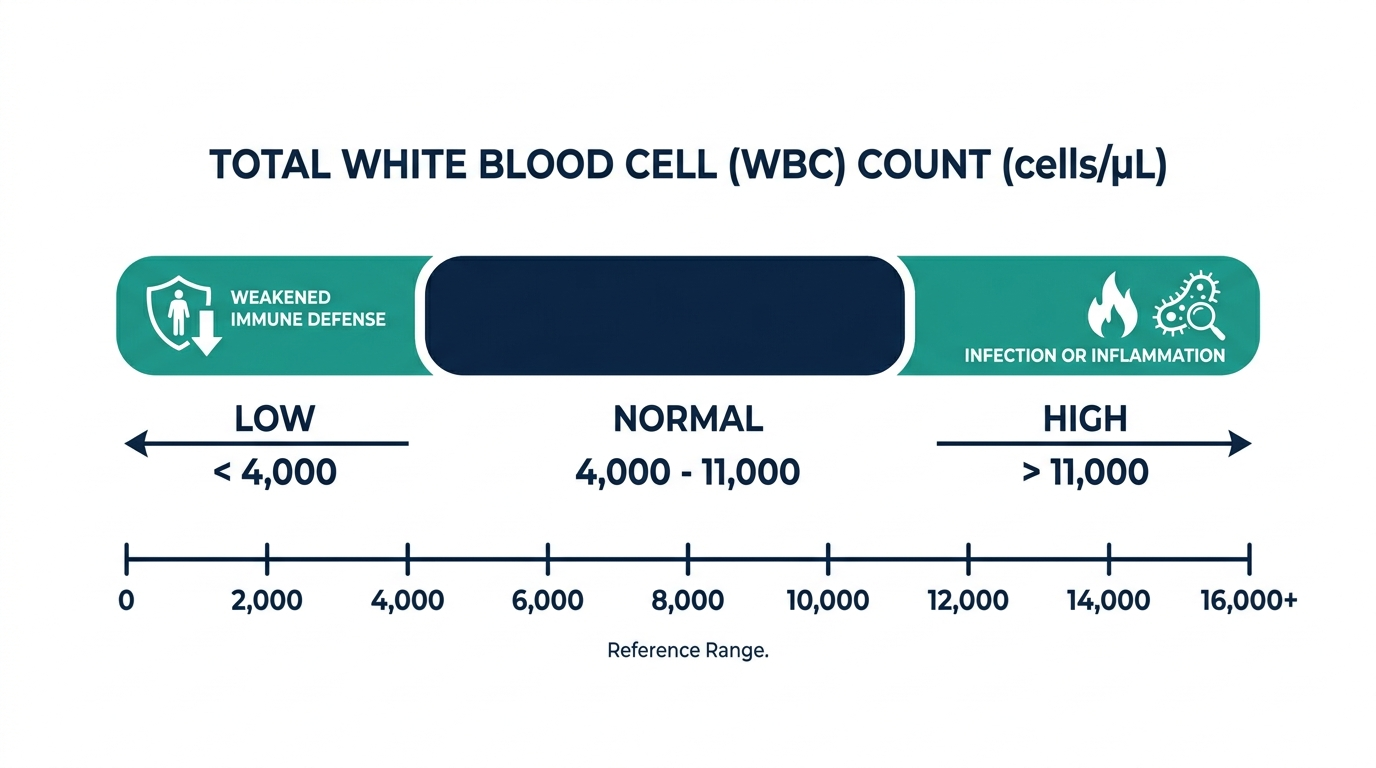
A normal WBC count for adults is generally about 4,500 to 11,000 cells per microliter, written as 4.5 to 11.0 times ten to the ninth per liter on many reports (MedlinePlus). Cleveland Clinic gives a closely overlapping range of 4,000 to 11,000 cells per microliter (Cleveland Clinic). The exact cutoffs shift slightly from one lab and instrument to the next, so the number that matters most is the reference range printed beside your own result.
One practical note that trips people up. The WBC count is genuinely twitchy. Smoking, pregnancy, and severe emotional or physical stress can all nudge it up or down, and everyday factors like diet, activity level, dehydration, and a menstrual period can move it too (MedlinePlus). A single value slightly outside the range, with no symptoms, is often less alarming than it looks. The trend across several tests usually says more than any one reading.
What does a high WBC mean?
A high WBC count, called leukocytosis, means your body has ramped up production of immune cells, most often in response to infection or inflammation. The threshold is generally a count above 11,000 cells per microliter (Cleveland Clinic). It is a reaction, not a disease in itself, and the common triggers are reassuringly ordinary:
- Infection, especially bacterial, which is the single most common cause (Cleveland Clinic).
- Inflammation, from conditions like rheumatoid arthritis or lupus.
- Physical or emotional stress, including injury, surgery, burns, or even intense exercise.
- Medications, particularly corticosteroids, lithium, and beta-agonists.
- Smoking, obesity, and spleen removal, which can all keep the count chronically elevated.
Less commonly, a persistently high WBC, especially a very high one, can signal a blood cancer such as leukemia or lymphoma, or a bone marrow disorder (Cleveland Clinic). This is exactly why clinicians do not panic at one elevated reading. They look at how high, how persistent, and which cell type is driving it.

What does a low WBC mean?
A low WBC count, called leukopenia, means you have fewer immune cells than expected, which can leave you more vulnerable to infection. The usual threshold is a count below 4,000 cells per microliter (Cleveland Clinic). In practice, the most common reasons a count runs low are:
- Bone marrow problems, such as aplastic anemia or multiple myeloma, where production itself falters (Cleveland Clinic).
- Cancer treatment, chemotherapy and radiation, which suppress the marrow that makes white cells (MedlinePlus).
- Autoimmune conditions, such as lupus, where the body turns on its own cells.
- Certain infections, including HIV and some severe viral or bacterial illnesses.
- Medications and nutritional deficiencies, from specific antibiotics to a shortage of key vitamins.
There is also a benign version worth knowing about. Some healthy people, particularly those of African or Middle Eastern descent, naturally run a lower neutrophil count without any underlying disease or extra infection risk. A low WBC is a reason to look, not a reason to assume the worst.
Why is WBC read with the differential and not alone?
WBC is rarely interpreted as a lone number because the differential, the breakdown into the five cell types, is where the actual diagnosis lives. The total tells you the size of the response. The differential tells you what kind of response it is. A high total with a neutrophil surge reads very differently from a high total with a lymphocyte surge, and a normal total can still hide an abnormal mix underneath (Cleveland Clinic).
This is the same reason your clinician orders a CBC with differential rather than a bare WBC. The CBC also sits the white count next to your red cells, hemoglobin, and platelets, so an abnormal WBC can be judged against the rest of the marrow’s output (MedlinePlus). One number in isolation is a headline. The differential is the article.
The part most people never hear: the neutrophil-to-lymphocyte ratio
Here is the insider detail that turns a routine WBC into something far more interesting. Take two of the numbers already sitting in your differential, neutrophils and lymphocytes, and divide one by the other. That single figure, the neutrophil-to-lymphocyte ratio or NLR, has become one of the most studied prognostic markers in modern medicine, and most patients have never heard of it.
The logic is elegant. Neutrophils rise with stress and inflammation. Lymphocytes tend to fall under the same conditions. So the ratio between them is a sensitive read on how much background inflammatory stress your body is carrying. A commonly cited frame is that a ratio around 1 to 2 is normal, 2 to 3 is a gray zone of subclinical inflammation, and above 3 suggests meaningful inflammation. Crucially, both numbers are already on your CBC. The ratio costs nothing extra to calculate.
What makes it striking is how consistently a high NLR tracks with worse outcomes. A 2025 systematic review and meta-analysis of 38 studies found that an elevated NLR was consistently associated with higher mortality in heart failure patients, strong enough that the authors recommended folding it into routine practice for risk stratification (PMC, NLR and mortality in heart failure). The same pattern shows up well beyond the heart. An elevated NLR has been validated as a prognostic marker in critically ill patients and across a range of cancers (PMC, NLR in pancreatic cancer).
None of this means you should diagnose yourself from a ratio. It is a signal of background inflammation, not a verdict, and it has to be read in context. But it is a vivid example of how much information is already buried in your WBC result, waiting for someone to actually look. The next time your white count comes back normal, the more useful question is not just how many cells, but what they are made of.

What each white cell type signals when it runs high or low
Since the differential is where the diagnosis lives, it helps to know what a shift in each individual cell line tends to point toward. None of these is a diagnosis on its own, but the pattern narrows the field fast.
| Cell type | Often high with | Often low with |
|---|---|---|
| Neutrophils | Bacterial infection, inflammation, physical stress, steroids | Chemotherapy, some viral infections, autoimmune disease, or a benign inherited low count |
| Lymphocytes | Viral infections, some chronic infections, certain leukemias | Acute illness, steroids, HIV, and some immune deficiencies |
| Monocytes | Chronic infections, recovery from infection, some autoimmune and blood disorders | Rarely meaningful on their own; can dip with acute stress or steroids |
| Eosinophils | Allergies, asthma, parasitic infection, drug reactions | Usually benign; often reflects steroids or the body’s own cortisol |
| Basophils | Allergic reactions, some chronic inflammation, rarely certain marrow disorders | Rarely clinically important |
Want to check your white blood cells?
Three ways to get it measured. Pick whichever fits you.
Affiliate links: we may earn a commission at no extra cost to you. A lab test does not replace a visit with your clinician.
The practical move when you see a high total WBC is to look immediately at which line is elevated. A neutrophil-driven rise says bacteria or stress; a lymphocyte-driven rise says virus. That single glance often reframes the whole result.
The “left shift”: why bands and immature cells matter
One nuance that rarely reaches patients but changes how clinicians read a high count is the presence of immature neutrophils, sometimes reported as bands. When the body faces a serious bacterial infection, the marrow releases neutrophils faster than usual, including younger forms that are normally kept in reserve. On a report this shows up as a rise in band cells, and clinicians call it a left shift.
A left shift matters because it suggests the immune response is not just active but urgent. A modest WBC rise with a prominent left shift can carry more weight than a higher WBC without one. If your report mentions bands, immature granulocytes, or a left shift, that is a detail worth asking your clinician about rather than ignoring.
Symptoms and red flags that give a WBC number context
The WBC value itself does not cause symptoms. What surrounds it does, and the surrounding picture is what turns a number into a decision.
With a high WBC, the usual companions are the signs of whatever triggered it: fever, localized pain or swelling from an infection, cough, burning with urination, or the aches of a systemic illness. A high count that arrives with fever and a clear source is usually the immune system doing its job.
With a low WBC, the danger is the infection you cannot fight off. Frequent, severe, or slow-to-heal infections, recurrent mouth sores, or fevers that keep returning can all point to a genuinely low functional count.
Red flags that warrant prompt attention regardless of the exact number: a fever above about 100.4 degrees Fahrenheit in someone known to have a low white count, especially during chemotherapy, is a medical emergency called febrile neutropenia and should be acted on immediately, not watched. Likewise, a very high or rapidly rising count with drenching night sweats, unexplained weight loss, easy bruising, or bone pain deserves urgent evaluation because it can signal a marrow problem.

How to prepare, and what can shift a WBC result
You usually do not need to fast for a WBC count unless it is bundled with tests that require fasting. What you should know is how easily the number moves for harmless reasons, so a single borderline value does not send you into a spiral.
- Stress and exertion. A hard workout, acute anxiety, or the physical stress of pain or injury can push neutrophils up within minutes. A draw taken right after a stressful commute is not the same as one taken calmly.
- Smoking. Smokers often run a chronically higher baseline white count, which is important context when a result looks mildly elevated.
- Steroids and other drugs. Corticosteroids raise the count by pulling neutrophils into circulation; certain other medications lower it. Always tell your clinician what you take.
- Pregnancy and menstruation. Both can nudge the count, with pregnancy in particular often running higher than baseline.
- Recent infection or vaccination. The immune system stays activated for a while, so timing relative to a recent illness matters.
Because of all this, clinicians trust the trend over any single reading. A count that is stable across several tests tells a calmer story than one snapshot slightly outside the range.
Living with a low white count: sensible precautions
If your WBC, and especially your neutrophil count, is genuinely low, the practical concern is a reduced ability to fend off infection. This is most relevant for people on chemotherapy or with a marrow condition, but the everyday precautions are the same and worth knowing.
- Take fever seriously. When your count is low, a fever is not a wait-and-see symptom. A temperature at or above 100.4 degrees Fahrenheit is a reason to contact your care team promptly, because infections can move fast without enough neutrophils to slow them.
- Hand hygiene and food safety. Frequent handwashing and avoiding undercooked or unwashed foods lower the exposure that a weakened defense might not handle well.
- Mind wounds and dental care. Small cuts and mouth sores are entry points for infection, so keeping them clean matters more than usual.
- Know your numbers. If a doctor is tracking your count during treatment, understanding roughly where it sits helps you gauge how cautious to be week to week.
Most people with a mild, stable low count from a benign cause need no special precautions at all. These steps matter most when the count is low because of treatment or disease, which is a distinction your clinician can help you draw.
Common misunderstandings about the WBC count
- “A high WBC means I have an infection.” Infection is the most common cause, but stress, steroids, smoking, inflammation, and even a hard workout can raise it too. The differential and your symptoms decide.
- “A normal total means my immune profile is fine.” A normal total can hide an abnormal mix, for example too many neutrophils balanced by too few lymphocytes. This is exactly why the differential exists.
- “A low count always means something is seriously wrong.” Some healthy people, including many of African or Middle Eastern descent, naturally run a lower neutrophil count with no extra infection risk.
- “One abnormal reading needs immediate aggressive testing.” Because the WBC is twitchy, a mild, symptom-free abnormality is often simply rechecked before anyone acts.
A worked example: making sense of a high count
Suppose your WBC comes back at 13,500 with a note that neutrophils are elevated. A reasonable read runs like this:
- Identify the driver. Neutrophils are up, which points toward a bacterial infection, inflammation, or a stress response rather than a viral cause.
- Look for a source. Is there a fever, a localized infection, a recent injury or surgery, or a course of steroids? A clear trigger usually explains the number.
- Check for a left shift. If bands or immature cells are present, the response looks more urgent and may warrant faster action.
- Decide on follow-up. A mild elevation with an obvious cause and improving symptoms often just gets rechecked. A high, persistent, or unexplained count, or one with red-flag symptoms, moves toward further testing.
The same 13,500 is routine in someone recovering from an infection and worth a closer look in someone with no obvious trigger and troubling symptoms. The number sets the question; the context answers it.
Frequently asked questions
What is WBC on a blood test?
WBC on a blood test is your white blood cell count, the total number of immune cells in a measured volume of blood, reported as part of a complete blood count. A normal adult range is about 4,500 to 11,000 cells per microliter (MedlinePlus).
Is a high WBC count something to worry about?
Usually not on its own. A high WBC, above 11,000 cells per microliter, most often reflects infection, inflammation, or stress rather than disease (Cleveland Clinic). Your clinician will look at how high it is, whether it persists, and which cell type is driving it.
What is a normal WBC level?
A normal WBC count for adults is generally about 4,500 to 11,000 cells per microliter, though ranges vary slightly by lab (MedlinePlus). Compare your result to the reference range printed on your own report.
What does a low WBC count mean?
A low WBC, called leukopenia, is a count below 4,000 cells per microliter and can mean your body is making fewer immune cells (Cleveland Clinic). Common causes include bone marrow problems, chemotherapy, autoimmune disease, and certain infections, though some healthy people simply run low.
Can my WBC count change from day to day?
Yes. The WBC count is sensitive to diet, dehydration, exercise, smoking, pregnancy, a menstrual period, and emotional or physical stress (MedlinePlus). A single result slightly outside the range, with no symptoms, is often less meaningful than the trend across several tests.
This article is for general educational purposes and is not medical advice. It cannot diagnose or treat you and does not replace your clinician. Always discuss your lab results and any health decisions with a qualified healthcare professional.
Vital Signs Today may earn a commission if you buy through links on this page. It does not affect our editorial assessments.