Related: How to bring AST back into range
You scanned your liver panel, and there it was: AST, flagged high, sitting just outside the reference range with a little H next to it. Maybe your doctor mentioned it in passing, maybe you found it yourself on the patient portal at 11pm. Either way, your stomach dropped, because AST lives mostly in the liver, and a high liver number sounds like bad news.
Here is the part that almost nobody explains clearly. A single high AST is one of the most common, and most misread, results in all of blood work. It can mean serious liver injury. It can also mean you went to the gym the day before your blood draw. The whole game is learning to tell those two apart.
Part of our Liver Function Tests guide.
What is AST in a blood test that is high, and what does it actually mean?
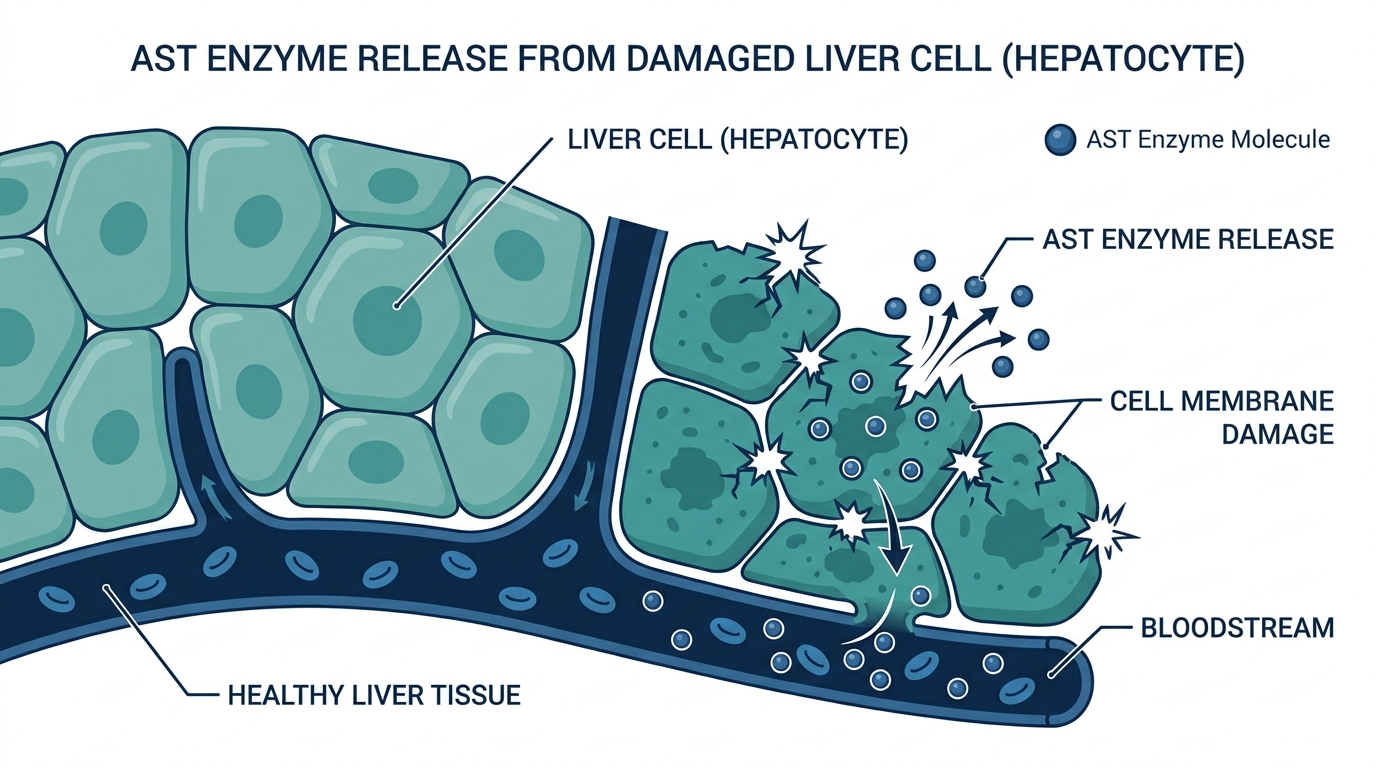
AST stands for aspartate aminotransferase, also called aspartate transferase. It is an enzyme found in your liver, but also in your heart, skeletal muscle, brain, kidneys, and pancreas (Cleveland Clinic). When any cell holding AST is damaged, it leaks the enzyme into your bloodstream. So a high AST is not a diagnosis. It is a leak detector. It tells you that cells somewhere are breaking open faster than usual, and the number measures how much enzyme spilled out.
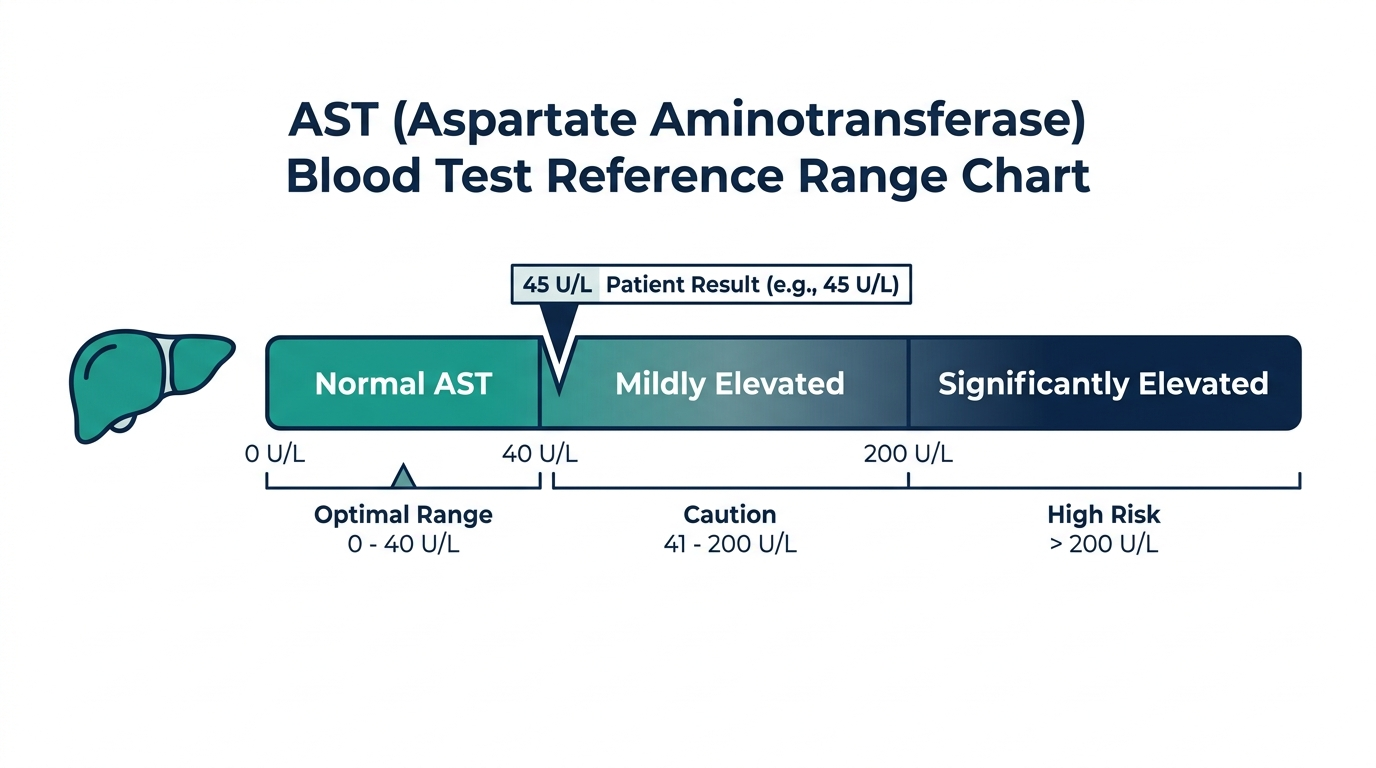
A common reference range for AST is roughly 8 to 33 units per liter, though some labs use 0 to 35 or 7 to 40, and the exact cutoff varies by lab, instrument, age, and sex (MedlinePlus). Anything above the top of the range printed on your own report counts as high. The single most useful habit you can build is to read your AST against the reference range on your own sheet, not against a number you found online.
And here is a number that should take the edge off: about 1 in 20 perfectly healthy people will land outside the normal range purely by statistics, because reference ranges are built to capture the middle 95 percent of the population (Cleveland Clinic). A mildly high AST on its own, with no symptoms, is genuinely common and often turns out to be nothing.

What does a high AST mean on a blood test? The thresholds that matter
The single most important thing about a high AST is not whether it is high. It is how high. Clinicians read AST in rough bands, measured as multiples of the upper limit of normal (ULN), because the magnitude points to wildly different causes (PMC, elevated liver enzymes in asymptomatic patients):
- Borderline (under 2 times ULN): often transient and benign. This is the zone where exercise, a fatty liver, a new medication, or simple statistical noise live.
- Mild (under 5 times ULN): still usually chronic and slow-burning, such as fatty liver disease or steady alcohol use.
- Moderate (5 to 10 times ULN): worth a prompt workup.
- Severe (over 10 times ULN, and especially over 1,000 U/L): this is a different conversation entirely, and it points toward acute, dramatic liver injury.
Put simply: an AST of 55 when the top of normal is 35 is a very different animal from an AST of 2,500. The first is a nudge to look closer. The second is a flashing alarm. Knowing which band you are in tells you most of what you need to know before you panic.
What causes a high AST?
The differential runs from “extremely common and dull” to “rare and serious.” Roughly in order of how often they actually show up:
- Nonalcoholic fatty liver disease (NAFLD). This is the most common cause of mildly elevated liver enzymes in the developed world, tied to extra weight, type 2 diabetes, and metabolic syndrome. AST and ALT are usually only modestly raised.
- Alcohol. Alcohol-related liver injury has a signature: AST runs roughly twice as high as ALT, a 2:1 ratio or greater (Cleveland Clinic).
- Medications and supplements. Statins, acetaminophen, certain antibiotics, antifungals, and a long list of herbal and bodybuilding supplements can raise AST (MedlinePlus).
- Muscle, not liver. This is the great trap, covered in detail below. Intense exercise, a muscle injury, or a muscle disease can push AST up with a completely healthy liver (StatPearls, NCBI).
- Viral hepatitis (A, B, C) and mononucleosis, which can raise AST into the hundreds or low thousands (MedlinePlus).
- Hereditary and autoimmune liver disease, including hemochromatosis (iron overload), autoimmune hepatitis, Wilson disease, and alpha-1 antitrypsin deficiency (PMC).
- Heart and pancreas. A heart attack, recent heart surgery, and pancreatitis all release AST (Cleveland Clinic).
- The extreme causes: ischemic hepatitis (a liver starved of blood, often after shock or very low blood pressure) and acute toxic injury such as acetaminophen overdose. These produce the giant numbers, frequently over 1,000 and sometimes peaking above 5,000 U/L (PMC).
What are the symptoms of a high AST?
Here is the uncomfortable truth: a high AST by itself usually causes no symptoms at all. AST is a number, not a feeling. Most people with a mildly elevated AST feel completely fine and only discover it because of a routine panel. That is exactly why so much liver disease goes unnoticed for years.
Symptoms, when they appear, come from the underlying condition damaging the cells, not from the enzyme itself. The warning signs of a liver problem to watch for include nausea or vomiting, pain in the upper right abdomen, unusual fatigue, loss of appetite, itchy skin, dark urine, and jaundice, the yellowing of the skin or the whites of the eyes (Cleveland Clinic). If a high AST comes packaged with any of those, the result carries far more weight than the same number in someone who feels perfectly well.

When is a high AST dangerous or a medical emergency?
The danger is not in the AST value alone. It is in the combination of a very high value, fast kinetics, and how you feel. The red flags worth knowing:
- AST over 1,000 U/L, or more than roughly 10 to 15 times the upper limit of normal. This level points toward acute hepatocellular injury such as ischemic hepatitis or a drug or toxin, and it needs urgent evaluation (PMC).
- Jaundice plus confusion, drowsiness, or easy bruising and bleeding. These suggest the liver is failing to do its job, not just leaking enzymes, and that is an emergency.
- A suspected acetaminophen (Tylenol) overdose. Even before AST climbs, this is a same-day emergency, because there is a time-sensitive antidote and the enzyme rise can be brutal (PMC).
- Severe upper-abdominal pain, persistent vomiting, or signs of a heart attack alongside a high AST.
A mildly high AST in someone who feels fine is not an emergency. A four-figure AST, or any high AST in someone who is jaundiced, confused, or in real pain, is.
What should you do about a high AST?
An isolated, mildly high AST almost never gets treated on the first result. It gets investigated. The usual, sensible sequence:
- Repeat the test. A borderline AST under 2 times normal in someone without symptoms is often simply rechecked after a few weeks, because so many of these normalize on their own (PMC). Before the recheck, skip alcohol and hard workouts for several days, since both can inflate the number.
- Look at AST next to ALT and the rest of the panel. The AST to ALT ratio, alkaline phosphatase, bilirubin, and GGT together tell the story far better than AST alone.
- Targeted follow-up tests if it stays high: viral hepatitis screening, iron studies for hemochromatosis, autoimmune and metabolic workup, and a liver ultrasound to look for fatty liver (PMC).
- Lifestyle, which is genuinely powerful here. For the most common cause, fatty liver, modest weight loss, cutting alcohol, and reviewing every medication and supplement with your clinician can drive the number back down.
The insider part: the high AST that has nothing to do with your liver
This is the nuance that gets a lot of people sent down an anxious rabbit hole for no reason. AST is not a liver-specific enzyme. It is also packed into skeletal muscle. ALT, its partner enzyme, is far more liver-specific (StatPearls, NCBI). So when AST is high but ALT is normal, an experienced clinician does not automatically think “liver.” They think “where else does AST come from?”
The classic miss: someone does a hard leg day, runs a race, or simply has a physically demanding job, gets blood drawn the next morning, and their AST is flagged high. It looks like a liver problem. It is muscle. The same pattern shows up with muscle injuries, intramuscular injections, seizures, and muscle diseases (MedlinePlus). The tell is the company AST keeps. If AST is up but ALT is normal, the clue often points to muscle, and a creatine kinase (CK) test, an enzyme that tracks muscle damage, can settle it.
The practical lesson is almost embarrassingly simple. Do not do intense exercise in the day or two before a liver panel, and tell your doctor if you did. A high AST from yesterday’s workout and a high AST from hepatitis can look identical on paper. Only the context separates them, and you are often the only person who holds that context.

When should you see a doctor?
Any abnormal AST is worth a conversation with your clinician, but the urgency scales with the picture. Book a routine visit for a mildly high AST when you otherwise feel fine, so it can be repeated and put in context. Move faster, within days, if it is moderately or markedly high, if it is climbing on repeat testing, or if you have risk factors such as heavy alcohol use, viral hepatitis exposure, or a liver-affecting medication. Seek urgent or emergency care if a high AST comes with jaundice, confusion, severe abdominal pain, or a possible medication overdose (Cleveland Clinic). When in doubt, the safest move is to let a clinician interpret the number against everything else on the page and everything going on in your body.
Decoding the AST-to-ALT ratio: what the pattern reveals
The relationship between AST and ALT is one of the most information-dense readings on a liver panel, and it is worth understanding in its own right. ALT is more concentrated in the liver, while AST is spread across liver, muscle, and heart. The ratio between them, sometimes called the De Ritis ratio, shifts the odds toward particular causes.
- AST roughly twice ALT or higher, both elevated. This pattern is the classic fingerprint of alcohol-related liver injury (Cleveland Clinic). When you see AST clearly outpacing ALT with both raised, alcohol is high on the list.
- ALT higher than AST, both mildly to moderately elevated. This leans toward nonalcoholic fatty liver disease and many forms of chronic hepatitis, where the liver-specific enzyme rises more.
- AST high with a normal ALT. This is the pattern that should redirect attention away from the liver, because a normal liver-specific ALT alongside a high AST often points to a muscle or heart source rather than liver injury.
- A very high AST-to-ALT ratio in advanced disease. As chronic liver disease progresses toward cirrhosis, the ratio can climb even without alcohol, so a high ratio is read differently depending on the whole clinical picture.
The point is that AST alone answers almost nothing. AST read against ALT starts to answer the real question: which tissue, and what kind of process. This is why a good clinician never comments on a high AST without looking at the ALT sitting right next to it.
The rest of the liver panel: the markers that complete the picture
A high AST is one line in a panel designed to be read as a set. The other markers each answer a different question, and together they separate a fatty liver from a blocked bile duct from a failing organ.
- ALT. The liver-specific partner to AST, essential for interpreting the ratio and confirming the liver as the source.
- Alkaline phosphatase (ALP) and GGT. These rise more when the problem is in the bile ducts rather than the liver cells themselves. A pattern dominated by ALP and GGT points toward a cholestatic, or bile-flow, problem, while a pattern dominated by AST and ALT points toward hepatocellular, or liver-cell, injury. GGT also helps confirm whether a raised ALP is coming from the liver or from bone.
- Bilirubin. A rise here, especially with jaundice, signals the liver is struggling to clear waste, which raises the seriousness of any enzyme elevation.
- Albumin. Made by the liver, so a low albumin can indicate reduced synthetic function in longer-standing disease.
- Platelet count. Not a liver enzyme, but a falling platelet count in someone with chronic liver disease can hint at scarring and advanced disease, which is why it is watched alongside the enzymes.
Reading these together lets a clinician classify a high AST into a recognizable pattern rather than treating it as an isolated scare. That classification, hepatocellular versus cholestatic, mild versus severe, drives the entire next set of decisions.

How to prepare for a liver panel and what can falsely raise AST
Because AST responds to muscle activity and other transient factors, how you prepare for the draw genuinely affects the result. A few practical steps prevent a false alarm:
- Skip intense exercise for a day or two beforehand. A hard workout, a long run, or heavy lifting can leak AST from muscle and inflate the number with a perfectly healthy liver (StatPearls, NCBI). This is the single most common self-inflicted cause of a confusing result.
- Avoid alcohol in the days before. Recent drinking can push AST up, so a value drawn after a weekend of drinking may not reflect your baseline.
- Bring your full medication and supplement list. Many common drugs and a long list of herbal and bodybuilding supplements can raise AST (MedlinePlus). Your clinician needs the whole list to interpret the result.
- Mention recent injections or muscle injuries. Intramuscular injections, a recent fall, or a muscle strain can all raise AST from a non-liver source.
- Note fasting instructions. AST itself does not strictly require fasting, but it often rides in a panel with markers that do, so follow the specific instruction on your order.
The recurring theme is that context you control, exercise, alcohol, medications, is exactly the context that separates a benign high AST from a meaningful one. Telling your clinician about it is part of the test.
Why fatty liver drives so many mildly high AST results
The most common explanation for a mildly elevated AST in the modern population is nonalcoholic fatty liver disease, a condition where excess fat accumulates in liver cells. It is closely tied to extra weight, type 2 diabetes, insulin resistance, and the cluster of findings known as metabolic syndrome. Because it usually produces only a modest enzyme rise and few or no symptoms, it is frequently discovered by accident on a routine panel.
What makes this worth understanding is that it is often reversible, especially early. The levers that lower the enzymes are the same ones that improve metabolic health overall:
- Gradual weight loss. Even a modest reduction in body weight can reduce liver fat and bring AST and ALT down.
- Reducing added sugars and refined carbohydrates. These feed the fat accumulation in the liver, so cutting back targets the root process.
- Regular physical activity. Exercise improves insulin sensitivity and reduces liver fat, though remember to leave a rest window before a blood draw so muscle release does not confuse the result.
- Limiting alcohol. Even when the primary problem is metabolic, alcohol adds a second insult the liver does not need.
The encouraging reality is that for the leading cause of a mildly high AST, the treatment is largely lifestyle, and the enzyme numbers often respond within months when the underlying metabolic picture improves.
Common misunderstandings about a high AST
- “A high AST means I have liver disease.” Not necessarily. AST comes from muscle and heart as well as liver, and a high AST with a normal ALT frequently points away from the liver entirely (StatPearls, NCBI).
- “The higher the number, the sicker I am.” Magnitude matters, but a moderate elevation from fatty liver can persist for years with little immediate danger, while a rapid rise into the thousands is a different, urgent situation. The trajectory and the whole picture matter as much as the single value.
- “A one-time high AST needs immediate treatment.” Usually it needs a repeat test, not treatment. A borderline value in someone who feels well often normalizes on its own, especially after avoiding alcohol and hard exercise before the recheck (PMC).
- “AST and ALT are interchangeable.” They are not. ALT is more liver-specific, and the relationship between the two, not either alone, is what points toward a cause.
- “There is a supplement to lower liver enzymes.” The durable way to lower a high AST is to treat the cause, most often through weight loss, reduced alcohol, and reviewing medications, not through a product marketed as a liver detox.
Frequently asked questions
Is a high AST something to worry about?
Usually not on its own, especially if it is only mildly elevated and you feel well. About 1 in 20 healthy people fall outside the normal range, and AST is a clue rather than a diagnosis (Cleveland Clinic). It becomes more concerning the higher it climbs and when it comes with symptoms like jaundice or abdominal pain.
What is a normal AST level?
A common reference range is about 8 to 33 U/L, though some labs use 0 to 35 or 7 to 40, and ranges vary by lab, age, and sex (MedlinePlus). Always compare your result to the reference range printed on your own report.
Can exercise cause a high AST?
Yes. AST is found in muscle as well as liver, so intense exercise, muscle injury, or muscle disease can raise it with a completely healthy liver (StatPearls, NCBI). If AST is high but ALT is normal, a muscle source is often the reason, and avoiding hard workouts before a blood draw helps avoid the confusion.
What AST level is dangerous?
Levels above roughly 1,000 U/L, or more than about 10 to 15 times the upper limit of normal, point toward acute liver injury such as ischemic hepatitis or a toxin and need urgent evaluation (PMC). A high AST combined with jaundice, confusion, or severe pain is a medical emergency regardless of the exact number.
Does a high AST mean liver disease?
Not necessarily. A high AST means cells containing the enzyme are leaking, and while the liver is the most common source, the heart, muscle, and pancreas all contain AST too (Cleveland Clinic). The pattern of AST relative to ALT and the rest of your panel is what points to the actual cause.
This article is for general educational purposes and is not medical advice. It cannot diagnose or treat you and does not replace your clinician. Always discuss your lab results and any health decisions with a qualified healthcare professional.
Vital Signs Today may earn a commission if you buy through links on this page. It does not affect our editorial assessments.