You asked for a thyroid check, the results landed in your inbox, and there it was: T3, with a number beside it and maybe a flag. Most people glance at TSH, decide everything is fine or not fine, and never really figure out what T3 is doing on the page. That is a mistake, because T3 is the hormone your cells actually feel. TSH is the thermostat. T3 is the heat.
Here is what most thyroid explainers gloss over: T3 is not just a smaller version of T4. It is the active hormone, and the way it shows up on your report can confirm an overactive thyroid that TSH and T4 alone would miss. Let me walk you through it the way an endocrinologist reads it.
Part of our Thyroid Panel guide.
What is a t3 blood test?
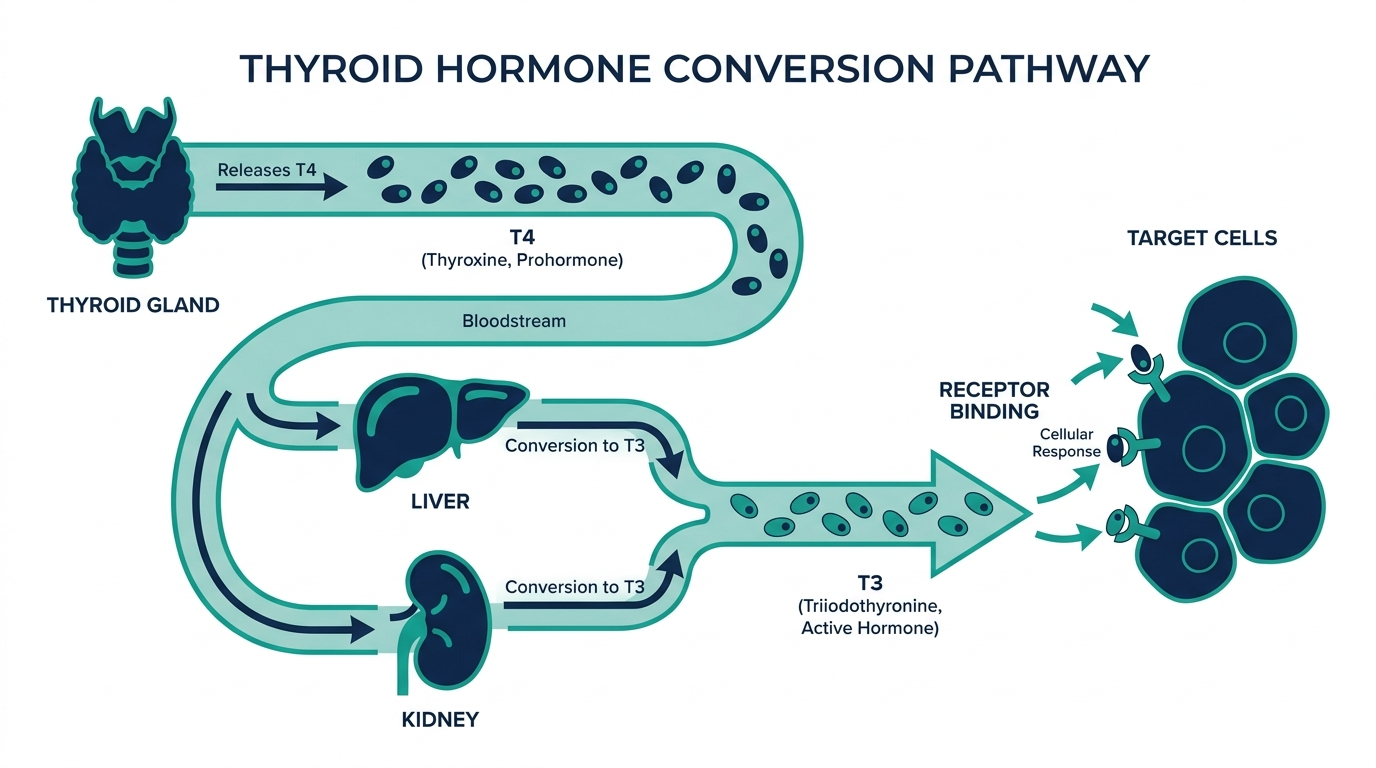
A T3 blood test measures the level of triiodothyronine in your blood, one of the two main hormones your thyroid gland releases (Cleveland Clinic). T3 is the active thyroid hormone, the one that drives your metabolism, heart rate, body temperature, and how fast your cells burn energy. The other main hormone, T4 (thyroxine), is largely a storage and delivery form that the body converts into T3 where it is needed.
In plain terms: if your thyroid system were a delivery business, T4 would be the warehouse inventory and T3 would be the package actually on your doorstep doing the work. A T3 test counts how many packages are in circulation. It is almost always ordered alongside TSH and T4, because no single thyroid number tells the whole story (MedlinePlus).
What does t3 mean in a blood test, and what is it actually measuring?
When you see T3 on a blood test, it is measuring triiodothyronine, the iodine-containing hormone that switches your cells into a higher or lower gear. The name comes from its three iodine atoms (T4 has four). Here is the part that surprises most people: only about 20 percent of your T3 is made directly by the thyroid. The other roughly 80 percent is produced when your body strips one iodine atom off T4 out in the tissues, mostly the liver and kidneys (Cleveland Clinic).
That conversion step matters, because it means your T3 level reflects both how much hormone your thyroid is making and how well your body is converting the storage form into the active form. T3 also travels in two states. Most of it is bound to proteins in the blood, which keeps it parked and inactive. A small fraction floats free and unbound, and that free portion is the part that can actually enter your cells and do something (MedlinePlus). This is why there are two flavors of the test, which trips a lot of people up.
What is the difference between total T3 and free T3 on a blood test?
Total T3 measures all the triiodothyronine in your blood, both the protein-bound portion and the free portion. Free T3 measures only the unbound, active hormone that can enter your tissues (MedlinePlus). They sound interchangeable, but they answer slightly different questions and they have different reference ranges.
The clinical wrinkle worth knowing: free T3 sounds like it should be the superior test, because it isolates the active hormone. In practice, the free T3 assay is technically harder to run accurately, and total T3 is often the more reliable measurement (Cleveland Clinic). That is why your doctor may order total T3 rather than free T3, and why you should never compare a free T3 number against a total T3 range. They are different scales measuring overlapping things.
What is a normal t3 level on a blood test?
A normal total T3 in adults is roughly 79 to 165 nanograms per deciliter (ng/dL), and a normal free T3 is about 2.3 to 4.1 picograms per milliliter (pg/mL), according to Cleveland Clinic reference values (Cleveland Clinic). Children have different ranges, and values shift with age. The exact cutoffs vary by laboratory and the instrument used, so the single most important number on your report is the reference range printed next to your own result.
One practical caution before you panic at a borderline value: a normal T3 alone does not rule out thyroid disease, and an abnormal T3 alone does not confirm it (MedlinePlus). T3 earns its meaning only when read next to TSH and T4. A T3 of 170 on a panel where TSH is suppressed reads very differently than the same 170 on a perfectly normal panel.
What an in-range but low T3 can hint at
There is a pattern that a bare normal-or-abnormal label misses entirely: a T3 sitting in the low part of its range while T4 looks fine. Because most of your T3 is made by converting T4 out in the tissues, a low-ish T3 next to a healthy T4 can suggest the conversion step is sluggish, whether from illness, stress, certain medications, or simply the body idling. This is not a formal diagnosis on its own, and it is easy to over-read, but it is why some clinicians look at the whole thyroid picture rather than a single line. If your T3 hugs the bottom of the range and you feel run down, that is a reason to review the full panel with your doctor, not to panic at one value.
What does a high T3 mean on a blood test?
A high T3 most often signals hyperthyroidism, a state in which your thyroid is producing too much hormone and your metabolism is running hot. T3 testing is one of the main tools used to diagnose hyperthyroidism and to gauge how severe it is (Cleveland Clinic). As a rule of thumb, the higher the T3 climbs, the more pronounced the overactivity tends to be.
Common drivers of an elevated T3 include:
- Graves’ disease, an autoimmune condition that is the most common cause of an overactive thyroid (Cleveland Clinic).
- An overactive thyroid nodule, a lump of thyroid tissue that pumps out hormone on its own.
- Thyroiditis, inflammation of the thyroid that can dump stored hormone into the bloodstream.
- Too much thyroid hormone medication, which can push levels above the target range.
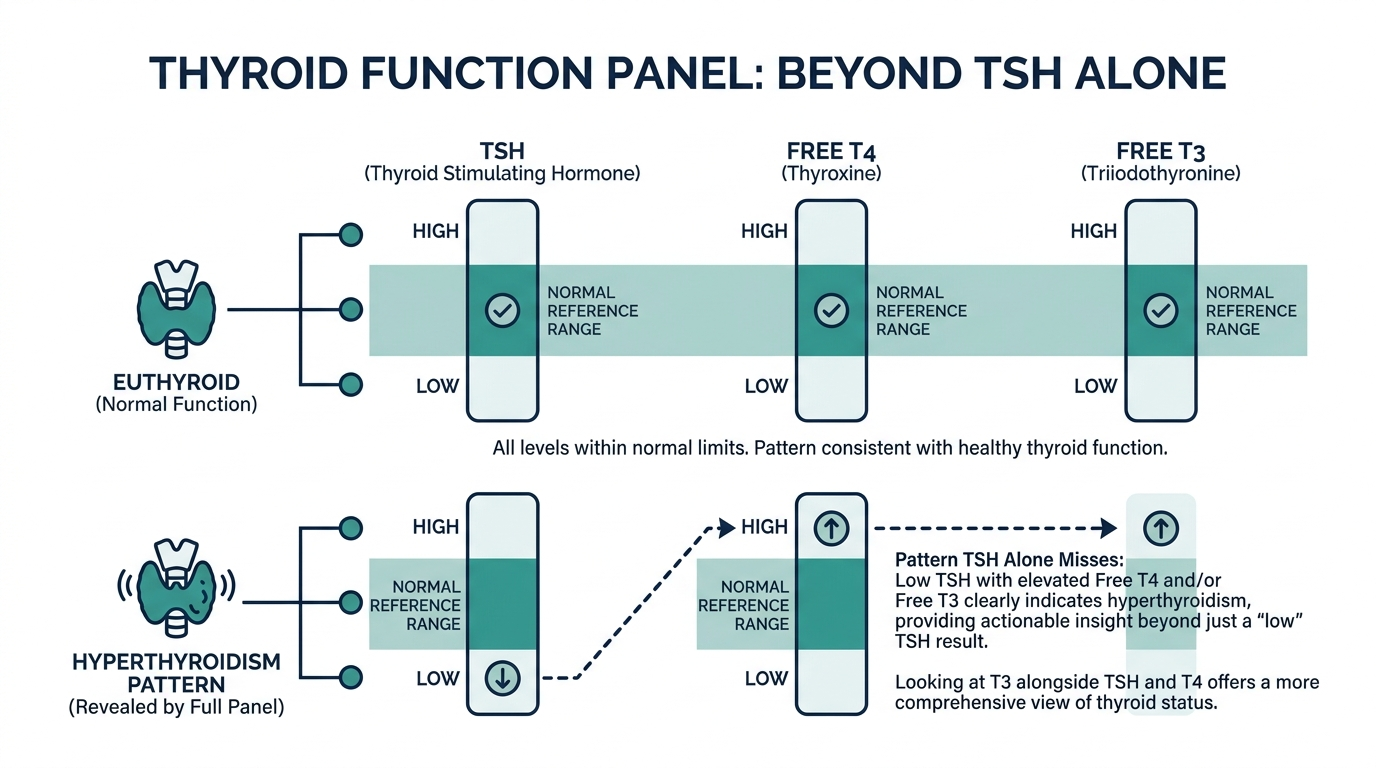
The classic hyperthyroid signature on a full panel is a high T3 and high free T4 with a low TSH, because the pituitary throttles back TSH production when it senses too much circulating hormone (MedlinePlus). Symptoms that travel with a high T3 include unexplained weight loss, a racing or irregular heartbeat, anxiety and jitteriness, heat intolerance, and more frequent bowel movements (Cleveland Clinic).
What does a low T3 mean on a blood test?
A low T3 can point toward hypothyroidism, an underactive thyroid, but clinicians rarely lean on T3 to make that diagnosis. T3 is typically the last thyroid value to fall as the gland slows down, so TSH and T4 usually flag an underactive thyroid long before T3 does (Cleveland Clinic). A low T3 with an otherwise sluggish panel fits the hypothyroid picture, but a low T3 on its own is often something else entirely.
Those other causes are important. A low T3 can result from certain medications, including steroids and the heart drug amiodarone, and it can appear during severe illness when the body’s ability to convert T4 into T3 drops off (Cleveland Clinic). That last scenario has a name, and it is the part most patients never hear about.
When a low T3 really is part of an underactive thyroid, the symptoms are the familiar hypothyroid cluster: fatigue that rest does not fix, weight gain, feeling cold when others are comfortable, dry skin, constipation, low mood, and sluggish thinking. But notice the trap. Those same symptoms overlap heavily with everyday stress, poor sleep, and simple recovery from illness, which is exactly why a low T3 is read next to TSH and T4 rather than treated on its own. The number points at a possibility; the rest of the panel decides whether it is real.
The insider piece: why a low T3 in a sick patient usually is not a thyroid problem
Here is the detail that separates a careful clinician from an automated lab flag. When someone is acutely or severely ill, the body deliberately tamps down T3 production. This is called euthyroid sick syndrome, also known as nonthyroidal illness syndrome, and the hallmark is a low total and free T3 with a normal or low TSH and T4 in a person whose thyroid gland is actually working fine (StatPearls, NCBI Bookshelf).
It is common. A reduced total T3 shows up in roughly 40 to 100 percent of seriously ill patients, which makes it one of the most frequent abnormal thyroid findings you will ever see in a hospital (StatPearls, NCBI Bookshelf). The body appears to do this on purpose, dialing down the active hormone to conserve energy while it fights an infection, recovers from surgery, or weathers a critical illness. The thyroid is not broken. It is being told to idle.
Why does this matter to you? Because T3 testing during an acute illness, or in the days after a major medical event, can produce a misleadingly low number that has nothing to do with your thyroid. A clinician who knows about nonthyroidal illness syndrome will often wait until you have recovered before chasing a single low T3, rather than starting thyroid treatment you do not need (StatPearls, NCBI Bookshelf). This is the kind of context a results portal will never give you when it slaps a red flag on the line.
Why is T3 measured with TSH and T4?
T3 is measured alongside TSH and T4 because thyroid hormones operate as a feedback loop, and one number in isolation can mislead you. TSH from the pituitary tells the thyroid how much hormone to make. The thyroid releases mostly T4, and your tissues convert that T4 into the active T3 that does the work (InformedHealth.org, NCBI Bookshelf). Reading all three lets your doctor see both the command signal and the output.
The pairing is what makes T3 genuinely useful in one specific situation. In some people with an overactive thyroid, TSH is low and free T4 is still normal, and the only thing clearly elevated is T3. This pattern, sometimes called T3 toxicosis, would be invisible if your doctor checked only TSH and T4. Ordering T3 is what catches it. That single extra number can confirm hyperthyroidism that the standard two-test screen would have waved through as normal (Cleveland Clinic).
How do you prepare for a T3 test, and what can throw it off?
A T3 test usually does not require fasting, but several everyday things can move the number, and most are easy to account for if your clinician knows about them. The one that catches the most people is biotin, the supplement found in many hair, skin, and nail products. High-dose biotin can interfere with the immunoassays used for thyroid tests, and the FDA has specifically warned that it can skew thyroid results, sometimes mimicking a pattern that looks like hyperthyroidism. If you take biotin, tell your clinician, because many advise pausing it for a couple of days before a thyroid draw.
Other common influences on a T3 result:
- Estrogen-containing medications and pregnancy, which raise the carrier proteins in the blood and can push total T3 up even when the active free hormone is normal.
- Acute or severe illness, which lowers T3 through nonthyroidal illness syndrome as described above (StatPearls, NCBI Bookshelf).
- Certain medications, including steroids, beta-blockers, and amiodarone, which can lower T3 or slow its production (Cleveland Clinic).
- Timing of thyroid medication, since when you took your last dose can shift the reading.
The practical move is to list every medication and supplement, flag any recent illness, and mention pregnancy or hormonal contraception, so a total T3 is read in the right context. When in doubt, the free hormone and the pattern across TSH, T4, and T3 matter more than any single total value pulled up by binding proteins.
What should you do about a high or low T3?
The first rule is that T3 is a supporting actor, not the lead. On its own it decides very little, so the next step after any abnormal T3 is to read it against TSH and free T4, and often to add thyroid antibodies when an autoimmune cause is possible. That pattern is what turns a lone number into a diagnosis.
- High T3 with low TSH: this fits hyperthyroidism, and the workup often adds antibodies such as TRAb for Graves’ disease, and sometimes imaging, to find the cause rather than just confirm the overactivity (Cleveland Clinic).
- Low T3 during or right after an illness: this is most often nonthyroidal illness syndrome, and the usual move is to wait and repeat testing once you have recovered rather than start thyroid medication (StatPearls, NCBI Bookshelf).
- Low T3 with high TSH and low T4: this fits an underactive thyroid, where T3 is usually the last value to fall, so TSH and T4 lead the diagnosis (Cleveland Clinic).
On retesting, thyroid values move slowly, so there is rarely any urgency to repeat a T3 the next day. If the result was drawn during illness, after starting a new medication, or while taking biotin, a repeat a few weeks later on a normal day, off the interfering factor, gives a far cleaner read. Thyroid problems are managed on trends and on the whole panel, not on a single T3 in isolation.
Two quick real-world reads
Picture a 45-year-old woman with a racing heart, weight loss, and trouble sleeping. Her TSH is low, but her free T4 comes back normal, so a two-test screen would look almost reassuring. Adding T3 changes everything: it is clearly elevated, the picture of T3 toxicosis, and it explains every symptom the standard screen nearly missed. Now picture a man recovering in the hospital after major surgery whose total T3 comes back low. On paper that looks like a thyroid problem, but his TSH and T4 are normal and he was critically ill, the textbook setup for nonthyroidal illness syndrome. Treating his thyroid would be a mistake; waiting for him to recover and rechecking is the right call. Same abnormal-looking T3, opposite meanings, and only the full context tells them apart.
Frequently asked questions
What is a t3 blood test used for?
It measures triiodothyronine, the active thyroid hormone, and is used mainly to help diagnose hyperthyroidism or judge how severe an overactive thyroid is (Cleveland Clinic). It is usually ordered together with TSH and T4, and can also help monitor thyroid treatment.
What is a normal t3 level on a blood test?
In adults, total T3 is roughly 79 to 165 ng/dL and free T3 is about 2.3 to 4.1 pg/mL, though ranges vary by lab and by age (Cleveland Clinic). Always compare your result to the reference range printed on your own report.
What is the difference between total T3 and free T3?
Total T3 measures all triiodothyronine in your blood, both protein-bound and free, while free T3 measures only the unbound active portion that enters your cells (MedlinePlus). Total T3 is often the more reliable assay, so they are not interchangeable and use different reference ranges.
What does a high T3 mean in a blood test?
A high T3 most often indicates hyperthyroidism, frequently from Graves’ disease, an overactive nodule, or thyroiditis, and the classic panel shows high T3 and free T4 with a low TSH (MedlinePlus). The higher the level, the more severe the overactivity tends to be.
Can T3 be low without a thyroid problem?
Yes. During severe illness the body lowers T3 on purpose, a pattern called euthyroid sick syndrome or nonthyroidal illness syndrome, where the thyroid itself is working normally (StatPearls, NCBI Bookshelf). Certain medications, including steroids and amiodarone, can also lower T3.
Do I need to fast for a T3 test?
Fasting is not usually required for a T3 test. What matters more is telling your clinician about supplements like biotin, any recent illness, pregnancy or estrogen-containing medication, and when you last took thyroid medication, since those can shift the result (Cleveland Clinic).
Can biotin affect a T3 test?
Yes. High-dose biotin, common in hair and nail supplements, can interfere with the immunoassays used for thyroid testing and skew the results, and the FDA has warned about this specifically for thyroid tests. Many clinicians suggest pausing biotin for a day or two before a thyroid draw and mentioning it either way.
What is reverse T3?
Reverse T3 (rT3) is an inactive form the body makes from T4 when it wants to slow metabolism, which is part of why T3 falls during serious illness. It is not part of a routine thyroid panel and is not needed for most people, but it helps explain how someone can have adequate T4 yet a low active T3.
Does pregnancy change T3 levels?
Pregnancy and estrogen-containing medications raise the carrier proteins that bind thyroid hormone, which can push total T3 upward even when the active free hormone is normal (MedlinePlus). This is one reason clinicians interpret total T3 in the context of the whole panel and your circumstances.
This article is for general educational purposes and is not medical advice. It cannot diagnose or treat you and does not replace your clinician. Always discuss your lab results and any health decisions with a qualified healthcare professional.
Related: test your thyroid and hormones from home.
Vital Signs Today may earn a commission if you buy through links on this page. It does not affect our editorial assessments.