Part of our Iron Studies guide.
You ordered an iron panel, or your doctor did, and tucked between serum iron and ferritin sits a line labeled UIBC with a number that looks oddly large next to everything else. No flag, no note, just three letters and a value in the hundreds. Most people glance at it and move on. Here is what almost no explainer tells you: UIBC is not a throwaway number. It is the spare-capacity gauge of your iron transport system, and once you understand it, the rest of your iron panel suddenly makes sense.
UIBC gets ignored because it is a calculated cousin of the more famous TIBC. That is a mistake. Read together with serum iron, it is one of the cleanest signals of whether your body is starving for iron or drowning in it.
What is UIBC in a blood test?
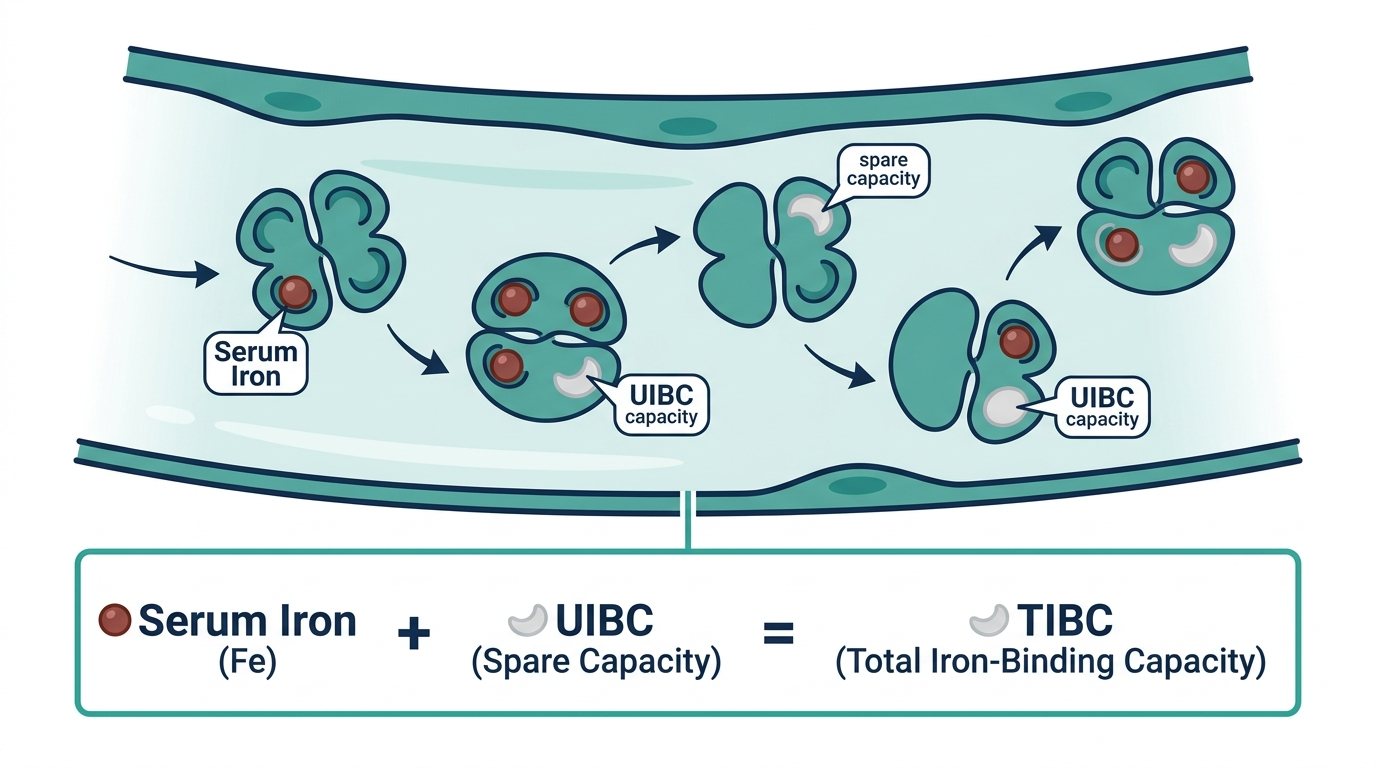
UIBC stands for unsaturated iron-binding capacity, and it measures how much spare room your iron-carrying protein, transferrin, still has to pick up more iron. In plain terms, UIBC is the empty seats on the bus. Transferrin is the bus that ferries iron through your bloodstream, and at any moment only some of its seats are filled. UIBC counts the seats still open (StatPearls, NCBI).
This is the heart of what UIBC means in a blood test. Your total iron-binding capacity (TIBC) is every seat on the bus, full or empty. Serum iron is the seats already taken. UIBC is simply the difference, the seats still available. In healthy adults only about one-third of transferrin is saturated with iron, which leaves roughly two-thirds, that 67 percent reserve, as the unsaturated binding capacity (StatPearls, NCBI).
What does UIBC mean on a blood test, and how is it calculated?
What UIBC means on a blood test is best understood through one simple relationship: UIBC equals TIBC minus serum iron. The three numbers are locked together. TIBC is the total capacity to bind iron, serum iron is how much is bound right now, and UIBC is the leftover (StatPearls, NCBI).
That formula is why labs can report UIBC and TIBC almost interchangeably. Many labs actually measure UIBC directly in the analyzer, then add serum iron to it to arrive at TIBC, rather than the other way around (StatPearls, NCBI). So when you see a UIBC line on a what-is-a-UIBC-blood-test report, you are looking at the directly measured value, and TIBC is often the derived one. The two move in opposite directions to serum iron, which is exactly what makes the pattern so readable.
What is a normal UIBC level?
A normal UIBC for most adults falls in the range of about 111 to 343 micrograms per deciliter (mcg/dL), although the exact cutoffs vary by laboratory and the analyzer used (StatPearls, NCBI). For context, normal TIBC generally runs about 240 to 450 mcg/dL (Cleveland Clinic), and since UIBC plus serum iron equals TIBC, the numbers stay internally consistent.
The practical move is always the same: compare your UIBC to the reference range printed on your own report, because that is the range your lab calibrated for its instrument. A value of 350 is normal on one lab’s scale and slightly high on another. The number alone tells you little until you read it against the iron sitting next to it.
How should you prepare for a UIBC or iron panel test?
Iron studies are more sensitive to timing and prep than most routine bloodwork, and a little care keeps the numbers honest. Serum iron follows a daily rhythm, generally running higher in the morning and lower later in the day, and because UIBC is calculated against serum iron, that swing moves your UIBC too. A morning draw gives the most consistent, comparable result.
Food and supplements are the bigger levers. A dose of iron, or an iron-rich meal, can raise serum iron for hours and temporarily shrink UIBC, which is why many labs ask you to have the panel drawn fasting in the morning and to hold iron supplements for a period beforehand. If you take an iron pill or a multivitamin containing iron, ask your provider whether to pause it before the test, since testing right after a dose can make your iron stores look better than they are.
Two more practical notes. Try to test when you are well, because inflammation from an infection can distort the wider iron picture, especially ferritin. And keep the comparison honest over time by testing under the same conditions each time, the same morning timing and the same fasting state, so a change in your UIBC reflects your body rather than your breakfast.
What does a high UIBC mean?
A high UIBC means your transferrin is mostly empty, with lots of open seats, which is the classic fingerprint of iron deficiency. When your body runs short on iron, the liver makes more transferrin to scavenge whatever iron it can find, so binding capacity goes up while the iron actually bound to it goes down (StatPearls, NCBI).
This is the same pattern seen across the rest of the iron panel in iron deficiency anemia. Ferritin, serum iron, and transferrin saturation all fall, while TIBC rises as the body tries to compensate for low iron (PMC, investigation of iron deficiency anaemia). A high UIBC is the spare-capacity side of that same coin: lots of empty bus seats because there is not enough iron to fill them. It is a clue, not a diagnosis, but it is a strong one when it lines up with low serum iron.
What does a low UIBC mean?
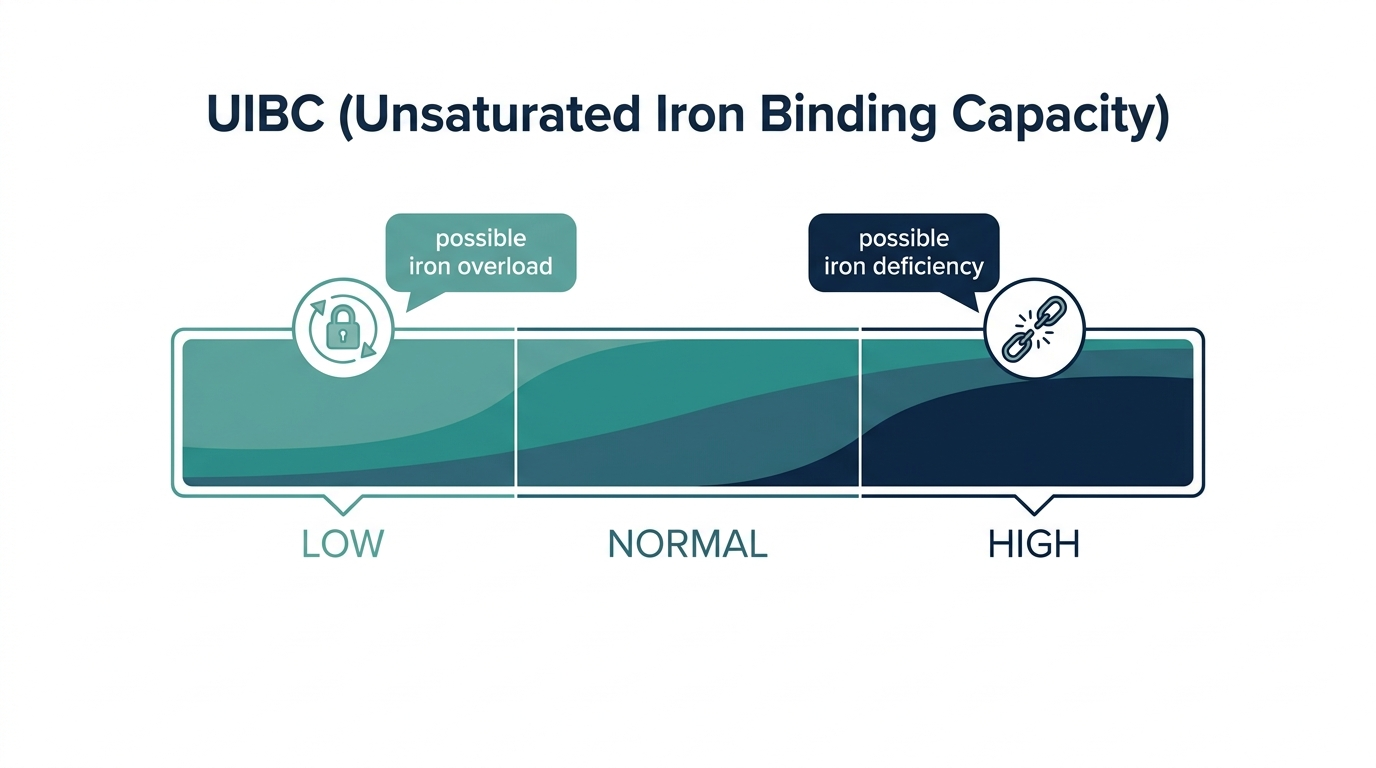
A low UIBC means your transferrin is mostly full, with few open seats, which usually points to iron overload or a drop in transferrin production. When iron stores are high, more of transferrin’s binding sites are already occupied, so the unsaturated capacity shrinks (StatPearls, NCBI).
There are two distinct stories behind a low UIBC, and they are worth telling apart. The first is genuine iron overload, such as hereditary hemochromatosis, where the bus is packed because there is too much iron. The second is reduced transferrin production. Conditions like cirrhosis, chronic inflammation, infection, malnutrition, and nephrotic syndrome can lower the amount of transferrin the body makes, which also drops UIBC and TIBC even when iron itself is not high (Cleveland Clinic). This is exactly why UIBC is never read alone.
What symptoms lead people to an iron panel?
UIBC rarely gets ordered on its own. It usually rides along on an iron panel requested because something already feels off. On the iron-deficiency side, the familiar signs are ongoing fatigue, pale skin, shortness of breath with effort, cold hands and feet, brittle nails, hair shedding, and sometimes restless legs at night or an odd urge to chew ice. A high UIBC paired with these symptoms and a low ferritin is the pattern clinicians expect to see.
The iron-overload side looks different and is easier to miss. Early hemochromatosis can be quiet for years, then surface as fatigue, aching joints, especially in the knuckles, low libido, or a subtle bronzing of the skin. Here a low UIBC alongside high serum iron and high transferrin saturation is the combination that prompts a closer look, often including genetic testing. In both directions, the symptoms are what turn a UIBC number from trivia into a signal worth acting on.
Why is UIBC measured with serum iron and TIBC?
UIBC is measured with serum iron and TIBC because no single one of them answers the question on its own. The trio is what lets a clinician calculate transferrin saturation, the percentage of transferrin actually carrying iron, which is the most decisive number in the whole panel (StatPearls, NCBI).
Transferrin saturation is serum iron divided by TIBC, expressed as a percent. The reading is sharp: in healthy people transferrin runs roughly 25 to 35 percent saturated, and saturation falling to about 16 percent or lower is a hallmark of iron deficiency, while a high saturation points toward iron overload (StatPearls, NCBI). Because UIBC and serum iron together build TIBC, your UIBC value is one of the inputs that produces that saturation percentage. Here is how the pattern reads at a glance:
- High UIBC with low serum iron: classic iron deficiency. Empty bus, little cargo.
- Low UIBC with high serum iron: iron overload, such as hemochromatosis. Full bus, plenty of cargo.
- Low UIBC with low serum iron: often anemia of chronic disease or low transferrin from liver or kidney issues.
One affordable panel separates conditions that can look superficially similar. Iron deficiency and anemia of chronic disease both show low serum iron, but the UIBC and TIBC behavior pulls them apart: high in deficiency, low or normal in chronic disease.
The part most people never hear: UIBC bounces around more than you think
Here is the insider caveat that rarely reaches the patient summary. UIBC and transferrin saturation are surprisingly noisy from one blood draw to the next, and a single borderline value can be misleading. In a study of repeat testing, the visit-to-visit correlation for UIBC was only around 0.5 to 0.6, and the researchers traced almost all of that swing to genuine within-person biological variability rather than lab error, since the analyzer itself accounted for only about 4 percent of the total variation (PMC, biological variability of transferrin saturation and UIBC).
The consequence is concrete. In that same work, screening for the main hemochromatosis gene variant on a single set of iron studies would have missed roughly a quarter to a third of true carriers, because their UIBC or transferrin saturation happened to land in the normal zone that day (PMC, biological variability of transferrin saturation and UIBC). Practically, this means a single mildly abnormal UIBC is rarely the final word. Serum iron also drifts with the time of day and recent meals, so the smart approach is to interpret UIBC alongside ferritin and, when the picture is borderline, to repeat the panel rather than act on one reading.
There is a second trap worth knowing. Ferritin, the marker clinicians lean on most for iron deficiency, is an acute-phase protein, so infection, inflammation, or cancer can push it up to 100 mcg/L or higher even when iron is genuinely low (PMC, investigation of iron deficiency anaemia). When inflammation muddies ferritin, the UIBC and TIBC pattern can become a useful tiebreaker. That is the quiet value of the number you were about to skip.
What should you do after a high or low UIBC?
The first move is never to treat the UIBC in isolation. Read it against serum iron, TIBC, transferrin saturation, and ferritin, because those together tell the story UIBC only hints at. A high UIBC with low ferritin and low saturation points toward iron deficiency and a search for the cause, from diet to blood loss. A low UIBC with high saturation points toward overload and usually earns further testing.
Resist the urge to self-correct with supplements before you know the pattern. Taking iron on the strength of a single high UIBC can be pointless if you are not actually deficient, and it is genuinely risky if the real issue is overload, where more iron is the last thing your body needs. When a result is borderline or does not match your symptoms, the sound next step is to repeat the panel under clean conditions and let your provider interpret the trend rather than chasing one reading.
Frequently asked questions
What does UIBC mean in a blood test?
UIBC means unsaturated iron-binding capacity, the spare capacity your transferrin protein still has to bind more iron. It equals TIBC minus serum iron, so it represents the open binding sites not yet carrying iron (StatPearls, NCBI).
What is a normal UIBC level?
A normal UIBC is generally about 111 to 343 mcg/dL, though ranges vary by laboratory and analyzer (StatPearls, NCBI). Always compare your value to the reference range printed on your own report.
What does a high UIBC mean?
A high UIBC usually signals iron deficiency. Your transferrin has lots of empty binding sites because there is not enough iron to fill them, a pattern that typically goes with low serum iron, low ferritin, and high TIBC (PMC, investigation of iron deficiency anaemia).
What does a low UIBC mean?
A low UIBC often points to iron overload, such as hemochromatosis, where transferrin is mostly full. It can also reflect lower transferrin production from cirrhosis, chronic inflammation, infection, malnutrition, or kidney disease (Cleveland Clinic).
What is the difference between UIBC and TIBC?
TIBC is the total capacity to bind iron, every binding site on transferrin. UIBC is only the unused portion, the sites still empty. UIBC plus serum iron equals TIBC, and the iron studies are interpreted together to calculate transferrin saturation (StatPearls, NCBI).
Do I need to fast for a UIBC test?
Often, yes. Because serum iron rises after meals and shifts through the day, iron studies are commonly drawn fasting in the morning for the most reliable UIBC. Follow the specific instructions your lab or provider gives, since protocols vary.
Should I stop iron supplements before the test?
Ask your provider first, but iron pills and iron-containing multivitamins can raise serum iron and lower UIBC for hours, so many clinicians ask you to hold them for a period before an iron panel. Testing right after a dose can make your iron status look better than it truly is.
This article is for general educational purposes and is not medical advice. It cannot diagnose or treat you and does not replace your clinician. Always discuss your lab results and any health decisions with a qualified healthcare professional.
Vital Signs Today may earn a commission if you buy through links on this page. It does not affect our editorial assessments.