
Related: What a low eosinophils result means
You scanned your complete blood count, saw the big numbers like hemoglobin and white blood cells, and then hit a tiny line near the bottom: eosinophils, with a number and a percentage that probably meant nothing to you. Most people skip it. Here is what almost nobody tells you. That little number is one of the most honest signals on your whole report about what your immune system is actually reacting to, whether that is pollen, a parasite, a drug, or something your doctor genuinely needs to chase down.
Eosinophils get dismissed as the “allergy cell.” They are far more interesting than that, and reading them correctly tells you something the rest of your CBC cannot.
Part of our Complete Blood Count guide.
What is eosinophils in a blood test?
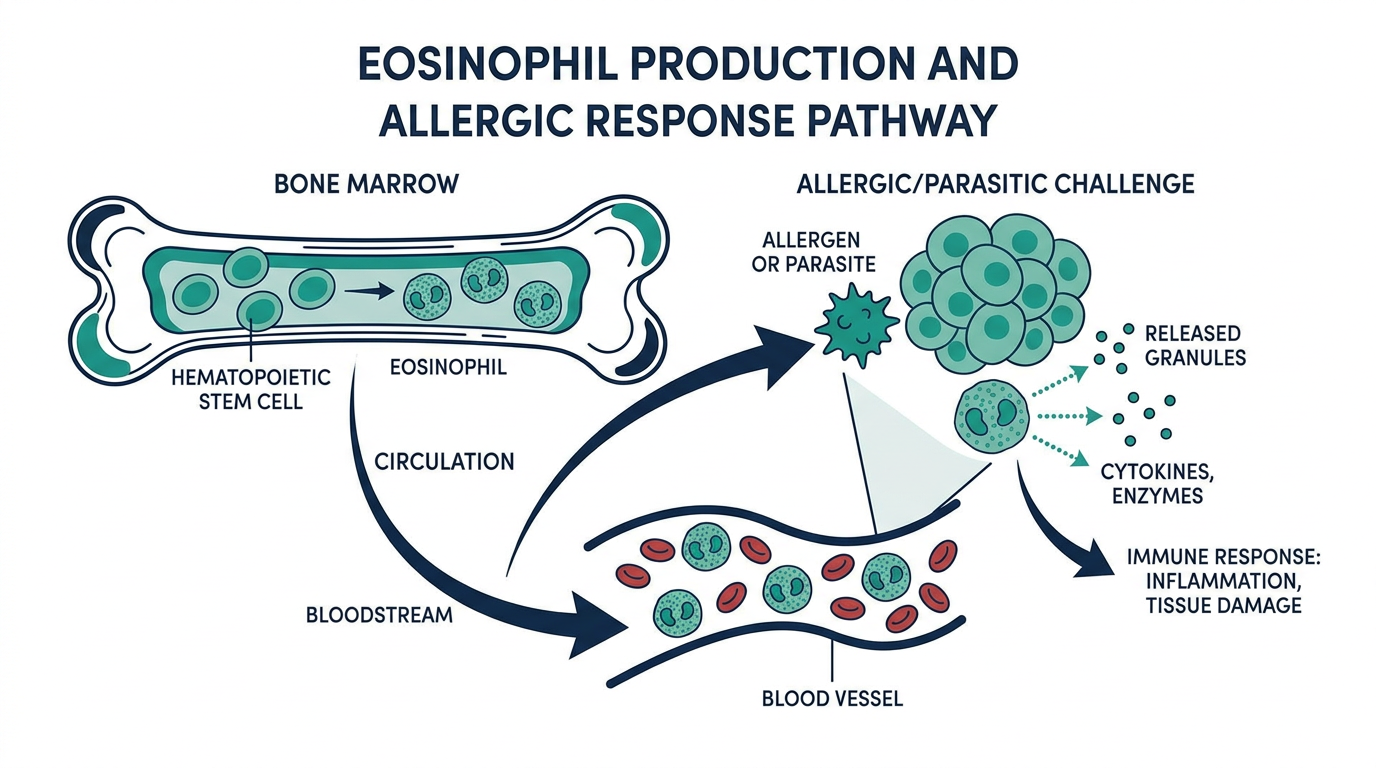
In a blood test, eosinophils are a type of white blood cell that your body uses to fight parasites, react to allergens, and manage certain kinds of inflammation. They normally make up less than 5 percent of all your white blood cells (Cleveland Clinic). On a standard complete blood count with differential, eosinophils are reported two ways at once: as a percentage of your white cells and as an absolute count, the actual number of eosinophils in a set volume of blood.
The simplest way to think about it: eosinophils are your immune system’s specialist response team for allergies and parasites. When that team is sitting quietly, the number is low, which is normal and healthy. When the number climbs, your body is mounting a response to something, and the job is to figure out what.

What does eosinophils mean in a blood test, and what does the test measure?
The eosinophil number on your report measures how many of these specialized white cells are circulating in your blood right now. The absolute eosinophil count is the precise version: a lab tech (or an automated analyzer) counts eosinophils out of 100 white cells to get the percentage, then multiplies that percentage by your total white blood cell count to produce the absolute number in cells per microliter (MedlinePlus).
This matters because the percentage alone can mislead you. If your overall white count is unusually high or low, a normal-looking eosinophil percentage can hide an abnormal absolute count, and vice versa. This is why clinicians lean on the absolute eosinophil count rather than the percentage when they want the real answer. Under the microscope, eosinophils are loaded with sand-like granules that release toxic proteins to destroy invaders such as parasites (Cleveland Clinic). That same arsenal, turned up too high for too long, is exactly what can damage your own tissue, which is the thread running through everything below.
What is a normal eosinophil level?
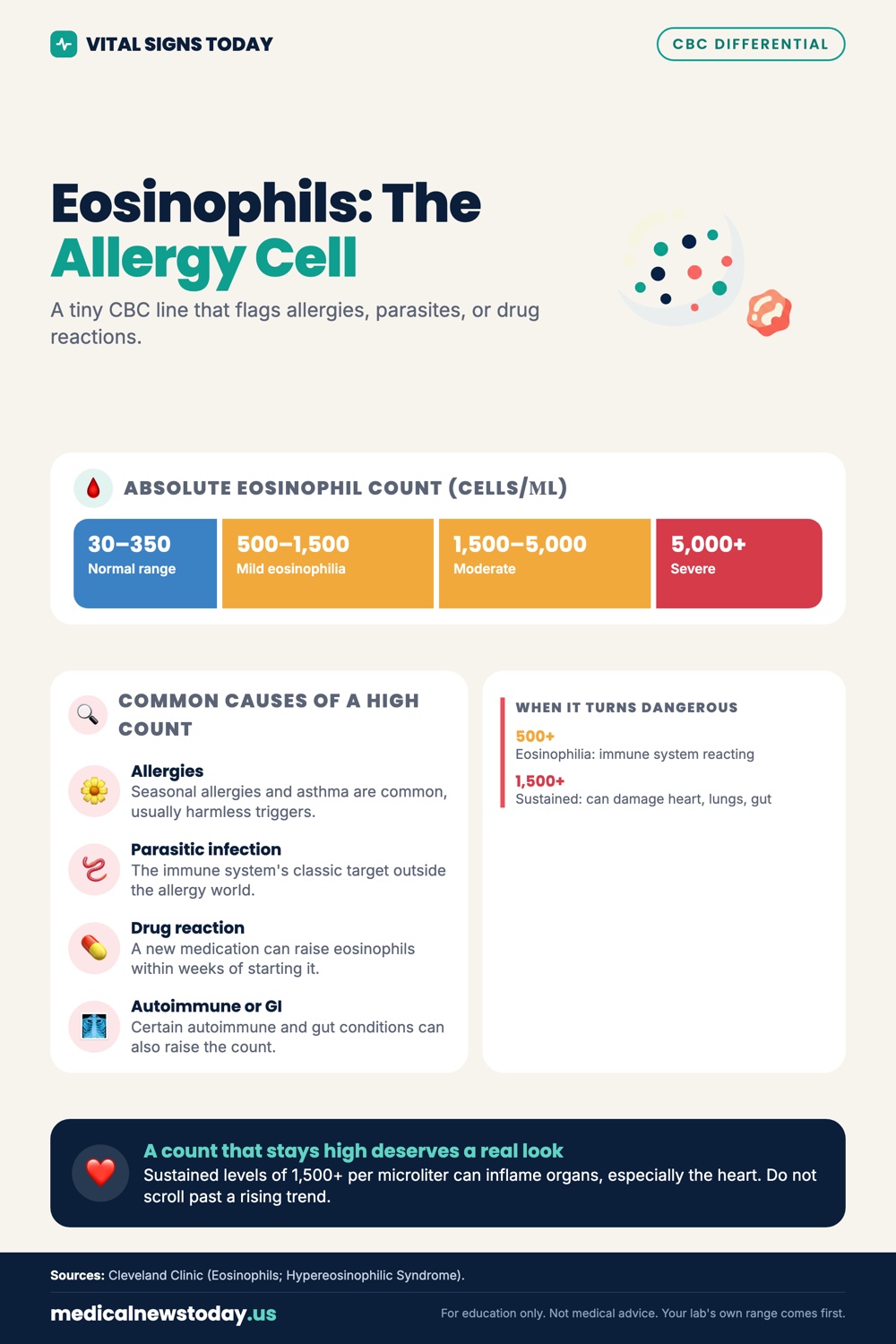
A normal absolute eosinophil count is generally between 30 and 350 cells per microliter of blood (Cleveland Clinic). MedlinePlus describes a normal result more simply as less than 500 cells per microliter, noting that exact ranges vary slightly between laboratories and equipment (MedlinePlus).
As a percentage, normal is typically under about 5 percent of your white blood cells. The practical takeaway: a result that lands under roughly 350 to 500 cells per microliter is in the ordinary zone, and a healthy person can easily have a count near zero. There is no “too low” to worry about in most cases. Always read your number against the reference range printed on your own report, since that is the range your lab calibrated its machines to.
What does a high eosinophil count mean?
A high eosinophil count, called eosinophilia, means more than about 500 eosinophils per microliter of blood (Cleveland Clinic). It is a clue, not a diagnosis, and most of the time the cause is common and not dangerous. Clinicians grade it by how high it goes (Cleveland Clinic):
- Mild eosinophilia: 500 to 1,500 cells per microliter.
- Moderate eosinophilia: 1,500 to 5,000 cells per microliter.
- Severe eosinophilia: more than 5,000 cells per microliter.
The usual suspects behind a mildly raised count are everyday issues. Seasonal allergies, asthma, and reactions to a medication are very common triggers and often are not serious (Cleveland Clinic). Beyond those, the list includes parasitic and fungal infections, certain autoimmune and gastrointestinal disorders, adrenal gland problems, and, less commonly, blood cancers such as leukemia and lymphoma (MedlinePlus).
Here is the honest limit of the test that gets glossed over: the count tells you the team is activated, but not why. As MedlinePlus puts it plainly, the test cannot tell whether the higher number is caused by an allergy or a parasite infection (MedlinePlus). The number opens the investigation. Your history, your symptoms, and follow-up tests close it.

What does a low eosinophil count mean?
A low or near-zero eosinophil count is usually nothing to worry about. Many perfectly healthy people have very few eosinophils, and a single occasional low count typically poses minimal health risk because other immune cells compensate (Cleveland Clinic). There is no widely recognized disease defined simply by a low eosinophil number on its own.
When a low count does carry meaning, the common drivers are predictable. Steroid medications and your body’s own cortisol both suppress eosinophils, so high steroid levels, including from Cushing syndrome, can push the number down (MedlinePlus). A sharply low count can also appear early in the stress response of a serious acute infection. So a low eosinophil count is rarely the headline. It is usually a side effect of something else, most often a medication you are already taking.
Why is the eosinophil count read together with the rest of the differential?
Eosinophils almost never get interpreted in isolation. They sit inside the white blood cell differential alongside neutrophils, lymphocytes, monocytes, and basophils, and the pattern across all five is what gives the number meaning. The eosinophil count is calculated from your total white blood cell count, so the two move together by design (MedlinePlus).
That context is what separates a shrug from a workup. A mildly high eosinophil count in someone with a runny nose during spring allergy season tells a very different story than the same number in someone with unexplained weight loss, night sweats, or a rash. The differential helps your clinician decide whether the elevation fits a tidy allergic explanation or whether it sits next to other clues that point somewhere more serious. One number, read in the company of the others, is far more powerful than the same number read alone.
The part most people never hear: eosinophils as a treatment compass and a tissue-damage warning
This is where eosinophils graduate from a passive allergy marker to something clinicians actively steer by. Two insider truths rarely make the patient version.
First, the blood eosinophil count has quietly become a decision-making biomarker in airway disease. In asthma and chronic obstructive pulmonary disease, blood eosinophils serve as a surrogate for eosinophilic airway inflammation and are used to guide treatment choices, including who is most likely to benefit from inhaled corticosteroids and from newer eosinophil-targeted biologic drugs (National Library of Medicine, PMC). In real-world practice, thresholds around 300 cells per microliter are used to flag patients who may qualify for anti-eosinophil biologics. Translation: the same little number you almost skipped can change which inhaler or injection a pulmonologist reaches for.
Second, a persistently very high count is not just a marker, it can become the disease. When eosinophils stay extremely elevated, around 1,500 per microliter or more, for a sustained period, they can release their toxic granule proteins into your own organs, a condition called hypereosinophilic syndrome that can inflame and scar the heart, lungs, gut, skin, and nervous system (Cleveland Clinic). The heart is the most feared target, where eosinophil-driven damage can progress to scarring and heart failure. This is the reason a moderate or severe eosinophilia is never something to scroll past. It is the difference between a cell that defends you and the same cell turned against your own tissue.
So the expert read on eosinophils is two-sided. A small bump is usually a harmless echo of allergies or a passing trigger. But a high number that stays high deserves a real explanation, because eosinophils are one of the few white cells that can quietly do structural harm if left unchecked.

What can throw off an eosinophil result before you even reach the lab
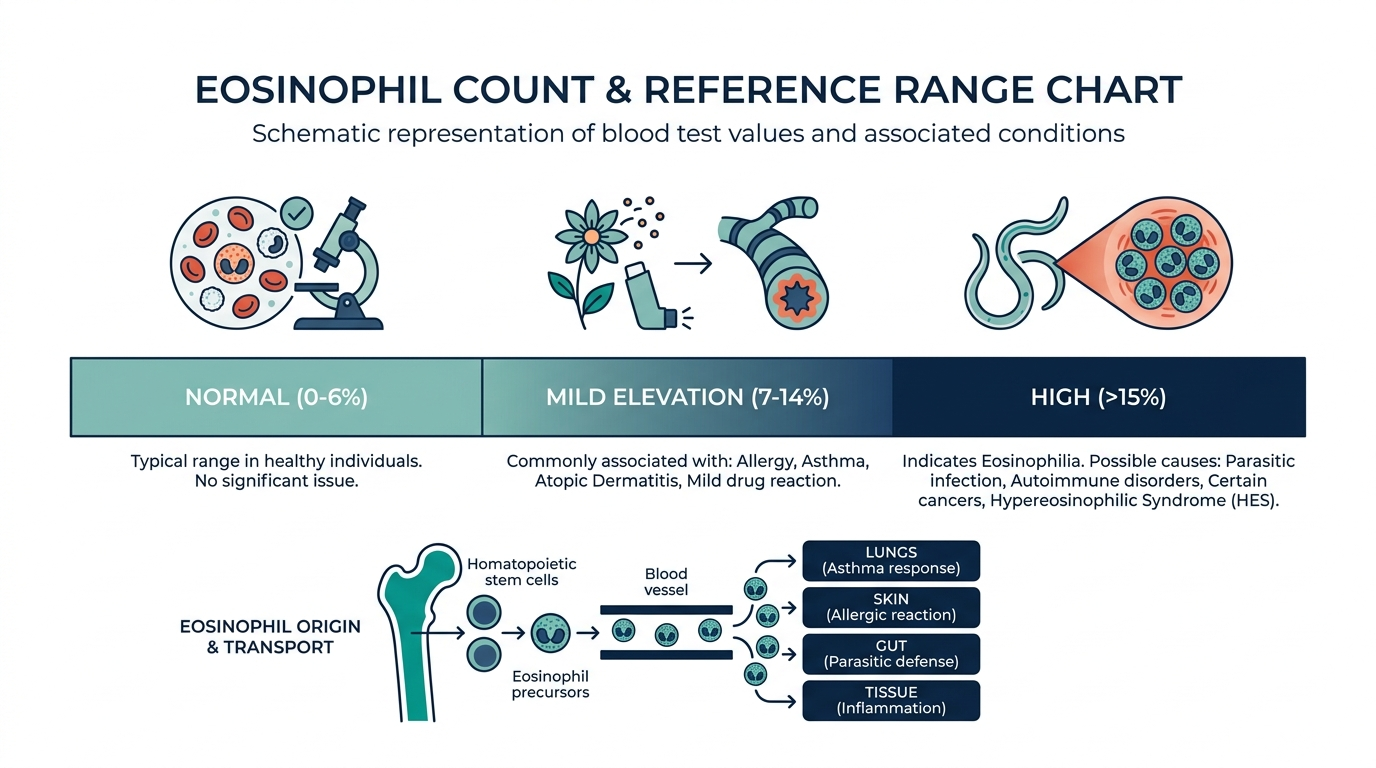
Eosinophils are one of the more restless numbers on a CBC, and part of reading them well is knowing what nudges them around for reasons that have nothing to do with disease. You usually do not need to fast for an eosinophil count, and no special prep is required in most cases. That said, several ordinary things can shift the result:
- Time of day. Eosinophils follow a daily rhythm that mirrors your cortisol cycle. Counts tend to be highest overnight and around 1 a.m. and lowest around midday, with typical within-person swings on the order of 20 percent. A draw at 8 a.m. and a draw at noon on the same healthy person can legitimately differ.
- A recent meal. Eating a light meal has been shown to lower blood eosinophils in the hours afterward, with reductions reported in the range of about 20 percent a few hours after eating. This is one reason repeat draws are best done at a consistent time.
- Exercise. A hard workout shortly before the draw can transiently pull the count down.
- Steroids. This is the big one. Corticosteroids, whether a prescription tablet, a steroid injection, or even a recent burst for a flare, suppress eosinophils quickly and can mask a genuinely elevated count. A normal-looking number on steroids is not the same as a normal number off them.
The practical rule: if a doctor is tracking your eosinophils over time, especially for asthma or COPD, try to test at a similar time of day and tell the lab about any steroids. Otherwise you may be comparing numbers that were never measured under the same conditions.
How to read your eosinophils alongside the rest of the panel
The eosinophil line means much more when you read it next to a few of its neighbors. Here is how experienced readers cross-check it.
| What you see | What it often suggests |
|---|---|
| High eosinophils plus a history of hay fever, eczema, or asthma | An allergic or atopic pattern, usually the most common and least worrying explanation |
| High eosinophils plus recent travel or raw or undercooked food | Worth screening for a parasitic infection, a classic cause outside the allergy world |
| High eosinophils plus a new medication started in the last few weeks | A drug reaction, which can range from trivial to serious and is a common miss |
| High eosinophils plus unexplained weight loss, night sweats, or abnormal other white cell lines | A red flag that warrants prompt evaluation rather than a wait-and-see approach |
| Very low or zero eosinophils in someone acutely ill or on steroids | Usually the expected stress or steroid effect, not a disease in itself |
Notice that the number is almost never the whole story. A count of 700 cells per microliter is reassuring in a sneezing allergy patient in April and concerning in someone losing weight for no reason. That is why your clinician reads the differential as a pattern, not as five separate numbers.
A worked example: what a doctor actually does with the number
Imagine your report shows an absolute eosinophil count of 900 cells per microliter, which is mild eosinophilia. A thoughtful workup does not jump to the scary causes. It works from common to rare:
- Retrace the obvious. Any allergies, asthma, eczema, or a recent seasonal flare? Any new drugs, including over-the-counter ones and supplements? These explain the majority of mild cases.
- Ask about exposure. Recent travel, well water, undercooked meat, or fish can point toward a parasite, which is checked with stool studies or serology rather than assumed.
- Repeat the test. Because eosinophils fluctuate, a single mildly high value is often rechecked before anyone acts. A number that comes back to normal on repeat needs no chase.
- Watch the trajectory and the company it keeps. A count that keeps climbing, or one paired with symptoms in the heart, lungs, gut, skin, or nerves, moves the workup toward specialist referral.
The lesson for a patient reading their own report: a mildly high eosinophil count is a question, not a verdict. The right next step is usually a conversation and sometimes a repeat draw, not panic.

How often should you recheck an abnormal eosinophil count?
There is no single schedule that fits everyone, because the right follow-up depends entirely on how high the count is and what surrounds it. A reasonable framework looks like this. For a mild, isolated elevation in someone who feels well, a repeat count in a few weeks is often enough, since many mild bumps resolve on their own once a seasonal allergy passes or a short-term trigger clears. For a moderate elevation, or a mild one that persists on repeat testing, clinicians tend to move faster and add targeted tests based on the suspected cause, whether that means checking for a parasite, reviewing medications, or looking at organ-specific symptoms. For a severe or rising count, the timeline compresses further, because sustained high eosinophils carry a real risk of tissue damage and usually prompt specialist referral rather than watchful waiting. The thread through all of it is trajectory. A number that is stable or falling is reassuring; a number that keeps climbing, or one that arrives with new symptoms, is the one that earns a closer and quicker look.
Common misunderstandings about eosinophils
- “High eosinophils means I definitely have an allergy.” Allergies are the most common cause, but the count cannot tell allergy from parasite from drug reaction on its own. The number flags activity; it does not name the trigger.
- “A percentage over 5 percent is automatically bad.” The percentage can mislead if your total white count is unusually high or low. The absolute count in cells per microliter is the number clinicians actually trust.
- “Low eosinophils mean my immune system is weak.” A low or zero count is normal in many healthy people and is often just the footprint of steroids or your own cortisol. There is no standalone disease defined by low eosinophils.
- “One high result needs immediate aggressive testing.” For a mild elevation, repeating the test and reviewing your history usually comes first, precisely because eosinophils vary day to day.
Who should pay closest attention to their eosinophil count
For most people, eosinophils are a line to glance at and move on. A few groups get more mileage from watching it:
- People with asthma or COPD. Here the blood eosinophil count is not just a marker of what is wrong, it helps guide treatment, including who benefits most from inhaled steroids and from eosinophil-targeted biologic drugs. If you have airway disease, this number is part of your treatment map.
- People starting a new long-term medication. A rising eosinophil count after a new drug can be an early sign of a reaction worth flagging.
- People with persistent unexplained symptoms. Chronic rashes, gut symptoms, or breathing problems paired with a stubbornly high count deserve a proper look rather than repeated reassurance.
- Anyone whose count is moderately or severely high and stays there. Sustained high eosinophils are the scenario where the cell can turn on your own tissue, so this is the one pattern that should never be scrolled past.
Frequently asked questions
What blood test shows eosinophils?
Eosinophils appear on a complete blood count (CBC) with differential, the standard panel that breaks your white blood cells into their five types. They can also be reported on their own as an absolute eosinophil count, a blood test that measures the exact number of eosinophils per microliter (MedlinePlus).
What is a normal eosinophil count?
A normal absolute eosinophil count is generally between 30 and 350 cells per microliter, and results under about 500 are usually considered normal, though ranges vary by lab (Cleveland Clinic). As a percentage, eosinophils normally make up less than 5 percent of your white blood cells.
Should I worry about a high eosinophil count?
Not automatically. A mildly high count (eosinophilia, above 500 per microliter) most often reflects allergies, asthma, a medication reaction, or an infection, and is frequently not serious (Cleveland Clinic). A moderately or severely high count that persists deserves prompt follow-up, because it can point to more serious causes and, rarely, organ damage.
Can eosinophils tell my doctor what is causing the problem?
Not by itself. A high count signals that your immune system is reacting, but the test cannot tell whether the cause is an allergy, a parasite, a drug, or something else (MedlinePlus). Your clinician uses it alongside your symptoms, history, and other tests to find the reason.
What does a low eosinophil count mean?
Usually nothing concerning. Many healthy people have very few eosinophils, and a low count is often caused by steroid medications or your body’s own cortisol rather than by disease (MedlinePlus). Other immune cells generally compensate.
This article is for general educational purposes and is not medical advice. It cannot diagnose or treat you and does not replace your clinician. Always discuss your lab results and any health decisions with a qualified healthcare professional.
Vital Signs Today may earn a commission if you buy through links on this page. It does not affect our editorial assessments.