Disclosure: Vital Signs Today may earn a commission if you buy through links on this page, at no extra cost to you. This does not influence our evidence-based assessments. We are not a medical provider; talk to a clinician before acting on test results.
Related: What a low eosinophils result means
You scanned your complete blood count, and there it was: eosinophils, flagged high. It is one of the smaller lines on the report, usually a tiny number with a percentage next to it, and most people have never given it a second thought. But a high eosinophil count is one of those results that can mean almost nothing or quite a lot, and the gap between those two is exactly what makes it worth understanding.
Here is what most explainers get wrong. They lump every high eosinophil result into one scary bucket. In reality, the number itself tells you which bucket you are in, and for the large majority of people that bucket is mundane.
Part of our Complete Blood Count guide.
What does high eosinophils mean in a blood test?
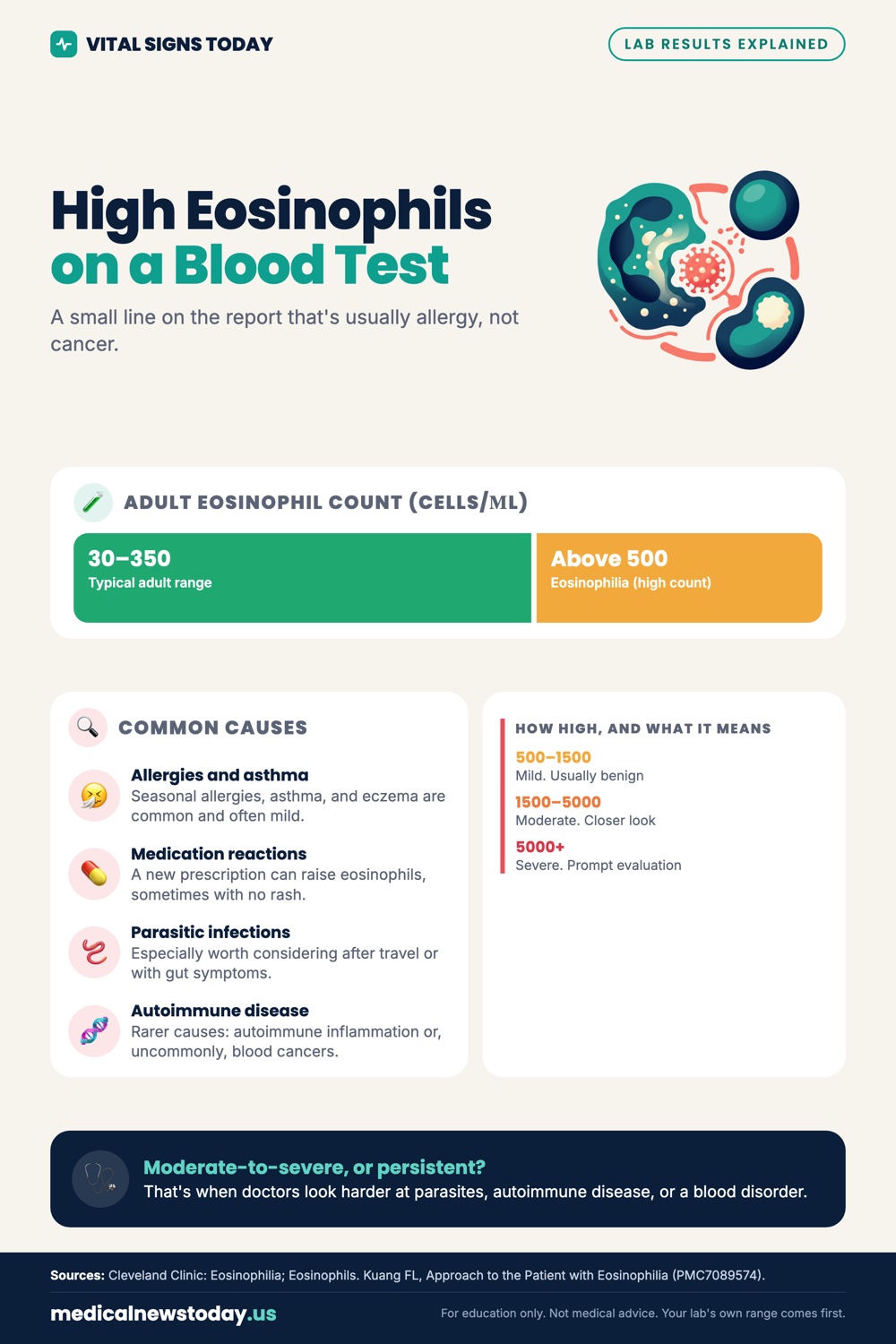
A high eosinophil count, the condition doctors call eosinophilia, means your blood contains more of these particular white blood cells than expected. The standard cutoff is an absolute eosinophil count of 500 cells per microliter or higher (Cleveland Clinic). A normal count sits roughly between 30 and 350 cells per microliter, and eosinophils usually make up less than 5 percent of your white blood cells (Cleveland Clinic).
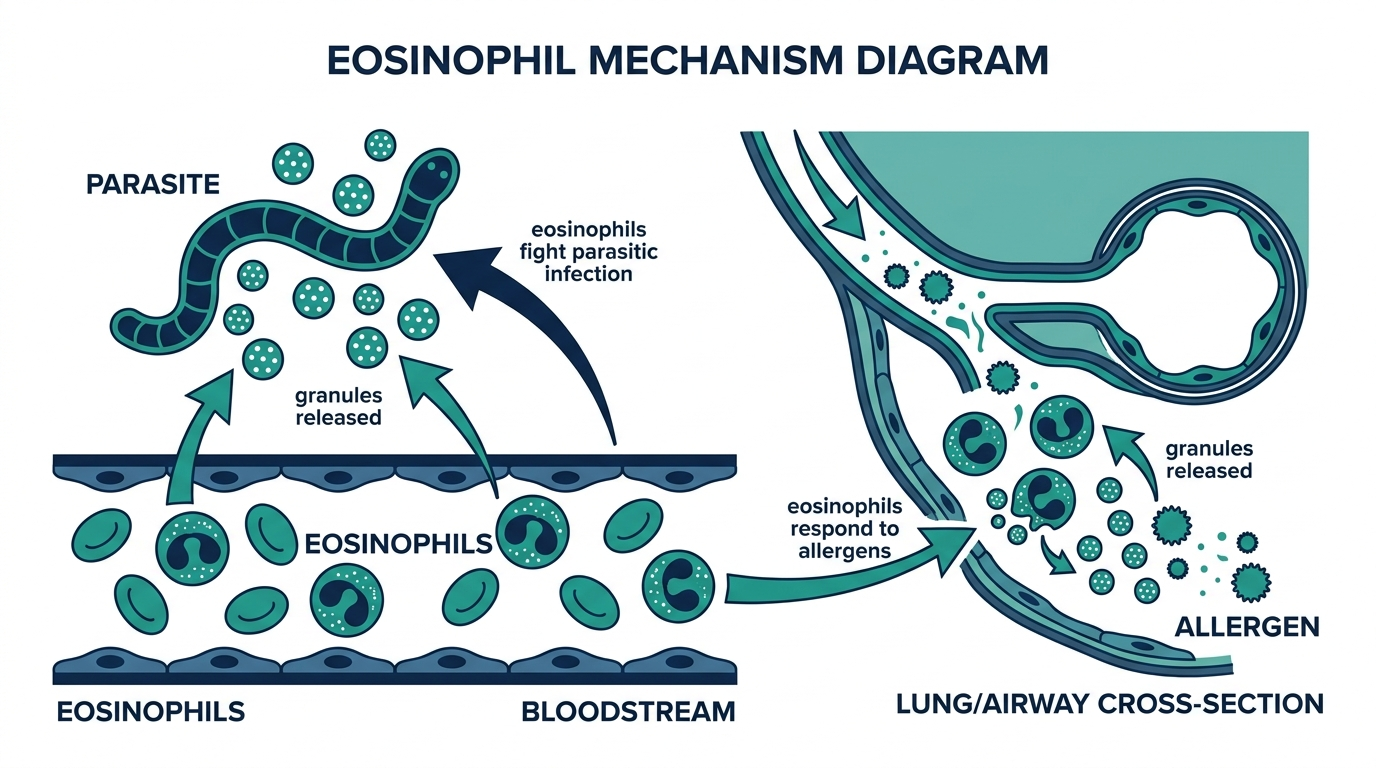
Eosinophils are immune cells built mainly to fight parasites and to drive allergic responses. When your body ramps up either of those programs, it produces more of them, and the count climbs. So a high eosinophil count is best read as a signal that your immune system is reacting to something, most often an allergy or, less commonly, a parasite, rather than as a diagnosis on its own.
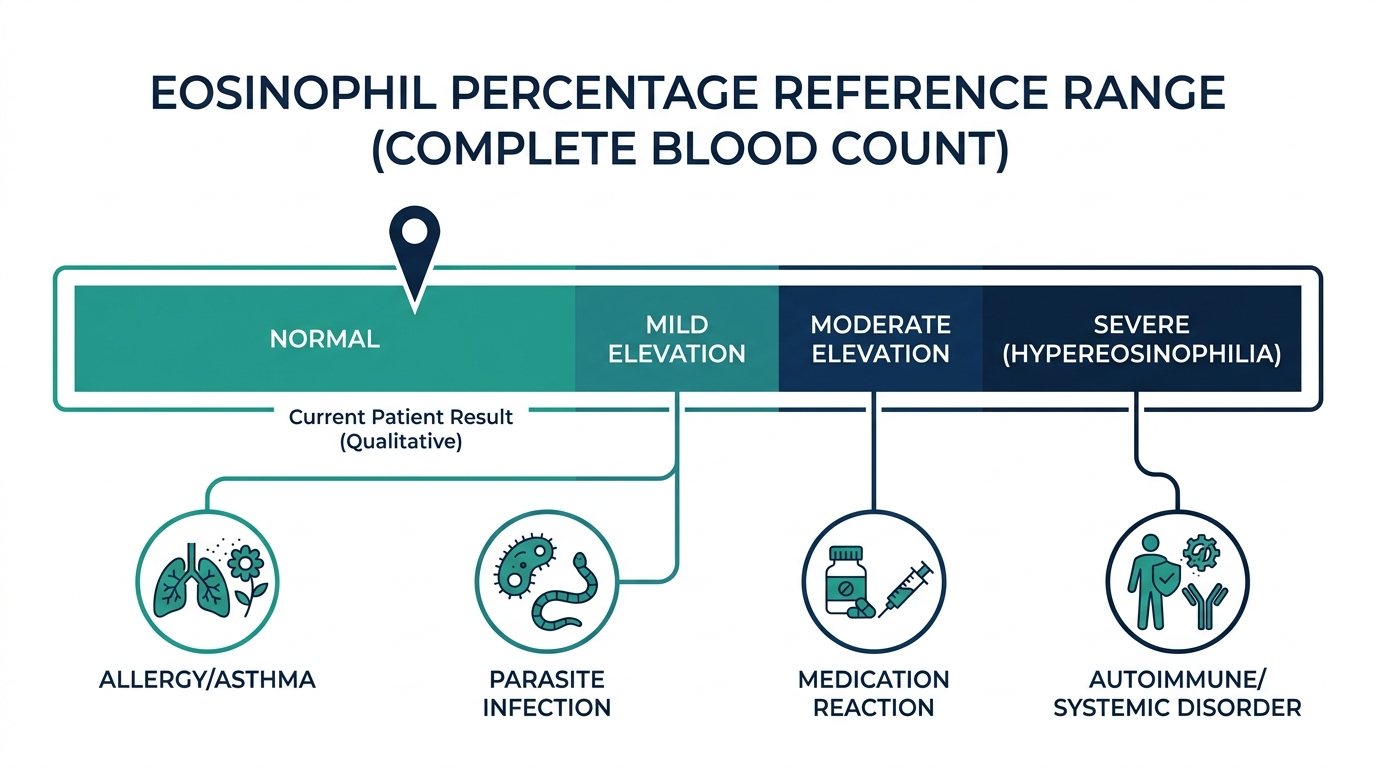
The single most useful thing you can do is look at how high. Clinicians grade eosinophilia in tiers (Cleveland Clinic):
- Mild: 500 to 1,500 cells per microliter. This is where most people land, and it is usually driven by something benign.
- Moderate: 1,500 to 5,000 cells per microliter. This tier prompts a closer look.
- Severe: above 5,000 cells per microliter. This is the level that needs prompt evaluation.
Pay attention to the absolute count, not just the percentage. A percentage can read high simply because your other white cells dropped, which is a different situation than your eosinophils genuinely rising. The absolute number is the one that matters.
What causes a high eosinophils result?
There is a real differential here, and the order matters because the common causes are common and the dangerous ones are rare. Roughly from most to least frequent:
- Allergic conditions. This is the headline cause. Asthma, hay fever, eczema, food allergies, and chronic sinus disease all push eosinophils up, and these account for a large share of mild eosinophilia (Cleveland Clinic).
- Medication reactions. Antibiotics, anti-seizure drugs, NSAIDs, and others can raise eosinophils, sometimes without any obvious rash. A new prescription started in the weeks before the test is a prime suspect.
- Parasitic infections. Worm infections in particular are a classic trigger, and they are worth considering more seriously if you have traveled or have gut symptoms (MedlinePlus).
- Fungal infections and certain other infections. Some fungal infections drive eosinophils up as well (MedlinePlus).
- Autoimmune and inflammatory diseases. Inflammatory bowel disease, vasculitis, and sarcoidosis can all show eosinophilia (Cleveland Clinic).
- Skin conditions and adrenal issues. Eczema appears again here, and adrenal gland insufficiency is a less obvious cause (MedlinePlus).
- Blood cancers and other malignancies. Leukemia, lymphoma, and certain solid tumors can raise eosinophils. This is rare, and it tends to sit at the higher and more persistent end of the range (MedlinePlus).
The practical pattern: mild eosinophilia is usually allergy, medication, or a passing infection. Moderate to severe, or a count that stays up over months, is what pushes a clinician toward parasites, autoimmune disease, or a blood disorder.
What are the symptoms of a high eosinophils count?
This surprises people: a high eosinophil count often causes no symptoms at all. Eosinophilia itself is frequently silent, and it gets discovered by accident on a routine blood test (Cleveland Clinic). When symptoms do appear, they usually belong to the underlying cause rather than to the eosinophils themselves.
Because of that, the symptom picture tracks whatever organ is involved. Common patterns include:
- Wheezing, cough, or shortness of breath when the lungs or airways are involved (Cleveland Clinic).
- Rash, itching, or eczema flares with skin involvement.
- Stomach and abdominal pain, sometimes with diarrhea, when the gut is involved.
- Fatigue, which is nonspecific but commonly reported.
The takeaway is to read your symptoms and your count together. A mild elevation with no symptoms is a very different story from a high count alongside breathlessness, a spreading rash, or fever.

When is a high eosinophils result dangerous or a medical emergency?
This is the part worth taking seriously, because severely high eosinophils are not just a number, they can actively damage tissue. When eosinophils are very elevated and stay that way, they release granule proteins that injure the organs they collect in.
The threshold to know is 1,500 cells per microliter. Persistent counts at or above that level define hypereosinophilia and can progress to hypereosinophilic syndrome, a condition where the eosinophil overload inflames and damages organs, most often the skin, lungs, gut, heart, and nervous system (Mayo Clinic). The heart is the most dangerous target. Most deaths from hypereosinophilic syndrome come from heart damage that leads to heart failure (Mayo Clinic).
Treat these as red flags that warrant urgent attention rather than a wait-and-see approach:
- Eosinophil count above 5,000, which is the severe tier (Cleveland Clinic).
- Chest pain, severe shortness of breath, or new swelling in your legs.
- Fever with a spreading rash and facial swelling, especially after starting a new medication.
- Numbness, weakness, or confusion, which can signal nervous system involvement (Cleveland Clinic).
Those last two combinations are genuine emergencies. The good news is that they are uncommon, and the vast majority of high eosinophil results never come close to this territory.
What should you do about a high eosinophils result?
Start by not panicking, then get specific. A high eosinophil count is a prompt to find the cause, and the workup is usually straightforward.
- Confirm and recheck. A single mildly high result is often repeated to see whether it persists or was a one-off blip. A transient bump after an allergy season or a cold frequently settles on its own.
- Review your medications. Go through everything you have started recently, including over-the-counter drugs and supplements. Medication-driven eosinophilia can resolve once the culprit is stopped, but only under a clinician’s guidance.
- Tell your clinician the context. Recent travel, gut symptoms, allergies, asthma, and any rash all narrow the differential fast.
- Expect targeted follow-up if needed. Depending on the level, that can mean stool testing for parasites, allergy evaluation, imaging, or referral to a specialist. Treatment is aimed at the underlying condition, not the eosinophil number itself (Cleveland Clinic).
There is no eosinophil diet or supplement that meaningfully lowers the count. The honest answer is that you treat what is driving it, and the number follows.
When should you see a doctor?
Any high eosinophil result deserves a conversation with the clinician who ordered the test, even when you feel fine, because the next step depends on how high the count is and what else is on the panel. Book a prompt appointment if your count is in the moderate range or higher, if it stays elevated on a repeat test, or if you have symptoms like persistent cough, an unexplained rash, abdominal pain, or unexplained weight loss.
Seek urgent or emergency care for chest pain, severe breathing difficulty, or fever with a spreading rash and facial swelling, particularly within weeks of starting a new drug. The underlying conditions can range from trivial to serious, so the safe move is to let the level and your symptoms set the pace (Cleveland Clinic).
The thing clinicians watch for that patients rarely hear about
Here is the insider nuance. The most dangerous cause of a high eosinophil count is not always the one with the highest number, and it can hide behind a count that looks only modestly elevated. The example that keeps specialists on alert is DRESS, short for drug reaction with eosinophilia and systemic symptoms. It is a delayed, potentially life-threatening reaction that typically shows up two to eight weeks after starting a drug, often an antibiotic or anti-seizure medication, and it can quietly damage the liver, kidneys, lungs, or heart.
The trap is in the name. Even though eosinophilia is in the title, the eosinophil count is not always dramatic, and in some cases it is not elevated at all when the patient first presents. A doctor who anchors on the number alone, waiting for it to be sky-high, can miss it. What flags DRESS is the constellation: a new drug, fever, a spreading rash with facial swelling, and abnormal liver or kidney labs, with eosinophils as one piece of the puzzle rather than the whole story.
The practical lesson for you is simple. If you developed a rash and felt unwell within a couple of months of a new medication and your eosinophils are up, mention the timing of that drug explicitly. That single detail can change everything, and it is the kind of context that does not show up anywhere on the lab report itself.

Want to check your eosinophils?
Three ways to get it measured. Pick whichever fits you.
Affiliate links: we may earn a commission at no extra cost to you. A lab test does not replace a visit with your clinician.
Which other blood markers to read alongside your eosinophils
An eosinophil count in isolation is a headline without a story. On a complete blood count the eosinophils sit inside the white blood cell differential, and the neighboring lines usually tell you which direction to look. Reading them together is exactly what a clinician does before deciding whether a high eosinophil result is trivial or worth chasing.
- Total white blood cell count. If your overall WBC is high along with the eosinophils, the body is mounting a broad immune response, which shifts attention toward infection or a systemic process. If the total WBC is normal and only the eosinophils are up, an allergic or medication cause becomes more likely.
- Neutrophils. A high neutrophil count points toward acute bacterial infection or inflammation, and it can make an isolated eosinophil bump look less important by comparison. A very low neutrophil count with rising eosinophils is a pattern that clinicians look at more carefully, because it can accompany certain drug reactions or bone marrow disorders.
- Basophils. These are the rarest white cells and share some biology with eosinophils. When both are persistently elevated, especially over months, that combination gets more scrutiny for a bone marrow or myeloproliferative process.
- Hemoglobin and platelets. When eosinophilia shows up alongside anemia or an abnormal platelet count, the concern moves beyond a simple allergy. A blood disorder affecting the marrow tends to disturb more than one cell line at once, so these lines act as a reality check on how worried to be.
- IgE and other add-on tests. Eosinophils and immunoglobulin E work in the same allergic pathway, so a doctor investigating allergy or parasite exposure often orders total IgE next. A high IgE alongside high eosinophils strongly supports an allergic or parasitic explanation.
The practical rule: an isolated high eosinophil count with every other line normal is reassuring and usually benign. Eosinophilia that travels with abnormalities in the other cell lines is the version that earns a deeper workup.
How to read your own eosinophil number: worked scenarios
Numbers become useful when you can map your own result onto a likely story. These are illustrative interpretation patterns, not a diagnosis, and your clinician always has the final word, but they show how the same value can mean different things depending on context.
- 620 cells per microliter, hay fever season, no symptoms otherwise. This is textbook mild eosinophilia with an obvious explanation. A clinician would typically note it, connect it to the allergy history, and often simply recheck it once the season passes.
- 900 cells per microliter, new antibiotic started three weeks ago, faint rash. Here the timing of the drug is the loudest clue. This combination raises the question of a medication reaction, and it is the kind of scenario where the drug history matters more than the exact count.
- 2,200 cells per microliter, recent travel abroad, intermittent diarrhea. A moderate count with gut symptoms and travel pushes parasitic infection up the list, and stool testing becomes a reasonable next step.
- 6,000 cells per microliter, persistent over two separate tests, fatigue and cough. A severe, persistent count is the pattern that prompts urgent evaluation, because sustained hypereosinophilia is what damages organs. This is not a wait-and-see situation.
The unifying lesson is that direction and persistence often matter more than a single snapshot. A number that keeps climbing across repeat tests carries far more weight than the same number seen once and never again.
How to prepare for the test and what can skew your result
Eosinophils are measured as part of a routine complete blood count, and the good news is that no special preparation or fasting is required for the count itself. That said, several everyday factors can nudge the result up or down, and knowing them helps you avoid reading too much into a borderline value.
- Time of day. Eosinophil counts follow a daily rhythm, running lowest in the morning and higher toward the evening, because they move inversely to your natural cortisol curve. A count drawn late in the day can read modestly higher than the same person’s morning value, which is one reason a single borderline result is often rechecked (Superpower).
- Corticosteroid medication. Steroids such as prednisone suppress eosinophils quickly and dramatically. If you are taking a steroid, or recently finished a course, your count can be artificially low and can mask a true eosinophilia. This is worth telling your clinician, because it changes how the result is interpreted.
- Acute stress or serious illness. The surge in cortisol that accompanies major physical stress, surgery, or a severe acute infection can temporarily drive eosinophils down. A low count in a very sick patient is not always reassuring.
- Recent allergy exposure or infection. A count checked during an active allergy flare or shortly after a parasitic or fungal exposure can be transiently elevated and then settle on its own.
Because of these swings, the smartest interpretation comes from trend rather than a lone data point. If you are tracking a borderline result, having it drawn at a similar time of day each time removes one source of noise.
Common misconceptions about high eosinophils
A few myths cause a lot of unnecessary worry, and clearing them up changes how you read your own report.
- “High eosinophils means I probably have cancer.” This is the fear that sends people down late-night search spirals, and it is backwards for most results. The overwhelming majority of mild elevations trace to allergy, medication, or a passing infection. Blood cancer is a real but uncommon cause, and it tends to sit at the high, persistent end of the range, not at a one-off mild bump.
- “The percentage is what matters.” Many people fixate on the eosinophil percentage because it is the bigger-looking number. The absolute count is the more meaningful figure, since a percentage can look high simply because another white cell line fell. Always anchor on the absolute value.
- “There is a diet or supplement to lower it.” There is no eosinophil-lowering diet, cleanse, or supplement that works by targeting the cells directly. The count falls when the underlying trigger is treated, whether that is an allergy, a medication, or an infection. Chasing the number in isolation is effort in the wrong place.
- “One high result means something is wrong right now.” A single mildly high count is frequently a transient blip. The pattern that carries real weight is a count that persists or climbs across repeat tests, which is why confirmation matters before drawing conclusions.
Understanding these distinctions turns a scary red flag on a lab report into a manageable question with a clear next step, which is usually a conversation with the clinician who ordered the test.
Frequently asked questions
What is considered a high eosinophil count?
A high eosinophil count, or eosinophilia, is an absolute count of 500 cells per microliter or more, since a normal count runs roughly 30 to 350 (Cleveland Clinic). Doctors grade it as mild from 500 to 1,500, moderate from 1,500 to 5,000, and severe above 5,000.
What is the most common cause of high eosinophils?
Allergic conditions are the most common cause, including asthma, hay fever, eczema, and food allergies, followed by medication reactions and parasitic infections (Cleveland Clinic). Most mild elevations trace back to one of these everyday triggers.
Can high eosinophils be a sign of cancer?
It can, but it is rare. Blood cancers like leukemia and lymphoma can raise eosinophils, and this is more of a concern when the count is high and persists over time rather than a one-off mild bump (MedlinePlus). A single mild elevation is far more likely to be an allergy or medication.
Do high eosinophils cause symptoms?
Often not. Eosinophilia is frequently silent and found by chance on a routine blood test, and when symptoms occur they usually come from the underlying cause, such as wheezing, rash, or abdominal pain (Cleveland Clinic).
When are high eosinophils dangerous?
The risk rises when counts persist at 1,500 or higher, which can lead to hypereosinophilic syndrome and organ damage, with the heart the most dangerous target (Mayo Clinic). Counts above 5,000, or any high count with chest pain, severe breathlessness, or a spreading rash, need prompt medical attention.
This article is for general educational purposes and is not medical advice. It cannot diagnose or treat you and does not replace your clinician. Always discuss your lab results and any health decisions with a qualified healthcare professional.
Vital Signs Today may earn a commission if you buy through links on this page. It does not affect our editorial assessments.