
Disclosure: Vital Signs Today may earn a commission if you buy through links on this page, at no extra cost to you. This does not influence our evidence-based assessments. We are not a medical provider; talk to a clinician before acting on test results.
You scanned your complete blood count, everything looked fine, and then one line stopped you: monocytes, flagged high. Maybe it was the percentage. Maybe it was the absolute number with an “H” next to it. Either way, you are now reading the fine print of a cell type almost nobody talks about, and the internet is happily offering you everything from “you had a cold” to “this could be leukemia.”
Both of those can be true. The distance between them is the whole point of this article. Monocytes are your body’s cleanup-and-defense crew, and when their numbers climb, it is almost always your immune system reacting to something. The job is figuring out what.
Part of our Complete Blood Count guide.
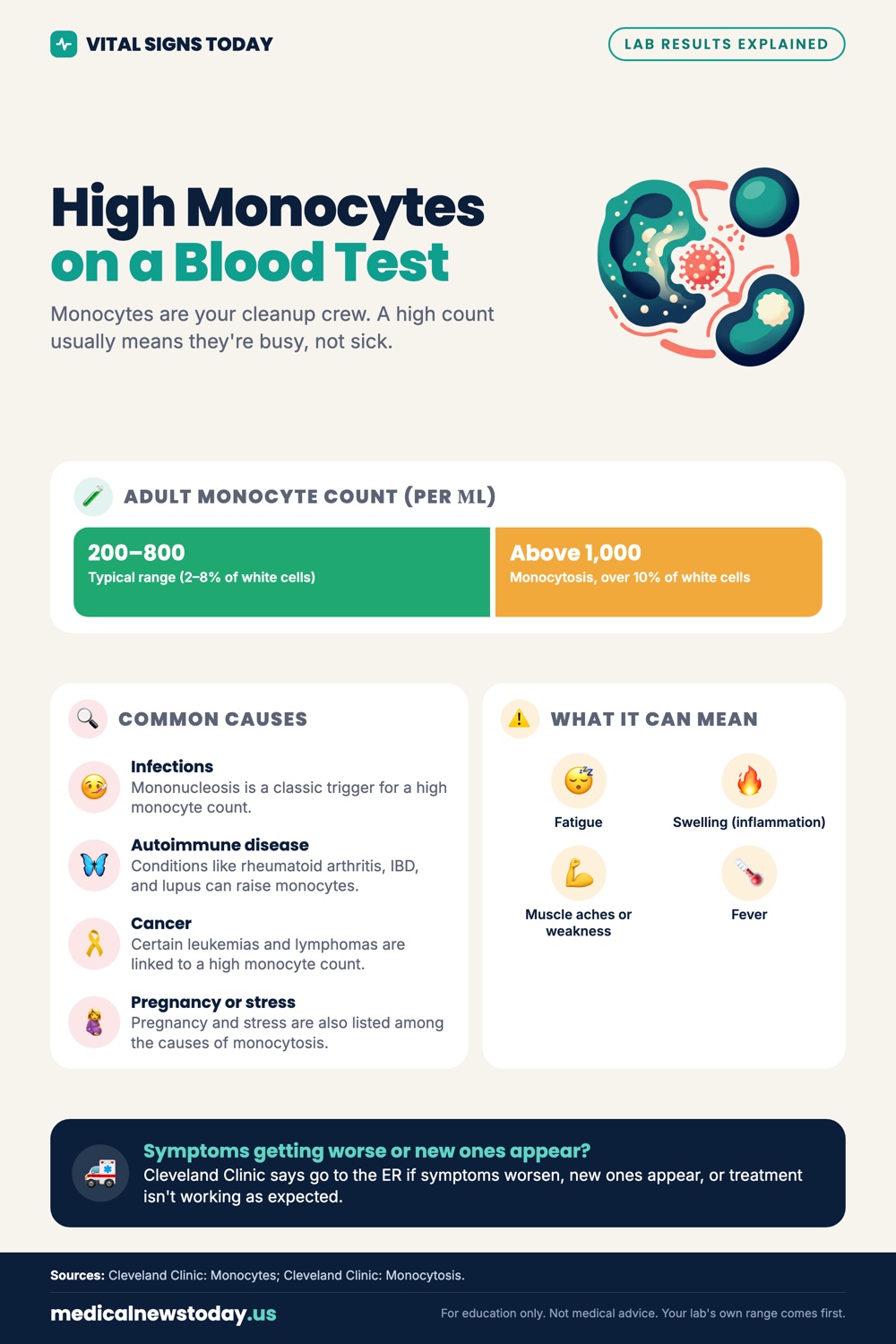
What does high monocytes in blood test mean?
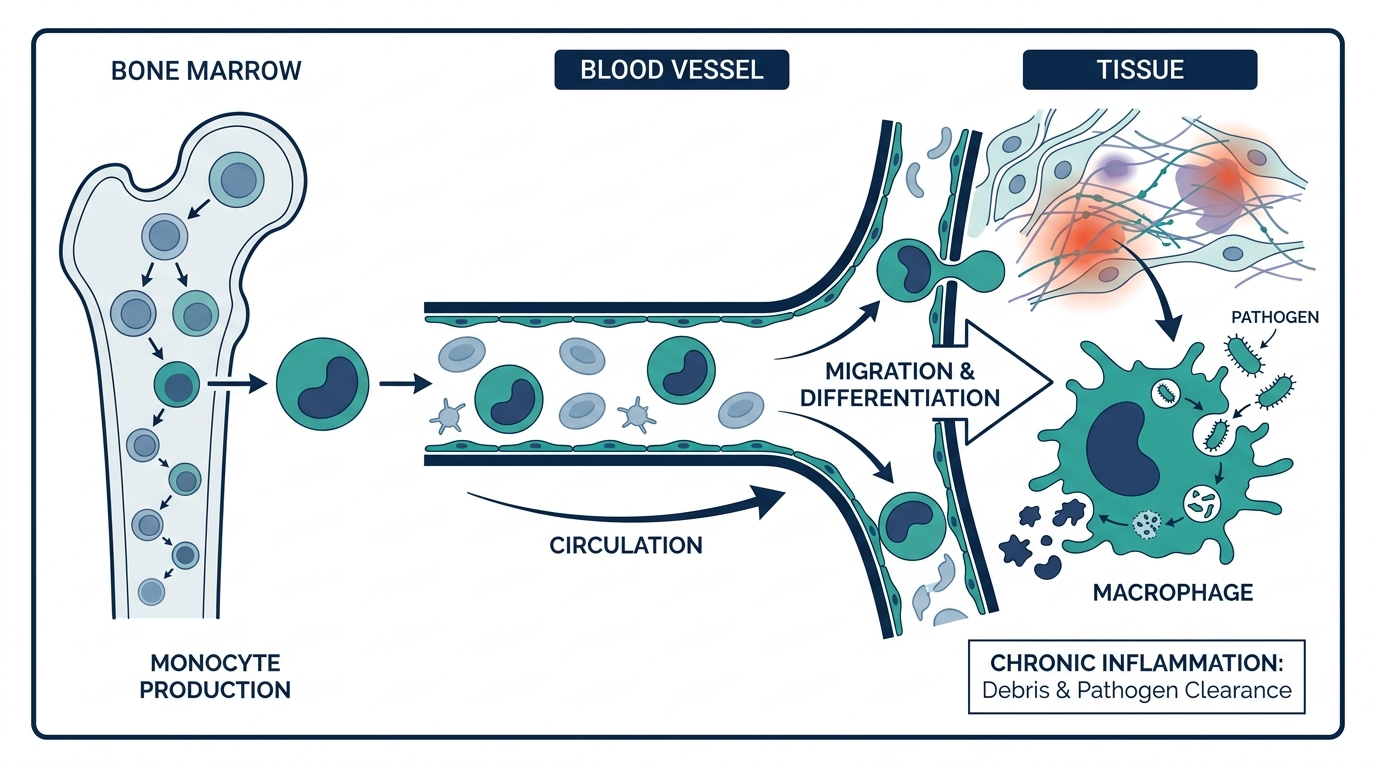
A high monocyte count, called monocytosis, means you have more of these particular white blood cells circulating than expected. Monocytes are immune cells that hunt down germs and toxic debris, then mature into macrophages and dendritic cells that finish the job (Cleveland Clinic). When the count rises, it usually signals that your immune system is busy, most often fighting or recovering from an infection or chronic inflammation.
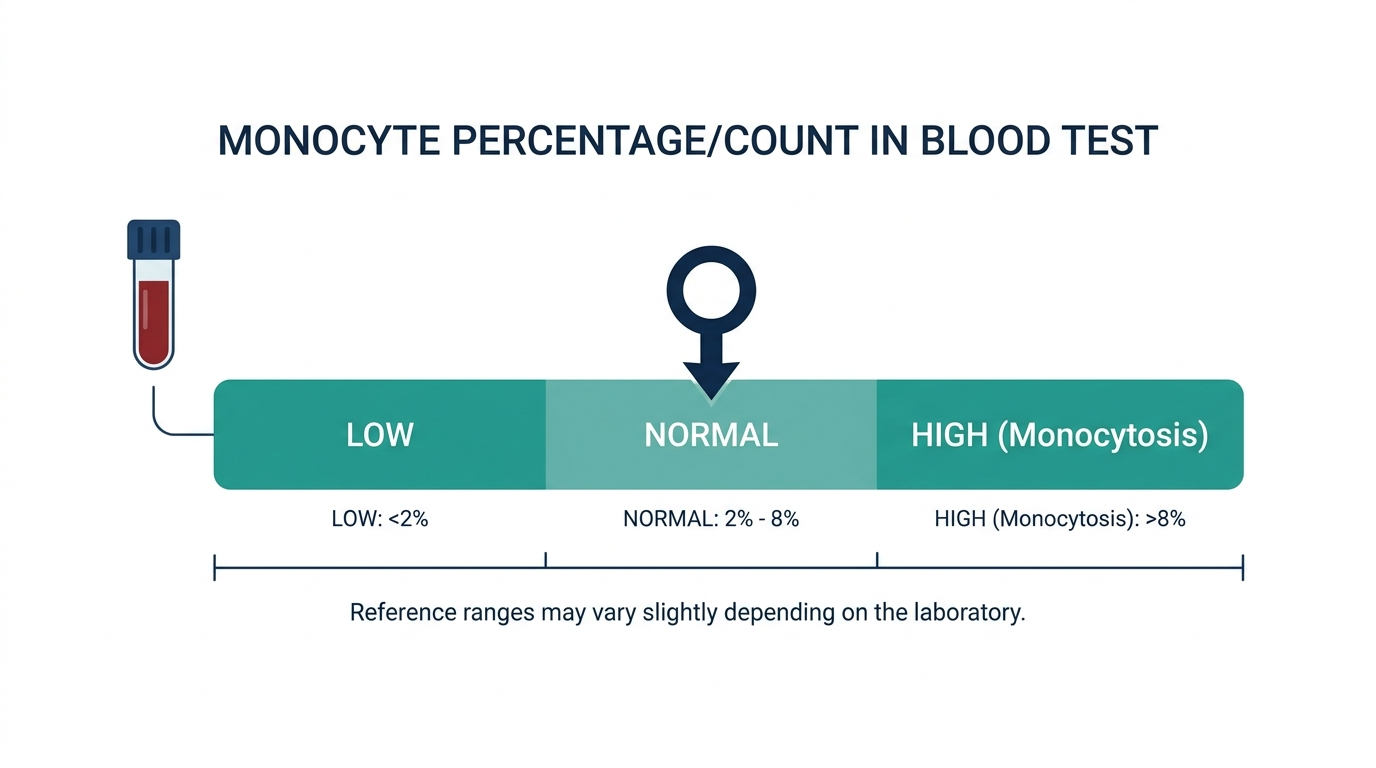
Here are the numbers that matter. In healthy adults, monocytes make up roughly 2 to 8 percent of your white blood cells, or about 200 to 800 monocytes per microliter of blood (Cleveland Clinic). The widely used cutoff for monocytosis in adults is an absolute count above 1,000 monocytes per microliter, with monocytes making up more than 10 percent of your total white cells (Cleveland Clinic).
One detail to fix in your head right now: the absolute monocyte count is what clinicians actually care about, not the percentage alone. The percentage can read “high” simply because your other white cells dropped, which makes monocytes a bigger slice of a smaller pie without a single extra monocyte being produced. Always find the absolute number on your report.

What causes a high monocyte count?
The honest answer most people are looking for: in the overwhelming majority of cases, a mildly high monocyte count is a reactive finding, meaning your immune system is responding to something temporary or manageable rather than something sinister. Doctors split the causes into two buckets, reactive and clonal, and they are worlds apart in seriousness (PMC, differential diagnosis of monocytosis).
Reactive causes, by far the most common, include:
- Infections. Viral infections such as infectious mononucleosis, mumps, and measles are classic triggers, and chronic infections like tuberculosis and brucellosis drive persistent monocytosis (PMC, differential diagnosis of monocytosis).
- Recovery from infection or illness. As your bone marrow rebounds, monocytes can surge. This is often why a count looks high right after you have been sick (Cleveland Clinic).
- Chronic inflammation and autoimmune disease. Rheumatoid arthritis, inflammatory bowel disease, lupus, and sarcoidosis all keep monocytes elevated (Cleveland Clinic).
- Stress, recovery, and physiologic shifts. Bone marrow recovery, recent surgery such as splenectomy, a heart attack, hard exercise, and even pregnancy can nudge monocytes up (PMC, differential diagnosis of monocytosis).
- Medications. Corticosteroids and growth factors like G-CSF are known to raise monocyte counts (PMC, differential diagnosis of monocytosis).
Clonal causes, the uncommon but serious bucket, mean the monocytes are part of an abnormal blood-cell line rather than a normal response. These include certain leukemias and lymphomas, and most notably chronic myelomonocytic leukemia (CMML), a blood cancer defined in part by persistent monocytosis (Cleveland Clinic). The key word is persistent. A single high reading does not put you in this category.
What are the symptoms of high monocytes?
Here is the part that surprises people: high monocytes themselves cause no symptoms (Cleveland Clinic). Monocytosis is not a disease you feel. It is a number on a lab report. Whatever symptoms you do have come from the underlying condition driving the count up, not from the monocytes themselves.
So the useful question is not “what does monocytosis feel like” but “what is my body telling me through the rest of my symptoms.” Depending on the cause, you might notice fatigue, fever, swelling or inflammation, muscle aches, or weakness, all of which are signatures of the underlying infection, inflammation, or illness rather than of the monocytes (Cleveland Clinic).
This is exactly why a high monocyte count is interpreted in context. A young adult with a sore throat, swollen glands, and fatigue plus high monocytes is a very different story from an older adult with no symptoms whose count has been creeping up for months.
When is a high monocyte count dangerous or a medical emergency?
A high monocyte count is rarely an emergency by itself. The danger lives in the cause, not the number. That said, there are situations where you should not wait for a routine follow-up.
Seek urgent care if a high monocyte count comes alongside red-flag symptoms: a high or persistent fever, drenching night sweats, unexplained weight loss, easy bruising or bleeding, bone pain, or an enlarged spleen causing belly fullness. Those combinations can point toward a blood disorder and deserve prompt evaluation. Cleveland Clinic advises seeking emergency care if your symptoms worsen, you develop new symptoms, or your reaction to treatment is more than expected (Cleveland Clinic).
The single most important danger signal in the lab itself is persistence. Under WHO criteria, monocytosis is considered clinically significant when the absolute count stays above 1 × 10⁹/L (1,000 per microliter) and monocytes exceed 10 percent of leukocytes for more than three months, which is one of the requirements used in diagnosing CMML (PMC, differential diagnosis of monocytosis). A count that is high once and normal a month later is reassuring. A count that stays elevated for months is the one that earns a deeper workup.
What should you do about a high monocyte count?
Do not treat the number. Treat, or rule out, the cause. There is no medication for “high monocytes,” because monocytosis is a signal, not a diagnosis (Cleveland Clinic). Your action plan depends on how high the count is, whether you have symptoms, and whether it persists.
A sensible sequence looks like this:
- Read the whole CBC, not just the monocyte line. Are your other white cells, hemoglobin, and platelets normal? Isolated mild monocytosis with an otherwise clean count behaves very differently from monocytosis bundled with anemia or low platelets (PMC, differential diagnosis of monocytosis).
- Repeat the test. Because acute infection, stress, and exercise can all spike monocytes transiently, clinicians often simply recheck the CBC in a few weeks to a few months. Many “high” results quietly normalize (PMC, differential diagnosis of monocytosis).
- Hunt for the obvious cause. Recent illness, a known autoimmune condition, a new medication like a corticosteroid, or pregnancy can explain the result without further testing.
- Escalate if it persists or the smear is abnormal. If monocytosis sticks around or your blood looks abnormal under the microscope, the next steps can include a peripheral blood smear, and in select cases a bone marrow biopsy with genetic testing (PMC, differential diagnosis of monocytosis).
On the lifestyle side, the most evidence-backed move is unglamorous: if you smoke, stop. Smoking is a recognized driver of chronically elevated white cell counts. Beyond that, addressing the underlying condition, whether that is treating an infection or controlling an autoimmune flare, is what brings the number down.
When should you see a doctor?
If a lab flagged your monocytes high, the result should be reviewed with the clinician who ordered it, full stop. That is not the same as needing to rush in. Book a routine visit if the elevation is mild, you feel well, and you have a plausible reason like a recent cold.
Move faster if any of these apply: the count is markedly high, it has stayed high across more than one test over several months, or it travels with the red-flag symptoms above (persistent fever, night sweats, weight loss, easy bruising). MedlinePlus notes that an abnormal white blood cell differential, which includes monocytes, can reflect infection, autoimmune or inflammatory disorders, or blood cancers, and is meant to be interpreted by your provider rather than self-diagnosed (MedlinePlus).
The insider nuance: the trap of the monocyte percentage
Here is the part that gets misread constantly, even in clinic. When patients and sometimes busy clinicians see “monocytes high,” they react to the percentage. But the percentage is a ratio, and ratios lie when the denominator moves. If your neutrophils or lymphocytes fall, your monocyte percentage can jump into the “high” zone while your actual monocyte production has not changed at all. The fix is simple and almost always overlooked: look at the absolute monocyte count, the cells-per-microliter number, before drawing any conclusion.
There is a second, subtler trap on the serious end. In people who already have an autoimmune or rheumatologic condition, the immune picture can muddy the specialized tests used to separate reactive monocytosis from CMML. The expansion of certain monocyte subsets that normally flags CMML can be masked, lowering the test’s sensitivity, and to make it harder, reactive and clonal disease can genuinely coexist, since CMML itself is frequently associated with autoimmune features (PMC, differential diagnosis of monocytosis). The takeaway is not to worry more, it is to know that “you have rheumatoid arthritis, so that explains it” is a reasonable first thought but not a permanent excuse to stop watching a count that will not come down.
Put plainly: one mildly high monocyte reading after an infection is among the most boring findings in hematology. A monocyte count that stays above the threshold for months, especially with other CBC abnormalities, is the version that deserves real attention. Knowing which one you are looking at is the difference between needless worry and a smart, timely workup.

What monocytes do, and why a high count usually means “reacting”
Understanding why monocytosis is usually reactive starts with what these cells are built to do. Monocytes are the largest white blood cells and the immune system’s versatile responders. They circulate briefly in the blood, then migrate into tissues where they mature into two working forms:
- Macrophages, the “big eaters” that engulf bacteria, dead cells, and debris, and clean up sites of infection or injury.
- Dendritic cells, messengers that show pieces of invaders to the rest of the immune system so a targeted response can be launched.
Because monocytes are dispatched wherever there is infection, inflammation, or tissue repair, the bone marrow ramps up production when demand rises. That is exactly why the great majority of high counts are reactive: the body is responding to a real stimulus, from a virus to an autoimmune flare to healing after surgery. It also explains why, when a count stays high for months with no obvious stimulus, clinicians start asking whether the production itself has become abnormal (clonal) rather than a response to something.
How a high monocyte count is read within the full CBC
Monocytes are one of five white cell types on the differential, and their meaning shifts based on the neighbors. Reading the whole panel is how a clinician decides whether a high monocyte count is trivial or worth pursuing.
| Companion value | Why it matters next to high monocytes |
|---|---|
| Neutrophils | High neutrophils plus high monocytes often signal an active infection or inflammation, a classic reactive pattern. |
| Lymphocytes | A high monocyte percentage can be misleading if lymphocytes are low. Check the absolute monocyte count instead. |
| Hemoglobin and red cells | Monocytosis with anemia raises concern for a marrow disorder rather than a simple reactive cause. |
| Platelets | Abnormal platelets alongside persistent monocytosis is one of the patterns that prompts a closer look. |
| Blood smear | A microscope review can spot abnormal or immature cells that a machine count misses, a key step when monocytosis persists. |
Want to check your blood count?
Three ways to get it measured. Pick whichever fits you.
Affiliate links: we may earn a commission at no extra cost to you. A lab test does not replace a visit with your clinician.
The single most useful move: confirm the absolute monocyte count, then scan whether hemoglobin, platelets, and the other white cells are normal. Isolated mild monocytosis with an otherwise clean CBC behaves very differently from monocytosis bundled with anemia or low platelets.
What can push monocytes up temporarily
Several everyday factors can raise a monocyte count without any serious disease. Knowing them prevents overreacting to one reading:
- Recent or resolving infection. As the marrow rebounds after an illness, monocytes can surge, so a count taken soon after being sick may be transiently high.
- Physical stress. Recent surgery, a significant injury, or intense exercise can nudge the count up temporarily.
- Medications. Corticosteroids and certain growth factors are known to raise monocytes. Share your full medication list.
- Pregnancy. Normal immune shifts in pregnancy can mildly elevate the count.
- Smoking. Tobacco use is a recognized driver of chronically higher white cell counts, including monocytes.
- Daily variation and lab calibration. Counts fluctuate through the day, and reference ranges differ slightly between labs, so read against your own report’s range.
No fasting is needed for a monocyte count, since it rides on a routine CBC. The most reliable read comes from a repeat test and the trend over time, not one perfectly timed draw.

Interpreting your result: worked scenarios
Context is what turns a flagged number into a plan. A few common patterns:
- Monocytes mildly high right after a viral illness, everything else normal, you feel better. The most common and most reassuring pattern. A recheck in a few weeks usually shows it has normalized.
- High monocytes with high neutrophils and symptoms of infection. A reactive pattern matching an active infection. Treating the infection typically resolves the count.
- Mildly high monocytes in someone with known rheumatoid arthritis or IBD. Chronic inflammation is a plausible driver, though a count that will not settle still deserves ongoing monitoring.
- Persistently high absolute monocyte count over three or more months, especially with anemia or abnormal platelets, in an older adult. This is the pattern that prompts a smear and, in select cases, a bone marrow evaluation to rule out a clonal disorder like CMML.
- A high monocyte percentage but a normal absolute count. Often not true monocytosis at all. The percentage rose only because another white cell line fell.
Reactive versus clonal monocytosis: the distinction that matters
Clinicians sort high monocyte counts into two fundamentally different categories, and understanding the split takes most of the fear out of the number. Reactive monocytosis, by far the most common, means the cells are normal and are simply increased in response to a stimulus: infection, chronic inflammation, autoimmune disease, recovery, stress, or medication. Remove or resolve the trigger and the count comes down.
Clonal monocytosis, the uncommon and serious category, means the monocytes arise from an abnormal blood-cell line, as in chronic myelomonocytic leukemia (CMML) and some other blood cancers. The defining clue is not a single high value but persistence: a count that stays above the threshold for more than three months, particularly when paired with other CBC abnormalities. That durability is why a one-off high reading is reassuring while a stubbornly elevated one earns a deeper workup. The trend, not the snapshot, is what separates these two worlds.
Common misconceptions about high monocytes
- “High monocytes means leukemia.” The overwhelming majority of high counts are reactive to infection or inflammation. Clonal blood disorders are the uncommon exception, flagged mainly by persistence and other abnormalities.
- “The percentage is what counts.” The absolute count carries the clinical weight. A high percentage with a normal absolute count is often not true monocytosis.
- “One high reading needs an urgent workup.” A single mildly high value, especially after an infection, is usually just rechecked in a few weeks.
- “High monocytes make me feel unwell.” The count itself is silent. Any symptoms come from the underlying cause, not the monocytes.
- “If I have an autoimmune disease, a high count is always explained.” Often true, but a count that keeps climbing still deserves watching, since reactive and clonal causes can coexist.
Frequently asked questions
What does high monocytes mean on a blood test?
It means you have more monocytes, a type of infection-fighting white blood cell, than normal, a condition called monocytosis. In adults the usual cutoff is an absolute count above 1,000 per microliter with monocytes over 10 percent of white cells (Cleveland Clinic). It is most often a reactive response to infection or inflammation, not a disease by itself.
What is a normal monocyte count?
In healthy adults, monocytes typically make up about 2 to 8 percent of white blood cells, or roughly 200 to 800 monocytes per microliter of blood (Cleveland Clinic). Always compare against the reference range on your own lab report, since labs and instruments vary slightly.
Is a high monocyte count serious?
Usually not. Most high counts are reactive, reflecting a recent or ongoing infection, inflammation, or stress. A small share reflect a clonal blood disorder such as CMML, which is why a count that stays elevated for more than three months, or comes with other abnormal blood values, warrants further testing (PMC, differential diagnosis of monocytosis).
Can high monocytes go back to normal on their own?
Yes. Monocytosis triggered by an acute infection, stress, or exercise is often transient and resolves once the trigger passes, which is why clinicians frequently just repeat the test after a few weeks or months (PMC, differential diagnosis of monocytosis).
Do high monocytes cause symptoms?
No. Monocytosis itself does not cause symptoms. Any fatigue, fever, swelling, or aches you feel come from the underlying condition driving the count up, not from the monocytes (Cleveland Clinic).
This article is for general educational purposes and is not medical advice. It cannot diagnose or treat you and does not replace your clinician. Always discuss your lab results and any health decisions with a qualified healthcare professional.
Vital Signs Today may earn a commission if you buy through links on this page. It does not affect our editorial assessments.