
Your blood test results came back, you scanned the white blood cell section, and there it was: neutrophils, with a number and a percentage beside it. Maybe it was flagged, maybe it was not. Either way, of all the cells your complete blood count reports, neutrophils are the one most worth understanding, because they are your body’s front-line soldiers and their number swings fast in response to almost anything happening inside you.
Most explainers stop at “neutrophils fight infection.” True, but incomplete. The way your neutrophil count moves, up or down, tells a story about infection, inflammation, stress, and even how your body is holding up over the long run.
Part of our Complete Blood Count guide.
What is neutrophils in a blood test?
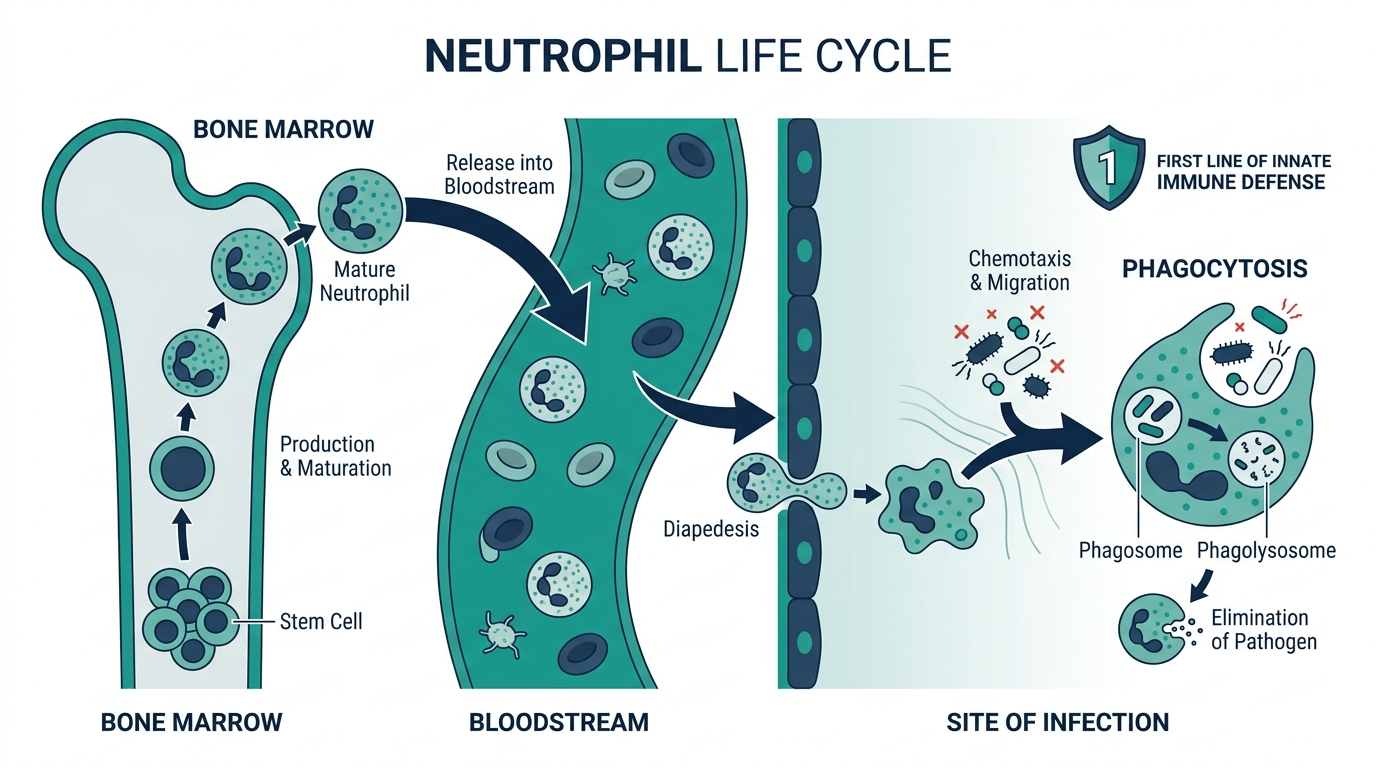
In a blood test, neutrophils are the most common type of white blood cell, and the count tells you how many of these infection-fighting cells are circulating in your blood. They are reported as part of the white blood cell differential within a complete blood count (CBC) (MedlinePlus). Neutrophils make up roughly 55 to 70 percent of all your white blood cells, which makes them the single largest slice of your immune army (Cleveland Clinic).
Your report usually shows neutrophils two ways: as a percentage of total white cells, and as an absolute number, often labeled the absolute neutrophil count, or ANC. In plain terms, neutrophils are the cells that rush to the scene first when bacteria, fungi, or debris breach your defenses, and the count is a snapshot of how many are on patrol the moment your blood was drawn.

What are neutrophils in a blood test actually doing?
Neutrophils are your immune system’s first responders, the cells that arrive earliest at the site of an infection or injury. They protect you by swallowing and killing bacteria, fungi, and foreign debris, a process that makes them the backbone of your innate immune defense (Cleveland Clinic).
Here is a detail that explains why the count moves so quickly. Your body produces over 100 billion neutrophils every single day, and each one lives less than 24 hours (Cleveland Clinic). They are disposable by design. Because they turn over so fast and are constantly being made and spent, the neutrophil count reacts within hours to a new infection, a fresh injury, or a spike in stress hormones. That sensitivity is exactly what makes the number so informative.
What is a normal neutrophil level?
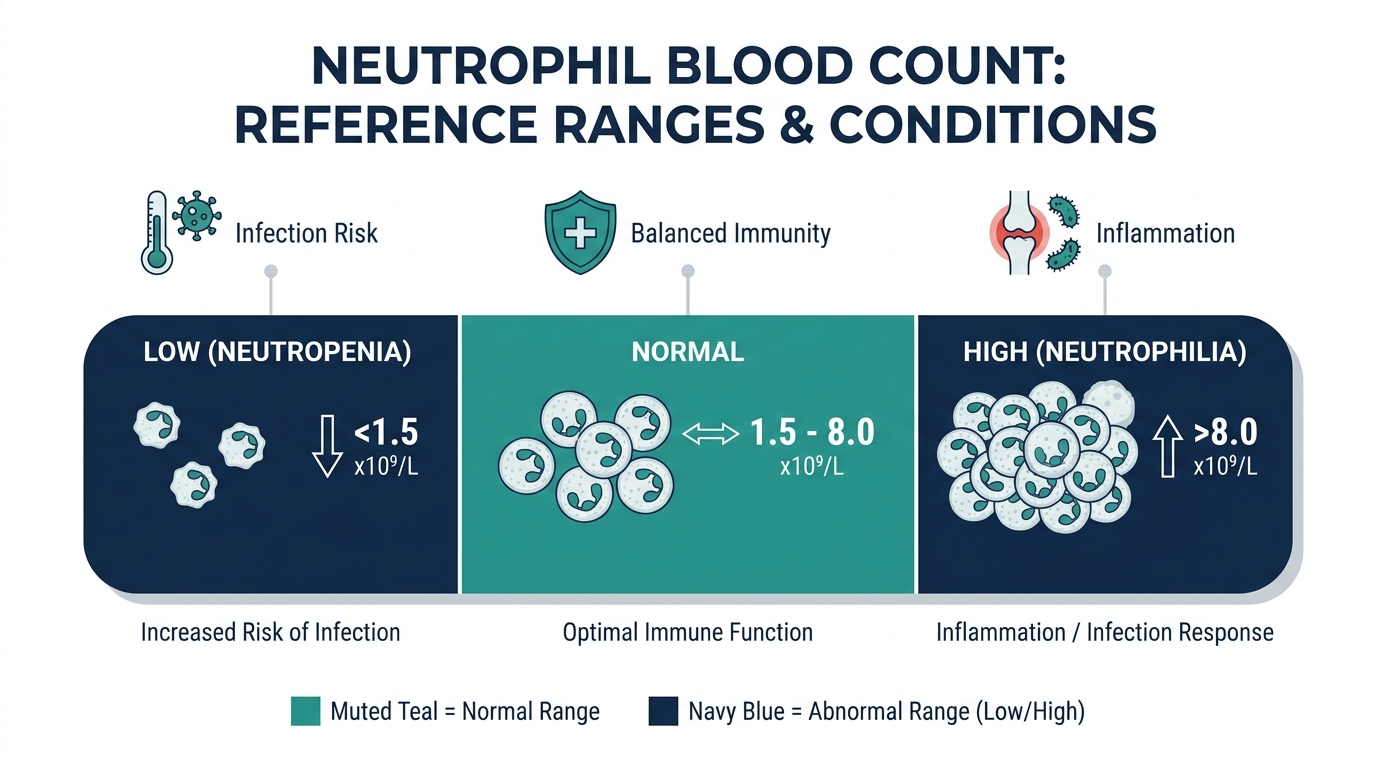
A normal absolute neutrophil count in healthy adults sits at roughly 2,500 to 7,000 neutrophils per microliter of blood (Cleveland Clinic). As a share of total white cells, the typical range is about 55 to 70 percent. Exact cutoffs shift slightly between labs and instruments, so the most reliable comparison is always the reference range printed on your own report.
The practical takeaway: a count comfortably inside that band, with the rest of your CBC unremarkable, is reassuring. It is when the number drifts well above or below that clinicians start asking why, and the direction it moves points to very different stories.
What does neutrophils mean in a blood test when the count is high?
A high neutrophil count, known as neutrophilia, means your body is producing or releasing extra neutrophils, almost always in response to a demand. Cleveland Clinic considers a count above roughly 7,000 to 7,500 per microliter elevated (Cleveland Clinic). It is a signal, not a diagnosis, and the usual suspects are common and often harmless (Cleveland Clinic):
- Bacterial infection. The classic trigger. Neutrophils surge to attack invading bacteria, and the count can climb within hours.
- Inflammation. Conditions like rheumatoid arthritis and inflammatory bowel disease keep neutrophils elevated.
- Physical or emotional stress. Even acute stress, vigorous exercise, or a physical injury can push the count up.
- Smoking. Cigarette smoking is a recognized cause of a chronically higher neutrophil count.
- Medications and, rarely, blood cancers. Certain drugs raise the count, and uncommonly a high count reflects a bone marrow disorder such as chronic myelogenous leukemia.
Here is the insider nuance that rarely reaches the patient. A genuinely sky-high neutrophil count with a flood of very immature cells, what hematologists call a “left shift,” reads differently than a modest bump after a stressful morning. A mild elevation right after exercise or a tense commute is often just physiology, because stress hormones can shove neutrophils that were clinging to your blood vessel walls back into circulation within minutes, with no new cells made at all. That is why a single high reading taken on a rough day is rarely worth panicking over. The pattern over time, and the company the number keeps, matters far more than one snapshot.

What does a low neutrophil count mean?
A low neutrophil count, called neutropenia, means you have fewer infection-fighting cells than normal, which can leave you more vulnerable to bacterial and fungal infections. Cleveland Clinic defines neutropenia as an absolute neutrophil count below about 1,500 per microliter and grades it by severity (Cleveland Clinic):
- Mild neutropenia: 1,000 to 1,500 neutrophils per microliter.
- Moderate neutropenia: 500 to 1,000 per microliter.
- Severe neutropenia: below 500 per microliter, where infection risk rises sharply.
The common causes span several categories (Cleveland Clinic): chemotherapy and radiation, which suppress the bone marrow; viral infections such as HIV and hepatitis; nutritional shortfalls in vitamin B12, folate, or copper; autoimmune conditions like lupus and rheumatoid arthritis; and certain inherited disorders. Chemotherapy-related neutropenia is the most familiar version, which is why cancer patients have their ANC watched so closely.
One point worth knowing: some perfectly healthy people, particularly those of African, Middle Eastern, or West Indian descent, run a naturally lower baseline count, a benign pattern sometimes called ethnic neutropenia (Cleveland Clinic). A number slightly under the standard cutoff is not automatically a problem, which is one more reason to interpret it with a clinician rather than alone.
Why are neutrophils read together with the rest of the white cell differential?
Neutrophils rarely tell the full story by themselves, which is why they are reported alongside the other white blood cells, lymphocytes, monocytes, eosinophils, and basophils, in the differential. The mix of cells often points to the type of problem better than any single number (MedlinePlus). A high neutrophil count with a high overall white count leans toward bacterial infection, whereas an infection that is mostly viral often shifts the balance toward lymphocytes instead.
This is also where one of the most useful derived numbers in modern medicine comes in: the neutrophil-to-lymphocyte ratio (NLR). You divide the neutrophil count by the lymphocyte count, and the result captures the balance between your acute, inflammatory response and your slower adaptive immunity in a single figure (PMC, NLR as a marker of immune and disease relationships). It costs nothing extra because both numbers are already on your CBC, yet it squeezes more meaning out of them than either alone.
The part most people never hear: your neutrophil balance and long-term risk
This is where neutrophils go from a simple infection gauge to something genuinely worth watching. A growing body of research shows that the neutrophil-to-lymphocyte ratio, that quiet division you can do yourself, is an independent predictor of death across very different groups of people, even after accounting for the usual risk factors.
In the large Rotterdam Study, which followed 8,715 community-dwelling older adults for nearly 12 years, a higher NLR was independently and significantly tied to all-cause mortality, with the highest groups carrying a clearly elevated risk (PubMed, NLR and mortality in the Rotterdam Study). The same pattern recurs in sepsis, heart failure, and chronic lung disease, where an elevated NLR consistently flags worse outcomes (PMC, NLR as a marker of immune and disease relationships).
Why would a ratio of two everyday blood cells predict survival? The leading explanation is that a relative rise in neutrophils paired with a relative fall in lymphocytes is a fingerprint of chronic, low-grade inflammation and physiological stress, the same background forces that quietly age the heart, blood vessels, and the rest of the body. The NLR is essentially a cheap, sensitive mirror of how much wear and tear your system is under. You will never get a diagnosis from a single neutrophil number, but a persistently skewed ratio is a sound reason to look closer rather than scroll past.
The left shift: when the number comes with immature cells
One detail on a neutrophil report carries more weight than the raw count: whether the rise includes immature cells. When the body faces a serious bacterial infection, the bone marrow releases neutrophils faster than usual, dipping into its reserve of younger forms. On a report these show up as bands, or sometimes as immature granulocytes, and clinicians call the pattern a left shift.
Why it matters is that a left shift signals urgency, not just activity. A modest total neutrophil count accompanied by a prominent left shift can be more concerning than a higher count without one, because it suggests the marrow is being pushed hard to meet demand. Some reports also mention toxic granulation or Dohle bodies, changes in the appearance of neutrophils that likewise point toward a significant infection or inflammatory response. If your report notes bands, immature granulocytes, or a left shift, that is a specific detail worth asking your clinician about rather than glossing over.
Symptoms and the one true neutrophil emergency
The neutrophil count itself produces no symptoms. What matters is what it reflects and, when the count is very low, what it fails to protect against.
With a high count, the symptoms are usually those of the trigger: fever and localized signs of an infection, the aches of inflammation, or nothing at all if the rise is just from stress or exercise.
With a low count, the danger is the infection you cannot mount a defense against. Recurrent fevers, mouth sores, sore throat, skin infections that heal slowly, or frequent infections can all reflect a genuinely low functional count.
The one scenario that is a true emergency is febrile neutropenia. In a person with a low neutrophil count, especially someone on chemotherapy, a fever of 100.4 degrees Fahrenheit or higher is a medical emergency that needs same-day attention, not a wait-and-see approach. Without enough neutrophils, an infection can spread rapidly, so prompt antibiotics can be lifesaving. Anyone with known neutropenia should be told this threshold clearly, because a fever that seems minor in a healthy person is a red alert when the front line is depleted.
What tends to drive the count in each direction
| Direction | Common drivers |
|---|---|
| High (neutrophilia) | Bacterial infection, inflammation such as rheumatoid arthritis or inflammatory bowel disease, physical or emotional stress, vigorous exercise, smoking, corticosteroids, and rarely a marrow disorder |
| Low (neutropenia) | Chemotherapy or radiation, viral infections including HIV and hepatitis, B12, folate or copper deficiency, autoimmune disease such as lupus, certain medications, and benign inherited low baselines |
Reading the direction against your history is what gives the number meaning. A high count in someone with a fever and a clear infection tells a tidy story; the same high count in a smoker with no symptoms is often just their baseline. A low count during chemotherapy is expected and monitored; the same low count in an otherwise healthy person of African or Middle Eastern descent may simply be benign ethnic neutropenia.
Living with a low neutrophil count: practical precautions
If your neutrophil count is genuinely low, especially during cancer treatment, a few sensible habits lower your infection risk. Most people with a mild, stable low count from a benign cause need none of this, but for those with treatment-related or significant neutropenia it matters.
- Treat fever as urgent. A temperature of 100.4 degrees Fahrenheit or above is a reason to contact your care team immediately, because infections move fast without neutrophils to slow them.
- Prioritize hand hygiene. Frequent, thorough handwashing is one of the most effective ways to reduce exposure.
- Handle food carefully. Avoiding undercooked meat, unwashed produce, and unpasteurized products lowers the chance of foodborne infection.
- Protect your skin and mouth. Small cuts and mouth sores are entry points for bacteria, so keeping them clean and avoiding trauma helps.
- Know your number. If your count is being tracked during treatment, understanding roughly where it sits helps you judge how cautious to be from week to week.
How to prepare, and what can shift a neutrophil count
You usually do not need to fast for a neutrophil count unless it is bundled with tests that require it. What is more useful is knowing how easily the number moves for harmless reasons, so a single borderline value does not cause alarm.
- Stress and exertion. A hard workout, acute anxiety, or the physical stress of pain can raise the count within minutes. This happens through demargination, where neutrophils clinging to blood vessel walls are pushed back into circulation, no new cells required. A calm draw and a rushed, stressful one are not the same.
- Steroids. Corticosteroids reliably raise the neutrophil count by the same demargination effect, which is worth flagging if you take them.
- Smoking. Smokers often carry a chronically higher baseline, useful context when a result looks mildly elevated.
- Time of day and recent illness or vaccination. The count varies modestly through the day and stays elevated for a while after an infection or immunization.
For all these reasons, clinicians trust the trend across several tests over any single reading. A count that is stable over time tells a calmer story than one snapshot slightly outside the range.
A worked example: reading a high neutrophil count
Suppose your report shows an absolute neutrophil count of 9,500 with a note of a mild left shift, and you have had a fever and a productive cough. A sensible read runs like this:
- Match the count to symptoms. Fever and cough plus a neutrophil rise and a left shift fit a bacterial infection well.
- Weigh the left shift. The presence of immature cells suggests the marrow is responding to real demand, which supports acting rather than waiting.
- Read the rest of the CBC. A high total white count reinforces the picture; abnormalities in other lines would broaden the workup.
- Decide follow-up. With a clear infection, treatment targets the source, and the count is expected to settle as the infection clears.
Now change one thing. If the same 9,500 appeared in a smoker with no symptoms and no left shift, the likely explanation is simply their baseline, and a recheck when well is often all that is needed. The number sets the question; the context answers it.
Common misunderstandings about neutrophils
- “A high neutrophil count means a serious infection.” Often it just reflects stress, exercise, smoking, or steroids. The pattern over time and the presence or absence of a left shift matter more than one high value.
- “A low count always means something is badly wrong.” Some healthy people run a naturally low baseline with no extra infection risk, a benign pattern that should not be mistaken for disease.
- “The percentage is what counts.” The absolute neutrophil count in cells per microliter is what clinicians rely on, since a normal-looking percentage can hide an abnormal absolute number when the total white count is unusual.
- “A fever with a low count can wait until morning.” In someone with significant neutropenia, a fever is an emergency, because infection can spread quickly without enough neutrophils to contain it.
Frequently asked questions
What is neutrophils on a blood test in simple terms?
Neutrophils are the most common white blood cell and your body’s first line of defense against infection. On a blood test, the count tells you how many of these infection-fighting cells are circulating, reported as part of the white blood cell differential within a complete blood count (MedlinePlus).
What is a normal neutrophil count?
A normal absolute neutrophil count in adults is roughly 2,500 to 7,000 per microliter, and neutrophils typically make up about 55 to 70 percent of your white blood cells (Cleveland Clinic). Ranges vary slightly by lab, so compare your result to the reference range on your own report.
Should I worry about a high neutrophil count?
Not on its own. A high count, or neutrophilia, most often reflects infection, inflammation, stress, exercise, or smoking rather than anything serious (Cleveland Clinic). Your clinician will read it alongside the rest of your CBC and your symptoms before deciding whether it needs follow-up.
What does a low neutrophil count mean?
A low count, called neutropenia, means fewer infection-fighting cells and is defined as an ANC below about 1,500 per microliter, graded mild, moderate, or severe (Cleveland Clinic). Common causes include chemotherapy, viral infections, and nutritional deficiencies, though some healthy people simply run a lower baseline.
What is the neutrophil-to-lymphocyte ratio and why does it matter?
It is your neutrophil count divided by your lymphocyte count, a single figure that captures systemic inflammation. A higher ratio has been independently linked to greater all-cause mortality in large population studies, making it a cheap and useful marker drawn straight from a standard CBC (PubMed, NLR and mortality in the Rotterdam Study).
This article is for general educational purposes and is not medical advice. It cannot diagnose or treat you and does not replace your clinician. Always discuss your lab results and any health decisions with a qualified healthcare professional.
Vital Signs Today may earn a commission if you buy through links on this page. It does not affect our editorial assessments.