Disclosure: Vital Signs Today may earn a commission if you buy through links on this page, at no extra cost to you. This does not influence our evidence-based assessments. We are not a medical provider; talk to a clinician before acting on test results.
You scanned your complete blood count, everything looked routine, and then your eyes caught it: neutrophils, flagged low. The word that probably ran through your head was infection, and that instinct is partly right. But the gap between a slightly low neutrophil count and a genuinely dangerous one is enormous, and most people stare at the flag without knowing which side of that gap they are on.
Here is what almost nobody explains clearly. The flag on your report is not the number that actually matters. What matters is your absolute neutrophil count, and how far below the line it sits. Let us decode it.
Part of our Complete Blood Count guide.
What is low neutrophils in blood test results, exactly?
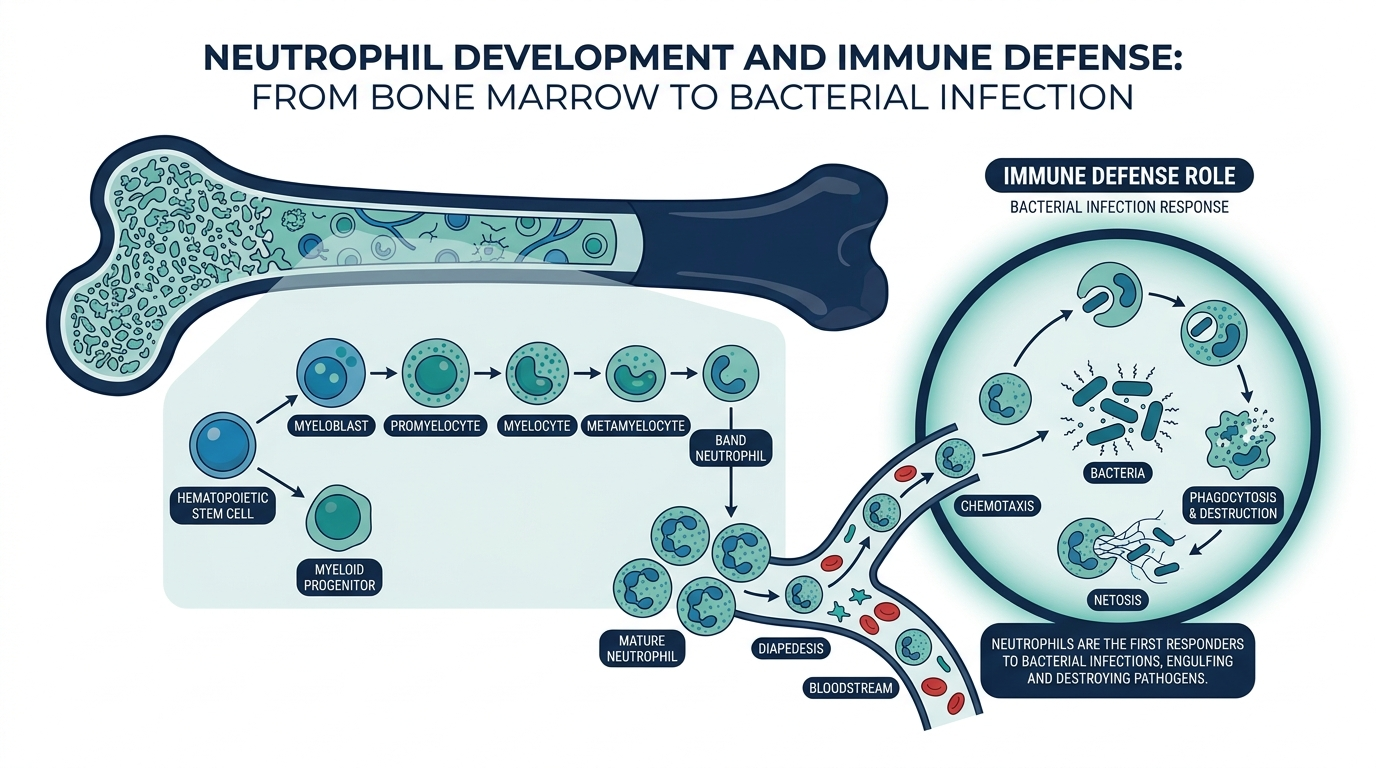
Neutrophils are the most abundant type of white blood cell, making up roughly 55 to 70 percent of all the white cells in your blood, and they are your immune system’s first responders against bacterial and fungal infections (Cleveland Clinic). A low neutrophil count, the condition doctors call neutropenia, simply means your blood has fewer of these front-line defenders than expected (Cleveland Clinic).
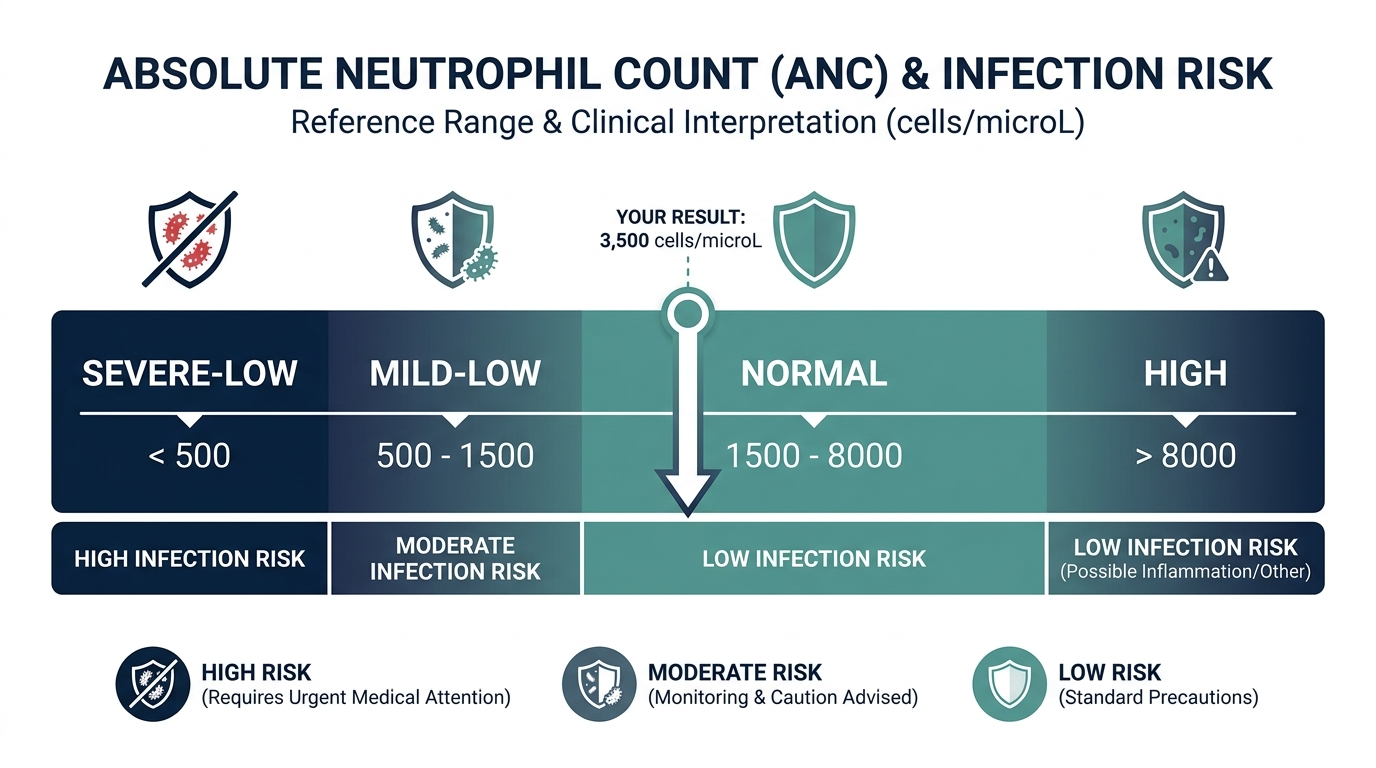
The number that counts is the absolute neutrophil count, or ANC, measured in cells per microliter of blood. The lower limit of normal for most adults sits around 1,500 neutrophils per microliter, though some labs use 1,800 (Cleveland Clinic). Below that line, you are technically neutropenic. But “technically low” and “clinically worrying” are not the same thing, which is why the next section matters more than the flag itself.
What does a low neutrophil count mean on a blood test?
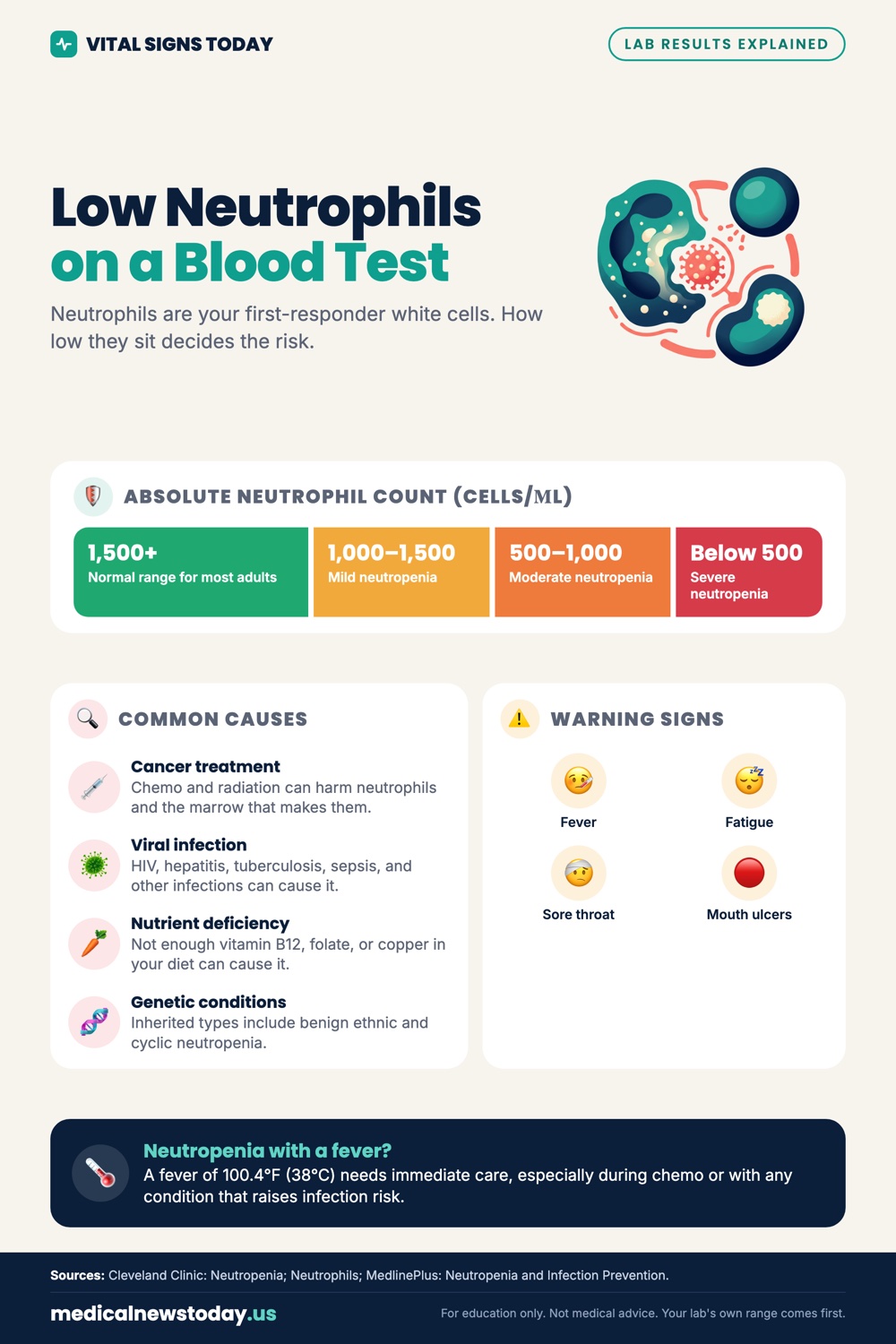
A low neutrophil count means your body has a thinner supply of its primary infection fighters, which can make it harder to clear bacterial and fungal invaders (MedlinePlus). How much harder depends almost entirely on how low the number goes. Clinicians grade neutropenia in three tiers, and these thresholds are the single most useful thing to understand about your result (Cleveland Clinic):
- Mild neutropenia: 1,000 to 1,500 neutrophils per microliter. Infection risk is barely changed from normal.
- Moderate neutropenia: 500 to 1,000 per microliter. Risk starts to climb, and the cause needs to be sorted out.
- Severe neutropenia: below 500 per microliter. This is the danger zone, where even the bacteria normally living on your skin, in your mouth, and in your gut can cause serious infections (MedlinePlus).
So the honest answer is: look at the actual number, not the flag. A count of 1,350 and a count of 350 both trigger the same red flag on the printout, but they live in completely different worlds. One is usually a footnote. The other can be a medical emergency.
What causes a low neutrophil count?
Neutropenia is a finding, not a diagnosis, and the list of things that can cause it is long. The good news is that the common causes are common, and the rare causes are genuinely rare. Here is the real differential, ordered roughly from most to least frequent (Cleveland Clinic):
- Cancer treatment. Chemotherapy and radiation are the single most common cause of significant neutropenia, because they slow the bone marrow that manufactures neutrophils (MedlinePlus). If you are in treatment, a dropping ANC is expected and closely watched.
- Infections, especially viral ones. A recent or ongoing viral illness, including common ones, can temporarily push neutrophils down. HIV, hepatitis, tuberculosis, and sepsis can do it too (Cleveland Clinic). Transient post-viral neutropenia is one of the most common reasons a healthy person gets an unexpected low result.
- Medications. Beyond chemo, certain antibiotics, antithyroid drugs, anti-seizure medicines, and others can suppress neutrophils as a side effect.
- Genetic and inherited conditions, including benign ethnic neutropenia, cyclic neutropenia, and severe congenital neutropenia (Cleveland Clinic). More on the first of those in the expert section, because it is the one most often misread.
- Nutritional deficiencies, particularly vitamin B12, folate, and copper, which the marrow needs to build white cells (Cleveland Clinic).
- Autoimmune disease, such as lupus and rheumatoid arthritis, where the immune system attacks neutrophils or the marrow that makes them.
- Bone marrow disorders, the most serious group, including leukemia, lymphoma, aplastic anemia, and myelodysplastic syndromes (Cleveland Clinic). These are uncommon, but they are the reason a persistent or severe low count is never dismissed without follow-up.
Notice the pattern: most everyday low neutrophil results trace back to a virus or a medication, both usually temporary. The serious causes are why your doctor will want to know whether the result is a one-off or a trend.
What are the symptoms of a low neutrophil count?
Here is the part that surprises people: neutropenia itself usually causes no symptoms at all (Cleveland Clinic). You cannot feel a low neutrophil count the way you might feel low iron. That is why it is so often discovered by accident on a routine blood test rather than because someone felt unwell.
What you can feel are the infections that low neutrophils fail to stop. When symptoms do appear, they are signs that an infection has taken hold, and they tend to include:
- Fever, chills, or sweats (MedlinePlus)
- Sore throat and swollen lymph nodes
- Mouth ulcers or gum inflammation
- Recurrent infections, or sores that are slow to heal (Cleveland Clinic)
- Diarrhea or burning with urination
The takeaway is counterintuitive but important. Feeling fine does not rule out neutropenia, and feeling sick when you are neutropenic is the part that demands attention. Which brings us to the line you genuinely need to memorize.
When is a low neutrophil count dangerous or a medical emergency?
There is one scenario in neutropenia that is a true emergency: fever when your neutrophils are very low. Doctors call it febrile neutropenia, and it is defined as a fever above roughly 38.3 degrees Celsius, about 100.9 Fahrenheit, in a person whose ANC is under 500 per microliter (National Library of Medicine). Many treatment teams use an even lower trigger of 100.4 Fahrenheit, or 38 Celsius, as the line to act on (Cleveland Clinic).
Why is this an emergency rather than a wait-and-see? Because with so few neutrophils, an infection can race through the body before the immune system can mount a response, and ordinary skin and gut bacteria can turn life-threatening (MedlinePlus). Febrile neutropenia typically requires immediate hospitalization and broad-spectrum intravenous antibiotics, started fast, before the exact bug is even identified (National Library of Medicine).
The practical rule: if you have severe neutropenia, for example during chemotherapy, and you develop a fever of 100.4 Fahrenheit or higher, that is not a “call in the morning” situation. It is a “go to the emergency department now” situation. By contrast, a mild low count with no fever and no symptoms is rarely dangerous on its own.
What should you do about a low neutrophil count?
The right next step depends entirely on which tier you are in and whether the result is new or repeated. Generally, this is how it unfolds:
- Repeat the test. A single low reading is often a transient blip, frequently from a recent virus. Doctors commonly recheck the CBC in a few weeks to see whether the count recovers on its own (Cleveland Clinic).
- Review your medications. If a drug is the cause, stopping or switching it, under medical guidance, often resolves the problem.
- Look for a cause if it persists. Persistent or worsening neutropenia may prompt tests for B12 and folate, autoimmune markers, viral panels, and in some cases a bone marrow examination to rule out a marrow disorder (Cleveland Clinic).
- Protect yourself if the count is severe. If your ANC is very low, practical infection precautions matter: diligent hand hygiene, careful food handling, avoiding crowds and sick contacts, and prompt attention to any fever.
- Targeted treatment when needed. Severe cases may be treated with medicines that stimulate neutrophil production, and the underlying cause, whether infection, deficiency, or marrow disease, is treated directly.
What you should not do is panic at a mildly low number with no symptoms, and equally, you should not ignore a fever when your count is severely low. The number tells you which response is appropriate.
When should you see a doctor?
If your neutrophils are flagged low, the result deserves a conversation with your clinician regardless of the tier, so the cause can be identified and the trend tracked. See a doctor promptly if the low count is moderate or severe, if it persists across repeat tests, or if it appears alongside unexplained fatigue, recurrent infections, mouth sores, or swollen lymph nodes.
Seek urgent care the same day, or go to the emergency department, if you have known severe neutropenia and develop a fever of 100.4 Fahrenheit or higher, shaking chills, or signs of a serious infection (National Library of Medicine). When neutrophils are very low, a fever is treated as an emergency until proven otherwise.

The insider point: the low count that is not actually low
Here is the clinical nuance that gets missed constantly, sometimes even by clinicians who do not work in hematology. A large share of people, particularly those of African, Middle Eastern, and West Indian descent, naturally run neutrophil counts below the standard reference range, and this is completely normal for them. It is called benign ethnic neutropenia, also tied to what researchers now call the Duffy-null associated neutrophil count.
This is not a rare curiosity. By some estimates, persistently lower neutrophil counts appear in 25 to 50 percent of people of African descent and certain Middle Eastern populations (National Library of Medicine). The crucial part: these people are not at increased risk of infection, because their bone marrow reserve and immune function are intact. The neutrophils are distributed differently, not missing.
Why does this matter to you? Because the standard “lower limit of normal” was largely built on reference populations of European descent, so a healthy Black or Middle Eastern patient can be labeled neutropenic, worried unnecessarily, subjected to extra tests, or even have a needed medication or chemotherapy dose withheld over a number that is perfectly normal for their body (National Library of Medicine). If you have a chronically mild low count, feel well, have no recurrent infections, and come from one of these backgrounds, it is worth asking your doctor directly whether benign ethnic neutropenia explains your result before going down a longer diagnostic road. A stable, lifelong mild low count behaves very differently from one that is newly dropping, and conflating the two is one of the most common misreads of this marker.
How the absolute neutrophil count is calculated
The number that matters, the ANC, is not measured directly by the analyzer as a standalone value. It is calculated from the total white blood cell count and the percentage of neutrophils in the differential. In practice, the ANC is the total white count multiplied by the combined percentage of mature neutrophils (often labeled segmented neutrophils, or “segs”) plus their immature form (bands).
Two practical consequences follow from this. First, if your report shows only a neutrophil percentage without the absolute number, you cannot judge severity from the percentage alone, because the same percentage means very different things depending on the total white count. A neutrophil share of 30 percent is reassuring if the total white count is high but concerning if the total count is very low. Second, a report may sometimes list neutrophils split into segs and bands; the ANC counts both. When in doubt, ask your clinician for the absolute neutrophil count in cells per microliter, since that is the figure the grading tiers are built on.
Want to check your neutrophils?
Three ways to get it measured. Pick whichever fits you.
Affiliate links: we may earn a commission at no extra cost to you. A lab test does not replace a visit with your clinician.
Reading low neutrophils alongside the rest of your CBC
A low neutrophil count is far more informative when read next to the other lines on the same report, because whether other cell lines are affected is the fork that separates a benign dip from something that needs a workup.
- Low neutrophils alone, red cells and platelets normal. This is the more reassuring pattern, and it fits the common causes such as a recent virus, a medication, or a stable constitutional low count.
- Low neutrophils with low red cells and low platelets. When all three lines drop together, called pancytopenia, the concern shifts toward the bone marrow itself, and this combination warrants a prompt, structured evaluation.
- The lymphocyte number. A low neutrophil count often makes the lymphocyte percentage look high even when the absolute lymphocyte count is normal. This is a percentage artifact, not a second problem, and reading the absolute numbers prevents a false alarm.
- Red cell indices. Clues of B12 or folate deficiency, such as enlarged red cells, support a nutrient cause that can lower neutrophils too.
The habit worth building: when neutrophils are flagged low, always check whether red cells and platelets are involved before drawing any conclusion.
What can skew a neutrophil count, and how to prepare
A CBC does not require fasting, so there is little special preparation. But several ordinary factors move the neutrophil count, and knowing them prevents overreaction to a single value.
- Timing around infection. A recent viral illness can suppress neutrophils for days to weeks, so a count drawn during or just after a cold may read low for that reason alone. This is why rechecking after recovery is standard.
- Time of day and demargination. Neutrophils shift between a circulating pool and a pool clinging to blood vessel walls. Stress, exercise, and even the time of day can move cells between these pools, so counts can vary through the day. Cyclic neutropenia, a rarer inherited pattern, causes counts to swing on a roughly three-week cycle, which is why serial counts over time can be more revealing than a single draw.
- Medications and recent vaccines. Many drugs lower neutrophils, and immune activation can shift counts. Tell your clinician about anything new, including over-the-counter products.
- Lab and analyzer differences. Reference ranges and instruments differ, so comparing results across labs is less reliable than tracking the trend within one lab.
Consistency is the theme: to know whether your neutrophil count is truly changing, compare results drawn under similar conditions at the same lab, ideally when you are well.
Living with severe neutropenia: practical precautions
If your ANC is low enough to raise infection risk, the aim is sensible protection rather than isolation. Clinicians generally recommend a consistent set of habits.
- Hand hygiene. Frequent, thorough handwashing is the single highest-yield habit, especially before eating and after being in public.
- Careful food handling. Cook foods thoroughly, wash produce, avoid unpasteurized dairy and undercooked meat or eggs, and watch expiration dates.
- Mouth and skin care. Keep the mouth and skin healthy, since sores and breaks are entry points for infection when defenses are down.
- Know your fever rule. With severe neutropenia, treat a fever of 100.4 Fahrenheit (38 Celsius) as a reason to seek emergency care the same day, not to wait (National Library of Medicine).
Sample interpretation scenarios
These illustrative patterns show how the same flagged low neutrophil count can mean very different things. They are examples, not a substitute for your clinician’s read of your actual numbers.
- ANC 1,300 a week after a cold, otherwise well. Most likely a transient post-viral dip. A recheck once recovered usually shows recovery.
- ANC 1,200, stable for years, of African ancestry, feeling well. This fits benign ethnic neutropenia, and a lifelong stable low is very different from a new drop.
- ANC 400 with anemia and low platelets. Severe neutropenia plus pancytopenia points toward the marrow and warrants a prompt, thorough workup.
- ANC drifting down over serial tests after starting a new medication. A drug cause is high on the list, and reviewing the medication with your clinician is the immediate next step.
Common misconceptions about low neutrophils
- “A low neutrophil count means I have leukemia.” Marrow disorders are uncommon and far down the list for an isolated mild dip. Viral infections and medications are the everyday causes, and serious conditions usually affect other blood lines too.
- “The percentage tells me how bad it is.” It does not. The absolute neutrophil count is what the grading tiers use, because the same percentage means different things at different total white counts.
- “I need a supplement to boost my neutrophils.” There is no general supplement that reliably raises neutrophils. Treatment targets the specific cause, such as correcting a B12, folate, or copper deficiency or stopping a culprit drug.
- “Feeling fine means the low count is nothing.” Neutropenia usually causes no symptoms, so feeling well does not rule it out. Whether the number is new, stable, or dropping matters more than how you feel today.
Frequently asked questions
What does low neutrophils mean in a blood test?
It means you have fewer neutrophils, your main infection-fighting white blood cells, than the normal range, a condition called neutropenia (Cleveland Clinic). The lower limit of normal is around 1,500 cells per microliter for most labs. How much it matters depends on how far below that line your absolute neutrophil count sits.
What if neutrophils in a blood test are low but I feel fine?
That is common, because neutropenia itself usually causes no symptoms and is often found by chance on routine bloodwork (Cleveland Clinic). A mild low count with no symptoms is frequently a temporary effect of a recent virus and often recovers on a repeat test, but it should still be reviewed by your doctor.
What neutrophil count is considered dangerous?
Severe neutropenia, an absolute neutrophil count below 500 per microliter, is the danger zone, because even normal body bacteria can cause serious infections at that level (MedlinePlus). A fever above 100.4 Fahrenheit with a count this low is a medical emergency called febrile neutropenia (National Library of Medicine).
What is the most common cause of low neutrophils?
Among significant cases, chemotherapy and radiation are the leading cause because they slow bone marrow production (MedlinePlus). Outside of cancer treatment, recent viral infections and certain medications are the most frequent everyday causes of an unexpected low neutrophil result (Cleveland Clinic).
Can low neutrophils be normal for some people?
Yes. Many people of African, Middle Eastern, and West Indian descent naturally have neutrophil counts below the standard range, known as benign ethnic neutropenia, and they are not at increased risk of infection (National Library of Medicine). A stable lifelong mild low count behaves very differently from one that is newly dropping.
This article is for general educational purposes and is not medical advice. It cannot diagnose or treat you and does not replace your clinician. Always discuss your lab results and any health decisions with a qualified healthcare professional.
Vital Signs Today may earn a commission if you buy through links on this page. It does not affect our editorial assessments.