
Disclosure: Vital Signs Today may earn a commission if you buy through links on this page, at no extra cost to you. This does not influence our evidence-based assessments. We are not a medical provider; talk to a clinician before acting on test results.
You picked up your blood work, scanned the white blood cell section, and one line jumped out: neutrophils, flagged high. Maybe it came with an asterisk, maybe just a number sitting above the reference range. Either way, the first thought is rarely calm. The good news is that of all the abnormal results on a complete blood count, a high neutrophil count is one of the most common and, most of the time, one of the least sinister. It is your immune system doing exactly what it was built to do.
That said, the same number can mean a passing cold or, far more rarely, something that needs attention this week. Knowing how to tell those apart is the whole game, and it is simpler than most explainers make it.
Part of our Complete Blood Count guide.
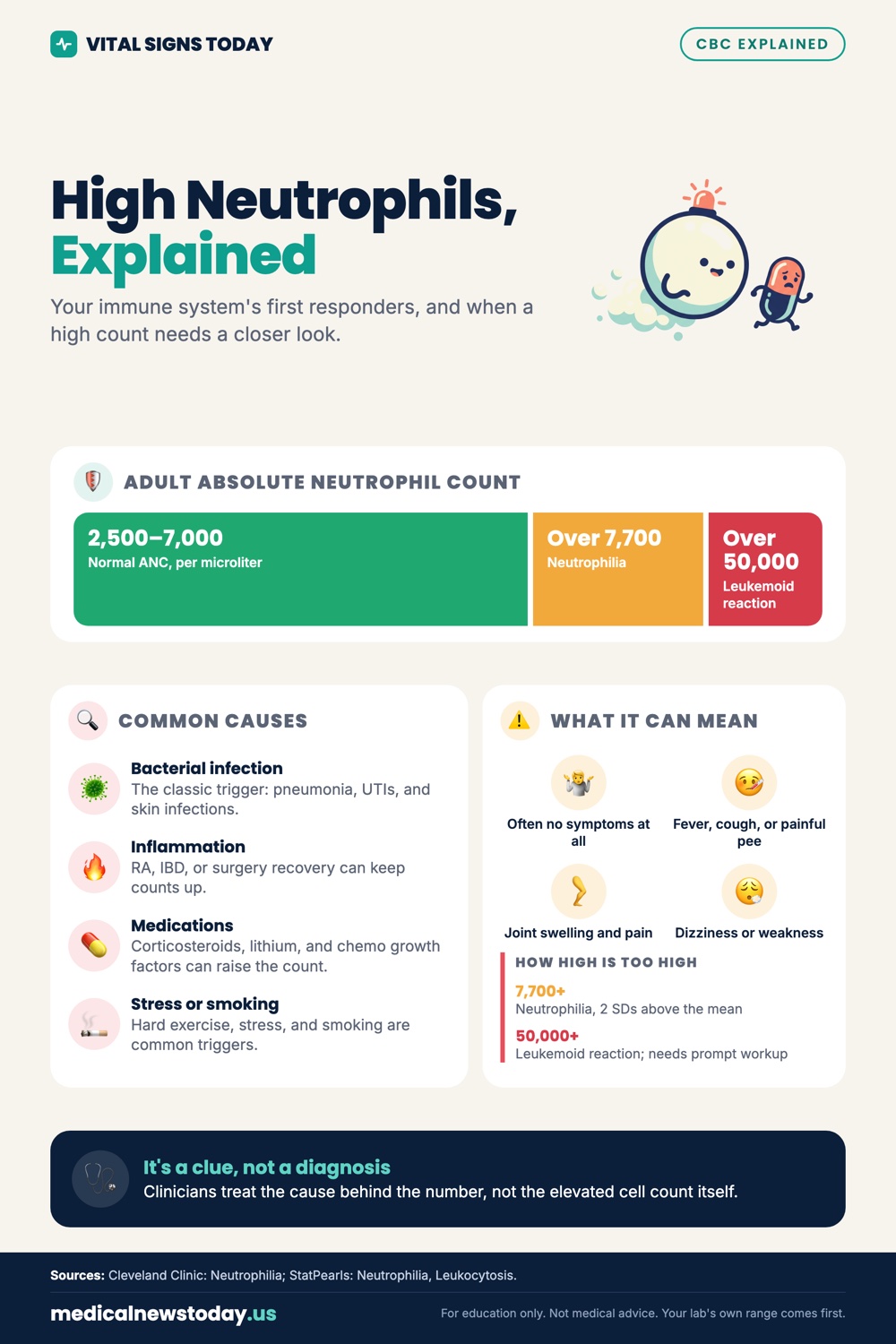
What does high neutrophils mean in a blood test?
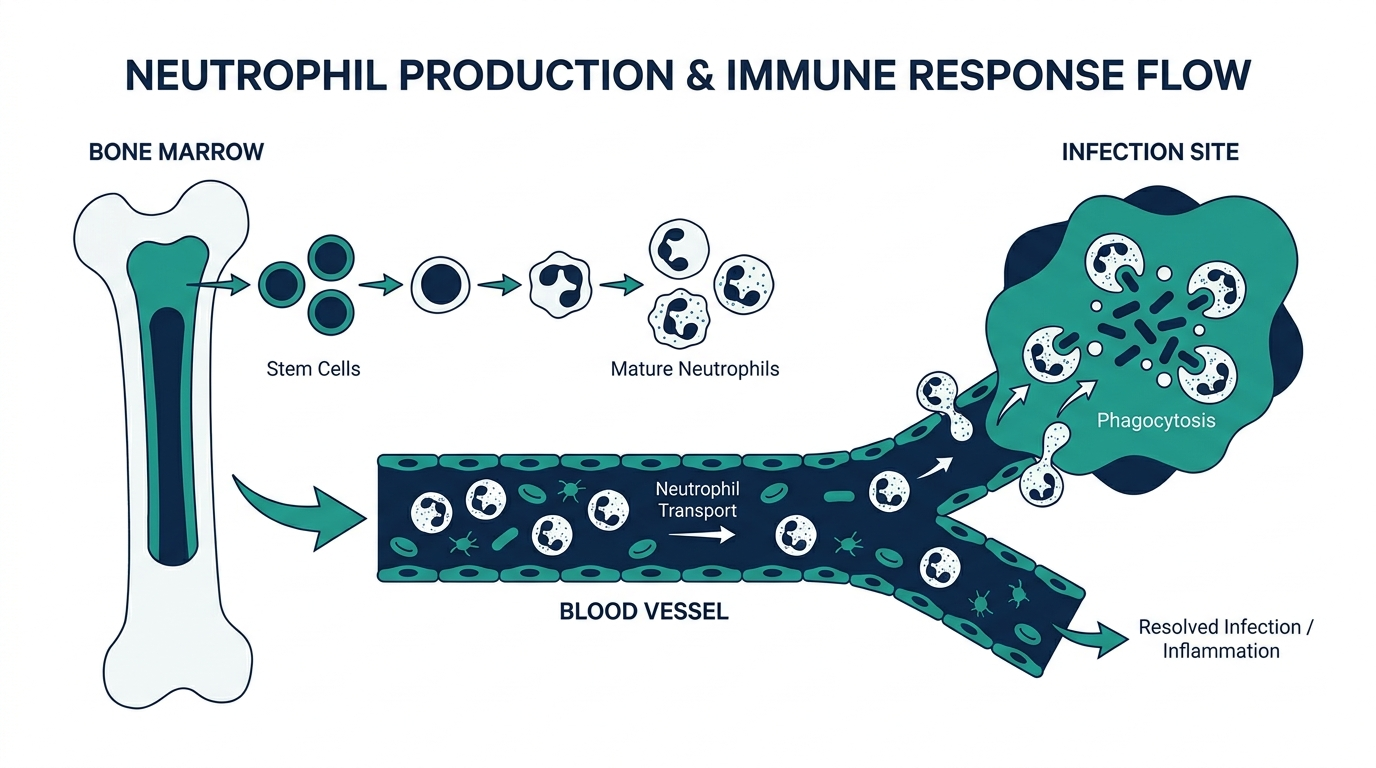
Neutrophils are the most abundant type of white blood cell and your body’s first responders, the cells that rush to the scene of a bacterial infection or injury (MedlinePlus). When a blood test shows them elevated, the medical term is neutrophilia, and it simply means your bone marrow has flooded the bloodstream with more of these frontline cells than usual (Cleveland Clinic).
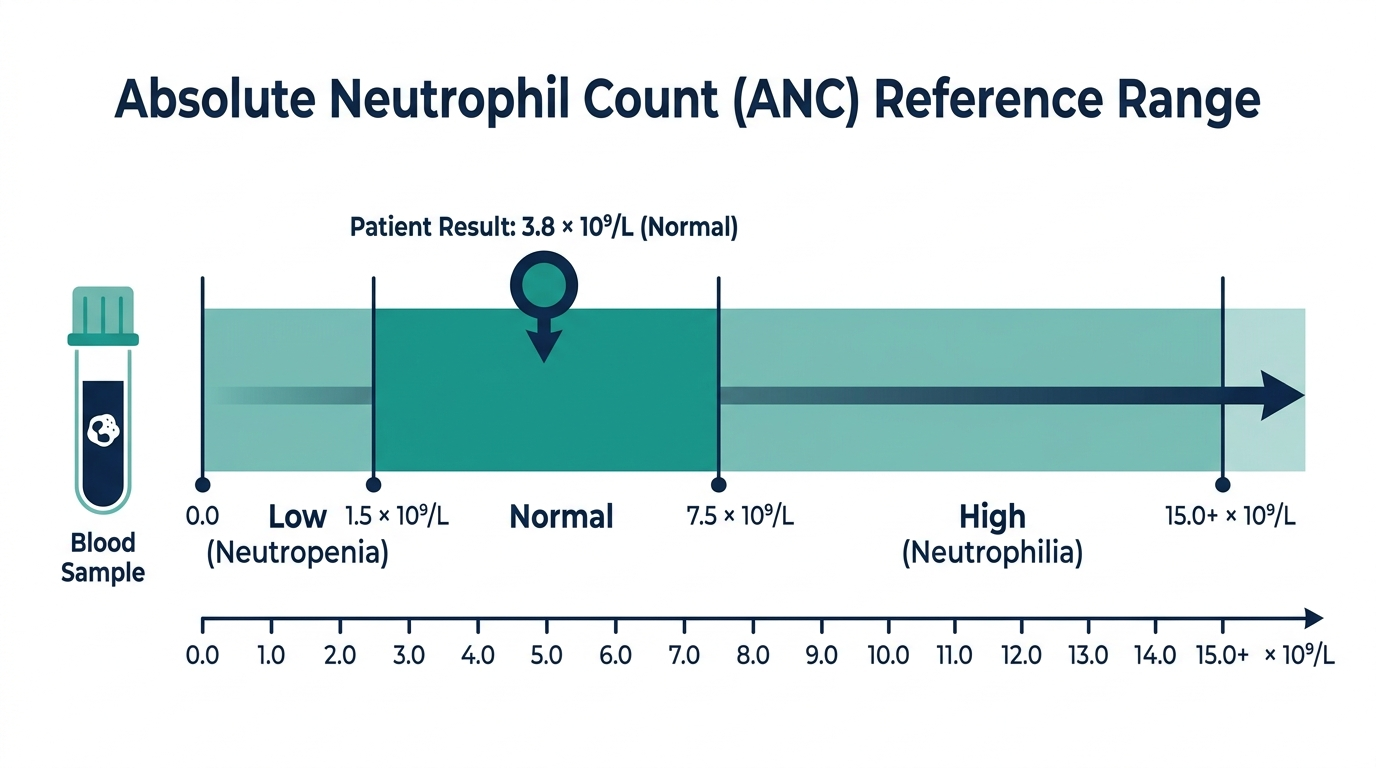
The number that matters is the absolute neutrophil count, or ANC, not the percentage. In adults the ANC normally runs from roughly 2,500 to 7,000 neutrophils per microliter, and neutrophilia is generally defined as a count above about 7,700 per microliter, which is two standard deviations above the average (StatPearls). Cleveland Clinic uses a similar cutoff of more than 7,500 per microliter (Cleveland Clinic). In plain terms: a high neutrophil count is your immune system on alert. It is a clue, not a diagnosis, and the entire point of reading it well is figuring out what triggered the alarm.
Here is the key idea to carry into everything below. Neutrophilia is almost never a disease in itself. It is a sign of something else, which is why your clinician treats the cause and not the number (Cleveland Clinic).
What causes a high neutrophils count?
The differential for high neutrophils is wide, but in everyday practice a short list covers the overwhelming majority of cases. Doctors group the causes into reactive (secondary), where something outside the marrow is driving the count up, and primary, where the marrow itself is the problem (StatPearls). Reactive causes are far more common. Listed roughly most common first:
- Bacterial infection. This is the classic and most frequent trigger. Pneumonia, urinary tract infections, skin and soft tissue infections, appendicitis, and abscesses all recruit neutrophils fast (StatPearls).
- Inflammation. Conditions like rheumatoid arthritis, inflammatory bowel disease, and recovery from surgery or a burn keep neutrophils elevated even without an active infection (Cleveland Clinic).
- Physical or emotional stress. Hard exercise, acute pain, panic, seizures, or even a stressful blood draw can spike the count temporarily (StatPearls, Leukocytosis).
- Smoking. A genuinely common and underappreciated cause of a chronically mild elevation (Cleveland Clinic).
- Medications. Corticosteroids such as prednisone, lithium, and growth factors like G-CSF used in chemotherapy support all raise neutrophils (StatPearls).
- Injury and tissue damage. Bone fractures, trauma, heart attack, and recent surgery (Cleveland Clinic).
- Blood cancers and marrow disorders. Uncommon, but real. Chronic myelogenous leukemia (CML) and other myeloproliferative neoplasms are the primary causes clinicians keep in the back of their mind, especially when the count is very high or persistent (StatPearls).
One nuance worth knowing: pregnancy raises neutrophils as a normal physiological change, and so does the surge after a major physical event. Context decides whether a number is alarming or expected.
What are the symptoms of high neutrophils?
Here is what surprises most people: a high neutrophil count itself causes no symptoms at all (Cleveland Clinic). You cannot feel neutrophilia. Any symptoms you have come from whatever is driving the count up, not from the elevated cells themselves.
So instead of looking for symptoms of high neutrophils, look at the symptoms of the likely cause. With an infection that often means fever, chills, a cough, burning with urination, or a red and tender patch of skin. With an inflammatory condition it might be joint swelling and pain or abdominal cramping. Cleveland Clinic notes the underlying problem can show up as fever of 100.4°F or higher, weakness, fatigue, dizziness, recurring infections, or slow healing sores (Cleveland Clinic). If you feel completely well and your only abnormal result is a mildly high neutrophil count, that combination is reassuring and very common.
When is a high neutrophils count dangerous or a medical emergency?
Most elevations are mild and benign. The level that genuinely raises eyebrows is the extreme one. When the total white cell count climbs above 50,000 cells per microliter in response to severe infection, stress, or medication, that is called a leukemoid reaction, and it can require urgent treatment (StatPearls). Counts that high, the kind seen in sepsis, can also drive blood clotting risk and need aggressive care (StatPearls, Leukocytosis).
But the number is only half the story. The danger usually lives in the symptoms surrounding it, not the count in isolation. Seek care promptly, the same day or via emergency services, if your high neutrophils come with any of these red flags:
- High fever, confusion, a racing heart, or shaking chills, which together can signal sepsis
- Severe or rapidly worsening pain, especially in the abdomen
- Difficulty breathing
- Unexplained weight loss, drenching night sweats, easy bruising, or bone pain over weeks, which can point toward a blood disorder (Cleveland Clinic)
A mild elevation in someone who feels fine is a footnote. A very high count in someone who feels sick is an emergency. Same lab line, completely different urgency.

What should you do about a high neutrophils count?
The honest answer is that you usually do not treat the neutrophils, you find and treat the trigger (Cleveland Clinic). What that looks like in practice:
- Repeat the test. A single elevated count is often just timing. Reviewing prior results and repeating the CBC, sometimes a week or two later, tells your clinician whether this is a one off spike or a real trend (StatPearls, Leukocytosis). This step alone resolves a huge share of worries.
- Look at the whole CBC, not just one line. Your doctor reads neutrophils alongside the rest of the white cells, the red cell numbers, and the platelets. The presence of immature cells called a left shift suggests an active infection, while blasts or other abnormal cells would prompt a different workup (StatPearls).
- Treat the cause. Antibiotics for a bacterial infection, managing an inflammatory disease, or simply stopping a culprit such as cigarettes can bring the count back down. When neutrophilia is from steroids, it is expected and needs no action.
- Order targeted follow up only if warranted. Persistently high or very high counts, or counts paired with other abnormalities, may lead to a peripheral blood smear or referral to a hematologist.
For the everyday lifestyle drivers, the moves are unglamorous but effective: quit smoking, manage chronic stress, and treat infections promptly rather than letting them simmer.
When should you see a doctor?
If you got this result as part of a routine check and feel well, your next step is a conversation with the clinician who ordered it, not a panic. Ask whether the elevation is mild, whether it should be rechecked, and whether the rest of your CBC was normal. That is a normal, unhurried follow up.
Move faster if the high neutrophil count comes with symptoms of infection that are worsening, or with any of the red flags above. And seek care without delay for signs of sepsis, severe pain, or trouble breathing. The rule of thumb: let your symptoms, not the number alone, set your urgency.
The insider read: why one high number often means nothing
Here is the part that rarely makes it into the patient handout. Neutrophils are unusually twitchy. A large fraction of them are not floating freely in your bloodstream at all, they are stuck loosely to the walls of your blood vessels in what is called the marginated pool. A jolt of adrenaline or cortisol, from a hard workout, a stressful morning, acute pain, or even anxiety about the blood draw itself, peels those cells off the walls and dumps them into circulation within minutes (StatPearls, Leukocytosis). This is called demargination, and it can push your neutrophil count up without your bone marrow producing a single extra cell.
That is why an isolated high neutrophil count in a person who feels perfectly fine is so often a non event. The count was real, but the cause was transient and harmless, and it normalizes on its own. This is also why clinicians lean so hard on repeating the test and reviewing old results before launching an expensive workup. The other commonly missed point is the difference between a left shift and true malignancy. Plenty of mature neutrophils plus a few immature bands is the signature of an infection fighting back, not leukemia, which instead shows immature blast cells on the smear (StatPearls). Knowing that distinction is the difference between a sleepless night and a shrug.

Percentage versus absolute count: read the ANC
One of the most common misreads on a CBC is confusing the neutrophil percentage with the absolute number. Your report usually shows both, and they can tell different stories.
The neutrophil percentage is simply what fraction of your white cells are neutrophils, often around 40 to 70 percent in adults. The absolute neutrophil count, or ANC, is that percentage multiplied by the total white cell count, which gives the actual number of neutrophils per microliter. The ANC is what clinicians act on, because a high percentage means nothing if the total white count is low, and a normal percentage can still hide a high absolute number when the total count is elevated.
A quick way to see it: if your total white count is 12,000 per microliter and 75 percent are neutrophils, your ANC is about 9,000, which is genuinely high. If your total is 5,000 and 75 percent are neutrophils, your ANC is only about 3,750, which sits comfortably in the normal range despite the same eye-catching percentage. This is exactly why you should look for the line labeled “absolute neutrophils” or “ANC” rather than reacting to a percentage.
The neutrophil-to-lymphocyte ratio and what it adds
Beyond the raw count, clinicians increasingly glance at the neutrophil-to-lymphocyte ratio (NLR), which divides your neutrophil count by your lymphocyte count. It is a rough, inexpensive gauge of systemic stress and inflammation, and it is useful precisely because it captures the balance between two arms of the immune system in a single number.
In a healthy, unstressed adult the ratio is typically low. It climbs when neutrophils rise and lymphocytes fall together, a pattern seen with significant bacterial infection, major physiological stress, and serious inflammation. A rising ratio is not a diagnosis, and there is no single universal cutoff, but a markedly elevated NLR alongside symptoms is one more nudge toward a closer look. Read it as a temperature gauge, not a verdict.
Reading the rest of the differential
Neutrophils never travel alone on a CBC with differential, and the neighboring cell lines change the interpretation:
- Bands and a “left shift.” Bands are immature neutrophils. A rise in bands alongside mature neutrophils, the classic left shift, points strongly toward an active bacterial infection with the marrow shipping out cells early to keep up.
- Lymphocytes. When lymphocytes are up and neutrophils are relatively lower, a viral process is more likely. High neutrophils with low lymphocytes leans bacterial or stress-related.
- Eosinophils and basophils. Persistently high basophils alongside high neutrophils can be a subtle clue that prompts a hematology review, since that combination shows up in certain marrow disorders.
- Blasts. Immature blast cells are not the same as bands. Blasts on a smear are a red flag that shifts the workup toward a blood cancer, whereas bands are a normal part of fighting infection.
This is why a clinician reads the whole panel as a pattern. The single neutrophil line is a headline; the differential is the article underneath it.

What can distort a neutrophil result
Because neutrophils respond so quickly, several everyday factors can nudge the count and are worth knowing before you over-interpret a result:
- Time of day and recent exertion. A hard workout or a stressful morning shortly before the draw can transiently raise the count through demargination, as covered above.
- Recent steroids. Even a short course of prednisone or a steroid injection reliably lifts neutrophils, and this is expected rather than alarming.
- Pregnancy. Neutrophil counts run higher in normal pregnancy, so the usual thresholds are read differently.
- Recovery from acute illness or surgery. Counts can stay elevated for a while after the acute event as inflammation resolves.
None of these require treatment on their own. They are context that turns a scary-looking number into an expected one.
Worked examples: same high count, different meaning
Consider two reports that both show neutrophils above the reference range.
In the first, the person has a fever, a productive cough, an ANC around 11,000, and a left shift with elevated bands. This is a textbook picture of a bacterial infection, and the sensible path is to identify and treat the infection, after which the count is expected to fall. The high neutrophils here are the immune system working correctly.
In the second, the person feels completely well, the ANC is only mildly above the top of the range, there is no left shift, and the rest of the CBC is normal. They mention they smoke and had rushed to the appointment. This is the archetype of a benign, transient elevation, and the reasonable move is to review prior results and simply repeat the CBC later rather than launch an expensive workup. Same abnormal line on paper, entirely different response.
Acute versus chronic neutrophilia: why persistence matters
The single most useful question after a high neutrophil count is whether it is new or longstanding. An acute, one-time elevation tied to an obvious trigger, an infection, a stressful event, a recent steroid dose, usually resolves as the trigger passes. That is the common, low-drama scenario.
A neutrophilia that persists across several tests over weeks or months, especially without an obvious reactive cause, is what earns a closer look. Persistent, unexplained elevation, particularly if it is climbing or paired with abnormalities in other cell lines, weight loss, night sweats, or an enlarged spleen, is the pattern that prompts a peripheral smear and sometimes a hematology referral. The reassuring flip side is that a count which normalizes on a repeat test has effectively answered its own question.
Questions people ask most about a high neutrophil count
The first thing most people want to know is whether a high neutrophil count means an infection. Often it does, since fighting bacteria is exactly what neutrophils are built for, but it is far from the only explanation. Physical stress, a recent hard workout, a large meal, pregnancy, smoking, and steroid or other medications can all push the count up without any infection present. This is why a single high reading, taken on its own, is treated as a prompt to look at the wider picture rather than a diagnosis.
People also ask whether stress alone can do it. It can. A surge of adrenaline, from a panic before a needle, a car accident, or even vigorous exercise on the way to the lab, can pull neutrophils that were sitting along blood vessel walls back into the flowing bloodstream within minutes. This is called demargination, and it can lift the count temporarily without a single sick cell involved. A repeat draw on a calm morning often reads noticeably lower.
Another frequent question is how long a high count should last before it matters. A brief bump that settles on a recheck a week or two later is usually reassuring. A count that stays elevated across several tests over weeks to months is the pattern that deserves a closer look, because persistence points away from a passing stressor and toward something ongoing that a clinician should trace to its source.
Tracking your neutrophil count over time
A high neutrophil result becomes far easier to interpret when you can compare it to earlier values. One number tells you where you are today. A series of numbers tells you the direction, and direction is often what separates a harmless blip from a real trend. A count that spiked during a week you had a cold and then returned to your usual baseline is a very different story from one that has been slowly climbing across three checks with no illness to explain it.
When you retest, try to keep the conditions similar. Draw at a comparable time of day, avoid intense exercise beforehand, and use the same lab where you can, since instruments and reference ranges vary slightly between them. Note whether you were fighting an infection, under unusual stress, or taking a new medication such as a steroid, because each of those can lift the count in ways that have nothing to do with an underlying problem. Recording that context next to each result keeps you from chasing a number that a temporary factor fully explains.
Read the neutrophil count alongside the rest of the differential each time rather than in isolation. A rising neutrophil count paired with a falling lymphocyte count, for example, tells a different story than neutrophils and lymphocytes climbing together. Keeping a simple log of the absolute neutrophil count, the total white count, and how you felt on each draw gives your clinician a trend to work with, and a clear trend is usually more informative than any single flagged value.
Want to check your neutrophils?
Three ways to get it measured. Pick whichever fits you.
Affiliate links: we may earn a commission at no extra cost to you. A lab test does not replace a visit with your clinician.
Frequently asked questions
What does it mean if my neutrophils are high on a blood test?
It means you have neutrophilia, more of these infection fighting white cells than the normal range, generally an absolute neutrophil count above about 7,500 to 7,700 per microliter (Cleveland Clinic). It is most often a normal immune response to infection, inflammation, stress, or smoking, and it is a clue your doctor interprets in context rather than a diagnosis on its own.
What is a dangerously high neutrophil count?
Mild elevations are usually benign. Concern rises sharply when the total white cell count exceeds 50,000 per microliter, a leukemoid reaction, which can occur in severe infection or sepsis and may need urgent treatment (StatPearls). Symptoms like high fever, confusion, or severe pain matter more than the number alone.
Can stress or exercise cause high neutrophils?
Yes. Catecholamines and cortisol from exercise, acute stress, or pain release neutrophils that were loosely attached to blood vessel walls into circulation, a process called demargination, raising the count temporarily without any increase in production (StatPearls, Leukocytosis). It typically normalizes on its own.
Do high neutrophils cause symptoms?
No. A high neutrophil count itself produces no symptoms (Cleveland Clinic). Any symptoms come from the underlying cause, such as fever and cough from an infection or joint pain from inflammation.
Should I worry if my neutrophils are high but I feel fine?
Usually not. A mild, isolated elevation in someone who feels well is common and often transient, which is why clinicians frequently just repeat the test and review prior results before doing more (StatPearls, Leukocytosis). Discuss it with your doctor, but it rarely signals anything serious on its own.
This article is for general educational purposes and is not medical advice. It cannot diagnose or treat you and does not replace your clinician. Always discuss your lab results and any health decisions with a qualified healthcare professional.
Vital Signs Today may earn a commission if you buy through links on this page. It does not affect our editorial assessments.