Last updated 18 June 2026. Educational content, not medical advice. Most peptides that generate weight-loss results are prescription drugs or unapproved research compounds. Talk to a licensed clinician before starting any peptide protocol.
Short answer: The fastest legal path to a weight-loss peptide in 2026 is a telehealth GLP-1 clinic prescribing oral Wegovy (semaglutide pill, available since January 2026 at $149 per month self-pay) or injectable Zepbound (tirzepatide, from $299 per month through platforms like Calibrate or Ro). Every other route, research vendors, supplement shops, and “no-prescription” websites, sells you something that either is not a therapeutic peptide or carries legal and safety risks the price tag does not warn you about.
Sourcing a weight-loss peptide safely starts with a telehealth clinic, but shouldn’t your metabolic markers come first? One at-home Superpower draw checks 100+ biomarkers, physician-reviewed.
Why does “where can I get peptides for weight loss” have so many confusing answers?
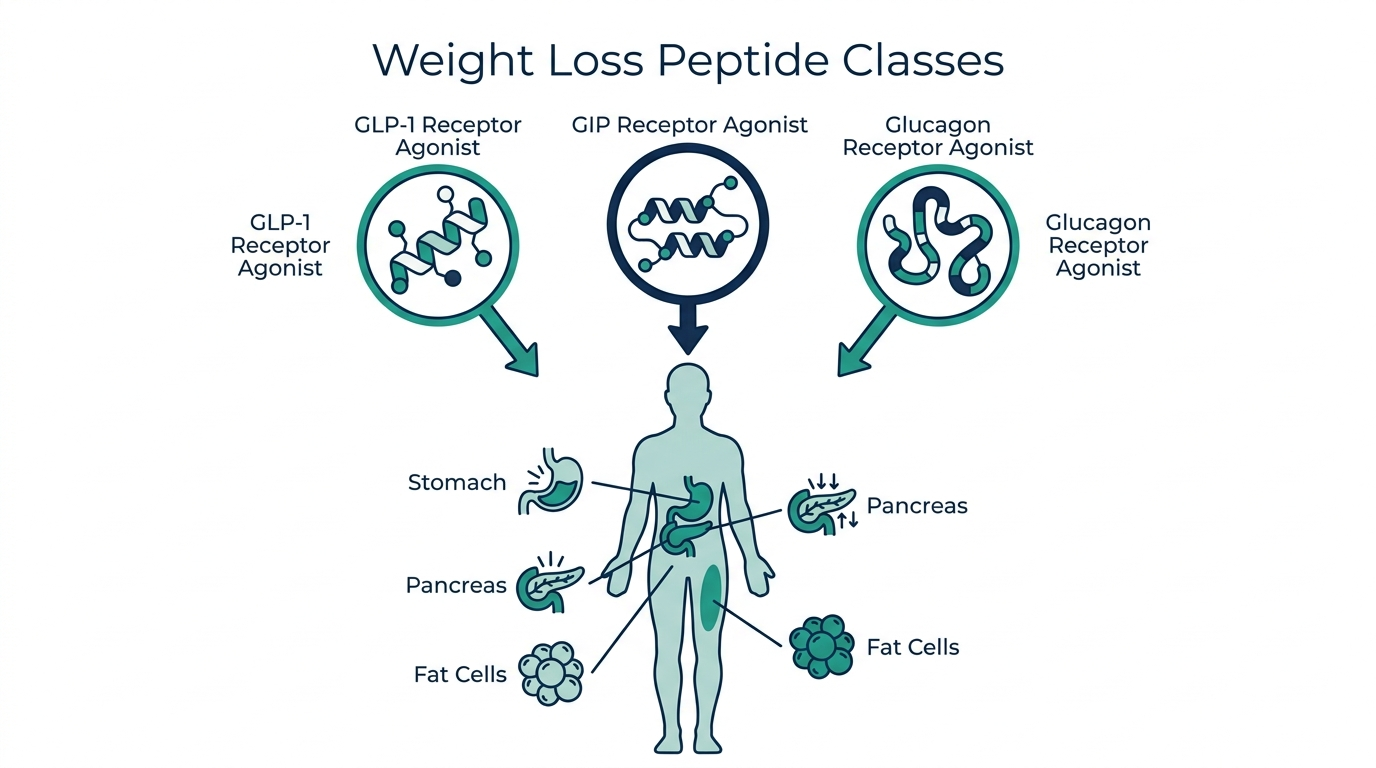
Because the word “peptide” is doing five completely different jobs at once in the weight-loss space, and the person selling collagen powder at Target and the person selling injectable semaglutide through a licensed telehealth clinic are both technically accurate when they call their product a peptide.
The honest map looks like this. GLP-1 receptor agonists, semaglutide and tirzepatide, are FDA-approved peptide drugs for weight management, available by prescription only. Growth hormone secretagogues like CJC-1295 and ipamorelin are peptides that were pulled from compounding pharmacies in 2023 and are now working their way back toward legal prescribability. BPC-157, the most Googled “recovery peptide,” is not specifically a weight-loss molecule but ended up on the same restricted list and is now in regulatory limbo. And collagen peptides and peptide supplements at GNC are food ingredients, not drugs, and will not move the scale by themselves.
Understanding which category you are actually shopping in determines whether you end up with a prescription, a vial of research chemical, or a tub of flavored protein powder. All three are sold under the same search term.
Full-body lab membership: 100+ biomarkers, doctor-reviewed, tracked over time.
What are the FDA-approved peptide options for weight loss in 2026?
The simplest way to actually get this done
Superpower is a full-body lab membership that runs 100+ biomarkers, has each result reviewed by a doctor, and tracks your numbers year over year (about $199/year). It is what we point readers to when they would rather get one clean, complete draw than chase single tests one at a time. Here is superpower reviewed in full.
There are four peptide drugs currently FDA-approved for weight management in the United States.
Semaglutide injection (Wegovy) was the first GLP-1 specifically approved for obesity, and the STEP 1 trial showed an average 14.9% body weight reduction over 68 weeks in adults with obesity. You get it by injection once a week, and the full 2.4 mg maintenance dose requires a graduated titration schedule.
Oral semaglutide (Wegovy pill) launched in the United States in January 2026, becoming the first FDA-approved oral GLP-1 for weight management. The OASIS 4 trial showed 16.6% mean weight loss in adherent participants. For people who are needle-averse, this is a meaningful shift. Novo Nordisk’s self-pay price starts at $149 per month for lower doses, rising to $299 per month for the full 25 mg maintenance dose.
Tirzepatide injection (Zepbound) is the current leader on clinical weight loss numbers. The SURMOUNT-5 head-to-head trial, published in the New England Journal of Medicine, found tirzepatide produced 20.2% weight loss versus 13.7% with semaglutide at 72 weeks, a 47% greater relative difference. Tirzepatide hits three hormone receptors (GIP, GLP-1, and glucagon) versus semaglutide’s one, which is where that gap comes from.
Liraglutide (Saxenda) is an older once-daily injectable GLP-1 that showed around 8% average weight loss in the SCALE Obesity trial. It is largely being displaced by semaglutide and tirzepatide given inferior results at higher inconvenience, but it remains an option, particularly for patients who do not tolerate the newer drugs.
One thing worth saying plainly: retatrutide, the “next-gen” triple agonist that dominated forum discussion in 2025, is not yet approved. Eli Lilly’s TRIUMPH-1 Phase 3 results released in May 2026 showed up to 28.3% body weight loss over 80 weeks, and a 12 mg cohort tracked to 104 weeks averaged 85 lbs lost. The numbers are extraordinary. But it will not be legally available through any legitimate channel until FDA review is complete, probably 2027 at the earliest. Anyone selling injectable retatrutide right now is selling a research compound, not an approved drug.
How do you actually get a prescription for weight-loss peptides?
The path has three branches, and your insurance situation usually decides which one makes sense.
Branch 1: Your primary care doctor or an endocrinologist. This is the most straightforward path and often the best for anyone with insurance that covers Wegovy or Zepbound. Eligible patients with a BMI of 30 or above, or BMI of 27 or above plus a comorbid condition, qualify under the approved indications. The catch is prior authorization, which can take weeks and is still denied frequently depending on your plan. If your insurance covers it, brand-name Zepbound or Wegovy can drop to $0 to $25 per month with manufacturer savings cards.
Branch 2: Telehealth GLP-1 clinics. This is the fastest, and for the uninsured, the most affordable route. As of mid-2026 the telehealth landscape has stabilized into two camps after compounded semaglutide and tirzepatide largely exited the market following FDA shortage resolutions. Most platforms now focus on brand-name access and insurance navigation, with a few still offering 503A-compounded options from compliant pharmacies.
Named platforms active in 2026 include Calibrate (the most clinically rigorous, requires metabolic labs before prescribing, $199 per month program fee plus medication), Ro (flexible model, works with both brand-name and some compounded options, ongoing clinician support), Found (70+ treatment paths including non-GLP-1 medications), WeightWatchers Clinic (combines GLP-1 prescriptions with behavioral coaching, a 53,000-patient retrospective published in Obesity showed 19.4% weight loss at 12 months among engaged patients), and Hims and Hers (settled with Novo Nordisk in March 2026 and now focuses on brand-name Wegovy at $299 per month). Program fees typically run $49 to $199 per month on top of medication costs.
Branch 3: Direct manufacturer programs. Eli Lilly’s LillyDirect self-pay program offers Zepbound vials at reduced cash prices for patients without insurance coverage, bypassing the pharmacy benefit manager markup that inflates retail pricing.
What about compounded semaglutide and tirzepatide? Are they still available?
This is where 2026 got complicated, and the answer changes depending on which month you are reading this.
The FDA declared the tirzepatide shortage resolved on October 2, 2024, and the semaglutide shortage resolved on February 21, 2025. Those declarations triggered legal deadlines for compounding pharmacies to wind down sales of 503A copies of brand-name drugs, with enforcement timelines that hit in February and April 2025. Courts denied injunctions from the Outsourcing Facilities Association challenging the FDA’s authority to enforce those deadlines.
Practically, this means the “$99 compounded semaglutide” that flooded telehealth ads in 2023 and 2024 is largely gone from compliant pharmacies. What remains is a narrower path: 503A compounding pharmacies can still compound semaglutide or tirzepatide for individual patients if there is a documented clinical reason the commercial product does not meet the patient’s needs, such as an allergy to an inactive ingredient or a need for a different concentration. This is not the mass-market route anymore.
If you encounter a telehealth platform still advertising compounded semaglutide broadly at deep discounts in mid-2026, that is a signal worth investigating. Compliant platforms will tell you explicitly which 503A pharmacy they use and why the compounded option qualifies for your individual case. Platforms that do not explain the clinical rationale may be operating outside the updated rules.
| Route | Typical cost/month | Prescription needed | Regulatory status |
|---|---|---|---|
| Brand Wegovy (injection) | $400-$600 without insurance; $0-$25 with coverage | Yes | FDA-approved |
| Oral Wegovy (pill) | $149-$299 self-pay | Yes | FDA-approved (Jan 2026) |
| Brand Zepbound | $300-$600 without insurance; $0-$25 with coverage | Yes | FDA-approved |
| Compounded semaglutide/tirzepatide | $169-$399 | Yes (503A pharmacy) | Legal only in narrow individual-patient cases post-shortage |
| Saxenda (liraglutide) | $800-$1,000 retail; varies with insurance | Yes | FDA-approved |
| GLP-1 telehealth program (brand-name) | $199-$399 program fee plus medication | Yes, issued by telehealth clinician | Legal |
| Research peptide vendors (grey market) | $40-$120 per vial | No (sold “for research only”) | Legal to sell, not legal to inject yourself |
| Collagen/OTC peptide supplements | $20-$60 | No | Legal dietary supplement; not a therapeutic peptide |
What are the non-GLP-1 weight-loss peptides and can you get them legally?
Here is where it gets nuanced, and most articles skip this part. GLP-1 drugs are not the only peptides that affect body composition, but the others sit in completely different legal territory.
Growth hormone secretagogues: CJC-1295 and ipamorelin. These two are almost always prescribed as a stack. CJC-1295 keeps a sustained pulse of growth hormone elevated, while ipamorelin amplifies the GH signal at specific timed intervals. The combo does not produce the dramatic weight loss numbers that GLP-1 drugs show in trials, but some users report improved body composition, better sleep, and faster recovery in ways that support a weight-loss protocol. The peptides were removed from FDA Category 2 restrictions in September 2024, meaning compliant 503A compounding pharmacies can prescribe them again. Telehealth longevity clinics including Defy Medical, Marek Health, and Hone Health were offering them with a prescription as of mid-2026. Expect to pay $200 to $350 per month for a CJC-1295/ipamorelin combination through a clinical program.
AOD-9604. This is a fragment of human growth hormone that was specifically designed for fat metabolism and made it to Phase IIb clinical trials before development stalled in 2007 due to the drug failing to reach statistical significance in its largest trial. The regulatory history is complicated: it was nominally removed from Category 2 restrictions but the PCAC voted against including it on the 503A bulks list. As of the July 23-24, 2026 PCAC review scheduled to discuss it further, the legal compounding pathway remains ambiguous. Do not let the “removed from Category 2” headline fool you into thinking it is freely prescribable.
BPC-157. Not a weight-loss peptide directly, but frequently mentioned alongside GLP-1 protocols by people wanting gut and soft-tissue support during a calorie deficit. BPC-157’s FDA status thawed significantly: it was removed from Category 2 on April 22, 2026, and the PCAC’s July 23-24, 2026 meeting includes a scheduled discussion about adding it to the 503A bulks list. If the committee votes yes, licensed compounding pharmacies will be able to prescribe it again. Until that decision, it remains in a grey zone between “no longer explicitly banned” and “not yet formally cleared.”
Personally, I would not spend money chasing BPC-157 or AOD-9604 for weight loss specifically. The mechanism for those compounds does not map cleanly to adipose tissue reduction, and the regulatory fog means anything you buy today may be legitimately prescribable from a proper pharmacy in three months. The smarter move is to wait for the PCAC decision in late July 2026 and access these compounds through a clinical channel if they are cleared.
Telehealth GLP-1 program with provider visits and pharmacy coordination.
What happens when you try to buy weight-loss peptides from research vendors?
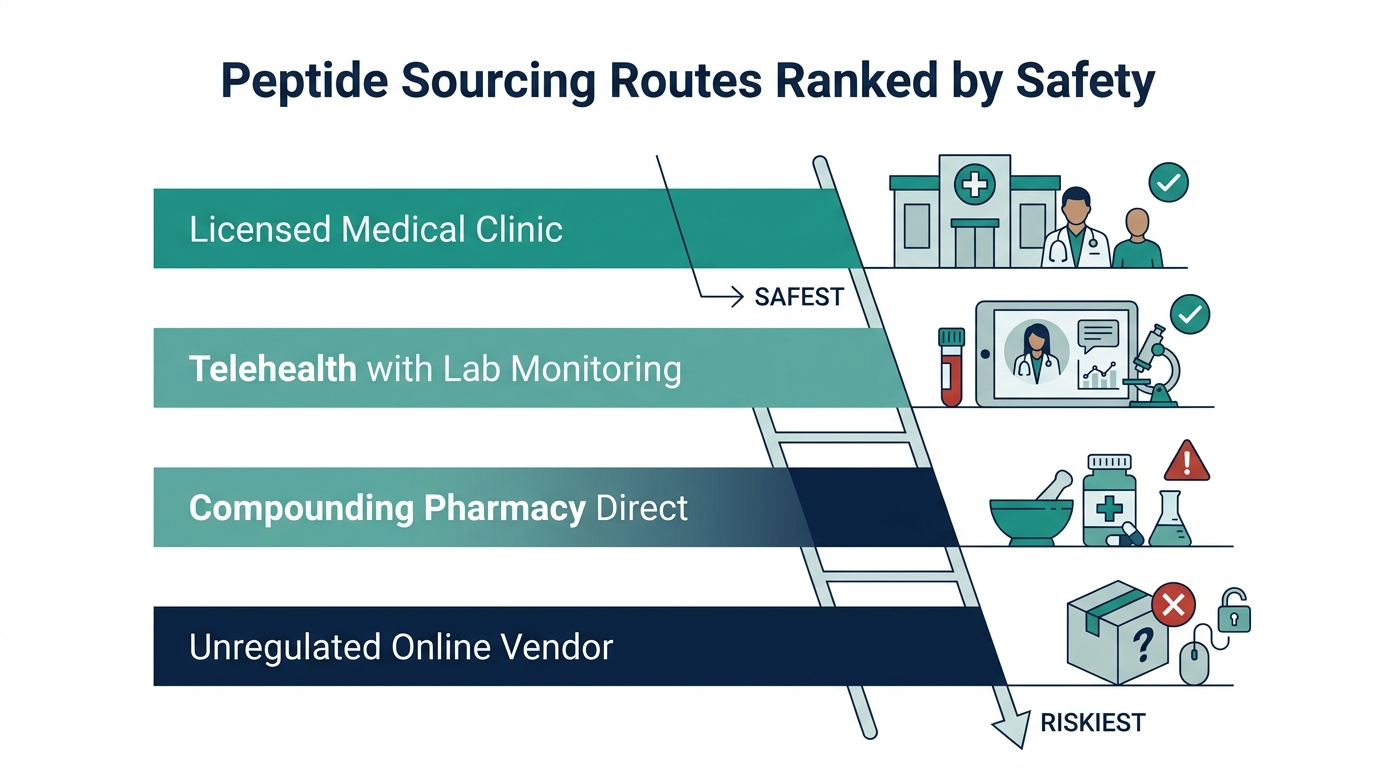
Do not believe anyone who tells you research peptide vendors are a reliable route to weight-loss peptides. The legal fiction works like this: a vendor labels a vial “for laboratory research only, not for human consumption,” charges $60 to $120, and ships it to your door. Selling it that way is technically legal. Injecting it is not, and the label protects the vendor, not you.
Beyond the legal exposure, the quality problem is severe. The independent testing platform Finnrick has run more than 8,000 tests across 225 vendors and publicly grades batches. Retatrutide batches from what was considered the most trusted research vendor consistently failed purity tests before the vendor’s 2026 closure. The lesson is not that one vendor was bad. The lesson is that without pharmaceutical-grade manufacturing controls and independent batch verification, you are conducting a chemistry experiment on yourself with an unknown reagent.
If you are determined to evaluate research vendors, the minimum bar is a recent, batch-matched Certificate of Analysis with HPLC purity at 96% or above, a Mass Spectrometry identity confirmation (not just purity), and independent verification from a lab like Janoshik, MZ Biolabs, or Colmaric Analyticals whose report carries a key you can verify on the lab’s own website. A COA from an “in-house lab,” a generic PDF reused across the whole catalog, or a vendor that accepts crypto only are disqualifying.
The forums treat COA verification as an advanced skill. It is not. It takes five minutes and a working link. The fact that most buyers skip it is entirely why the fraud rate in the research peptide market is what it is.
Can you get peptides for weight loss without a prescription?
Only if what you mean is collagen peptides or amino-acid-blend supplements, both of which are over-the-counter dietary supplements and neither of which are therapeutic peptides in any meaningful weight-loss sense. Collagen peptides at $30 a tub are food ingredients that support skin and connective tissue. They do not replicate the mechanism of a GLP-1 drug or a growth hormone secretagogue. Any product on Amazon or at GNC that claims peptide-driven fat loss without a prescription is either a collagen supplement or making claims that the FDA’s supplement rules do not permit.
For actual weight-loss peptides, everything therapeutic requires a prescription because these are drugs that act on hormone receptors and carry real dose-dependent risks. Nausea, vomiting, and pancreatitis risk are documented with GLP-1 drugs, which is exactly why the regulatory requirement for clinical oversight exists.
How much does a weight-loss peptide program actually cost?
The honest answer is “more than the vial price, less than you probably fear.”
For GLP-1 programs, the spectrum runs from $149 per month for oral Wegovy under Novo Nordisk’s self-pay pricing to $1,086 per month for Zepbound at retail list price without insurance or a savings program. Most people accessing GLP-1s through telehealth end up in the $200 to $500 per month range all-in, covering program fees, medication, and any required labs.
For CJC-1295 and ipamorelin through a longevity telehealth clinic, expect $200 to $350 per month including consultation and monitoring.
None of this is covered by standard insurance as an elective weight-management program, though some plans cover Wegovy and Zepbound for medically qualifying patients. HSA and FSA funds can cover the medication and clinical fees at most platforms.
The comparison people almost always get wrong is the research-vial math. A $60 research vial looks cheap against a $299 monthly telehealth program until you price in the bacteriostatic water, syringes, alcohol swabs, and, more importantly, the cost of an unknown purity profile, no dosing guidance from a clinician, and the legal exposure. When you add all of that up honestly, including the value of your time and the risk you are absorbing, the “cheap” route is only cheap at the moment of checkout.
A myth worth correcting: more peptides do not mean more weight loss
The research peptide forums have developed a culture of stacking: GLP-1 plus BPC-157 plus CJC-1295 plus ipamorelin plus a handful of other compounds at the same time. The underlying theory is that more pathways hit equals more results. The actual outcome is often more side effects and less ability to diagnose what is doing what.
The clinical evidence for weight loss exists primarily for the FDA-approved GLP-1 drugs, and it is substantial. SURMOUNT-5 showed tirzepatide produced 20.2% average weight loss in 72 weeks. TRIUMPH-1 showed retatrutide (not yet approved) produced 28.3% loss over 80 weeks. Those are the numbers with the evidence behind them. The stacking culture adds compounds without adding evidence, and every additional compound without a clinical basis is a variable you cannot control and cannot explain to an emergency room doctor if something goes wrong.
Do not believe anyone who tells you that a particular stack is what “the biohackers know.” The people with the best documented results are using a single FDA-approved GLP-1 with proper medical supervision and a structured diet and exercise protocol. That is not exciting forum content, but it is what the data says.
Telehealth GLP-1 program with provider visits and pharmacy coordination.
Turn what you just learned into action.
Superpower lets you test 100+ biomarkers from home, then re-check them over time so you can actually see progress, physician-reviewed at every step.
Frequently asked questions
Where is the safest place to get peptides for weight loss?
A licensed telehealth GLP-1 clinic or your primary care doctor. Platforms like Calibrate, Ro, Found, and WeightWatchers Clinic prescribe FDA-approved semaglutide or tirzepatide with a real clinician, pharmacy-grade medication, and ongoing monitoring. For secretagogues like CJC-1295 and ipamorelin, longevity clinics such as Defy Medical and Hone Health are appropriate after those peptides cleared Category 2 restrictions in September 2024.
Can I get weight-loss peptides without a prescription?
Not the therapeutic ones. FDA-approved GLP-1 drugs (Wegovy, Zepbound, oral Wegovy, Saxenda) all require a prescription. Growth hormone secretagogues prescribed through compounding pharmacies also require a prescription. Collagen peptide supplements do not require a prescription, but they are not the same thing and do not produce weight-loss results comparable to GLP-1 drugs.
Is compounded semaglutide still available in 2026?
Only in narrow individual-patient cases, not as a mass-market alternative. After the FDA declared the semaglutide shortage resolved on February 21, 2025, 503A pharmacies lost the broad legal basis to compound it as a GLP-1-shortage substitute. Compliant 503A pharmacies can still compound it when there is a documented clinical need (allergy to inactive ingredients, for example) with a specific prescription. The $99 per month mass-market compounded semaglutide era is largely over.
How much do weight-loss peptides cost per month?
Oral Wegovy starts at $149 per month self-pay. Injectable Wegovy and Zepbound run $300 to $600 without insurance, dropping to $0 to $25 per month with qualifying insurance. Telehealth program fees add $49 to $199 per month. CJC-1295/ipamorelin through a longevity clinic runs $200 to $350 per month. None of these are covered by standard insurance as elective programs, though brand-name GLP-1s are covered for qualifying patients.
What is the difference between semaglutide and tirzepatide for weight loss?
Both are GLP-1 receptor agonists, but tirzepatide (Zepbound) also activates GIP and glucagon receptors. In the SURMOUNT-5 direct comparison trial, tirzepatide produced 20.2% weight loss versus 13.7% with semaglutide at 72 weeks, a 47% greater relative reduction. Tirzepatide is generally considered the more powerful of the two currently available approved options.
Are peptides from online research vendors safe for weight loss?
The honest answer is no. Research vendors sell compounds labeled “for laboratory research only, not for human consumption.” Independent testing platforms have repeatedly found batch purity failures, identity mismatches, and even counterfeit compounds. Beyond the quality risk, injecting research chemicals is not covered by any legal or medical protection. The vendors’ “for research only” label transfers the entire liability to you.
What is retatrutide and can I get it now?
Retatrutide is Eli Lilly’s investigational triple hormone receptor agonist (GIP, GLP-1, glucagon). Phase 3 TRIUMPH-1 results released in May 2026 showed up to 28.3% body weight loss over 80 weeks, and some cohorts tracked to 104 weeks averaged 85 lbs lost. It is not FDA-approved and is not legally available through any legitimate clinical channel as of mid-2026. Anything sold as retatrutide today is a research chemical with the full purity and safety uncertainty that entails.
Author: Vital Signs Today Editorial Team, [credential]”]. Educational content, not medical advice. Sources linked inline.
Primary sources:
– FDA oral Wegovy approval, AJMC
– SURMOUNT-5 tirzepatide vs semaglutide trial, NEJM
– TRIUMPH-1 retatrutide Phase 3 results, Eli Lilly press release
– FDA GLP-1 compounding policy statement
– FDA PCAC meeting July 23-24, 2026 calendar
– FormBlends FDA peptide ban 2026 legal status tracker
– Finnrick independent peptide testing database
– STEP 1 semaglutide trial, NEJM
– TrimRX GLP-1 program cost breakdown
– WeightWatchers Clinic 53,000-patient outcome data, joinfound.com
Want a real clinician to run the numbers, not a guess?
Joi + Blokes is a telehealth clinic that prescribes GLP-1 medication (Zepbound, compounded semaglutide and tirzepatide), hormone therapy (TRT, HRT), thyroid care, and peptides after a real lab panel and clinician review, with no membership or consult fee (prescriptions from about $59/month, lab panels from $149). If the scale will not budge, this is where you find out whether insulin, thyroid, or hormones are the real reason. Here is Joi + Blokes reviewed in full.
Related reading
Related: which GLP-1 telehealth service fits you.
Vital Signs Today may earn a commission if you buy through links on this page. It does not affect our editorial assessments.