Last updated 18 June 2026. Educational content, not medical advice. The weight-loss “peptides” people search for are prescription GLP-1 drugs, not supplements. Talk to a licensed clinician before starting anything.
Short answer: The safe place to buy a peptide for weight loss in 2026 is a licensed telehealth clinic or a doctor who writes you a real prescription, not a vial off a research-chemical website. The two molecules that actually work, semaglutide (Ozempic, Wegovy) and tirzepatide (Mounjaro, Zepbound), are FDA-approved and dispensed through legitimate channels for roughly $149 to $599 a month cash-pay, or far less with insurance. The cheap “$60 retatrutide vial” you keep seeing is investigational, unapproved, and was the exact product caught failing independent lab tests on its way out the door. Buying it means you are the pharmacist, the lab, and the patient all at once, and the only one accountable when something is wrong.
Buying a real GLP-1 prescription starts with a licensed clinic, and that process starts with knowing your metabolic markers. One at-home Superpower draw checks 100+ biomarkers, physician-reviewed.
What people mean by “peptides for weight loss” (and why the word matters)
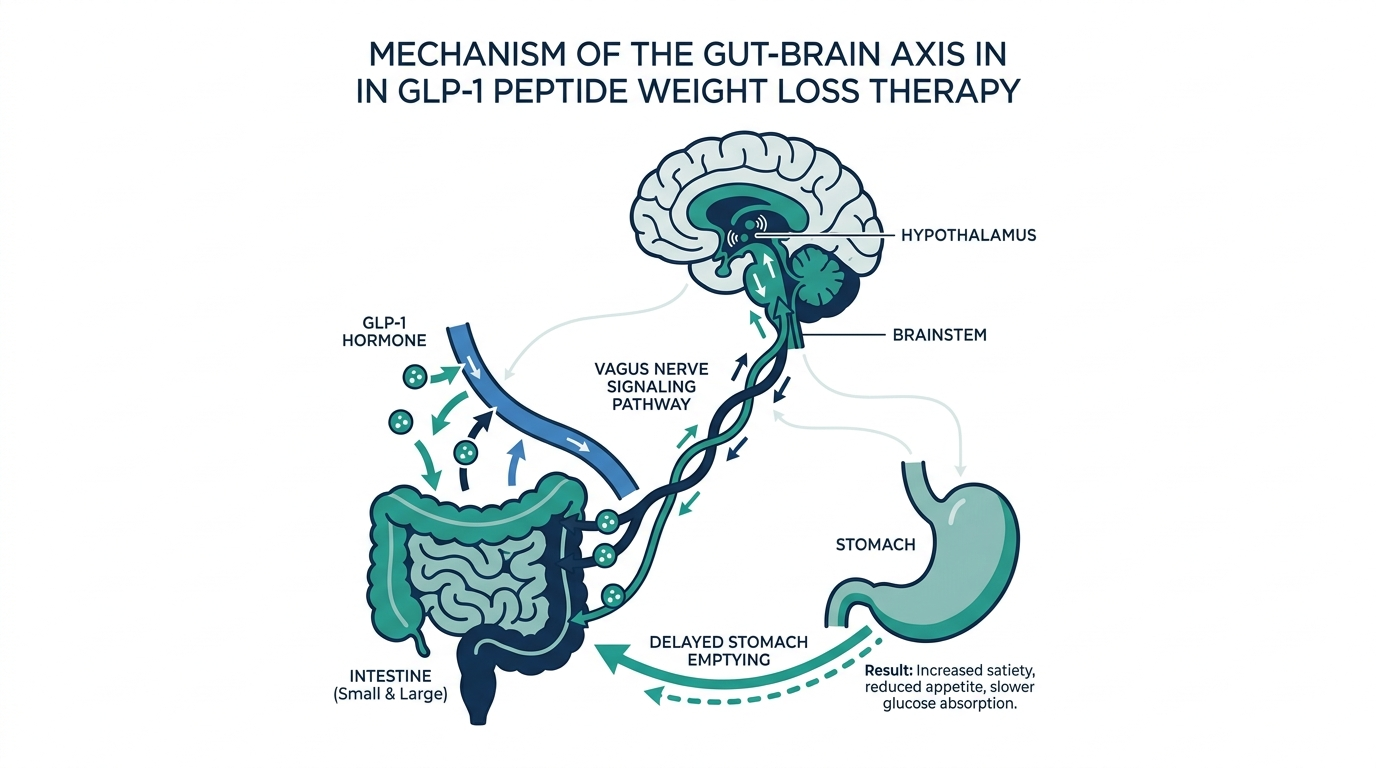
Let me clear up the confusion the search term creates, because it sends people to the wrong store. When someone types “where to buy peptides for weight loss,” they are almost never looking for a collagen powder or a skincare serum. They mean the GLP-1 class: semaglutide, tirzepatide, and the new triple-agonist retatrutide. These are peptides in the chemistry-textbook sense, short chains of amino acids, but in the real world they are prescription injectable drugs, and that single fact changes everything about where you should buy them.
This is the gap the grey market lives in. Research-chemical sites sell “semaglutide” and “retatrutide” in the same catalog as melanotan and BPC-157, stamped “for research use only,” priced like a hobby. That label is not a description of quality. It is the legal fiction that lets the whole market exist while transferring 100% of the risk to you the moment you draw it into a syringe.
So the honest version of your question is: do you want a drug, or do you want a chemistry experiment you run on yourself? They are bought in completely different places.
Full-body lab membership: 100+ biomarkers, doctor-reviewed, tracked over time.
Which weight-loss peptides actually work, and how well?
The simplest way to actually get this done
Superpower is a full-body lab membership that runs 100+ biomarkers, has each result reviewed by a doctor, and tracks your numbers year over year (about $199/year). It is what we point readers to when they would rather get one clean, complete draw than chase single tests one at a time. Here is superpower reviewed in full.
Before we talk about where to buy, you should know what you are buying, because the effectiveness gap between these molecules is huge and the marketing flattens it.
| Peptide | Brand / status | What the trials show | The legitimate route |
|---|---|---|---|
| Semaglutide | Ozempic, Wegovy (FDA-approved) | ~15% mean body-weight loss at 68 weeks (STEP trials) | Prescription via doctor or telehealth |
| Tirzepatide | Mounjaro, Zepbound (FDA-approved) | 22.5% mean body-weight loss at the 15 mg dose in SURMOUNT-1 (Eli Lilly / NEJM) | Prescription via doctor or telehealth |
| Retatrutide | Investigational, not approved | Up to ~30% weight loss at 104 weeks in Phase 3 TRIUMPH-1 (AJMC) | None yet. No legal way to buy it as a drug |
Tirzepatide is the current champion you can actually fill at a pharmacy: a 22.5% average body-weight reduction at the top dose, with 36.2% of trial participants losing at least a quarter of their body weight (Eli Lilly). Semaglutide sits a tier below at around 15%. Both are FDA-approved, both have a name on the box and a clinician behind the prescription.
Retatrutide is the one the forums are buzzing about, and here is the trap. In May 2026, Eli Lilly reported Phase 3 TRIUMPH-1 results showing retatrutide delivered up to roughly 30% weight loss at two years, numbers that creep into bariatric-surgery territory (Eli Lilly). That headline is real. What is also real: retatrutide is still investigational and not FDA-approved. There is no legal, prescribable, pharmacy-dispensed version of it in 2026. So every “buy retatrutide” listing online is, by definition, grey-market research chemical. The drug is genuinely promising in a controlled trial and genuinely a gamble in a vial you bought online. Both things are true at once, and the vendors only tell you the first half.
Where to buy semaglutide and tirzepatide safely: the telehealth lane
This is the lane I steer almost everyone toward, and in 2026 it is more accessible and more competitive than the grey market wants you to believe. A wave of legitimate telehealth platforms now prescribe GLP-1 medications after a real intake: Ro, Hims & Hers, Mochi Health, Noom, WeightWatchers Clinic, and others, with cash-pay pricing that has dropped sharply since 2024 (U.S. News).
Roughly where prices land as of mid-2026:
– Brand-name semaglutide or tirzepatide, cash-pay: $900 to $1,350+ a month without insurance, often far less if your plan covers it.
– Mid-tier telehealth (Hims, Ro, Mochi): about $149 to $199 a month.
– The cheapest legitimate compounded options: as low as $99 to $125 a month on annual billing at the value players (Trimi).
A legitimate provider clears five bars, and you should treat any missing one as a red flag:
– A licensed physician, NP, or PA actually prescribing after reviewing your history, not a one-click checkout.
– Medication from a named, verifiable pharmacy you can look up.
– A real intake covering your medical history, contraindications, and current meds.
– Structured follow-up and a way to reach a clinician if you get side effects.
– Pricing that makes sense for what is included, no “fire sale, crypto only” energy.
Here is the insider tell worth the whole section: in 2026, if a site is selling you injectable GLP-1 with no prescription, no clinician, and no medical questions, that is not convenience, it is the confession. A compliant provider cannot legally do that. A site that does is either dispensing through a non-compliant pharmacy or quietly shipping research-chem product dressed up in a clinical-looking interface. The friction you resent (the questionnaire, the lab review, the wait) is the exact thing that makes it safe.
Telehealth GLP-1 program with provider visits and pharmacy coordination.
What happened to the cheap “$99 compounded semaglutide” everyone remembers?
If you shopped for GLP-1 drugs in 2023 or early 2024, you remember the flood of cheap compounded semaglutide and tirzepatide. That era is mostly over, and understanding why protects you from the ads that are still running on its fumes.
Compounding pharmacies are allowed to make copies of a drug while it is in official shortage. Both GLP-1 drugs were in shortage, so the copies were legal and cheap. Then the shortages ended:
– Tirzepatide: the FDA declared the shortage resolved in late 2024, with a 503A enforcement deadline of 18 February 2025 for state-licensed pharmacies (NCPA).
– Semaglutide: the FDA declared its shortage resolved on 21 February 2025, with the 503A compounding deadline hitting 22 April 2025 (FDA).
The Outsourcing Facilities Association sued to keep the discretion windows open. Courts denied the injunctions, and the deadlines held (McDermott). Then in 2026, the FDA moved to permanently close the door by proposing to keep semaglutide, tirzepatide, and liraglutide off the 503B bulks list and cracking down on misleading mass-marketed compounded ads (Pharmacy Times).
What this means for you in plain terms: the broad, cheap, mass-marketed compounded GLP-1 of 2023 is largely gone or operating on borrowed time. Some legitimate clinical-need compounding still happens through named pharmacies, but the “$99 semaglutide, no questions” banner ad is, in 2026, a strong sign you are looking at something either non-compliant or counterfeit. The discount did not survive the shortage ending. The ads did.
Why buying “retatrutide peptide” or GLP-1 from research-chem vendors is a gamble
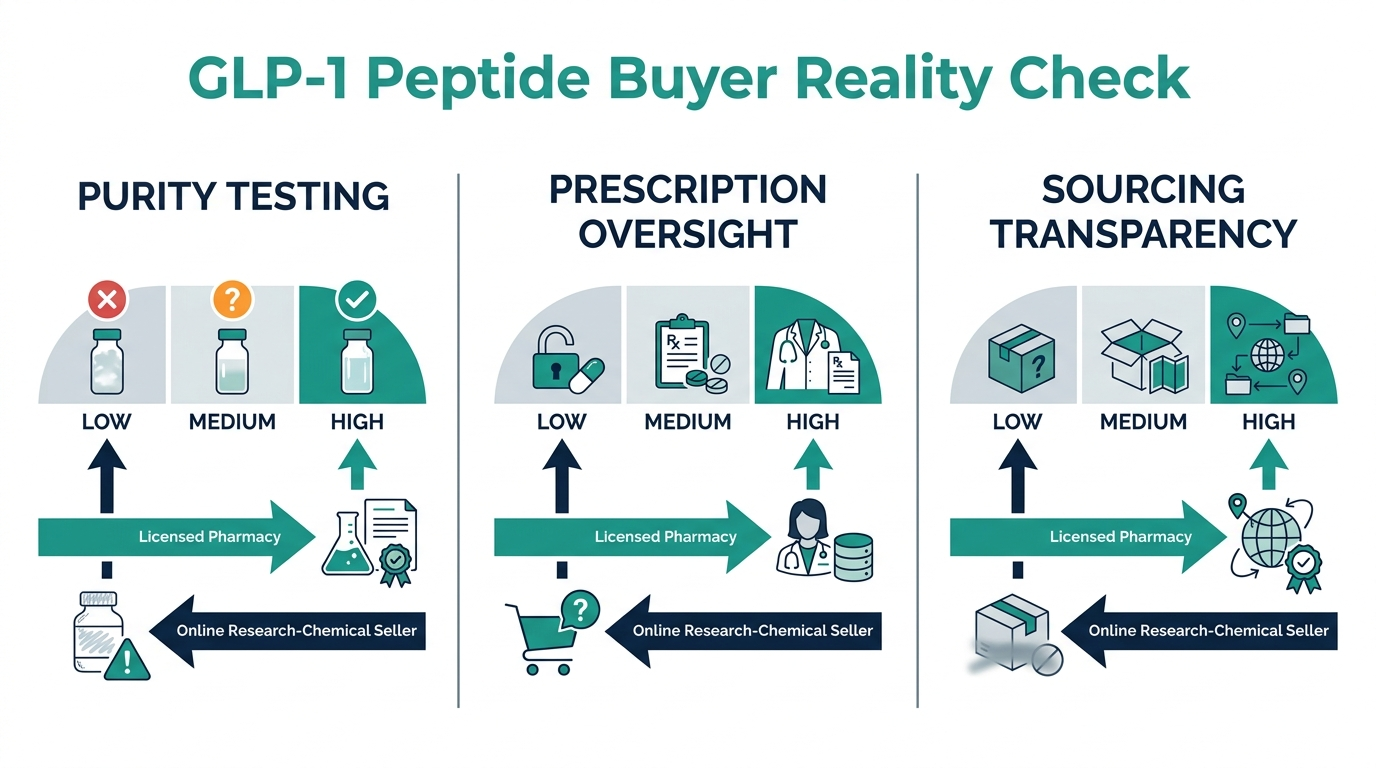
This is the section the YMYL warning is built for, so I am going to be blunt. Buying injectable GLP-1 from a “research use only” vendor is not a clever hack to skip the doctor. It is a bet that an unaccountable seller put the right molecule, at the right purity, at the right concentration, in a sterile vial, and shipped it cold. In 2026, that bet has a bad track record.
Consider the receipts:
- The FDA logged real harm from the compounded and unverified versions. As of early 2025 the agency had received more than 455 adverse-event reports tied to compounded semaglutide and more than 320 tied to compounded tirzepatide, some requiring hospitalization, many from dosing errors with multi-dose vials (FDA / AJMC). On 16 September 2025, the FDA fired off more than 55 warning letters to online sellers of compounded GLP-1s at once.
- Counterfeits are documented. The FDA has identified fraudulent compounded semaglutide and tirzepatide carrying labels of pharmacies that either do not exist or never made the product.
- The “trusted” research vendor failed on the exact molecule. Peptide Sciences, for years the default forum recommendation, voluntarily shut down in March 2026. The independent testing platform Finnrick gave its retatrutide an “E” rating across 37 batches collected December 2024 to March 2026, including a counterfeit flag in November 2025 (Finnrick). The supposed quality leader was, by the end, shipping a product an independent lab would not pass, and then it vanished with people’s open orders.
Now layer on the handling problem that the price tag hides. A research vial does not arrive ready to use. It is a lyophilized (freeze-dried) powder you reconstitute yourself with bacteriostatic water, then dose with an insulin syringe. The concentration math is unforgiving: get a decimal wrong and you are not “slightly off,” you are out by a factor of ten, which is exactly the dosing-error pattern the FDA tied to hospitalizations. I am deliberately not giving you a reconstitution recipe or a dosing protocol here, because this is a weight-loss decision that belongs with a clinician, not a checkout cart.
The myth worth busting: “research-grade means high quality.” It does not. “Research use only” is a legal category about what the seller is allowed to claim, not a quality grade about what is in the vial. The day you inject it, you have left every protection that label pretended to offer, and you are holding all the risk alone.
How to vet a weight-loss telehealth provider before you hand over a card
Not every site with a clean logo and a “board-certified physicians” badge is the same. After watching this space churn through 2025 and 2026, here is the checklist I actually run before trusting a GLP-1 telehealth provider, in the order that catches the most problems fastest.
- Name the pharmacy, then look it up. A legitimate provider will tell you which pharmacy fills your script and let you verify its license with the state board of pharmacy. If the site is vague about “our partner pharmacy” and you cannot get a name, stop. Counterfeit GLP-1 has shipped under labels of pharmacies that do not exist.
- Make them ask the dangerous questions. A real intake screens for the contraindications that matter: personal or family history of medullary thyroid carcinoma or MEN 2 syndrome, pancreatitis, gallbladder disease, and your full medication list. If the questionnaire never asks, the “clinical review” is theater.
- Confirm there is a human you can reach. Side effects from GLP-1 drugs (nausea, vomiting, dehydration) are common in the first weeks. A provider with no way to message a clinician after you start is selling you a vial with extra steps.
- Read how they handle the brand-versus-compounded question. Post-shortage, a trustworthy clinic is upfront about whether you are getting FDA-approved brand product or a compounded version, and why. Evasiveness here is the single biggest tell in 2026.
- Be suspicious of prices that are too good and too fast. Same-day approval with no records, no labs, and a price far under market is the profile of a non-compliant operation, not a bargain.
One quiet truth the comparison blogs gloss over: the “cheapest GLP-1” rankings churn every quarter because the cheapest provider is often the one cutting the corner that gets it shut down next. Optimizing purely for the lowest monthly price is how people ended up holding orders from a vendor that vanished overnight. Buy the provider that will still be answering its phone in six months, not the one with the best coupon this week.
So where should you actually buy peptides for weight loss?
Here is the decision tree I would give a friend, in order:
- Start with a clinician and a blood panel, not a vendor. GLP-1 drugs have real contraindications (a personal or family history of medullary thyroid cancer or MEN 2, for instance) and real side effects. A baseline panel and an intake are not bureaucracy, they are the difference between an experiment you can read and a guess you cannot.
- For semaglutide or tirzepatide, use a legitimate telehealth clinic or your own doctor. That is the only route where the molecule, the dose, the pharmacy, and the accountability all come in one package. Compare on the five non-negotiables above, not on the lowest sticker price.
- For retatrutide, wait. There is no legal way to buy it as a drug in 2026, and the only thing currently sold under that name is grey-market research chemical with a documented failure history. The Phase 3 data is exciting; that is an argument for patience, not for a crypto checkout.
- Ignore the “no prescription needed” sites entirely. In this category, that phrase is not a feature. It is the loudest warning label on the page.
If you take one line from this guide: for weight-loss peptides, you are not buying a molecule, you are buying a system. The drug is the cheap part. The prescription, the named pharmacy, the correct dose, the cold-chain shipping, the monitoring, and someone licensed who is accountable if it goes wrong, that is the expensive part, and it is the part that actually keeps you safe. The grey vial sells you the molecule and quietly hands you every other job in the chain. The clinic sells you the whole system. In 2026, that is the real choice behind “where to buy.”
Telehealth GLP-1 program with provider visits and pharmacy coordination.
Turn what you just learned into action.
Superpower lets you test 100+ biomarkers from home, then re-check them over time so you can actually see progress, physician-reviewed at every step.
Frequently asked questions
Where can I buy semaglutide or tirzepatide for weight loss safely?
Through a licensed telehealth clinic (Ro, Hims, Mochi, Noom, WeightWatchers Clinic, and others) or your own doctor, with a real prescription. Cash-pay ranges from about $149 to $199 a month at mid-tier telehealth up to $900 to $1,350+ for brand-name without insurance, and often much less with coverage. Avoid any site selling injectable GLP-1 with no prescription or clinician.
Is compounded semaglutide still legal in 2026?
Mostly not in the mass-marketed form. The FDA declared the semaglutide shortage resolved on 21 February 2025, with the 503A compounding deadline on 22 April 2025, and tirzepatide’s deadline on 18 February 2025. Courts denied the lawsuits trying to keep those windows open, and in 2026 the FDA moved to permanently restrict mass-marketed compounded GLP-1s. Some clinical-need compounding through named pharmacies remains, but “$99 no-questions semaglutide” is a red flag.
Where can I buy retatrutide?
Nowhere legitimately, as a drug. Retatrutide is investigational and not FDA-approved in 2026, despite strong Phase 3 results showing up to ~30% weight loss. Any site selling “retatrutide” is grey-market research chemical, and that exact compound failed independent testing (an “E” rating across 37 batches, plus a counterfeit flag) at Peptide Sciences before it shut down. The safe move is to wait for approval.
Why is a research vial so much cheaper than a telehealth clinic?
Because the vial is only the molecule. The clinic price bundles a clinician’s prescription, a named pharmacy, the correct dose, cold-chain shipping, and accountability if something goes wrong. With a research vial you perform every one of those jobs yourself, including reconstituting a freeze-dried powder, where a single decimal error changes the dose tenfold, the exact mistake the FDA tied to hospitalizations.
How effective are these peptides for weight loss?
In trials, tirzepatide produced about 22.5% mean body-weight loss at its top dose (SURMOUNT-1), semaglutide about 15%, and investigational retatrutide up to roughly 30% at two years (TRIUMPH-1). Real-world results vary with dose, adherence, diet, and how long you stay on therapy.
Can I buy peptides for weight loss over the counter?
No. Effective weight-loss peptides are prescription injectable drugs, not supplements. Any product sold over the counter or “no prescription needed” as an injectable GLP-1 is operating outside the rules, and is exactly what FDA warning letters and counterfeit alerts target.
Author: Vital Signs Today Editorial Team, [credential]”]. Educational content, not medical advice. This article does not provide dosing protocols or purchasing links for unapproved or research-chemical products. Sources linked inline.
Primary sources (verify live before publish):
– FDA, “FDA clarifies policies for compounders as national GLP-1 supply begins to stabilize”: https://www.fda.gov/drugs/drug-alerts-and-statements/fda-clarifies-policies-compounders-national-glp-1-supply-begins-stabilize
– Pharmacy Times, “FDA Moves to Permanently Close the Door on Compounded GLP-1s”: https://www.pharmacytimes.com/view/fda-moves-to-permanently-close-the-door-on-compounded-glp-1s
– AJMC, “FDA to Restrict Ingredients Used in Mass-Marketed Compounded GLP-1s”: https://www.ajmc.com/view/fda-to-restrict-ingredients-used-in-mass-marketed-compounded-glp-1s-crack-down-on-misleading-ads
– Eli Lilly / NEJM, SURMOUNT-1 tirzepatide results: https://investor.lilly.com/news-releases/news-release-details/lillys-surmount-1-results-published-new-england-journal-medicine
– AJMC, “Retatrutide Achieves Up to 30.3% Average Weight Loss in Phase 3 TRIUMPH-1”: https://www.ajmc.com/view/retatrutide-achieves-up-to-30-3-average-weight-loss-in-phase-3-triumph-1-trial
– Eli Lilly, retatrutide Phase 3 obesity data: https://investor.lilly.com/news-releases/news-release-details/lillys-triple-agonist-retatrutide-delivered-powerful-weight-loss
– Finnrick, Peptide Sciences retatrutide test results: https://www.finnrick.com/products/retatrutide/peptide-sciences
– McDermott, “Semaglutide Shortage Resolved”: https://www.mwe.com/insights/semaglutide-shortage-resolved/
– U.S. News, “Top GLP-1 Weight Loss Medication Providers”: https://health.usnews.com/best-diet/medication/top-glp-1-weight-loss-medication-providers
Want a real clinician to run the numbers, not a guess?
Joi + Blokes is a telehealth clinic that prescribes GLP-1 medication (Zepbound, compounded semaglutide and tirzepatide), hormone therapy (TRT, HRT), thyroid care, and peptides after a real lab panel and clinician review, with no membership or consult fee (prescriptions from about $59/month, lab panels from $149). If the scale will not budge, this is where you find out whether insulin, thyroid, or hormones are the real reason. Here is Joi + Blokes reviewed in full.
Related reading
Related: which GLP-1 telehealth service fits you.
Vital Signs Today may earn a commission if you buy through links on this page. It does not affect our editorial assessments.