
Last updated 18 June 2026. Educational content, not medical advice. GLP-1 receptor agonists are prescription medications in the United States. Talk to a licensed clinician before starting any weight-loss drug.
Short answer: The only legal way to get a GLP-1 peptide for personal use in the US is through a licensed prescriber, and your realistic options in 2026 are brand-name injections through insurance or manufacturer programs ($299 to $1,086 per month), a telehealth platform paired with a compounding pharmacy for patients with documented clinical need ($99 to $399 per month), or a direct-to-consumer program like LillyDirect. The grey-market “research peptide” route for GLP-1 compounds does not exist in any meaningful legal sense, and the FDA spent the first half of 2026 making that clearer by the month.
Buying a legal GLP-1 peptide means going through a prescriber, and your metabolic bloodwork is the first thing they’ll want. One at-home Superpower draw checks 100+ biomarkers, physician-reviewed.
What exactly is a GLP-1 peptide, and why does everyone want it?
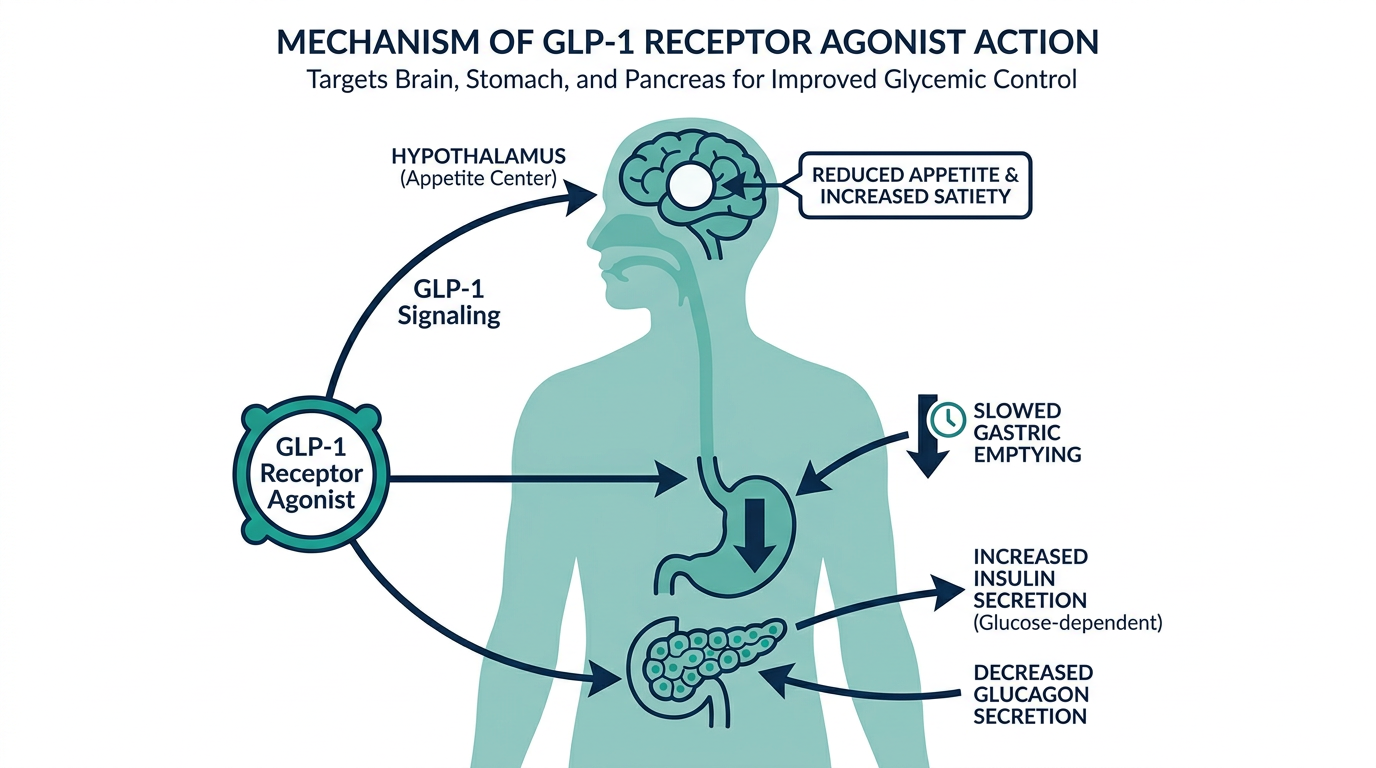
GLP-1 stands for glucagon-like peptide-1, and it is a hormone your own gut produces every time you eat. Its natural job is simple and powerful: it tells your pancreas to release insulin, slows how quickly food empties from your stomach, and carries a satiety signal up the vagus nerve to your brain’s appetite centers. You feel full faster, stay full longer, and eat less without fighting willpower.
The drugs modeled on this hormone, primarily semaglutide and tirzepatide, work by mimicking and amplifying that natural signal for hours or days rather than minutes. In the landmark SURMOUNT-5 trial published in the New England Journal of Medicine in May 2025, tirzepatide at its maximum 15 mg dose produced a mean body-weight reduction of 20.2% over 72 weeks, compared with 13.7% for semaglutide 2.4 mg. Those numbers changed the conversation about what weight-loss pharmacology could accomplish, and they also ignited enormous demand that the supply chain has been struggling to match ever since.
This is not a niche longevity hack. It is the fastest-growing drug category in pharmaceutical history, and the regulatory machinery around it is moving at the same speed.
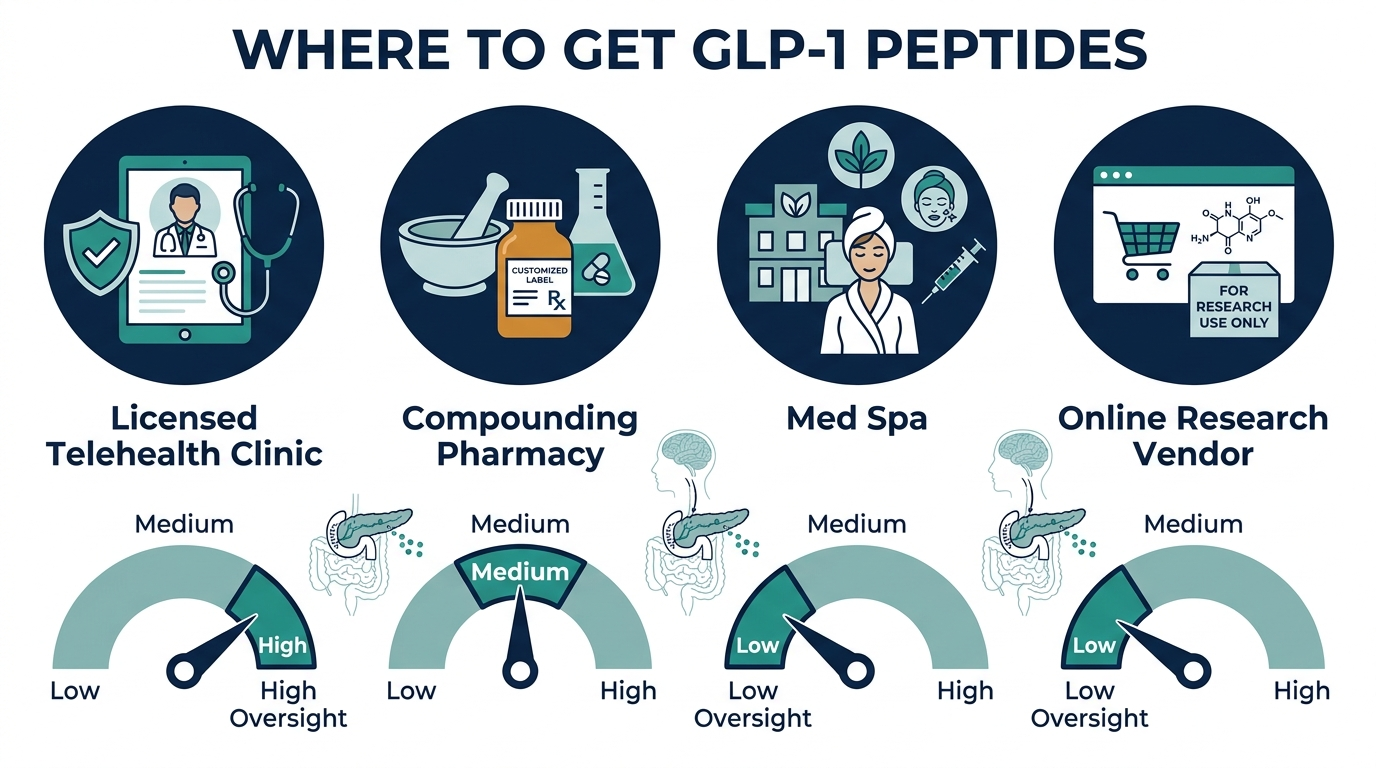
When people search “where to buy GLP-1 peptide,” they usually mean one of three things: where to get a prescription at the lowest possible cost, whether a compounding pharmacy is still a legitimate option after all the recent headlines, or whether research-chemical vendors sell GLP-1 compounds. The answer to each question is different, and getting them confused is an expensive mistake.
Full-body lab membership: 100+ biomarkers, doctor-reviewed, tracked over time.
What happened to cheap compounded GLP-1 peptides?
The simplest way to actually get this done
Superpower is a full-body lab membership that runs 100+ biomarkers, has each result reviewed by a doctor, and tracks your numbers year over year (about $199/year). It is what we point readers to when they would rather get one clean, complete draw than chase single tests one at a time. Here is superpower reviewed in full.
For roughly two years, the affordability story around GLP-1s was built almost entirely on compounding pharmacies. When semaglutide (Ozempic, Wegovy) and tirzepatide (Mounjaro, Zepbound) hit shortage lists in 2022 and 2023, a federal exemption allowed 503A traditional pharmacies and 503B outsourcing facilities to compound copies from bulk drug substances. Dozens of telehealth platforms rushed in, and prices fell to as low as $99 per month for injectable semaglutide.
That window is now largely closed, and the timeline matters because many ads still pretend otherwise:
- October 2, 2024: the FDA declared the tirzepatide shortage resolved.
- February 21, 2025: the FDA declared the semaglutide shortage resolved.
- May 2025: grace periods for 503B outsourcing facilities expired, and large-scale compounding of both drugs became unlawful.
- March 3, 2026: the FDA sent 30 new warning letters to telehealth companies for making false or misleading claims about compounded GLP-1 medications, with a 15-day correction deadline before facing seizure or injunction.
- March 9, 2026: Hims & Hers, which had been referred to the Department of Justice by HHS in February, settled with Novo Nordisk and agreed to cease advertising compounded alternatives, switching to branded Wegovy and Zepbound on its platform.
- April 30, 2026: the FDA proposed formally removing semaglutide, tirzepatide, and liraglutide from the 503B bulks list entirely, with a public comment period running through June 29, 2026.
The practical effect: most of what was marketed as “compounded semaglutide” through a telehealth app is no longer legal for routine dispensing. What remains is a narrow 503A pathway for individual patients when a prescriber documents that the patient needs a formulation with a clinically meaningful difference from the brand-name product, and that individualized compounding cannot be done at more than four prescriptions per calendar month per pharmacy. A few legitimate platforms still work within this window. Many do not.
Personally, I would not take the word of a telehealth ad on this. The gap between what is being sold and what is currently lawful is wider than most buyers realize, and the ones who will absorb the enforcement consequences are the patients who paid for a product that was not properly authorized.
Is there a research-peptide route for GLP-1?
Do not believe anyone telling you that research-chemical vendors sell genuine semaglutide or tirzepatide as “for research use only.” They do not, for two compounding reasons.
First, GLP-1 receptor agonists like semaglutide and tirzepatide are not free molecules sitting in a lab catalog. They are proprietary biologics manufactured under pharmaceutical-grade conditions by Novo Nordisk and Eli Lilly, respectively, with active patents. A research vendor cannot legally synthesize or sell them.
Second, and more practically, any vial labeled “semaglutide, research use only” from a non-licensed source almost certainly contains something else entirely, at unknown purity, with zero independent verification. The FDA has received more than 455 adverse event reports linked to compounded semaglutide and over 320 tied to compounded tirzepatide, many involving severe dosing errors. Those are reports from people who bought from sources that at least claimed to be pharmacies. The risk from truly uncontrolled sources is higher still.
Retatrutide, the experimental triple-agonist peptide sometimes grouped with GLP-1 drugs, is a separate case. It remains in Phase 3 clinical trials as of June 2026, with FDA approval submissions not expected until 2027 or 2028. It cannot be compounded under any current rule, and any product sold as retatrutide online is, in the FDA’s own language, “not legitimate and illegal.” I flag this because research vendors do sell powders labeled as retatrutide, and demand has grown sharply since its trial results leaked. The molecule being named on the vial does not mean the molecule is in the vial.
The three legal routes to a GLP-1 in 2026
Route 1: Brand-name drugs through insurance or manufacturer programs
This is the most straightforward path and the one with the clearest clinical and legal standing.
Semaglutide (Wegovy for weight loss, Ozempic for type 2 diabetes): the official list price for Wegovy is approximately $1,350 per month without insurance. With the NovoCare savings card for commercially insured patients, monthly costs can drop to $25. Medicare Part D now covers semaglutide for patients with a BMI over 27 and cardiovascular disease. GoodRx introduced Wegovy oral pills at under $150 per month for eligible patients through a promotional program in early 2026.
Tirzepatide (Zepbound for weight loss, Mounjaro for type 2 diabetes): the list price for Zepbound runs from $499 to $1,086 per month depending on dose. Lilly’s LillyDirect self-pay program undercuts retail significantly: $299 per month for 2.5 to 5 mg, $399 per month for 7.5 to 10 mg, and $449 per month for 12.5 to 15 mg. This is the most transparent direct-to-consumer pricing in the GLP-1 market right now, and it does not require insurance.
The catch: neither manufacturer’s program covers people who rely on government insurance programs like Medicaid, and the LillyDirect pricing requires purchasing directly through Lilly’s platform rather than a retail pharmacy.
Route 2: Telehealth platform with compliant compounding (narrow window)
A shrinking but still real option. A handful of platforms operate within the 503A individual-patient exception, meaning they work with a licensed prescriber who documents a genuine clinical need for a modified formulation, such as a different concentration, preservative-free preparation, or delivery format. The price range on legitimate platforms in this lane currently runs $99 to $299 per month.
The survivor platforms that appear to be operating compliantly in mid-2026 include Henry Meds ($119 to $179 per month for compounded options, with documented supply constraints), Mochi Health (which emphasizes clinical monitoring and quarterly labs), and Eden Health (flat-rate pricing with prescriber review).
What a compliant platform looks like: a licensed physician, NP, or PA who actually evaluates you rather than rubber-stamping a symptom checklist; medication from a named, verifiable 503A compounding pharmacy; required lab work before your first dose; and structured follow-up with dose adjustments tied to results.
Route 3: Direct branded programs through major telehealth companies
Following its March 2026 settlement, Hims & Hers now offers injectable Wegovy at $299 per month and oral Wegovy at $249 per month through its platform, and Zepbound at $399 per month. Ro Body charges $99 to $145 monthly for programs that include telehealth support. These are branded products at negotiated prices, not compounded alternatives.
This route is legally the cleanest and the most likely to survive further enforcement changes. The tradeoff is that you are paying for the brand premium, though the pricing at these telehealth companies is often below the brand list price.
Telehealth GLP-1 program with provider visits and pharmacy coordination.
GLP-1 provider comparison: what you actually get at each price point
| Provider | Medication | Monthly cost | Branded or compounded | Clinical monitoring |
|---|---|---|---|---|
| LillyDirect | Zepbound (tirzepatide) | $299–$449 | Branded FDA-approved | None built-in, through your prescriber |
| Hims & Hers | Wegovy / Zepbound | $249–$399 | Branded FDA-approved | Async check-ins |
| Ro Body | Semaglutide program | $99–$145 | Branded or compounded | Async, some labs |
| Henry Meds | Compounded semaglutide | $119–$179 | Compounded (503A) | Async, limited |
| Mochi Health | Compounded or branded | $149–$299 | Both options | Quarterly monitoring, specialist prescribers |
| Noom Med | Compounded or branded | $149–$199 | Both options | Behavior coaching + clinical |
| Brand via insurance | Wegovy or Zepbound | $0–$25 (copay) | Branded FDA-approved | Your prescriber |
Prices as of June 2026 and change frequently. Verify directly with each provider before committing.
Two things in that table worth flagging. First, Mochi Health stands out for including actual clinical monitoring rather than asynchronous questionnaires, which matters more than most buyers realize when side effects emerge or doses need adjusting. Second, the insurance copay of $0 to $25 per month for Wegovy is only available to commercially insured patients whose plan covers it for weight management, which is not yet universal.
What nobody tells you about dosing and self-administration
GLP-1 drugs are administered as subcutaneous injections, which means into the fatty tissue of the abdomen, thigh, or upper arm, once a week. The pen is prefilled and dose-metered, which sounds simple but generates more questions in practice than the packaging suggests.
A few insider realities that the telehealth onboarding screens often gloss over:
Injection site rotation matters. Using the same spot repeatedly creates lipohypertrophy, a lump of thickened fat tissue that absorbs the drug unpredictably. Rotating between the abdomen, both thighs, and both upper arms on a tracked schedule keeps absorption consistent.
Nausea is a timing problem as much as a dosing problem. Most nausea from GLP-1 drugs peaks 4 to 6 hours after injection. Taking the weekly shot before bed rather than in the morning means you sleep through the worst of it. Almost no one tells new patients this before their first dose.
Muscle loss is the underreported tradeoff. A 2025 meta-analysis found that roughly one-third of weight lost on semaglutide is lean mass, not fat, particularly in patients who do not do resistance training alongside the drug. This is not a disqualifying reason to avoid GLP-1 therapy, but it is a reason to lift weights and track protein intake concurrently. The drug does not distinguish between what you wanted to lose and what you did not.
Personally, the muscle-loss data is the single piece of information I would give every new GLP-1 patient before they start, because it is the finding most likely to change how they use the drug rather than whether they use it.
What the SURMOUNT-5 data means for which drug to pick
If you have the choice between semaglutide and tirzepatide, the clinical data now clearly favors tirzepatide for weight loss. The SURMOUNT-5 trial was a head-to-head Phase 3b comparison, 72 weeks, branded products at maximum approved doses, adults with obesity and no type 2 diabetes. Tirzepatide: 20.2% mean body-weight loss. Semaglutide 2.4 mg: 13.7%.
What that means in practice: a 250-pound person loses an average of about 50.5 lbs on tirzepatide versus 34.25 lbs on semaglutide, and that gap is statistically and clinically significant, not just marginal.
Tirzepatide’s advantage comes from its dual mechanism. Semaglutide is a GLP-1 receptor agonist. Tirzepatide is both a GLP-1 and a GIP (glucose-dependent insulinotropic polypeptide) receptor agonist. The added GIP activity appears to enhance fat cell metabolism and augment the satiety effect beyond what GLP-1 alone achieves.
The clinical choice is still a conversation with a prescriber, because individual tolerability varies, and semaglutide’s longer safety record in some patient populations matters to some clinicians. But anyone presenting tirzepatide as “not meaningfully different” from semaglutide has not read the trial.
How to tell a legitimate GLP-1 telehealth provider from a risky one
The regulatory crackdown of 2025 to 2026 has created a predictable problem: the bad actors have not disappeared, they have just changed their marketing copy. A provider that was advertising “compounded semaglutide, no prescription required” in January 2026 may be advertising “prescription-required personalized therapy” in June 2026 while running the same operation.
The tells that separate a compliant provider from one operating on borrowed time:
Five green flags:
1. A named, verifiable compounding pharmacy or a recognized brand-name supply chain, not a vague “licensed pharmacy partner.”
2. Baseline labs required before your first prescription, not optional.
3. A clinician who can explain why your specific formulation, if compounded, qualifies under the 503A individual-patient exception.
4. Follow-up appointments with dose adjustments tied to results, not a standing refill button.
5. No claims that their compounded version is “just as good as” or “bioequivalent to” Wegovy or Zepbound, because the FDA has specifically cited that language as deceptive.
Three red flags:
1. Same-day prescriptions with no clinical review, or a checkout flow that looks more like a supplement store than a medical intake.
2. Prices dramatically below the market floor of $99 per month with no explanation of how that is possible.
3. Marketing language that treats the FDA enforcement as overreach or conspiracy, which is a signal they are not planning to comply.
Don’t just read about your health, track it.
A single result is a snapshot. Superpower re-tests 100+ markers over time so you can watch them move as you change sleep, food, and training.
Frequently asked questions
Is it legal to buy a GLP-1 peptide online without a prescription?
No. GLP-1 receptor agonists are prescription drugs under US federal law. Any website selling semaglutide, tirzepatide, or similar compounds without a valid prescriber-patient relationship is operating illegally. That includes sites selling them as “research peptides,” because GLP-1 branded biologics cannot be legally sold in that category.
What happened to cheap compounded semaglutide?
The FDA resolved the semaglutide shortage in February 2025 and tirzepatide’s in October 2024, ending the legal exemption that allowed mass compounding. 503B outsourcing facilities can no longer compound these drugs. 503A pharmacies retain a narrow individual-patient exception that requires documented clinical justification. The FDA is now proposing to close even the 503B bulks pathway entirely, with a final rule expected after the June 29, 2026 comment period closes.
Is tirzepatide better than semaglutide for weight loss?
By the clinical evidence, yes. The SURMOUNT-5 head-to-head trial showed 20.2% mean body-weight loss with tirzepatide 15 mg versus 13.7% with semaglutide 2.4 mg over 72 weeks in adults with obesity. Individual results vary, and a prescriber should guide the choice based on your health history.
What is the cheapest legal way to get a GLP-1 drug in 2026?
If you have commercial insurance that covers Wegovy, your copay can be as low as $25 per month. Without insurance, the lowest documented prices from compliant sources in June 2026 are around $99 per month from platforms like Ro Body, and $149 per month for Noom Med’s microdose program, though these require clinical intake and a prescriber’s determination that a compounded option is individually appropriate. Lilly’s LillyDirect program offers branded Zepbound at $299 per month for 2.5 to 5 mg without insurance or membership.
Can I get a GLP-1 drug without injections?
Oral semaglutide (Rybelsus for diabetes; oral Wegovy approved for weight management in 2024) is a real option. GoodRx introduced access to oral Wegovy at $149 per month for 1.5 mg and 4 mg doses early in 2026. Hims & Hers offers oral Wegovy at $249 per month. Absorption is lower than injection, but for patients who cannot self-inject, it is a clinically viable path.
What labs should I get before starting a GLP-1 drug?
At minimum, a prescriber should review your HbA1c (to confirm or rule out type 2 diabetes), fasting glucose, lipid panel, thyroid function (TSH), kidney function (creatinine, GFR), and a basic metabolic panel. A comprehensive panel is better because GLP-1 drugs affect multiple metabolic systems and your baseline shapes what your follow-up labs will mean. Knowing your numbers before you start is the only way to actually read the results after.
What is retatrutide, and can I buy it?
Retatrutide is a triple agonist (GLP-1, GIP, and glucagon receptors) in Phase 3 clinical trials with Eli Lilly. As of June 2026, it is not FDA-approved, cannot be legally compounded, and is not available through any legitimate source outside of registered clinical trials. Any vial sold as retatrutide outside a trial is illegal and unverified.
Author: Vital Signs Today Editorial Team. Educational content, not medical advice. Sources linked inline.
Primary sources:
– FDA: Proposes excluding semaglutide, tirzepatide, liraglutide from 503B bulks list (April 30, 2026)
– FDA: Clarifies policies for compounders as GLP-1 supply stabilizes
– NEJM: SURMOUNT-5: Tirzepatide vs. Semaglutide for Obesity (May 2025)
– Medical News Today: FDA proposes ban on bulk compounding of semaglutide, tirzepatide
– Frier Levitt: FDA warning letters and Hims-Novo Nordisk deal signal new era for compounded GLP-1 drugs
– Telehealth.org: FDA warns telehealth companies over compounded GLP-1 marketing (March 2026)
– LillyDirect: Zepbound self-pay pricing
– GoodRx: Wegovy cost and savings guide
– freemedicaljournals.com: Retatrutide FDA approval status 2026
Telehealth GLP-1 program with provider visits and pharmacy coordination.
Want a real clinician to run the numbers, not a guess?
Joi + Blokes is a telehealth clinic that prescribes GLP-1 medication (Zepbound, compounded semaglutide and tirzepatide), hormone therapy (TRT, HRT), thyroid care, and peptides after a real lab panel and clinician review, with no membership or consult fee (prescriptions from about $59/month, lab panels from $149). If the scale will not budge, this is where you find out whether insulin, thyroid, or hormones are the real reason. Here is Joi + Blokes reviewed in full.
Related reading
Vital Signs Today may earn a commission if you buy through links on this page. It does not affect our editorial assessments.