
Last updated 30 July 2026. Educational content, not medical advice. Consult a licensed clinician before starting any new supplement.
Short answer: For joint and tendon support, 15 g of collagen peptides taken with vitamin C roughly one hour before exercise produced double the collagen synthesis markers in a peer-reviewed clinical trial. For sleep quality, 15 g taken one hour before bed significantly reduced nighttime awakenings in a 2024 randomized crossover study. For skin and general use, the most honest answer is: consistency beats precision, but pairing with vitamin C at any meal matters more than the clock.
Timing collagen around workouts or sleep only helps if your body has what it needs. What do your markers show? One at-home Superpower draw checks 100+ biomarkers, physician-reviewed.
Timing is the question every collagen brand avoids giving a direct answer to, because the real answer depends on what you are trying to fix. Joint repair after a hard run is a different biological problem than skin hydration at 40, which is a different problem than fragmented sleep. This guide maps each goal to what the actual clinical literature says, names specific doses and study authors, and cuts through the noise that fills most “when to take collagen” articles.
Why does timing matter at all for collagen peptides?
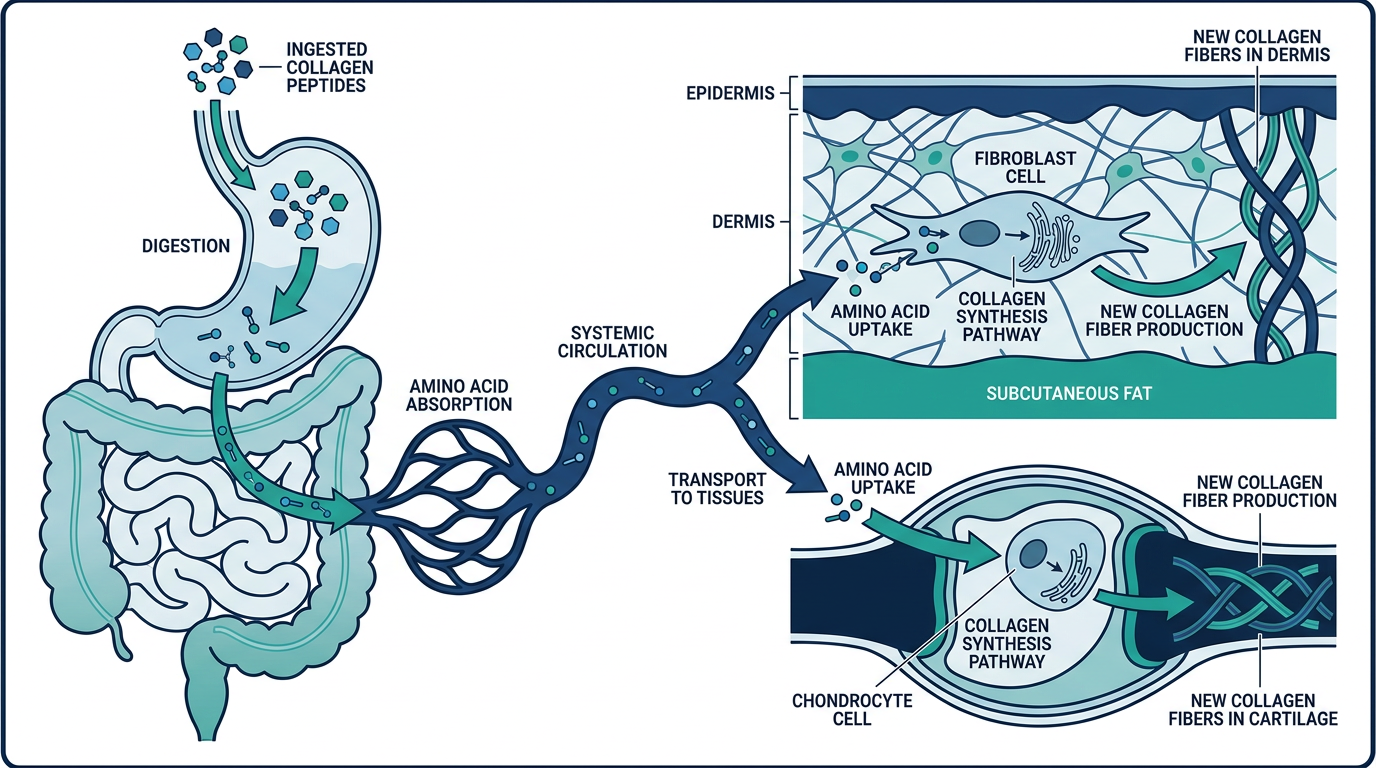
Most supplements are absorbed on roughly the same schedule regardless of when you swallow them. Collagen peptides are genuinely different in one specific context: the window around physical exercise.
When you load a tendon mechanically, blood flow to the connective tissue spikes for a short period, and that spike is when the tendon is primed to uptake amino acids for repair and synthesis. Shaw et al. (2016) tested this directly. Eight healthy men consumed either a placebo, 5 g, or 15 g of vitamin C-enriched gelatin one hour before six minutes of jump rope. The 15 g group showed double the circulating N-terminal propeptide of procollagen-I (a direct marker of new collagen synthesis) compared to placebo at 4 hours post-exercise, and that doubling was maintained across the full 72-hour measurement window. The 5 g dose showed no meaningful advantage over placebo.
That study is the single strongest piece of timing evidence in the collagen literature. Read it carefully before letting any brand convince you their once-daily-whenever capsule is equivalent.
Outside of exercise, the evidence for strict timing is weaker. A 2024 randomized crossover trial at the University of East Anglia found that 15 g of bovine collagen peptides taken one hour before bed reduced objective nighttime awakenings (polysomnography: 21.3 vs. 29.3 awakenings, p=0.028) and improved next-day cognitive Stroop test accuracy in 13 physically active males with sleep complaints. The mechanism almost certainly runs through glycine: 15 g of hydrolyzed collagen delivers approximately 3.5 g of glycine, and glycine taken before bed has been shown in separate trials to lower core body temperature and shorten time to slow-wave sleep.
For skin, joint, and hair goals without exercise in the picture, a 2024 Frontiers in Nutrition crossover study tracked plasma amino acid absorption after a single 10 g dose of collagen hydrolysate taken after an overnight fast. Peak free hydroxyproline appeared within 100 to 130 minutes in all subjects, and critically, the results were comparable across fish, porcine, and bovine sources and across molecular weight ranges. The practical read: the body absorbs collagen peptides reliably and the source matters less than brands suggest, but the timing of a specific meal is not a major determinant of absorption.
The takeaway: timing has a proven impact for one goal only, which is connective tissue synthesis around exercise. For everything else, choosing a time you will actually stick to is more important than optimizing the clock.
What is the best time to take collagen peptides for joint and tendon health?
Sixty minutes before your workout, paired with vitamin C.
This is the one timing recommendation with direct clinical support rather than theoretical rationale. The Shaw study did not just measure amino acids in blood; it measured PINP, which is a biomarker for actual new collagen being assembled. The 15 g dose with vitamin C at the one-hour mark represents the point at which circulating collagen-derived peptides (specifically Pro-Hyp and Gly-Pro-Hyp di- and tripeptides) peak in plasma, timed to coincide with exercise-induced mechanical loading of the tendon.
Do not believe any brand that tells you the pre-workout window applies to building muscle. Collagen peptides are approximately 0% leucine, which is the amino acid that triggers muscle protein synthesis. For hypertrophy, collagen before the gym does nothing whey protein could not do better. The pre-workout timing applies specifically to tendons, ligaments, cartilage, and bones, where the collagen-derived peptides are the primary structural building blocks.
Personally, I find the pre-workout window the easiest to remember precisely because you are already doing something intentional before the gym. Setting a 60-minute reminder alongside the gym bag is a habit stack that requires no extra discipline.
The dose from the Shaw study is 15 g, not the 10 g most canisters default to as a serving size. Some brands do not tell you this because it means you go through the container faster. Vital Proteins Collagen Peptides provides 20 g per serving at roughly $1.64 per serving, which means a single scoop exceeds the studied dose. Mixing with a citrus drink or a 250 mg vitamin C tablet covers the cofactor requirement.
Full-body lab membership: 100+ biomarkers, doctor-reviewed, tracked over time.
When should you take collagen for skin, hair, and nails?
Morning is practical, not magical. There is no clinical study showing that skin hydration or nail strength improves faster with morning collagen versus afternoon collagen. The brands promoting a fixed morning window are extrapolating from the fasted-state absorption argument, which says that taking collagen before breakfast avoids competition with other dietary proteins.
The competition argument sounds plausible but largely does not hold in practice. A normal breakfast containing 20 to 30 g of protein does not meaningfully block collagen peptide absorption, because collagen-specific tripeptides like Pro-Hyp and Gly-Pro-Hyp use specialized intestinal transporters rather than competing with bulk amino acid absorption. The 2024 Frontiers in Nutrition crossover study confirmed consistent plasma absorption across all tested sources after a 10-hour overnight fast, but that design does not tell us that a fasted state outperforms a fed one, only that it works in a fasted state.
What does matter for skin collagen synthesis is vitamin C. Collagen’s triple-helix structure requires hydroxylation of proline residues by the enzyme prolyl hydroxylase, which uses vitamin C as a cofactor. Without adequate vitamin C, the amino acids from your supplement arrive at the synthesis site and wait at a bottleneck. Pairing morning collagen with orange juice, a kiwi, or a 250 mg supplement is the practical answer for this goal, because vitamin C from fruit tends to be consumed at breakfast rather than other meals.
For skin specifically, the published dose range in clinical trials is wide: 2.5 g daily produced measurable improvements in dermal collagen density in the VERISOL study, while larger trials used 10 g. Healthline’s review of the research summarizes most skin studies as clustering between 2.5 g and 10 g. If your goal is visible skin change by week 8 to 12 (the typical timeline from trials), a 10 g dose with vitamin C at any reliable point in your day is more important than whether the clock reads 7:00 AM or 12:00 PM.
Is there a circadian rhythm argument for nighttime collagen?
Yes, and it is more interesting than most supplement blogs acknowledge.
A 2020 paper in Nature Cell Biology (Pickard et al.) demonstrated that collagen-I protein production in fibroblasts oscillates on a 24-hour clock, with peak abundance occurring during the nighttime phase. The chaperone protein BiP ramps up in advance of this nightly surge to prevent misfolding, which suggests the body specifically prepares for a concentrated collagen synthesis burst during sleep. A separate 2026 review in the Journal of Cosmetic Dermatology confirmed that circadian clock genes regulate the key enzymes of skin collagen metabolism and that disrupted circadian rhythm directly impairs repair capacity.
The argument for nighttime collagen is therefore: supply the substrate (amino acids) just before the body’s built-in collagen synthesis window opens. This is not proven in an intervention study the way the pre-exercise timing is, but it is mechanistically coherent rather than speculative.
What the 2024 sleep trial added to this picture is that nighttime collagen has a measurable secondary benefit (fewer awakenings, better next-day cognition) through glycine, independent of whether the circadian synthesis argument is correct. So the nightly dose does at least two things simultaneously: it may feed the nocturnal collagen burst, and it demonstrably improves sleep architecture for people with fragmented nights.
Practically: if your primary goal is skin repair or general anti-aging, splitting your dose so that 10 g comes at night and 5 g comes in the morning is a reasonable protocol that respects both the circadian data and the vitamin C timing logic.
Should you take collagen before or after a workout?
Before, if the goal is tendons and joints. After, if the goal is convenience with no joint-specific agenda.
The pre-exercise timing advantage (Shaw 2016) is specifically about connective tissue synthesis, not muscle recovery. For muscle protein synthesis, collagen peptides are a poor choice regardless of timing because of their near-zero leucine content and low methionine content. A whey or casein protein shake after training is a better choice for muscle repair.
Where the confusion comes from: many “post-workout collagen” recommendations are carried over from the general “protein window” logic for muscle, which does not transfer to collagen. The tendons that attach those muscles together respond to a different protocol.
One nuance worth knowing: if you train in the morning in a fasted state, taking collagen beforehand also doubles as a light pre-workout amino acid load that can reduce muscle breakdown during fasted exercise, even if it is not optimizing muscle synthesis. This is a side benefit, not the primary rationale.
For practical athlete scheduling, the 60-minute pre-workout window also conveniently separates collagen from a post-workout protein shake, which prevents any theoretical amino acid competition and allows both to absorb cleanly.
| Goal | Best timing | Dose | Must-pair |
|---|---|---|---|
| Tendon / joint repair | 60 min before exercise | 15 g | Vitamin C (48–250 mg) |
| Skin hydration / anti-aging | Morning with breakfast, or before bed | 10 g | Vitamin C |
| Sleep quality / reduced fragmentation | 60 min before bed | 15 g | None required |
| Bone density support | Morning or with largest meal | 10–15 g | Vitamin C + calcium-rich meal |
| General / hair + nails | Whenever most consistent | 10 g | Vitamin C |
Does it matter if you take collagen on an empty stomach?
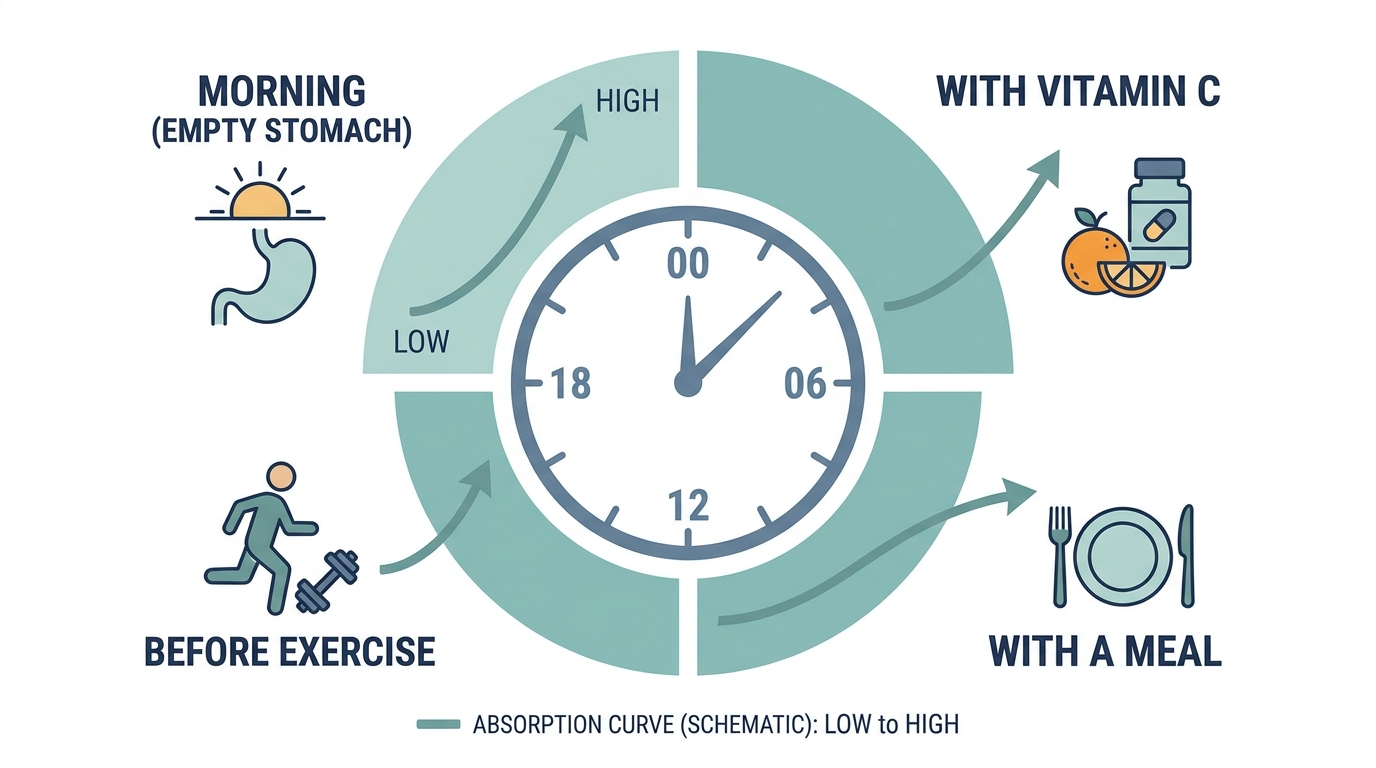
Less than you have probably been told.
The empty-stomach argument relies on the idea that other dietary proteins outcompete collagen peptides for intestinal absorption. The logic sounds clean, but the mechanism does not fully apply. Collagen-derived bioactive peptides, particularly Pro-Hyp and Gly-Pro-Hyp tripeptides, are absorbed via peptide transporter PEPT1 rather than through the same free amino acid channels that compete with larger protein loads. The Frontiers in Nutrition 2024 crossover trial used a fasted state for methodological consistency, not because fasted absorption is clinically superior.
Personally, I take collagen with breakfast rather than before it, because the practical effect of “before breakfast” is that many people forget it entirely during a rushed morning. Compliance over 90 days matters far more than whether the stomach had food in it.
The one real caveat: if you have a high-protein breakfast with 40+ g of protein, taking collagen at the same moment may slightly dilute the relative proportion of collagen-specific peptides reaching your tissue. Spacing it 20 to 30 minutes before eating is a reasonable middle ground, not a strict requirement.
What happens if you take collagen at the wrong time?
Nothing dramatic. The myth-buster version: there is no “wrong time” for collagen in the sense that you are wasting the supplement. Taking collagen at noon when your goal is tendon repair is not a disaster; it is just suboptimal compared to the pre-exercise protocol. The baseline benefit of daily collagen supplementation, particularly for skin, comes from consistent amino acid availability over weeks and months rather than from any single dose’s precise timing.
The real cost of bad timing is opportunity cost, not damage. Someone treating a chronic Achilles injury who takes collagen at dinner instead of before physical therapy is not harming themselves, they are missing a window that could accelerate recovery. That is a meaningful difference if the goal is to return to training faster, but it is not a safety issue.
Hydrolyzed type I & III collagen peptides, third-party tested, unflavored.
How long before you see results from collagen peptides?
Timeline matters as much as timing, and the two get conflated constantly.
The clinical evidence clusters around these windows by goal:
- Skin hydration and elasticity: 8 to 12 weeks at 2.5 to 10 g daily. A 2019 meta-analysis of 11 randomized trials found statistically significant improvements in skin elasticity at 8 weeks and skin hydration at 12 weeks.
- Joint comfort during activity: as early as 3 to 5 weeks for subjective comfort scores, with more robust data at 12 to 24 weeks. Research published in the British Journal of Sports Medicine on athletes found reduced joint pain at 24 weeks.
- Hair and nail growth: 3 months is the realistic minimum; most published trials showing nail brittleness reduction ran for 24 weeks.
- Bone density: this is a long game. Studies showing measurable changes in bone biomarkers run 12 months or longer.
The pattern: collagen is a slow compound. The people who quit after three weeks because their skin looks the same are quitting precisely when the tissue-level changes are just beginning to accumulate.
Don’t just read about your health, track it.
A single result is a snapshot. Superpower re-tests 100+ markers over time so you can watch them move as you change sleep, food, and training.
Frequently asked questions
Is morning or night better for collagen peptides?
For most people without a specific exercise-timing goal, night has a slight edge based on current evidence. The 2024 University of East Anglia study found that 15 g before bed reduced sleep fragmentation and improved next-day cognition, and the circadian biology literature shows that fibroblast collagen synthesis peaks during the nighttime repair cycle. Morning is easier for habit-stacking with coffee and vitamin C, which makes it the more practical choice for many. The honest answer is that either works if you are consistent, and consistency over 90 days outperforms perfect timing executed sporadically.
Should I take collagen before or after exercise?
Before exercise, for tendon and joint goals specifically. Shaw et al. (2016) demonstrated double the collagen synthesis markers when 15 g of gelatin with vitamin C was taken 60 minutes before loading the tendon. Post-workout collagen has not shown the same connective-tissue signal. For muscle recovery, switch to a leucine-rich protein source like whey instead.
Can I take collagen with coffee?
Yes. Hot coffee does not degrade collagen peptides in a meaningful way, and the habit-stacking benefit of adding a scoop to your morning coffee is a genuine aid to consistency. Add a small vitamin C source alongside (citrus juice, berries, or a supplement) to cover the synthesis cofactor requirement.
How much collagen should I take per day?
The studied range spans from 2.5 g (VERISOL skin trials) to 20 g (larger athletic trials). For a practical general dose, 10 g covers most skin and nail goals. For the pre-exercise tendon protocol, the Shaw study used 15 g. Going above 20 g daily has no additional benefit demonstrated in published research, and the excess amino acids are simply oxidized for energy.
Does collagen peptide type (I, II, III) affect timing recommendations?
Type matters more than timing for specific goals. Type I and III collagen peptides (bovine hide, marine) are the relevant types for skin, hair, nails, and tendons. Type II (chicken sternal cartilage) is the type studied for joint cartilage specifically, often at lower doses of 40 mg undenatured collagen (UC-II) rather than hydrolyzed grams. The pre-exercise timing protocol was tested with gelatin (Type I), not Type II, so do not assume the 15 g pre-workout protocol applies to UC-II collagen for knee cartilage.
Is it safe to take collagen every day?
Published human trials running 6 to 12 months at doses up to 20 g daily have not reported serious adverse events in healthy adults. WebMD’s ingredient monograph notes that collagen peptides appear safe for most people, with mild digestive discomfort as the most commonly reported side effect. People with fish or shellfish allergies should choose bovine collagen and check sourcing carefully. This is educational information; talk to your doctor if you have a specific health condition.
Can collagen peptides replace a protein supplement?
No, and conflating them is one of the most common supplement mistakes. Collagen is not a complete protein. It is missing tryptophan entirely and is very low in leucine, the key trigger for muscle protein synthesis. If you are supplementing for muscle, a whey or plant protein supplement remains necessary. Collagen supplements sit alongside a protein strategy, not instead of it.
Hydrolyzed type I & III collagen peptides, third-party tested, unflavored.
Author: Vital Signs Today Editorial Team, [credential]”]. Educational content, not medical advice. Sources linked inline.
Primary sources:
– Shaw G, et al. “Vitamin C–enriched gelatin supplementation before intermittent activity augments collagen synthesis.” Am J Clin Nutr 2017;105(1):136-143. https://pmc.ncbi.nlm.nih.gov/articles/PMC5183725/
– Aussieker T, et al. “Collagen peptide supplementation before bedtime reduces sleep fragmentation and improves cognitive function in physically active males with sleep complaints.” Eur J Nutr 2024;63:799-811. https://pmc.ncbi.nlm.nih.gov/articles/PMC10799148/
– de Leeuw CA, et al. “Absorption of bioactive peptides following collagen hydrolysate intake: a randomized, double-blind crossover study in healthy individuals.” Front Nutr 2024;11:1416643. https://pmc.ncbi.nlm.nih.gov/articles/PMC11325589/
– Pickard A, et al. “Circadian control of the secretory pathway maintains collagen homeostasis.” Nat Cell Biol 2019;22(1):74-86. https://pmc.ncbi.nlm.nih.gov/articles/PMC7613259/
– Wang Y, et al. “Targeting Circadian Rhythm for the Regulation of Skin Collagen Metabolism.” J Cosmet Dermatol 2026. https://onlinelibrary.wiley.com/doi/10.1111/jocd.70638
– Healthline: How Much Collagen Per Day. https://www.healthline.com/nutrition/how-much-collagen-per-day
– WebMD Collagen Peptides monograph. https://www.webmd.com/vitamins/ai/ingredientmono-1606/collagen-peptides
– Vital Proteins Collagen Peptides product page. https://www.vitalproteins.com/products/vp-collagen-peptides
Related reading
Vital Signs Today may earn a commission if you buy through links on this page. It does not affect our editorial assessments.