
Last updated 22 July 2026. Educational content, not medical advice. BPC-157 is not FDA-approved as a finished drug. Consult a licensed clinician before using any peptide.
Short answer: The safest place to get BPC-157 in 2026 is a licensed telehealth clinic, such as Defy Medical, AgelessRx, or Invigor Medical, where a physician prescribes it, a 503A compounding pharmacy fills it, and the whole program runs $150 to $400 per month. The research-vendor route is still legal to purchase but remains “for laboratory use only,” carries real contamination risk (28% of vendors failed Finnrick’s independent testing in 2026), and puts every responsibility on you. A third option, the licensed compounding route, is actively being rebuilt: on April 22, 2026, the FDA removed BPC-157 from its restricted Category 2 list, and a formal PCAC committee review is scheduled for July 23 to 24, 2026 at the FDA White Oak Campus in Silver Spring, Maryland, which could restore full compounding access within months.
Vetting BPC-157 vendors and telehealth clinics? Start with what your own bloodwork actually shows before you spend. One at-home Superpower draw checks 100+ biomarkers, physician-reviewed.
Why is everyone suddenly searching “where to buy BPC-157”?
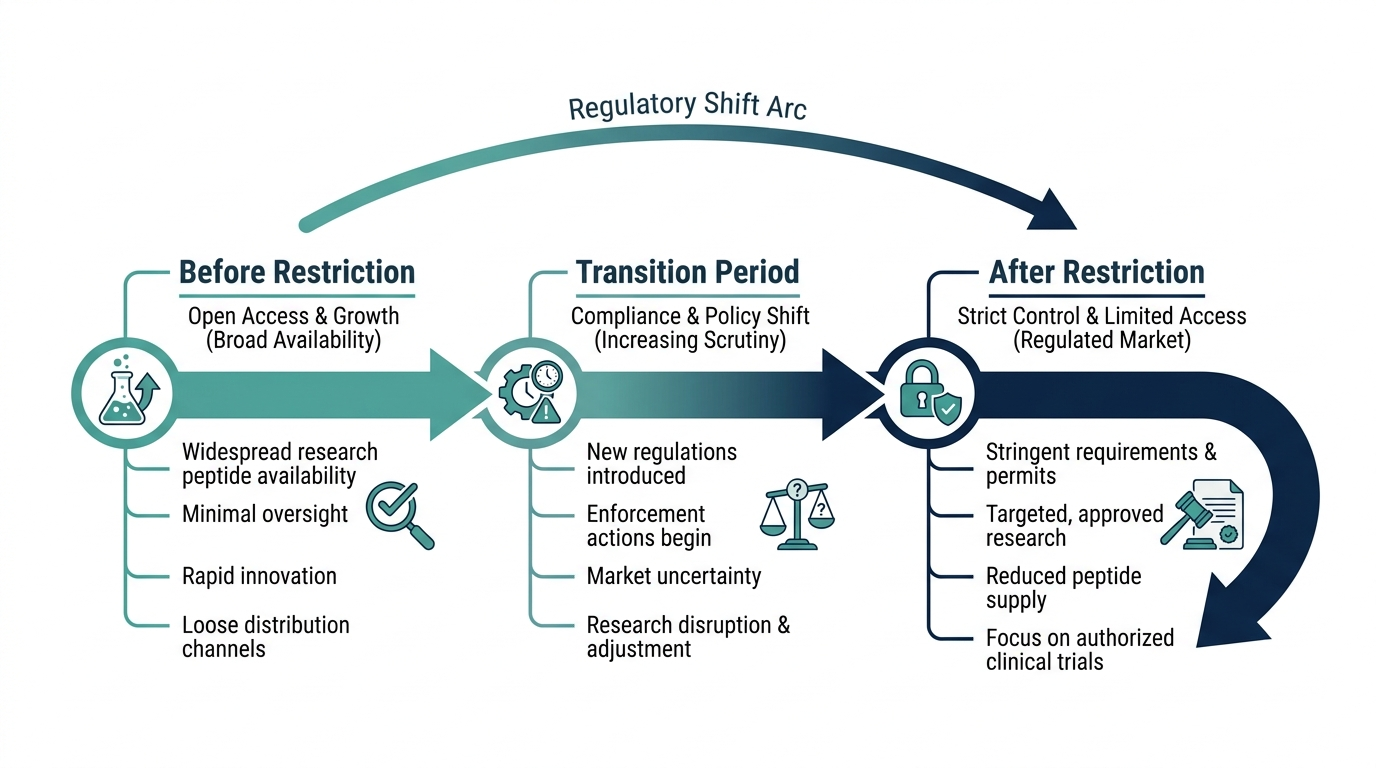
The answer is a three-year regulatory whiplash that left buyers confused about what is even legal. In late 2023, the FDA placed BPC-157 on its 503A Category 2 list, the substances it deemed to “present significant safety risks,” effectively blocking licensed compounding pharmacies from making it. For the roughly two years that followed, anyone who wanted BPC-157 had only one real option: research-chemical vendors, with all the uncertainty that involves.
Then the ground shifted. On February 27, 2026, HHS Secretary Robert F. Kennedy Jr. announced a formal review of 14 previously restricted peptides, including BPC-157. By April 22, 2026, the FDA officially removed BPC-157 from Category 2. The PCAC meeting on July 23 to 24, 2026, will decide whether to recommend adding it to the positive 503A Bulks List, and a favorable vote would reopen the licensed compounding lane for the first time in nearly three years.
That sequence is why people are searching now. The conversation shifted from “is this illegal?” to “when does it get legal again, and where do I go in the meantime?” Those are two very different questions, and this article answers both.
Full-body lab membership: 100+ biomarkers, doctor-reviewed, tracked over time.
What exactly is BPC-157, and why do people want it?
BPC-157 stands for Body Protection Compound 157. It is a 15-amino-acid synthetic peptide derived from a sequence in human gastric juice, first isolated and studied by Croatian researcher Predrag Sikiric and colleagues at the University of Zagreb starting in the early 1990s. The “157” is simply a lab designation, not a potency rating.
The reason it became the most-searched research peptide in the world is a convergence of mechanisms. BPC-157 activates VEGFR2 (vascular endothelial growth factor receptor 2) through the Akt-eNOS signaling axis, which drives angiogenesis, the formation of new blood vessels, at injury sites. It also reduces pro-inflammatory cytokines including TNF-alpha, IL-6, and IFN-gamma, and upregulates fibroblast activity for connective tissue repair. Put simply: in animal models, it accelerates healing across tendons, ligaments, muscle, bone, and gut lining at the same time.
The honest caveat is that the human data is thin. A 2025 narrative review published in PMC (PMC12446177) identified only three human studies: a 2021 knee pain trial where 14 of 16 patients had significant relief with intraarticular injection, a 2024 interstitial cystitis study where 12 participants achieved 80 to 100 percent symptom resolution, and a 2025 safety study in two healthy adults that found no adverse events with intravenous infusion. No randomized controlled trial in humans has been completed and published. The review concluded BPC-157 “should be considered investigational” until well-designed human trials are done.
That gap between dramatic animal results and nearly nonexistent human trials is the central tension in every BPC-157 conversation. Knowing it upfront makes you a smarter buyer.
What is the legal status of BPC-157 in the United States right now?
Three distinct legal realities apply to BPC-157 in mid-2026, and most buyers do not realize they are different things.
The research-vendor lane: Selling BPC-157 labeled “for research use only” and “not for human use” remains legal. The compound is not a controlled substance. Vendors can ship it, and you can purchase it. The legal protection that label provides to the seller evaporates the moment you use it on yourself, which transfers every risk entirely to you with zero recourse.
The compounding pharmacy lane: This lane was closed by the November 2023 Category 2 designation and is now in the process of reopening. The FDA’s April 22, 2026 removal of BPC-157 from Category 2 was, as FDA attorneys have noted, “primarily procedural” and does not constitute approval. The PCAC meeting on July 23 to 24, 2026, will produce an advisory recommendation. Even a favorable recommendation requires subsequent federal rulemaking, which takes additional months, before compounding is formally authorized again. So as of the publish date of this article, a compliant 503A pharmacy is still not freely dispensing BPC-157.
The prescription drug lane: BPC-157 is not an FDA-approved finished drug product. There is no Lane 3 that gives you a pharmacy-shelf bottle. Any website claiming to sell it “OTC for human use, no prescription required” is either misrepresenting what “OTC” means or operating outside the rules.
The practical takeaway: if a telehealth clinic is advertising injectable BPC-157 right now, ask them which 503A or 503B pharmacy is filling the prescription and confirm that pharmacy’s compounding license. A clinic that cannot answer that question specifically is likely sourcing through the research-vendor channel and presenting it in a clinical wrapper, which is not the legal protection it looks like.
How do you actually get BPC-157 through a telehealth clinic?
For patients who want physician supervision and pharmacy-grade product, the telehealth route has matured significantly even under the regulatory uncertainty. Named platforms that regularly appear in independent reviews include Defy Medical (Tampa-based, nationwide telehealth, initial consult $250, follow-ups $150, monthly peptide cost $200 to $500), AgelessRx (offers 15+ peptides, monthly all-in pricing ranges from $150 to $400), and Invigor Medical (online-only, intake-to-prescription typically 7 to 14 days). Newer entrants like OneTwenty, launched in 2026, also offer a streamlined intake-to-prescriber model.
A legitimate telehealth provider has five non-negotiables that separate it from a gray-market storefront with a clinical veneer:
- A licensed physician, nurse practitioner, or physician assistant actually reviewing your case and writing a prescription, not a checkbox “consultation.”
- Medication dispensed by a named, independently verifiable 503A or 503B compounding pharmacy, not sourced wholesale from a research vendor.
- Baseline laboratory work required before your first dose, not listed as “optional.”
- Structured follow-up with protocol adjustments tied to lab results.
- Pricing that makes sense: $150 to $400 per month all-in is the realistic range; pricing dramatically below that should prompt the question of what is being cut.
The first-cycle cost at a specialist practice typically runs $350 to $700 when you include the initial consultation ($150 to $400) and required baseline labs ($100 to $250). A six-month program ranges from $1,500 to $3,200 depending on the clinic tier, compounds used, and monitoring frequency. Adding TB-500 to the stack increases monthly medication cost by $100 to $250.
None of this is covered by insurance. BPC-157 is not FDA-approved for any indication, and carriers do not reimburse off-label peptide therapy regardless of the clinical rationale.
Telehealth GLP-1 program with provider visits and pharmacy coordination.
What does buying from a research vendor actually involve?
If you are going to use the research-vendor route, the gap between what the price tag shows and what the purchase actually involves is large, and most first-time buyers discover it after checkout.
BPC-157 from a research vendor arrives as a lyophilized (freeze-dried) powder in a sealed vial, typically 5 mg. It is not ready to inject. You have to reconstitute it yourself, which requires bacteriostatic water ($8 to $15), U-100 insulin syringes ($10 to $15), alcohol swabs ($5), and a sharps disposal container ($5 to $10). The total for a single 4-week course, compound plus supplies, runs $68 to $125 at current pricing.
The concentration math is where errors happen. If you add 1 mL of bacteriostatic water to a 5 mg vial, you get a solution of 5,000 mcg/mL. On a U-100 syringe, 10 units equals 0.1 mL, which equals 500 mcg. Get a decimal wrong and you are not “slightly off,” you are off by a factor of ten. A licensed pharmacy calculates and fills that dose for you. With a research vial, you are the pharmacist, the quality-control lab, and the nurse simultaneously, with no liability attached to anyone else if any of the three goes wrong.
Six months of the research-vendor route runs approximately $100 to $200 for the compound and supplies alone. The cost comparison to a clinic program looks favorable on a spreadsheet. It does not include the cost of not knowing what is actually in the vial.
How do you verify a BPC-157 vendor’s Certificate of Analysis?
This is the single most important skill in the research-vendor universe, and Finnrick’s data suggests fewer than half of buyers actually use it correctly. As of June 2026, Finnrick has tested 606 samples of BPC-157 from 86 vendors. Their quality distribution tells you everything: 10 vendors rated A (Great), 16 rated B (Good), 14 rated C (Okay), 15 rated D (Poor), 24 rated E (Bad), and 2 rated F (Fraud). That means 47 out of 86 vendors tested, more than half, received a D, E, or F rating. Purity among the better vendors runs 96.49% to 99.95%, but quantity variance can hit plus or minus 70% from the advertised value at the 95th percentile.
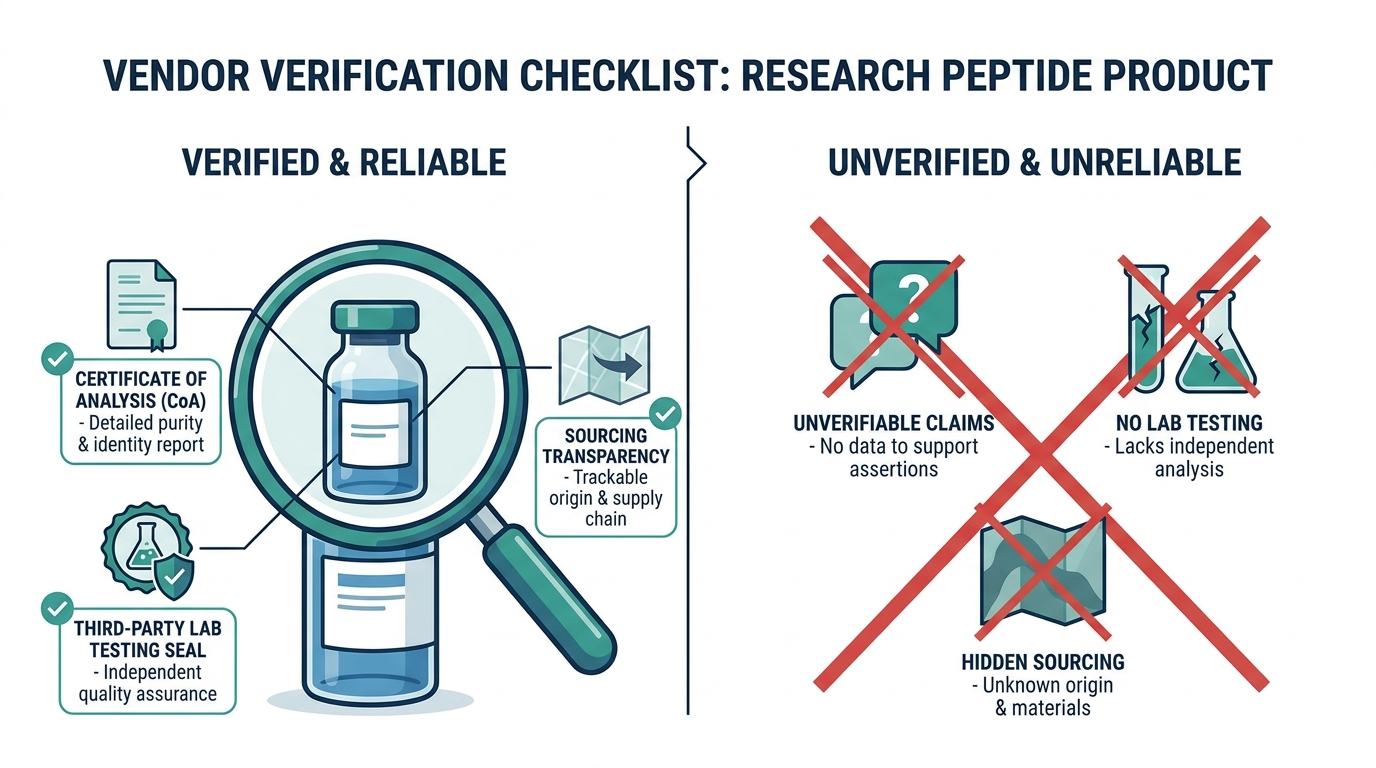
A legitimate Certificate of Analysis (COA) clears four specific bars. First, it uses both HPLC and Mass Spectrometry. HPLC measures purity, meaning how much of the vial is the target peptide. Mass Spec confirms identity, meaning the molecule is actually BPC-157 and not a cheaper, structurally similar compound. Purity without identity is useless. Second, HPLC purity should be 96% or higher; 99% or above is excellent. Third, the COA must be batch-specific and recent, and the batch number on the document must match the number on the physical vial you receive. A single generic PDF reused across the whole catalog is theater, not quality control. Fourth, the COA must come from a named independent lab, not the vendor’s “in-house” testing.
The labs with real verification infrastructure are Janoshik Analytical, MZ Biolabs, and Colmaric Analyticals. A Janoshik COA carries a unique alphanumeric key you enter on Janoshik’s own website to confirm the report is real and has not been altered. That key verification step is what separates a legitimate COA from a Photoshopped document, and almost nobody checks it.
Do not believe that a vendor’s high review count on a forum or a polished website means the product is clean. The Finnrick data makes clear that a brand can appear credible on the surface while ranking F on independent testing. Popularity is not purity.
BPC-157 oral versus injectable: which route actually reaches the target?
This is one of the most debated practical questions in the BPC-157 community, and the answer is more nuanced than the forums usually admit.
Injectable BPC-157 (subcutaneous) has bioavailability exceeding 80% in animal models. Standard oral BPC-157 acetate has approximately 3% bioavailability in rats, though no controlled pharmacokinetic study has been published for any species. The arginate salt form of BPC-157 was specifically engineered for oral use: the arginate modification improves stability in acidic stomach environments and resistance to peptidase degradation, making it the preferred oral form when gut healing is the goal.
The practical split is this: oral capsules deliver high local concentrations to the gut mucosa, which makes them sensible for gastrointestinal indications including ulcers, IBD-pattern inflammation, and intestinal permeability repair. They do not reach the bloodstream in amounts clinically meaningful for musculoskeletal or systemic use. Some researchers use both routes simultaneously, oral for GI and subcutaneous near the injury site for localized tissue healing.
The “oral vs. injectable” debate often buries the actual first question: what tissue are you trying to reach? The answer should determine the route, not the other way around.
| Delivery Route | Estimated Bioavailability | Best Suited For | Key Limitation |
|---|---|---|---|
| Subcutaneous injection | >80% (animal data) | Tendon, muscle, joint, systemic | Requires reconstitution, syringe technique |
| Oral (acetate form) | ~3% (rat model) | Gut lining, local GI effects only | Minimal systemic reach |
| Oral (arginate form) | Improved vs. acetate, no RCT data | Gut healing with improved stability | No human pharmacokinetic data published |
| Intranasal | Theoretical; no published data | Possible CNS/brain research | No validated protocols |
What does BPC-157 actually cost, broken down by route?
The $30 vial and the $400 monthly clinic program are not the same product at different prices. They are different products with different accountability structures. Here is what the numbers actually reflect.
Research-vendor route: $30 to $120 per 5 mg vial for the peptide alone, per PeakedLabs. A complete first-cycle kit including bacteriostatic water, syringes, swabs, and sharps disposal runs $68 to $125. A six-month supply of compound plus consumables runs roughly $100 to $200. No physician, no pharmacy, no lab monitoring, no accountability.
Med-spa or convenience clinic: Consultation $0 to $150 (often bundled), monthly medication $150 to $350, minimal monitoring $0 to $75 per check-in. The lower end of this tier is worth scrutinizing on the sourcing question above.
Full telehealth program: Initial consultation $150 to $400, baseline labs $100 to $250, monthly medication $200 to $500. First four-week course total for a first-time patient: $350 to $700. Six-month program: $1,500 to $3,200 depending on clinic tier and compounds.
BPC-157 plus TB-500 stack (Wolverine stack): $795 for a single cycle at some clinic programs, per the Florida Surgery and Weight Loss Center pricing. The stack is popular for soft-tissue recovery because TB-500’s mechanism, primarily thymosin beta-4 derived, complements BPC-157’s angiogenic pathway through a different actin-cytoskeleton route.
One cost nobody factors in initially: none of this is covered by insurance, ever. BPC-157 is not FDA-approved for any indication. Budget out-of-pocket before you start.
What are the real red flags when shopping for BPC-157?
Personally, I think the three biggest red flags are underpriced product, unverifiable COAs, and clinics that cannot name their compounding pharmacy. Each one, on its own, would give me pause. All three together is a pass regardless of how good the testimonials look.
Specific warning signs by category:
Vendor red flags: Price under $25 per 5 mg vial (below the floor cost of legitimate peptide synthesis). COA from an “in-house” lab with no independent verification key. No batch number on the vial or a batch number that does not match the COA. Crypto-only checkout, which signals the vendor expects to lose its payment processor. Missing batch tracking entirely means there is no quality control trail.
Lab-result red flags: COA that shows purity without a Mass Spec identity confirmation. HPLC purity below 96%. A single generic COA PDF reused across the entire product catalog. Any independent testing database entry (Finnrick) that shows a D, E, or F rating for that vendor’s BPC-157 batches.
Clinic red flags: Marketing that advertises injectable BPC-157 or TB-500 boldly while the regulatory situation is still pending the July 2026 PCAC decision, without any explanation of how their pharmacy is compliant. “Same-day prescription” with no clinical review. Patient materials that still carry “research use only” language, which should not appear anywhere in a legitimate clinical program.
Contamination risk: Independent testing of black-market peptide products has found heavy metals including arsenic and lead at up to ten times the acceptable limit for injectable drugs. This is not a theoretical risk. It is the direct consequence of unregulated synthesis at the cheapest source.
How does BPC-157 compare to the other peptides people stack it with?
Most people who research BPC-157 eventually encounter the question of stacking. Here is the honest comparison table for the compounds most commonly paired with it.
| Peptide | Mechanism | Common Use | Legal Lane (2026) | Typical Cost |
|---|---|---|---|---|
| BPC-157 | VEGFR2-Akt-eNOS angiogenesis, anti-inflammatory | Tendon, gut, joint healing | Research / compounding pending PCAC | $30-120/vial (research); $200-500/mo (clinic) |
| TB-500 (Thymosin Beta-4 fragment) | Actin regulation, cell migration, anti-inflammation | Soft tissue recovery, often stacked with BPC-157 | Research / on PCAC July 2026 agenda | $50-150/vial; adds $100-250/mo at clinic |
| Sermorelin | GHRH analog, stimulates pituitary GH release | GH support, sleep, lean mass | Fully legal prescription | $175-225/month via telehealth |
| CJC-1295 + Ipamorelin | Extended GHRH + GHRP stack, GH pulse | Muscle, recovery, anti-aging | Research (awaiting compounding review) | $150-300/mo research; $200-400/mo clinic |
| GHK-Cu (copper peptide) | Copper carrier, collagen synthesis, anti-aging | Skin topical; injectable for systemic | Cosmetic (topical); research (injectable) | $20-60 topical; $60-100/vial injectable |
Two things jump out from that table. Sermorelin is the cleanest option for anyone who wants a legally unambiguous prescription peptide with established pharmacy access right now. BPC-157 and TB-500 are the two most popular repair peptides and, not coincidentally, the first two on the July 23 PCAC agenda, which suggests the regulatory community understands exactly where the demand is.
What should you do before you buy anything?
Personally, I would not start with a vendor or a clinic until I had two things in hand: a recent blood panel and a clinician who has actually read it. That is not a hedge. It is the only way to know whether anything is working.
The BPC-157 community tends to talk in terms of injury type, whether tendon, gut, or joint, and sometimes produces striking anecdotal results. What it almost never does is report a baseline inflammatory or biomarker profile that would let an outside observer verify the change. Without that baseline, you are spending money on an experiment you cannot read.
The second thing worth knowing before you buy: the regulatory window is moving fast. The July 23 to 24, 2026 PCAC meeting covers BPC-157, TB-500, KPV, and MOTS-C on day one and Emideltide, Semax, and Epitalon on day two. A favorable committee vote for BPC-157 followed by the federal rulemaking process could produce a fully legal compounding pathway within months. That means the research-vendor route, already the riskier option, is also potentially a short-term workaround that expires. If the timing works for your situation, waiting for the compounding pharmacy route to reopen is worth considering.
Curious what your own levels look like?
Baseline 100+ biomarkers today and retest as life changes, all in one membership with physician review.
Frequently asked questions
Is BPC-157 legal to buy in the United States in 2026?
Yes, with important nuance. Purchasing BPC-157 labeled “for research use only” is legal. It is not an FDA-approved drug for human use, it cannot be legally prescribed or sold as such. On April 22, 2026, the FDA removed it from its Category 2 restricted compounding list, and a PCAC committee review on July 23 to 24, 2026, may recommend restoring licensed 503A compounding access. That formal pathway is not yet open as of this article’s publish date.
What is the safest way to get BPC-157?
A licensed telehealth clinic that routes your prescription through a named, verifiable 503A compounding pharmacy. The program should require baseline labs, include clinical follow-up, and give you the pharmacy’s name and license number. Expect $150 to $400 per month all-in. Platforms that meet this standard include Defy Medical, AgelessRx, and Invigor Medical.
How do I know if a BPC-157 vendor is legitimate?
Demand a batch-specific Certificate of Analysis showing both HPLC purity (96% minimum) and Mass Spec identity confirmation, from Janoshik Analytical, MZ Biolabs, or Colmaric Analyticals, with a verification key you can check on the lab’s own website. Cross-check the vendor on Finnrick’s product page for BPC-157, which has tested 606 samples from 86 vendors. Any vendor with a D, E, or F rating is a pass regardless of price or testimonials.
How much does BPC-157 cost?
Research-vendor route: $30 to $120 per 5 mg vial, plus $38 to $45 in supplies for the first cycle. Telehealth clinic: $150 to $400 per month all-in (consult, prescription, compounded medication, and shipping), with first-visit costs higher due to required labs. None of this is covered by insurance.
What is the difference between BPC-157 acetate and BPC-157 arginate?
The acetate is the standard form used in most injectable research protocols. The arginate (salt form) was developed specifically for oral use because it resists stomach acid degradation better, making it the preferred form when gut healing is the goal. Neither form is an FDA-approved drug. Oral bioavailability of the acetate is approximately 3% in animal models; the arginate improves on that but has no published human pharmacokinetic data.
Will BPC-157 be available from compounding pharmacies after July 2026?
Possibly. The PCAC meeting on July 23 to 24, 2026, will produce an advisory recommendation. Even a favorable vote requires subsequent federal rulemaking before compounding pharmacies can legally dispense it. That process typically takes additional months. The trajectory is clearly toward legalization, but the timeline is not certain as of this publish date.
Should I stack BPC-157 with TB-500?
The BPC-157 plus TB-500 stack (sometimes called the “Wolverine stack”) is popular in recovery-focused protocols because the two compounds work through different repair pathways. TB-500 primarily regulates actin polymerization and cell migration through the thymosin beta-4 mechanism, complementing BPC-157’s angiogenic focus. Both are on the July 2026 PCAC review agenda. Whether to stack them is a clinical question for a licensed provider, not a forum decision.
Telehealth GLP-1 program with provider visits and pharmacy coordination.
Author: Vital Signs Today Editorial Team, MD, [specialty]”]. Educational content, not medical advice. Sources linked inline.
Primary sources:
– FDA Pharmacy Compounding Advisory Committee July 23-24, 2026 calendar
– Federal Register notice: PCAC meeting and 503A bulk substance nominations, April 16, 2026
– Finnrick BPC-157 testing database, 606 samples, 86 vendors
– Finnrick independent testing overview, 8,026+ tests, 225 vendors
– PMC12446177: Regeneration or Risk? Narrative review of BPC-157 for musculoskeletal healing (2026)
– PMC11859134: Multifunctionality and Possible Medical Application of the BPC 157 Peptide, Pharmaceuticals 2025
– Loti Labs: BPC-157 Legal Status 2026, FDA Category 2 removal and PCAC review timeline
– HealingMaps: FDA Peptides 503A PCAC July 2026, all 7 peptides under review
– PeakedLabs: BPC-157 cost guide 2026, research vendor and clinic pricing
– PeptideDeck: How to get BPC-157 in 2026, every route explained
– Lengea Law: FDA BPC-157 TB-500 503A review prescriber guidance
Related reading
Vital Signs Today may earn a commission if you buy through links on this page. It does not affect our editorial assessments.