
Last updated 18 June 2026. Educational content, not medical advice. Speak to a licensed dermatologist before starting any new skincare regimen.
Short answer: GHK-Cu (copper tripeptide-1) is the single most-evidence-backed peptide for overall skin health in 2026. A double-blind human trial published in 2001 showed it matched or exceeded retinoic acid for collagen induction with significantly less irritation, and gene-array studies confirm it upregulates over 4,000 human genes related to collagen synthesis, wound healing, and inflammation control. For targeted wrinkle-depth reduction, Matrixyl 3000 at 3% cuts wrinkle volume by up to 45% after 56 days. Neither answer changes the underlying question every serious user should ask first: what is actually driving your skin’s decline?
GHK-Cu tops the evidence for skin health. Want to see what your own skin and collagen-related markers look like? One at-home Superpower draw checks 100+ biomarkers, physician-reviewed.
That question matters because “best peptide” is not a single answer. It is a map. The peptide category most likely to help you depends on whether you are dealing with loss of collagen density, deepening expression lines, dehydrated barrier skin, or uneven pigment, and each of those problems maps to a different peptide class. The guide below gives you that map, with the real clinical numbers, the concentrations that matter, the products that hit those concentrations, and the one tier most buyers overlook: oral supplementation.
Full-body lab membership: 100+ biomarkers, doctor-reviewed, tracked over time.
What exactly is a skin peptide, and why do only some of them work?
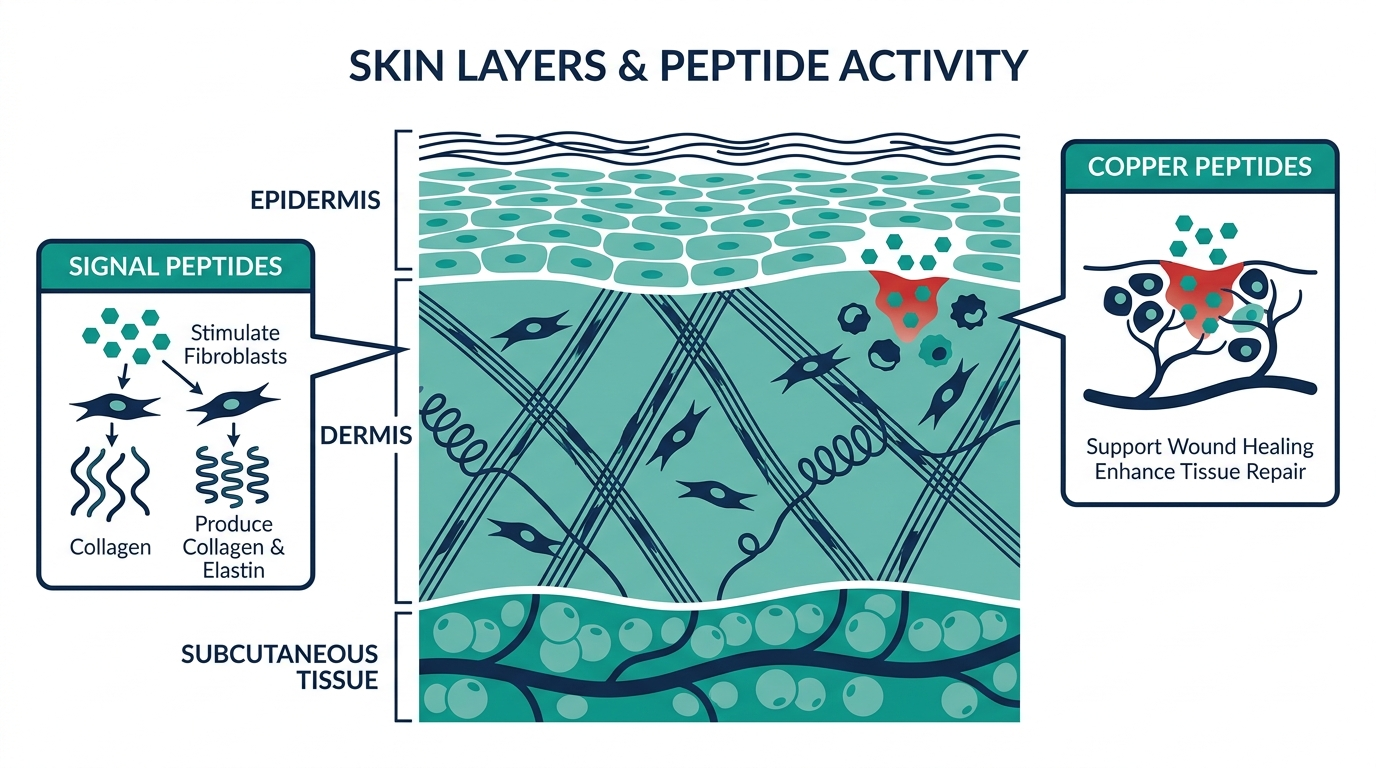
A peptide is a short chain of amino acids, the same building blocks that make up collagen, elastin, and every other structural protein in your skin. Cosmetic peptides take several distinct forms, and the mechanism determines the target problem.
Signal peptides mimic the breakdown fragments of collagen (called matrikines) and signal skin fibroblasts to ramp up production. Matrixyl is the flagship: its two components, palmitoyl tripeptide-1 and palmitoyl tetrapeptide-7, together send a message that collagen is degrading and more synthesis is needed. Carrier peptides chaperone trace minerals (most importantly copper) to enzymatic sites where they catalyze collagen cross-linking. GHK-Cu is the archetypal carrier. Neuropeptides block or mimic signals in the neuromuscular junction to soften the muscle contractions that etch expression lines. Argireline and Syn-Ake both belong here.
The classic objection to topical peptides, summarized as the “500 Dalton Rule,” says that molecules above 500 Da cannot cross the stratum corneum. Most cosmetic peptides exceed 500 Da in their free form. What that rule misses is formulation engineering. Adding a palmitoyl (fatty acid) tail to a peptide improves lipid solubility enough to cross the stratum corneum. Liposomal and nano-emulsion delivery systems move the molecule even deeper. Shorter peptides (five amino acids or fewer) penetrate passively.
The real dividing line between peptide serums that do something and ones that do not is not which peptide is on the label. It is the concentration in the finished product. A published study showing 3% Matrixyl reduces wrinkle depth by 20% tells you nothing about a serum listing “palmitoyl tripeptide-1” as ingredient number eighteen. Always look for the stated percentage.
GHK-Cu: The case for copper tripeptide-1 as the overall winner
GHK-Cu (glycine-histidine-lysine copper complex) has been studied since the early 1970s, which means it has more independent replicated data than almost any other cosmetic peptide. The 4,000-gene figure from gene-array studies is not hype: it reflects GHK-Cu’s role as a natural tissue-remodeling signal. Skin produces it after injury, and levels decline measurably from your mid-30s onward, which is also when collagen loss accelerates.
The clinical case:
- A 2001 double-blind, IRB-approved split-face trial compared topical GHK-Cu at 1% against retinoic acid. GHK-Cu produced “improvements in skin texture, collagen density, and fine lines comparable to retinoic acid” with significantly fewer reports of redness, scaling, and photosensitivity. That result has never been replicated head-to-head since, and the absence of a follow-up trial is itself an insider data point: retinoic acid cannot be patented by a cosmetic brand, so there is no commercial motive to publish a comparison that might validate it.
- In vitro studies confirm GHK-Cu increases production of collagen, elastin, glycosaminoglycans, and superoxide dismutase (an antioxidant enzyme). It also upregulates tight-junction proteins, which contribute to barrier integrity.
- A 2018 review in the journal Biomolecules described GHK-Cu as a “safe, inexpensive, extensively studied compound” with potential beyond cosmetic use, including wound healing and systemic anti-inflammatory effects.
Effective topical concentration: 0.1% to 0.5% for maintenance. Up to 1% for intensive repair protocols. Absorption drops sharply above 1% without a specialized delivery vehicle because the copper ion can become pro-oxidant at high concentrations if unbound.
Do not believe the marketing that “more copper peptide is always better.” At high concentrations without the right vehicle, GHK-Cu can actually cross-link collagen prematurely and create a stiffening effect the opposite of what you want. The sweet spot for most people is 0.5%, daily, applied after actives and before moisturizer.
Retail products at effective concentrations:
| Product | GHK-Cu % | Price / 30 mL | Notes |
|---|---|---|---|
| NIOD Copper Amino Isolate Serum 3 (CAIS3) | 1% GHK-Cu + 1% GHK | $93 | Minimalist formula; GHK-free form adds receptor-binding coverage |
| The Ordinary Multi-Peptide + Copper Peptides 1% | 1% | $32 | Multi-peptide formula; add Matrixyl and Argireline in same bottle |
| Allies of Skin Copper Tripeptide & Ectoin Advanced Repair | Undisclosed; ectoin stabilizes peptide | $199 | Ectoin shown to enhance peptide stability and UV barrier; NEA Accepted |
| Brainflow GHK-Cu Face Serum (top-rated June 2026) | 1% | $48 | Third-party batch testing published per run |
Matrixyl 3000: The best choice for measurable wrinkle depth
If your primary goal is reducing established wrinkle depth rather than maintaining collagen density, Matrixyl 3000 has the most replicated clinical dataset of any signal peptide in cosmetics.
Clinical evidence, at the 3% concentration used in studies:
- After 56 days of twice-daily application, Matrixyl 3000 reduced deep-wrinkle area by 44%, deep-wrinkle density by 37%, and skin roughness by 14%, while improving skin tone by 15% and elasticity by a similar margin.
- In a separate two-month study on male participants, wrinkle volume decreased by 17.1% and the area occupied by deep wrinkles fell by nearly 30%.
- A 2024 study in Skin Research and Technology evaluating a multi-component eye cream with Matrixyl components showed significant fibroblast proliferation and both collagen and elastin synthesis stimulation via histological biopsy.
Matrixyl 3000 works through a different pathway than GHK-Cu: instead of carrying copper to enzymatic sites, it mimics collagen-breakdown fragments (specifically the C-terminus telopeptide sequence) to trigger a biological alarm response. Fibroblasts read the signal as “collagen is degrading; produce more.” The result is a measurable increase in collagen I, III, and IV synthesis.
Personally, I think the clinical evidence for Matrixyl 3000 at 3% is underappreciated in consumer media, probably because it is not as conceptually exciting as “copper peptide” or “snake venom.” The numbers in the published data are as good as or better than many prescription-adjacent actives. The issue is that most consumer serums list it far below the 3% threshold where the studies ran.
Argireline and Syn-Ake: The neuropeptide tier for expression lines
Argireline (acetyl hexapeptide-3 or -8; the names refer to the same molecule) mimics the N-terminal fragment of SNAP-25, a SNARE protein involved in neurotransmitter release at the neuromuscular junction. By competing for that binding site, it partially inhibits the muscle contraction that carves crow’s feet and forehead lines. A 2002 clinical study found a 27% reduction in periorbital wrinkle depth after 28 days of twice-daily use at 10% concentration. A 2021 replication confirmed the effect at the same concentration.
Syn-Ake (dipeptide diaminobutyroyl benzylamide diacetate) works via a slightly different mechanism, blocking the nicotinic acetylcholine receptor (nACh) rather than the SNARE pathway, which gives it a broader inhibitory effect on muscle firing. A clinical study with 45 participants at 4% concentration reported up to 52% reduction in wrinkle size after 28 days.
The key insider caveat on both: results are site-specific and concentration-dependent, and they attenuate when you stop using the product because the muscle simply contracts normally again. These are not the peptides to use if your goal is long-term structural remodeling. They are the peptides to use if you have specific expression lines you want softened now, while a collagen-stimulating base (GHK-Cu or Matrixyl) does slower structural work underneath.
Layering tip: neuropeptides lose potency in very low-pH formulations, so do not apply them directly after vitamin C serum at pH 2.5. A brief wait of a few minutes, or a separate application step at different times of day, preserves activity.
Oral collagen peptides: The tier everyone underestimates
The entire topical conversation above is dwarfed, in terms of clinical evidence volume, by oral supplementation data. A 2026 systematic review and meta-analysis published in Frontiers in Medicine examined 19 randomized controlled trials with 1,341 participants and found statistically significant improvements in skin hydration, wrinkle depth, brightness, and roughness, with oral polypeptides specifically driving the strongest effects on wrinkle reduction (MD 1.5, p = 0.01).
The mechanism is indirect: hydrolyzed collagen peptides do not travel intact to your dermis and slot into collagen fibrils. Instead, small di- and tripeptides (especially Pro-Hyp and Gly-Pro-Hyp fragments) reach the bloodstream, accumulate in skin tissue, and stimulate fibroblast activity. A 2026 double-blind, placebo-controlled trial published in a peer-reviewed dermatology journal found that 1,650 mg per day of low-molecular-weight collagen peptides (containing 74.25 mg Gly-Pro) produced significant improvements in skin hydration, elasticity (R2, R5, R7 parameters), and wrinkle depth at crow’s feet and nasolabial folds, with improvements beginning at day 10 and persisting through a two-week washout after the eight-week intervention.
The VERISOL ingredient (a Gelita patented bovine hydrolysate) has its own independent trial set: a double-blind, placebo-controlled study with 2.5 g daily for eight weeks showed improvements in hydration observable at four weeks and wrinkle and elasticity gains at eight weeks, with bovine and porcine-sourced versions performing equivalently.
Effective dose range from the pooled trial data: 2.5 g to 10 g per day of hydrolyzed collagen. The lower end (2.5 g) suffices for VERISOL-specific outcomes. For general skin hydration and elasticity, 5 to 10 g is the range most trials used.
The authors of the Frontiers meta-analysis concluded that “oral polypeptides may be more effective than topical formulations” across most measured outcomes, attributed to systemic bioavailability advantages. That is not a reason to skip topical peptides. It is a reason to stop treating oral collagen supplementation as optional.
Hydrolyzed type I & III collagen peptides, third-party tested, unflavored.
How to choose the right peptide for your specific skin concern
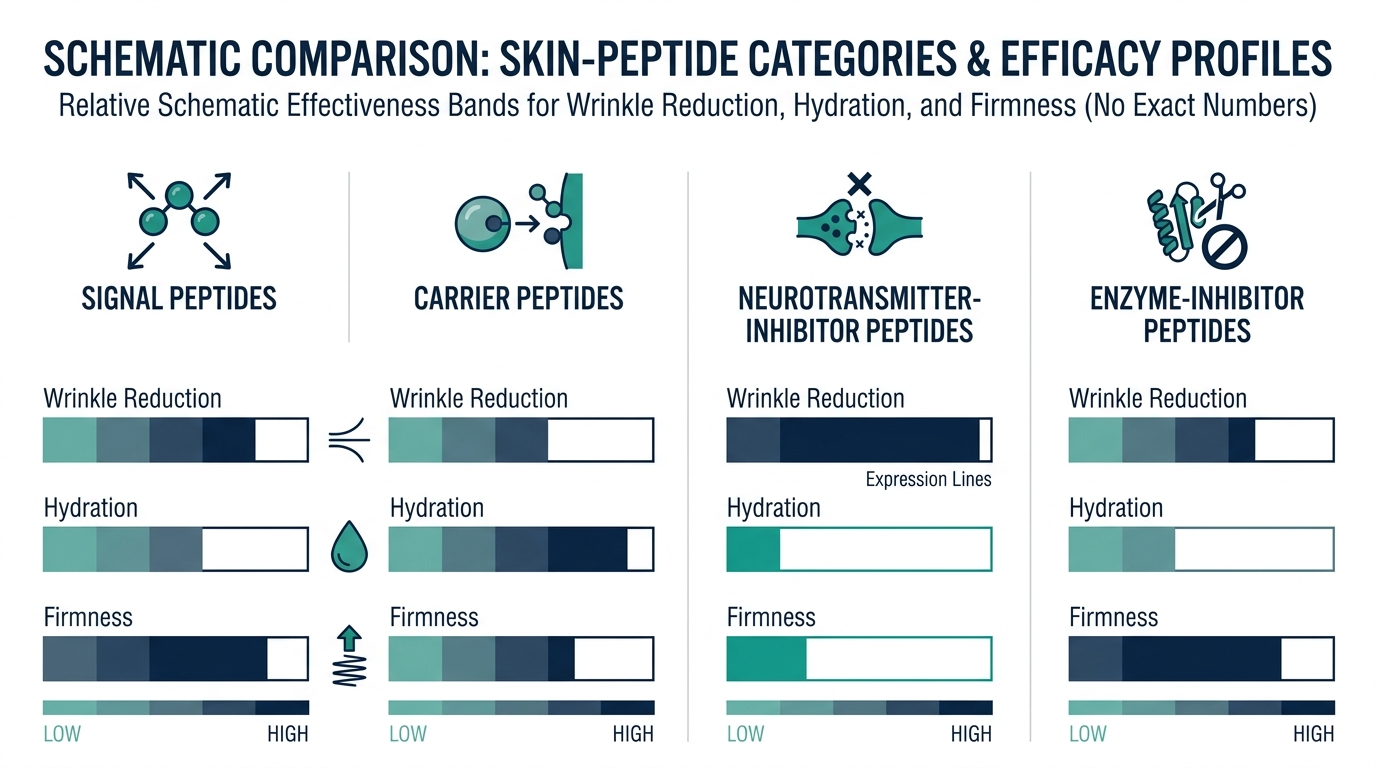
The table below maps your primary concern to the peptide class with the strongest evidence base for that target, the minimum effective concentration, and the realistic timeline.
| Skin concern | Best peptide class | Specific peptide(s) | Min. effective conc. | Timeline |
|---|---|---|---|---|
| Collagen loss, thinning, density | Carrier peptide | GHK-Cu | 0.5% topical | 8-12 weeks |
| Deep wrinkle volume, texture | Signal peptide | Matrixyl 3000 (palmitoyl tripeptide-1 + tetrapeptide-7) | 3% | 8 weeks |
| Expression lines (crow’s feet, forehead) | Neuropeptide | Argireline 10%, or Syn-Ake 4% | 10% / 4% | 4 weeks |
| Barrier, hydration, overall tone | Oral collagen | Hydrolyzed collagen (VERISOL, Peptan) | 2.5-10 g/day oral | 4-8 weeks |
| Wound healing, redness, repair | Carrier + anti-inflammatory | GHK-Cu + anti-inflammatory stack | 0.5-1% | 4-6 weeks |
| Pigment / uneven tone | Enzyme-inhibitor peptide | Oligopeptide-34, Tetrapeptide-30 | Varies by formulation | 12+ weeks |
One decision the table cannot make for you: whether to layer multiple peptide classes or focus on one. The honest answer is that most clinical studies tested single ingredients. The multi-peptide serums popular in 2026 (The Ordinary Multi-Peptide + Copper Peptides, for example) have not been tested as formulations in published trials. They may be complementary; they may dilute each activity below its effective concentration. What you can observe yourself: if you switch from a single-ingredient GHK-Cu serum to a multi-peptide blend and your skin stops responding, the blend may have diluted the copper below its working threshold.
What 2026 added to the peptide story: BASF NeoHelix and the precision-peptide frontier
In April 2026, BASF debuted two ingredients at in-cosmetics Global in Paris that represent the next direction for cosmetic peptide science.
NeoHelix Regenerate is a precision peptide designed using collagen-hybridizing peptide (CHP) concepts, developed in partnership with US biotech firm 3Helix. In a 56-day in vivo study of five women aged 60 to 70, it produced a 41% reduction in damaged collagen and a 65% increase in hyaluronic acid. The mechanism is novel: instead of signaling fibroblasts to produce more collagen, it selectively binds to denatured (unwound) collagen fibrils and stabilizes them, reducing fragmentation and promoting repair at the fibril level rather than just synthesis.
SkinNexus Collag3n is not a peptide but a recombinant human-identical Collagen III fragment produced by vegan yeast fermentation, developed with AI-driven protein design from Bota Biosciences. In a 3D dermis model it raised collagen I by 48%, collagen III by 82%, and collagen V by 71%. In clinical testing on women aged 53 to 70 it improved tone and wrinkle appearance within four weeks and outperformed a benchmark ingredient at ten times the concentration.
Neither ingredient is in wide consumer distribution yet as of mid-2026. NeoHelix and SkinNexus represent the formulator tier, supplying cosmetic brands rather than selling direct. Expect to see them in premium launches in the second half of 2026 and into 2027. Knowing their mechanism now gives you a sharper lens for evaluating those products when the marketing rolls out.
Three myths about skin peptides that keep circulating
Myth: “Peptides are basically just moisturizers that make skin look temporarily plumper.”
The biopsy data from multiple Matrixyl studies shows histological increases in actual collagen density, not just surface hydration. That is a structural change, not a temporary plumping effect. GHK-Cu’s upregulation of gene expression for collagen cross-linking enzymes is also a durable biochemical change that persists beyond the moment of application.
Myth: “You need a prescription to get a peptide that actually works on skin.”
Prescription territory in the peptide space is occupied by GLP-1 compounds for metabolic indications and compounded growth hormone secretagogues for clinical use. The most evidence-backed topical peptides for skin, including GHK-Cu at 1% and Matrixyl at 3%, are available over the counter from brands like The Ordinary, NIOD, and others at prices between $30 and $100. Injectable peptides for skin (BPC-157, TB-500) are a separate and legally more complex category discussed in the next section.
Myth: “If a peptide is in the ingredients list, it’s at a meaningful concentration.”
This is the most important myth to dispel. INCI ingredient lists in the EU and US are required to list ingredients in descending order of concentration down to 1%, below which order is not regulated. A peptide listed after preservatives, fragrance, or colorants is present at below 1%, almost certainly below any concentration used in a clinical study. Look for brands that publish their percentages, or use formulas from ingredient-transparent brands where the claimed active is among the first ten ingredients.
A note on injectable peptides for skin: the clinical lane vs. the grey market
A different class of peptide conversation exists around BPC-157, TB-500, and GHK-Cu in injectable form, marketed in some clinics as “GLOW” or “regenerative” protocols for skin and tissue healing. These are not cosmetic peptides in the topical sense. BPC-157 and TB-500 are research peptides with no FDA approval for human use; GHK-Cu at injectable concentrations moves from the cosmetic lane to the pharmaceutical lane.
As of June 2026, BPC-157 is in a regulatory transition: the FDA removed it from its 503A Category 2 (prohibited) list in April 2026, and a Pharmacy Compounding Advisory Committee meeting scheduled for July 23 to 24, 2026 may clear it for licensed compounding. If it clears that hurdle, the legitimate route for anyone interested in injectable peptide therapy for skin healing will be through a licensed telehealth or compounding pharmacy, not through research-chemical vendors.
For the cosmetic skin concerns this article covers, the topical and oral routes provide genuine, evidence-backed results. Anyone pursuing injectable peptide protocols for skin should do so only through a licensed clinical provider, with baseline labs and monitored follow-up. The grey-market injectable route is not the same product category as the serums above, and it carries a completely different risk profile.
Curious what your own levels look like?
Baseline 100+ biomarkers today and retest as life changes, all in one membership with physician review.
Frequently asked questions
What is the number one peptide for aging skin overall?
GHK-Cu (copper tripeptide-1) holds the strongest combined dataset for overall anti-aging effects: collagen stimulation, elastin support, wound healing, barrier repair, and anti-inflammatory activity. At 0.5% to 1% topical concentration, it is the foundation most dermatologists would build a peptide regimen around.
How long does it take for a peptide serum to work?
Skin hydration can improve within two to four weeks, since peptides can support hyaluronic acid production relatively quickly. Measurable changes in wrinkle depth typically require 8 to 12 weeks of consistent twice-daily use. Histological changes in collagen density (verifiable only by biopsy) follow a 12-week-plus timeline. Products that promise results in seven days are marketing surface-hydration effects, not structural collagen change.
Can I use GHK-Cu and Matrixyl together?
Yes, and they are genuinely complementary: GHK-Cu works at the carrier and tissue-remodeling level, while Matrixyl sends a signal-peptide collagen-synthesis message via a different receptor pathway. The risk is concentration dilution in a single product. For the highest potency, use a dedicated GHK-Cu serum and a separate Matrixyl serum in different steps, rather than relying on a multi-peptide blend where both may be underdosed.
Is oral collagen as effective as topical peptides for skin?
The 2026 Frontiers in Medicine meta-analysis suggests oral collagen polypeptides may outperform topical formulations across hydration, wrinkle depth, and brightness endpoints, largely because absorption from the gut is more predictable than percutaneous delivery. The two are not substitutes: topical peptides apply directly to dermal fibroblasts; oral supplementation works systemically. The strongest outcomes come from combining both.
Are peptide serums safe for sensitive skin?
Peptides are among the gentlest actives in cosmetic chemistry. They do not exfoliate, generate free radicals, or disrupt the acid mantle. Most peptide formulas are appropriate for sensitive, rosacea-prone, and post-procedure skin. The exception: very high-copper formulations (above 1% without a stabilizing vehicle) can potentially cause pro-oxidant effects. If you have highly reactive skin, start with a 0.1% to 0.5% GHK-Cu product and observe your response for two weeks before increasing frequency or concentration.
What is the difference between Argireline and Botox?
Both target the same neuromuscular signaling cascade, but by different mechanisms and at very different magnitudes. Botox (botulinum toxin type A) cleaves the SNAP-25 protein permanently until the nerve terminal regenerates (three to six months). Argireline competes reversibly for the same binding site without cleavage, producing partial and temporary inhibition. Clinical trials show 27% to 30% wrinkle-depth reduction. Botox, in clinical settings, reduces dynamic wrinkle depth by 70% to 90%. Argireline is not a Botox replacement. It is useful for early-stage expression lines where you want a softening effect with zero downtime or injection risk.
What peptides does The Ordinary Multi-Peptide + Copper Peptides 1% contain?
It contains Matrixyl 3000 (palmitoyl tripeptide-1 and palmitoyl tetrapeptide-7), Matrixyl Synthe’6 (palmitoyl tripeptide-38, a newer signal peptide that stimulates collagen IV and laminin synthesis), Argireline (acetyl hexapeptide-8), Syn-Ake (dipeptide diaminobutyroyl benzylamide diacetate), GHK-Cu at 1%, and leuphasyl. At $32 for 30 mL, it is the most accessible way to test all four major peptide classes in one formula, with the tradeoff that each individual peptide is likely below its solo clinical concentration.
Hydrolyzed type I & III collagen peptides, third-party tested, unflavored.
Author: Vital Signs Today Editorial Team, [credential]”]. Educational content, not medical advice. Sources linked inline.
Primary sources:
– PeptideDeck, “The 7 Best Peptides for Skin, Ranked by Evidence (2026)”: https://www.peptidedeck.com/peptides/peptides-for-skin
– Frontiers in Medicine, “Oral and topical peptides for skin aging: systematic review and meta-analysis of RCTs” (2026): https://www.frontiersin.org/journals/medicine/articles/10.3389/fmed.2026.1618306/full
– PMC / Journal of Cosmetic Dermatology, low-molecular-weight collagen peptide RCT (2026): https://pmc.ncbi.nlm.nih.gov/articles/PMC12438954/
– Innerbody, “Best Copper Peptide Serum 2026”: https://www.innerbody.com/best-copper-peptide-serum
– BASF NeoHelix and SkinNexus launch, April 2026: https://www.basf.com/global/en/media/news-releases/2026/04/p-26-066
– GELITA VERISOL clinical trial update: https://www.gelita.com/en/news/verisolr-confirmed-elevate-skin-hydration-and-elasticity-while-reducing-wrinkles
– Meder Beauty, “Peptides in Skincare: Science, Myths, and Innovations”: https://mederbeauty.com/blogs/blog/peptides-in-skincare
– Biotech Peptides, “Syn-AKE Tripeptide and Dermal Wrinkles” (2025): https://biotechpeptides.com/2025/10/02/syn-ake-tripeptide-and-dermal-wrinkles/
– Cellbone, Matrixyl 3000 clinical study data: https://cellbone.com/pages/matrixyl-clinical
– Springer Nature, “Immune-Modulatory Effects of Bioactive Collagen Peptides Improve Skin Health” (2026): https://link.springer.com/article/10.1007/s13555-026-01654-9
Related reading
Vital Signs Today may earn a commission if you buy through links on this page. It does not affect our editorial assessments.