Last updated 18 June 2026. Educational content, not medical advice. Several peptides discussed here require a prescription or are available only in research settings. Consult a licensed clinician before starting any peptide therapy.
Short answer: Tirzepatide (Zepbound) is the best clinically proven fat-loss peptide available by prescription today, producing 20.2% average body-weight loss in a direct head-to-head trial against semaglutide, with 75% of that loss coming from fat mass. Retatrutide is the most powerful candidate in the pipeline, now showing 28.3% average body-weight loss in Phase 3, but it is not yet approved. GH-axis peptides like tesamorelin and CJC-1295 with ipamorelin occupy a supporting role for body recomposition, not primary weight loss.
Ranking the best fat-loss peptides only matters if you know your own metabolic starting point. Do you? One at-home Superpower draw checks 100+ biomarkers, physician-reviewed.
What does “peptide for fat loss” actually mean?
Not every peptide that gets marketed for fat loss works through the same mechanism, and conflating them leads to serious mis-expectations. Before ranking, it helps to split the field into two clean categories.
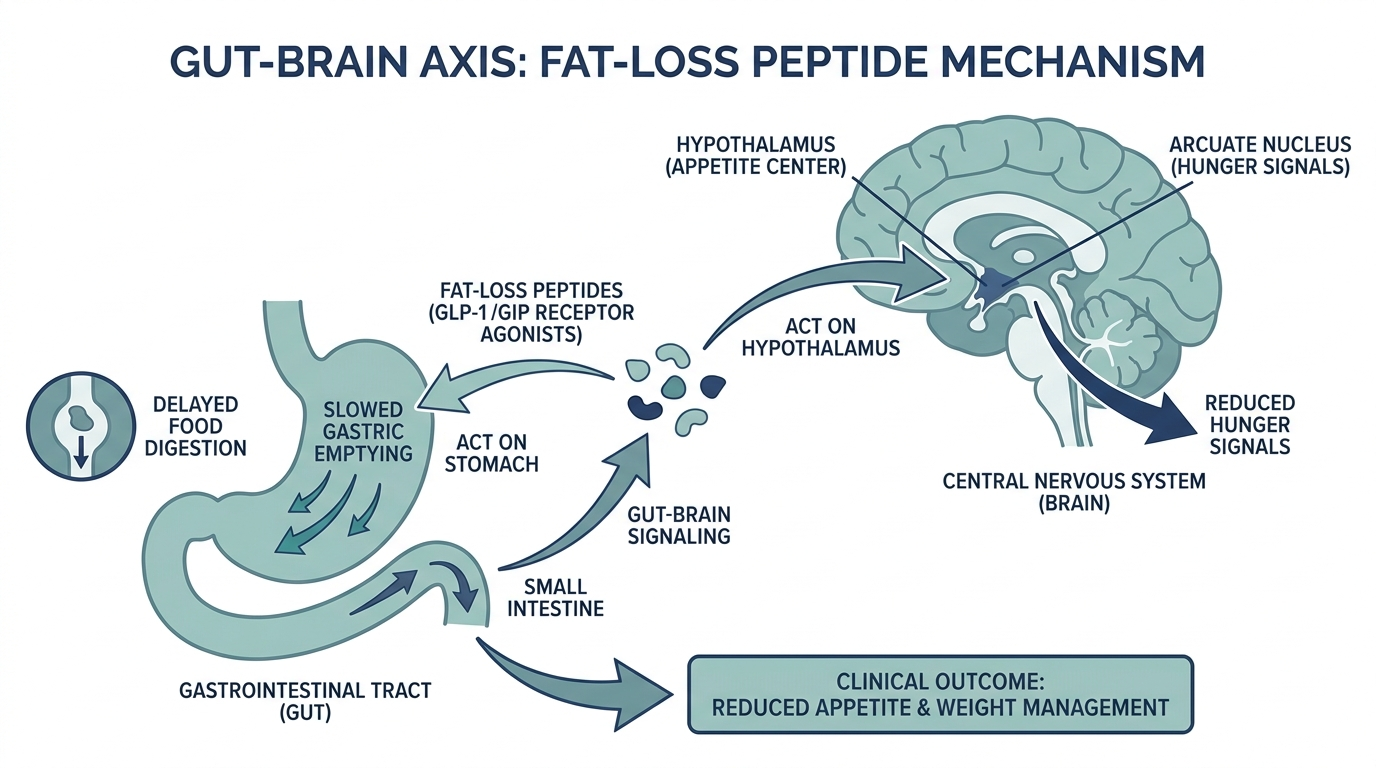
Category 1: appetite and satiety axis peptides. These mimic or amplify hormones that signal fullness, slow gastric emptying, and reduce caloric intake. GLP-1 agonists (semaglutide, tirzepatide, retatrutide) fall here. They do not directly burn fat; they reduce the surplus calories that created it. The weight-loss results are dramatic precisely because appetite suppression is durable at therapeutic doses.
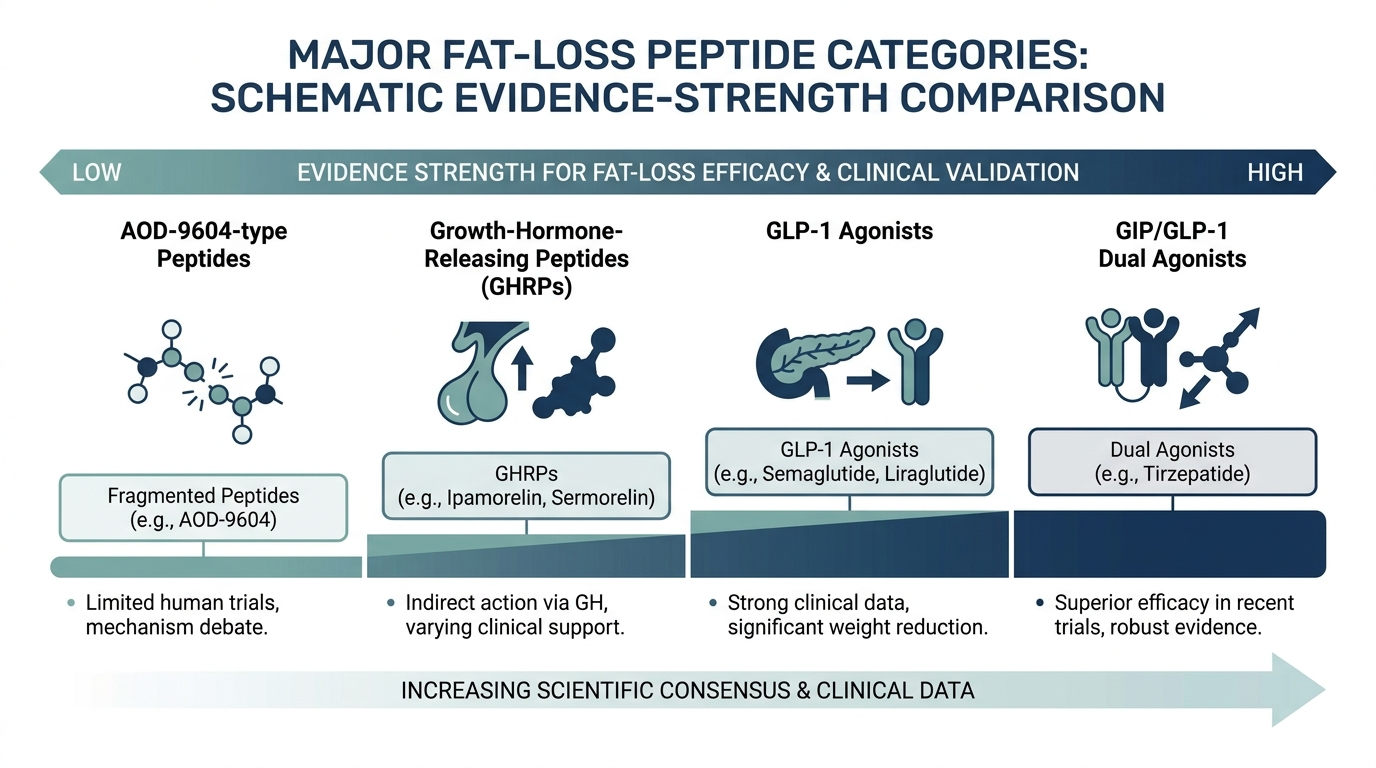
Category 2: fat mobilization and oxidation peptides. These work through growth-hormone signaling, direct receptor action on adipocytes, or enhanced metabolic rate. Tesamorelin, sermorelin, CJC-1295, ipamorelin, and AOD-9604 belong here. They tend to shift body composition, not scale weight. The body recomposition is real but measured in single-digit kilograms over months, not the 20-plus percent body-weight changes seen in Category 1.
Knowing which category a peptide sits in tells you whether you are shopping for a weight-loss drug or a body-recomposition tool. These are different problems, and mixing up the answer is how people end up disappointed.
Most popular articles rank CJC-1295 alongside semaglutide as if they are comparable interventions. They are not. Treating them as equivalent is the central myth of the “best peptides for fat loss” genre, and this guide will not repeat it.
The ranked evidence: which peptides produce the most fat loss?
The simplest way to actually get this done
Superpower is a full-body lab membership that runs 100+ biomarkers, has each result reviewed by a doctor, and tracks your numbers year over year (about $199/year). It is what we point readers to when they would rather get one clean, complete draw than chase single tests one at a time. Here is superpower reviewed in full.
Here is the evidence table, sorted by documented body-weight reduction in controlled human trials. Every number below comes from peer-reviewed or registered trial sources cited inline.
| Peptide | Mechanism | Avg. body-weight loss | Trial / Source | Legal status (US, June 2026) |
|---|---|---|---|---|
| Retatrutide 12 mg | Triple agonist: GLP-1 + GIP + glucagon | 28.3% at 80 weeks | TRIUMPH-1 Phase 3 (Lilly, May 2026) | Investigational, not approved |
| Tirzepatide 15 mg | Dual agonist: GLP-1 + GIP | 20.2% at 72 weeks vs semaglutide | SURMOUNT-5, NEJM 2025 | FDA-approved (Zepbound), prescription |
| Semaglutide 2.4 mg | GLP-1 agonist | 14.9% (STEP 1) / 13.7% vs tirzepatide (SURMOUNT-5) | STEP 1 trial; SURMOUNT-5 | FDA-approved (Wegovy), prescription |
| Tesamorelin 2 mg | GHRH analog, reduces visceral adipose tissue | ~18% visceral fat reduction at 26 weeks | FDA approval trials; PMC10678288 | FDA-approved (Egrifta), prescription |
| CJC-1295 + Ipamorelin | GHRH analog + GH secretagogue | 10 to 20 lbs fat over 4 to 6 months (observational) | Telehealth clinic outcome data; no large RCT | Research / grey zone; HHS Category 1 pending |
| AOD-9604 1 mg | HGH fragment 176-191 | 2.6 to 2.8 kg vs 0.8 kg placebo (Phase IIb) | Phase IIb 12-week trial in 300 obese adults | Research only; failed Phase III, never approved |
One number jumps off that table: the gulf between the GLP-1 class (14.9 to 28.3%) and everything else (2 to 20 lbs with caveats). That is not a ranking difference. That is a different category of intervention. If the goal is meaningful scale-weight reduction, the evidence points clearly to the prescription GLP-1 class, accessed through a licensed clinic.
Full-body lab membership: 100+ biomarkers, doctor-reviewed, tracked over time.
Tirzepatide: the current gold standard for prescription fat loss
Tirzepatide (brand names Zepbound for weight loss, Mounjaro for type 2 diabetes) is a dual GIP and GLP-1 receptor agonist developed by Eli Lilly. In the SURMOUNT-1 trial published in the New England Journal of Medicine, participants on the 15 mg weekly dose lost an average of 22.5% of their body weight at 72 weeks, compared to 2.4% for placebo.
The body-composition data from SURMOUNT-1 is worth reading carefully. A 2025 analysis in Diabetes, Obesity and Metabolism found that of the total weight lost, approximately 75% was fat mass and 25% was lean mass. The fat-mass reduction from baseline reached 33.9% in the tirzepatide groups versus 8.2% in placebo.
Then came SURMOUNT-5, published in the New England Journal of Medicine in May 2025, the first head-to-head randomized trial comparing tirzepatide and semaglutide in 751 adults with obesity. Tirzepatide produced 20.2% body-weight reduction at 72 weeks versus 13.7% for semaglutide. That 6.5-percentage-point gap represents 47% greater relative weight loss. Tirzepatide also beat semaglutide on every key secondary endpoint, including the proportion of patients reaching 20% and 25% body-weight reduction thresholds.
Personally, the SURMOUNT-5 data should have ended the tirzepatide-versus-semaglutide debate for anyone whose primary goal is fat loss. The answer is clear, the trial design was rigorous, and the result was published in the same journal that launched semaglutide’s reputation.
Access: through a licensed telehealth clinic. Expect $299 to $499 a month depending on the provider and whether you use compounded or brand-name medication. Hone Health offers tirzepatide starting at $349 for the first month. GoodRx clinics and Ro Body are also structured routes. None of this is covered by most insurance for obesity (as opposed to type 2 diabetes).
Retatrutide: the most powerful pipeline candidate
Retatrutide is Eli Lilly’s triple agonist, hitting GLP-1, GIP, and glucagon receptors simultaneously. The glucagon receptor addition is the key difference from tirzepatide. Glucagon receptor activation directly increases energy expenditure and hepatic fat oxidation, adding a third fat-burning lever that the dual agonists do not have.
On 21 May 2026, Lilly announced positive topline results from TRIUMPH-1, the first registrational Phase 3 obesity trial, in 2,339 participants. The 12 mg dose group lost an average of 28.3% of their body weight at 80 weeks. In participants with a starting BMI of 35 or higher who continued on treatment through week 104, average weight loss reached 30.3%, representing 85.0 lbs lost from a baseline that averaged around 280 lbs.
The FDA filing window is late 2026 to early 2027, with an approval decision unlikely before mid-to-late 2027 under standard review. Retatrutide is not available by prescription or through compounding as of June 2026.
Do not believe any vendor currently offering “pharmaceutical-grade retatrutide” as a legitimate clinical option. There is no licensed supply chain, and independent testing by Finnrick identified counterfeit retatrutide and purity failures across 37 batches from the grey market before the Peptide Sciences shutdown in March 2026. The molecule with the most impressive Phase 3 numbers is also the one with the worst documented quality control in the research-vendor space.
Semaglutide: the most established GLP-1 for fat loss
Semaglutide (Wegovy at 2.4 mg for weight loss, Ozempic at 1 mg for diabetes) is a GLP-1 receptor agonist developed by Novo Nordisk. The STEP 1 trial established 14.9% average body-weight loss at 68 weeks in adults with obesity but without type 2 diabetes. The cardiovascular benefit (20% reduction in MACE events) was confirmed in the SELECT trial in 2023.
Semaglutide now has the longest clinical follow-up data and the largest post-market pharmacovigilance body of any fat-loss peptide. For someone who needs the most proven track record, with the most documented safety signals and the clearest prescriber familiarity, semaglutide is still a reasonable first choice.
The practical consideration in 2026: the FDA declared the semaglutide shortage resolved on 21 February 2025, which ended the compounding pharmacy window for low-cost copied versions. Brand-name Wegovy runs $1,349 a month at retail without insurance coverage. Telehealth programs like Ro and GoodRx care provide access starting around $149 to $299 a month, though availability depends on the program’s current supply agreement.
Tesamorelin: the only peptide FDA-approved specifically for visceral fat
Tesamorelin (brand name Egrifta) occupies a unique lane. It is a synthetic analog of growth-hormone-releasing hormone (GHRH), and it was FDA-approved specifically for the reduction of excess visceral abdominal fat in adults with HIV-associated lipodystrophy. The FDA approval trials documented an approximately 18% reduction in visceral adipose tissue at 26 weeks, compared to less than 5% with placebo. Critically, this visceral fat reduction was specific: subcutaneous fat did not change significantly.
The off-label use case in metabolic wellness is growing. Telehealth providers now prescribe tesamorelin to non-HIV adults with abdominal obesity and metabolic syndrome, based on studies showing visceral-fat reduction similar to the HIV population with generally favorable effects on glucose, lipids, and inflammatory markers.
Tesamorelin will not move your scale dramatically. It targets the visceral fat depot specifically, the fat wrapped around your organs that correlates most strongly with cardiovascular and metabolic risk, not the subcutaneous fat that changes your belt size. For someone whose visceral-to-subcutaneous fat ratio is metabolically abnormal (detectable on a comprehensive body-composition scan or inferred from waist circumference relative to BMI), this distinction matters a great deal. The expected outcome is body-composition improvement on labs and imaging, not a dramatic number on a scale.
Telehealth access runs $199 to $399 a month with monitoring included. Florida Surgery and Weight Loss Center, TrimRX, and other licensed telehealth providers offer structured tesamorelin programs with prescription and compounding pharmacy supply.
CJC-1295 with ipamorelin: real but limited, misrepresented constantly
CJC-1295 is a GHRH analog that extends the half-life of growth-hormone-releasing hormone. Ipamorelin is a selective growth-hormone secretagogue that triggers a clean GH pulse without the cortisol or appetite spikes associated with older secretagogues like GHRP-6. Together, they stimulate the pituitary gland to produce and release growth hormone in a pulsatile, physiologic pattern, amplifying natural GH output rather than introducing synthetic hormone.
The mechanism does support fat loss: elevated GH increases lipolysis in adipose tissue and preserves lean mass during caloric restriction. Telehealth clinics that offer this stack report 10 to 20 lbs of fat loss over 4 to 6 months in motivated patients combining the protocol with nutrition optimization.
There is no large randomized controlled trial for CJC-1295 with ipamorelin on body weight specifically. The outcome data comes from clinic observations and small studies, not a SURMOUNT-level program. Comparing these numbers to the 20-plus percent reductions from GLP-1 agonists is not a fair comparison: those trials enrolled thousands of participants, ran for 72 to 104 weeks, and were designed to isolate the drug effect.
The practical case for this stack is body recomposition, not weight loss. If someone wants to lose 50 lbs, CJC-1295 and ipamorelin are the wrong tool. If someone wants to improve fat-to-muscle ratio while maintaining energy and recovery, these are a reasonable telehealth-accessible option.
The regulatory status shifted favorably in early 2026. HHS signaled that CJC-1295 and ipamorelin are among approximately 14 peptides expected to move to Category 1 (permitted for compounding) status, pending the Pharmacy Compounding Advisory Committee meeting scheduled for 23 to 24 July 2026. The grey-market rationale for buying these from research vendors is actively shrinking.
AOD-9604: strong mechanism, failed trial, still marketed aggressively
AOD-9604 is a synthetic fragment of human growth hormone (amino acids 176 to 191) developed by Monash University. The theory was compelling: isolate the part of the HGH molecule responsible for fat metabolism and skip the growth-promoting effects that make full HGH complex to use clinically.
Early results justified the excitement. A 12-week Phase IIb trial in 300 obese adults found 2.6 kg average weight loss with 1 mg daily AOD-9604 versus 0.8 kg for placebo. A 23-week RCT found 2.8 kg versus 0.8 kg. The safety profile was consistently clean across six studies: no serious adverse events, no immunogenic responses, no disruption to IGF-1, glucose, or insulin.
Then the Phase III trial came. In 534 obese participants at doses of 0.25 mg, 0.5 mg, and 1.0 mg daily over 24 weeks, AOD-9604 produced no statistically significant weight loss over placebo. Development for obesity treatment was terminated, and no regulatory authority has approved it.
AOD-9604 is still sold by research vendors and marketed by some wellness sites as though it is an evidence-based fat-loss compound. The safety data is genuinely reassuring, but the efficacy data does not support the claims at the doses used in human trials. A compound that passed Phase IIb and failed Phase III is not a “proven fat-loss peptide.” It is a cautionary example of why Phase III outcomes matter.
Telehealth GLP-1 program with provider visits and pharmacy coordination.
What the forums get wrong: five widespread myths about fat-loss peptides
Myth 1: “Research peptides work just as well as prescription GLP-1s.” The clinical-trial evidence says otherwise, clearly and by a wide margin. A 28.3% body-weight reduction (TRIUMPH-1 retatrutide) versus 2.8 kg (AOD-9604 Phase IIb) are not comparable outcomes, and even the 2.8 kg figure did not survive Phase III.
Myth 2: “More peptides stacked together means more fat loss.” Mechanistic stacking logic (GH secretagogue plus GLP-1 analog) is coherent in theory. In practice, the evidence base for combination protocols is almost nonexistent. The GLP-1 trials that generated 20-plus percent weight loss did not use stacks. Adding an untested layer to a proven intervention adds cost, complexity, and unknown interaction risk.
Myth 3: “Peptides burn fat directly.” GLP-1 agonists reduce fat primarily by suppressing appetite and reducing caloric intake. The body then mobilizes fat for energy. There is no peptide that walks up to adipocytes and dissolves them. The mechanism is metabolic, not topical.
Myth 4: “A high purity COA means the peptide is safe to use.” Purity describes how much of the vial is the target molecule. It says nothing about sterility, endotoxin levels, particulate matter, or whether the batch was prepared in a controlled environment. A 99% pure unsterile preparation is still dangerous to inject. This is why the entire premise of a licensed pharmacy matters beyond just the molecule.
Myth 5: “You need to cycle off peptides regularly.” For the GLP-1 class, the published data does not support mandatory cycling. The SURMOUNT-1 trial ran for 72 weeks continuously. For GH secretagogues, clinicians typically recommend cycles because sustained pituitary stimulation is less studied at two-plus years. The cycling advice for one category gets applied wholesale to peptides that work through entirely different mechanisms.
How to access fat-loss peptides legally in 2026
The access pathway depends entirely on which peptide and which legal lane it sits in.
Prescription GLP-1 agonists (tirzepatide, semaglutide): Through a licensed telehealth provider that employs a prescribing clinician and dispenses through a named pharmacy. Providers like Hone Health ($299 to $499/month), Ro Body (starting around $149/month for compounded options where still available), and GoodRx Care offer structured intake, labs, and monitoring. The compounding window for semaglutide effectively closed in early 2025, so realistic access increasingly means brand-name medication or approved compounding through 503B outsourcing facilities.
Tesamorelin (off-label): Prescription only, through telehealth providers specializing in metabolic wellness. TrimRX, Florida Surgery and Weight Loss Center, and similar platforms offer structured programs at $199 to $399 a month.
CJC-1295 and ipamorelin: Currently in a regulatory transition. Expect these to become clearly available through licensed compounding pharmacies after the PCAC meeting in July 2026. In the meantime, platforms like Defy Medical, Marek Health, and Hone Health offer them in states where the prescribing clinician determines they are medically appropriate.
Retatrutide: Not legally accessible by prescription anywhere in the US as of June 2026. Any vendor selling it for human use is operating outside licensed channels.
One practical point that rarely appears in the marketing: none of these therapies work without lifestyle context. The SURMOUNT-1 and SURMOUNT-5 trials included structured diet and exercise counseling. Telehealth programs that include nutritional coaching alongside the prescription produce better outcomes than those that do not. A good clinic looks like a team, not just a prescription pad.
Curious what your own levels look like?
Baseline 100+ biomarkers today and retest as life changes, all in one membership with physician review.
FAQ
Which peptide produces the most fat loss?
By clinical trial data, retatrutide leads at 28.3% average body-weight loss in TRIUMPH-1 Phase 3 (80 weeks), but it is not yet FDA approved. Among approved options, tirzepatide at 20.2% beats semaglutide at 13.7% in a direct 72-week head-to-head trial (SURMOUNT-5, NEJM 2025).
Is tirzepatide better than semaglutide for fat loss?
Yes, according to the best available evidence. In SURMOUNT-5, the first randomized head-to-head trial in 751 adults, tirzepatide produced 47% greater relative weight loss than semaglutide (20.2% vs 13.7% at 72 weeks). Tirzepatide also beat semaglutide on every key secondary endpoint.
Can peptides target belly fat specifically?
Tesamorelin is the one peptide with FDA approval specifically for visceral abdominal fat reduction, showing an 18% reduction in visceral adipose tissue at 26 weeks. GLP-1 agonists reduce total fat mass including visceral fat, but they are not selective. GH secretagogues like CJC-1295 with ipamorelin can support visceral fat reduction as part of overall body recomposition, but the evidence is observational.
What is the difference between fat loss and weight loss for peptides?
Weight loss includes water, lean mass, and fat. For GLP-1 agonists, approximately 75% of total weight lost is fat mass, per the SURMOUNT-1 body-composition substudy. For GH secretagogues, the outcome is often improved fat-to-lean ratio at roughly the same or slightly lower scale weight, which is why these protocols are described as body recomposition rather than weight loss.
How long does it take to see fat loss results on peptides?
For GLP-1 agonists, the trial timelines run 68 to 104 weeks for full effect. Clinically meaningful weight loss (5 to 10%) typically appears within 12 to 16 weeks at therapeutic doses. For tesamorelin targeting visceral fat, the 18% visceral-fat reduction was measured at 26 weeks. For GH secretagogues, observational data suggests 4 to 6 months for visible body-recomposition results.
Are fat-loss peptides covered by insurance?
GLP-1 agonists prescribed for type 2 diabetes (Mounjaro, Ozempic) have broader insurance coverage. The same drugs prescribed for obesity (Zepbound, Wegovy) are covered by some commercial plans and some state Medicaid programs, but many plans exclude weight-loss medications entirely. Tesamorelin for HIV-associated lipodystrophy has coverage; off-label use for metabolic wellness does not. GH secretagogues are virtually never covered.
Is AOD-9604 worth trying for fat loss?
The evidence does not support it. AOD-9604 produced promising Phase IIb results (2.6 to 2.8 kg over placebo) but failed to demonstrate statistically significant fat loss over placebo in a larger Phase III trial in 534 participants. Development was discontinued for obesity treatment. The safety profile is reassuring, but a compound without Phase III efficacy is not a fat-loss tool by any evidence standard.
Author: Vital Signs Today Editorial Team, [credential]”]. Educational content, not medical advice. Sources linked inline.
Telehealth GLP-1 program with provider visits and pharmacy coordination.
Primary sources
- Eli Lilly TRIUMPH-1 retatrutide Phase 3 announcement (May 2026)
- Tirzepatide vs. Semaglutide SURMOUNT-5, NEJM (2025)
- Eli Lilly SURMOUNT-5 press release
- SURMOUNT-1 NEJM publication, tirzepatide 22.5% weight loss
- SURMOUNT-1 body composition substudy, Diabetes Obesity and Metabolism (2025)
- Tesamorelin visceral fat and liver fat study (PMC10678288)
- Frontiers Endocrinology: Mechanisms of GLP-1 and dual GIP/GLP-1 receptor agonists
- Finnrick independent peptide testing database
- Retatrutide FDA approval timeline update, retaweightloss.com (June 2026)
- GLP-1 telehealth provider pricing comparison, TrimRX (2026)
- AOD-9604 Phase IIb and Phase III outcome data, Tucson Wellness MD
- FDA bulk drug substances under 503A compounding policy
Want a real clinician to run the numbers, not a guess?
Joi + Blokes is a telehealth clinic that prescribes GLP-1 medication (Zepbound, compounded semaglutide and tirzepatide), hormone therapy (TRT, HRT), thyroid care, and peptides after a real lab panel and clinician review, with no membership or consult fee (prescriptions from about $59/month, lab panels from $149). If the scale will not budge, this is where you find out whether insulin, thyroid, or hormones are the real reason. Here is Joi + Blokes reviewed in full.
Related reading
Related: which GLP-1 telehealth service fits you.
Vital Signs Today may earn a commission if you buy through links on this page. It does not affect our editorial assessments.