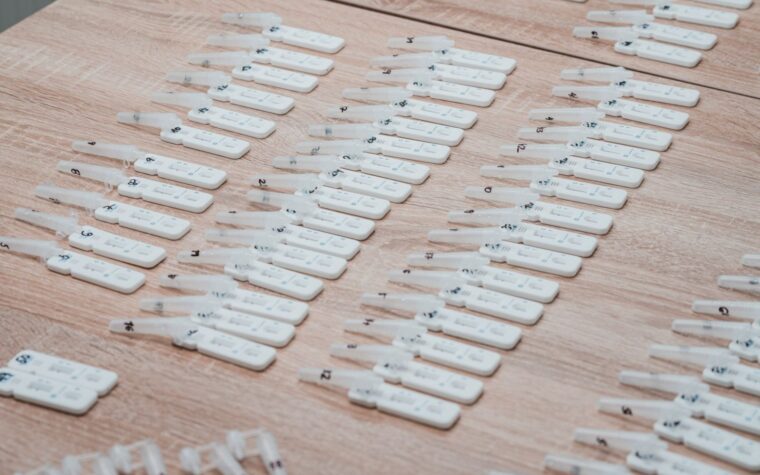
Quick answer: A modern at home drug test is a urine dipstick or cup that screens for one or several drug classes in about five minutes, and the good ones are roughly 97 to 99 percent accurate at the cutoff levels they print on the box. They are a fast, cheap screen, not a courtroom result. Any positive should be confirmed by a certified lab, because over-the-counter kits produce occasional false positives and they cannot tell apart a prescription you are allowed to take from a substance you are not.
Here is the part most people get wrong before they ever open the package. An at home drug test is built to give you a yes or no against a fixed threshold, not a number. It will not tell you how much of a drug is in your system, how long it has been there, or whether a faint line means you are almost clear. If you need a result that holds up for a job, a custody case, or probation, a home kit is the wrong tool. For everything below that bar, a $10 to $30 kit from the pharmacy does the job well.
How accurate is an at home drug test, really?
A reputable at home drug test is about 97 to 99 percent accurate, but that number only describes how well it agrees with lab testing at one specific cutoff. The FDA clears these kits, and the better brands (the ones used in clinics and by home health agencies) print their sensitivity and the cutoff for each drug right on the insert. Read it. A test set to detect THC at 50 ng/mL will read negative on someone at 30 ng/mL even though they are not fully clear.
The insider detail laypeople miss: home kits are immunoassay tests, which means they look for a chemical shape, not the exact molecule. That is why false positives happen. Some over-the-counter cold medicines (pseudoephedrine) can trip an amphetamine line, certain antidepressants and the antibiotic family can confuse opiate panels, and a high dose of ibuprofen has flagged THC on cheaper strips. None of this means the test is broken. It means a positive is a flag to confirm, not a verdict.
What “99 percent accurate” actually hides
Accuracy splits into two numbers that the box rarely separates. Sensitivity is how reliably the test catches a true user above the cutoff. Specificity is how reliably it clears a true non-user. A strip can be 99 percent sensitive and only 95 percent specific, which means roughly 1 in 20 clean samples could throw a false positive line. Now layer in base rates. If you screen 100 people in a low-use setting where maybe 5 are actual users, a 95 percent specific test will flag about 5 false positives on top of the 5 real ones, so half your positives are wrong. That is not a defect in the strip. It is simple math, and it is exactly why a screen is never the final word.
Substances that commonly cross-react
If you take any regular medication, check it against this list before you read a positive as proof of anything.
| What you took | Panel it can falsely trip |
|---|---|
| Pseudoephedrine (Sudafed), some decongestants | Amphetamines |
| Sertraline, trazodone, some antidepressants | Amphetamines or LSD on cheaper strips |
| Quinolone antibiotics, poppy seed bagels | Opiates |
| High-dose ibuprofen or naproxen | THC or barbiturates |
| Dextromethorphan (cough syrup) | PCP or opiates |
| CBD products with trace THC | Marijuana (THC) |
None of these are exotic. Poppy seeds and a head cold are enough to confuse a $12 strip, which is the whole reason the confirmation step exists.
Screen versus confirmation
Labs run a two-step process for a reason. The first step is the same immunoassay screen your home kit uses. If that is positive, the lab runs a second, far more specific test (GC-MS or LC-MS/MS) that names the exact compound and rules out cross-reactions. A home kit gives you step one only. If a result matters, you pay for step two. You can read more about that pathway in our guide to where to get a drug test for an employer, court, or personal use.
How to use a home kit and read the lines correctly
The simplest way to actually get this done
Superpower is a full-body lab membership that runs 100+ biomarkers, has each result reviewed by a doctor, and tracks your numbers year over year (about $199/year). It is what we point readers to when they would rather get one clean, complete draw than chase single tests one at a time. Here is superpower reviewed in full.
Collect a fresh urine sample (midstream is fine), dip the strip or fill the cup to the marked line, lay it flat, and wait the full time on the box, usually five minutes. Then read it in good light. The counterintuitive rule that trips everyone up: two lines is negative, one line is positive.
- Control line (C) only, no test line: that is a positive (or non-negative) result for that drug.
- Control line plus a test line (T), even a faint one: negative. A faint test line still counts as negative. Any visible band, however pale, means below the cutoff.
- No control line at all: the test is invalid. Discard it and use a new one.
Three practical cautions. Read it inside the time window, because a strip read 20 minutes late can show a false faint line as it dries. Do not test first-morning urine if you want a realistic daytime picture, since the first void of the day is the most concentrated and reads strongest. And temperature matters for tampering checks: a real fresh sample sits between 90 and 100 degrees Fahrenheit within four minutes, which is why supervised cups have a temperature strip on the side.
A step-by-step walkthrough with timing
Here is exactly how a clean home test goes, start to finish, so nothing surprises you.
- Minute 0: Let the cup or strip reach room temperature if it was stored cold. A cold strip wicks unevenly and can stall the control line.
- Minute 0 to 1: Collect a fresh midstream sample. For a cup test, fill past the marked fill line. For a dip card, submerge the absorbent end up to the arrow for 10 to 15 seconds, no deeper.
- Minute 1: Lay the device flat on a dry surface. Do not hold it vertically while it develops, because pooling fluid skews the read.
- Minutes 1 to 5: Watch the control line appear first. If no control line shows by minute 5, the device failed and the result is void.
- Minute 5: Read it. Two lines means negative. One line (control only) means non-negative for that drug.
- After minute 10: Stop trusting it. Lines that develop or fade after the window are artifacts, not results.
Saliva, hair, and urine: which home format to choose
Most home kits are urine because it is the cheapest format with the best documented cutoffs. But the format changes the detection window, and that is the real decision.
| Sample type | Detection window | Best for |
|---|---|---|
| Urine | 1 to 30 days depending on drug | General screening, cheapest, most panels available |
| Saliva (oral fluid) | Minutes after use up to 1 to 2 days | Recent or same-day use, hard to tamper with |
| Hair | Up to 90 days | Long-term pattern, useless for recent use (takes about a week to show in hair) |
The mistake people make is reaching for a hair test to catch last night. Hair will not show anything for roughly seven days after use, because the drug has to grow out from the follicle into the visible shaft. If you want to know about the last day or two, saliva is the right tool. If you want a 90-day picture, hair is the only home option that reaches that far.
What panels and detection windows to expect
A 5-panel kit covers the classic workplace set: marijuana (THC), cocaine, opiates, amphetamines, and PCP. A 10-panel or 12-panel adds benzodiazepines, barbiturates, methadone, oxycodone, and sometimes fentanyl. Buy the panel that matches what you actually need to know, not the biggest box on the shelf.
| Substance | Typical urine detection window |
|---|---|
| Marijuana (occasional use) | 3 to 7 days |
| Marijuana (heavy daily use) | up to 30 days |
| Cocaine | 2 to 4 days |
| Opiates (heroin, codeine) | 2 to 4 days |
| Amphetamines / meth | 2 to 5 days |
| Benzodiazepines | 3 to 7 days (longer for some) |
| Alcohol (EtG urine) | up to 80 hours |
These windows are why a single negative does not prove someone is drug-free, and why marijuana is the hardest to predict. THC is fat-soluble and lingers, so a heavy user can test positive weeks after stopping. If you are reading these strips to make a decision about another person, separate the chemistry from the myths first in our breakdown of what actually affects drug test results.
How to pick a panel by purpose
The panel count is not a measure of quality. A 5-panel from a clinical brand beats a vague 12-panel from a no-name seller every time. Match the panel to the question you are actually asking.
- Checking yourself before a workplace screen: a 5-panel mirrors what most employers run, so it gives you the most relevant read.
- Worried about prescription misuse in the household: go 10 or 12-panel so you cover benzodiazepines, oxycodone, and methadone, which the 5-panel skips.
- Concerned about fentanyl specifically: buy a dedicated fentanyl strip, because many standard panels do not include it and the ones that do can miss analogs.
- Monitoring alcohol abstinence: a standard panel will not catch it. You need an EtG urine strip, which extends the window to about 80 hours.
Can you buy a drug test at CVS, and what does it cost?
Yes, you can buy a drug test at CVS, Walgreens, Walmart, and most grocery pharmacies, and you can also order them on Amazon. A single-substance THC strip runs about $7 to $15. A 5-panel cup is roughly $15 to $25, and a 10 or 12-panel home kit lands around $25 to $40. Mail-in kits where you collect at home and ship to a lab cost more, usually $50 to $150, because they include the certified confirmation step.
| Option | Typical cash price | Confirmation included? | Result speed |
|---|---|---|---|
| Single-substance strip (THC, fentanyl, etc.) | $7 to $15 | No | 5 minutes |
| 5-panel cup | $15 to $25 | No | 5 minutes |
| 10 or 12-panel home kit | $25 to $40 | No | 5 minutes |
| Mail-in lab kit (collect at home, ship out) | $50 to $150 | Yes (GC-MS or LC-MS/MS) | 2 to 5 business days |
| Walk-in lab screen (Quest, Labcorp, urgent care) | $50 to $200 | Usually, on positive | Same day to a few days |
Worked example on cost. Say you want to check yourself for THC and opiates before a job. A $20 5-panel cup answers it in five minutes at home. If it comes back positive and the job is real, you now want certainty, so you spend another $60 to $90 on a mail-in confirmation or a walk-in lab. Total: about $80 to $110, which is still cheaper and faster than guessing wrong and failing the employer’s test. Compare that to buying a $40 12-panel you did not need, which screens for eight substances you were never going to take. The expensive box is not the smart buy. The right-sized box plus a confirmation when it matters is.
One quiet detail on payment: many at-home test kits are HSA and FSA eligible, so you can use those funds at the pharmacy register. Keep the receipt. The home-collection lab kits almost always qualify too, since they bill as diagnostic testing.
If you are buying a test only because you want a general read on your health rather than to screen for a specific substance, step back for a second. A drug strip answers one narrow question. If you are getting blood drawn anyway, it is often smarter to capture a full baseline at once. Here is how a full-body panel compares.
Common mistakes people make with home drug tests
Most wrong results from a home kit are not the kit failing. They are user error, and almost all of it is avoidable.
- Reading two lines backwards. The single biggest mistake. Two lines is negative. People see a faint second line, panic, and read it as a weak positive. It is the opposite.
- Reading outside the window. A strip checked at 20 minutes can show evaporation lines that look like real bands. Set a timer and read at five minutes, not whenever you remember.
- Ignoring the cutoff on the insert. A negative at a 50 ng/mL THC cutoff is not the same as a negative at 20 ng/mL. If you do not know your kit’s cutoff, you cannot interpret a negative.
- Forgetting medications and food. Not listing your prescriptions, supplements, or that poppy seed bagel before treating a positive as truth. Cross-reactivity is real and common.
- Using a home kit as proof. Trying to hand a home strip result to an employer, a court, or a co-parent. It carries no chain of custody and no confirmation, so it is not admissible anywhere that matters.
- Buying the biggest panel by reflex. A 12-panel feels thorough, but if you only need to know about THC, you paid triple for noise.
- Storing strips wrong. Heat and humidity degrade the antibodies. A kit left in a hot car or an open bathroom drawer can give unreliable lines. Store sealed, cool, and dry, and respect the expiration date.
Edge cases: minors, uninsured, employer-required, and Medicare
The standard advice changes at the margins. Here is how the common edge cases actually play out.
Testing a minor at home
A parent can legally buy and use a home kit on their own minor child, and many do. Two cautions. First, the same cross-reactivity rules apply, so a positive from a teenager on cold medicine or an ADHD prescription needs the same skepticism as any adult positive. Second, if the result will feed into a treatment program or a custody dispute, the home strip is a starting point only and a clinical, observed collection is what counts.
Uninsured and paying cash
If you are uninsured, the home kit is the cheapest entry point at $10 to $40. For a confirmed result, discount lab marketplaces let you order a urine drug screen with confirmation for cash, often $50 to $120, without a doctor’s order in most states. That is usually cheaper than an urgent care visit, which bills a facility fee on top of the test.
Employer-required testing
If an employer requires the test, do not try to substitute a home kit. Employer programs need a chain-of-custody collection at an approved site, typically Quest or Labcorp, so the result is legally defensible. A home kit is only useful here as a private pre-check to know what you are walking into. For exactly what that employer screen looks for, see our guide to the pre-employment drug test and what gets screened.
Medicare and Medicaid coverage
Medicare and Medicaid generally do not cover at-home drug strips you buy off the shelf, because they are not ordered or supervised by a clinician. They may cover a drug screen when a doctor orders it as medically necessary, for example to manage an opioid prescription or monitor a substance use treatment plan. The home kit you grab at CVS is an out-of-pocket purchase, full stop.
Who should pick which option: a quick decision guide
Strip away the marketing and there are only a few real situations. Find yours.
- You want a private heads-up before a job screen: buy a $15 to $25 5-panel cup, test at home, and only escalate to a lab if it is positive.
- You need a result for a court, custody case, or employer: skip the home kit entirely and go straight to a chain-of-custody lab collection.
- You are checking a family member for prescription or opioid misuse: a 10 or 12-panel covers the prescription classes a 5-panel misses, and a positive deserves a calm conversation plus a lab confirmation, not an accusation.
- You are worried specifically about fentanyl: buy dedicated fentanyl test strips, because most standard panels do not reliably catch it.
- You want to verify abstinence over a long period: a hair test reaches back about 90 days, while urine only covers days to weeks.
- You actually want a general health baseline, not a drug screen: a single drug strip is the wrong purchase. A full blood panel tells you far more about your body than one yes or no line.
Do home health agencies and aides get drug tested?
Yes. Home health care is a clinical, patient-facing field, so home health agencies almost always drug test, both at hire and randomly or for cause afterward. Home health aides, home health nurses, and therapists who enter patients’ homes are all subject to it, because they handle medications, work unsupervised, and are bound by the same standards as hospital staff. This is one of the most searched questions about the industry, and the short version is: assume you will be tested.
The specifics by employer:
- Bayada Home Health Care: drug tests as part of standard pre-employment screening and reserves the right to test for cause.
- Kindred at Home (now part of CenterWell/Humana): conducts pre-employment and for-cause testing in line with large healthcare-employer policy.
- Maxim Healthcare Services: requires pre-employment drug screening for clinical staff.
- Elite Home Health and most regional agencies: screen at hire; random and post-incident testing varies by state and contract.
- Cardinal Health at-Home: as a healthcare distributor it follows standard employment screening; for marijuana specifically, the result depends on the role and state law more than on company preference.
Marijuana is the gray zone. Even where recreational use is legal, a positive THC result can still cost you a clinical job, because home health employers answer to federal Medicare and Medicaid conditions of participation, not state cannabis law. A few employers have stopped screening for THC at hire, but most patient-facing roles still flag it. If you are preparing for a clinical hire, our guide to the pre-employment drug test and what gets screened walks through exactly what the lab looks for.
One more nuance people ask about: Medicaid does not drug test the patients receiving home health care, and it does not run the staff tests itself. The agency that employs the caregiver sets and runs the testing policy. Medicaid funding simply raises the compliance bar the agency has to meet, which is part of why testing is so common in this corner of healthcare.
What home health workers should do before a hire
If you work in home health and a screen is coming, the practical move is to pre-check yourself with a 5-panel at home so there are no surprises, and to gather documentation for any prescription that could trip a panel. A valid prescription for amphetamine-based ADHD medication or an opioid pain regimen can usually be cleared with a Medical Review Officer, but only if you disclose it. The MRO is the physician who reviews a lab positive and talks to you before reporting the result to the employer, and an honest disclosure with a script attached is how legitimate medications get cleared instead of counted against you.
FAQ
Do home health nurses get drug tested?
Yes. Home health nurses are licensed clinicians who administer medications in patients’ homes, so agencies screen them at hire and can test for cause or after an incident. Diversion of controlled substances is a real risk in the role, which is why oversight is strict.
Do home health aides get drug tested?
Yes. Home health aides work unsupervised in patients’ homes and often assist with medications, so agencies typically screen them before hire and may test randomly or after an incident. The exact policy varies by agency, state, and the contract the agency holds.
Does Cardinal Health at Home drug test for marijuana?
It follows standard healthcare-employer screening, and whether THC specifically disqualifies you depends on the position and your state’s laws. Even in legal states, a patient-facing or safety-sensitive role can still treat a positive as a fail.
Does Bayada Home Health Care drug test?
Yes, Bayada includes drug screening in its standard pre-employment process and reserves the right to test for cause during employment, consistent with other large home health agencies.
Does Kindred home health drug test?
Yes. Kindred at Home, now part of CenterWell under Humana, runs pre-employment and for-cause testing in line with large healthcare-employer policy. Patient-facing clinical roles are screened before hire.
Does Maxim home health drug test?
Yes. Maxim Healthcare Services requires pre-employment drug screening for clinical staff, and additional testing can apply depending on the assignment, the client facility, and state rules.
Does Elite Home Health drug test?
Yes. Like most regional home health agencies, Elite screens new hires, with random or post-incident testing depending on state rules and the specific contract.
Does Medicaid home health care drug test the patient?
No. Medicaid does not drug test the patients who receive home health services, and it does not run staff testing itself. The employing agency sets and runs the drug testing policy, while Medicaid funding raises the compliance standards that make testing common.
Can a faint line on a home kit mean a weak positive?
No. On these tests a faint test line still counts as negative, because any visible band means the sample is below the detection cutoff. If you genuinely need to know the amount, only a lab confirmation can give you that, and you should talk to a clinician about what the result means for any medication you take.
How long should I wait before reading the result?
Read it at the time printed on the box, usually five minutes, and never after about 10 minutes. A strip read too late can develop evaporation lines that look like real bands and lead you to misread a clear negative as something it is not.
Related: best at-home biomarker tests of 2026.