
Part of our Complete Blood Count guide.
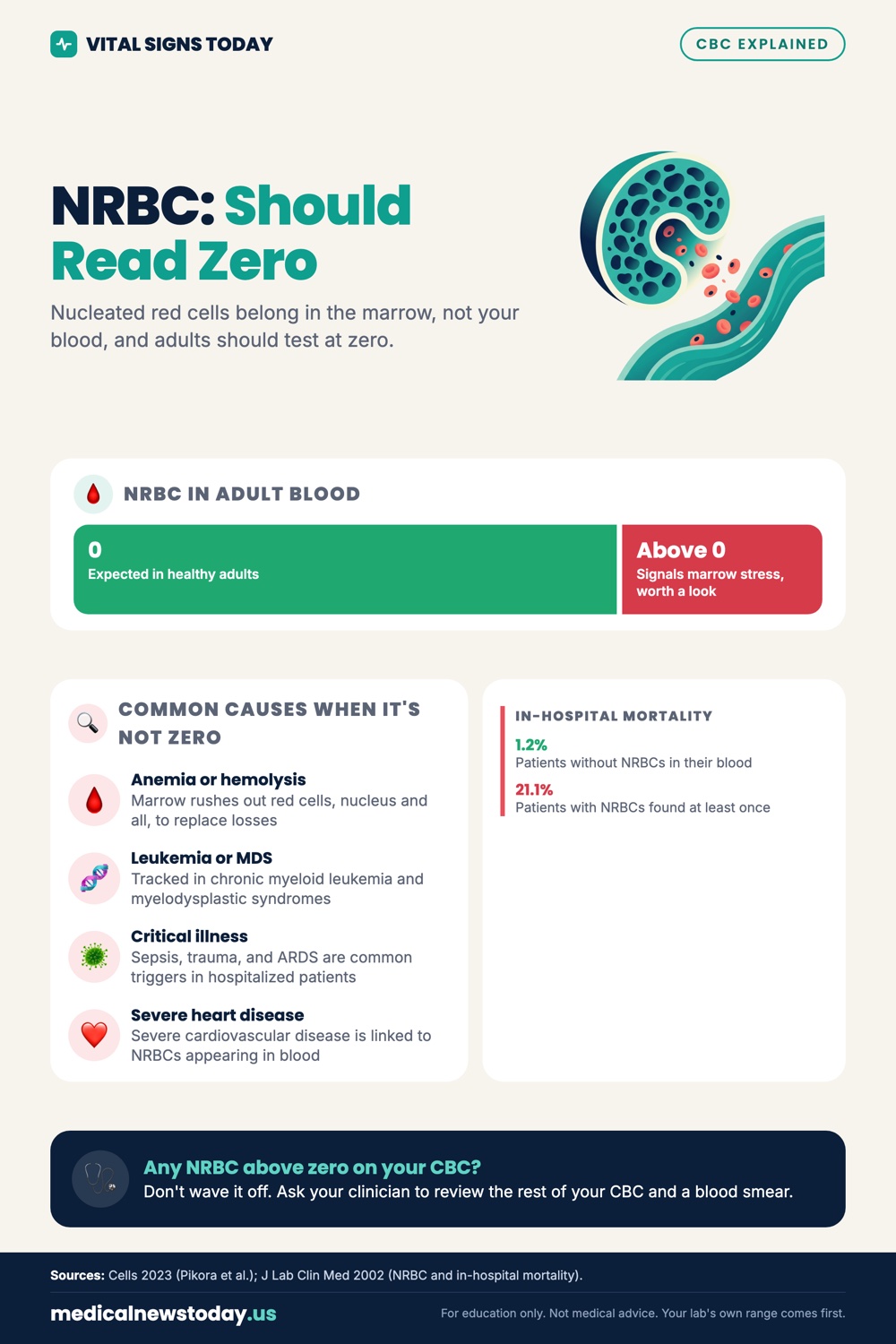
You scanned your blood work, everything looked roughly in range, and then you spotted a line near the bottom of the complete blood count: NRBC, with a tiny number next to it, often 0 or 0.0. Easy to ignore. Here is what most explainers will not tell you plainly. NRBC is one of the few results on a routine report where the ideal answer is simply zero, and any number above zero is worth a real conversation with your clinician.
This is not a marker you want trending up. Understanding what is NRBC in blood test reporting turns a confusing acronym into one of the most honest signals on the whole page.
What is NRBC in blood test results?
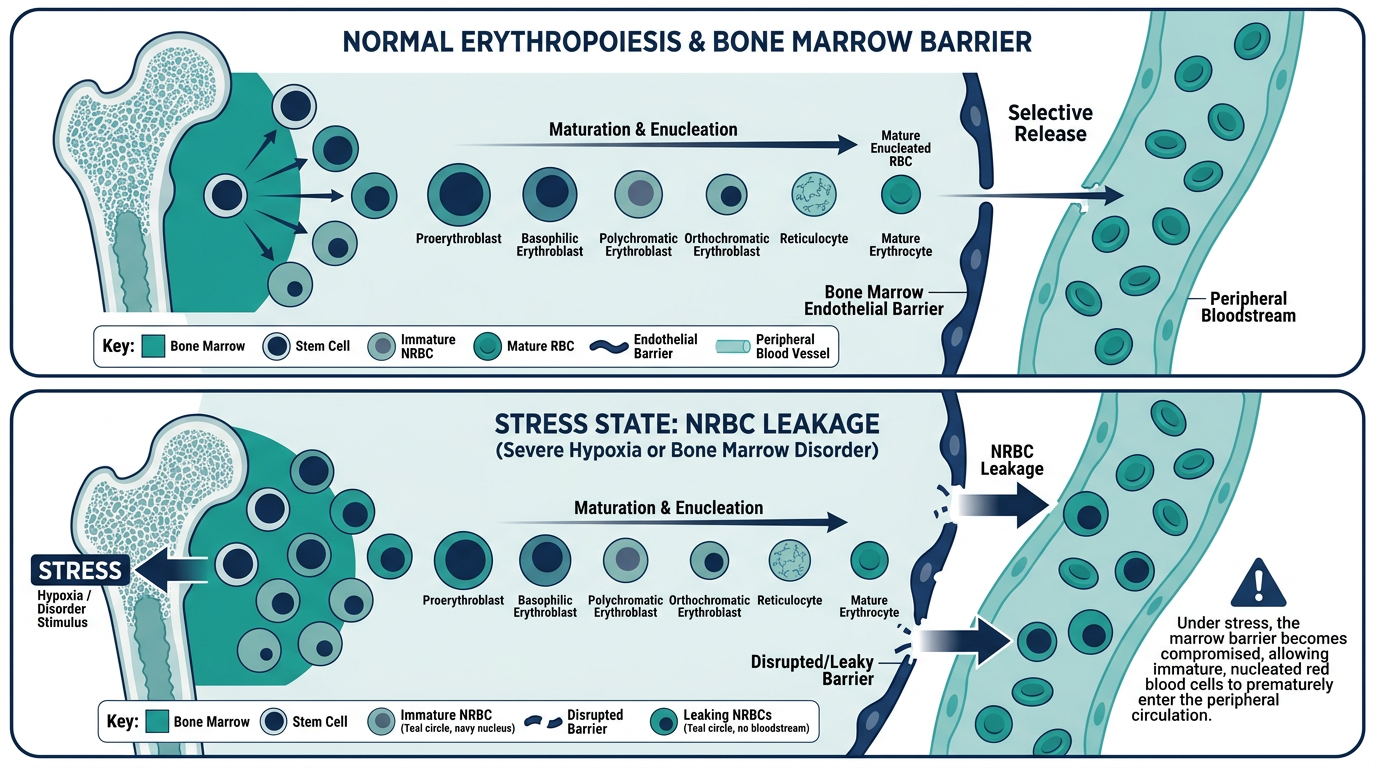
NRBC stands for nucleated red blood cells, the immature red blood cells that still contain a nucleus. In healthy adults they live in the bone marrow and are not supposed to circulate in your bloodstream at all (Cleveland Clinic Journal of Medicine). A mature red blood cell ejects its nucleus before it enters circulation, which is what makes room for all the hemoglobin that carries your oxygen. So when NRBCs show up in a peripheral blood sample, it means cells that should still be in the bone marrow nursery got pushed out into the blood early.
That single idea, immature cells leaving the marrow before they are finished, is the key to everything below. It usually means the bone marrow is under pressure and is rushing reinforcements into circulation before they are ready.

What does NRBC mean in a blood test, and how is it reported?
When people ask what does NRBC mean in a blood test, the short answer is the body’s stress flare for red cell production. NRBCs are erythrocyte precursors, the unfinished version of a red blood cell, and a modern hematology analyzer counts them automatically as part of the CBC (Cleveland Clinic Journal of Medicine).
You may see the result reported in two ways. One is NRBC per 100 white blood cells, a ratio the lab calculates while it differentiates your white cells. The other is an absolute count, often written as NRBC# in units like cells per microliter or 10 to the sixth per microliter. They describe the same finding, immature red cells in circulation, on different scales. Whichever your report uses, the interpretation starts the same way: in an adult, you want this number at or very near zero.
What is a normal NRBC level?
A normal NRBC level in a healthy adult is essentially zero, because nucleated red blood cells normally stay in the bone marrow and do not circulate (Cleveland Clinic Journal of Medicine). On many reports you will literally see 0 per 100 white blood cells, or an absolute count reported as 0.0. That is the result you are hoping for.
The exact cutoff is being refined. A large analysis of more than 66,000 specimens from healthy, non-hospitalized people proposed updating the upper limit of the reference interval from 0.01 to 0.10 times 10 to the sixth per microliter, after finding that a small fraction of clearly healthy people carry a tiny number of circulating NRBCs with otherwise normal blood work (PubMed, updated NRBC reference interval). The practical message has not changed much: a clear zero is reassuring, and a number that is anything more than trivially small is the point where clinicians start asking why.
Newborns are the big exception. It is completely normal for babies to have nucleated red blood cells in their blood at birth, sometimes up to around 1,000 per cubic millimeter in a healthy term infant, and these clear from circulation within days (PMC, diagnostic and prognostic value of NRBC). So an NRBC result on a newborn is read with a completely different rulebook than one on an adult.

What does a high NRBC mean?
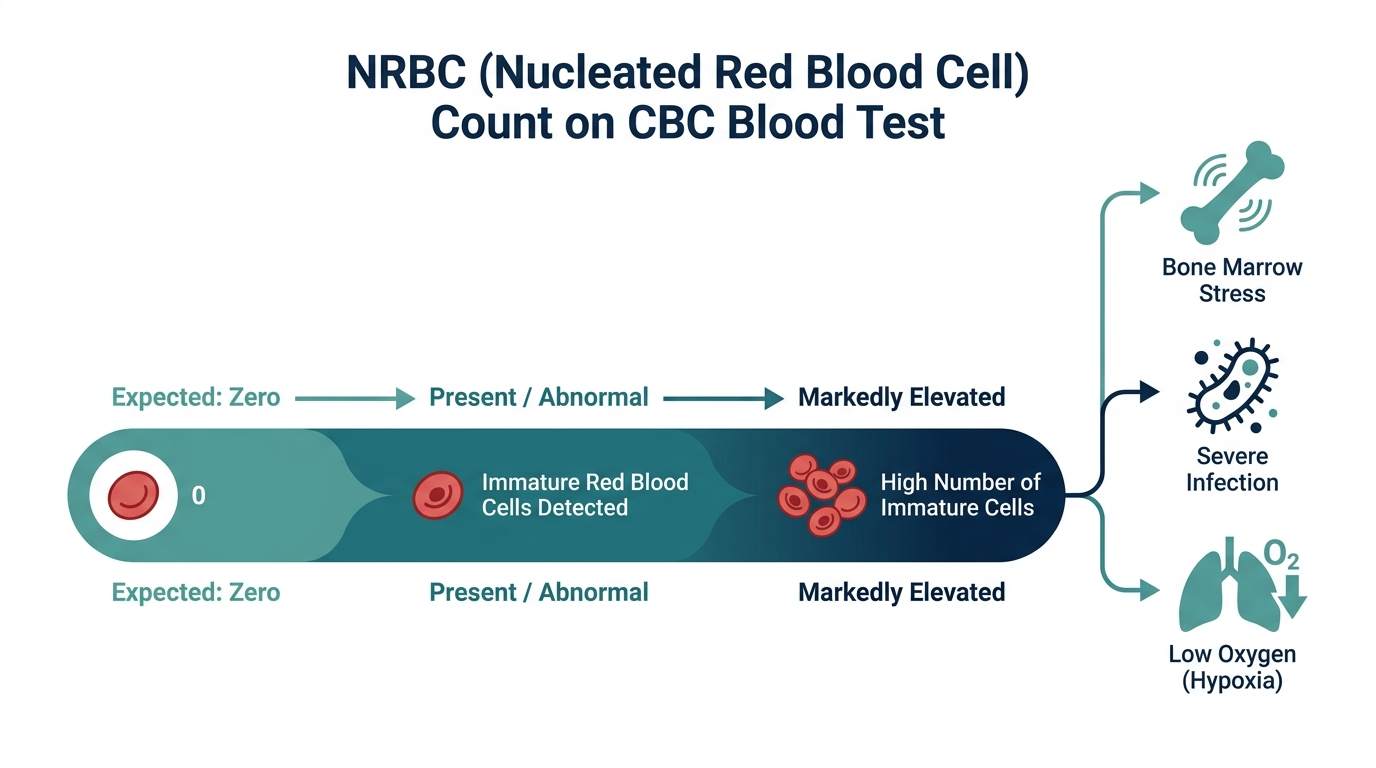
A high NRBC, meaning any meaningful number in an adult, tells you the bone marrow is under enough stress that it is releasing immature red cells early. It is a signal of hematopoietic stress, not a diagnosis by itself, and it points to a fairly serious short list of causes (Cleveland Clinic Journal of Medicine):
- Severe or acute anemia and blood loss. When the body needs red cells fast, the marrow flushes out whatever it has, nucleus and all.
- Hypoxia. Low oxygen, from severe lung or heart disease, drives the marrow to ramp up red cell output.
- Bone marrow and blood disorders. NRBCs appear in a high share of hematologic diseases, including chronic myeloid leukemia, acute leukemia, and myelodysplastic syndromes (Cleveland Clinic Journal of Medicine).
- Critical illness. Sepsis, trauma, acute respiratory distress syndrome, and other severe acute conditions frequently push NRBCs into the blood (PMC, diagnostic and prognostic value of NRBC).
Here is the insider point that rarely reaches the patient version. In a hospital setting, a positive NRBC is one of the strongest quiet predictors of in-hospital death on the entire CBC, and it often shows up well before the patient visibly crashes. In one large study, patients with NRBCs in their blood had a 21.1 percent in-hospital mortality rate compared with 1.2 percent for those without, and NRBCs appeared a median of 13 days before death, behaving like an early warning system (PubMed, NRBC and in-hospital mortality). Among critically ill ICU patients the signal is even louder, with NRBC-positive patients showing roughly double the mortality of NRBC-negative ones (PMC, NRBC frequency in ICU patients). This is exactly the kind of number that gets buried when a report just says results were reviewed.
What does a low NRBC mean?
A low NRBC, which in adults means zero or as close to zero as possible, is the normal and reassuring result. There is no such thing as a problematic low NRBC in adults, because the healthy baseline is no nucleated red cells in circulation at all (Cleveland Clinic Journal of Medicine). If your report shows 0 NRBC per 100 white blood cells, that line is doing its job by staying quiet. Unlike most markers where both high and low can mean trouble, NRBC is one-directional: the closer to zero, the better.

Why is NRBC reported alongside the white blood cell count?
NRBC is tied to the white blood cell count for a very practical reason: older analyzers and manual counts could mistake nucleated red cells for white blood cells, because both have a nucleus. That mix-up falsely inflates the WBC count. Modern analyzers flag and subtract NRBCs so the corrected white cell count is accurate, which is why you often see NRBC printed right next to the differential (Cleveland Clinic Journal of Medicine).
This pairing matters more than it sounds. If a lab did not account for NRBCs, a critically ill patient with many circulating nucleated red cells could appear to have a high white count that is partly an illusion. Reading NRBC next to the WBC differential keeps both numbers honest and is part of why the finding gets formally reported rather than quietly discarded.
The part most people never hear: NRBC as a severity dial, not a yes or no
Most patient explainers treat NRBC as a simple present-or-absent flag. The more useful truth is that it behaves like a dial, and the height of the number tracks with how sick someone is. Across hospital studies, mortality climbs in a dose-response pattern as NRBC concentration rises, so a faint trace and a flood of NRBCs are not the same warning (PMC, diagnostic and prognostic value of NRBC).
In intensive care, researchers have even identified working cutoffs, with one study finding that an NRBC level above roughly 2.5 per 100 white blood cells flagged a high risk of ICU death with about 91 percent sensitivity (PMC, NRBC frequency in ICU patients). The leading explanation for why a red cell marker predicts survival is that circulating NRBCs are a downstream readout of severe systemic stress: profound hypoxia, intense inflammation, and tissue injury all signal the marrow to break its own rules and release immature cells. NRBC is essentially the body confessing how hard it is being pushed.
One honest caveat. Almost all of this prognostic research comes from hospitalized and critically ill patients, not from routine outpatient checkups. A single trace NRBC on an otherwise pristine outpatient CBC is not the same as a rising NRBC in an ICU. It is still a finding your clinician should explain rather than wave away, but context is everything, and the number is interpreted very differently depending on where you are and how you feel.

How NRBC is measured and what can affect the result
You do not prepare for an NRBC test the way you would for a fasting glucose or lipid panel. NRBC is not ordered on its own. It rides along automatically whenever a complete blood count with differential is run, so there is no fasting, no special timing, and nothing to do beforehand. A standard venous blood draw into an EDTA tube is all it takes, and the hematology analyzer counts nucleated red cells as part of processing the sample.
Because the count is automated, a handful of technical and biological factors can influence what you see:
- Delayed processing. Blood that sits too long before analysis can degrade, and cell morphology changes over time, which is one reason labs prefer to run CBC samples promptly.
- Analyzer flagging. When an automated count flags a high or unusual NRBC, many labs confirm it with a manual review of a stained blood smear under the microscope, where a technologist can eyeball the actual cells. A flagged result often triggers this second look before it is finalized.
- Very high white cell counts or clumping. Extreme leukocytosis or platelet clumping can complicate automated differentials, which is part of why NRBC is cross checked against the corrected white cell count.
- Recent transfusion or acute event. A recent major bleed, transfusion, or acute illness can transiently change the marrow’s output, so timing relative to a clinical event matters for interpretation.
The point is that NRBC is rarely a standalone lab you schedule. It is a byproduct of the CBC, which is why you will only ever see it in the context of a full blood count rather than as a test you request in isolation.
Markers read alongside NRBC on the CBC
An NRBC number becomes far more informative when you read it next to the rest of the complete blood count. Each neighboring value helps explain why immature red cells might be spilling into circulation.
- Hemoglobin and hematocrit. If these are low, the body is anemic, and a positive NRBC alongside low hemoglobin fits the picture of marrow working overtime to replace red cells.
- Reticulocyte count. Reticulocytes are the slightly more mature step just before a finished red cell. A high reticulocyte count with NRBCs present says the marrow is in active, vigorous production mode, often in response to blood loss or hemolysis.
- White blood cell count and differential. Because NRBCs can be miscounted as white cells, they are read together to keep the corrected WBC honest. A blood picture with immature white cells and NRBCs together, sometimes called a leukoerythroblastic picture, points toward significant marrow stress or infiltration.
- Red cell indices like MCV and RDW. These describe red cell size and variability and help pin down the type of anemia driving the marrow response.
Reading these together is what separates a benign explanation from a worrying one. This is also why capturing the full panel in a single draw, rather than one marker at a time, gives a clinician the context to interpret NRBC correctly instead of guessing.
Interpreting NRBC: how context changes everything
The same NRBC value can carry very different weight depending on who it belongs to. A few scenarios show how much context shifts the meaning:
- NRBC 0 in a healthy adult. This is the target result. Nothing to act on.
- A term newborn with NRBCs present. Entirely normal. Babies are born with circulating nucleated red cells that clear within days, so this is read against an infant rulebook, not an adult one.
- A trace NRBC on an otherwise pristine outpatient CBC. Worth a conversation and possibly a repeat test, but not an emergency. The rest of the panel and how the person feels drive the next step.
- A rising NRBC in a hospitalized, seriously ill patient. This is the setting where NRBC carries its strongest prognostic weight and warrants close attention.
- NRBCs with low hemoglobin and a high reticulocyte count. This pattern fits a marrow responding hard to anemia or blood loss, and it directs the workup toward finding the source.
The lesson is that NRBC is never interpreted as a number in a vacuum. Where you are, how you feel, and what the rest of the blood count shows all change what it means.
What happens after a positive NRBC result
Finding NRBCs on an adult report is a starting point, not a conclusion. Because the causes range from a vigorous response to anemia all the way to serious marrow disease, the next steps depend heavily on the clinical picture. A clinician will typically start by looking at the rest of the CBC, checking hemoglobin, white cells, and platelets, and reviewing a manual blood smear to see the cells directly.
Depending on what that shows and how the person feels, further evaluation may include a reticulocyte count to gauge marrow response, iron and other anemia studies, and in some cases referral to a hematologist. The one thing a positive NRBC should not do is get ignored. It is one of the few CBC lines where the ideal reading is a flat zero, so any deviation earns an explanation rather than a shrug.
Common misconceptions about NRBC
- “A tiny NRBC number is nothing, since everyone has some.” In adults the healthy baseline is essentially zero. While research suggests a very small number can appear in some healthy people, an NRBC above that trivial level is a finding to explain, not to dismiss.
- “NRBC is a diagnosis.” It is not. It is a signal that the marrow is stressed. The cause could be as manageable as recovering from blood loss or as serious as a marrow disorder, and only the wider picture tells you which.
- “High NRBC in a newborn means something is wrong.” Not on its own. Babies normally have circulating NRBCs at birth, so the finding is interpreted against a completely different reference than in adults.
- “If both high and low are bad for most markers, low NRBC must be bad too.” Not here. NRBC is one directional. Zero is the goal, and there is no such thing as a dangerously low NRBC in an adult.
- “The lab just miscounted my white cells.” Modern analyzers specifically identify and subtract NRBCs so the corrected white count stays accurate, which is exactly why NRBC is reported separately rather than folded silently into the WBC.
NRBC in newborns versus adults: the same cell, a different rule
NRBC is one of the few blood values where the normal result flips completely depending on age, and understanding that flip prevents a lot of misplaced worry. In a healthy adult or an older child, the expected NRBC count is zero, and finding these immature red cells in the circulation is a signal worth explaining. In a newborn, the same cells are a normal part of arriving in the world.
The reason is developmental. Before birth, a baby lives in a lower oxygen environment and the bone marrow runs hot to produce red cells, so some are released while still nucleated. That is why healthy term newborns can show a meaningful number of NRBCs on a first blood count, and premature infants typically show even more because their red cell production is working harder for longer (NRBC as a severity marker in neonatal care). These cells are then cleared quickly. In a normal term baby the count falls toward zero within the first weeks of life, and by around a month it should read at or near zero, the same as it does for the rest of childhood and adulthood.
The practical takeaway is that an NRBC result can only be judged against the right age. A number that is completely expected on a newborn’s first count would be a finding that needs explaining in an adult. This is also why a persistently high NRBC in a newborn, or one that fails to clear on schedule, draws a closer look from the care team, since in that setting the count can track how much stress the baby’s system is under rather than simply marking normal transition.
Frequently asked questions
What is a normal NRBC level in adults?
In a healthy adult, the normal NRBC level is essentially zero, because nucleated red blood cells normally stay in the bone marrow and do not circulate (Cleveland Clinic Journal of Medicine). Many reports show 0 per 100 white blood cells. Newborns are an exception and normally have NRBCs at birth that clear within days.
Is it bad to have nucleated red blood cells in your blood?
In an adult, any meaningful NRBC reading is abnormal and worth investigating, because it signals that the bone marrow is under stress and releasing immature red cells early (Cleveland Clinic Journal of Medicine). It is a clue, not a diagnosis, and your clinician will look at the rest of your CBC and your clinical picture.
What conditions cause a high NRBC?
Common causes include severe or acute anemia, blood loss, hypoxia from heart or lung disease, bone marrow and blood disorders such as leukemia and myelodysplastic syndromes, and severe acute illness like sepsis and trauma (PMC, diagnostic and prognostic value of NRBC).
Does a high NRBC predict mortality?
In hospitalized and critically ill patients, yes, the presence of NRBCs is a strong predictor of in-hospital death and often appears days before a patient declines (PubMed, NRBC and in-hospital mortality). This research comes mainly from inpatient settings, so a single trace finding in a healthy outpatient is interpreted with more caution.
Why is NRBC measured with the white blood cell count?
Because nucleated red cells have a nucleus, older methods could miscount them as white blood cells and falsely raise the WBC count. Modern analyzers identify and subtract NRBCs so the corrected white cell count stays accurate, which is why NRBC is reported next to the differential (Cleveland Clinic Journal of Medicine).
This article is for general educational purposes and is not medical advice. It cannot diagnose or treat you and does not replace your clinician. Always discuss your lab results and any health decisions with a qualified healthcare professional.
Vital Signs Today may earn a commission if you buy through links on this page. It does not affect our editorial assessments.