Part of our Complete Blood Count guide.
You scanned your complete blood count, found your hemoglobin sitting comfortably in range, and then your eye snagged on four letters stacked among the red cell numbers: MCHC. No flag, no asterisk, so you moved on. Here is what most explainers gloss over. MCHC is not just another filler value. It is the one red cell index that quietly tells you how tightly your red blood cells are packing their hemoglobin, and in a few specific situations it is the number that cracks a diagnosis open.
Most people never get told what MCHC actually means, so it becomes background noise on the report. Once you understand it, you read your own results differently.
What is MCHC in a blood test?
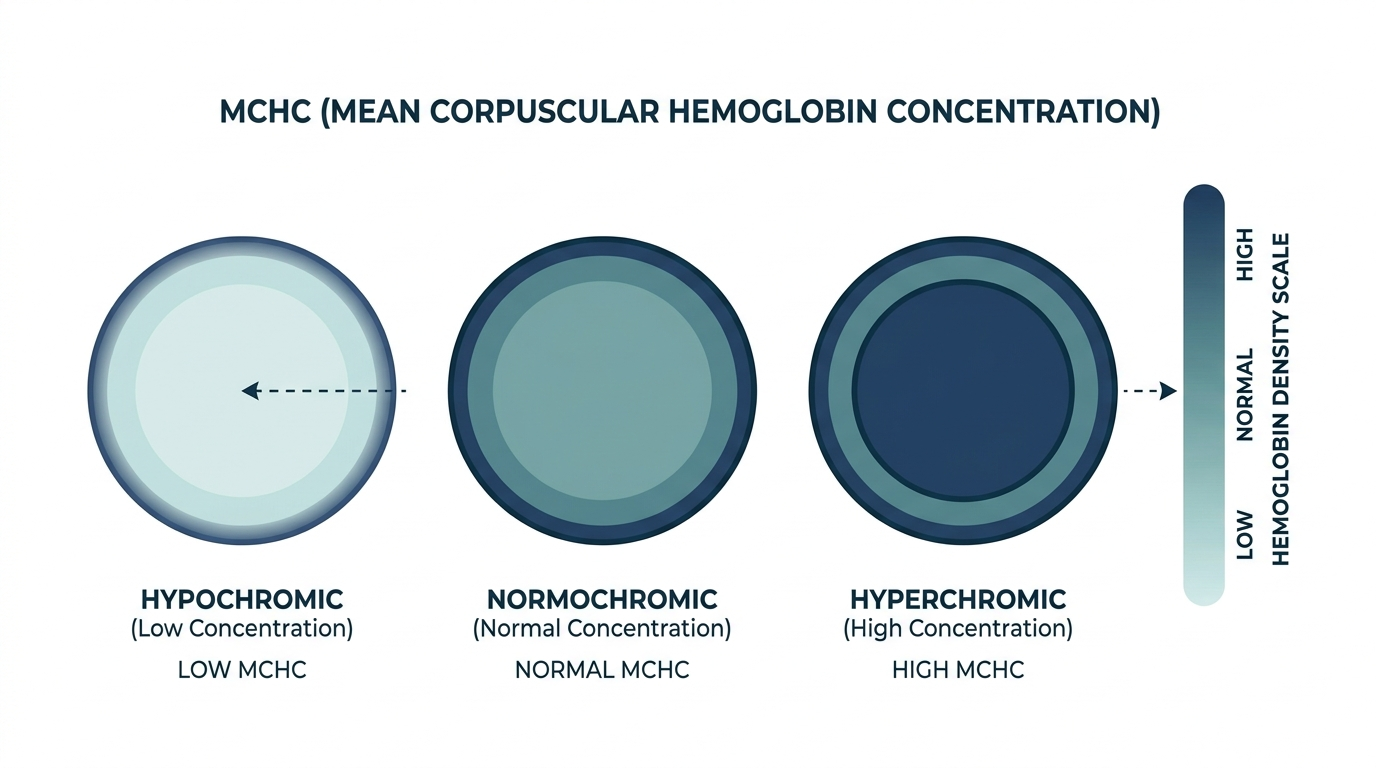
MCHC stands for mean corpuscular hemoglobin concentration, and it measures the average concentration of hemoglobin inside your red blood cells. It is one of the red cell indices reported automatically as part of a standard complete blood count, or CBC (Cleveland Clinic). In plain terms, MCHC tells you how densely hemoglobin, the protein that carries oxygen, is crammed into each cell. A typical adult MCHC sits around 32 to 36 grams per deciliter (Cleveland Clinic).
Think of each red blood cell as a small bottle and hemoglobin as the liquid inside it. MCHC is not how big the bottle is and not the total amount of liquid. It is the concentration, how full each bottle is for its size. That single idea is the key to everything below.
What does MCHC mean in a blood test compared to MCV and MCH?
MCHC describes hemoglobin concentration, while MCV and MCH describe size and quantity, and the three are read together to characterize your red blood cells. The CBC reports four red cell indices: MCV is the average size of your red cells, MCH is the average amount of hemoglobin per cell, MCHC is the average concentration of hemoglobin, and RDW is how much the cell sizes vary (Cleveland Clinic).
The distinction between MCH and MCHC trips up almost everyone, so it is worth nailing down. MCH is the raw amount of hemoglobin in an average cell. MCHC factors in both the amount of hemoglobin and the size of the cell, which is why it reads as a concentration rather than a quantity (Cleveland Clinic). Going back to the bottle analogy: MCH is how much liquid is in the bottle, while MCHC is how full the bottle looks for its size. A normal MCV runs about 80 to 100 femtoliters (Cleveland Clinic), and MCHC adjusts hemoglobin content against that volume.
What is a normal MCHC level?
A normal MCHC for an adult is generally 32 to 36 grams per deciliter (Cleveland Clinic). The exact cutoffs vary slightly depending on the laboratory and the analyzer that ran your sample, so the number that matters most is the reference range printed beside your own result. That is the range your lab actually calibrated its instrument against.
Here is the practical framing. Because hemoglobin concentration is biologically capped, MCHC has a narrow window. Cells cannot physically hold much more than about 36 to 37 grams per deciliter without losing membrane integrity. That ceiling is exactly why a genuinely high MCHC is uncommon and, when real, worth a second look.
What does a low MCHC mean?
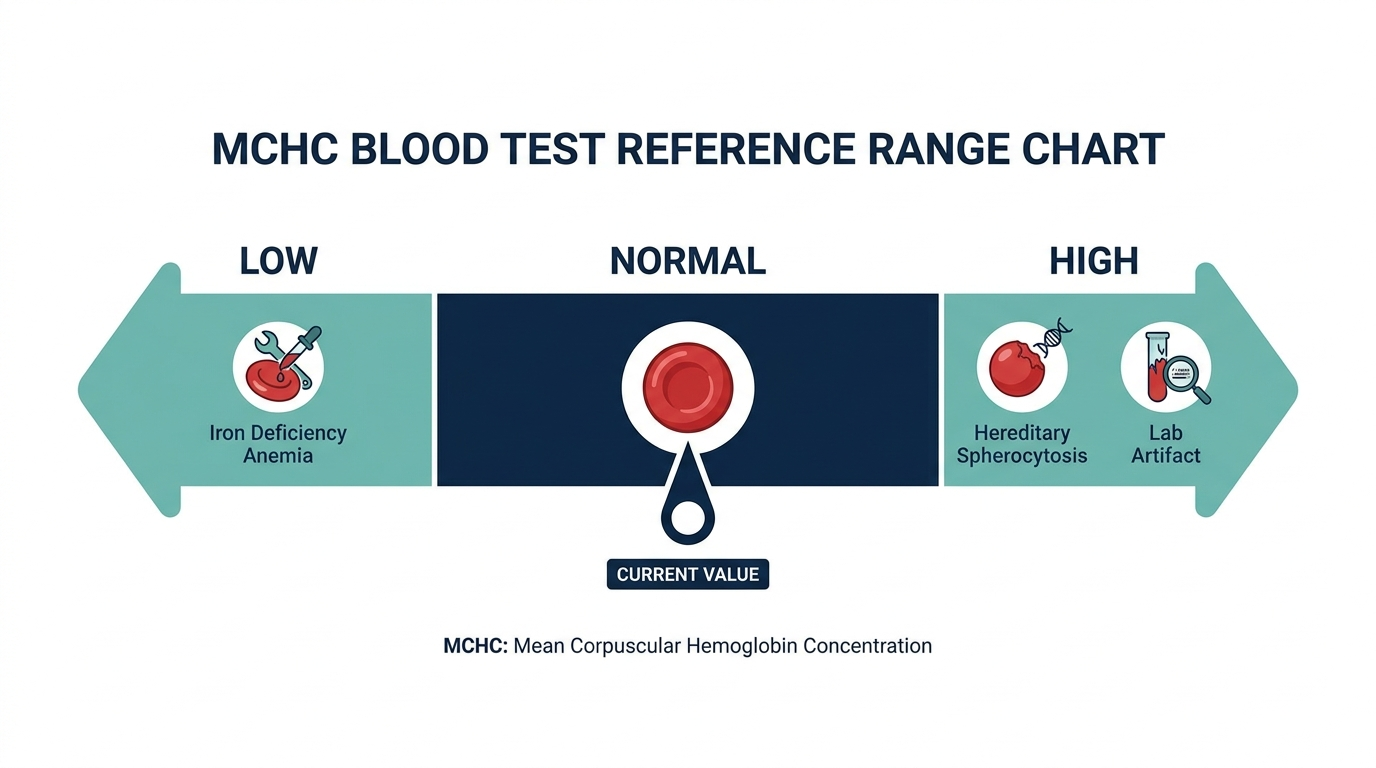
A low MCHC means your red blood cells contain hemoglobin at a lower than normal concentration, so they are paler than they should be. Doctors call this hypochromia, and the classic cause is iron deficiency, the most common nutritional deficiency worldwide. Without enough iron, your bone marrow cannot manufacture enough hemoglobin to fill each cell to its usual density. A CBC is one of the main tests used to detect this kind of anemia and start the search for its cause (MedlinePlus).
Low MCHC most often shows up alongside a low MCV, because in iron deficiency the cells tend to be both small and underfilled. Other causes of a low MCHC include chronic blood loss, such as heavy menstrual periods or slow gastrointestinal bleeding, and the thalassemias, a group of inherited conditions affecting hemoglobin production. A low MCHC is a clue, not a diagnosis, and it is interpreted next to your hemoglobin, MCV, and iron studies rather than in isolation.

What does a high MCHC mean?
A high MCHC means hemoglobin is unusually concentrated inside your red blood cells, and unlike a low result, it usually has one of two explanations: a real biological cause or a laboratory artifact. The narrow band on MCHC is what makes a true elevation interesting, because cells rarely exceed their natural concentration ceiling.
The most clinically important real cause is hereditary spherocytosis, an inherited condition in which red cells lose part of their membrane and become small, dense spheres instead of flexible discs. Because these spherocytes have less surface area for the same hemoglobin payload, their concentration climbs, and an increased MCHC is a recognized laboratory clue to the diagnosis (NCBI StatPearls). In fact, a diagnosis of hereditary spherocytosis is considered positive when there is Coombs-negative hemolysis together with an increased MCHC and other supporting findings (NCBI StatPearls). Other true causes include autoimmune hemolytic anemia, where cells are destroyed faster than they are made, and severe dehydration.
Now here is the insider point that rarely reaches the patient version. A surprising share of high MCHC results are not real at all. They are artifacts. Cold agglutinins, which are antibodies that make red cells clump in a chilled sample, fool the analyzer into reporting a falsely high concentration. So can lipemia, when fat in the blood interferes with the optics, and in-vitro hemolysis, when cells rupture inside the collection tube before testing. A genuinely elevated MCHC, especially one above the physiologic ceiling of roughly 37 grams per deciliter, often prompts the lab to rerun the sample or warm it before flagging a disease. This is exactly the kind of nuance that gets lost when a result just says high.
Why is MCHC measured with MCV and the rest of the CBC?
MCHC rarely tells the full story alone, so clinicians read it next to MCV, MCH, hemoglobin, and the red cell count to classify anemia and point toward a cause. The red cell indices are designed to work as a panel, each describing a different property of the same cells (Cleveland Clinic). MCV gives you size, MCH gives you hemoglobin quantity, and MCHC gives you concentration. Read together, they sketch the shape and quality of your entire red cell population.
A simplified version of how the picture comes together:
- Low MCHC with low MCV: the classic pattern of iron deficiency anemia, where cells are small and underfilled (hypochromic and microcytic).
- Normal MCHC with low MCV: can point toward thalassemia trait, where cells are small but still normally concentrated.
- High MCHC with low MCV: a flag for hereditary spherocytosis, where dense small spheres raise the concentration (NCBI StatPearls).
- Normal MCHC with normal MCV: typical when anemia, if present, comes from causes like chronic disease or recent blood loss rather than a problem packing hemoglobin.
That third row is why MCHC earns its keep. Several conditions can shrink red cells, but very few push the hemoglobin concentration up. When MCHC rises rather than falls, it narrows a wide list of possibilities down to a short one, and it can do that from a test that costs almost nothing extra.
Should you worry about an abnormal MCHC?
An abnormal MCHC on its own is a reason to look closer, not a reason to panic. The number is a single data point in a panel, and its meaning depends entirely on what your hemoglobin, MCV, RDW, and symptoms are doing alongside it. A mildly low MCHC in someone with low hemoglobin and a known reason to be iron deficient, such as heavy periods, usually tells a coherent story that iron studies can confirm.
A high MCHC deserves a different kind of attention. Because true elevations are uncommon and lab artifacts are common, a flagged high MCHC often warrants a repeat test before anyone reaches for a diagnosis. If it stays high on a clean sample, and especially if there are signs of hemolysis or a family history of anemia, that is when hereditary spherocytosis and related conditions move up the list (NCBI StatPearls). Either way, the move is the same: bring the result to your clinician, who reads it in context rather than in isolation.

How MCHC is calculated, and why that explains the artifacts
Understanding one small piece of math demystifies why high MCHC results are so often false. MCHC is not measured directly. It is calculated from two other numbers already on your CBC: the hemoglobin and the hematocrit. In effect, it is the hemoglobin divided by the hematocrit, expressed as a concentration. That derivation is the whole reason MCHC behaves the way it does.
Because it is a ratio built from hemoglobin and hematocrit, anything that falsely raises the measured hemoglobin, or falsely lowers the measured red cell volume, pushes the calculated MCHC up. That is exactly what the classic artifacts do. Cold agglutinins make red cells clump so the analyzer counts them as fewer, larger particles, distorting the volume. Lipemia, or fat in the sample, and free hemoglobin from cells that ruptured in the tube both inflate the hemoglobin reading. The number climbs on paper while nothing is wrong with your actual cells. This is why a high MCHC, especially above the natural ceiling of roughly 37 grams per deciliter, is treated as a prompt to recheck the sample rather than an immediate diagnosis. The math cannot exceed biology, so when it appears to, the sample is usually the suspect.
Symptoms tied to the anemias MCHC helps flag
MCHC itself causes nothing you can feel. What you notice comes from the underlying red cell problem it points toward, most often anemia.
With a low MCHC, usually iron-deficiency territory, the symptoms are those of anemia developing slowly: fatigue that rest does not fix, weakness, shortness of breath on exertion, pale skin, cold hands and feet, brittle nails, and sometimes unusual cravings for non-food items like ice, a pattern called pica. Because iron deficiency builds gradually, people often adapt and overlook these signs for months.
With a genuinely high MCHC from a hemolytic condition such as hereditary spherocytosis or autoimmune hemolytic anemia, the picture can include fatigue, jaundice or a yellow tint to the skin and eyes from red cell breakdown, dark urine, and an enlarged spleen. A family history of anemia, gallstones at a young age, or episodes of jaundice can be clues that point toward an inherited membrane disorder.
The practical takeaway is that MCHC is a signpost, not a symptom generator. If your MCHC is abnormal and you also feel any of the above, that combination is what makes the number worth acting on.
The RDW pairing that sharpens an MCHC result
One index often gets overlooked next to MCHC but adds real diagnostic power: the RDW, or red cell distribution width, which measures how uniform your red cells are in size. Reading MCHC and RDW together refines the picture in a way either does alone.
- Low MCHC with a high RDW is a strong fingerprint of iron deficiency, where cells are not only underfilled but also vary widely in size as the marrow struggles.
- Low or normal MCHC with a normal RDW can point more toward thalassemia trait, where cells are small and uniform rather than jumbled.
- A rising RDW before other numbers shift can be an early hint that a mixed or evolving anemia is developing.
This is why clinicians rarely stop at a single index. The combination of MCV, MCHC, and RDW turns a vague low hemoglobin into a specific hypothesis that iron studies or hemoglobin electrophoresis can then confirm.

What to do about a low MCHC: the usual next steps
Because a low MCHC most often points toward iron deficiency, the follow-up is usually straightforward and worth knowing so an abnormal result does not feel like a dead end.
- Confirm with iron studies. A low MCHC alongside low hemoglobin and low MCV typically leads to iron tests, including ferritin, which reflects your iron stores. Low ferritin confirms iron deficiency.
- Find the source. Iron deficiency is a symptom, not a cause. In menstruating women, heavy periods are a common driver. In others, especially men and postmenopausal women, slow gastrointestinal blood loss is investigated, since it can be the first sign of something that needs attention.
- Replace the iron. Treatment usually means dietary changes and iron supplementation, with the dose and duration guided by how low the stores are.
- Recheck the trend. The indices are retested over weeks to months to confirm the marrow is refilling cells properly as iron is restored.
The order matters. Simply taking iron without finding why you were deficient can mask an underlying bleeding source, which is why the search for a cause is part of the standard workup.
How to prepare, and what can distort an MCHC
You usually do not need special preparation for the CBC that produces your MCHC, but a few conditions can distort it, and knowing them helps you read a surprising result calmly:
- Sample temperature. A sample that cools before analysis can trigger cold agglutinin clumping and a falsely high MCHC. Warming and rerunning the sample often fixes it.
- Very high blood fats. Lipemia after a fatty meal can interfere with the optics and inflate the reading, which is one reason some panels are drawn fasting.
- Rough handling of the sample. Cells that rupture inside the tube, called in-vitro hemolysis, release hemoglobin and push the calculated concentration up artificially.
- Severe dehydration. This is a genuine, not artifactual, way concentration can edge upward, and it usually corrects with rehydration.
The recurring theme is that a high MCHC is more often a sample story than a body story, so a repeat on a clean, properly handled specimen is the sensible first move.
A worked example: reading MCHC in context
Suppose your report shows an MCHC of 30 grams per deciliter, flagged low, with a low hemoglobin and a low MCV. A coherent read runs like this:
- Recognize the pattern. Low MCHC plus low MCV plus low hemoglobin is the textbook signature of hypochromic, microcytic anemia, most often from iron deficiency.
- Check the RDW. A high RDW strengthens the case for iron deficiency; a normal RDW nudges toward thalassemia trait.
- Order iron studies. Ferritin and related tests confirm whether iron stores are truly depleted.
- Look for the cause. Menstrual loss, diet, or a possible gastrointestinal source are considered based on age, sex, and history.
Now flip it. If the same report instead showed a high MCHC above 37 with signs of hemolysis, the path would lead toward a repeat test to exclude an artifact, and if it held, toward conditions like hereditary spherocytosis. The same four letters send the workup in completely different directions depending on which way they move and what surrounds them.
Common misunderstandings about MCHC
- “A high MCHC means my blood is too rich or too strong.” Not so. True high values usually reflect a red cell membrane or hemolytic problem, and most flagged high results are lab artifacts rather than real elevations.
- “MCH and MCHC are the same thing.” MCH is the amount of hemoglobin per cell; MCHC is the concentration, which accounts for cell size. One answers how much, the other how dense.
- “A low MCHC is the diagnosis.” It is a clue, most often to iron deficiency, but the real task is finding why the iron is low, which can matter more than the anemia itself.
- “An abnormal MCHC needs urgent action.” Because MCHC is calculated and prone to artifact, the usual first step is to read it alongside the other indices and, for high values, to repeat the test rather than react to a single number.
Frequently asked questions
What is MCHC on a blood test in simple terms?
MCHC, or mean corpuscular hemoglobin concentration, is the average concentration of hemoglobin inside your red blood cells, reported as part of a complete blood count (Cleveland Clinic). It tells you how densely each cell is packed with the oxygen carrying protein, not how big the cell is or how many cells you have.
What is a normal MCHC blood test level?
A normal MCHC for an adult is generally 32 to 36 grams per deciliter, though the exact range varies slightly by lab (Cleveland Clinic). Compare your result to the reference range printed on your own report.
What does a low MCHC mean?
A low MCHC means your red cells carry hemoglobin at a lower concentration than normal, making them paler, a state called hypochromia. The most common cause is iron deficiency, often alongside a low MCV, and a CBC is a key test for detecting this kind of anemia (MedlinePlus).
What does a high MCHC mean?
A high MCHC means hemoglobin is unusually concentrated in your red cells. The main real cause is hereditary spherocytosis, where dense spherical cells raise the concentration, recognized as a laboratory clue to that condition (NCBI StatPearls). Many high results are actually lab artifacts and prompt a repeat test.
What is the difference between MCH and MCHC?
MCH is the average amount of hemoglobin in a single red cell, while MCHC is the average concentration, which factors in both the hemoglobin amount and the size of the cell (Cleveland Clinic). MCH answers how much, MCHC answers how dense.
This article is for general educational purposes and is not medical advice. It cannot diagnose or treat you and does not replace your clinician. Always discuss your lab results and any health decisions with a qualified healthcare professional.
Vital Signs Today may earn a commission if you buy through links on this page. It does not affect our editorial assessments.