You got your complete blood count back, and tucked among the red blood cell indices was a number reading a little hot: MCHC, sitting above the top of its reference range. Maybe your report flagged it with an H. Maybe it did not flag it at all and you only noticed because you read every line. Either way, you are now staring at four letters wondering whether they mean a real problem or nothing at all.
Here is the short version before we go deep. A high MCHC is genuinely unusual, and that is exactly what makes it interesting. Of all the values on a blood count, MCHC is one of the few that the body has a hard time pushing above normal on its own. So when it is high, there are really only two explanations, and one of them is not a disease at all. Knowing which is which is the whole game.
Part of our Complete Blood Count guide.
What is high MCHC on a blood test?
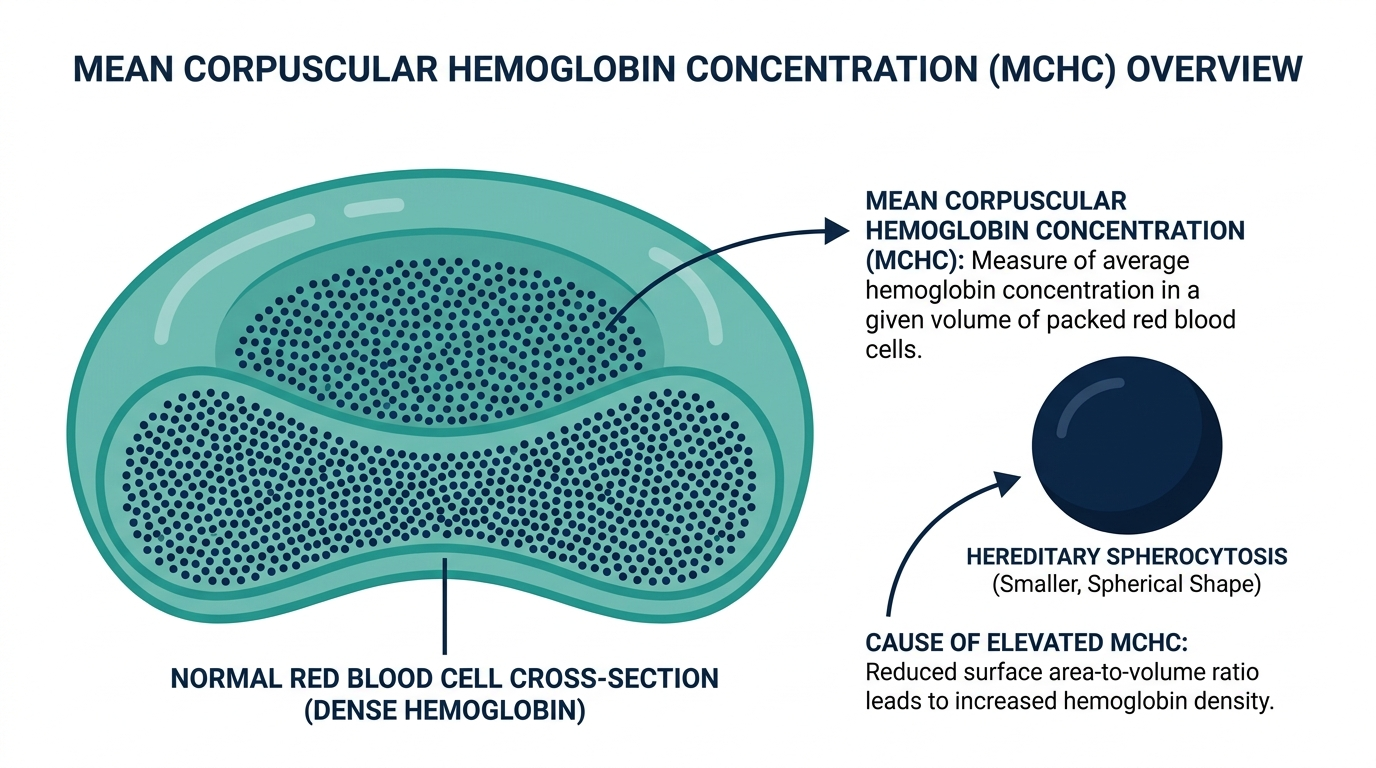
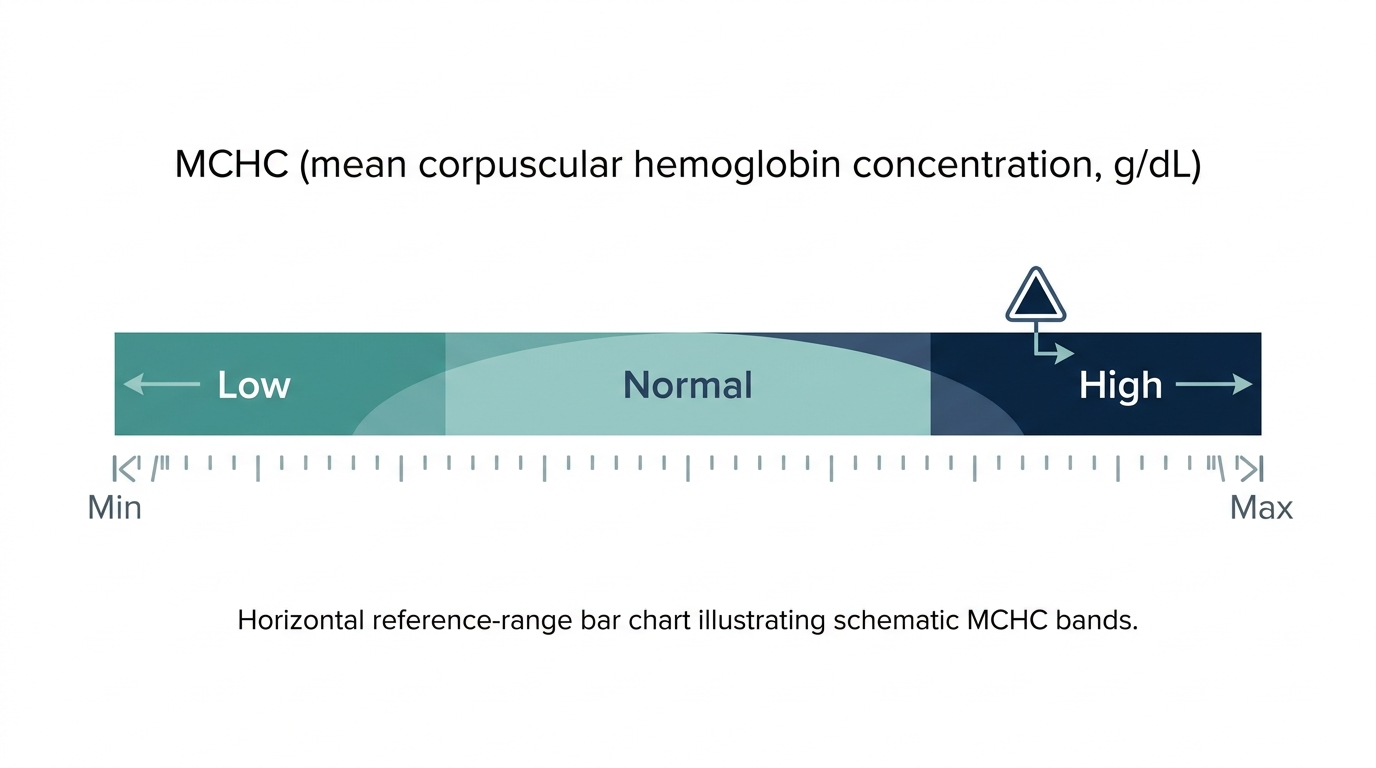
MCHC stands for mean corpuscular hemoglobin concentration, and it measures the average concentration of hemoglobin packed inside your red blood cells (Cleveland Clinic). It is reported automatically as part of a standard complete blood count. Think of each red cell as a small bag and hemoglobin as the cargo inside it. MCHC asks one question: how densely is that bag filled? A normal MCHC sits at roughly 33 to 36 grams per deciliter, with most laboratories centering the value around 34 (StatPearls, NCBI Bookshelf).
A high MCHC means your red cells are reading as more densely packed with hemoglobin than usual. In practice, the cutoff that gets clinicians’ attention is around 36 grams per deciliter and above, and a value pushing toward 37 or higher is the threshold that genuinely raises eyebrows (StatPearls, Hereditary Spherocytosis). The reason this matters is simple. There is a biological ceiling on how much hemoglobin you can cram into a red cell. The cell physically cannot hold much more than its normal saturation, so a truly elevated MCHC almost always means one of two things: the cells have shrunk while keeping their full load of hemoglobin, or the measurement itself is wrong. Both are worth understanding, and they get handled very differently.
What does a high MCHC mean on a blood test?
A high MCHC means the average red blood cell in your sample is carrying hemoglobin at a higher than normal concentration, which is a clue about either the shape of your red cells or a glitch in how the analyzer measured them (StatPearls, NCBI Bookshelf). It is not a diagnosis. It is a flag that splits the road into two directions.
Direction one is a real change in red cell shape. The classic example is spherocytosis, where red cells lose part of their membrane and round up into tight little spheres instead of the usual flattened discs. Less surface area, same hemoglobin, so the concentration inside reads high (StatPearls, Hereditary Spherocytosis).
Direction two is a laboratory artifact, meaning the number is spuriously high and your actual red cells are fine. This happens more often than patients realize, and it is the single most common reason a one-time MCHC comes back elevated (PMC, cold agglutinin effects on CBC). The practical takeaway: a high MCHC is not something to panic over, but it is something that should never be ignored, because the real causes behind it are specific and findable.
What causes a high MCHC?
The differential for an elevated MCHC is short, which is part of what makes it a useful number. Here are the real causes, most common first.
- A spurious result from the analyzer. This is the leading explanation for an isolated high MCHC, and it is not a disease. Cold agglutinins, which are antibodies that make red cells clump together when blood cools below body temperature, are the classic culprit. The clumps fool the automated counter into reading too few cells with too much hemoglobin, and the MCHC comes out impossibly high (PMC, cold agglutinin disease lab challenge). Lipemia, meaning fat-laden plasma after a fatty meal or in high triglycerides, can falsely raise the hemoglobin reading and push MCHC up with it. Hemolysis in the tube, severe jaundice, and very high white cell counts can do the same (StatPearls, NCBI Bookshelf).
- Hereditary spherocytosis. This is the textbook true cause. An inherited defect in the red cell membrane makes cells shed surface area and turn spherical, concentrating their hemoglobin. An MCHC at or above roughly 36 grams per deciliter, especially paired with a high RDW, is a recognized screening signal that prompts further testing for this condition (StatPearls, Hereditary Spherocytosis).
- Autoimmune hemolytic anemia. When the immune system attacks red cells, it can carve away their membrane and generate spherocytes, driving MCHC up through the same shape change as the inherited form (StatPearls, NCBI Bookshelf).
- Other rare membrane disorders and hemoglobinopathies, such as hereditary xerocytosis and certain hemoglobin C states, which alter red cell hydration or shape (StatPearls, NCBI Bookshelf).
Notice what is not on this list. There is no everyday, fixable cause of high MCHC the way iron deficiency drives a low one. You cannot eat your way to a high MCHC. That is why an elevated value is meaningful: it points to a narrow set of real explanations rather than vague lifestyle noise.
What are the symptoms of a high MCHC?
A high MCHC by itself causes no symptoms. You cannot feel your hemoglobin concentration, and many people with a mildly elevated value feel completely fine. The symptoms, when they exist, come from the underlying cause, not from the number on the page.
If the high MCHC is a spurious lab result, there are no symptoms at all, because nothing is actually wrong with your blood. If it reflects a true hemolytic process such as hereditary spherocytosis or autoimmune hemolytic anemia, the symptoms are those of red cells breaking down faster than normal (StatPearls, Hereditary Spherocytosis):
- Fatigue and pallor, from the anemia that hemolysis can cause. Anemia is present in roughly half of people with hereditary spherocytosis.
- Jaundice, a yellow tint to the skin or eyes, from the bilirubin released as red cells break down. In newborns with spherocytosis, jaundice is the most common finding.
- Gallstones, one of the most common complications, often appearing between the ages of 10 and 30, because chronic red cell breakdown overloads the gallbladder with pigment.
- An enlarged spleen, which is where the misshapen cells get trapped and destroyed.
The key insight: do not look for symptoms of high MCHC. Look at whether you have signs of hemolysis. If you feel well and the rest of your blood count is normal, the elevated MCHC is far more likely to be a measurement quirk than a hidden illness.
When is a high MCHC dangerous or a medical emergency?
An MCHC number on its own is never an emergency. It is a calculated index, not a vital sign. What can be urgent is the condition behind it when that condition is active hemolysis.
The red flags are not about the MCHC value but about how fast red cells are being destroyed. Rapidly worsening fatigue or breathlessness, deepening jaundice, dark or tea-colored urine, a racing heart, dizziness, or pain in the upper left abdomen over the spleen can signal a brisk hemolytic episode that needs prompt evaluation (StatPearls, Hereditary Spherocytosis). In autoimmune hemolytic anemia and in spherocytosis, an infection can trigger an aplastic or hemolytic crisis where hemoglobin drops sharply, and that is a situation for same-day medical care.
By contrast, an MCHC of, say, 37 in someone who feels well, with normal hemoglobin and no jaundice, is not dangerous in the moment. It is a reason to investigate, not to rush to the emergency room. The danger lives in the underlying process, so the symptoms tell you the urgency, not the index.

What should you do about a high MCHC?
The first move is almost always to confirm the number, because a single high MCHC has a real chance of being an artifact. Here is the sensible sequence.
Step one, repeat and inspect the sample. If cold agglutinins or lipemia are suspected, the lab can warm the blood to body temperature, around 37 degrees Celsius, and rerun it, which breaks up cold-induced clumps and corrects the falsely high reading (PMC, cold agglutinin effects on CBC). A fasting redraw can clear a lipemia artifact. This single step resolves a large share of isolated high MCHCs.
Step two, look at the peripheral blood smear. This is the test that earns its keep. A trained eye looking at your red cells under the microscope can see spherocytes directly and can also spot the clumping that signals an artifact, which is why the smear is the recommended next move when MCHC is high (StatPearls, NCBI Bookshelf).
Step three, read MCHC in context. Your clinician will look at hemoglobin, RDW, reticulocyte count, bilirubin, and a direct antiglobulin (Coombs) test. The combination of a high MCHC and a high RDW is a strong pointer toward hereditary spherocytosis and may lead to confirmatory testing such as the EMA binding test or osmotic fragility (StatPearls, Hereditary Spherocytosis).
On lifestyle: there is no diet or supplement that lowers a true MCHC, and you should be wary of any source that suggests one. The number reflects red cell shape, not nutrition. Treatment, when needed, targets the underlying condition. People with hereditary spherocytosis are typically given folic acid to support their faster red cell turnover, and in more severe cases splenectomy can dramatically reduce hemolysis (StatPearls, Hereditary Spherocytosis).
The part most people never hear: most high MCHCs are not real
Here is the nuance that gets lost in patient-facing explainers. Because there is a hard physical ceiling on how much hemoglobin a red cell can hold, a markedly elevated MCHC is one of the strongest hints in all of laboratory medicine that the result is spurious rather than true. Experienced hematologists treat a surprisingly high MCHC almost as a built-in error alarm. When the analyzer prints a number that the biology says should be nearly impossible, the first assumption is interference, not disease (StatPearls, NCBI Bookshelf).
The most elegant illustration is cold agglutinin interference. The antibodies make red cells stick together in the cool sample tube, so the counter sees fewer, larger clumps and calculates an MCHC that can climb past 38 or 39, well beyond what a living cell can sustain (PMC, cold agglutinin disease lab challenge). The fix is almost comically low-tech: warm the tube and run it again (PMC, cold agglutinin effects on CBC). This is also why a high MCHC should never be read in isolation. If your RBC count looks oddly low and your MCHC looks oddly high on the same report, that pairing itself is a tell for clumping in the sample. The number that looks most alarming is often the one most likely to be a harmless lab quirk, and the only way to know is to look closer rather than scroll past.
When should you see a doctor?
See your clinician any time a lab value is flagged, including a high MCHC, so it can be interpreted against the rest of your blood count rather than in a vacuum. Book a prompt visit if the elevated MCHC comes with any sign of hemolysis: ongoing fatigue, pale skin, yellowing of the eyes or skin, dark urine, or a known family history of anemia, jaundice, gallstones at a young age, or spherocytosis (StatPearls, Hereditary Spherocytosis). Seek urgent care for rapidly worsening breathlessness, a pounding heart, severe weakness, or deepening jaundice, which can mark an acute hemolytic episode. And if you feel perfectly well, the right move is still a simple conversation with your clinician about repeating the test, because confirming or dismissing the number is quick and worth doing.
How MCHC is calculated, and why that math explains its quirks
MCHC is not measured directly by a needle. It is a calculated index, derived from two values the analyzer does measure: your hemoglobin and your hematocrit. The standard formula is straightforward.
MCHC = (Hemoglobin / Hematocrit) x 100, reported in grams per deciliter (Red Cell Indices, NCBI Bookshelf).
Understanding that it is a ratio explains almost everything strange about MCHC. Because the number is hemoglobin divided by the volume the red cells occupy, anything that falsely raises the measured hemoglobin, or falsely lowers the measured cell volume, will push the ratio up without any real change in your blood. That is precisely how lipemia and cold agglutinins create their artifacts. Lipemic, fatty plasma scatters light and inflates the hemoglobin reading, so the top of the fraction grows. Cold agglutinins clump red cells so the counter undercounts their volume, so the bottom of the fraction shrinks. Either way the calculated MCHC climbs past what a living cell could actually hold. A value that is impossible biologically is a signature of a problem in the inputs, not the cells, which is why hematologists treat a very high MCHC as a built-in quality check on the sample.
MCHC versus MCH versus MCV: three numbers people constantly confuse
Your report lists several red cell indices with similar-looking acronyms, and mixing them up leads to reading your result wrong. They answer three different questions about the same red cells.
| Index | What it measures | Typical adult range | Plain-English version |
|---|---|---|---|
| MCV | Average size (volume) of a red cell | About 80 to 100 fL | How big is each bag? |
| MCH | Average amount of hemoglobin per cell | About 27 to 31 pg | How much cargo is in each bag? |
| MCHC | Average concentration of hemoglobin per cell | About 33 to 36 g/dL | How densely is the cargo packed? |
The distinction that trips people up is MCH versus MCHC. MCH is an absolute amount, the total hemoglobin in the cell. MCHC is a concentration, the hemoglobin relative to the cell’s volume (Red Cell Indices, NCBI Bookshelf). A large cell can hold a lot of hemoglobin, giving a high MCH, yet still have a normal MCHC because the cell is roomy enough that the hemoglobin is not densely packed. This is exactly why MCHC behaves differently from the other two. MCV and MCH can swing widely in common conditions like iron deficiency or B12 deficiency, but MCHC stays anchored near its narrow band because the cell simply cannot concentrate hemoglobin beyond a physical ceiling. That stubbornness is what makes a high MCHC unusual and informative.
A worked example: reading a high MCHC in context
The single most useful habit is never reading MCHC alone. It only becomes meaningful next to the neighboring indices. Consider two reports that both show an MCHC of 37 g/dL and how differently they should be read.
- Scenario A, likely an artifact. MCHC is 37, but the RBC count is oddly low, MCV looks strangely high, and the person feels completely well with no jaundice. The pairing of a low red cell count and a high MCHC on the same report is a classic fingerprint of clumping, often cold agglutinins. The sensible next step is to warm and rerun the sample, and the value usually normalizes.
- Scenario B, possibly real. MCHC is 37 and the RDW (red cell distribution width) is also elevated, hemoglobin is somewhat low, the reticulocyte count is up, and bilirubin is high. That cluster points toward genuine hemolysis with spherocytes, and it warrants a peripheral smear plus a direct antiglobulin (Coombs) test to sort hereditary spherocytosis from autoimmune hemolytic anemia.
Same MCHC number, two entirely different meanings, decided by the company it keeps. This is the practical reason a good clinician never acts on a lone flagged index, and why exporting your full report matters more than screenshotting one line.
The rest of the CBC panel that gives MCHC its meaning
MCHC sits inside the complete blood count, and a handful of its neighbors are the ones that turn it from a curiosity into a diagnosis. When your MCHC is flagged high, these are the values worth finding on the same report.
- RBC count and hemoglobin. A low red cell count paired with a high MCHC hints at sample clumping and artifact. A low hemoglobin paired with a truly high MCHC raises the question of hemolysis.
- RDW. The red cell distribution width measures how variable your cells are in size. A high RDW alongside a high MCHC strengthens the case for spherocytosis, since a mix of normal and shrunken cells widens the distribution.
- Reticulocyte count. Reticulocytes are young red cells. A high count means the marrow is replacing cells rapidly, which is what you expect if red cells are being destroyed faster than normal.
- Bilirubin. Released when red cells break down, elevated bilirubin supports a real hemolytic process and helps explain any jaundice.
- Peripheral smear. Not a number but the tiebreaker. A human looking through the microscope can directly see spherocytes or the clumping that betrays an artifact.
Read together, these markers usually resolve the two-way split at the heart of a high MCHC: real red cell change versus measurement quirk. That is why the answer to a flagged MCHC is almost never a supplement and almost always another look at the full panel.
Frequently asked questions
What does a high MCHC mean on a blood test?
It means your red blood cells are reading as more densely packed with hemoglobin than normal, usually above about 36 grams per deciliter. This points to either a true change in red cell shape, such as spherocytosis, or a spurious lab result from interference like cold agglutinins or lipemia, which is actually the most common reason for an isolated high value (StatPearls, NCBI Bookshelf).
What is a normal MCHC level?
A normal MCHC is generally about 33 to 36 grams per deciliter, with most labs centering it around 34 (StatPearls, NCBI Bookshelf). Always compare your result to the reference range printed on your own report, since ranges vary slightly by laboratory and instrument.
Can a high MCHC be a mistake?
Yes, and frequently it is. Because red cells have a physical limit on how much hemoglobin they can hold, a markedly high MCHC is often a laboratory artifact rather than a true result. Cold agglutinins and lipemia are common causes, and warming or redrawing the sample usually corrects it (PMC, cold agglutinin effects on CBC).
Does a high MCHC always mean a disease?
No. The two real explanations are a true red cell shape change, such as hereditary spherocytosis or autoimmune hemolytic anemia, and a spurious measurement. If you feel well and the rest of your blood count is normal, an artifact is more likely, but the value should still be checked alongside hemoglobin, RDW, and a blood smear (StatPearls, Hereditary Spherocytosis).
How do you treat a high MCHC?
You do not treat the number itself, since no diet or supplement lowers a true MCHC. Treatment targets the cause. If it is an artifact, the result is simply corrected. If it reflects hereditary spherocytosis, care may include folic acid and, in severe cases, splenectomy (StatPearls, Hereditary Spherocytosis).
This article is for general educational purposes and is not medical advice. It cannot diagnose or treat you and does not replace your clinician. Always discuss your lab results and any health decisions with a qualified healthcare professional.
Vital Signs Today may earn a commission if you buy through links on this page. It does not affect our editorial assessments.