
Last updated 18 June 2026. Educational content, not medical advice. Talk to a licensed clinician before taking any peptide-based supplement or therapy.
Short answer: A polypeptide is a chain of ten or more amino acids linked by peptide bonds. Every protein in your body, from the insulin managing your blood sugar to the collagen holding your skin together, starts as a polypeptide. The word “poly” simply means many: many amino acids, bonded in sequence, carrying instructions encoded in your DNA.
Every protein in your body starts as a polypeptide, so what do the proteins in your own blood actually say about you? One at-home Superpower draw checks 100+ biomarkers, physician-reviewed.
What is a polypeptide, really?
Start with the basics, because the terminology in this space is genuinely confusing, and most sources use “peptide,” “polypeptide,” and “protein” as if they are interchangeable. They are not.
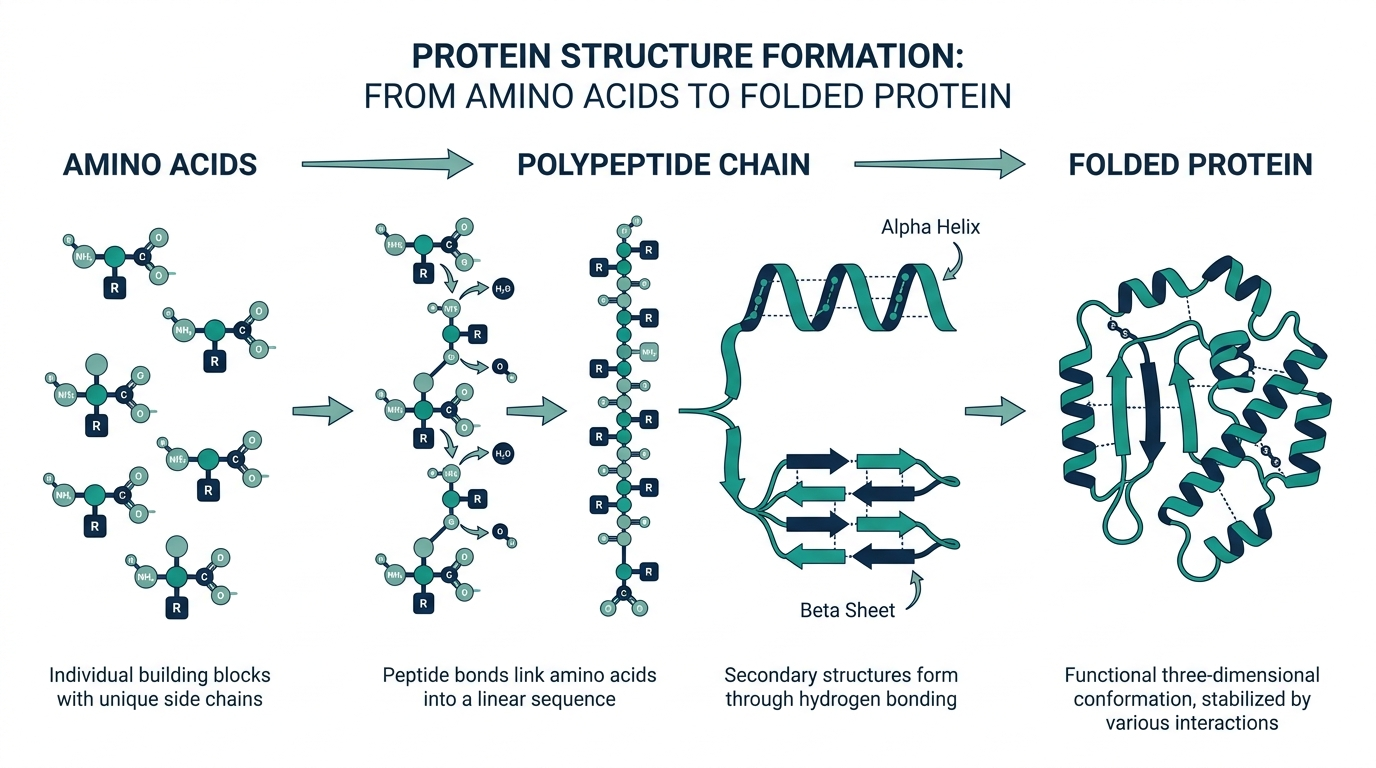
A polypeptide is a long, unbranched chain of amino acids connected through covalent peptide bonds. Each bond forms the same way: the carboxyl group (-COOH) on the tail end of one amino acid links to the amino group (-NH2) at the head of the next, releasing one molecule of water in the process. This condensation reaction happens inside the ribosome, the cellular machine that reads a strand of messenger RNA and assembles the matching amino acid sequence one residue at a time.
The resulting chain has a free amino group at one end (the N-terminus) and a free carboxyl group at the other (the C-terminus). By convention, sequences are always read and written N-terminus to C-terminus, left to right. The order of amino acids in that sequence is the primary structure, and it determines everything the polypeptide will ever do.
Polypeptides do not arrive in their final form. The chain that comes off the ribosome is typically a floppy, unfolded string. What comes next is where the biology gets interesting.
How does a polypeptide differ from a peptide and a protein?
This is the question that trips most people, and the honest answer is that the field has never agreed on clean cutoffs. Here is the practical breakdown used in most biochemistry and pharmacology contexts:
| Term | Amino acid count | Molecular weight | Typical behavior |
|---|---|---|---|
| Dipeptide | 2 | ~200 Da | No folding; signaling fragments |
| Oligopeptide | 3 to 9 | ~300 to 900 Da | Short signals, antimicrobial |
| Peptide (general use) | 2 to ~50 | Under ~5,000 Da | Hormones, skin signals, research drugs |
| Polypeptide | 10 to ~100+ | 1,000 to ~10,000 Da | Precursor to functional proteins |
| Protein | 50 to thousands | Above ~5,000 Da | Folded 3D structure, enzymatic work |
The critical insight from Bachem, one of the world’s leading peptide manufacturers: “All proteins are polypeptides, not all polypeptides are proteins.” A protein is specifically a polypeptide (or group of polypeptides) that has folded into a defined three-dimensional shape and performs a sophisticated biological function as a result of that shape. A polypeptide straight off the ribosome has the sequence but not yet the structure.
The University of Queensland’s Institute for Molecular Bioscience places the peptide/protein boundary at around 50 amino acids, the point at which chains typically become large enough to fold stably on their own. Below 50 residues, chains usually stay loose unless they are held in shape by disulfide bridges or are part of a larger complex.
Do not believe anyone who tells you there is a hard rule. Insulin has 51 amino acids across two chains. Glucagon has 29. Depending on the textbook you read, both of these are described as either a peptide hormone or a small protein. The biology does not care about our labels.
How does a polypeptide actually fold into a protein?
Folding is where the sequence information stored in the chain becomes a working machine, and it happens through four recognizable levels of structure:
Primary structure is the raw amino acid sequence, nothing more. Change one amino acid in the wrong position and you can get sickle cell disease, because hemoglobin’s sixth amino acid switches from glutamic acid to valine, which alters the shape of the entire polypeptide chain and causes red blood cells to deform under low-oxygen conditions.
Secondary structure emerges when short segments of the chain coil or sheet locally. Alpha-helices (like a tightly wound spring) and beta-sheets (like pleated ribbons side by side) form when hydrogen bonds develop between amino acids that are close to each other in the chain. These sub-structures are held together by hydrogen bonds, relatively weak individually but collectively powerful.
Tertiary structure is the overall three-dimensional shape of a single polypeptide chain, determined by interactions between amino acid side chains across the full length of the molecule: hydrogen bonds, ionic attractions, hydrophobic clustering, and covalent disulfide bridges. Insulin’s two polypeptide chains are held together by exactly these disulfide bridges.
Quaternary structure arises when two or more separate polypeptide chains assemble into a larger complex. Hemoglobin is the classic example: four polypeptide subunits (two alpha chains and two beta chains) dock together to form one functional oxygen-carrier. The individual chains are polypeptides. The assembled complex is the protein.
The machinery that oversees folding is not passive. Molecular chaperones, a class of proteins themselves, actively prevent premature folding and misfolding while the polypeptide chain is still being synthesized. Proteins that fail to fold correctly are flagged and destroyed by the cell’s proteasome. Misfolded polypeptide accumulation is a driver of diseases including Alzheimer’s, Parkinson’s, and type 2 diabetes.
Why does the polypeptide sequence matter so much?
Every function a protein performs flows from the amino acid sequence of its polypeptide chain. Change the sequence and you change the shape. Change the shape and you change the function. This is not a minor point for your health; it is the entire operating system.
Semaglutide (Ozempic, Wegovy) is a 31-amino-acid polypeptide engineered to mimic the natural 30-amino-acid GLP-1 hormone, with one extra residue and a fatty acid modification that extends its half-life from two minutes to roughly a week. The single modification to the sequence and the attached side chain is worth roughly $26 billion in annual revenue for Novo Nordisk and represents a meaningful percentage of the GLP-1 market now projected to reach $101.4 billion in 2026. That is the commercial value of one carefully engineered change to one polypeptide sequence.
Insulin, the most important polypeptide in clinical medicine, consists of chain A (21 amino acids) and chain B (30 amino acids), linked by two disulfide bridges. The first human insulin was extracted from animal pancreases in 1921. Recombinant human insulin, produced by bacteria carrying the human insulin gene, became commercially available in 1982 and essentially replaced animal-derived insulin by the 1990s. Today, insulin analogs like glargine and lispro are engineered polypeptides with modified sequences that change the absorption rate, not the primary glucose-lowering mechanism, but the kinetics of how quickly the chain does its job.
Personally, the number that still surprises me: the human proteome contains at least 19,433 protein-coding genes, which generate roughly 70,000 distinct polypeptide sequences once splice variants are included, and potentially hundreds of thousands of unique “proteoforms” once post-translational modifications are counted. Every one of those begins as a polypeptide chain reading off a ribosome. The diversity of human biology reduces, at its foundation, to variations in the sequence of these chains.
What are the most important polypeptides in the human body?
Knowing the names anchors the abstract biology. These are the ones you will encounter most in a health context:
Insulin (51 amino acids, 2 chains). Regulates blood glucose. The first peptide drug in history, commercially available since 1923. Over 100 million people worldwide use an insulin product today.
Glucagon (29 amino acids). Does the opposite of insulin: raises blood glucose when levels drop too low. Every person with type 1 diabetes carries glucagon for emergencies. Produced by alpha cells in the pancreatic islets of Langerhans.
GLP-1 / semaglutide (30 amino acids naturally; 31 in the drug). Stimulates insulin secretion, slows gastric emptying, and signals satiety through receptors in the brain. The FDA approved high-dose semaglutide (Wegovy HD, 7.2 mg) on 19 March 2026, and the first oral semaglutide formulation for weight loss in February 2026.
Collagen polypeptide chains. Collagen is assembled from three polypeptide chains wound into a triple helix, with a repeating Glycine-X-Y sequence pattern (where X is often proline) that is essential to maintain the helical structure. It is the most abundant protein in the human body, making up roughly 30% of total body protein. Hydrolyzed collagen peptides sold as supplements are collagen polypeptide chains broken into shorter fragments for better absorption, typically 2.5 to 15 grams per day in clinical studies showing skin hydration and joint benefits.
GHK-Cu (3 amino acids: glycine, histidine, lysine). Technically a tripeptide, not a polypeptide, but worth understanding in context because it illustrates how even the shortest chains carry meaningful biological information. GHK occurs naturally in human plasma and saliva, stimulates collagen synthesis and wound healing, and is active at nanomolar concentrations. Levels drop by over half by age 60.
Oxytocin (9 amino acids). The bonding and trust hormone. Released during childbirth, breastfeeding, and physical touch. Nine amino acids, one disulfide bridge, and a documented role in social cognition, pain modulation, and inflammatory regulation.
Full-body lab membership: 100+ biomarkers, doctor-reviewed, tracked over time.
Where do polypeptides come from inside a cell?
The process is called translation, and it runs continuously in every living cell you have. Here is the chain of events, stripped to its essentials:
- A segment of DNA is transcribed into a single-stranded messenger RNA (mRNA) molecule inside the nucleus.
- The mRNA travels out of the nucleus and attaches to a ribosome in the cytoplasm.
- The ribosome reads the mRNA in three-nucleotide codons. Each codon specifies one of the 20 standard amino acids (or a start/stop signal).
- Transfer RNA (tRNA) molecules ferry the matching amino acids into the ribosome.
- The ribosome catalyzes the peptide bond between each new amino acid and the growing chain through peptidyl transferase activity, an RNA-based catalytic function located in the large ribosomal subunit.
- The chain elongates, one amino acid every few milliseconds, until a stop codon signals the ribosome to release the completed polypeptide.
A ribosome can add roughly 15 to 20 amino acids per second. A 300-residue polypeptide, about the average length for a human protein, takes approximately 20 seconds to synthesize from start to finish.
The catalytic core of the ribosome is RNA, not protein. This is one of the strongest pieces of evidence for the “RNA world” hypothesis, the idea that RNA molecules were the original self-replicating catalysts before DNA and proteins took over their current roles.
What is the difference between a polypeptide and a protein, in plain terms?
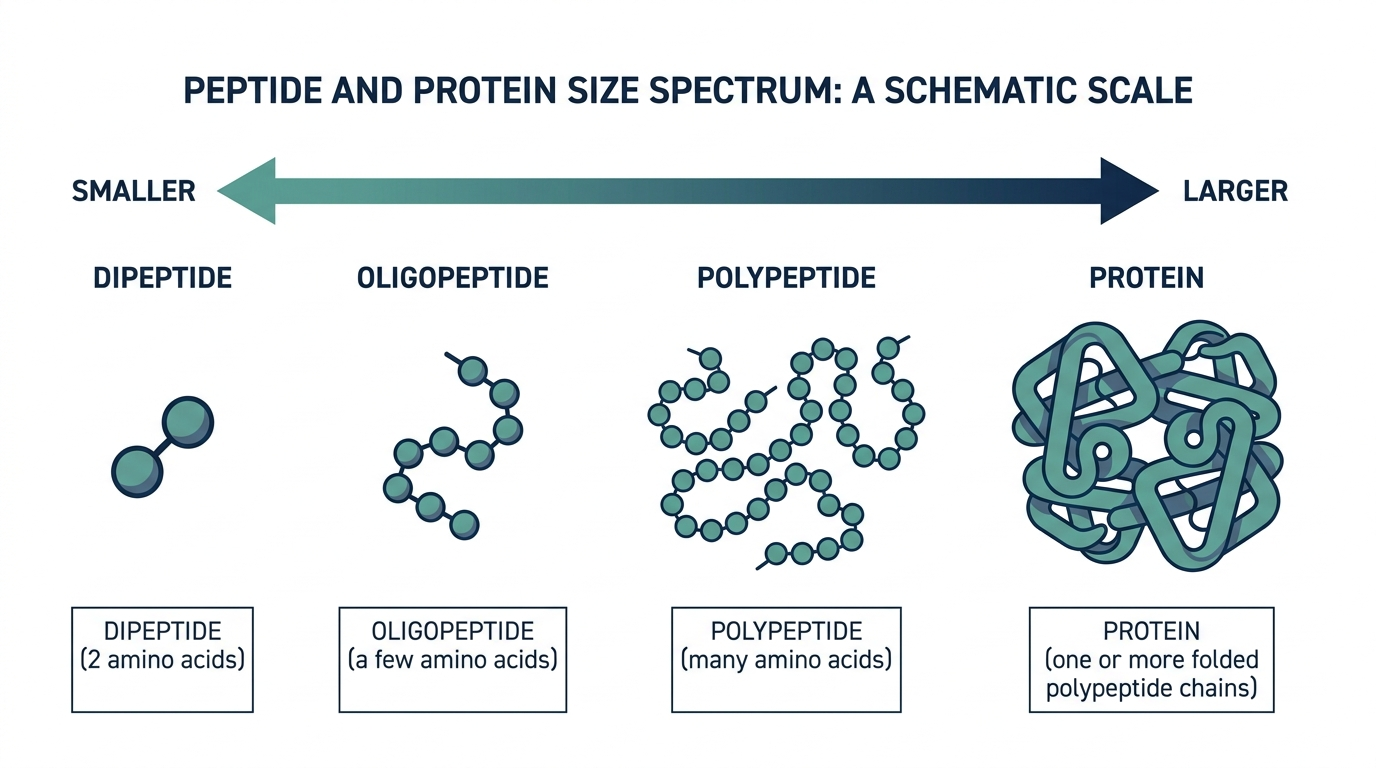
Think of it this way: a polypeptide is the flat Lego bricks just poured out of the box. A protein is the finished model. The bricks (amino acids) are the same in both cases. What separates them is whether the chain has folded into a stable, functional three-dimensional architecture.
Practically speaking:
– A polypeptide can be folded or unfolded.
– A protein is, by most definitions, specifically the folded form that performs a biological function.
– Processing, folding, and often chemical modification (glycosylation, phosphorylation, cleavage of signal sequences) happen after translation and are collectively called post-translational modification.
Insulin is a useful example of this transformation. The ribosome does not produce insulin directly. It produces preproinsulin, a 110-amino-acid polypeptide that includes a signal peptide directing it to the endoplasmic reticulum. The signal peptide is cleaved, giving 86-amino-acid proinsulin. Proinsulin folds and forms disulfide bridges, then a C-peptide is removed, leaving the two-chain, 51-amino-acid mature insulin molecule. Four steps of post-translational processing, starting from a single polypeptide chain, before you get the hormone that keeps blood glucose in range.
Polypeptides in medicine: from the pharmacy shelf to the clinic
The pharmaceutical significance of polypeptides in 2026 cannot be overstated. More than 100 peptide-based drugs hold FDA approval, with 34 new approvals between 2016 and 2024 alone and over 170 peptide molecules in active global clinical development as of 2025.
The commercial scale is substantial:
– The global peptide therapeutics market reached $52.6 billion in 2025.
– Semaglutide (Ozempic/Wegovy) generated approximately $26 billion in combined 2024 revenue for Novo Nordisk alone.
– Tirzepatide (Mounjaro/Zepbound) reached $16.47 billion in 2024, with a single Q3 2025 quarter worth $10.1 billion.
– About 1 in 8 U.S. adults (12.4%) reported taking a GLP-1 drug as of late 2025, double the adoption rate of 18 months earlier.
These are all polypeptide-based drugs. The engineering approach in each case follows the same logic: start from a natural polypeptide sequence your body already recognizes, modify specific residues or attach molecular anchors to change pharmacokinetics, and you produce a drug your body reads as a natural signal but with duration, potency, or selectivity tuned beyond what evolution provided.
Personally, I think the conceptual leap most health consumers are still missing is this: when you read about semaglutide or tirzepatide, you are not reading about an exotic synthetic compound. You are reading about engineered variations of the exact same class of molecules your own intestinal cells produce every time you eat. The pharmaceutical version is longer-lasting and precisely dosed. The underlying biology is yours already.
Full-body lab membership: 100+ biomarkers, doctor-reviewed, tracked over time.
Common myth: polypeptides you eat become polypeptides in your body
This is the belief behind much of the “collagen peptide supplement” marketing, and the reality is more nuanced.
The myth: swallow a collagen polypeptide supplement and your body absorbs it and deposits it directly into skin, joints, or tendons.
The reality: the gut breaks down most polypeptides into individual amino acids or short di- and tripeptides before absorbing them. Those building blocks then go into a general amino acid pool. Your body uses that pool to synthesize its own collagen, among thousands of other proteins, according to its own demand signals.
The nuance: hydrolyzed collagen peptides, pre-broken into very short fragments (typically 2 to 5 amino acids, molecular weight around 1,000 to 5,000 Da), are absorbed intact in small but meaningful amounts and have been detected in blood and skin tissue in clinical studies. A 2018 randomized, double-blind, placebo-controlled trial showed that low-molecular-weight oral collagen peptides improved skin hydration, elasticity, and wrinkling measurably at doses of 2.5 to 10 grams per day.
So the truth sits between the myth and the dismissal. Collagen supplementation does not work by direct deposition. It works partly through providing the amino acids glycine, proline, and hydroxyproline that are the specific building blocks of collagen polypeptides, and partly because specific short fragments appear to act as signaling molecules that stimulate fibroblasts to produce more collagen. The global collagen peptides supplement market was valued at $1.98 billion in 2026, growing at roughly 10% per year, and the clinical evidence, while not rock-solid for every claim, is stronger than many dismissive accounts suggest.
Do not believe anyone who tells you “it’s just broken down anyway, so it doesn’t matter what you eat.” The specific amino acid profile and the short-chain fragments both matter. Do not believe anyone who tells you a collagen supplement directly rebuilds your tendons like a patch. It provides raw materials and signals, not placement.
Why polypeptide structure matters for biomarker testing
Understanding polypeptides matters practically when you look at your blood test results, because several of the most clinically important markers are polypeptide hormones or the metabolic products of polypeptide pathways:
- Insulin (51 amino acids): measured to assess beta cell function and insulin resistance, a key component of metabolic syndrome diagnostics.
- IGF-1 (Insulin-like Growth Factor 1) (70 amino acids): reflects growth hormone axis activity, used in longevity and performance medicine to gauge whether GH-axis polypeptides are functioning optimally.
- C-peptide (31 amino acids, the fragment cleaved out of proinsulin): a marker of how much insulin your pancreas is actually making, as opposed to exogenous insulin injected.
- BNP / NT-proBNP: polypeptide fragments released by the heart under stress, used as markers of cardiac strain.
- Thyroid hormones (TSH, T3, T4): while TSH is a peptide hormone and T3/T4 are amino acid derivatives, the axis is deeply interconnected with polypeptide signaling at every level.
Comprehensive panels, such as those offered by Superpower at $199 per year and covering 100+ biomarkers across hormonal, metabolic, and inflammatory categories, put several key polypeptide hormones in context alongside each other. Seeing insulin alongside IGF-1, cortisol, and inflammatory cytokines in a single snapshot is meaningfully different from checking one number in isolation.
Curious what your own levels look like?
Baseline 100+ biomarkers today and retest as life changes, all in one membership with physician review.
Frequently asked questions
What is the simplest definition of a polypeptide?
A polypeptide is a chain of ten or more amino acids linked together by peptide bonds, formed inside a ribosome as it reads a strand of messenger RNA. It is the basic structural unit that folds into every functional protein in your body.
What is the difference between a polypeptide and a protein?
A polypeptide is the chain; a protein is the folded, functional form that chain takes once it achieves a stable three-dimensional structure. All proteins are built from one or more polypeptide chains, but a polypeptide is not automatically a protein until it folds. Think of the polypeptide as the unassembled kit and the protein as the finished product.
What is the difference between a polypeptide and a peptide?
Length and complexity. “Peptide” conventionally refers to chains of roughly 2 to 50 amino acids. “Polypeptide” often implies longer chains, typically 10 or more residues, though the two terms are used interchangeably in clinical and commercial contexts. In pharmacology, peptide drugs are almost always under 50 amino acids.
What are some examples of polypeptides in the human body?
Insulin (51 amino acids, 2 chains), glucagon (29 amino acids), GLP-1 (30 amino acids), GHK (3 amino acids, technically a tripeptide), oxytocin (9 amino acids), growth hormone (191 amino acids), and the individual alpha and beta chains of hemoglobin (141 and 146 amino acids respectively) are all polypeptides. Collagen is built from polypeptide triple helices.
Can you absorb polypeptides from food or supplements?
Mostly no, in their intact form. The digestive tract breaks most polypeptides into amino acids and di- or tripeptides before absorption. The exception is hydrolyzed collagen peptides, where pre-broken short fragments (around 1,000 to 5,000 Da) are absorbed intact in small quantities and have documented effects in skin hydration and joint studies at doses of 2.5 to 10 grams per day.
Why do pharmaceutical companies modify polypeptide sequences?
To change the pharmacokinetics (how quickly the molecule acts and how long it stays active in the body) without changing the core biological signal. Semaglutide adds one amino acid and a fatty acid side chain to the natural GLP-1 sequence, extending its half-life from two minutes to roughly one week. This modification makes it practical as a once-weekly drug, which natural GLP-1 could never be.
Are polypeptides the same as proteins in supplements?
Not exactly. Protein supplements like whey or casein contain full-length polypeptides that your digestive system breaks down. Peptide supplements (collagen peptides, BPC-157 in research contexts, GHK-Cu topicals) contain shorter, pre-hydrolyzed chains. The distinction matters because the smaller the chain, the better the absorption, at the cost of complexity and active length.
Full-body lab membership: 100+ biomarkers, doctor-reviewed, tracked over time.
Author: Vital Signs Today Editorial Team, [credential]”]. Educational content, not medical advice. Sources linked inline.
Primary sources:
– Bachem: What Is a Polypeptide Chain?
– Biology LibreTexts: Ribosomes and Protein Synthesis
– Frontiers: Molecular Puzzle of Insulin (2025)
– PMC: GHK-Cu Regenerative and Protective Actions
– PMC: Oral Collagen Peptide RCT, skin hydration/elasticity
– PMC: The Size of the Human Proteome
– NCBI Bookshelf: Translation of mRNA
– PeakLabs: Peptide Statistics 2026
– University of Queensland: Peptides vs Proteins Explainer
– Superpower: Blood Test for Biomarkers
– AJMC: FDA Approves Oral Semaglutide
– Chemistry LibreTexts: The Peptide Bond
– Mordor Intelligence: Collagen Peptides Market
– News-Medical: Insulin Protein Structure
Related reading
Vital Signs Today may earn a commission if you buy through links on this page. It does not affect our editorial assessments.