
Educational content, not medical advice. Talk to a licensed clinician before making any clinical decisions based on a BNP result.
Short answer: B-type natriuretic peptide (BNP) is a 32-amino-acid hormone secreted by the heart’s ventricles when the heart muscle is under mechanical strain. A BNP below 100 pg/mL is considered normal. Above 400 pg/mL, clinicians treat it as strong evidence of heart failure. The number alone does not make a diagnosis, but it is one of the most reliable early warning signals your cardiovascular system can produce.
Above 400 pg/mL, BNP is strong evidence of heart strain, so where does your own heart marker actually stand? One at-home Superpower draw checks 100+ biomarkers, physician-reviewed.
What exactly is this thing called BNP?
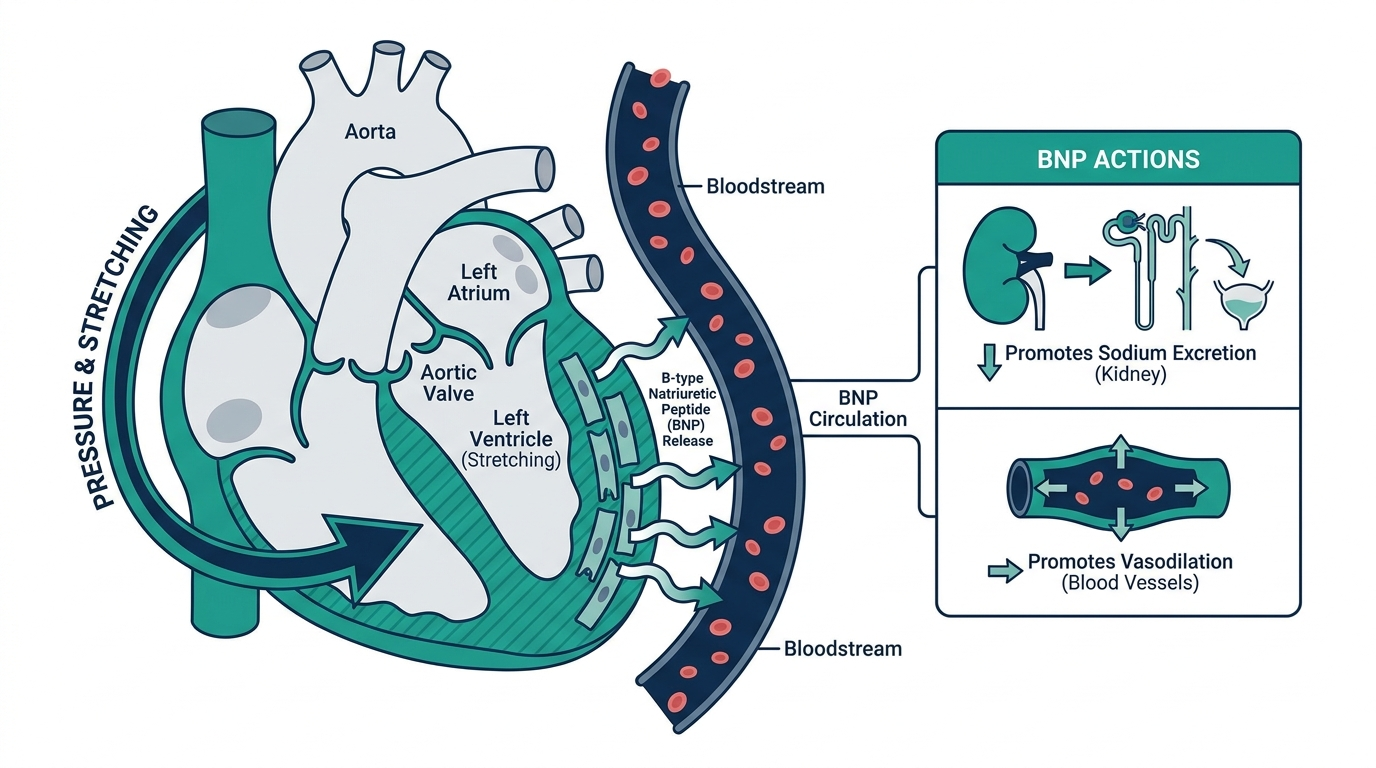
BNP did not start its scientific life with a glamorous name. In 1988, Japanese researchers Sudoh and colleagues isolated a natriuretic peptide from porcine brain tissue and published their finding in Nature, naming it “brain natriuretic peptide.” The name stuck, even after subsequent studies, including a 1991 paper in Hypertension by Hosoda and colleagues, made clear that in humans, BNP originates overwhelmingly in the ventricles of the heart, not neural tissue. Today, the preferred designation is “B-type natriuretic peptide,” and the B stands for nothing more than the historical accident of a brain extraction.
The molecule itself is a cardiac hormone, one piece of the body’s built-in pressure-relief system. When the ventricular wall is stretched, the heart synthesizes a precursor protein called proBNP (108 amino acids). An enzyme called corin cleaves it into two fragments in equimolar proportions: the active hormone BNP (32 amino acids) and an inactive fragment called NT-proBNP (76 amino acids). Both are released into the bloodstream simultaneously. Clinicians measure one or the other, rarely both, depending on which assay their laboratory runs.
The naming confusion is not just trivia. Many patients who receive a “brain natriuretic peptide” result panic before they understand it has nothing to do with the brain. Cardiologists deal with this miscommunication constantly.
What does BNP actually do in the body?
The simplest way to actually get this done
Superpower is a full-body lab membership that runs 100+ biomarkers, has each result reviewed by a doctor, and tracks your numbers year over year (about $199/year). It is what we point readers to when they would rather get one clean, complete draw than chase single tests one at a time. Here is superpower reviewed in full.
Think of BNP as the heart filing an official complaint with the rest of the body. The complaint has three parts, and each one is remarkably well designed.
First, vasodilation. BNP binds to natriuretic peptide receptor A (NPR-A) on vascular smooth muscle cells and activates guanylyl cyclase, generating the second messenger cGMP. This relaxes blood vessel walls, lowers peripheral resistance, and reduces the blood pressure the heart is pushing against (cvphysiology.com).
Second, natriuresis and diuresis. BNP acts on the kidneys, dilating the afferent arteriole while constricting the efferent arteriole, which raises glomerular filtration rate and drives more sodium and water into the urine. Crucially, this effect is potassium-sparing, unlike loop diuretics that drain potassium alongside fluid. This is physiologically elegant: the heart tells the kidneys to offload volume without depleting the electrolytes that keep the heart itself beating properly (NCBI StatPearls NBK556136).
Third, RAAS suppression. BNP suppresses renin release, which cascades into lower angiotensin II and lower aldosterone. This directly opposes the renin-angiotensin-aldosterone system, the body’s primary sodium-retention mechanism, pushing the fluid balance toward a lower-volume, lower-pressure state.
In a healthy person, this system activates modestly during exercise, pregnancy, or brief spikes in blood pressure, then quiets down. In a person with heart failure, the ventricle is chronically overstretched, and BNP secretion is chronically elevated, as if the heart is writing the same urgent memo every minute of every day but nobody is fixing the underlying problem.
Full-body lab membership: 100+ biomarkers, doctor-reviewed, tracked over time.
What are normal BNP levels, and what does the gray zone mean?
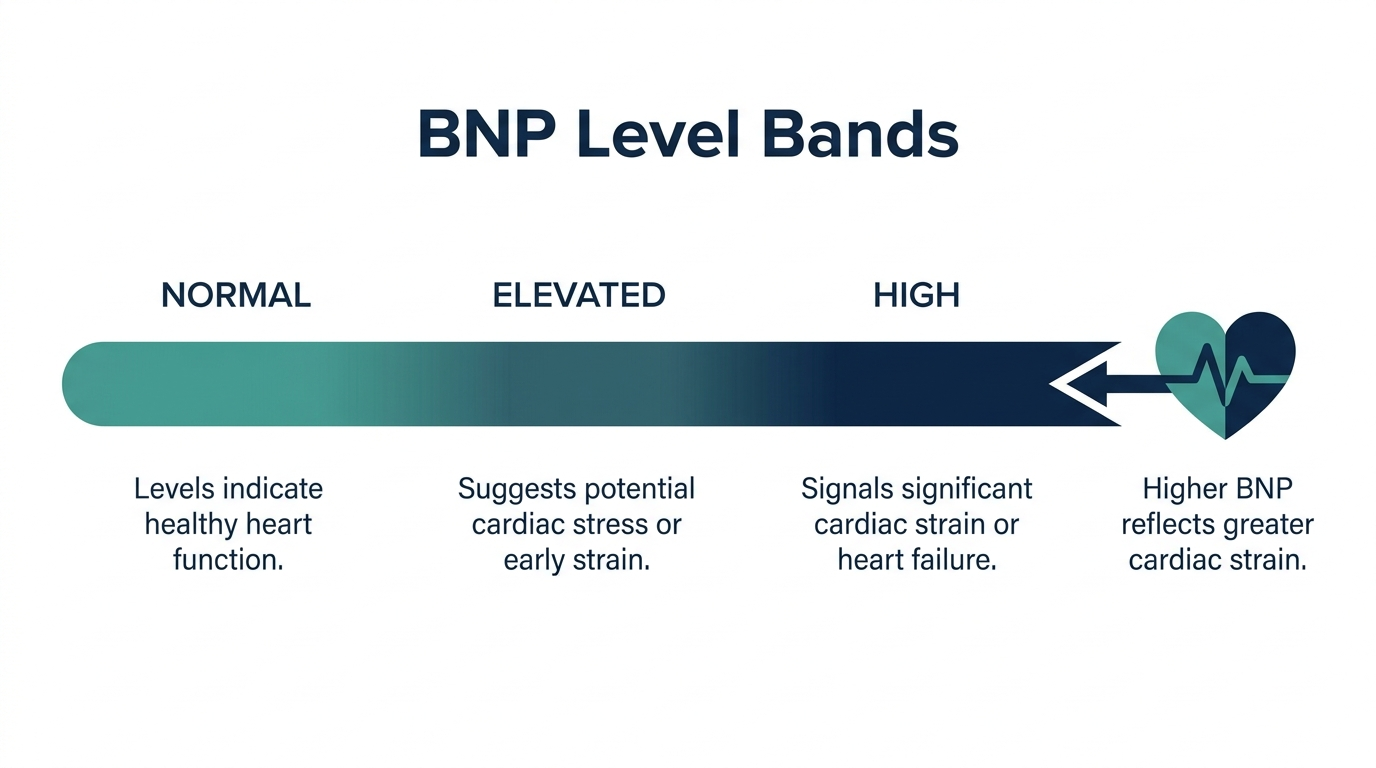
The reference ranges below come from widely adopted clinical thresholds. Different laboratories may use slightly different assays, so always read your result in the context of the lab’s own reference interval.
| BNP Level (pg/mL) | Interpretation | Typical Next Step |
|---|---|---|
| Below 100 | Normal, heart failure unlikely | Routine monitoring |
| 100 to 400 | “Gray zone”, indeterminate | Clinical evaluation + imaging |
| Above 400 | High likelihood of heart failure | Urgent cardiology workup |
| Above 3,000 | Severe, often acute decompensation | Hospitalization likely |
(Cleveland Clinic; Superpower BNP Normal Range)
The gray zone between 100 and 400 pg/mL is real and not a cop-out. In a patient with dyspnea and bilateral leg edema, a BNP of 250 pg/mL is clinically meaningful. In a patient with morbid obesity and no cardiac symptoms, a BNP of 110 pg/mL may be entirely expected, even reassuring, for reasons explained below. The number informs; it does not diagnose by itself.
Two quick scenarios that show why context beats the cutoff
Consider two people who both come back with a BNP of 300 pg/mL. The first is a 68-year-old with three weeks of worsening breathlessness, ankle swelling that leaves a dent when you press it, and waking at night gasping for air. Here the 300 fits a story, and it points hard toward heart failure that needs an echocardiogram and treatment now. The second is a lean 40-year-old marathon runner tested the morning after a race, with no symptoms at all. Same number, very different meaning: the recent extreme exertion, combined with an already efficient and well-conditioned heart, can produce a mildly elevated reading that settles on a repeat draw. The lab value is identical. The interpretation is not, and that gap is the whole art of reading BNP.
For NT-proBNP, the European Society of Cardiology 2023 Heart Failure Association published age-adjusted rule-in thresholds: at least 125 pg/mL for patients under 50 years, at least 250 pg/mL for patients aged 50 to 74 years, and at least 500 pg/mL for patients 75 years and over (ESC Heart Failure, 2023). The 2022 AHA/ACC/HFSA guidelines recommend that any individual with a persistently elevated BNP of at least 35 pg/mL or NT-proBNP of at least 125 pg/mL should be evaluated for Stage B heart failure, meaning structural changes present before symptoms appear (AHA/ACC/HFSA 2022 Guideline, Circulation).
Why is BNP so important for diagnosing heart failure?
Heart failure is more common than most people realize. According to the Heart Failure Society of America’s HF Stats 2025 report, approximately 6.7 million Americans over age 20 are living with heart failure, and the prevalence is projected to reach 8.7 million by 2030, with associated costs potentially rising to $858 billion (HFSA HF Stats 2025). The lifetime risk for an adult has now climbed to 24%.
The diagnostic problem BNP solves is elegant. A patient arrives in the emergency department short of breath. Is it heart failure, pneumonia, a pulmonary embolism, anxiety, or deconditioning? These conditions look similar at first glance, and the treatments are radically different. A BNP below 100 pg/mL rules out acute heart failure as the cause with roughly 97% sensitivity (StatPearls). That single number alone allows clinicians to stop one expensive diagnostic cascade before it starts.
A landmark paper published in Circulation demonstrated that patients diagnosed with congestive heart failure had a mean BNP concentration of 1,076 ± 138 pg/mL, compared with a mean of 38 ± 4 pg/mL in non-CHF patients (Berger et al., Circulation 2002). At a cut point of 80 pg/mL, BNP was found to be both highly sensitive and highly specific for the diagnosis of CHF. That is the kind of discrimination that earns a biomarker a permanent place in clinical practice.
Beyond diagnosis, BNP predicts what happens next. Elevated pre-discharge BNP and NT-proBNP levels are strong predictors of death or hospital readmission for heart failure. Patients whose BNP decreases in response to guideline-directed medical therapy have better long-term outcomes than patients whose levels stay high despite treatment (AHA/ACC/HFSA 2022).
The five confounders that flip BNP results the wrong direction
Personally, this is where I think most online BNP explainers fail their readers. They recite the cutoffs and move on. But BNP is not an isolated cardiac number. It is the output of a system that is influenced by the kidneys, body fat, sex hormones, specific medications, and age. Getting the interpretation wrong in either direction, calling a high result heart failure when it is actually kidney disease, or missing a true elevation in an obese patient, has real clinical consequences.
1. Obesity drives BNP artificially low. Adipose tissue highly expresses the natriuretic peptide clearance receptor (NPR-C), which pulls BNP out of circulation and degrades it. Adipocytes also produce neprilysin, an enzyme that metabolizes BNP. The result is a documented phenomenon researchers call the “natriuretic handicap”: obese patients can have structurally compromised hearts but display BNP levels in the normal range because their fat tissue is scavenging the signal (JACC: Heart Failure, 2021; PubMed 28651075). Standard cutoffs may miss heart failure in this population.
2. Kidney disease drives BNP artificially high. BNP is cleared partly by the kidneys, and as glomerular filtration rate falls, BNP accumulates even without worsening cardiac function. The 2022 ACC/HFSA guidelines recommend raising the rule-out cutoff for BNP to 200 pg/mL when GFR is below 60 mL/min, and for NT-proBNP, even higher adjusted thresholds apply (StatPearls).
3. Sacubitril/valsartan (Entresto) makes BNP useless as a monitoring tool. This drug, which is now a cornerstone of heart failure treatment, works by inhibiting neprilysin, the enzyme that breaks down BNP. Patients taking it will always have elevated BNP regardless of how well their heart is doing, because the molecule is not being cleared. For these patients, clinicians must switch to NT-proBNP for serial monitoring, since NT-proBNP is not a substrate for neprilysin and is not affected by sacubitril (StatPearls NBK507904). This is a detail that even some general practitioners miss.
4. Sex and age push baseline levels up. Women run higher BNP levels than men, with the effect most pronounced in the premenopausal years, likely due to estrogen’s influence on NPR-C expression. BNP also rises naturally with age due to declining renal clearance and progressive myocardial stiffening. A BNP of 80 pg/mL in a 35-year-old woman and in an 80-year-old man carry very different clinical weights.
5. Non-cardiac conditions elevate BNP meaningfully. Pulmonary embolism, sepsis, acute kidney injury, pulmonary hypertension, severe anemia, cirrhosis, and acute coronary syndromes can all push BNP above 100 pg/mL without any primary heart failure (medicinenet.com). BNP is a marker of ventricular wall stress, not a marker of heart failure specifically.
How should you prepare for a BNP test, and what can skew a single reading?
BNP is one of the easier cardiac tests to prepare for, because it needs almost no preparation at all. You do not have to fast, and there is no need to stop eating or drinking water beforehand. It is a standard venous blood draw, and in most laboratories the result is back the same day or the next morning. That simplicity is part of why emergency departments lean on it so heavily when a breathless patient rolls through the door.
That said, a single BNP is a snapshot of ventricular wall stress at one moment, and several ordinary things move it. Body position matters: lying flat shifts fluid back toward the chest and can nudge BNP upward compared with a sample drawn while sitting. A recent hard workout, as noted above, transiently raises it. Atrial fibrillation, even without heart failure, tends to push BNP higher because the fibrillating atria stretch and misfire. Acute illness, fever, and dehydration can each shift the number too. None of these invalidate the test. They are context your clinician folds into the reading, which is exactly why a borderline result is repeated rather than acted on in isolation.
One practical point that trips people up: BNP and NT-proBNP are not interchangeable numbers on a lab report. If you are tracking your own trend over months, make sure every draw uses the same assay. Comparing a BNP value from one visit to an NT-proBNP value from the next tells you almost nothing, because the two run on completely different scales.
BNP versus NT-proBNP: which one should your lab be running?
Both molecules come from the same precursor and are released simultaneously, so they measure the same underlying physiology. The differences are practical rather than conceptual.
BNP has a half-life of roughly 20 minutes; NT-proBNP has a half-life of about 120 minutes, which means NT-proBNP circulates at approximately six times higher concentrations for the same level of ventricular stress. NT-proBNP is also more stable in the test tube, staying reliable for up to three days refrigerated in heparin or EDTA tubes. BNP must be collected in EDTA only and tested within four hours (StatPearls).
The clinical difference that matters most: if your patient is taking sacubitril/valsartan, order NT-proBNP, not BNP. For everyone else, either test is acceptable, and the choice usually comes down to which assay your laboratory has validated.
Do not believe any claim that one test is simply “better” than the other in all patients. A 2025 comparative study found BNP was more sensitive than NT-proBNP in detecting cardiovascular risk among chronic kidney disease patients specifically (PMC12302115). The right biomarker depends on the clinical question.
Full-body lab membership: 100+ biomarkers, doctor-reviewed, tracked over time.
What does it mean if your BNP is high but you feel fine?
This is more common than most people expect, and it is an important question to take seriously rather than dismiss. The 2022 AHA/ACC/HFSA guidelines define Stage B (pre-HF) as structural or functional cardiac abnormalities with elevated biomarkers but no symptoms of heart failure yet. A persistently elevated BNP of at least 35 pg/mL without any symptoms falls into this category and warrants evaluation (AHA/ACC/HFSA 2022, Circulation).
The clinical term for this is “subclinical cardiac dysfunction,” and the data on its prevalence are sobering. Many people with elevated natriuretic peptides and no symptoms already have measurable diastolic dysfunction on echocardiography. Heart failure with preserved ejection fraction (HFpEF), where the heart squeezes normally but fills poorly, is particularly underdiagnosed precisely because BNP can stay in the low-normal range early in the disease, especially in obese patients (PMC12089450).
The practical implication: if you receive an incidentally elevated BNP result during a routine panel, do not assume it is a lab error or an overreaction. It is a prompt for an echocardiogram and a cardiology referral, not necessarily an emergency, but not something to ignore.
Can BNP be too low? What a suppressed result tells you
Myth to bust here: a very low BNP is not automatically reassuring in every context. In the setting of obesity, as described above, a low BNP can coexist with significant cardiac disease that is simply not generating a detectable signal. In the setting of acute flash pulmonary edema that resolves rapidly with treatment, BNP can normalize quickly, which means a low result at follow-up could reflect treatment response rather than a healthy heart.
Conversely, a low BNP in a patient with known heart failure who is on stable, well-titrated therapy is genuinely a good sign. Guideline-directed medical therapy that drives BNP downward is associated with reduced mortality and reduced rehospitalization (AHA/ACC/HFSA 2022).
Turn what you just learned into action.
Superpower lets you test 100+ biomarkers from home, then re-check them over time so you can actually see progress, physician-reviewed at every step.
What should you actually do if your BNP comes back elevated?
An elevated result on a routine panel is a prompt, not a verdict. The sensible sequence looks like this.
- Do not panic over a single value. Unless you have clear symptoms, one mildly high number is a reason to investigate, not an emergency. Ask whether it should be repeated with the same assay.
- Pair it with an echocardiogram. BNP tells you the ventricle is under strain. An echo shows why, whether that is a stiff and poorly filling heart, a weak pump, or a valve problem. The two together are far more informative than either alone.
- Account for the confounders. Kidney function, body weight, atrial fibrillation, and medications such as sacubitril/valsartan all shift the number, so your clinician reads your BNP against your eGFR and your medication list, not in a vacuum.
- Map it against other markers. A troponin rules heart-muscle injury in or out, an eGFR gauges kidney clearance, and a resting ECG catches rhythm problems. BNP is one instrument in a small panel, not a solo verdict.
- Know when it is urgent. Breathlessness at rest, chest pain, coughing up pink frothy sputum, or a BNP in the thousands are red flags that warrant same-day care rather than a scheduled follow-up.
If your number was flagged incidentally and you feel completely well, the realistic timeline is a cardiology referral within a few weeks plus an echocardiogram, not a hospital admission.
Frequently asked questions
What is a normal BNP level?
A BNP below 100 pg/mL is generally considered normal and makes heart failure as the cause of symptoms unlikely. Healthy adults under 75 typically maintain BNP well below 50 pg/mL. Women naturally run slightly higher than men, and levels rise with age and declining kidney function.
What causes elevated BNP other than heart failure?
Pulmonary embolism, sepsis, acute kidney injury, pulmonary hypertension, severe anemia, cirrhosis, and significant cardiac arrhythmias can all elevate BNP without primary heart failure. Kidney disease in particular raises BNP because the peptide is partly cleared through the kidneys.
Why is BNP called “brain” natriuretic peptide if it comes from the heart?
The name is a historical artifact. BNP was first isolated from porcine brain tissue by Sudoh et al. in 1988. Subsequent research confirmed that in humans, BNP is produced predominantly by the ventricles of the heart. The preferred current term is “B-type natriuretic peptide,” and the B no longer stands for brain.
What is the difference between BNP and NT-proBNP?
Both are released from the same precursor protein in equimolar amounts when the heart ventricle is under stress. BNP is the active hormone with a half-life of about 20 minutes; NT-proBNP is the inactive fragment with a half-life of about 120 minutes, giving it higher circulating levels and greater stability. If you are on sacubitril/valsartan (Entresto), your doctor should order NT-proBNP specifically, because that drug artificially elevates BNP.
Can obesity make a BNP result falsely normal?
Yes. Adipose tissue expresses the clearance receptor NPR-C, which removes BNP from circulation, and also produces neprilysin, which degrades it. This “natriuretic handicap” means that obese patients can harbor significant cardiac dysfunction while displaying BNP levels within normal ranges. Standard cutoffs may underdiagnose heart failure in obese patients.
How often should BNP be tested?
For people with established heart failure or significant cardiovascular risk factors, every three to six months is a reasonable interval for serial monitoring. For people without known heart failure but with risk factors such as hypertension, diabetes, or obesity, an annual check as part of a comprehensive cardiovascular panel is appropriate. No established guideline mandates population-wide screening.
Does BNP rise with exercise?
Transiently, yes. Intense aerobic exercise acutely raises BNP due to temporary increases in ventricular wall stress. This normalizes within hours. A BNP drawn shortly after intense exercise may be mildly elevated without clinical significance. Chronic aerobic fitness, however, is associated with lower resting BNP over time.
Can BNP be measured at home?
Not reliably yet. BNP and NT-proBNP are standard blood draws run on laboratory analyzers, and point-of-care fingerstick versions exist mainly in clinics and emergency departments rather than as consumer home kits. If you want your natriuretic peptide checked outside a hospital, the practical route is a lab draw ordered on a broader cardiovascular or full-body panel, where it sits alongside markers like troponin, lipids, and kidney function.
Is BNP the same as a troponin test?
No, and the difference is worth understanding. Troponin measures damage to heart-muscle cells and rises during a heart attack. BNP measures wall stress and stretch, the pressure load on the ventricle, which is the signature of heart failure rather than a blocked artery. A person can have a normal troponin and a high BNP, which typically points toward heart failure rather than an acute coronary event. Clinicians often order both because they answer different questions.
Can lifestyle changes lower a high BNP?
Indirectly, yes, when the elevation is being driven by something modifiable. Controlling blood pressure, cutting dietary sodium, treating sleep apnea, losing excess weight, and taking guideline-directed heart failure medication as prescribed all reduce the ventricular strain that BNP reflects. In treated heart failure, a falling BNP over time is one of the signals clinicians use to confirm therapy is working. BNP is not a number you lower for its own sake. You lower it by fixing whatever is straining the heart.
Author: Vital Signs Today Editorial Team, [credential]”]. Educational content, not medical advice. Sources linked inline.
Full-body lab membership: 100+ biomarkers, doctor-reviewed, tracked over time.
Primary sources
- Cleveland Clinic: B-Type Natriuretic Peptide (BNP) Test
- StatPearls: Natriuretic Peptide B Type Test (NCBI NBK556136)
- CV Physiology: Atrial and Brain Natriuretic Peptides
- AHA/ACC/HFSA 2022 Heart Failure Guidelines, Circulation
- Berger et al. 2002, BNP Levels in CHF, Circulation
- ESC Heart Failure Association 2023 NT-proBNP age-adjusted thresholds
- JACC Heart Failure 2021: Obesity and Natriuretic Peptide Pathway
- PubMed 28651075: Natriuretic handicap in morbidly obese patients
- StatPearls: Sacubitril-Valsartan (NBK507904)
- PMC12302115: BNP vs NT-proBNP in CKD 2025
- HFSA HF Stats 2025 Report
- Superpower: BNP Normal Range
- MedicineNet: BNP Test
- PMC12089450: HFpEF and Low BNP: A Diagnostic Dilemma
Related reading
Vital Signs Today may earn a commission if you buy through links on this page. It does not affect our editorial assessments.