- A low INR on a blood test means your blood is clotting faster than expected, and for people on warfarin it usually means a value below the therapeutic range of 2.0 to 3.0, while for people not on blood thinners the normal range is roughly 0.8 to 1.1.
- The main risk of a low INR is that warfarin is not thinning the blood enough, which raises the chance of a dangerous blood clot such as a stroke, deep vein thrombosis, or pulmonary embolism.
- A single low INR is often fixed by a dose adjustment, checking for missed pills, vitamin K intake, or new medications, so the next step is to call the clinic or anticoagulation team rather than self-correcting.
An INR (International Normalized Ratio) is a standardized way of reporting how long your blood takes to clot. It comes from the prothrombin time (PT) test, and labs convert the raw PT into an INR so results are comparable across different machines. When the number comes back lower than expected, it usually points in one direction: your blood is clotting more readily than the target. What that means for you depends almost entirely on whether you take a blood thinner.
What does a low INR mean and what is the cutoff
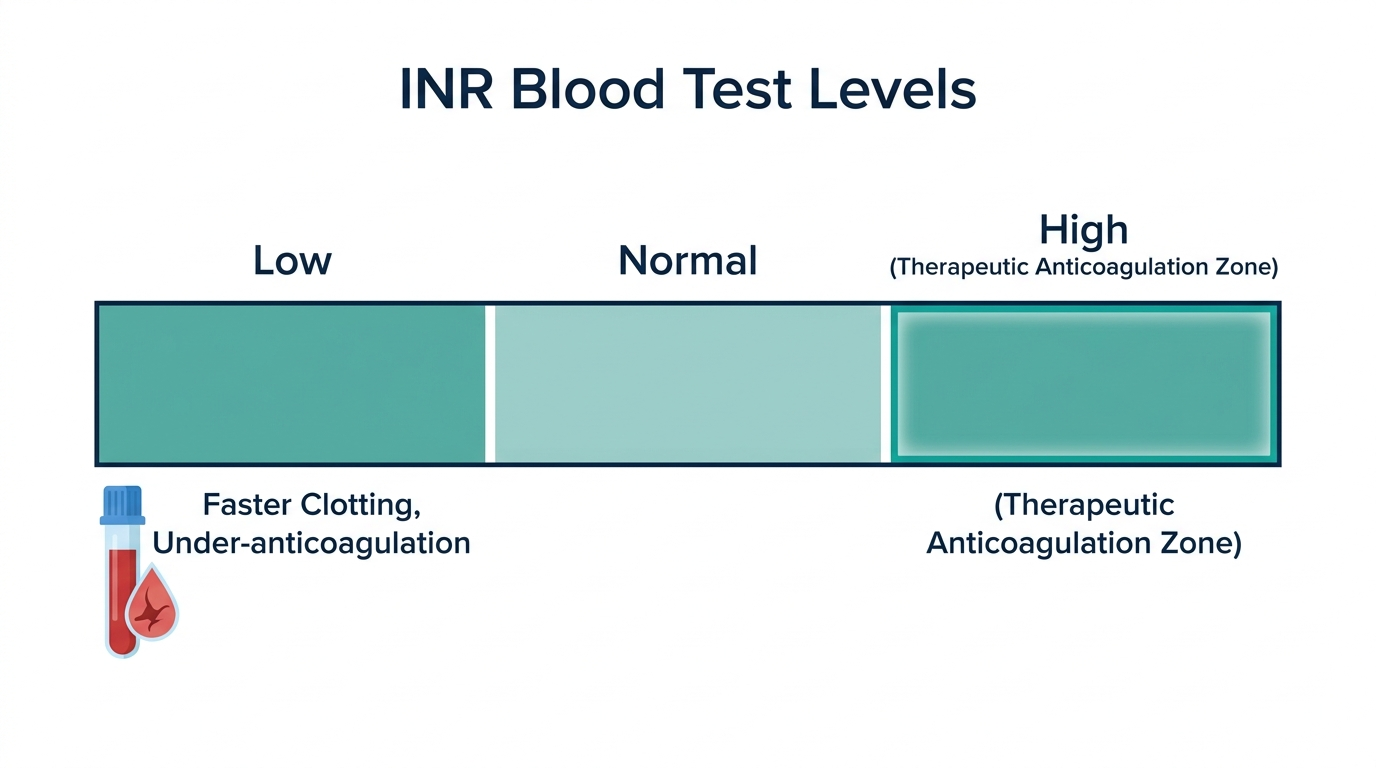
A low INR means your blood clots faster than the test target. For people not on anticoagulants, the normal INR range is about 0.8 to 1.1, and a value below 0.8 is considered low (MedlinePlus). For people taking warfarin, the standard therapeutic range is 2.0 to 3.0, so any result under 2.0 is “low” for them even though it would look normal in someone not on the drug (MedlinePlus).
Low INR changes your clotting risk. See the fuller picture of what else might be driving it. One at-home Superpower draw checks 100+ biomarkers, physician-reviewed.
This context matters. A reading of 1.3 is perfectly healthy for a person not on blood thinners but represents a low, undertreated INR for someone whose target is 2.5. Some conditions carry a higher target of 2.5 to 3.5, such as certain mechanical heart valves, so even an INR of 2.4 can count as low for them. Always interpret the number against the goal your clinician set for you, not against a generic chart.
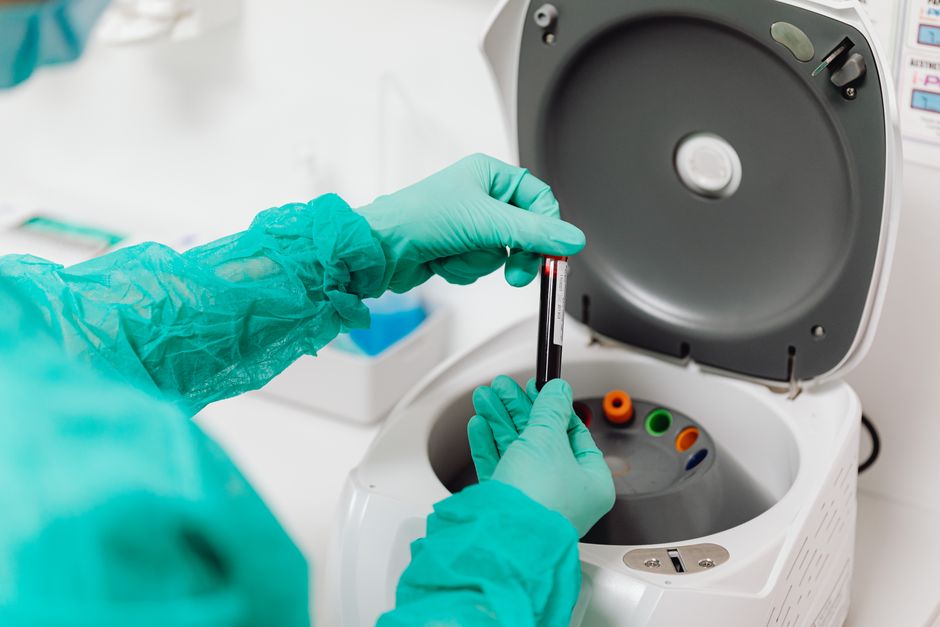
What causes a low INR
The most common cause of a low INR in someone on warfarin is simply too little drug effect, often from a missed or reduced dose. Vitamin K is the other big driver, because warfarin works by blocking vitamin K, so eating much more vitamin K than usual can push the INR down (Cleveland Clinic).
- Missed or skipped doses: the leading reason an INR drifts below target between visits.
- More vitamin K in the diet: a sudden increase in leafy greens such as kale, spinach, and broccoli counteracts warfarin.
- New medications or supplements: some drugs and herbal products speed up how the liver clears warfarin.
- Increased alcohol changes or illness recovery: shifts in routine can change how warfarin behaves.
In a person who does not take blood thinners, a mildly low or normal-low INR is usually not a problem at all and rarely needs treatment. A true clotting tendency from a genetic condition is uncommon and would be evaluated separately.
Symptoms of a low INR, or why it is usually silent
A low INR itself produces no symptoms. You cannot feel your blood clotting faster, which is exactly why people on warfarin need regular monitoring rather than waiting for warning signs (Cleveland Clinic). The danger is silent until a clot actually forms.
When a clot does develop, the symptoms come from the clot, not the lab value. Watch for a swollen, warm, painful calf (a sign of deep vein thrombosis), sudden shortness of breath or chest pain (possible pulmonary embolism), or signs of stroke such as face drooping, arm weakness, and slurred speech. These are emergencies. Because the lab number gives no early sensation, the practical takeaway is that sticking to your testing schedule is the only reliable way to catch a low INR before it causes harm.
When a low INR is dangerous
A low INR is dangerous when it leaves a high-risk person underprotected against clots. For someone with atrial fibrillation, a mechanical heart valve, or a history of clots, an INR below their 2.0 to 3.0 target means warfarin is not doing its job, and the risk of stroke or other clots climbs (MedlinePlus).
The further below target and the longer it stays there, the greater the concern. An INR of 1.9 for a day before a dose tweak is far less worrying than an INR of 1.2 that has been missed for two weeks. Mechanical valve patients are especially sensitive, because clot formation on the valve can be catastrophic. For a person not on anticoagulants, by contrast, a low INR is almost never an emergency on its own. The risk profile is defined by why you are being monitored, so the same number can be trivial for one person and urgent for another.

What to do next and when to see a doctor
If you take warfarin and your INR is low, contact your anticoagulation clinic or prescriber promptly rather than changing the dose yourself. They will look at the trend, ask about missed pills, diet, and new medications, and may adjust your dose or schedule a recheck (MedlinePlus).
- Do not double up doses on your own: overcorrecting can swing the INR too high and cause bleeding.
- Report missed doses honestly: this is the single most useful piece of information for your clinician.
- Keep vitamin K intake steady: consistency matters more than avoiding greens entirely.
- List every new medicine and supplement: including over-the-counter and herbal products.
Seek urgent care right away if you have any signs of a clot: leg swelling and pain, sudden breathlessness, chest pain, or stroke symptoms. If you are not on blood thinners and a routine low INR turned up, ask your clinician whether it needs any follow-up at all, because often it does not.
An insider nuance: the number is only as good as the sample and the timing
One thing many patients miss is that a low INR can be partly an artifact of how and when the blood was drawn. A short delay before a warfarin dose, a difficult or partially clotted draw, or even a different testing device can nudge the value, which is why the PT is converted into an INR in the first place: to reduce variation between labs and reagents (NCBI StatPearls).
Experienced clinicians treat one isolated low INR as a signal to look at the trend, not a crisis to overcorrect. If your last several readings were in range and a single result dips, the question becomes “what changed?” before “how much more warfarin?” Point-of-care fingerstick monitors are convenient and well validated, but they can read slightly differently from a venous lab draw, so a borderline result is sometimes worth confirming. This is also why your clinic may repeat a surprising INR rather than act on it immediately.
INR reference ranges by clinical situation
INR is unusual among lab values because “normal” depends entirely on why you are being tested. The same number can be perfect for one person and dangerously low for another. The table below shows the common targets and what counts as low in each situation.
| Situation | Target INR | Considered low |
|---|---|---|
| Not on anticoagulants | About 0.8 to 1.1 (MedlinePlus) | Under 0.8, though rarely a problem |
| Warfarin for atrial fibrillation or clot treatment | 2.0 to 3.0 (MedlinePlus) | Under 2.0 |
| Some mechanical heart valves | 2.5 to 3.5 | Under 2.5 |
| Recurrent clots despite therapy | Sometimes higher, set individually | Below the individualized target |
This is why you should never compare your INR to a generic chart. A value of 1.3 is entirely healthy for someone not on blood thinners but represents a seriously undertreated result for a person whose target is 2.5. The only meaningful comparison is against the goal your clinician set for your specific condition.

The biology: what PT and INR actually measure
To understand a low INR, it helps to know what the underlying test measures. The prothrombin time, or PT, times how long it takes a sample of your blood plasma to form a clot after a clotting trigger is added. Because different labs use different reagents, the raw PT is converted into the International Normalized Ratio, a standardized value that lets results be compared across machines and over time (NCBI StatPearls).
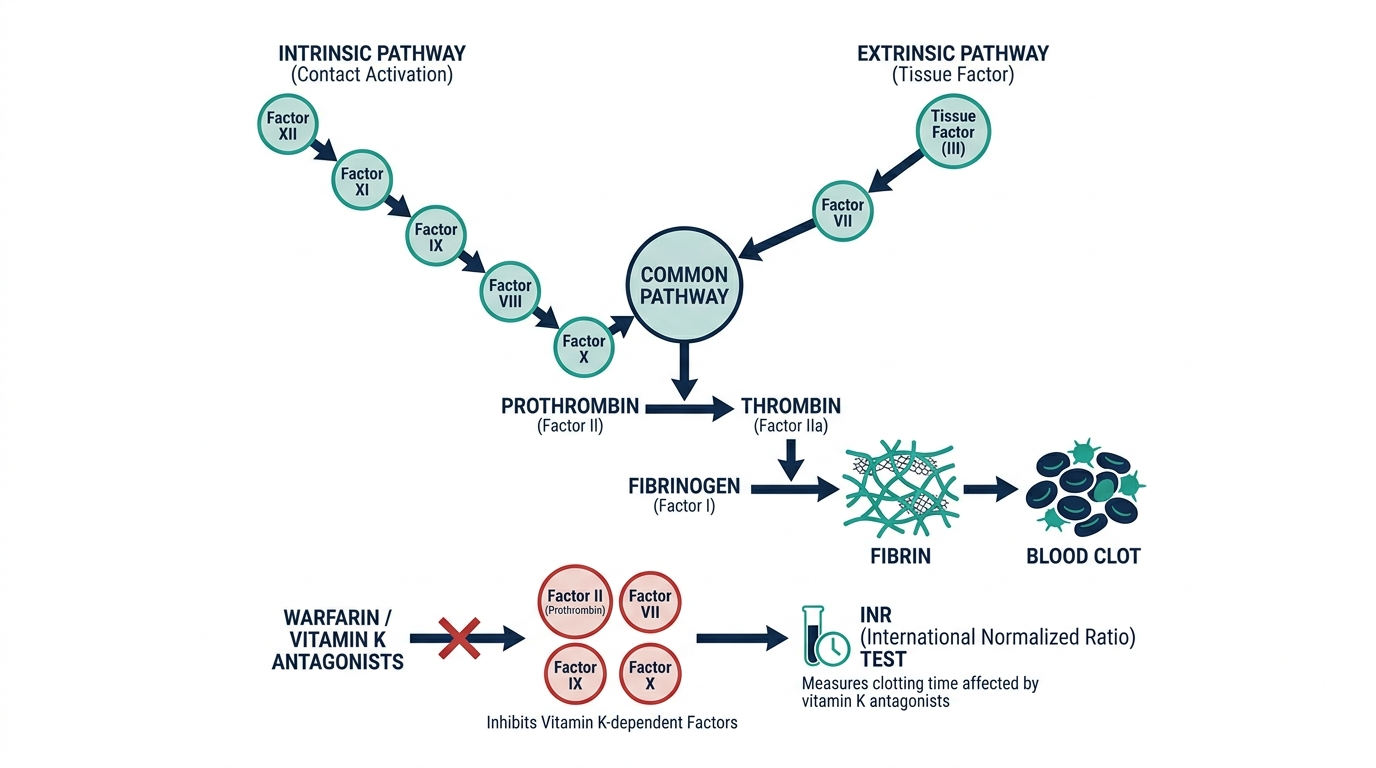
The PT and INR reflect one branch of the body’s clotting system, sometimes called the extrinsic and common pathways, which depend on several clotting factors made by the liver. Four of these factors, numbers two, seven, nine, and ten, require vitamin K to be produced in working form. A higher INR means the blood takes longer to clot, and a lower INR means it clots faster. In practical terms, a low INR indicates that clotting factors are plentiful and active, which is normal in a healthy person but a sign of insufficient drug effect in someone on warfarin.
How warfarin and vitamin K move the number
The reason INR is so central to warfarin therapy lies in a direct tug-of-war between the drug and vitamin K. Warfarin works by blocking the recycling of vitamin K, which the liver needs to build those four clotting factors. Less usable vitamin K means fewer active clotting factors, slower clotting, and a higher INR. That is the intended effect.
Vitamin K pulls in the opposite direction. When you eat more vitamin K, you partly overcome warfarin’s block, clotting factors recover, and the INR falls. This is why a sudden increase in leafy greens such as kale, spinach, and broccoli can push an INR below target (Cleveland Clinic). The key word is sudden. Clinicians do not ask patients to avoid greens; they ask for consistency, because a steady vitamin K intake keeps warfarin’s effect predictable. A person who eats a large salad every day can be dosed around that habit, but someone who swings from no greens to a huge serving creates a moving target.
Medications, supplements, and other factors that lower INR
Beyond missed doses and diet, several other factors can drop an INR. Knowing them helps explain a surprising result.
- New medications: some drugs speed up how the liver clears warfarin, reducing its effect and lowering the INR.
- Herbal products and supplements: certain herbs, including some used for mood or energy, can interfere with warfarin and reduce its potency.
- Vitamin K supplements: multivitamins or specific vitamin K products directly counteract warfarin.
- Changes in health: recovery from an illness, changes in appetite, or altered alcohol intake can all shift how warfarin behaves.
- Nonadherence: the single most common cause, whether from forgotten pills or confusion about the schedule.
Because so many everyday changes can move the number, the safest habit is to tell your anticoagulation team about any new medication, supplement, or major diet change rather than assuming it does not matter.

Companion tests and how INR is monitored
INR rarely stands entirely alone, and understanding the monitoring rhythm helps you use it well.
- Prothrombin time (PT): the raw measurement the INR is derived from, usually reported together.
- Activated partial thromboplastin time (aPTT): assesses a different clotting pathway and is used for other anticoagulants such as heparin.
- Complete blood count (CBC): checks platelets, which are also essential for clotting.
- Liver function tests: because the liver makes clotting factors, liver problems can affect the INR independently of warfarin.
Monitoring frequency depends on stability. When warfarin is first started or a dose changes, the INR is often checked within days to a couple of weeks, because dose changes take a few days to fully register as clotting factors turn over. Once stable, testing may stretch to every few weeks. Point-of-care fingerstick monitors let some patients test at home, which is convenient and well validated, though a borderline value is sometimes confirmed with a venous lab draw because the two methods can read slightly differently.
Sample interpretation scenarios
Concrete examples show how the same low INR can mean very different things. These illustrate clinical reasoning and are not personalized advice.
- INR 1.0 in a healthy person not on warfarin: perfectly normal, no action needed.
- INR 1.8 in a warfarin patient targeting 2.0 to 3.0: slightly low, usually handled with a modest dose adjustment and a recheck.
- INR 1.2 in a mechanical valve patient targeting 2.5 to 3.5: seriously undertreated, a higher-risk situation that needs prompt attention because clot formation on the valve can be dangerous.
- A single dip after months in range: more likely reflects a recent diet change, a missed pill, or sampling variation, so the clinician looks at the trend and asks what changed before overcorrecting.
The pattern is that the target, the trend, and the reason for anticoagulation matter far more than the isolated number.
Why standardizing to INR matters for consistency
One reason the INR exists at all is to protect patients from the very swings that a low reading can represent. Before standardization, the same blood sample could produce different prothrombin times depending on which reagent and machine a lab used, making it hard to compare results or travel between clinics safely. The INR corrects for those differences using a calculation that accounts for each reagent’s sensitivity, so a value of 2.5 measured in one city means the same thing as a 2.5 measured in another.
For someone on long-term warfarin, this consistency is not a technical footnote, it is what allows safe dosing over years and across providers. If you move, travel, or switch clinics, your INR target and your interpretation stay comparable. It also means that when a result looks unexpectedly low, the standardization has already removed one common source of error, which is why clinicians focus on real causes such as diet, adherence, and medications rather than blaming the machine.
Common misconceptions about a low INR
INR causes confusion partly because the same number carries opposite meanings depending on context. A few clarifications help.
- “A low INR means my blood is healthy.” Only if you are not on anticoagulants. For a warfarin patient, a low INR means underprotection against clots.
- “I should eat more greens to fix a high INR, or avoid them entirely for a low one.” The goal is consistency, not avoidance. Erratic vitamin K intake is what destabilizes the number.
- “I can just take an extra pill to bump it up.” Self-correcting risks overshooting into a high INR and bleeding. Dose changes belong with your clinician.
- “One low reading is an emergency.” Usually it is a signal to check the trend and look for a cause, not a crisis, unless you are very high risk or far below target.
The reliable habit is to read your INR against your personal target, report changes in diet and medication, and let your anticoagulation team, not guesswork, guide any dose adjustment.
Why INR does not apply to the newer blood thinners
A common source of confusion is the assumption that everyone on a blood thinner needs INR checks. That is true for warfarin, but not for the newer direct oral anticoagulants, and understanding the difference prevents needless worry over an INR value.
Warfarin works indirectly by interfering with vitamin K, so its effect varies with diet, other drugs, and how each person metabolizes it. That variability is exactly why warfarin requires INR monitoring and dose adjustment: the test tells the clinician whether the blood is thinned to the right degree. The direct oral anticoagulants, sometimes called DOACs, act on a single clotting factor in a more predictable, fixed-dose way. Because their effect is steadier, they are generally taken at a set dose without routine INR testing.
Two practical consequences follow. First, an INR drawn on someone taking a direct oral anticoagulant can look near normal even though the person is fully anticoagulated, so the INR is the wrong tool to judge their protection. Reading it as reassurance would be a mistake. Second, if you are switched from warfarin to one of these newer agents, your clinic will usually stop your regular INR checks, which can feel strange after years of frequent testing but is expected. The takeaway is that INR is a warfarin measurement. If your blood thinner is a direct oral anticoagulant, the number on an INR report is not the right gauge of whether your treatment is working, and your prescriber will monitor you in other ways.
Curious where your INR really sits?
Baseline INR and 100+ biomarkers today and retest as life changes, all in one membership with physician review.
Frequently asked questions
Is a low INR good or bad?
It depends on context. If you do not take blood thinners, a low or normal-low INR is usually harmless. If you take warfarin, a low INR is a problem because it means your blood is not thinned enough, raising your risk of a dangerous clot.
What is a dangerously low INR?
For someone on warfarin, an INR well below their target of 2.0 to 3.0, such as 1.2 to 1.5, leaves them underprotected against clots. The exact danger depends on your condition, so any below-target reading should be reviewed by your prescriber.
Can a low INR cause a stroke?
Indirectly, yes, in people on warfarin. A low INR means the drug is not preventing clots effectively, which raises stroke risk in conditions like atrial fibrillation or a mechanical heart valve. The low number does not cause the stroke, but the resulting clot can.
How can I raise my INR naturally?
Do not try to self-adjust. The safest step is to take warfarin exactly as prescribed and keep vitamin K intake consistent. Large amounts of leafy greens lower INR, so steady habits help, but only your clinician should change your dose.
How quickly does INR change after a dose change?
Warfarin dose changes typically take a few days to fully show up on the INR, because it works by gradually reducing clotting factors. Your clinic will usually recheck within several days to a couple of weeks after adjusting your dose.
Sources
- MedlinePlus, Prothrombin Time Test and INR (PT/INR)
- Cleveland Clinic, Prothrombin Time (PT/INR) Test
- MedlinePlus Medical Encyclopedia, Prothrombin time (PT)
- NCBI StatPearls, Interpretation of Blood Clotting Studies and Values (PT, PTT, aPTT, INR)
This article is for general educational purposes and is not medical advice. It cannot diagnose or treat you and does not replace your clinician. Always discuss your lab results and any health decisions with a qualified healthcare professional.
Related: find the right at-home biomarker test.
Vital Signs Today may earn a commission if you buy through links on this page. It does not affect our editorial assessments.