- Low basophils, called basopenia, means your blood has fewer than about 0.01 x10⁷/L (10 cells per microliter) of basophils, the rarest type of white blood cell, which according to Cleveland Clinic normally make up only 0.5% to 1% of total white blood cells.
- A basophil count of zero is usually not a problem on its own, because basophils are so scarce that a routine sample may simply not capture any, and isolated basopenia rarely signals serious disease.
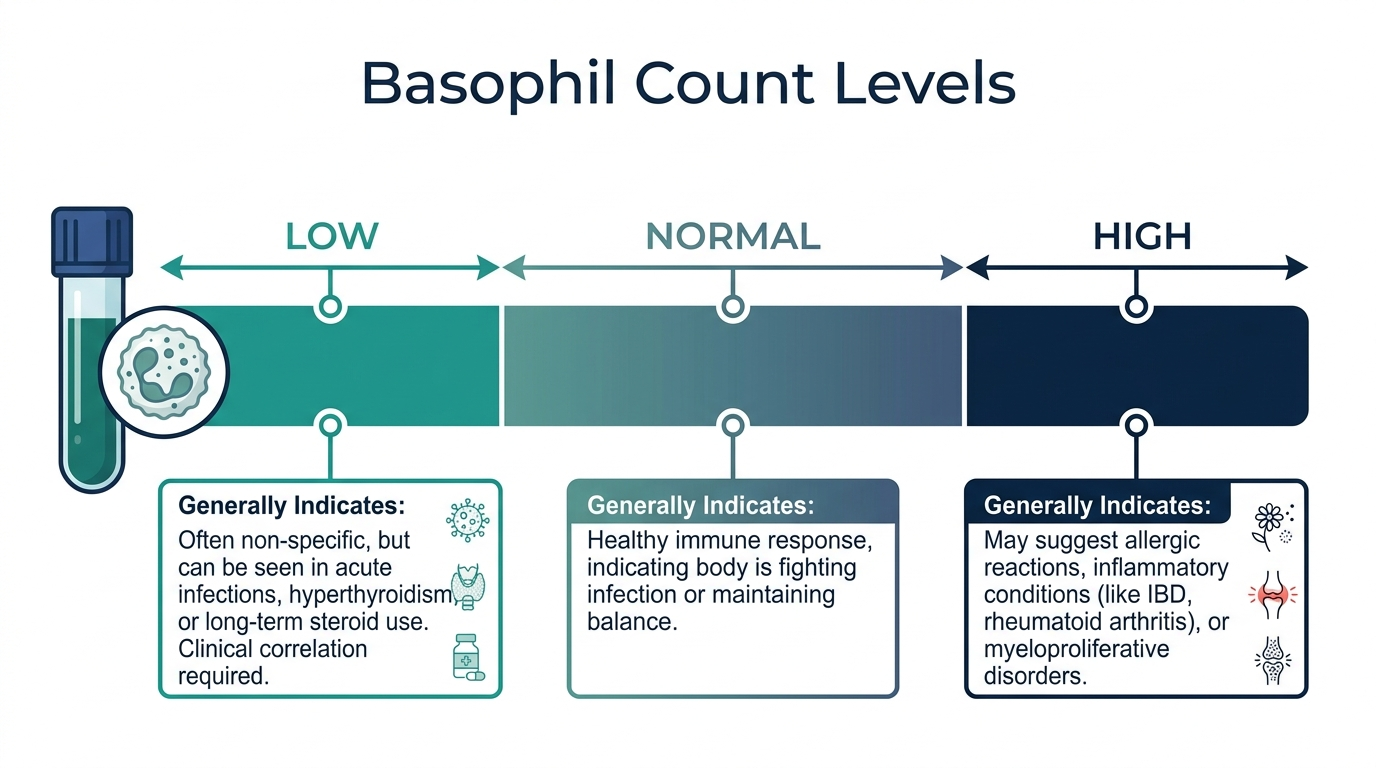
- The most common causes of low basophils are acute infection, physical or emotional stress, an overactive thyroid (hyperthyroidism), corticosteroid medication, and the early phase of a severe allergic reaction.
If your complete blood count (CBC) flagged your basophils as low, the number probably looks alarming because it can read as 0.0. Here is the reassuring part most people are not told: basophils are the least common white blood cell in your body, so a low or even absent result is frequently meaningless on its own. This guide explains the exact cutoff, what genuinely drives basopenia, when it actually matters, and what to do next.
Part of our Complete Blood Count guide.
Low basophils are rarely alarming alone. See the full white blood cell breakdown for context. One at-home Superpower draw checks 100+ biomarkers, physician-reviewed.
What does low basophils mean and what is the cutoff?
Low basophils (basopenia) means the basophil portion of your white blood cell count has fallen below the reference range, typically under 0.01 x10⁷/L, which equals about 10 basophils per microliter of blood. Cleveland Clinic reports that basophils normally make up just 0.5% to 1% of your total white blood cells, with a healthy absolute count of roughly 0 to 300 cells per microliter (Cleveland Clinic). Because the normal floor already touches zero, many labs and clinicians do not treat a count of 0.0 as truly abnormal.
Why the zero is misleading: a standard CBC differential counts a limited sample of cells. Basophils are so rare that a sample can easily contain none by chance. That is why an isolated low basophil value, with every other line of the CBC normal, is generally considered a normal variant rather than a disease marker.
What causes low basophils?
The leading causes of low basophils are acute infection, stress, hyperthyroidism, corticosteroid use, and acute allergic reactions, according to Cleveland Clinic and clinical references. In most cases basopenia is a temporary, reactive change rather than a sign that your bone marrow has stopped making these cells.
- Acute infection: short-term infections commonly pull basophils out of circulation.
- Stress, surgery, or illness: physical or emotional stress raises cortisol, which can redistribute or suppress circulating basophils.
- Hyperthyroidism: an overactive thyroid can lower the basophil count.
- Corticosteroid medications: drugs such as prednisone are a well known cause of basopenia.
- Acute allergic reactions: during a strong allergic episode or anaphylaxis, basophils degranulate and migrate into tissues, briefly dropping the blood count.
- Pregnancy: can be associated with a modest reduction in basophils.
Basopenia is a weak, non-specific marker. It does not point to one diagnosis, which is why clinicians read it alongside the rest of your CBC and your symptoms rather than in isolation.
What are the symptoms of low basophils?
Low basophils usually cause no symptoms at all. There is no recognized cluster of complaints from basopenia itself, because the drop is too small and the cells too few to affect how you feel. Any symptoms you notice almost always come from the underlying trigger, not from the low count.
For example, an overactive thyroid may bring a racing heart, weight loss, tremor, or heat intolerance. An acute infection brings fever, fatigue, or localized signs. A severe allergic reaction brings hives, swelling, or trouble breathing and is a medical emergency. The takeaway: do not look for “basopenia symptoms.” Instead, pay attention to whatever else is going on in your body and report that to your clinician.
When is low basophils dangerous?
Low basophils on their own are rarely dangerous, and isolated basopenia without other CBC abnormalities or symptoms is usually not clinically actionable. The concern is never the basophil number itself but the condition behind it. With the normal range starting at essentially zero, a single low reading carries very little independent weight.
It deserves closer attention when it appears with other red flags: low counts across multiple white cell lines, abnormal red blood cells or platelets, unexplained fever, drenching night sweats, unexplained weight loss, or persistent fatigue. In that setting the pattern, not the basophils alone, prompts further testing. The signs of a true emergency are those of anaphylaxis, including swelling of the face or throat and difficulty breathing, which require calling 911 immediately rather than waiting for a lab result.
What to do next and when to see a doctor
For an isolated low basophil result with a normal CBC and no symptoms, the usual next step is simply nothing, or a repeat CBC later to confirm stability. Because basopenia is so often a normal variant or a brief reaction to infection, stress, or medication, a one-time low value rarely needs a workup on its own.
Contact your clinician if the low basophils come with other abnormal blood counts, or with symptoms such as persistent fever, unexplained weight loss, night sweats, or signs of thyroid overactivity like a fast heartbeat and tremor. Bring a full picture: recent infections, new medications (especially steroids), stress, and pregnancy status all help interpret the result. Your clinician may recheck the CBC, review your medication list, or test thyroid function depending on your individual situation.
The insider nuance most patients miss
Here is what experienced clinicians know that lab portals do not explain: basophils are the only white cell whose normal lower limit is effectively zero, so “low basophils” is the least informative abnormal result on a CBC. A 0.0 basophil count is almost never investigated by itself. The number that actually changes clinical decisions is a high basophil count (basophilia), because persistent elevation can point to conditions such as chronic myeloid leukemia or other myeloproliferative disorders. In practice, automated analyzers also have limited precision at counting such rare cells, so small differences near zero are essentially noise. If your only abnormal value is low basophils, the smart move is to look at the whole CBC pattern and your symptoms, not to fixate on that single line.
What basophils actually do in your body
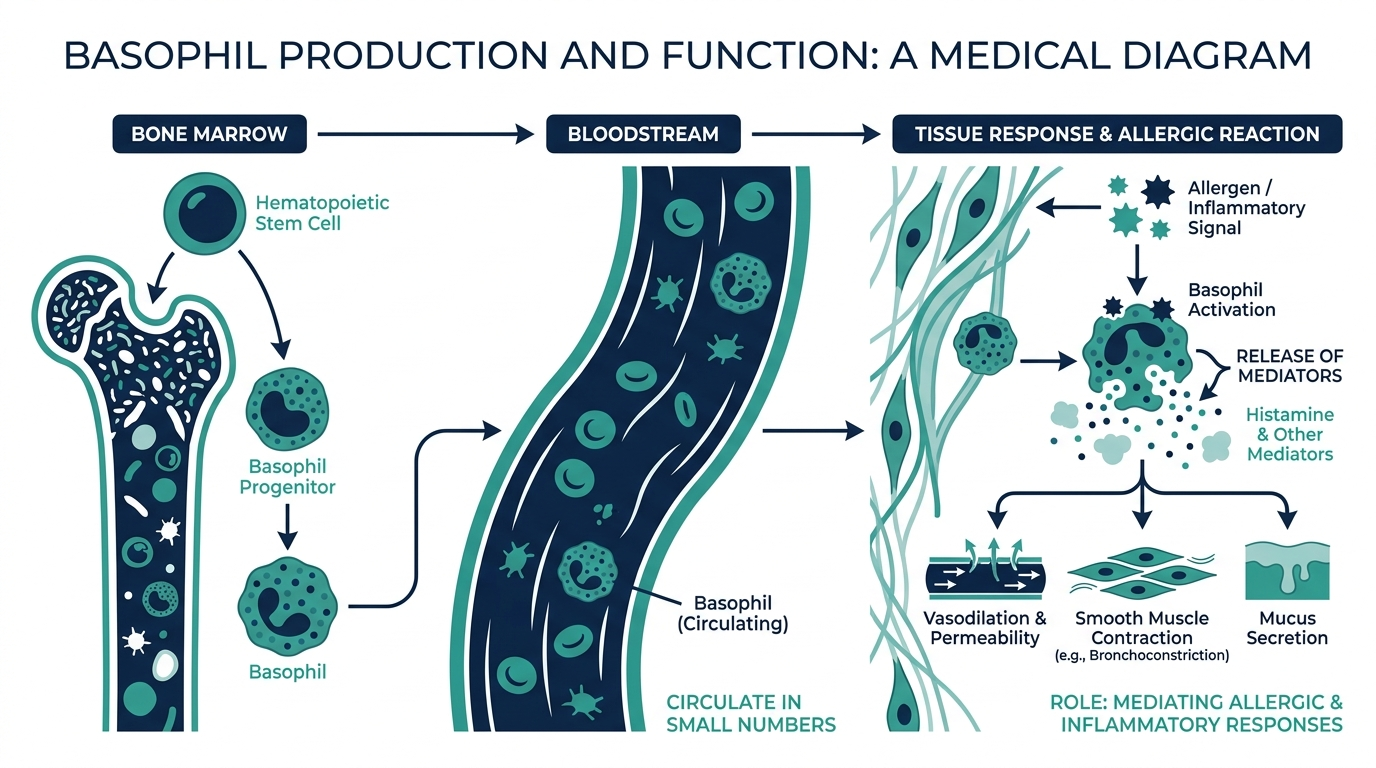
To understand why a low basophil count means so little, it helps to know what these cells are for. Basophils are white blood cells made in the bone marrow, and despite being the rarest, they are packed with powerful chemicals. Their granules store histamine and heparin, the same histamine responsible for the itch, swelling, and redness of an allergic reaction, and heparin, a natural blood thinner.
Basophils are close relatives of mast cells, which live in your tissues rather than your blood. Both carry receptors for IgE, the antibody central to allergies. When you encounter an allergen you are sensitized to, IgE on the basophil surface triggers the cell to release its contents, a process called degranulation. That histamine release is what produces classic allergy symptoms. Basophils also help defend against certain parasites and play a role in the broader inflammatory response.
Here is the key insight for interpreting your result: because basophils do their most important work after leaving the bloodstream and entering tissues, the number circulating in your blood at any moment is a small and fluctuating snapshot. A low blood count does not mean your body lacks the capacity to mount an allergic or inflammatory response.
Why high basophils matter more than low ones
If you take one practical lesson from this page, let it be this: clinicians pay far more attention to a high basophil count than a low one. Because the normal lower limit is effectively zero, there is almost nowhere for the number to fall, so a low or absent count carries little information. A rise, on the other hand, is a genuine signal.
Elevated basophils, called basophilia, are generally defined as an absolute count above roughly 200 cells per microliter. Persistent basophilia can be associated with:
- Myeloproliferative disorders: chronic myeloid leukemia in particular is classically associated with a rising basophil count, which is one reason a high value gets investigated.
- Chronic inflammation: some inflammatory and autoimmune conditions can nudge basophils up.
- Allergic and hypersensitivity states: chronic allergic conditions and certain drug reactions.
- Hypothyroidism: an underactive thyroid can raise basophils, the mirror image of the hyperthyroidism that lowers them.
So if your report shows a low basophil count, the reassuring direction, and every other line is normal, the clinical weight is minimal. It is the sustained high count, especially alongside other abnormal CBC values, that prompts a workup.
Absolute count versus percentage: reading the number correctly
Your CBC reports basophils two ways, and confusing them is a common source of needless worry.
- Percentage (relative count): what fraction of your total white cells are basophils, normally about 0.5% to 1%.
- Absolute count: the actual number of basophils per microliter of blood, roughly 0 to 300 cells per microliter.
The absolute count is the more reliable figure, and here is why. A percentage can look abnormal simply because a different cell line changed. If your neutrophils surge during an infection, your basophils will make up a smaller percentage of the total even though the actual number of basophils has not moved. This is called a relative change, and it fools people constantly. Whenever you compare your basophils to a reference range, use the absolute count, and give the same courtesy to every other cell type on the differential.
A second technical point worth knowing is that automated hematology analyzers have limited precision when counting extremely rare cells. Near zero, tiny differences between two samples are essentially measurement noise rather than a real biological change. That is another reason a single 0.0 is not chased.
How basophils fit into the full white blood cell differential
Basophils are one of five white blood cell types the differential breaks out, and reading them in isolation misses the point of the test. The five types and their rough adult shares are:
- Neutrophils (about 40% to 60%): first responders to bacterial and fungal infection.
- Lymphocytes (about 20% to 40%): the B and T cells that fight viruses and coordinate immunity.
- Monocytes (about 2% to 8%): cleanup cells that mature into macrophages.
- Eosinophils (about 1% to 4%): tied to allergies and parasites.
- Basophils (about 0.5% to 1%): the rarest, involved in allergy and inflammation.
Because basophils and eosinophils are both linked to allergic and parasitic responses, clinicians often read them together. A pattern of high eosinophils, for example, is far more informative for allergy or parasite questions than the basophil line. When your basophils are low but the other four types and the red cell and platelet lines are all normal, that whole-panel normalcy is exactly the reassurance you need. The differential is designed to be read as a set of relationships, not a row of independent numbers.

How the test is run and when to repeat it
Basophils are not tested by a separate procedure. They are counted as part of the CBC with differential, a routine blood draw that usually needs no fasting or special preparation. A phlebotomist collects a small tube of blood from a vein, and an automated analyzer produces the counts, sometimes supplemented by a manual review of a stained blood smear under a microscope when the analyzer flags something unusual.
The manual smear is relevant to basophils because it lets a trained technologist visually confirm rare or abnormal cells that an automated count near zero might handle imprecisely. If your basophil result is puzzling, this is one way a lab double-checks it.
When it comes to repeating the test, the guiding principle is simple. An isolated low basophil count with a normal CBC and no symptoms rarely needs a repeat at all, or at most a single recheck to confirm stability. What warrants closer follow-up is a pattern: low counts across several cell lines, a rising basophil count over time, or any abnormal value paired with symptoms such as persistent fever, night sweats, or unexplained weight loss. In those cases your clinician decides the interval and may add targeted tests such as thyroid function or a smear review.
Common misconceptions about low basophils
This single line on a lab report generates more anxiety than it deserves, largely because of a few persistent myths.
- “Zero basophils means my immune system failed.” No. Basophils are a tiny fraction of your immune cells, and a low count does not reflect overall immune strength, which is judged from the whole CBC and your clinical picture.
- “Low basophils cause symptoms.” There is no recognized symptom cluster from basopenia itself. Any symptoms come from the underlying trigger, such as an overactive thyroid or an acute infection.
- “A low result is always worse than a high one.” The opposite is true here. A high, sustained basophil count is the more meaningful finding because it can point to myeloproliferative disorders, while a low count is often just a sampling artifact.
- “I need to fix my basophils.” There is no treatment aimed at raising basophils, and none is needed. If a cause like a medication or thyroid issue is identified and addressed, the count follows along on its own.
Clearing up these misconceptions is usually the entire remedy for a low basophil result, because in most cases the correct response is understanding rather than treatment.
Medications and conditions that lower basophils
When a low basophil count does have an explanation, it usually traces to something on this list rather than to a bone marrow problem. Recognizing your own situation in these items often removes the mystery entirely.
- Corticosteroids: drugs such as prednisone are among the most reliable causes of a low basophil count. If you started or increased a steroid before your test, that alone can explain the drop.
- Acute infection: during a short-term infection, basophils are pulled out of circulation into tissues, temporarily lowering the blood count.
- Hyperthyroidism: an overactive thyroid can lower basophils, which is why a fast heartbeat, tremor, weight loss, or heat intolerance alongside a low count may prompt thyroid testing.
- Physical or emotional stress: surgery, serious illness, or intense stress raises cortisol, the body’s own steroid, with the same suppressing effect on basophils.
- Acute allergic reactions: during a strong allergic episode, basophils degranulate and migrate into tissues, briefly dropping the blood count at the very moment they are most active.
- Pregnancy: can be associated with a modest reduction in circulating basophils.
The common thread is that these are reactive, temporary shifts. Once the trigger resolves, the steroid is stopped, the infection clears, the thyroid is treated, the count typically returns to its usual range without any specific effort aimed at the basophils.
Bringing the right context to your clinician
If you do discuss a low basophil result with your clinician, the interpretation is much easier when you arrive with the full picture. A basophil count in isolation tells them almost nothing, but the surrounding details can quickly turn it into a clear answer. Come prepared to share:
- Current medications, especially any steroids like prednisone, and when you started them.
- Recent infections or illnesses, even a cold in the past couple of weeks.
- Major stressors or surgery in the recent past.
- Thyroid symptoms, such as a racing heart, tremor, unexplained weight change, or heat or cold intolerance.
- Pregnancy status.
- The rest of your CBC, so you and your clinician can see whether any other line is abnormal.
With that context, a low basophil value almost always resolves into either a normal variant or a simple, explainable reaction. The number by itself is the least useful part of the story, and the context you bring is what makes it interpretable.
Curious where your basophils really sits?
Baseline basophils and 100+ biomarkers today and retest as life changes, all in one membership with physician review.
Frequently asked questions
Is a basophil count of zero bad?
Usually no. Basophils normally make up only 0.5% to 1% of white blood cells, so a routine sample may contain none by chance. A zero reading with an otherwise normal CBC and no symptoms is generally considered a normal variant, not a disease.
What is the normal range for basophils?
Cleveland Clinic lists basophils at about 0.5% to 1% of total white blood cells, or roughly 0 to 300 cells per microliter (about 0.01 to 0.10 x10⁷/L) in healthy adults. Reference ranges vary slightly by lab, so check your own report.
Can stress lower basophils?
Yes. Physical or emotional stress, surgery, and acute illness raise cortisol, which can suppress or redistribute circulating basophils. This is a common, temporary cause of basopenia and typically resolves once the stressor passes.
Do low basophils mean a weak immune system?
No. Basophils are a tiny fraction of immune cells and a low count does not indicate weakened immunity. Immune strength is judged by the overall CBC and clinical picture, not by this single, very rare cell type.
Should I worry about low basophils with normal everything else?
Generally no. Isolated basopenia with a normal CBC and no symptoms is rarely clinically meaningful and often needs no action beyond a possible repeat test. Discuss persistent or pattern abnormalities with your clinician.
Sources
- Cleveland Clinic, Basophils: Function, Range and Related Conditions
- MedicineNet, Basophils: Function, Normal, High, Low Range
- Healthline, Basophils: Normal Range, Function, and More
- WebMD, What Are Basophils? Functions, Properties and Levels
This article is for general educational purposes and is not medical advice. It cannot diagnose or treat you and does not replace your clinician. Always discuss your lab results and any health decisions with a qualified healthcare professional.
Related: compare the best at-home biomarker and blood tests.
Vital Signs Today may earn a commission if you buy through links on this page. It does not affect our editorial assessments.