Disclosure: Vital Signs Today may earn a commission if you buy through links on this page, at no extra cost to you. This does not influence our evidence-based assessments. We are not a medical provider; talk to a clinician before acting on test results.
Related: GGT blood test: the full guide · What a low GGT result means · How to bring GGT back into range
You scanned your liver panel, everything looked fine, and then your eye snagged on three letters with a number sitting well above the reference range: GGT. Maybe it is flagged in red. Maybe a portal message just said “mildly elevated, recheck in a few weeks” and left you to stew. Either way, you are here because a high GGT feels like a warning light you do not know how to read.
Here is the honest version most explainers skip. GGT is the single most sensitive liver enzyme on a standard panel. That sensitivity is its gift and its curse. It picks up trouble early, but it also rises for reasons that have nothing to do with serious disease, which is exactly why a high number scares people more than it often should.
Part of our Liver Function Tests guide.
What does a high GGT blood test mean?
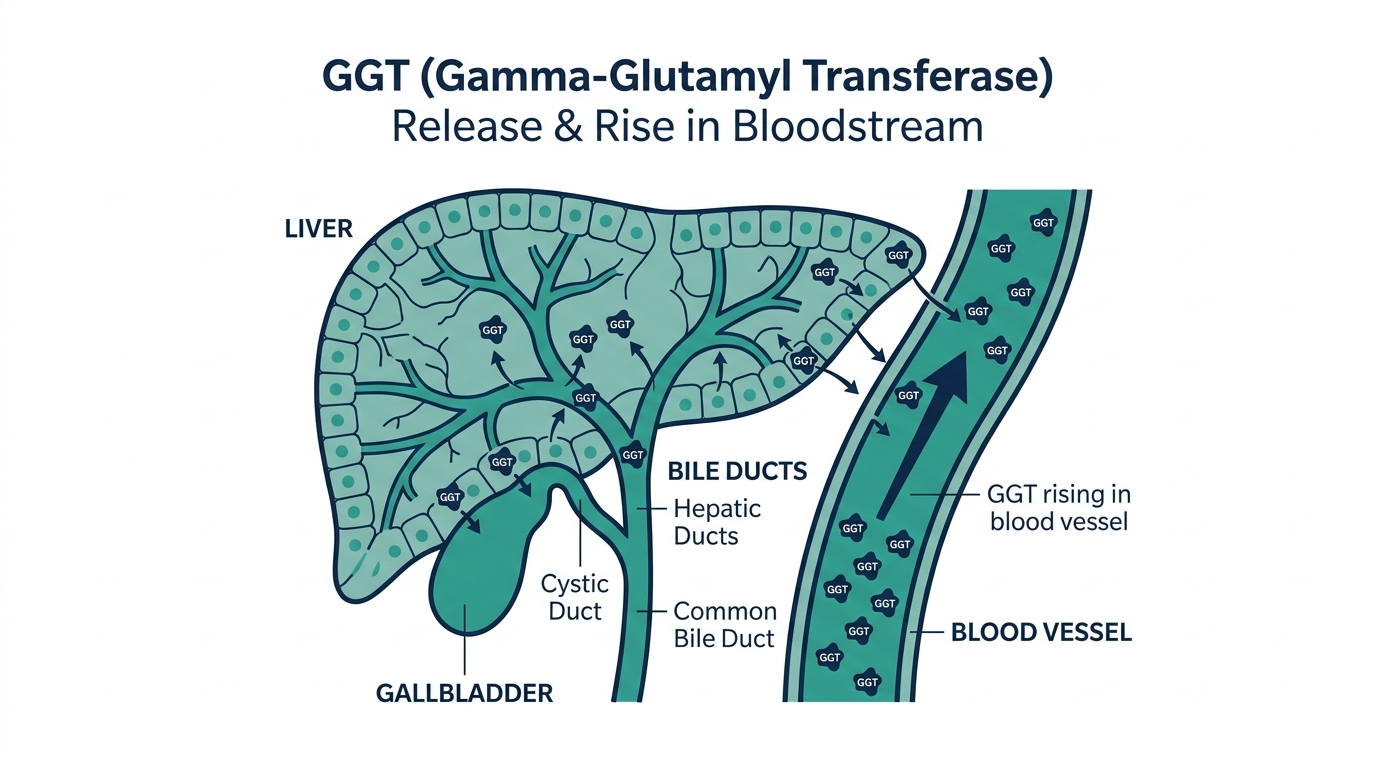
A high GGT blood test means your gamma-glutamyl transferase level is above your lab’s reference range, which usually signals that your liver or bile ducts are irritated, inflamed, or blocked in some way. GGT is an enzyme that lives mostly in the cells of your liver and bile ducts, and when those tissues are stressed or damaged it leaks into the bloodstream (MedlinePlus).
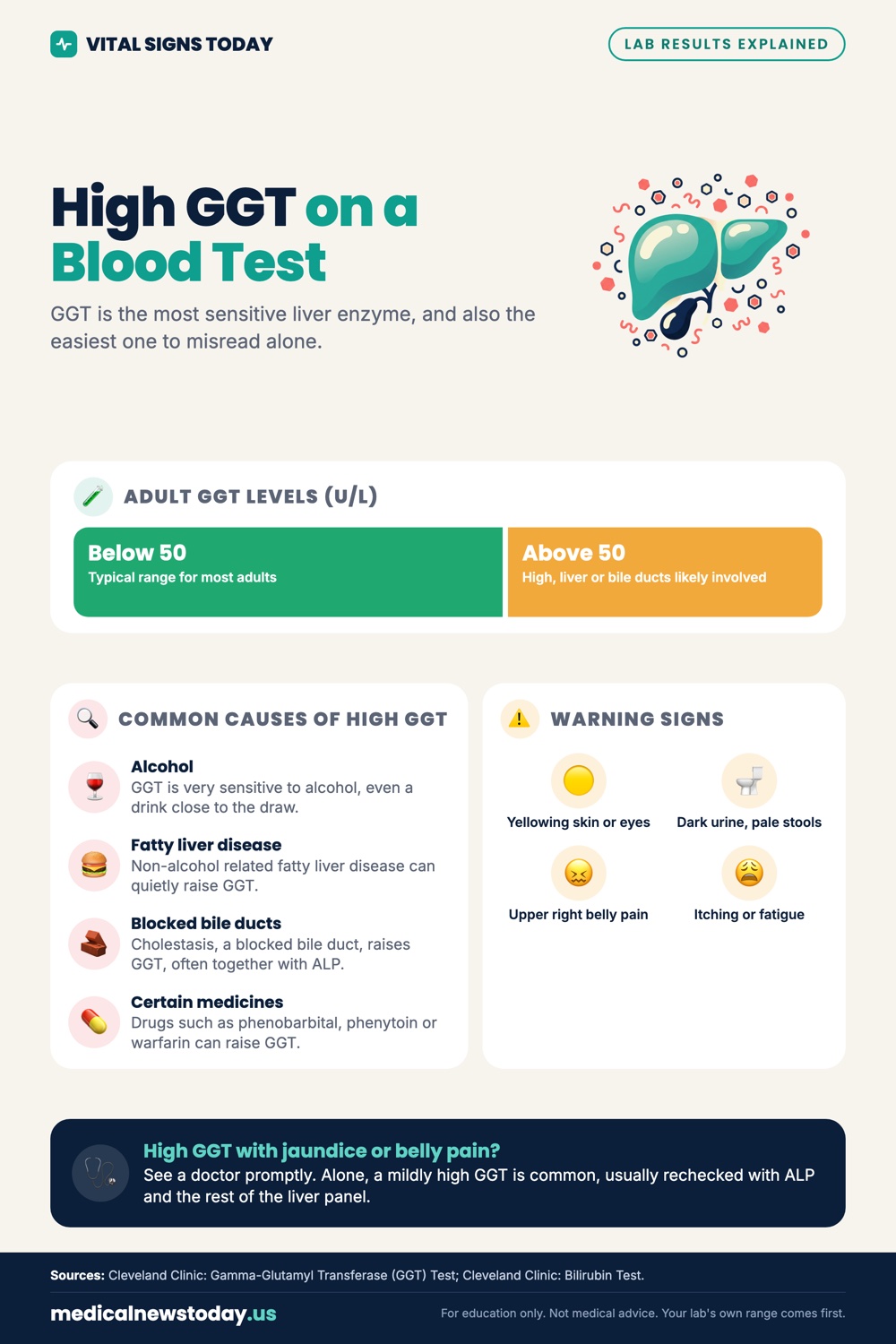
The normal range for GGT is often below about 50 U/L (units per liter), although the exact cutoff varies by lab, sex, and the instrument used (Cleveland Clinic). So “high” simply means above the number printed on your own report. A result a little over the top of the range is a different conversation from one that is three, five, or ten times higher. As a rough rule, the bigger the elevation, the more it points toward real liver or bile duct disease rather than background noise.
The critical thing to understand: a high GGT on its own is a clue, not a diagnosis. It tells you something is bothering your liver. It does not tell you what (Cleveland Clinic).

What causes a high GGT?
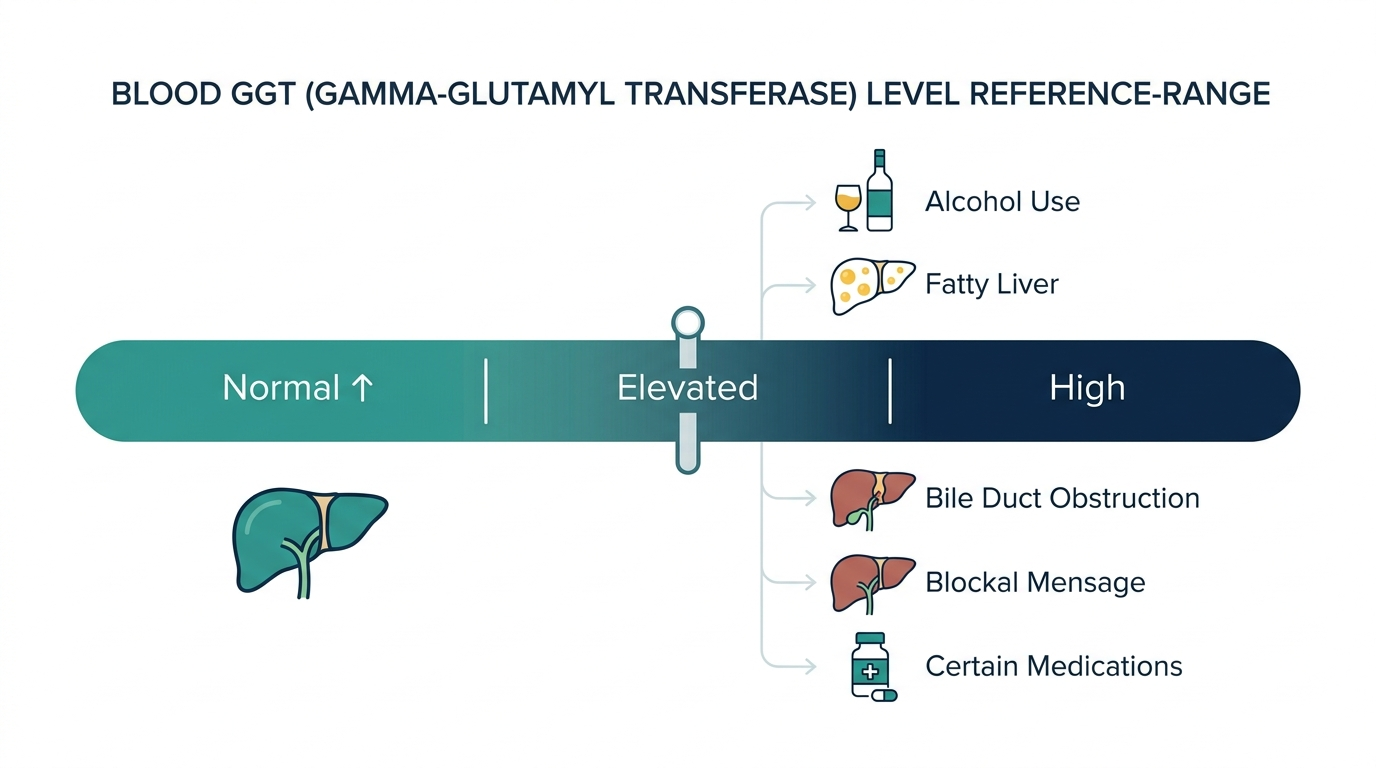
The differential for a raised GGT is broad, but a handful of causes account for the vast majority of real-world cases. Roughly in order of how often they show up:
- Alcohol. GGT is famously sensitive to alcohol. Heavy or even moderately regular drinking can push it up, and drinking shortly before your blood draw can nudge it higher still (MedlinePlus). This is the first thing most clinicians think of with an isolated high GGT.
- Fatty liver disease. Metabolic (non-alcohol-related) fatty liver is now one of the most common reasons for a quietly elevated GGT, often traveling with extra weight, prediabetes, or high triglycerides (Cleveland Clinic).
- Bile duct problems (cholestasis). When bile flow is blocked or sluggish, GGT climbs, usually alongside another enzyme called alkaline phosphatase (MedlinePlus).
- Hepatitis. Viral and alcohol-related hepatitis both raise GGT (MedlinePlus).
- Medications and supplements. Drugs such as phenytoin, phenobarbital, and warfarin, plus certain supplements, can lift GGT (MedlinePlus).
- Cirrhosis and liver tumors, which represent more advanced liver disease (MedlinePlus).
- Non-liver causes. Less commonly, GGT can rise with pancreatitis, diabetes, and heart failure (Cleveland Clinic).
Notice the pattern. The top of the list is dominated by lifestyle and metabolic factors, not rare and frightening diseases. That is the reassuring part. The catch is that “common” does not mean “harmless,” because fatty liver and steady alcohol use are precisely the slow-burn problems that do real damage over years.
What are the symptoms of a high GGT?
For most people, a high GGT produces no symptoms at all. The enzyme itself does not make you feel anything. People with mildly elevated liver enzymes very often feel completely well, which is exactly why these results tend to be discovered by accident on routine blood work (Cleveland Clinic).
When symptoms do appear, they belong to the underlying liver or bile duct problem, not to the GGT number itself. Watch for:
- Yellowing of the skin or eyes (jaundice)
- Dark-colored urine and pale or light-colored stools
- Abdominal pain, especially on the upper right side, or swelling in the belly or legs
- Nausea, vomiting, or loss of appetite
- Persistent fatigue or itching
These are the warning signs that matter (Cleveland Clinic). A high GGT with none of them is common and usually low-drama. A high GGT alongside any of them deserves prompt attention.
When is a high GGT dangerous or a medical emergency?
GGT is not measured by a single magic number that flips from safe to dangerous. There is no universally agreed “panic value.” What matters far more than the exact figure is the company it keeps and how fast it is moving.
The context that should prompt urgent evaluation:
- A high GGT plus jaundice, dark urine, or pale stools. That combination suggests bile is not draining properly, which can mean a blocked bile duct that needs imaging soon (Cleveland Clinic).
- A high GGT with severe upper-right abdominal pain, fever, vomiting, or confusion. These can signal acute liver or biliary trouble and warrant same-day care.
- A very large or rapidly rising elevation, especially together with raised ALT, AST, or bilirubin, which points toward active liver injury rather than a stable, low-grade finding.
The blunt truth is that elevated liver enzymes can lead to serious liver damage if the cause goes untreated, even when you feel fine (Cleveland Clinic). So a high GGT is rarely an emergency by itself, but it is never something to permanently ignore.
What should you do about a high GGT?
A high GGT is an invitation to investigate, and the path is usually straightforward. Your clinician will almost never act on GGT alone (Cleveland Clinic). Expect some combination of:
- The rest of the liver panel. ALT, AST, ALP, and bilirubin together sketch the pattern of what is going on. GGT is most useful read next to ALP (more on that below).
- A focused history. Honest answers about alcohol intake, medications, supplements, and weight trends do more to narrow the cause than any single test.
- Imaging. An abdominal ultrasound is the common next step to look at the liver and bile ducts, with CT or MRI if needed (Cleveland Clinic).
- A recheck. Often the smartest move is simply to repeat the test in a few weeks after addressing obvious contributors (Cleveland Clinic).
On the lifestyle side, two levers do most of the work. Cutting back or pausing alcohol can drop a GGT noticeably within weeks, since the enzyme responds quickly to drinking. And for metabolic fatty liver, losing even a modest amount of weight, moving more, and tightening blood sugar and triglycerides can pull GGT back toward normal. Treatment, when it is needed, targets the underlying cause, whether that is stopping a culprit medication, treating hepatitis, or managing the metabolic picture.

When should you see a doctor?
If a routine test shows a high GGT and you feel well, this is a conversation for your regular clinician, not the emergency room. Book a visit to review the full panel and your risk factors (Cleveland Clinic).
Seek care promptly, the same day if needed, if your high GGT comes with jaundice, dark urine, pale stools, severe abdominal pain, persistent vomiting, fever, or new confusion. Those are signs the underlying problem may be acute and the number is no longer the headline.
The insider angle: GGT is often misread as just an alcohol number
Here is the nuance that even experienced patients miss. Many people, and frankly some clinicians in a hurry, treat a high GGT as a de facto alcohol test and stop thinking once they have asked about drinking. That is a real misread, and it cuts both ways.
First, GGT genuinely shines when paired with ALP, not when judged solo. If both GGT and ALP are high, the problem is almost certainly in the liver or bile ducts. If ALP is high but GGT is normal, the source is more likely bone, not liver (MedlinePlus). That single comparison saves people from unnecessary liver workups, and it is the main reason GGT is ordered in the first place.
Second, plenty of things besides alcohol raise GGT: fatty liver, certain medications, smoking, and even a recent meal, since GGT levels can dip after eating, which is why fasting may be requested (MedlinePlus). A teetotaler can absolutely have a high GGT.
Third, and least appreciated: a persistently high GGT may be telling you something about your whole body, not just your liver. A large body of research links elevated GGT to higher long-term cardiovascular and all-cause mortality, independent of the usual risk factors (PMC, GGT and cardiovascular disease). The leading explanation is that GGT is a marker of oxidative stress and inflammation, the same forces that drive atherosclerosis, with catalytically active GGT actually found inside arterial plaques (PMC, GGT and cardiovascular disease). One meta-analysis found the cardiovascular mortality risk in the highest GGT group was meaningfully elevated compared with the lowest (PMC, GGT and cardiovascular mortality meta-analysis). This does not mean a high GGT condemns you to anything. It means the number is worth taking seriously as a general health signal, not waving away as “just the alcohol enzyme.”
Reference ranges: why “normal” GGT is not one number
One of the most confusing things about GGT is that two labs can call the same result normal and abnormal. There is no single legally fixed cutoff. Instead, each laboratory validates its own reference interval against the specific analyzer and reagent it uses, then reports “high” relative to that interval. This is why your printed range matters more than any number you read online.
A few structural facts help you read your own report with less anxiety:
- Sex matters. Reference intervals for GGT are typically higher for men than for women, because average GGT activity runs higher in men. A value that flags high on a unisex range may sit comfortably inside a sex-specific one.
- Age shifts the range. GGT tends to be higher in newborns, then settles, then drifts upward again with age. Pediatric and adult cutoffs are not interchangeable.
- Units are almost always U/L (units per liter), sometimes written IU/L. If you compare an old result to a new one, confirm the units and the reference range are the same before you conclude anything changed.
- The upper limit is the useful edge. Because the biologically interesting question is elevation, the top of the range is what clinicians watch. A GGT far below the lower bound is not a recognized disease pattern the way a low sodium or low hemoglobin would be.
Practical takeaway: do not compare your absolute GGT number to a friend’s, and do not compare it across labs without checking both reference intervals. The honest question is not “is 62 high?” but “how far above my own lab’s ceiling is it, and is it stable or climbing?”
How GGT is made, and why it leaks into blood
Understanding the biology takes the mystery out of the result. Gamma-glutamyl transferase is an enzyme anchored to the outer surface of cell membranes, and it is especially concentrated in the cells lining the small bile ducts inside the liver. Its day job is to help recycle glutathione, the body’s master antioxidant, by transferring a chemical group during that recycling process. That is why GGT sits at the crossroads of both bile handling and oxidative stress.
When bile flow is obstructed or sluggish, the cells lining those ducts respond by producing more GGT and shedding it into the blood, which is why cholestatic (bile-blocking) problems raise GGT so reliably. When the liver is exposed to certain drugs or alcohol, it ramps up production of GGT as part of a broader enzyme-induction response, so the enzyme rises even without frank cell death. And when liver cells are actually injured, membrane-bound GGT is released directly. These three mechanisms, induction, cholestasis, and cell injury, explain nearly every high GGT you will encounter, and they are the reason the same result can mean very different things depending on the pattern around it.
Reading GGT inside the full liver panel
GGT is rarely informative alone. Its power comes from how it sits next to the other liver markers. Here is how clinicians actually triangulate.
| Pattern | Likely direction |
|---|---|
| High GGT and high ALP | Points to the liver or bile ducts (cholestatic pattern), especially if bilirubin is also up |
| High ALP but normal GGT | Points away from the liver toward bone or, in pregnancy, the placenta |
| High GGT with high ALT and AST | Suggests active liver cell injury, from causes like alcohol, fatty liver, or hepatitis |
| Isolated high GGT, everything else normal | Often alcohol, a medication, or early metabolic fatty liver; frequently rechecked rather than chased |
Want to check your GGT?
Three ways to get it measured. Pick whichever fits you.
Affiliate links: we may earn a commission at no extra cost to you. A lab test does not replace a visit with your clinician.
Two ratios worth knowing about, though your clinician will interpret them in context. In heavy alcohol use, AST often runs higher than ALT (an AST-to-ALT ratio above two is a classic clue), and GGT rising alongside that pattern strengthens the picture. In metabolic fatty liver, ALT usually leads, with GGT along for the ride. None of these are diagnostic on their own, but together they turn a lone abnormal number into a readable story.
How to prepare for a GGT test and avoid a false high
You can make your result more trustworthy by controlling a few variables before the draw:
- Hold alcohol for several days if you can. Because GGT is so sensitive to drinking, even a single episode close to the test can nudge it up. If your goal is a clean baseline, avoid alcohol for a few days beforehand rather than just the night before.
- Bring your full medication and supplement list. Enzyme-inducing drugs and some herbal supplements can raise GGT. Your result is only interpretable if the person reading it knows what you take.
- Ask whether to fast. GGT is often drawn as part of a metabolic or liver panel that requires fasting, and GGT itself can shift slightly after eating, so follow the fasting instructions you are given.
- Do not start a crash diet or a big new exercise program the week before. Sudden large changes in weight or intense unaccustomed exertion can transiently perturb liver enzymes and muddy the picture.
If your result comes back high and one of these factors was in play, that context is exactly what a recheck under cleaner conditions is designed to sort out.
A worked example: reading a mildly high GGT
Imagine a report shows GGT modestly above the top of the range, with ALP, ALT, AST, and bilirubin all normal, and you feel completely well. How should you think about it?
First, this is a common and usually low-drama pattern. An isolated, mild GGT elevation with an otherwise clean panel most often reflects alcohol, a medication, smoking, or early metabolic fatty liver, not advanced disease. Second, the single most useful next step is honest self-inventory: recent drinking, new medications or supplements, and weight and blood-sugar trends. Third, a repeat test in a few weeks after trimming the obvious contributors tells you whether the finding is drifting up, holding steady, or already settling.
Now change one detail. Suppose ALP is also high alongside the GGT. That shifts the conversation toward the bile ducts and usually earns an abdominal ultrasound. Or suppose ALT and AST are elevated too. Now the story is active liver injury, and the workup broadens accordingly. The number that looked identical on paper means something quite different depending on its neighbors, which is the whole reason GGT is almost never interpreted in isolation.
Frequently asked questions
What level of GGT is considered high?
Normal GGT is often below about 50 U/L, though ranges vary by lab, sex, and instrument, so “high” means above the reference range printed on your own report (Cleveland Clinic). A small elevation is common and often benign, while a result several times above the upper limit more strongly suggests liver or bile duct disease.
Does a high GGT always mean liver damage?
No. A high GGT usually points to the liver or bile ducts, but it can also rise from alcohol, certain medications, smoking, fatty liver, and occasionally non-liver conditions like diabetes or heart failure (MedlinePlus). It is a clue, not a diagnosis, and is interpreted alongside other liver tests.
Can a high GGT come down, and how fast?
Often yes. Because GGT responds quickly to alcohol, cutting back or pausing drinking can lower it within weeks, and managing fatty liver through weight loss and metabolic control can bring it down over time. Clinicians frequently recheck the level after addressing obvious causes (Cleveland Clinic).
Why is GGT tested together with ALP?
GGT helps interpret a high alkaline phosphatase (ALP) result. When both GGT and ALP are elevated, the cause is likely liver or bile duct related, whereas a high ALP with a normal GGT points more toward bone (MedlinePlus).
Should I worry about a high GGT if I feel fine?
Most people with a mildly high GGT feel completely well, so it is usually not an emergency on its own (Cleveland Clinic). It still deserves follow-up, because untreated liver problems can progress silently, and a persistently high GGT has been linked to broader long-term health risks (PMC, GGT and cardiovascular disease).
This article is for general educational purposes and is not medical advice. It cannot diagnose or treat you and does not replace your clinician. Always discuss your lab results and any health decisions with a qualified healthcare professional.
Vital Signs Today may earn a commission if you buy through links on this page. It does not affect our editorial assessments.