
Last updated June 2026. Educational content only, not medical advice. Talk to a licensed clinician before starting any supplement, especially if you have a health condition.
Short answer: Yes, with real limits. Vital Proteins Collagen Peptides delivers 20 grams of hydrolyzed bovine Type I and III collagen per serving, a dose supported by multiple randomized controlled trials for improving skin hydration, reducing nail brittleness, and moderately reducing joint pain. A 2025 Korean RCT found 3,000 mg of low-molecular-weight collagen daily significantly reduced WOMAC knee pain scores after 180 days versus placebo. The brand holds NSF Certified for Sport status on its core SKUs, which is more than most competitors can say. The limits are real too: it is not a complete protein, it does not contain Type II cartilage collagen, and industry-funded bias is a documented problem in the research base.
20 grams of collagen a serving sounds like a lot. Want to see what it’s actually doing to your biomarkers over time? One at-home Superpower draw checks 100+ biomarkers, physician-reviewed.
What exactly is in a scoop of Vital Proteins Collagen Peptides?
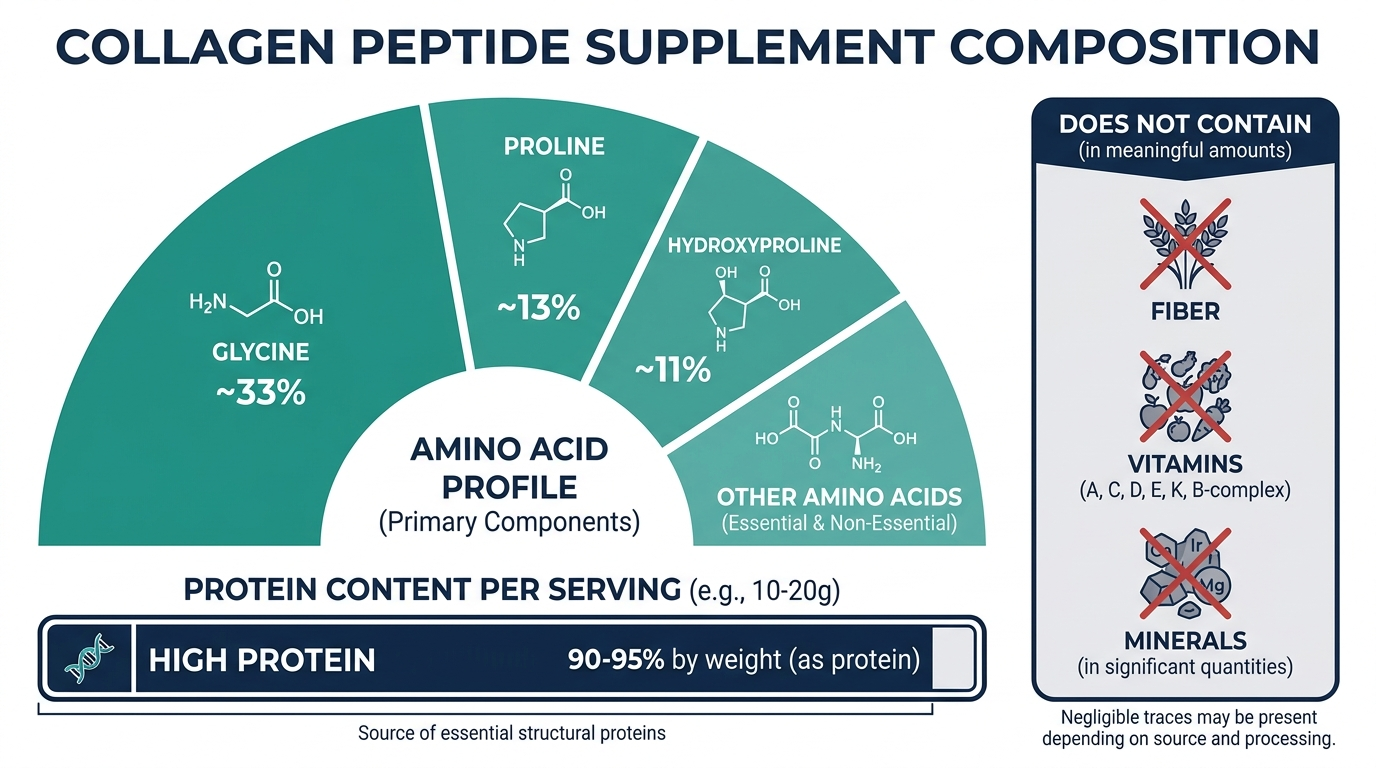
The label is simple by design. The original unflavored canister contains a single ingredient: hydrolyzed bovine collagen peptides sourced from the hides of pasture-raised cattle. Two scoops (one serving, 20 g) delivers 70 calories, zero fat, zero carbohydrates, and 18 grams of protein. The amino acid breakdown skews heavily toward glycine, proline, and hydroxyproline, the three residues that make up the collagen triple helix and have almost no presence in muscle meat or whey.
The Advanced formula adds 100% of the daily value of vitamin C (a cofactor for collagen synthesis) and 120 mg of hyaluronic acid, which research links to joint lubrication and skin moisture retention. Both versions dissolve cleanly in hot or cold liquid, a practical advantage over many cheaper competitors that clump.
One thing the label does not advertise: Vital Proteins was acquired by Nestlé Health Science in 2020 (majority stake) and fully in February 2022. The sourcing claim shifted to “grass-fed Brazilian bovine collagen,” and the brand has publicly acknowledged it cannot guarantee 100% grass-fed status for every batch. For buyers who care about traceability, that nuance matters.
Full-body lab membership: 100+ biomarkers, doctor-reviewed, tracked over time.
Does the research actually say collagen peptides work?
The simplest way to actually get this done
Superpower is a full-body lab membership that runs 100+ biomarkers, has each result reviewed by a doctor, and tracks your numbers year over year (about $199/year). It is what we point readers to when they would rather get one clean, complete draw than chase single tests one at a time. Here is superpower reviewed in full.
This is where most articles give you a cheerful yes. The honest answer requires a sentence more.
A 2026 systematic review published in Frontiers in Medicine examined oral and topical peptides for skin aging across randomized controlled trials and found significant improvements in skin hydration, elasticity, and crow’s-feet wrinkle reduction. A separate 2025 meta-analysis in The American Journal of Medicine pooled data from 23 RCTs covering 1,474 participants and concluded collagen supplements significantly improved skin hydration, elasticity, and wrinkles. Both reviews are real. Here is the catch that neither press release mentioned: the American Journal of Medicine analysis found that studies funded by pharmaceutical companies consistently reported positive effects, while independently funded studies showed no significant effect on skin hydration or elasticity. Funding bias is not unique to collagen research, but it is unusually pronounced here.
A larger 2026 review (113 clinical trials, 16 systematic reviews, nearly 8,000 participants total) gave a more measured verdict: collagen supplements provide “moderate improvements in muscle health and reduced pain in people with osteoarthritis” and support skin elasticity and hydration, but 15 of those 16 systematic reviews were rated low or critically low quality due to poor methodology. Newer research shows lower improvements in elasticity but greater improvements in hydration than older studies did, suggesting that early enthusiasm was somewhat overstated.
The intellectual honest position: the signal is real, but weaker and more conditional than the wellness industry portrays it.
Personally, I read the research differently depending on the outcome. Nail brittleness has some of the cleanest data: a 2017 RCT (published in the Journal of Cosmetic Dermatology) showed 2.5 g of bioactive collagen peptides daily for 24 weeks produced a 12% increase in nail growth rate and a 42% reduction in broken nails in participants with brittle nails. That is a specific population, a specific dose, a blinded design, and a large effect size. Do not expect the same result if your nails were fine to begin with.
What does Vital Proteins collagen peptides actually do for skin?
The mechanism is not magic: you swallow protein, it gets digested. What distinguishes collagen from most other proteins is the hydroxyproline (Hyp) content. Hyp-containing di- and tripeptides, particularly Ala-Hyp, Leu-Hyp, and Pro-Hyp-Gly, survive gut digestion better than most peptides because the Hyp residue confers resistance to protease degradation. A 2025 crossover study in healthy individuals confirmed that ingesting 10 g of collagen hydrolysate increased free plasma hydroxyproline by 6.2 to 9.9 times baseline depending on source, with bovine CH producing a 6.2-fold increase. Once in the bloodstream, these fragments are thought to stimulate fibroblasts in the dermis to produce more of their own collagen.
A 6-week RCT published in Cosmetics found participants taking low-molecular-weight collagen peptides showed a 46% reduction in wrinkle volume, 44% reduction in wrinkle area, and a 34% increase in skin moisture compared to placebo. A four-week bovine-derived collagen peptide trial in women aged 35 to 55 found statistically significant reductions in eye wrinkle volume alongside increased elasticity and hydration.
What the marketing does not specify: these benefits are measured in dermatological units like “cutometry R2 values” and “Visiometer wrinkle depth scores.” Meaningful to researchers, but the visible change you notice in the mirror is modest and takes 8 to 12 weeks of daily use to appear, sometimes longer. If you are expecting a dramatic transformation in three weeks, the data do not support it.
How does it compare to other collagen supplements?
| Feature | Vital Proteins Original | Vital Proteins Advanced | Generic store-brand collagen | Marine collagen |
|---|---|---|---|---|
| Collagen per serving | 20 g | 20 g | 10-20 g (varies) | 10-12 g |
| Collagen type | I + III (bovine) | I + III (bovine) | I + III (bovine) | I (fish skin) |
| Added actives | None | 120 mg HA + vitamin C | None | Varies |
| Third-party certification | NSF Certified for Sport | NSF Certified for Sport | Rare | Rare |
| Price per serving (approx.) | $1.64 | $1.79 | $0.40 to $0.80 | $0.80 to $1.50 |
| Tryptophan (complete protein) | No | No | No | No |
| Type II (cartilage collagen) | No | No | No | No |
The NSF Certified for Sport certification is genuinely meaningful. NSF tests for 290 banned substances, verifies that label contents match actual contents, and conducts a toxicological review of ingredients. Most collagen supplements on the market carry no independent certification at all. Vital Proteins charges for it in the price, and whether that premium is worth it depends on how much you value that assurance.
The comparison most buyers miss: marine collagen is also Type I, absorbs well, and has a higher hydroxyproline density per gram, but costs more and has a distinct taste profile some people find unpleasant. If you want specifically Type II collagen for cartilage health, neither Vital Proteins nor most bovine collagens supply it. You need undenatured Type II collagen (UC-II), which is a separate product at much lower doses (10 to 40 mg, not grams).
How should you actually take collagen peptides for best results?
The supplement industry has spun a lot of myth around timing, so here is what the mechanism supports and what it does not. Collagen peptides do not need to be taken on an empty stomach, at a specific hour, or away from other protein. They are digested like any other protein, and the free hydroxyproline-containing peptides that reach your bloodstream do so regardless of the clock. If a brand tells you a morning ritual or a bedtime dose unlocks a special benefit, that is marketing, not pharmacology.
Two things do matter. First, pair it with vitamin C. Collagen synthesis in your own tissue is vitamin C dependent, which is why the Advanced formula bundles it in and why several trials that showed benefit used collagen plus vitamin C together. If you take the plain unflavored version, having a source of vitamin C in the same meal is a sensible, cheap hedge. Second, heat is fine. Hydrolyzed collagen is already broken into peptides, so stirring it into hot coffee or oatmeal does not denature it in any way that reduces the benefit.
For dose, consistency beats size. A steady 10 grams every day outperforms 20 grams taken sporadically, because the fibroblast signal that drives skin and tendon collagen production responds to a continuous supply, not an occasional bolus. If cost is a factor, splitting one 20 gram scoop into two 10 gram days is a defensible way to stretch a canister without giving up most of the effect.
Is Vital Proteins collagen peptides good for joints?
Joint health is probably the most clinically interesting use case, and the data from 2025 is more specific than previous reviews reported.
A September 2025 randomized, double-blind, placebo-controlled trial published in Frontiers in Nutrition by researchers at Pusan National University tested 3,000 mg of low-molecular-weight collagen peptides daily for 180 days in adults with early-stage knee osteoarthritis (Kellgren-Lawrence grade I or II). The collagen group showed significantly greater reductions in WOMAC pain scores compared to placebo (p = 0.006), with improvements in physical function and total WOMAC scores. No adverse events occurred. The dose is notably lower than the 10 to 20 g range typically discussed, suggesting molecular weight matters as much as total quantity.
A separate 2025 study in Joint Diseases and Related Surgery compared Type I/III collagen peptides to hydrolyzed Type II collagen for osteoarthritis-related pain. Both types produced improvements; the Type I/III group (similar to Vital Proteins’ composition) showed statistically significant improvements in pain, quality of life, and function over 12 weeks.
Important context: these studies recruited people with diagnosed osteoarthritis. If you have healthy joints and are taking collagen peptides for “preventive” purposes, the evidence base for that specific claim is sparse. The research does not reliably show that collagen supplementation prevents cartilage loss in people with normal joint function.
Is Vital Proteins collagen peptides good for hair and nails?
Nails: yes, particularly for brittle ones. The 24-week RCT cited above (2.5 g daily) is the most cited trial and shows meaningful effect sizes in people with brittle nail disorder. Vital Proteins’ serving provides 8 times that dose, so efficacy is not the limiting factor if you match the population studied.
Hair: more complicated. Collagen peptides supply glycine and proline, which support keratin synthesis. A 2024 study by Gibson et al. found significant benefits for hair health from a hydrolyzed collagen plus vitamin C supplement over 12 weeks. But “hair health” in that context measured density and shaft thickness in people with early thinning, not in people with normally dense hair. If you are not experiencing noticeable hair thinning, you are unlikely to notice a hair difference.
Do not believe the claim that collagen “grows” your hair or nails directly. Collagen is not keratin. It provides substrate amino acids that your body may or may not deploy toward hair and nail synthesis depending on what you are already deficient in. The people who see dramatic nail results from collagen supplementation are usually the same people who were silently underconsuming glycine and proline in their diet, a surprisingly common situation in people eating high amounts of skinless chicken breast and whey protein.
Who should and should not take it?
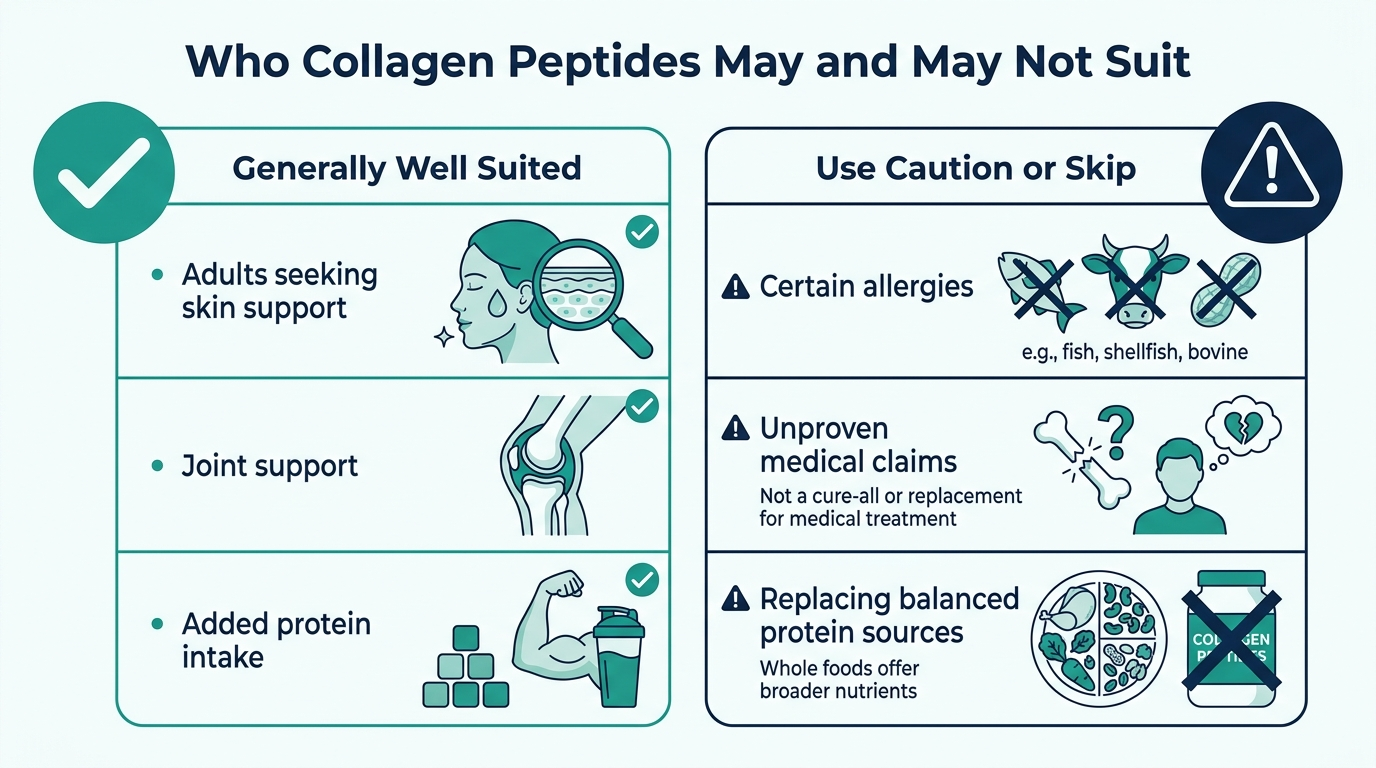
The supplement is appropriate for most healthy adults. People who are likely to see real benefit: adults over 35 with declining skin elasticity or hydration (documented by objective measurement, not just a feeling), people with early osteoarthritis and WOMAC-confirmed joint pain, anyone with brittle nail disorder, and athletes combining collagen peptides with resistance training (research shows collagen + vitamin C before exercise may support tendon collagen synthesis).
People who should avoid it or consult a clinician first: those with known allergies to bovine proteins, people with chronic kidney disease (high daily protein load requires clearance), anyone with a history of kidney stones (collagen’s hydroxyproline metabolizes to oxalate), and people who rely on complete protein sources since collagen is incomplete, missing tryptophan entirely.
One side effect the label glosses over: a small percentage of users report digestive heaviness, bloating, or a persistent “meaty” aftertaste, particularly with unflavored bovine collagen at 20 g doses. Starting with 10 g for the first two weeks and building up tends to eliminate this.
Hydrolyzed type I & III collagen peptides, third-party tested, unflavored.
What dose actually works, and how long does it take?
The 2025 Pusan National University trial used 3,000 mg (3 g) for joints. The nail brittleness RCT used 2.5 g. Most skin studies ran 5 to 10 g. Vital Proteins recommends 20 g per serving, which is at the high end of research doses rather than the low end. You are not underdosing with their serving size.
The timeline that clinical trials actually report:
– Nail improvements: 3 to 4 weeks for growth rate, 12 weeks for brittleness reduction
– Skin hydration: visible improvement around 8 weeks of daily use
– Skin elasticity: 12 weeks minimum, with ongoing incremental gains to 6 months
– Joint pain: 8 to 12 weeks before subjective improvement, full benefit at 6 months in the knee OA trial
Consistency matters more than dose within the effective range. Taking 20 g three days a week is less useful than taking 10 g every day. The fibroblast stimulation that drives skin and tendon collagen production operates on a continuous supply signal, not a bolus response like muscle protein synthesis.
The underappreciated practical issue: most people stop collagen within 4 to 6 weeks because they do not see obvious results. The clinical benefit curves for most outcomes do not bend meaningfully until week 8 to 12. Quitting at week 5 is not a data point; it is an incomplete experiment.
Here is how that plays out in practice. Someone with brittle, splitting nails and mid-30s skin starts 20 grams daily, sees nothing at week three, and nearly quits. They stay on it. Around week four the nails stop breaking as often, by week eight the skin feels less tight, and by three months a partner notices before they do. Nothing dramatic happened on any single day. The benefit was a slope, not a switch, and the only reason they saw it was that they did not stop at the flat part of the curve.
Curious what your own levels look like?
Baseline 100+ biomarkers today and retest as life changes, all in one membership with physician review.
Frequently asked questions
Is Vital Proteins collagen actually good quality?
Yes by objective industry standards. It holds NSF Certified for Sport certification, which verifies label accuracy and screens for 290 banned substances. It is sourced from pasture-raised bovine hide and contains 20 g hydrolyzed collagen (Types I and III) per serving. The one quality asterisk: Nestlé’s 2022 acquisition shifted primary sourcing to Brazilian cattle, and Vital Proteins cannot guarantee 100% grass-fed status for every batch.
How long does Vital Proteins collagen take to work?
Expect 8 to 12 weeks of daily use before meaningful changes in skin hydration and elasticity. Nail brittleness improvements begin around 3 to 4 weeks. Joint pain studies show significant WOMAC improvements at 6 months. Anyone who says “I noticed a difference in two weeks” either experienced a placebo response or had pre-existing deficiency resolving quickly.
Is 20 grams of collagen per day too much?
Not for most healthy adults. Research doses range from 2.5 g to 20 g depending on outcome. The 2025 knee OA trial used only 3 g and found significant effects, suggesting that molecular weight and peptide composition matter alongside total dose. 20 g per day is safe, but you could likely achieve most benefits at 10 g daily and halve your cost.
Can collagen peptides replace a protein supplement?
No. Collagen is missing tryptophan, making it an incomplete protein that cannot be your sole protein source. It complements whole-food protein and complete supplements like whey; it does not replace them. The amino acid profile is purpose-built for connective tissue, not muscle protein synthesis.
Does Vital Proteins work for joint pain?
Yes, conditionally. A September 2025 RCT in Frontiers in Nutrition showed 3 g of low-molecular-weight collagen peptides daily for 180 days significantly reduced WOMAC knee pain in early osteoarthritis. Vital Proteins’ bovine Type I/III collagen is within the studied category. If you have diagnosed osteoarthritis, the evidence is reasonably strong. If you have healthy joints and are hoping for “prevention,” the trial data does not support that claim.
What are the side effects of Vital Proteins collagen peptides?
Most users report no side effects. A minority experience digestive heaviness, bloating, or an unpleasant meaty aftertaste, especially at full 20 g doses. People with bovine protein allergies, kidney disease, or a history of calcium oxalate kidney stones should consult a clinician before use. Collagen does not interact with common medications at standard doses.
Is Vital Proteins collagen safe during pregnancy?
Vital Proteins does not contain any ingredient known to be unsafe in pregnancy at these doses. However, the company and most clinical guidelines recommend consulting your OB or midwife before adding any supplement during pregnancy, primarily because pregnancy-specific trials simply do not exist for this product.
Should I take collagen with or without food?
Either works. Collagen peptides are absorbed as di- and tripeptides regardless of whether your stomach is empty or full, so take it whenever you will actually remember to. The only pairing with a real mechanistic rationale is vitamin C, which supports your body’s own collagen synthesis, so a version with added vitamin C or a meal containing it is a small, sensible edge.
Is Vital Proteins better than a cheaper store-brand collagen?
On the collagen itself, often no. Most bovine Type I and III peptides are chemically similar. What you pay extra for with Vital Proteins is the NSF Certified for Sport testing, clean dissolving, and brand consistency. If third-party purity verification matters to you, that premium is defensible. If it does not, a reputable cheaper powder at the same dose will likely give you comparable results.
Does collagen break a fast?
Technically yes. It contains calories and amino acids, so it triggers a small insulin and protein response and is not a zero during a strict fast. For most people using time-restricted eating for weight or metabolic goals, a scoop of collagen is a minor input, but if you are fasting for autophagy or a clean lab draw, save it for your eating window.
Hydrolyzed type I & III collagen peptides, third-party tested, unflavored.
Author: Vital Signs Today Editorial Team, [credential]”]. Educational content, not medical advice. Sources linked inline.
Primary sources:
- Medicalxpress: Collagen supplements can help skin and joints, large new study finds (2026)
- Frontiers in Nutrition: Efficacy and safety of low-molecular-weight collagen peptides in knee osteoarthritis, RCT (2025)
- PMC: Absorption of bioactive peptides following collagen hydrolysate intake, crossover study (2024/2025)
- Frontiers in Medicine: Oral and topical peptides for skin aging, systematic review and meta-analysis of RCTs (2026)
- American Journal of Medicine: Effects of Collagen Supplements on Skin Aging, meta-analysis (2025)
- NSF Certified for Sport: Vital Proteins product search
- Vital Proteins official product page
- Nestlé Health Science acquisition announcement (2022)
- BarBend expert review of Vital Proteins Collagen Peptides (2026)
- PubMed: Collagen peptide supplementation improves function, pain, and outcomes in active adults (PMC10411303)
Related reading
Vital Signs Today may earn a commission if you buy through links on this page. It does not affect our editorial assessments.