
Last updated June 2026. Educational content, not medical advice. BPC-157 is not FDA-approved for any human use. Speak to a licensed clinician before considering any peptide therapy.
Short answer: BPC-157 is a synthetic 15-amino-acid peptide derived from a protein in human gastric juice, and it is primarily used (in animal research) for tendon and ligament healing, gut lining repair, and nerve injury recovery. Human evidence consists of exactly three small published studies totaling 30 participants; the largest had 16 people and no control group. As of April 2026, the FDA removed BPC-157 from its prohibited compounding list, and a Pharmacy Compounding Advisory Committee review is scheduled for July 23-24, 2026, which may open the door to legal prescriptions through licensed pharmacies.
BPC-157 is being tried for tendon and gut healing, so what do your own inflammation and gut markers look like now? One at-home Superpower draw checks 100+ biomarkers, physician-reviewed.
What exactly is BPC-157?
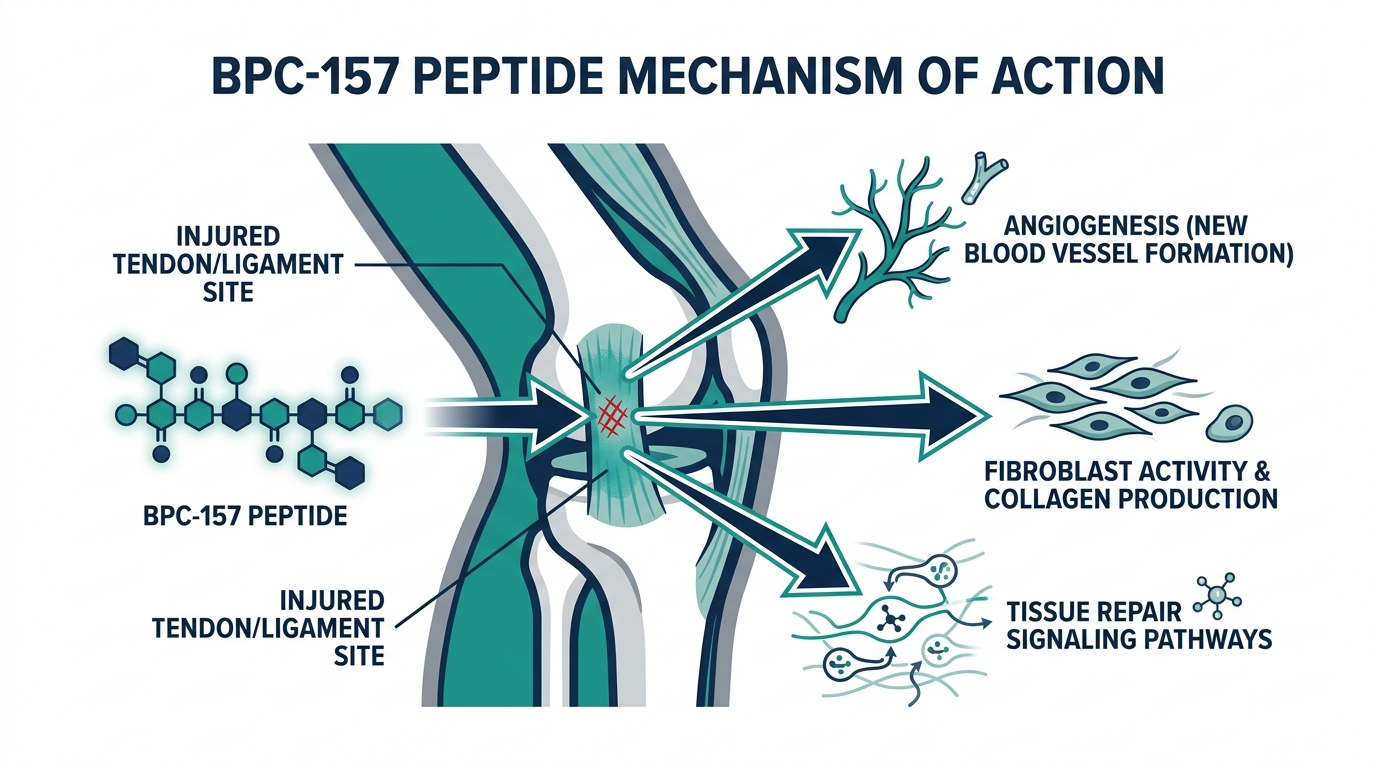
BPC stands for Body Protection Compound. The peptide is a synthetic analog of a naturally occurring protective protein found in human gastric juice, isolated and characterized by Dr. Predrag Sikirić and his team at the University of Zagreb School of Medicine in Croatia beginning in 1989. Its full amino acid sequence is Gly-Glu-Pro-Pro-Pro-Gly-Lys-Pro-Ala-Asp-Asp-Ala-Gly-Leu-Val, with a molecular weight of 1,419 Da (Wikipedia: BPC-157).
One property that immediately set it apart from most peptides: BPC-157 is unusually stable in human gastric juice. Most peptides are rapidly destroyed by stomach acid. This stability is partly why researchers became interested in it as an orally active compound, and why some proponents argue it makes sense as a gut-targeted therapy delivered in capsule or liquid form.
The “157” in the name refers to the position within the parent gastric protein where this particular amino acid sequence was identified. It is not a naturally occurring molecule in the same form it is used experimentally; it is a synthetic fragment engineered for stability and activity.
What is BPC-157 actually used for?
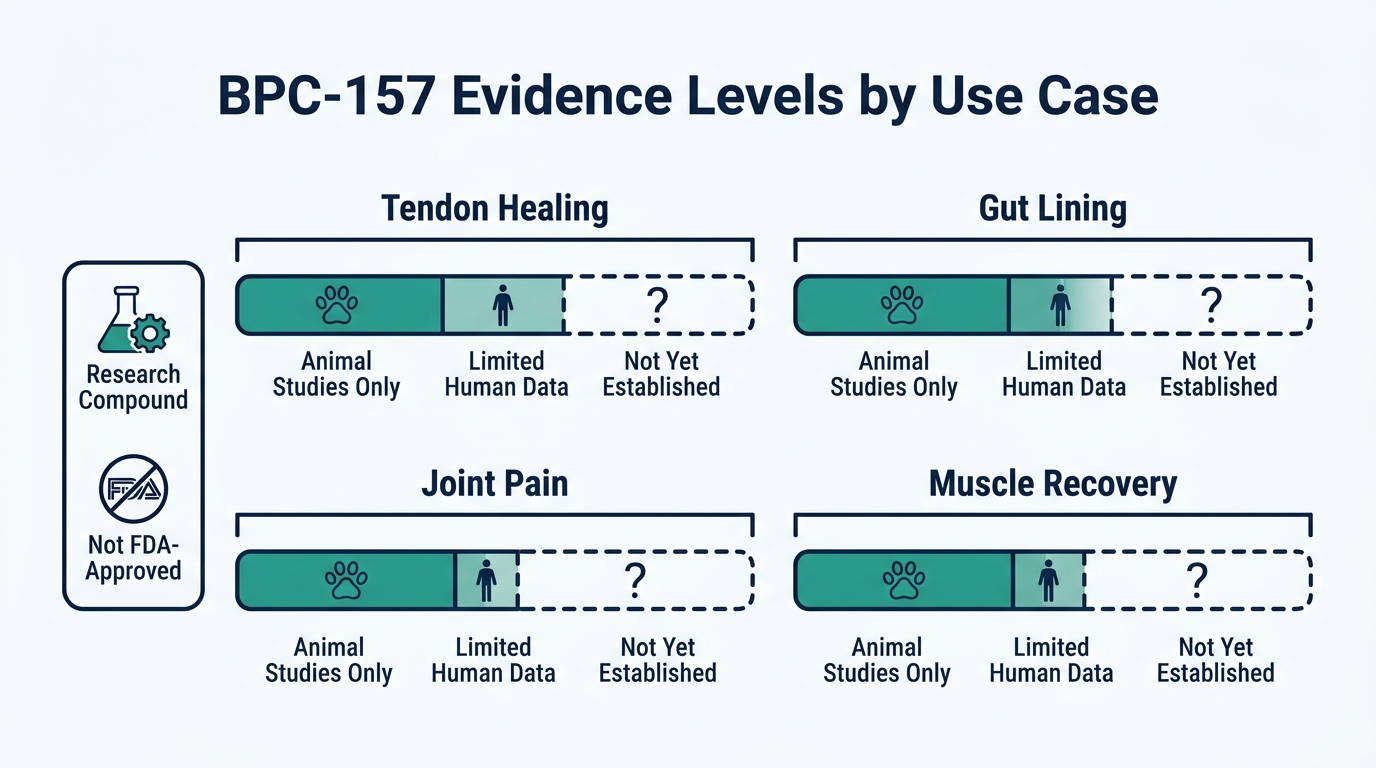
This is where the gap between what people believe and what the science shows becomes genuinely important to understand. BPC-157 is claimed for a wide range of uses, nearly all of them backed by animal data only. Here is what the research actually covers:
Tendon and ligament healing
The most consistent preclinical signal is tissue repair, particularly in tendons and ligaments, which are notoriously difficult to heal because they have poor blood supply. A 2025 systematic review published in the HSS Journal examined 36 studies on BPC-157 in musculoskeletal applications: 35 were preclinical (animal), and 1 was human. Across those animal studies, the peptide improved functional, structural, and biomechanical outcomes in muscle, tendon, ligament, and bone injury models.
The biological mechanism is specific: BPC-157 activates the VEGFR2-Akt-eNOS axis, which triggers targeted angiogenesis (new blood vessel formation) and nitric oxide synthesis, driving nutrient-dense blood flow into normally avascular connective tissue (PMC12446177). In short, it appears to force a blood supply into tissue that usually cannot attract one.
The single human study in this category is small: Dr. Edwin Lee and colleagues injected BPC-157 directly into the knee joints of 16 patients with chronic knee pain. Fourteen of 16 reported significant pain relief at the 6-to-12-month follow-up, an 87.5% response rate. That sounds impressive until you look at the design: no control group, no placebo, and mixed diagnoses across participants. A placebo response alone in pain studies typically runs 30-40%. Without a comparator, the number is interesting, not convincing.
Gut repair and inflammatory bowel conditions
The gut-healing claim is actually the one with the longest research history. Sikirić’s original work in the 1990s focused on gastric ulcers, and BPC-157 consistently heals mucosal ulcers in rodent models at doses that would be difficult to replicate in humans. The peptide appears to stabilize tight junction proteins that keep the gut lining sealed, which is why it has been popularized as a treatment for “leaky gut” in wellness circles.
The pharmaceutical company PLIVA (now part of Teva) actually ran two human clinical trials on BPC-157 for ulcerative colitis in the early 2000s. This is the insider detail that most forum discussions and supplement marketing completely miss: the drug already had real clinical investment from a major manufacturer. The trials were never published in peer-reviewed journals, and PLIVA quietly moved on. The most plausible interpretation is that the results were not compelling enough to justify continuing toward approval, though the exact data has never been made public (STAT News, February 2026).
A 2024 study by Lee and colleagues treated 12 patients with interstitial cystitis, a painful bladder condition, via intravesicular injection. All 12 had previously failed FDA-approved pentosan polysulfate treatment. The result: 80-100% resolution of moderate to severe symptoms at 6 weeks. Again, no control group, and the total patient count is 12 (PMC12446177). Promising as a signal; nowhere near sufficient for clinical conclusions.
Nerve repair and neuroprotection
Rodent studies suggest BPC-157 can regenerate peripheral nerves and has protective effects in models of traumatic brain injury and Parkinson’s disease. The mechanism here involves the modulation of dopaminergic and serotonergic pathways, and stabilization of acetylcholine receptors at the neuromuscular junction. As of mid-2026, no human studies exist specifically for neurological applications.
Systemic anti-inflammatory effects
BPC-157 downregulates pro-inflammatory cytokines including TNF-alpha, IL-6, and IFN-gamma, and promotes a shift in macrophage polarization from the inflammatory M1 phenotype to the resolution-promoting M2 phenotype (PMC12446177). This has generated interest in potential applications for autoimmune conditions, though no human trials exist in this area.
Full-body lab membership: 100+ biomarkers, doctor-reviewed, tracked over time.
Who is doing the research, and why does that matter?
Personally, this is the part of the BPC-157 story I find most worth examining carefully, because it changes how you should weight the evidence.
Of the roughly 200 published studies on BPC-157 indexed on PubMed, the overwhelming majority list Dr. Predrag Sikirić or his longtime co-author Dr. Sven Seiwerth as authors. Sikirić has published more than 150 BPC-157 papers since the early 1990s. He also holds ownership stakes in two companies with direct financial interest in the peptide: PharmaCotherapia and Diagen, the patent-holding company built around BPC-157 (STAT News, February 2026).
This is not automatically disqualifying. Many founders of research lines have financial interests. But it does mean the entire preclinical evidence base for the most popular research peptide in the biohacking world comes almost entirely from a single lab, run by a researcher with a patent stake in the outcome, and that no major independent replication effort has yet reproduced the results at scale.
Independent reviewers from the US, UK, and Poland who examined the BPC-157 literature concluded there are “too many unknowns to justify clinical use.” Polish reviewers specifically flagged confirmation bias risk and noted the peptide “will remain difficult to convince the broader medical community” without rigorous, pre-registered, independently conducted trials. That is not a condemnation of the molecule. It is an honest description of where the evidence sits right now.
Do not believe anyone telling you the science is settled on BPC-157. It is not. The promise is real enough that multiple researchers, a major pharmaceutical company, and a compounding pharmacy industry built a market around it. The evidence for human use is not.
What do the three human studies actually show?
Because only three published human studies exist, they are worth spelling out in full rather than summarizing loosely.
| Study | Year | N | Application | Outcome | Limitation |
|---|---|---|---|---|---|
| Lee & Padgett (intraarticular knee) | 2021 | 16 patients | Knee joint injection | 14/16 reported significant pain relief (87.5%) at 6-12 mo | No control group, mixed diagnoses |
| Lee et al. (interstitial cystitis) | 2024 | 12 patients | Intravesicular bladder injection | 80-100% symptom resolution at 6 weeks | No control, all treatment-refractory patients |
| Lee & Burgess (IV safety) | 2025 | 2 healthy adults | IV infusion up to 20 mg | No adverse events, labs normal, plasma cleared within 24 hours | 2 subjects; safety signal only, not efficacy |
All three studies are from the same US researcher, Dr. Edwin Lee of Orlando, Florida, a co-founder of the Clinical Peptide Society.
The safety data from the 2025 IV study is genuinely meaningful: 20 mg IV with no cardiac, hepatic, renal, thyroid, or glucose changes is a useful baseline for human safety assessment. But 2 people is not a safety study; it is a pilot signal. And all three studies come from one investigator, mirroring the concentration problem in the animal literature.
Is BPC-157 legal in 2026?
The legal status shifted meaningfully in April 2026, and most articles written before then are already outdated.
Timeline:
– September 2023: The FDA placed BPC-157 on the 503A Category 2 bulk drug substances list, citing “significant safety risks” and insufficient human safety data. This effectively banned compounding pharmacies from preparing it for patients.
– February 2026: HHS Secretary Robert F. Kennedy Jr. signaled that approximately 14 of the 19 restricted peptides, including BPC-157, TB-500, CJC-1295, Ipamorelin, and Sermorelin, are expected to be moved back to Category 1 (permitted for compounding) status.
– April 22, 2026: The FDA removed BPC-157 from the Category 2 restricted list (FDA bulk substances list).
– July 23-24, 2026: A Pharmacy Compounding Advisory Committee (PCAC) meeting is scheduled to formally review BPC-157 and related peptides.
The implication of April’s action: licensed 503A compounding pharmacies can now, in principle, prepare BPC-157 for individual patients when prescribed by a licensed provider. The July PCAC meeting will determine whether that door stays open formally.
What has not changed: BPC-157 is not FDA-approved for any indication. It has no NDA or ANDA on file. The “research use only” market continues to exist legally as a research-chemical designation, but that label does not confer safety or purity guarantees.
If you compete in any sport governed by WADA: BPC-157 was added to the 2022 Prohibited List under the S0 Unapproved Substances category. It is banned in-competition and out-of-competition, year-round, with no Therapeutic Use Exemption available. In 2023, a professional combat sport athlete was suspended for two years after a positive test for BPC-157 (USADA advisory).
Oral vs. injectable: does the delivery route actually matter?
Yes, and the answer is counterintuitive enough to qualify as insider knowledge.
For gastrointestinal applications, oral delivery appears to work as well as injection, or better, because BPC-157 acts locally on the gut mucosa it contacts during transit. The peptide does not need to circulate systemically to repair gut tissue; it needs to touch the tissue. Multiple animal studies show gut-localized effects at oral doses 3-10x higher than subcutaneous injection doses, consistent with direct mucosal contact rather than systemic absorption (Amino Innovations).
For musculoskeletal applications (tendons, joints, muscle), oral bioavailability is estimated at 10-30% based on dose-equivalence data from animal studies. Injectable delivery is more appropriate for systemic tissue-healing goals because it bypasses gastrointestinal first-pass degradation and delivers the peptide directly into circulation.
The practical implication: the same peptide, delivered the same way, may be essentially doing different jobs depending on the target tissue. This nuance is almost entirely absent from the supplement and biohacking marketing around BPC-157, which treats “oral vs. injectable” as a convenience preference rather than a mechanistic decision.
What are the real safety concerns?
The most commonly discussed concern is the cancer risk from angiogenesis promotion. Because BPC-157 triggers new blood vessel formation via VEGF upregulation, and because tumor growth also requires new blood vessels, there is a theoretical risk that the peptide could accelerate growth of an undetected existing tumor. The 2025 PMC review found BPC-157 actually demonstrated anti-tumor properties in some preclinical settings, and the peptide appears to regulate angiogenesis contextually rather than simply switching it on (PMC12567428). But the honest answer is: no one has studied what happens in a person with an undiagnosed malignancy who uses BPC-157 for months. That data does not exist.
Other safety considerations:
- Anecdotal reports in online communities (Reddit r/peptides, various forums) include episodes of intense anxiety, anhedonia, and nausea. These are not documented in the clinical literature because the clinical literature has 30 total participants.
- Impurity risk from grey-market sources is not theoretical. Independent testing platform Finnrick has documented purity failures across multiple research peptide vendors, and the closure of Peptide Sciences in March 2026 followed reports of batches testing as low as 75% purity.
- Injection site reactions, dizziness, and headaches are the most commonly reported mild effects in both the small clinical studies and anecdotal reports.
The 2025 IV safety study finding no adverse events at 20 mg is genuinely reassuring for acute safety. It says nothing about long-term effects at the doses and frequencies that self-experimenters actually use.
Telehealth GLP-1 program with provider visits and pharmacy coordination.
What is a realistic cost comparison?
| Route | Cost | What’s included |
|---|---|---|
| Research vial (grey market) | $30-$120 per 5 mg vial | Molecule only; no oversight, labs, or clinical support |
| Full research course (4 weeks) | $68-$125 total | Supplies separate ($10-30); you handle reconstitution, dosing, and risk |
| Telehealth clinic (monthly) | $199-$425/month | Consultation, compounded medication from 503A pharmacy, shipping |
| Telehealth with initial labs | $350-$700 first month | Adds baseline bloodwork and clinical review |
| In-person specialist clinic | $445-$1,295 per cycle | Full intake, labs, injections training, follow-up |
Insurance covers none of these routes. BPC-157 is not approved for any indication, and carriers do not reimburse off-label peptide therapy regardless of the clinical rationale.
The price comparison that matters is not vial vs. clinic. It is: who is accountable if something goes wrong? With a research vial, you are the pharmacist, the prescriber, and the QC lab, simultaneously. With a licensed clinic, all three are someone else’s licensed liability.
The myth worth correcting
The dominant myth around BPC-157 is that the evidence is being suppressed by pharmaceutical companies who cannot patent it. The claim goes: it is so cheap to produce that Big Pharma has no incentive to run trials, so they block it.
This argument does not survive contact with the actual history. PLIVA, a major pharmaceutical manufacturer, did run Phase II trials in the early 2000s specifically to develop BPC-157 as a drug for ulcerative colitis. They had every financial incentive to find positive results. They did not publish those results, which is most consistent with findings that were not compelling enough to continue. The patent landscape around BPC-157 is owned by Diagen, a company co-founded by the primary researcher. There is no credible evidence of suppression; there is considerable evidence of unremarkable Phase II results that did not justify the investment required for Phase III.
That does not mean the peptide does not work. It means the hypothesis has already faced one serious commercial test and did not clear it. Every honest discussion of BPC-157 should include that fact, and most do not.
Turn what you just learned into action.
Superpower lets you test 100+ biomarkers from home, then re-check them over time so you can actually see progress, physician-reviewed at every step.
Frequently asked questions
What is BPC-157 most commonly used for?
In both animal research and human self-experimentation, the most common applications are tendon and ligament injuries, chronic knee and joint pain, and gastrointestinal conditions including inflammatory bowel symptoms and gut permeability issues. The 2025 HSS Journal systematic review confirmed consistent preclinical benefits for musculoskeletal healing across 35 animal studies, though human evidence remains extremely limited.
Does BPC-157 really work for tendons?
In animal models, consistently yes. In humans, there is one study of 16 patients with knee injections, where 87.5% reported significant pain relief, but there was no control group. That result cannot be cleanly separated from placebo effect. The mechanism is well-documented in preclinical work, and the result is plausible. It is not proven in humans.
Is BPC-157 legal to buy in 2026?
The FDA removed BPC-157 from its restricted compounding list on April 22, 2026, opening the pathway for licensed compounding pharmacies to prepare it with a prescription. It remains unscheduled under the Controlled Substances Act, so possession is not a criminal issue. It is not FDA-approved for any indication. For athletes in WADA-governed sports, it remains prohibited year-round under the S0 category.
What is the difference between oral and injectable BPC-157?
For gut-related conditions, oral delivery may be equally or more effective because the peptide acts locally on the gut mucosa it contacts during transit, not systemically. For tendon and joint applications, injectable delivery is preferred because it bypasses gastrointestinal degradation. Most marketing treats this as a convenience decision; it is actually a mechanistic one.
What are the risks of BPC-157?
The theoretical cancer risk from angiogenesis promotion is real but unquantified in humans. Impurity risk from grey-market sources is real and documented via independent lab testing. Anecdotal reports of anxiety and nausea exist. The 2025 IV safety study in 2 healthy adults found no adverse events at 20 mg. Long-term safety data in humans simply does not exist.
Why did PLIVA stop developing BPC-157?
PLIVA ran two Phase II clinical trials for BPC-157 in ulcerative colitis patients in the early 2000s and never published the results. The most likely explanation is that the data was not compelling enough to justify continuing to Phase III. Those unpublished results represent the most significant human data on BPC-157 that currently exists, and they are not accessible.
How much does BPC-157 cost through a clinic?
Telehealth programs run $199-$425 per month including consultation, compounded medication from a licensed 503A pharmacy, and shipping. Initial months with baseline labs run $350-$700. In-person specialist clinics charge $445-$1,295 per cycle. None of it is covered by insurance.
What the evidence actually warrants
BPC-157 is one of the most biochemically interesting peptides in the healing space. The animal data is extensive, the mechanisms are specific, and the preclinical signal for tendon and gut repair is real enough that a major pharmaceutical company once invested in human trials. What the evidence does not yet support is confident human use. Three studies, 30 participants, one investigator, no control groups, and one set of unpublished Phase II results from 20 years ago: that is the complete human evidence base.
The April 2026 regulatory shift matters because it points toward the outcome that makes the most sense: clinical access through licensed compounding pharmacies, with proper baseline testing, clinician oversight, and pharmacy-grade product. That route is more expensive than a grey-market vial. It is also the version where the risks are known, the dose is verified, and someone with a license is accountable.
If BPC-157 is going to prove itself for human healing, the evidence will come from that lane, not from forums, podcasters, or self-reported biohacker outcomes measured without controls.
Telehealth GLP-1 program with provider visits and pharmacy coordination.
Author: Vital Signs Today Editorial Team, [credential]”]. Educational content, not medical advice. Sources linked inline.
Primary sources:
– BPC-157 – Wikipedia
– STAT News: BPC-157, the peptide with big claims and scant evidence (February 2026)
– STAT News: BPC-157 researcher Predrag Sikirić addresses skeptics (June 2026)
– PMC12446177: Regeneration or Risk? A Narrative Review of BPC-157 for Musculoskeletal Healing
– PMC12567428: BPC 157 Therapy, Targeting Angiogenesis and Nitric Oxide
– HSS Journal 2025: BPC-157 in Orthopaedic Sports Medicine, Systematic Review
– FDA bulk drug substances under section 503A
– USADA athlete advisory: BPC-157 Prohibited
– PeakedLabs: BPC-157 Cost Guide 2026
– Amino Innovations: BPC-157 Oral vs Injection
Related reading
Vital Signs Today may earn a commission if you buy through links on this page. It does not affect our editorial assessments.