
Educational content, not medical advice. BPC-157 is not FDA-approved for human use. Consult a licensed clinician before considering any peptide therapy.
Short answer: BPC-157 is a synthetic 15-amino acid peptide with the sequence GEPPPGKPADDAGLV, originally isolated from a protein in human gastric juice by Croatian researcher Predrag Sikiric in the late 1980s. Over 147 peer-reviewed animal studies document effects on tendon repair, gut lining, and nerve tissue. Zero completed, published Phase II human trials exist. Its regulatory status in the US shifted meaningfully in April 2026 when HHS removed it from the FDA’s Category 2 restricted list, with a formal Pharmacy Compounding Advisory Committee hearing scheduled for July 23 to 24, 2026.
147 animal studies back BPC-157’s healing claims, so what does your own recovery and inflammation profile show? One at-home Superpower draw checks 100+ biomarkers, physician-reviewed.
Why is BPC-157 suddenly everywhere?
A compound that spent three decades in obscure Croatian rodent studies did not go mainstream by accident. Two separate forces collided in 2024 and 2025: a wave of FDA enforcement letters that dismantled the grey-market peptide supply chain, and the MAHA (Make America Healthy Again) political movement that began actively championing unapproved therapeutics.
The result is a compound that, as of mid-2026, is simultaneously more legally accessible than it has been in three years and more scrutinized than at any point in its history. That combination makes it worth understanding from the ground up, starting with the exact molecule and ending with the honest gap between the animal data and what anyone can claim about humans.
Full-body lab membership: 100+ biomarkers, doctor-reviewed, tracked over time.
What exactly is the BPC-157 molecule?
BPC stands for Body Protection Compound. The 157 in the name traces back to a quirky piece of origin history: researcher Predrag Sikiric numbered it after July 15, 1990, which he initially believed was Croatian Independence Day (it was not, but the name stuck). The “157” is not a dosage, a batch number, or a purity rating.
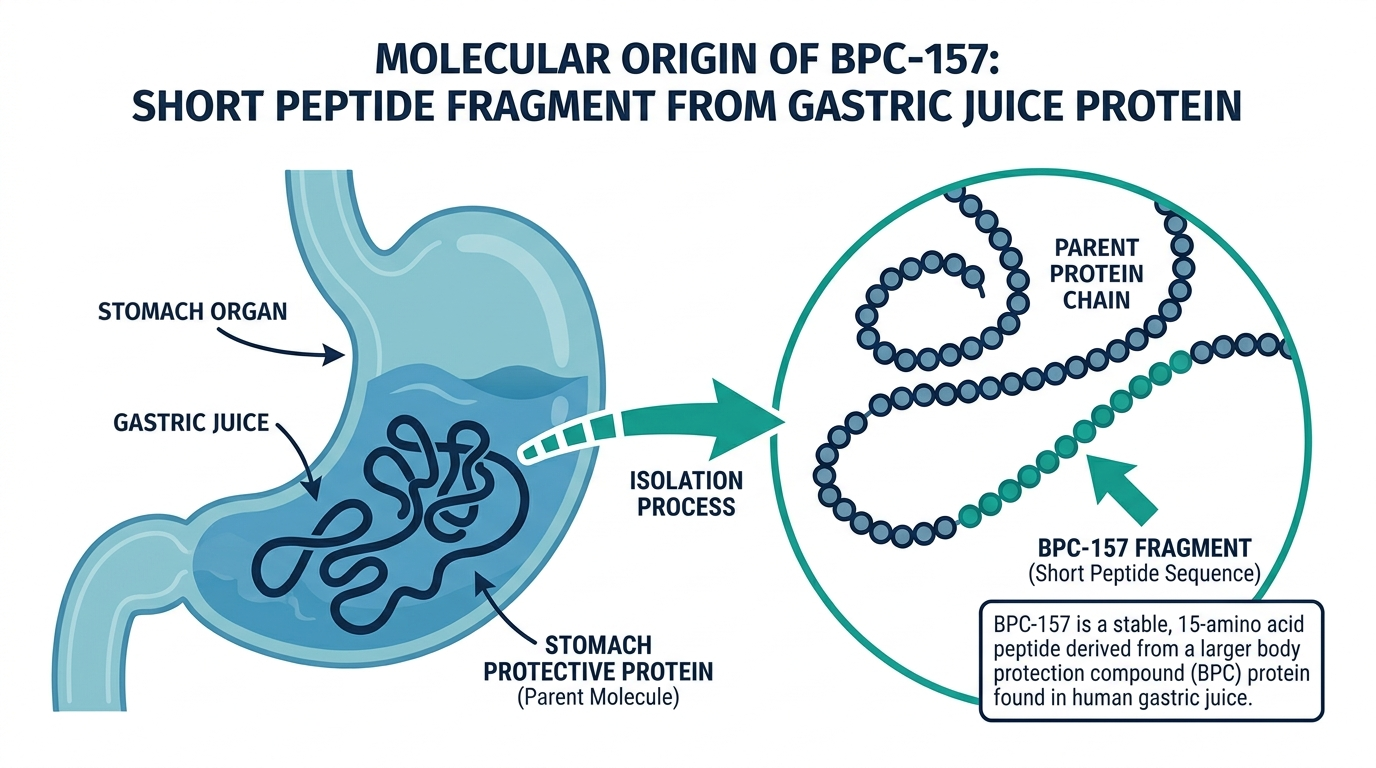
The peptide itself is a string of 15 amino acids: Glycine-Glutamic acid-Proline-Proline-Proline-Glycine-Lysine-Proline-Alanine-Aspartic acid-Aspartic acid-Alanine-Glycine-Leucine-Valine. Written in single-letter code that is GEPPPGKPADDAGLV. It was isolated from a larger protective protein found in human gastric juice, a fluid the stomach naturally secretes.
Critically, this specific 15-amino acid fragment does not exist as a standalone molecule in the body. It is a synthetic excerpt from a larger naturally occurring protein, which is a meaningful distinction: the compound is not “natural” in the sense of simply extracting something your body makes. It is engineered to retain the biological activity of the parent protein in a more stable, researched form.
The molecular weight is approximately 1,419 daltons, which is small by peptide standards. That small size likely contributes to its relatively rapid clearance, with a half-life under 30 minutes in circulation. Yet one of the genuinely puzzling findings across rodent studies is that the therapeutic effects persist far longer than the peptide itself. One spinal cord injury study documented functional improvements maintained for up to 360 days after a single treatment. No one has a clean mechanistic explanation for that duration gap.
Who discovered BPC-157, and why does that history matter?
The story starts in 1975, when a Croatian medical student named Predrag Sikiric developed a theory: the stomach produces extraordinary amounts of acid and digestive enzymes yet rarely destroys itself. Something in gastric fluid must act as a protective compound. He spent the next 15 years collecting gastric juice from hospital gastroenterology clinics, freezing it, and systematically hunting for the protecting molecule.
By 1989, his team at the University of Zagreb had isolated the peptide fragment. Their first landmark paper appeared in 1991, and PLIVA, then Croatia’s largest pharmaceutical company, licensed the compound in 1993. Early rodent studies were promising enough that PLIVA ran a Phase I safety trial. Then GlaxoSmithKline acquired PLIVA in 2006 and quietly shelved the project. Sikiric regained the licensing rights in 2009, and the research has continued from his Zagreb laboratory ever since.
Here is the insider complication that most BPC-157 content glosses over: the amino acid sequence GEPPPGKPADDAGLV has not been found in the human genome. Several researchers, including University of Michigan chemist Anna Mapp who reviewed the original patent, have flagged this as scientifically troubling. Former PLIVA adviser Michael Parnham noted that in some preclinical studies, BPC-157 “barely outperformed an existing drug.” STAT News, which ran a detailed investigation in June 2026, reported that Sikiric’s longtime collaborator Sandor Szabo raised the possibility that the team may have “misinterpreted an amino acid sequence many years ago” when 1980s analytical techniques were less refined.
Personally, I think this history deserves more weight in the public conversation than it gets. The compound’s discoverer is still its primary researcher, 35 years on. No independent laboratory has successfully replicated the full range of effects at scale. That does not make the research fraudulent, but it does make the extraordinary claims circulating on wellness platforms premature.
How does BPC-157 work at the cellular level?
The proposed mechanisms are legitimately interesting, even if they are not yet proven in humans. Four pathways dominate the preclinical literature:
Angiogenesis via VEGFR2 activation. BPC-157 upregulates Vascular Endothelial Growth Factor receptors, stimulating the formation of new blood vessels at injury sites. More blood vessels means more oxygen and nutrient delivery to damaged tissue, which is the likely driver of its tendon and ligament repair effects in rats.
FAK-paxillin pathway signaling. The focal adhesion kinase pathway governs cell migration, the process by which fibroblasts (cells that build connective tissue) move toward injury sites. A 2010 Journal of Applied Physiology study demonstrated that BPC-157 accelerated tendon fibroblast migration dose-dependently and increased cell survival under oxidative stress.
Nitric oxide modulation. BPC-157 appears to act as a contextual nitric oxide regulator, increasing NO in tissues that need vasodilation and decreasing it where excess NO causes oxidative damage. A 2025 paper in PMC journals describes this as BPC-157 “targeting angiogenesis and nitric oxide’s cytotoxic actions” while preserving NO’s protective functions, which is a sophisticated balancing act not typically seen in simpler compounds.
Growth hormone receptor upregulation. Studies show BPC-157 increases GH receptor expression in tendon fibroblasts, which may explain part of its tissue repair effect independent of direct GH secretion. This is not the same as increasing growth hormone itself, a distinction routinely blurred on supplement forums.
None of these mechanisms has been demonstrated in human tissue at therapeutically relevant doses.
What does the animal research actually show?
The breadth of the rodent data is, genuinely, striking. Over 147 published peer-reviewed studies document effects across multiple tissue types:
Tendons and ligaments. Consistent acceleration of repair in severed Achilles tendon models, transected cruciate ligaments, and rotator cuff injuries. The 2010 Journal of Applied Physiology study remains a benchmark: BPC-157-treated tendon explants showed significantly greater outgrowth than controls, and treated cells survived H2O2 (oxidative) stress that killed untreated cells.
Gastrointestinal tract. The most robust area of study, given the compound’s gastric origin. Animal models show accelerated healing of gut fistulas, reduced NSAID-induced stomach lesions, and protection against colitis. This is the area most relevant to the original discovery hypothesis.
Neurological tissue. More recent studies (2024 to 2025) document neuroprotective effects in rodent models of Parkinson’s disease and Alzheimer’s disease-like disturbances, which represents a significant expansion of the research scope beyond tissue repair.
Liver and distant organs. A 2025 study in PMC journals examined protective effects on liver, kidney, and lung in rats with experimental limb ischemia-reperfusion injury, with statistically significant reductions in organ damage markers.
The consistent limitation in every one of these studies: rats. Rodent physiology, wound healing rates, and pharmacokinetics differ substantially from humans, and the translation from rodent model to human outcome has failed for many highly promising preclinical compounds.
How does BPC-157 compare to TB-500?
The two peptides are frequently discussed together in recovery and biohacking circles, and the comparison is instructive because they work on entirely different mechanisms.
| Feature | BPC-157 | TB-500 |
|---|---|---|
| Source | Gastric juice protein fragment | Thymosin Beta-4 fragment |
| Amino acids | 15 | 43 |
| Primary target | Localized tissue (tendon, gut, nerve) | Systemic; binds G-actin in muscle/cardiac cells |
| Key mechanism | Angiogenesis + FAK-paxillin signaling | Actin sequestration, promoting cell migration |
| Best evidence for | Tendon and GI repair (rodents) | Wound healing, cardiac tissue repair (rodents) |
| Half-life | Under 30 minutes | Longer, due to larger molecular weight |
| WADA status | Prohibited (S0 and S2) | Prohibited (S0 and S2) |
| 2026 US legal route | Awaiting PCAC decision, July 23 to 24 | Same regulatory timeline |
| Telehealth stack cost | $400 to $700/month combined | See combined figure |
Do not believe the forum consensus that you must stack both. The logic behind stacking them is reasonable: BPC-157 targets the local repair cascade while TB-500 provides systemic recovery support. But “reasonable logic” and “human clinical evidence” are not the same thing, and no published study has examined the combined stack in humans.
What are the only three human studies?
This is the section that separates informed users from forum readers, and it is worth reading slowly.
Three small human trials have been published with results:
Knee pain (Lee and Padgett, 2021). A retrospective review of 16 patients who received intraarticular BPC-157 injections for chronic knee pain. 14 of 16 reported significant relief, with some maintaining benefit for over six months after a single injection. No control group. Not a randomized controlled trial. The 87.5% response rate is eye-catching, but without a placebo comparison, you cannot separate BPC-157’s effect from the well-documented placebo response in injection procedures for joint pain, which is substantial.
Interstitial cystitis (Lee et al., 2024). 12 participants with moderate to severe interstitial cystitis who had previously failed FDA-approved therapies received intravesicular BPC-157 injections. The study reported 80 to 100% resolution of symptoms at six weeks. No adverse events were observed. Again, no control group.
IV safety and pharmacokinetics (Lee and Burgess, 2025). Two healthy adults received intravenous BPC-157 at doses up to 20 mg, with plasma levels returning to baseline within 24 hours and no adverse events reported. This is a safety signal, not an efficacy study, and two participants is not a sample size that supports strong conclusions.
One active trial, NCT07437547, is recruiting participants for a randomized placebo-controlled study of BPC-157 for acute hamstring strain. That is the kind of rigor the field has lacked, and its results will matter considerably.
The earlier Phase I trial, NCT02637284, was run by PharmaCotherapia in the 2010s and was listed as canceled, with no results ever submitted. That cancellation is the single most important data point most BPC-157 content never mentions.
What is BPC-157’s legal status in June 2026?
Three separate legal realities apply, and confusing them costs people either money or legal exposure:
Research Use Only (current default). BPC-157 is legal to purchase and possess in the US under an RUO (Research Use Only) designation. It is not scheduled under the Controlled Substances Act. Selling it “for laboratory research” is permitted; using it on yourself is where the legal fiction ends.
503A compounding status: thawing. The FDA placed BPC-157 on its Category 2 list in November 2023, barring licensed compounding pharmacies from dispensing it. In April 2026, the FDA removed it from Category 2. On February 27, 2026, HHS Secretary Robert F. Kennedy Jr. announced that BPC-157 and 13 other peptides are expected to return to Category 1 (permitted for compounding) status. The formal PCAC vote is scheduled for July 23 to 24, 2026. If the committee votes yes and the FDA concurs, licensed compounding pharmacies can begin filling prescriptions. That decision is weeks away at time of writing.
Prescription via telehealth (narrow current window). Some telehealth clinics are already prescribing BPC-157 using regulatory frameworks that predate the Category 2 placement, though the landscape is not uniform. If a clinic is advertising injectable BPC-157 with same-day approvals and no required labs, those are red flags, not a green light.
WADA-prohibited for competitive athletes. BPC-157 is banned under WADA’s 2026 Prohibited List in both S0 (Non-Approved Substances) and S2 (Peptide Hormones and Growth Factors) categories. There is no Therapeutic Use Exemption pathway. High-resolution mass spectrometry can now detect metabolites below 1 ng/mL, making “I didn’t know” an increasingly difficult position.
Telehealth GLP-1 program with provider visits and pharmacy coordination.
What does BPC-157 cost in 2026?
Pricing depends entirely on which lane you use:
Grey-market research vials. Lyophilized BPC-157 from research vendors costs roughly $40 to $120 per vial, with typical vials at 5 mg each. That number does not include bacteriostatic water, U-100 insulin syringes, alcohol swabs, or a refrigerator. More importantly, it does not include the cost of verifying purity, because a research vial has no pharmacist, no licensed prescriber, and no accountability chain behind it.
Telehealth clinic, single peptide. A supervised BPC-157 protocol through a licensed clinic typically runs $200 to $600 per month, with initial consultations adding $150 to $400 for the first visit. Some clinics structure it as a per-cycle fee; one clinic in Doral, Florida, quoted $445 for a single peptide cycle as of mid-2026.
BPC-157 plus TB-500 stack. The combined protocol at telehealth clinics runs $400 to $700 per month during an active recovery phase.
None of this is covered by insurance. BPC-157 is not FDA-approved for any indication, and no insurer reimburses off-label experimental peptide therapy regardless of clinical rationale.
What are the realistic risks?
The honest risk profile of BPC-157 is not zero, but it is also not as dramatic as some conservative medical sites suggest. Here is what the published record actually supports:
Known safety signals from animal studies: none significant. The compound has been studied at doses many times higher than common human protocols without producing toxicity in rodents.
Theoretical concern, angiogenesis. The same pathway that makes BPC-157 interesting for healing (new blood vessel formation) raises a theoretical concern about stimulating blood vessel growth in tumors. PMC reviewers in 2025 note that BPC-157 “appears to selectively modulate angiogenesis depending on tissue context” and that some models show inhibition of tumor proliferation, not promotion. This is not settled, and anyone with a cancer history should treat this as a firm contraindication until human evidence exists.
Unknown drug interactions. No pharmacokinetic interaction studies exist in humans.
Supply chain risk on grey-market product. Purity variation in research peptide vials is documented. Independent testing platform Finnrick has graded vendor products across thousands of batches; buying from a vendor without a verifiable, batch-specific third-party COA means no guarantee that the labeled compound is what you are injecting.
Personally, I would not treat the animal-only evidence as sufficient justification for self-injection, and I do not think that position is overly conservative. The known unknowns here are structural, not just gaps that more reading fills.
How is BPC-157 typically administered in research settings?
This section is educational only. No dosing protocol here is a recommendation, and the clinical administration of any peptide should be directed by a licensed physician.
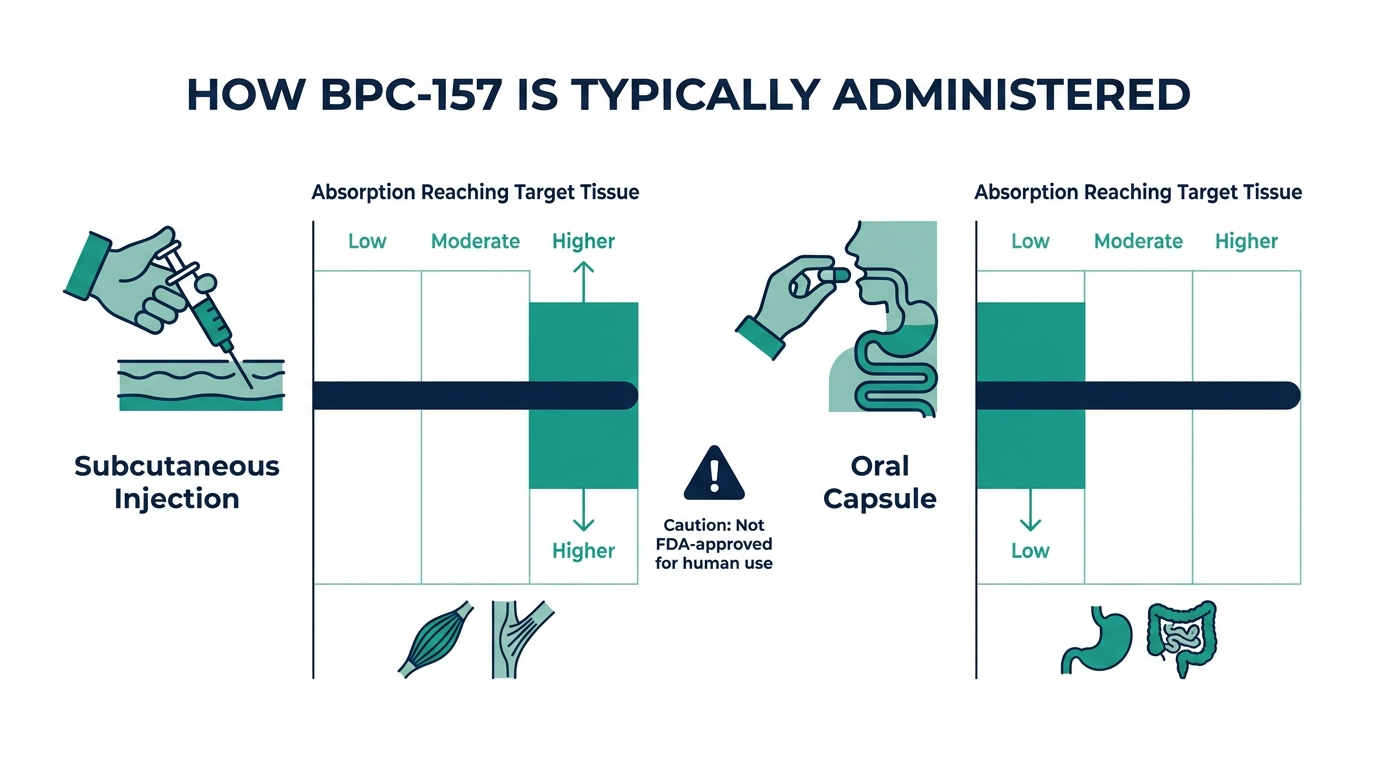
Research protocols use two main routes. Subcutaneous injection is the most common, typically near the injury site in animal studies. Oral administration has also shown efficacy in rodent gut models, which is notable because most peptides are degraded in the gastrointestinal tract before absorption. BPC-157’s stability in gastric acid, likely inherited from its gastric origin, may be the reason oral dosing works in rodents when it fails for most other peptides.
Injectable BPC-157 arrives as a lyophilized (freeze-dried) powder that must be reconstituted with bacteriostatic water before use. This reconstitution step introduces error if not done precisely, and an off-by-one-decimal mistake changes the dose tenfold, not slightly.
The compound is not a topical. There is no credible evidence for transdermal BPC-157 absorption, and any product marketed that way is almost certainly not delivering the compound past the skin barrier.
Curious what your own levels look like?
Baseline 100+ biomarkers today and retest as life changes, all in one membership with physician review.
Frequently asked questions
What is BPC-157 used for?
In preclinical research, BPC-157 has been studied for tendon and ligament repair, gastrointestinal healing, neuroprotection, and reduction of inflammation. No FDA-approved human indication exists. Some telehealth clinics prescribe it off-label for musculoskeletal recovery, but the human evidence base consists of three small, uncontrolled pilot studies.
Is BPC-157 safe?
Animal studies report a favorable safety profile with no significant toxicity at doses many times above research levels. The two-adult IV pharmacokinetics study in 2025 showed no adverse effects. That said, no large-scale human safety data exists, the sequence has not been found in the human genome, and theoretical concerns around angiogenesis in the context of cancer remain unresolved. “No reported adverse effects in small studies” is not the same as a clean safety record.
Is BPC-157 legal in the US in 2026?
It is legal to purchase under a Research Use Only designation. It is not FDA-approved for human use. The FDA removed it from its Category 2 restricted list in April 2026, and a Pharmacy Compounding Advisory Committee review is scheduled for July 23 to 24, 2026, which could open the legal compounding pharmacy route. It is banned under WADA rules for competitive athletes.
How is BPC-157 different from collagen peptides?
Collagen peptides are food-grade protein fragments used as supplements for skin, joint, and gut support. They are taken orally, are fully legal as dietary supplements, and have substantial human clinical evidence. BPC-157 is a specific synthetic research peptide, injectable in most studied protocols, with an entirely different mechanism and regulatory status. Comparing them is like comparing aspirin to an investigational gene therapy.
Why did the FDA restrict BPC-157 in 2023?
The FDA placed BPC-157 on its 503A Category 2 list in November 2023, flagging it for “significant safety concerns.” The specific basis was the absence of US-standard clinical trial data and the compound’s widespread off-label use exceeding its evidence base. The reversal in April 2026 reflects the RFK Jr. HHS position that restricting unapproved compounds pushes users toward unregulated grey-market products without improving safety.
Can athletes use BPC-157?
No. WADA lists BPC-157 as prohibited in both S0 and S2 categories of its 2026 Prohibited List. There is no Therapeutic Use Exemption pathway. Detection technology now identifies BPC-157 metabolites below 1 ng/mL, making accidental ingestion arguments very difficult to sustain.
What happens at the July 2026 FDA hearing?
The Pharmacy Compounding Advisory Committee will review the published evidence on BPC-157 (and six other peptides including TB-500, Semax, and Epitalon), hear from nominators, and vote on whether to recommend adding each to the 503A bulk substances list. A positive vote and subsequent FDA concurrence would allow licensed compounding pharmacies to prepare and dispense BPC-157 with a physician prescription, which is a fundamentally different level of oversight than the current grey-market vials.
Author: Vital Signs Today Editorial Team, [credential]”]. Educational content, not medical advice. Sources linked inline.
Primary sources:
– FDA PCAC July 23-24 2026 meeting calendar
– BPC-157 FDA Category 2 removal, Loti Labs 2026
– Hidden history of BPC-157, STAT News, June 1 2026
– Regeneration or Risk: Narrative Review of BPC-157 for Musculoskeletal Healing, PMC 2025
– From Regeneration to Analgesia: BPC-157 in Tissue Repair, PMC 2025
– Promoting effect of BPC-157 on tendon healing, Journal of Applied Physiology 2010
– BPC-157 enhances GH receptor expression in tendon fibroblasts, PMC 2018
– BPC-157 angiogenesis and nitric oxide, PMC 2025
– Protective effects of BPC-157 on distant organ damage, PMC 2025
– NCT07437547 BPC-157 hamstring strain trial, ClinicalTrials.gov
– USADA BPC-157 prohibited substance notice
– BPC-157 cost guide 2026, PeakedLabs
– BPC-157 vs TB-500 comparison, PeptideDeck 2026
– HHS Secretary RFK Jr. peptide reclassification announcement, AgeMD coverage
Related reading
Vital Signs Today may earn a commission if you buy through links on this page. It does not affect our editorial assessments.