Quick answer: Function Health, Joi, and Blokes all sell lab-based health memberships, but they solve different problems. Function Health runs a broad panel of 100+ biomarkers once or twice a year to find hidden issues across every organ system. Joi (for women) and Blokes (for men) are hormone-focused telehealth platforms: they test sex hormones, thyroid, and a handful of metabolic markers, then prescribe treatment when levels are low. The practical rule is simple: run a full-body panel first, confirm what is actually off, then decide whether targeted hormone therapy is the right next step.
What each service actually does
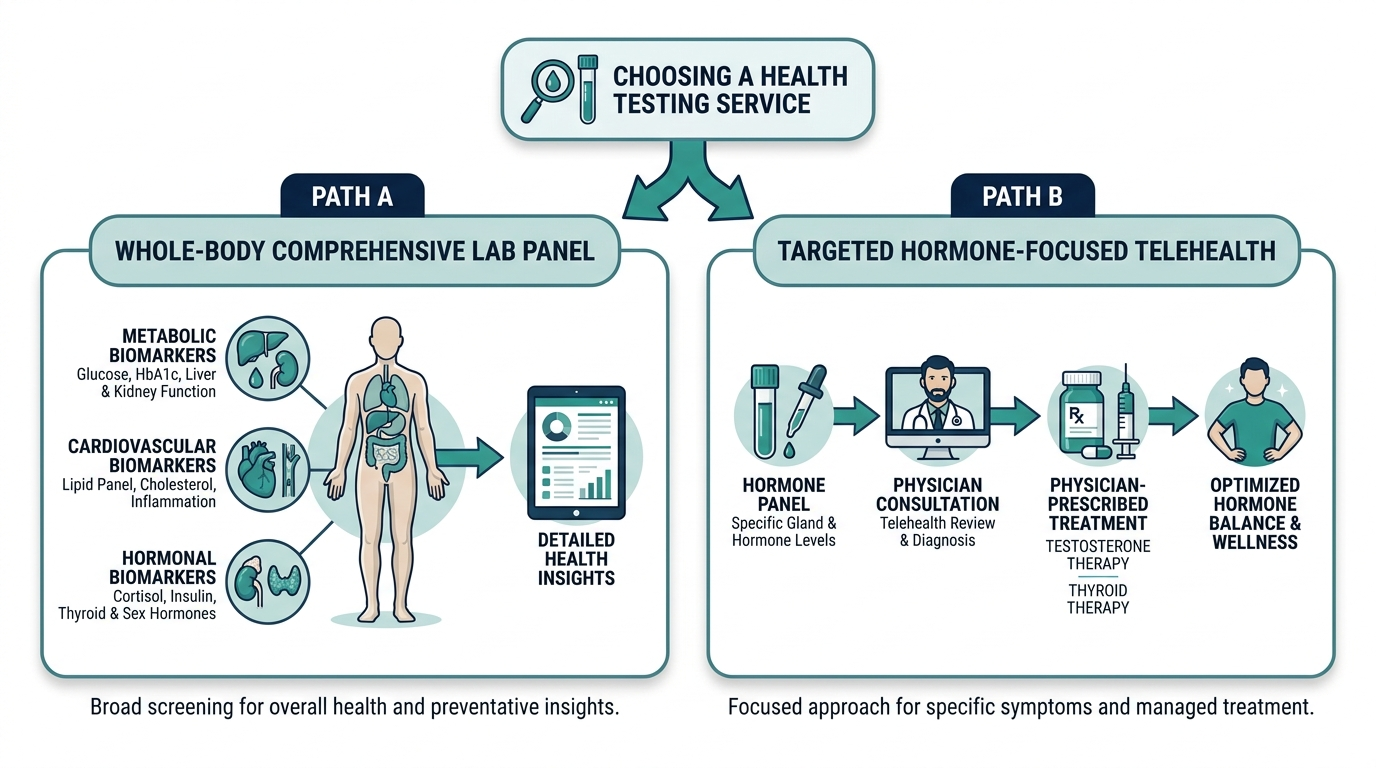
Knowing the category each service fits into saves a lot of confusion. Function Health is a direct-to-consumer lab membership, not a telehealth clinic. You pay a membership fee, get drawn at any Quest or Labcorp location, and receive annotated results plus a doctor review. No prescriptions come out the other side. Joi and Blokes are telehealth clinics first. Labs are part of their intake process, but the end goal is a treatment plan, usually hormone replacement therapy (HRT), testosterone replacement therapy (TRT), or peptide protocols.
Choosing between hormone-focused telehealth and a whole-body lab panel? See how far past sex hormones 100+ biomarkers reaches. One at-home Superpower draw checks 100+ biomarkers, physician-reviewed.
Neither model is wrong. They just sit at different points in the care pathway. A function health review makes clear the service is built for people who want comprehensive baseline data before any intervention. Joi and Blokes are built for people who already suspect a hormone deficiency and want a streamlined path to treatment.
Function Health at a glance
- 100+ biomarkers across lipids, metabolic, thyroid, sex hormones, inflammation, nutrients, organ function, and cancer markers
- Annual membership roughly $499, two draws per year included
- Results reviewed by a physician, but no prescriptions issued
- Unisex, available in most US states
- Blood drawn at existing Quest or Labcorp sites
Joi (women) at a glance
- Hormone panel focused on estradiol, progesterone, testosterone, DHEA-S, FSH, LH, and thyroid
- Telehealth consult included; licensed providers can prescribe HRT, thyroid medications, and GLP-1 agents
- Membership tiers from roughly $99 to $199 per month depending on protocol
- Ships compounded hormones (bioidentical estradiol, progesterone, testosterone) directly
- Available in most US states; lab kit mailed to home or local draw site
Blokes (men) at a glance
- TRT-focused panel: total testosterone, free testosterone, estradiol, SHBG, PSA, hematocrit, LH, FSH, thyroid
- Telehealth consult included; prescribes testosterone cypionate, enanthate, or cream plus ancillaries (anastrozole, HCG)
- Blokes TRT cost runs roughly $149 to $299 per month including medication and monitoring labs
- Quarterly follow-up draws to monitor hematocrit and estradiol on therapy
- Available across most US states
How the lab panels compare side by side
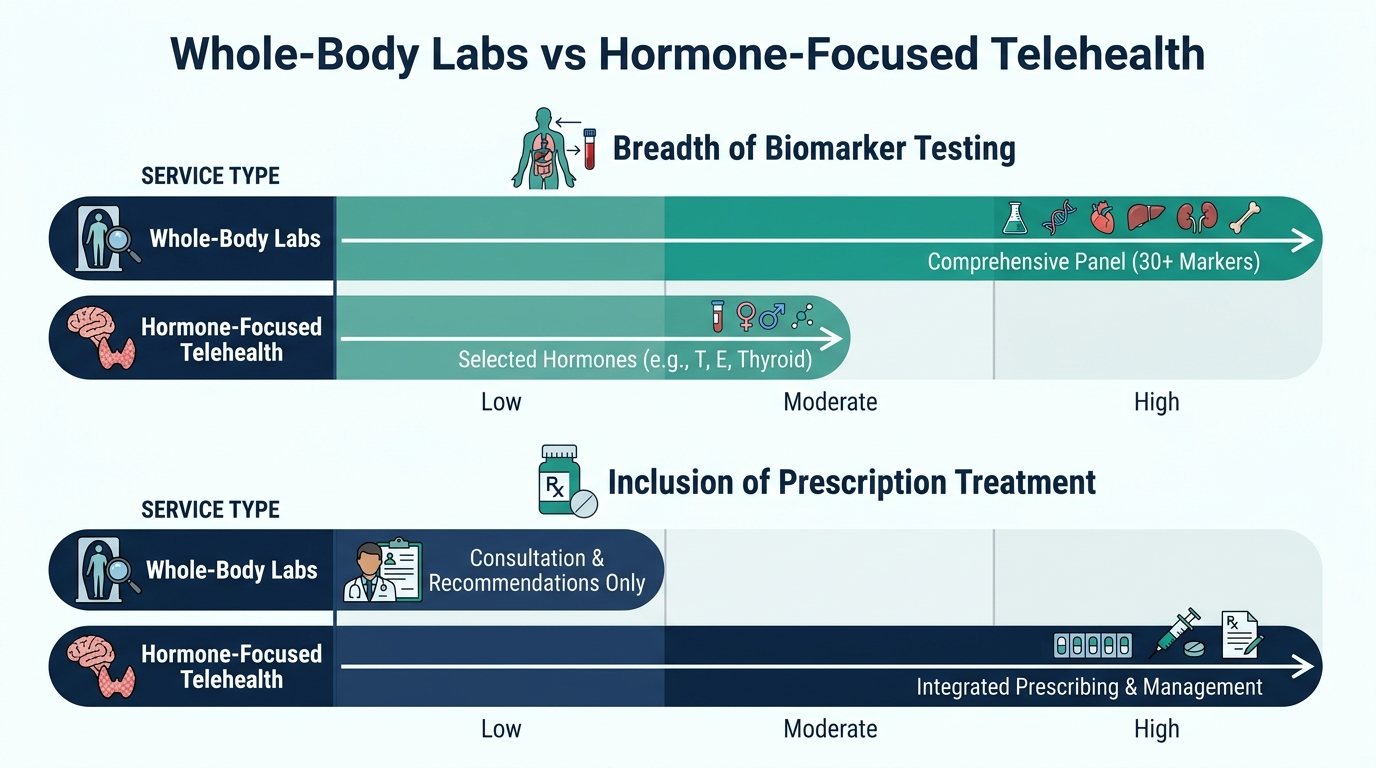
The gap in panel breadth is the most important difference in the function health vs joi and blokes comparison. Function Health casts a wide diagnostic net; Joi and Blokes cast a narrow, targeted one.
| Biomarker category | Function Health | Joi | Blokes |
|---|---|---|---|
| Sex hormones (E2, T, DHEA, SHBG) | Yes | Yes | Yes |
| FSH, LH (pituitary signals) | Yes | Yes | Yes |
| Thyroid (TSH, Free T3, Free T4) | Yes | TSH + Free T4 | TSH only |
| Complete metabolic panel (CMP) | Yes | Partial | Partial |
| Lipids (LDL-P, ApoB, Lp(a)) | Yes, advanced | Standard lipids | Standard lipids |
| HbA1c, fasting insulin | Yes | HbA1c only | HbA1c only |
| Micronutrients (B12, D, ferritin, magnesium) | Yes | Vitamin D only | Vitamin D only |
| Inflammatory markers (hsCRP, homocysteine) | Yes | No | No |
| CBC with differential | Yes | No | Hematocrit only |
| PSA (men) | Yes | N/A | Yes (safety screen) |
| Cancer markers (CEA, AFP, CA-125) | Yes | No | No |
| Prescription pathway | No | Yes | Yes |
Blokes checks PSA as a TRT safety screen, not a cancer workup. Function Health runs a broader PSA alongside multiple other tumor markers, which is a meaningfully different scope. Similarly, Joi’s thyroid panel stops at TSH and Free T4, while Function Health adds Free T3 and often reverse T3, which matters when TSH looks normal but symptoms persist.
Why order matters: broad labs before hormone therapy
Starting hormone therapy without a full metabolic baseline is a common and avoidable mistake. Here is the clinical logic behind running a comprehensive panel first.
Low testosterone in a man can come from primary hypogonadism (the testes are the problem), secondary hypogonadism (the pituitary is not signaling), obesity-driven aromatization, insulin resistance, sleep apnea, or iron overload. TRT treats the symptom in all of these cases, but it does not fix the root cause in most of them. If Blokes finds low T and starts therapy without ruling out hemochromatosis, the testosterone may improve but ferritin continues climbing toward liver damage. Function Health’s panel would have flagged the ferritin.
The same logic applies to women. Joi hormone therapy targets estradiol and progesterone, but perimenopausal fatigue, brain fog, and irregular cycles can also come from subclinical hypothyroidism (missed if only TSH is checked), vitamin D deficiency below 20 ng/mL, or insulin resistance. Treating hormones while these remain uncorrected produces partial results at best.
Clinicians who run concierge preventive panels will tell you: the surprises are almost never in the hormones. They show up in ApoB, Lp(a), hsCRP, ferritin, and fasting insulin, markers that Joi and Blokes do not routinely run. If you are comparing hormone telehealth vs full body labs purely on cost, you may be framing the wrong question.
Cost comparison: what you actually pay in 2026
Pricing across these services is structured so differently that a direct comparison requires breaking it into what the dollar buys, not just the annual total.
| Service | Upfront or monthly cost | What is included | Prescription access |
|---|---|---|---|
| Function Health | ~$499/year | 100+ biomarkers x2 draws, physician review, longitudinal tracking | No |
| Joi (entry tier) | ~$99 to $149/month | Hormone panel, consult, HRT prescription, compounded medication | Yes |
| Joi (comprehensive) | ~$199/month | As above plus GLP-1, peptides, expanded labs | Yes |
| Blokes (monitoring only) | ~$99/month | Quarterly labs, provider check-ins, no medication | No (monitoring) |
| Blokes (TRT protocol) | ~$149 to $299/month | Quarterly labs, consult, testosterone + ancillaries shipped | Yes |
Run the math: Blokes TRT cost at $199 per month is $2,388 per year. Function Health at $499 per year is a different spend entirely, covering different ground. If you use both (labs first, then TRT), the combined annual cost lands roughly $2,800 to $3,000, which is still less than many traditional endocrinology practices after insurance co-pays and the cost of separate lab orders. For context on what Function Health charges in detail, see our function health cost breakdown.
HSA and FSA dollars can typically cover lab fees and telehealth consults at both types of services, though you should confirm with your plan administrator since coverage rules vary by account type and state.

What Function Health misses that Joi and Blokes provide
Function Health is not a clinical service. That is a feature for some people and a limitation for others. If your labs come back showing low free testosterone at 8 pg/mL or estradiol at 18 pg/mL on day 3 of your cycle, Function Health will annotate those results and recommend you follow up with a provider. It will not write a prescription or ship you anything.
Joi and Blokes handle the full loop: diagnose, treat, monitor, adjust. For someone who already knows they want hormone optimization and just needs access to a licensed provider who will actually prescribe it, the Joi or Blokes model is faster and often cheaper than navigating to an endocrinologist with a 6-week wait and a primary care physician who considers a total testosterone of 300 ng/dL within the normal range.
Blokes in particular has built a reputation for being willing to treat men whose testosterone sits in the low-normal zone (roughly 300 to 400 ng/dL) when symptoms are present, which is a stance many conventional practices will not take. Joi similarly works with women in perimenopause whose estradiol is technically within the lab reference range but clinically suboptimal.
What Joi and Blokes miss that Function Health catches
The case for running a broad panel before (or alongside) hormone therapy is strongest in three groups.
Men starting TRT: Testosterone replacement raises hematocrit, which increases clotting risk. If a man has undiagnosed polycythemia vera (a bone marrow disorder that already elevates red cell mass), starting TRT can be dangerous. Blokes monitors hematocrit quarterly on therapy, but it does not screen for the underlying condition beforehand. A CBC with differential and erythropoietin level, available in Function Health’s panel, would surface that risk before the first injection.
Women starting HRT: Cardiovascular risk stratification matters before initiating hormone therapy in women over 45. Lp(a), ApoB, and hsCRP change the calculus on whether oral estrogen is appropriate. Joi does not routinely run these. A woman with Lp(a) above 100 nmol/L starting oral estradiol without knowing her baseline cardiac risk is making an uninformed bet.
Anyone with fatigue, brain fog, or weight gain: These are the most common symptoms that drive people toward hormone telehealth. They are also the symptoms of iron deficiency, B12 deficiency, subclinical hypothyroidism, insulin resistance, and vitamin D deficiency below 20 ng/mL. Function Health checks all of these. Treating low testosterone while ferritin sits at 9 ng/mL is like inflating one tire while the other three are flat.
The simplest way to actually get this done
Superpower is a full-body lab membership that runs 100+ biomarkers, has each result reviewed by a doctor, and tracks your numbers year over year (about $199/year). It is what we point readers to when they would rather get one clean, complete draw than chase single tests one at a time. Here is superpower blood test reviewed in full.
Head-to-head: who should pick which service
The function health vs joi and blokes question has a clean answer once you define what problem you are trying to solve.
| Situation | Best starting point |
|---|---|
| You want a complete health picture, no symptoms guiding you | Function Health or Superpower |
| You have fatigue, low libido, brain fog, weight gain, want to rule everything out | Full-body panel first (Function Health, Superpower) |
| Your labs already confirm low testosterone and you want treatment fast | Blokes |
| You are in perimenopause, confirmed by labs, and want HRT | Joi |
| You want both broad screening AND hormone treatment | Function Health for labs, Blokes or Joi for treatment |
| You are on TRT and need monitoring but already have a doctor | Function Health or Blokes monitoring tier |
| You want one service to handle everything including prescriptions | Joi or Blokes (accept the narrower panel as a trade-off) |
For people who want to compare Function Health against other broad-panel services before committing, our piece on function health vs empirical health and function health vs 10x health cover the other major competitors in that space.
Joi blokes review: what real users report
User feedback on Joi and Blokes follows a consistent pattern. The people most satisfied are those who had already confirmed low hormone levels through another lab test and simply wanted a convenient, willing prescriber. The friction points cluster around three areas.
First, compounded medications. Both platforms ship bioidentical or compounded hormones, which are not FDA-approved in the same way as brand-name drugs. Most compounded testosterone and estradiol from reputable 503B outsourcing facilities is clinically interchangeable, but some users report inconsistent potency across refill batches, which matters when you are titrating a hormone protocol to a specific target range.
Second, monitoring depth. Blokes monitors hematocrit, PSA, and a hormone panel quarterly on TRT. It does not routinely check sleep apnea risk, erythropoietin, or advanced lipids. Users who wanted deeper tracking often ended up supplementing with an independent lab order or adding a separate service.
Third, provider continuity. Telehealth platforms rotate providers. Several Blokes and Joi users noted that their protocol adjustments felt inconsistent when a different clinician reviewed their follow-up labs compared to the one who started their protocol. This is a structural limitation of asynchronous telehealth, not unique to these two companies.
The people most frustrated with Joi and Blokes are typically those who entered with vague symptoms and found that a narrow hormone panel could not explain their presentation. If your fatigue is from ferritin at 11 ng/mL, a Joi consult will not find it. Talk to a clinician about your results if symptoms persist despite normal hormone levels, since micronutrient deficiencies and metabolic disorders require a different workup.
How to run both services without wasting money
The most efficient sequence if you want the broadest picture and the fastest path to treatment is straightforward. Do the full-body draw first through Function Health or a comparable service like Superpower, which runs at roughly $199 per year. Wait for annotated results, which typically arrive within 5 to 7 business days. Then bring those results to a Joi or Blokes intake consult.
Practically, this speeds up the hormone telehealth intake considerably. Joi and Blokes both ask for recent labs at signup. If you arrive with a complete Function Health report showing estradiol, progesterone, FSH, LH, SHBG, free testosterone, TSH, Free T4, and a CBC already run within the last 90 days, many providers will accept those results and skip the repeat draw or reduce it to a confirmation panel of two or three markers. That saves you a lab fee and two weeks of waiting.
The combined annual cost (Function Health at $499 plus Blokes TRT at $149 to $299 per month) is real money. But for most people who land on this comparison, the alternative is a six-week primary care wait, a referral to endocrinology with another eight-week wait, and a provider who may be unwilling to treat borderline levels. The telehealth pathway, when preceded by solid lab data, is faster and often produces better outcomes because the clinician is starting from a complete picture rather than a narrow hormone snapshot.
How to read your own hormone numbers before you sign up
You do not need to wait for a telehealth provider to make sense of a hormone panel. Knowing the standard reference ranges tells you in advance whether a service like Blokes or Joi is even likely to offer you treatment, and it protects you from being upsold a protocol you do not need.
For men, the widely cited harmonized reference range for total testosterone in healthy nonobese men aged 19 to 39 is 264 to 916 ng/dL, established from four large cohort studies in the United States and Europe. That is the number most quality labs anchor to. The catch is that this range flattens age differences. Testosterone declines roughly 1 to 2 percent per year after age 30, so a total testosterone of 350 ng/dL might sit inside the printed range yet be genuinely low for a 32-year-old man with symptoms. This is precisely the gray zone where Blokes will often treat and a conventional primary care office will not.
Free testosterone matters more than total when SHBG is high or low. If your total testosterone reads normal but you feel every symptom of deficiency, look at free testosterone and SHBG together. High SHBG binds testosterone and lowers the free fraction, which is why a man can have a total of 500 ng/dL and still function like someone much lower.
For women, there is no single tidy range because estradiol swings dramatically across the menstrual cycle. In premenopausal women, estradiol can run from roughly 30 pg/mL in the early follicular phase to well over 200 pg/mL at ovulation. After menopause it typically falls below 30 pg/mL. This is why the day of your cycle when blood is drawn changes the interpretation completely, and why a single random estradiol value is nearly meaningless without knowing where you are in your cycle.

Timing and prep: how to avoid a misleading draw
Hormone results are unusually sensitive to when and how the blood is collected. A sloppy draw can send you down a treatment path you did not need, or hide a real deficiency. A few rules apply across both Function Health and the telehealth intakes.
- Draw testosterone in the morning. Testosterone peaks in the early morning and drifts down through the day. Most guidelines call for a sample between 7 and 10 a.m. An afternoon draw can read 20 to 25 percent lower and falsely suggest deficiency.
- Fast for the metabolic markers. Fasting insulin, glucose, and the lipid panel need 9 to 12 hours without food. Sex hormones themselves do not strictly require fasting, but since a full-body draw bundles everything into one appointment, fasting is the safe default.
- Time the female panel to your cycle. For a fertility or perimenopause workup, FSH, LH, and estradiol are often drawn on day 2 or 3 of the cycle. Progesterone to confirm ovulation is drawn about 7 days before the expected period. A random draw scrambles all three.
- Flag your supplements and medications. Biotin (common in hair and nail supplements) can interfere with immunoassay-based hormone tests and skew thyroid results in particular. Stop high-dose biotin 48 to 72 hours before a draw. Exogenous DHEA, pregnenolone, and even topical hormone creams can distort a baseline reading.
- Avoid drawing during acute illness or after heavy exercise. A recent hard workout, fever, or poor sleep the night before can transiently suppress testosterone and elevate cortisol, muddying the picture.
Because Function Health draws at a Quest or Labcorp site, you control the timing directly. With mail-in finger-prick kits used by some telehealth intakes, you self-collect, so discipline on timing falls entirely on you. If you want the cleanest baseline, a morning venous draw beats a mid-afternoon home kit almost every time.
Common mistakes people make choosing between these services
The comparison trips up predictably, and the same errors show up again and again in user forums and clinic intake notes.
Mistake 1: Treating the printed reference range as a diagnosis. A result inside the reference range is not automatically healthy, and a result slightly outside is not automatically a disease. Ranges describe the middle 95 percent of a reference population, not an optimal target. A testosterone of 300 ng/dL is technically in range and clinically low for a symptomatic 35-year-old.
Mistake 2: Buying a treatment membership before confirming the deficiency. Signing up for a monthly TRT or HRT plan before you have a clean, correctly timed lab draw locks you into a recurring charge for a problem you have not verified. Run the labs first, confirm the number is genuinely low on a proper morning draw, then commit.
Mistake 3: Ignoring the markers that explain the symptoms. Fatigue, low libido, and brain fog push people toward hormone platforms, but those same symptoms come from iron deficiency, low vitamin D, subclinical hypothyroidism, and insulin resistance. A narrow hormone panel cannot see these. This is the core reason a broad baseline draw belongs first in the sequence.
Mistake 4: Assuming compounded equals inferior, or that brand-name equals safer. Compounded bioidentical hormones from reputable 503B facilities are clinically appropriate for many patients. The real variable is consistency of potency across refills, which you manage by rechecking levels after a batch change, not by avoiding compounding altogether.
A realistic monitoring schedule once you start therapy
If you do proceed to hormone therapy through Joi or Blokes, the monitoring cadence is where a broad-panel service keeps paying off. Here is a sensible year-one schedule that combines what the telehealth platforms track with what they tend to miss.
| Timepoint | What to check | Why |
|---|---|---|
| Baseline (before therapy) | Full panel: hormones, CBC, ferritin, hsCRP, ApoB, Lp(a), fasting insulin, thyroid | Establishes the complete picture and rules out hidden drivers |
| Week 6 to 8 | Total and free testosterone (men) or estradiol and progesterone (women), estradiol on TRT | Confirms the dose is reaching target before it stabilizes |
| Month 3 | Hematocrit and hemoglobin (men on TRT), hormone levels, symptom review | TRT raises red cell mass; catch rising hematocrit early |
| Month 6 | Full hormone panel, PSA (men), lipid check | Mid-year recalibration of dose and safety markers |
| Month 12 | Repeat the full baseline panel | Confirms nothing new has drifted and treatment is still on target |
Blokes and Joi generally cover the hormone and safety markers on this list at quarterly intervals. What they do not routinely repeat are the metabolic and cardiovascular markers, which is why many people on long-term therapy keep an annual broad-panel membership running in parallel. The broad panel is the safety net; the telehealth platform is the prescriber and dose manager.
Turn what you just learned into action.
Superpower lets you test 100+ biomarkers from home, then re-check them over time so you can actually see progress, physician-reviewed at every step.
FAQ
Can I use Function Health instead of Joi or Blokes?
Not directly. Function Health gives you comprehensive lab data but does not prescribe treatment. If your results show hormone deficiency, you will still need a licensed prescriber, which is exactly what Joi (for women) and Blokes (for men) provide. Think of them as sequential steps rather than competing alternatives: run broad labs first, then connect with a telehealth prescriber if treatment is warranted.
Does Blokes check testosterone levels before prescribing TRT?
Yes. Blokes requires an intake lab panel that includes total testosterone, free testosterone, estradiol, SHBG, LH, FSH, PSA, hematocrit, and a basic metabolic profile before initiating any TRT protocol. They will not prescribe based on symptoms alone. The panel is typically mailed to your home as a finger-prick kit or ordered to a local draw site.
Is Joi hormone therapy the same as traditional HRT from a gynecologist?
The hormones are similar, but the delivery differs. Joi primarily uses compounded bioidentical hormones (estradiol, progesterone, testosterone cream), which are not FDA-approved as finished drugs the way Vivelle-Dot or Prometrium are. Compounded hormones from 503B facilities are generally considered clinically equivalent for most patients, but if you have a complex medical history, breast cancer risk factors, or prior thrombotic events, a specialist in person may be more appropriate than a telehealth platform.
Can women use Blokes or men use Joi?
Blokes is men-only by design. Joi is women-only. The parent company (Joi and Blokes share ownership) intentionally split the brands by sex to tailor the clinical protocols and provider expertise. There is no co-ed version of either service. Function Health is unisex and tests all relevant sex hormones for both men and women.
What does Blokes TRT cost per month all-in?
Expect $149 to $299 per month depending on the protocol. The base tier covers testosterone (cypionate or enanthate), quarterly monitoring labs, and asynchronous provider access. The higher tiers add HCG to maintain testicular function and fertility, anastrozole for estradiol management, and more frequent lab checks. Shipping compounded medication is included in most tiers. Annual total lands roughly $1,800 to $3,600.
Does Function Health test all the same hormones as Joi and Blokes?
Yes, and more. Function Health tests estradiol, progesterone, testosterone (total and free), SHBG, DHEA-S, LH, FSH, and a full thyroid panel (TSH, Free T3, Free T4) as part of its standard draw. Joi typically covers estradiol, progesterone, testosterone, DHEA-S, FSH, LH, and TSH plus Free T4. Blokes covers total testosterone, free testosterone, estradiol, SHBG, LH, FSH, and TSH. Function Health’s panel is broader on thyroid and adds micronutrients, inflammatory markers, and advanced lipids that neither Joi nor Blokes run routinely.
Is Joi or Blokes covered by insurance?
Neither Joi nor Blokes accepts traditional insurance for the membership or medication cost. Lab fees may occasionally be submitted to insurance depending on your plan and state, but the compounded hormones are cash-pay. HSA and FSA dollars are generally accepted for both the telehealth consults and lab fees. Function Health similarly does not bill insurance for its membership, and its lab panel is structured as a bundled cash-pay service rather than individual CPT-coded draws.
How does Function Health compare to Superpower for a broad baseline draw?
Both run 100+ biomarkers and include physician review of results. The key structural difference is price: Superpower runs about $199 per year versus Function Health at roughly $499 per year. Superpower uses Labcorp for draws; Function Health uses both Quest and Labcorp depending on location. For a detailed side-by-side, our superpower blood test review covers the marker list, turnaround, and clinical quality in full.
Vital Signs Today may earn a commission if you buy through links on this page. It does not affect our editorial assessments.