
- The single most effective way to lower GGT is stopping or sharply cutting alcohol, because GGT has a half-life of about 14 to 26 days and often falls by half within 2 to 3 weeks and can normalize within 4 to 8 weeks of abstinence.
- For non-alcohol causes, losing 5 to 10 percent of body weight, treating fatty liver, and drinking 3 or more cups of coffee daily are each linked to lower GGT, since most chronically elevated GGT in adults reflects metabolic fat in the liver rather than drinking.
- A GGT above your lab’s reference range (commonly 5 to 40 U/L per Cleveland Clinic) needs a doctor’s review with ALP and other liver enzymes to find the cause, because GGT itself does not diagnose a specific disease.
Gamma-glutamyl transferase (GGT) is one of the most sensitive markers of liver and bile-duct stress on a standard blood panel. The good news is that for most people, a high GGT is reversible. This guide walks through what counts as high, why it matters, and the evidence-based steps that actually move the number, starting with the changes that work fastest.
Part of our Liver Function Tests guide.
Cutting alcohol can normalize GGT in weeks, so do you know how high your liver enzyme actually is? One at-home Superpower draw checks 100+ biomarkers, physician-reviewed.
What counts as high GGT?
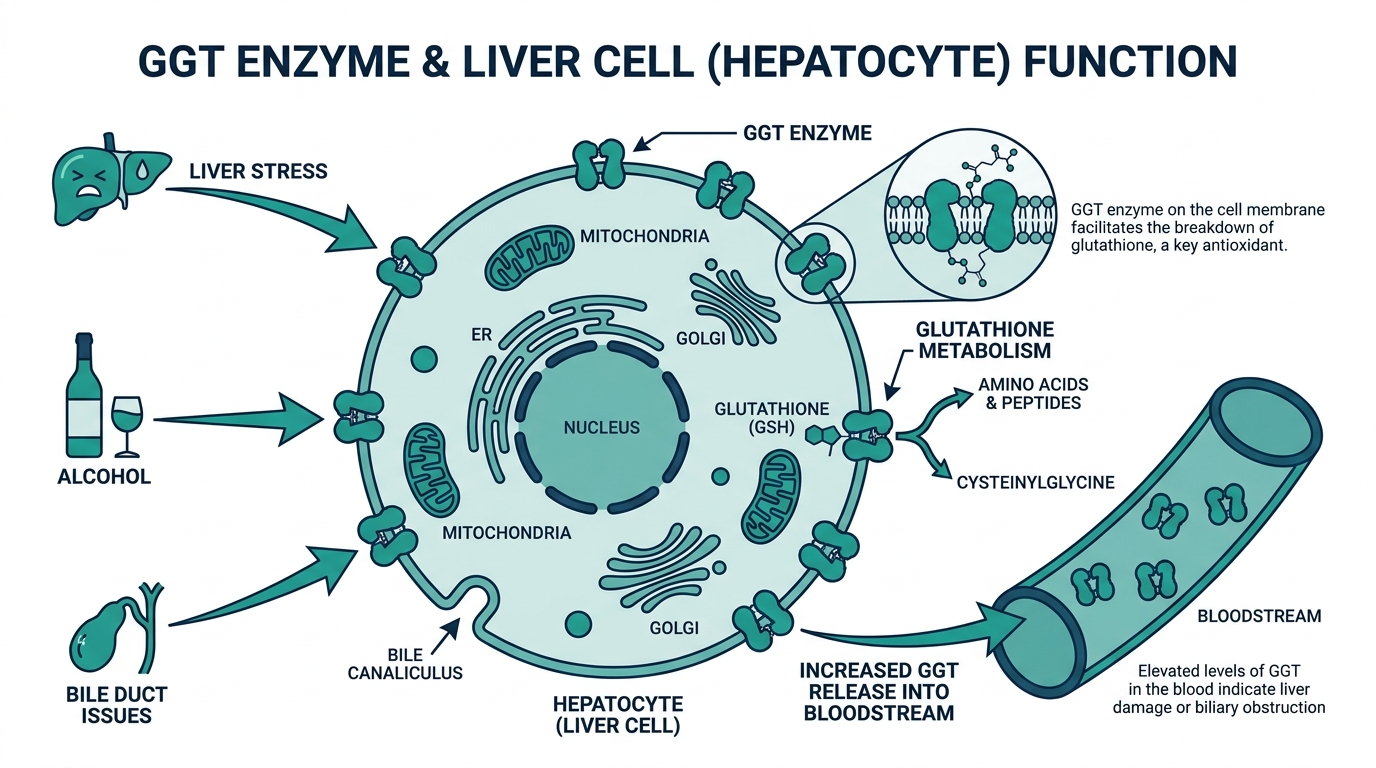
A high GGT is any result above your laboratory’s reference range, which is commonly listed as 5 to 40 U/L for adults according to Cleveland Clinic. Ranges vary by lab and sex. Men and people assigned male at birth tend to run higher, so some labs use roughly 8 to 61 U/L for men and 6 to 42 U/L for women.
Always read your own report, because the printed reference interval is what your result is judged against. A result a few points over the top of the range is mildly elevated and often metabolic. Levels that are several times the upper limit point more strongly toward bile-flow problems or significant liver injury and deserve prompt evaluation.
- Borderline or mild: just above the upper limit, frequently linked to weight, fatty liver, or alcohol.
- Markedly high: two to ten or more times the upper limit, which warrants imaging and a clinician’s workup.
Optimal versus standard reference ranges
The reference range on your report is a statistical band, not a health target. It is built from a reference population, so the top of the range simply marks where the highest few percent of that group sat, not the point where liver stress begins. Many clinicians who focus on prevention prefer to see GGT comfortably inside the lower half of the range rather than hugging the ceiling, because GGT tends to climb quietly with liver fat and insulin resistance long before it crosses the official cutoff. A result of 45 U/L and a result of 12 U/L can both look acceptable on paper if the lab flags only values above 40, yet they describe very different livers.
Age and sex shift the picture too. GGT tends to rise slowly across adulthood, and men usually run higher than women, which is why some labs print separate columns. Body weight and recent alcohol within the past week can nudge the number as well. Because of all this, a single reading tells you less than the direction of travel. Two or three results over several months are far more informative than one snapshot, and that trend is what you are really trying to move.
Why lower it?
The simplest way to actually get this done
Superpower is a full-body lab membership that runs 100+ biomarkers, has each result reviewed by a doctor, and tracks your numbers year over year (about $199/year). It is what we point readers to when they would rather get one clean, complete draw than chase single tests one at a time. Here is superpower reviewed in full.
You want to lower GGT because a persistently raised level is one of the earliest signals of liver fat, oxidative stress, and bile-duct strain, and it tracks with broader health risk. Elevated GGT is associated with metabolic syndrome and subclinical inflammation independent of other cardiometabolic risk factors, as shown in a cross-sectional study indexed in PMC (NCBI).
GGT is not a disease in itself. Think of it as a smoke detector for the liver and bile system. A high reading means something is irritating those tissues, most often fat accumulation, alcohol, or a medication. Bringing the number down usually means you have removed or reduced that underlying stressor, which is the real goal. Lowering GGT is therefore a proxy for improving liver health, not just a cosmetic lab fix.
What actually raises GGT?
GGT sits on the surface of liver and bile-duct cells and leaks into the blood when those cells are irritated or when bile flow is impaired. It is the most sensitive liver enzyme on a routine panel, which is both a strength and a weakness. It picks up trouble early, but it rises for so many reasons that the number alone rarely names the cause. Knowing the usual suspects helps you and your doctor read it correctly.
The metabolic and alcohol causes
For most adults with a mildly high GGT, the answer is metabolic. Fat stored inside liver cells, the condition now called metabolic dysfunction associated steatotic liver disease, drives low-grade inflammation that pushes GGT up. This is why GGT tracks so closely with waist size, triglycerides, blood sugar, and blood pressure. Alcohol is the other heavy hitter. It induces the enzyme directly, so even without visible liver damage, regular drinking lifts GGT, and heavy drinking lifts it a lot. The two causes often overlap in the same person, which is why the fastest results come from addressing both at once.
Medications, bile flow, and other triggers
A long list of medicines raises GGT because they switch on the liver’s drug-processing machinery. Anti-seizure drugs such as phenytoin and carbamazepine, barbiturates, and some others are classic examples, and several over-the-counter supplements marketed for liver or muscle support can do the same. This is exactly why a clinician reviews everything you take before reading the result. Anything that blocks bile flow, from gallstones to a narrowed duct, sends GGT and alkaline phosphatase up together. Less commonly, heart failure that congests the liver, an overactive thyroid, and smoking are linked to higher readings. None of these can be sorted out from the GGT figure by itself, which is the whole point of pairing it with the rest of the panel.
Why GGT is read next to ALP
The single most useful thing GGT does is explain a high alkaline phosphatase. ALP comes from both liver and bone, so on its own a raised ALP is ambiguous. If GGT is high at the same time, the source is almost certainly the liver or bile ducts. If ALP is high but GGT is normal, attention shifts to bone, growth, or pregnancy instead. That pairing is a large part of why the marker is on the panel at all. GGT also helps flag alcohol as a driver when it is elevated out of proportion to ALT and AST. Reading these enzymes as a group, rather than one line at a time, is how clinicians turn a vague high number into a working answer.
Evidence-based ways to lower GGT
The most effective way to lower GGT is to address its cause, and the highest-yield levers are alcohol, body weight, and metabolic health. With full alcohol abstinence, GGT can fall by half within 2 to 3 weeks and normalize within 4 to 8 weeks, reflecting its half-life of roughly 14 to 26 days.
Diet and drink changes
Diet works on GGT mainly by reducing liver fat and oxidative load. The clearest wins come from cutting alcohol and added sugar while increasing coffee and antioxidant-rich foods.
- Cut or stop alcohol: this is the fastest lever. Because GGT’s half-life is about 14 to 26 days, abstinence can halve the value in 2 to 3 weeks and normalize it in 4 to 8 weeks.
- Drink coffee: intake of 3 or more cups per day is associated with lower liver enzymes including GGT in epidemiological studies summarized by PMC (NCBI). Black or unsweetened is best.
- Reduce added sugar and refined carbs: sugary drinks and ultra-processed foods drive liver fat, the most common cause of mildly high GGT.
- Eat more plants: vegetables, fruit, fiber, and healthy fats support antioxidant defenses that GGT depletion reflects.
Lifestyle changes
Lifestyle changes lower GGT chiefly by shrinking fatty liver and improving insulin sensitivity. Losing 5 to 10 percent of body weight is a widely cited threshold for meaningful reductions in liver fat and liver enzymes.
- Lose excess weight gradually: a 5 to 10 percent reduction often lowers GGT and other liver markers; crash diets can temporarily worsen them.
- Move regularly: aim for the standard 150 minutes per week of moderate activity to burn liver fat.
- Sleep and stress: poor sleep and chronic stress worsen metabolic risk that feeds into liver fat.
Medical options
Medical options target the disease behind a high GGT rather than the number directly, so they start with finding the cause. Because medications and supplements are themselves a common reason for raised GGT, a clinician will review every product you take before recommending changes.
- Treat the underlying condition: managing fatty liver, diabetes, high triglycerides, or hepatitis often brings GGT down over months.
- Review medications: several drugs and supplements raise GGT; never stop a prescribed medicine without your prescriber’s guidance.
- Relieve bile obstruction: if GGT and alkaline phosphatase are both high, imaging may find a blockage that needs specific treatment.
What a realistic plan looks like
Consider a common case. A 44-year-old with a GGT of 78 U/L, a slightly high ALT, and a widening waistline, who drinks a few beers most evenings. The highest-yield move is not a supplement, it is the alcohol. Cutting it out for eight weeks alone often drops a reading like this substantially, because the enzyme’s half-life means the blood level falls steadily once the trigger is gone. Layering in a 5 to 10 percent weight loss, a daily walk, less added sugar, and two or three cups of black coffee addresses the fatty liver underneath. A recheck at eight to twelve weeks then shows whether the plan is working, and if the number has barely moved, that itself is useful information that sends you and your doctor looking harder for another cause.
The order matters. People often reach first for milk thistle or a liver detox tea and skip the alcohol and sugar that are doing the damage. Fix the biggest input first, give it enough weeks to register, and only then judge whether smaller levers are needed.
How fast can it change?
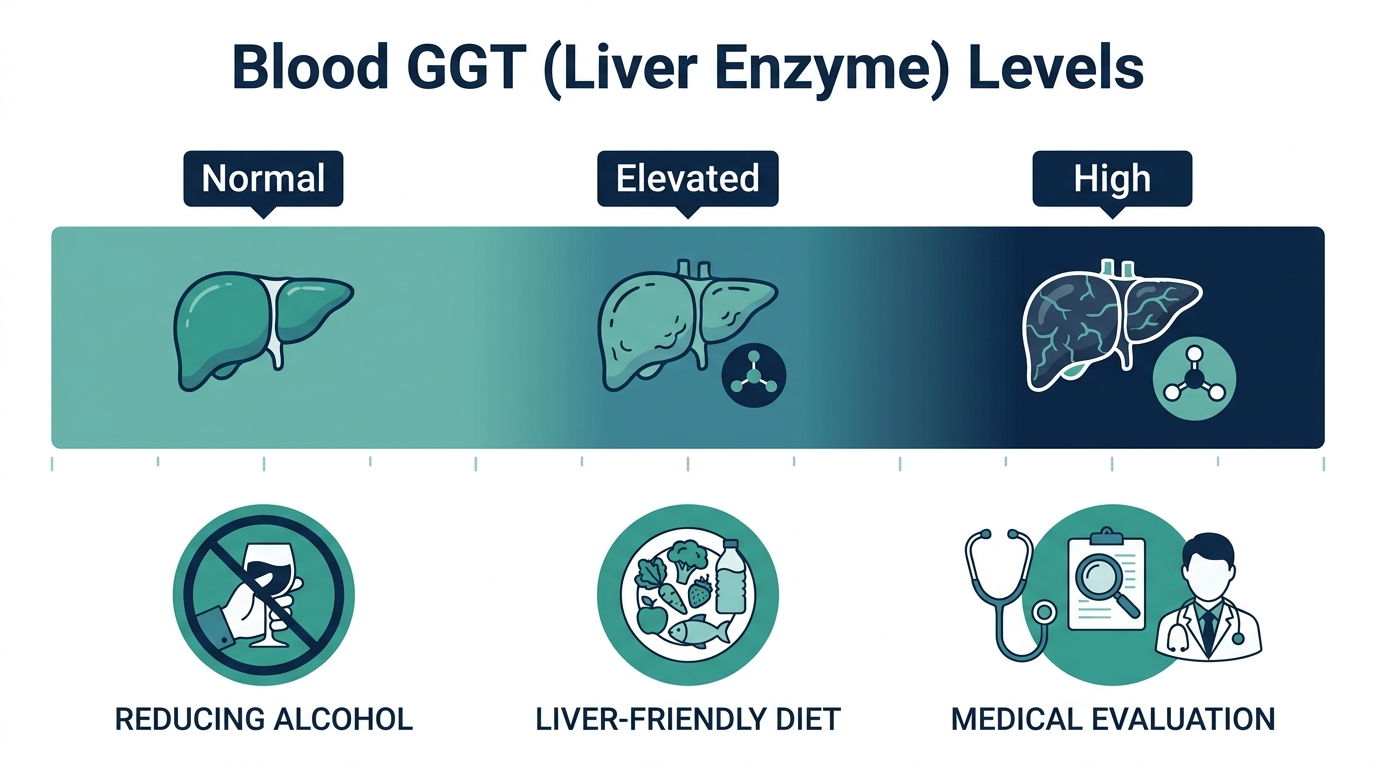
GGT can change meaningfully within weeks once you remove the cause, but it is not instant. With complete alcohol abstinence, levels can drop significantly within 2 to 4 weeks and typically normalize within 4 to 8 weeks, driven by a half-life of roughly 14 to 26 days.
For metabolic causes the timeline is slower and tied to fat loss. Expect to recheck after about 6 to 12 weeks of consistent weight loss, exercise, and diet changes, since liver fat takes time to mobilize. One off result can be affected by recent drinking, medications, or illness, so a single high value is best confirmed with a repeat test rather than acted on alone. Patience and consistency matter more than any quick fix, because the number follows the underlying liver recovery.
What can throw off a GGT reading
You do not usually need to fast for a GGT test on its own, though many labs draw it as part of a panel that does require fasting, so follow the instructions you are given. A few things can move the result on the day. Alcohol within the previous several days can raise it, so a test the morning after a heavy night is not representative. Starting or changing certain medications can nudge it. Intense exercise and acute illness can cause small shifts. Because of this, one isolated high value is best confirmed with a repeat draw taken under calmer, more typical conditions before anyone acts on it.
When do you need medication or a doctor?
You need a doctor whenever GGT stays above your lab’s reference range on repeat testing, and especially if it is several times the upper limit or rising. There is no over-the-counter pill that lowers GGT safely, so management is always guided by a clinician who interprets it alongside ALP and other liver tests.
Seek prompt medical care if a high GGT comes with warning signs such as yellowing of the skin or eyes (jaundice), dark urine, pale stools, persistent abdominal pain, severe fatigue, or unexplained weight loss. These can signal bile-duct obstruction or significant liver disease. Your doctor may order liver imaging, viral hepatitis testing, or a referral. Do not start or stop any supplement or medication on your own, since some products marketed for liver health can themselves raise liver enzymes.
Turn what you just learned into action.
Superpower lets you test 100+ biomarkers from home, then re-check them over time so you can actually see progress, physician-reviewed at every step.
Frequently asked questions
How long does it take for GGT to return to normal?
With complete alcohol abstinence, GGT often halves within 2 to 3 weeks and normalizes within 4 to 8 weeks, reflecting a half-life of about 14 to 26 days. Metabolic causes such as fatty liver usually take 6 to 12 weeks of weight loss and exercise to improve.
Does coffee lower GGT?
Coffee is associated with lower GGT. Studies summarized by PMC link 3 or more cups daily to lower liver enzymes, including GGT. Unsweetened coffee is best, since added sugar can worsen liver fat and offset the benefit.
What is a dangerously high GGT level?
There is no single danger threshold, but levels several times the upper limit (the upper limit is often 40 to 61 U/L) warrant prompt evaluation, especially with jaundice, dark urine, or abdominal pain. A clinician interprets GGT alongside ALP and other liver tests to judge severity.
Can GGT be high without drinking alcohol?
Yes. The most common cause of mildly high GGT in non-drinkers is fatty liver tied to weight, diabetes, or high triglycerides. Some medications, supplements, and bile-duct problems also raise it, so a high GGT does not prove alcohol use.
What foods lower GGT?
No single food lowers GGT directly, but diets rich in vegetables, fruit, fiber, and healthy fats, plus unsweetened coffee, support liver health. Cutting alcohol, added sugar, and ultra-processed foods matters most because they drive the liver fat behind most elevated readings.
Does GGT rise with age?
GGT tends to creep up slowly across adult life, partly because liver fat and medication use both become more common with age. A modest rise over the years is common, but it should still sit within your lab’s range. A reading that climbs above the range, or rises quickly, deserves review rather than being written off as aging.
Can supplements or medications raise GGT?
Yes, and this is often missed. Anti-seizure drugs, barbiturates, and a range of other prescriptions induce the enzyme, and several over-the-counter products, including some marketed for liver or muscle health, can lift it too. Never stop a prescribed medicine on your own, but do give your clinician a full list of everything you take, supplements included, so a harmless drug effect is not mistaken for disease.
Is a high GGT always a liver problem?
Not always. GGT is present in the kidneys, pancreas, and intestines as well as the liver, and it can rise with bile-duct issues, heart failure, and some medications. In practice, though, a raised GGT on a routine panel most often reflects the liver, which is why it is interpreted alongside ALP, ALT, and AST rather than in isolation.
Sources
- Cleveland Clinic, Gamma-Glutamyl Transferase (GGT) Test
- PMC (NCBI), Elevated GGT and subclinical inflammation independent of cardiometabolic risk factors
- PMC (NCBI), Impact of alcohol and coffee intake on the risk of advanced liver fibrosis
- PMC (NCBI), Gamma-Glutamyl Transferase as a Diagnostic Marker of Metabolic Syndrome
- MedlinePlus, GGT Test
This article is for general educational purposes and is not medical advice. It cannot diagnose or treat you and does not replace your clinician. Always discuss your lab results and any health decisions with a qualified healthcare professional.
Related: compare GLP-1 telehealth options.
Vital Signs Today may earn a commission if you buy through links on this page. It does not affect our editorial assessments.