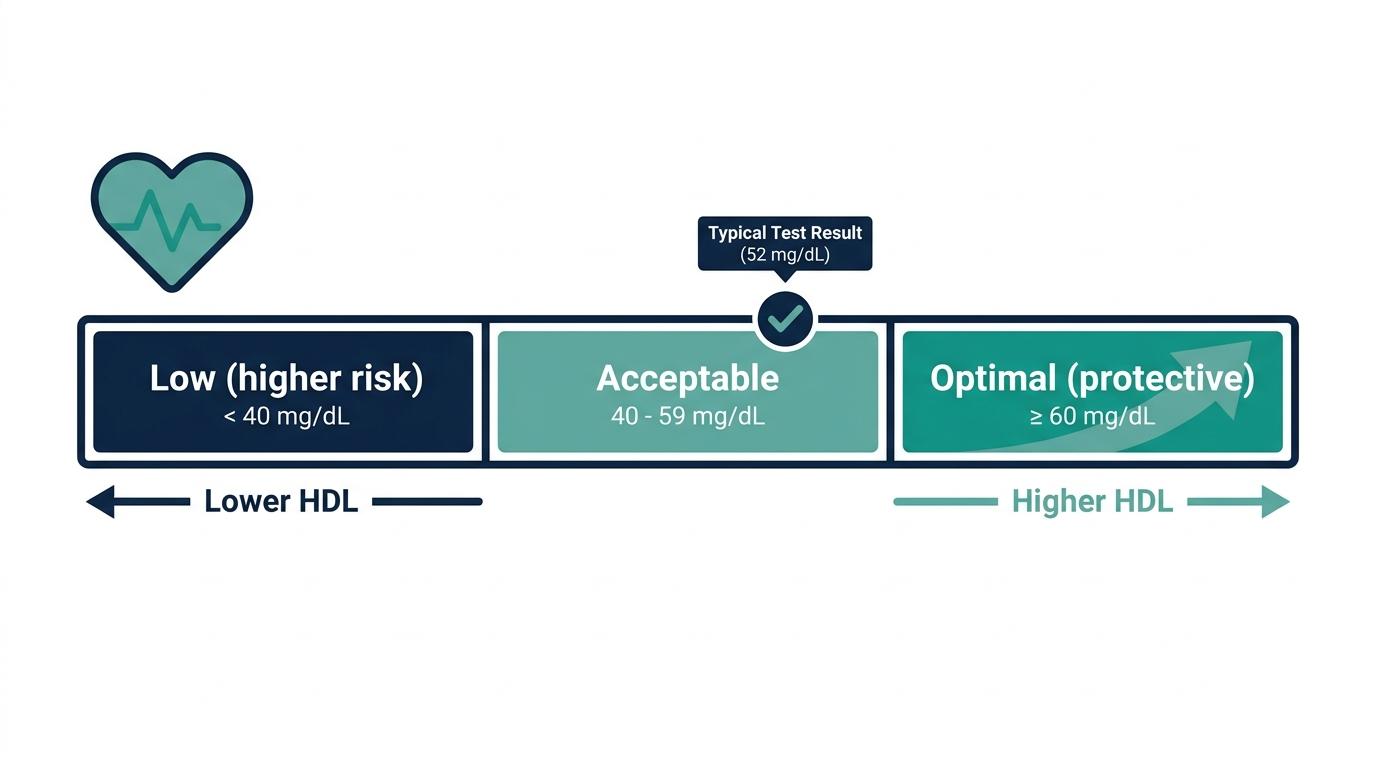
- A normal HDL cholesterol level is 40 mg/dL or higher for men and 50 mg/dL or higher for women, and the optimal protective range runs from 60 to 80 mg/dL (Cleveland Clinic).
- HDL reference ranges barely shift across adult age groups, but the recommended cutoff for women is about 10 mg/dL higher than for men because of how estrogen affects the lipid profile.
- For children and teens an HDL above 45 mg/dL is acceptable, below 40 mg/dL is low, and 40 to 45 mg/dL is borderline (NHLBI National Cholesterol Education Program).
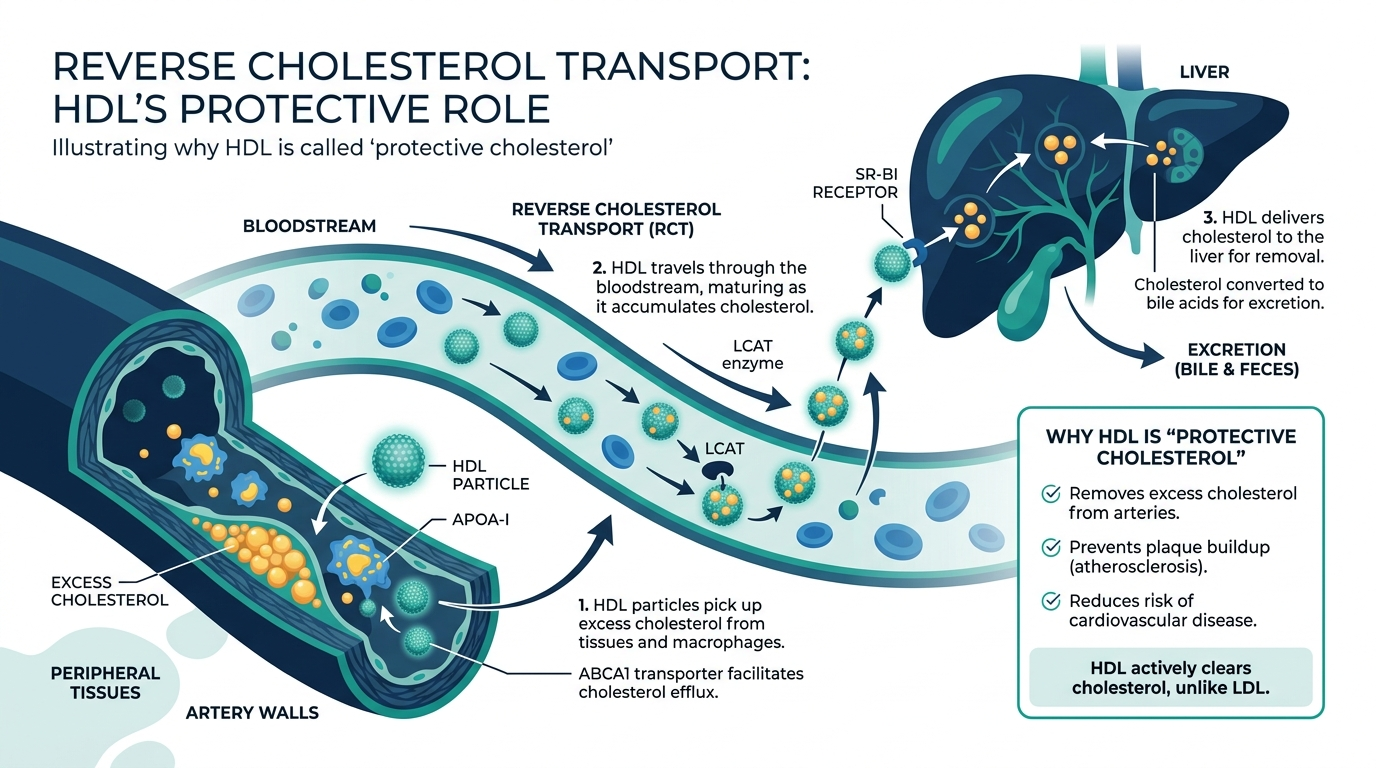
HDL stands for high-density lipoprotein, the cholesterol carrier most people call the “good” cholesterol. It ferries excess cholesterol away from your arteries and back to the liver for disposal, which is why a higher number is generally better. This guide gives the real reference ranges by age and sex, explains why women and men are scored differently, and shows when a result is worth a conversation with your clinician.
Part of our Lipid Panel guide.
Curious where your HDL falls against the optimal 60 to 80 range? See your full lipid picture. One at-home Superpower draw checks 100+ biomarkers, physician-reviewed.
What is a normal HDL level?
A normal HDL cholesterol level is 40 to 80 mg/dL for men and 50 to 80 mg/dL for women, according to the Cleveland Clinic. The protective sweet spot for both sexes is roughly 60 mg/dL and above, which is associated with lower heart disease risk. HDL is the one cholesterol number where higher usually means healthier, the opposite of LDL.
The simplest way to read your result is by these labels:
- Low (a risk factor): below 40 mg/dL in men and below 50 mg/dL in women (Cleveland Clinic).
- Normal: 40 to 80 mg/dL in men, 50 to 80 mg/dL in women.
- Optimal and protective: 60 mg/dL or higher (WebMD, Cleveland Clinic).
- Unusually high: above 80 mg/dL, which is uncommon and occasionally signals an underlying lipid disorder rather than extra protection.
Unlike LDL, HDL does not have a long list of age brackets in standard guidelines. The cutoffs above apply to most adults regardless of decade. What changes more with age is your overall risk picture, not the HDL threshold itself.
Is higher HDL always better?
Up to a point. Moving from a low HDL into the normal and optimal range tracks with lower heart risk, which is where the good cholesterol label comes from. But the relationship is not a straight line that keeps improving forever. Very high HDL, generally above 80 to 100 mg/dL, does not appear to add protection, and some research links unusually high levels with a genetic lipid quirk or even worse outcomes rather than better ones. The practical takeaway: aim to get out of the low range, not to chase the highest possible number.
Part of the reason is that HDL quality matters as much as quantity. Two people can have the same HDL of 55 while their particles differ in how well they actually pull cholesterol out of artery walls, a property researchers call cholesterol efflux capacity. Standard lab tests measure how much HDL you have, not how well it works, which is one reason the single number has limits.
HDL normal range by age
The simplest way to actually get this done
Superpower is a full-body lab membership that runs 100+ biomarkers, has each result reviewed by a doctor, and tracks your numbers year over year (about $199/year). It is what we point readers to when they would rather get one clean, complete draw than chase single tests one at a time. Here is superpower reviewed in full.
HDL reference values stay remarkably stable across adult age groups: the same cutoffs (40 mg/dL for men, 50 mg/dL for women, 60 mg/dL as optimal) apply from your 20s through your 60s and beyond (Cleveland Clinic). The biggest split is by sex, not age, with children and teens carrying their own pediatric thresholds from the NHLBI.
The table below pulls the published reference values together. These are screening categories, not personal targets, and your clinician interprets them alongside LDL, triglycerides, and your total risk.
| Group | Low (risk factor) | Acceptable / normal | Optimal |
|---|---|---|---|
| Children and teens (under 19) | Below 40 mg/dL | Above 45 mg/dL (40 to 45 is borderline) | Above 60 mg/dL |
| Adult men (20+) | Below 40 mg/dL | 40 to 80 mg/dL | 60 to 80 mg/dL |
| Adult women (20+) | Below 50 mg/dL | 50 to 80 mg/dL | 60 to 80 mg/dL |
| Older adults (65+) | Below 40 (men) / 50 (women) mg/dL | Same as adult ranges | 60 to 80 mg/dL |
Sources for the table: adult and “above 80” figures from Cleveland Clinic; the protective 60 mg/dL mark from WebMD and Cleveland Clinic; pediatric cutoffs (40, 45, 60 mg/dL) from the NHLBI National Cholesterol Education Program, summarized by the University of Rochester Medical Center. Note that an HDL above 80 mg/dL is flagged as unusually high in adults rather than better.
How does sex change the range?
Sex shifts the HDL cutoff by about 10 mg/dL: women are expected to sit at 50 mg/dL or higher to be considered normal, while men only need 40 mg/dL or higher (Cleveland Clinic). HDL is the only routine cholesterol number with a built-in sex difference, so the same lab value can read “normal” for a man and “low” for a woman.
The reason is largely hormonal. Estrogen tends to raise HDL, so premenopausal women typically run higher HDL than men of the same age, and the reference range was set higher to match. After menopause, HDL can drift down as estrogen falls, which is one reason cardiovascular risk in women tends to climb in later decades. The protective target of 60 mg/dL and above is the same for everyone, but the floor that counts as “low” is higher for women.
Does raising HDL actually lower heart risk?
This is where HDL surprises people. Low HDL is a reliable marker of higher cardiovascular risk, but deliberately pushing HDL up with medication has repeatedly failed to lower that risk. Large trials of niacin, a vitamin that raises HDL, and of a drug class called CETP inhibitors that raises it even more, boosted the number substantially yet did not reduce heart attacks or strokes. That result reshaped how doctors think about HDL.
The lesson is that HDL is better understood as a mirror of your metabolic health than a lever you pull directly. A low HDL usually travels with the things that truly drive risk: high triglycerides, insulin resistance, excess weight, smoking, and inactivity. Fix those, and HDL often rises as a side effect, but the benefit comes from fixing the drivers, not from the HDL number itself. This is why modern guidelines put far more weight on lowering LDL and non-HDL cholesterol than on chasing a higher HDL.
For you, that means a low HDL is best treated as a prompt to look at the whole picture, blood sugar, triglycerides, weight, and activity, rather than a target to medicate on its own.
How do you prepare for an HDL test?
HDL is one of the steadier lipids, but a few things can still shift a single reading, so a little consistency pays off:
- Fasting is often requested, though HDL barely moves with food. HDL itself changes little whether you have eaten or not, but because it is measured on the same panel as triglycerides, labs frequently ask for a 9 to 12 hour fast. Follow whatever your clinician orders.
- Note your alcohol the day before. Alcohol can nudge HDL up temporarily, so a heavy night out can make a reading look better than your true baseline.
- Do not test during illness or right after unusual exertion. Acute infection, injury, or a very hard workout can move lipids for a short while, so wait until you are back to normal.
- Standardize repeat tests. If you are tracking HDL over months, test under the same conditions each time, same fasting state, similar recent activity and alcohol, so a change reflects real progress.
Because HDL responds to sustained habits more than to any single day, do not read too much into one point. The trend across several draws is what matters.
What makes HDL rise or fall with age?
HDL is shaped more by lifestyle, genetics, and hormones than by age itself, and the published cutoffs do not change as you get older (Cleveland Clinic). Still, several real-world factors push your personal number up or down over the years, and most of them are modifiable.
Things that tend to raise HDL:
- Aerobic exercise: regular cardio is one of the most reliable ways to lift HDL.
- Quitting smoking: smoking lowers HDL, and quitting reverses some of that loss.
- Healthy fats: olive oil, nuts, and fatty fish support HDL more than refined carbohydrates do.
- Moderate weight loss: losing excess body fat often nudges HDL upward.
Things that tend to lower HDL:
- Type 2 diabetes and insulin resistance, which commonly pair low HDL with high triglycerides.
- Smoking and a sedentary routine.
- Menopause, as falling estrogen reduces HDL in many women.
- Genetics, since some people inherit naturally low HDL despite a healthy lifestyle.
Because these drivers accumulate over a lifetime, your HDL at 55 reflects decades of habits more than a fixed age penalty.
When is an out-of-range result a concern?
An HDL below 40 mg/dL in men or below 50 mg/dL in women counts as a cardiovascular risk factor and is the result most worth acting on (Cleveland Clinic). Low HDL rarely travels alone, so clinicians read it next to your LDL, triglycerides, blood pressure, and blood sugar before deciding what it means for you.
A few patterns that prompt follow-up:
- Low HDL plus high triglycerides: a classic signature of insulin resistance or metabolic syndrome.
- HDL above 80 mg/dL: uncommon, and very high levels are not assumed to be extra protective. They occasionally point to an underlying genetic or lipid disorder and may warrant a closer look (Cleveland Clinic).
- A single borderline reading: often repeated, since HDL can vary with recent illness, stress, or even the fasting state of the sample.
HDL is one input, not a verdict. The goal is to interpret it inside your full lipid panel and personal risk, then decide together whether lifestyle changes or treatment make sense.
The cholesterol ratio your clinician may use
Because HDL only makes sense in context, clinicians often calculate a total cholesterol to HDL ratio: your total cholesterol divided by your HDL. A lower ratio is better. A common target is below 5, with below 3.5 considered optimal. The same HDL of 45 looks very different when total cholesterol is 180 versus 260, and the ratio captures that at a glance. Non-HDL cholesterol, total minus HDL, is another way clinicians fold HDL into an overall risk read.
What to do if your HDL is low
Low HDL is rarely treated in isolation. The steps that help are the same ones that improve the whole panel:
- Add regular aerobic exercise, the single most reliable HDL raiser, aiming for consistent weekly cardio.
- Stop smoking, which lowers HDL and harms the arteries directly.
- Lose excess weight and cut refined carbs and sugar, since the low HDL with high triglycerides pattern responds well to this.
- Choose unsaturated fats, such as olive oil, nuts, and oily fish, over refined carbohydrates.
A realistic example: a 41 year old woman with an HDL of 44, borderline triglycerides, and a mostly seated job starts walking and lifting a few times a week and trims sugary drinks. Six months later her HDL reads 53 and her triglycerides have fallen. The HDL rose because the underlying metabolic picture improved, which is exactly how HDL is meant to be moved.
Does a low HDL cause symptoms?
No. Like most cholesterol numbers, HDL causes no symptoms you can feel, whether it is high or low. That is exactly why it is found on a routine lipid panel rather than through how you feel, and why periodic screening matters even when you feel completely well. The consequences of a long standing low HDL show up as cardiovascular risk over years, not as day to day symptoms.
Don’t just read about your health, track it.
A single result is a snapshot. Superpower re-tests 100+ markers over time so you can watch them move as you change sleep, food, and training.
Frequently asked questions
Is HDL of 60 good?
Yes. An HDL of 60 mg/dL or higher is considered optimal and is associated with a lower risk of heart disease for both men and women (Cleveland Clinic, WebMD). It sits comfortably inside the normal range and is often described as protective.
What HDL level is dangerous?
An HDL below 40 mg/dL in men or below 50 mg/dL in women is a recognized cardiovascular risk factor (Cleveland Clinic). Unusually high HDL above 80 mg/dL is also worth review, since it may reflect an underlying lipid disorder rather than added protection.
Does HDL change with age?
The published HDL cutoffs do not change with age. The same thresholds apply across adult decades (Cleveland Clinic). Your personal number can drift, though, especially around menopause in women, driven mainly by hormones, weight, and lifestyle rather than age alone.
Why do women need higher HDL than men?
Estrogen tends to raise HDL, so women typically run higher levels and the normal floor was set higher to match. Women are considered normal at 50 mg/dL and above, while men qualify at 40 mg/dL and above (Cleveland Clinic).
How can I raise my HDL naturally?
Regular aerobic exercise, quitting smoking, choosing healthy fats like olive oil and fatty fish, and losing excess weight all tend to raise HDL (Cleveland Clinic). These habits also improve the rest of your lipid panel at the same time.
Can HDL be too high?
It can be unusually high. Above about 80 mg/dL, extra HDL is not assumed to add protection, and very high levels sometimes reflect a genetic lipid variation. If your HDL is strikingly high, your clinician may simply confirm it and look at the rest of your lipids rather than treat it (Cleveland Clinic).
Does alcohol raise HDL?
Moderate alcohol does tend to raise HDL, but this is not a recommended way to improve it. The heart risks and other harms of alcohol outweigh a small HDL bump, and exercise raises HDL without the downsides. If you drink, note it before a test, since it can inflate a single reading.
Do I need to fast for an HDL test?
HDL itself changes little with eating, but it is usually measured alongside triglycerides, which do need fasting, so many labs still ask for a 9 to 12 hour fast. Follow the instructions your clinician or lab gives you for the specific panel.
What is the difference between HDL and LDL?
Both carry cholesterol, but in opposite directions. LDL delivers cholesterol to tissues and can leave it in artery walls, which is why high LDL raises risk. HDL picks up excess cholesterol and returns it to the liver, which is why higher HDL is generally favorable. A lipid panel reports both.
How often should I check my HDL?
HDL is checked as part of a standard lipid panel, which many adults have every four to six years if results are normal and risk is low, and more often with existing risk factors, a prior abnormal result, or heart disease. Your clinician sets the interval based on your overall risk.
How quickly can HDL rise?
More slowly than triglycerides. HDL responds to sustained changes rather than a single good week, so meaningful gains from exercise, quitting smoking, and weight loss usually show over a few months rather than a few weeks. Consistency is what moves it.
Sources
- Cleveland Clinic, HDL: Why It’s Good Cholesterol
- Cleveland Clinic, Cholesterol: Understanding Levels and Numbers
- WebMD, HDL (High-Density Lipoprotein): Overview and Safe Levels
- University of Rochester Medical Center, Cholesterol, LDL, HDL, and Triglycerides in Children and Teens
- MedlinePlus, Cholesterol Levels: What You Need to Know
- American Academy of Family Physicians, NHLBI Expert Panel Guidelines for Cardiovascular Health in Children
This article is for general educational purposes and is not medical advice. It cannot diagnose or treat you and does not replace your clinician. Always discuss your lab results and any health decisions with a qualified healthcare professional.
Vital Signs Today may earn a commission if you buy through links on this page. It does not affect our editorial assessments.