- For most adults without diabetes, a normal fasting blood glucose is 70 to 99 mg/dL, while 100 to 125 mg/dL signals prediabetes and 126 mg/dL or higher on repeat testing indicates diabetes (Cleveland Clinic).
- The normal fasting range of 70 to 99 mg/dL is the same for healthy children, adults, and seniors, because the diagnostic cutoffs do not change with age; what changes is the treatment target for people who already have diabetes.
- Sex does not change the normal glucose cutoffs, but pregnancy lowers them, and some research notes small average differences between men and women that stay inside the same reference range.
Part of our Comprehensive Metabolic Panel guide.
What is a normal glucose level?
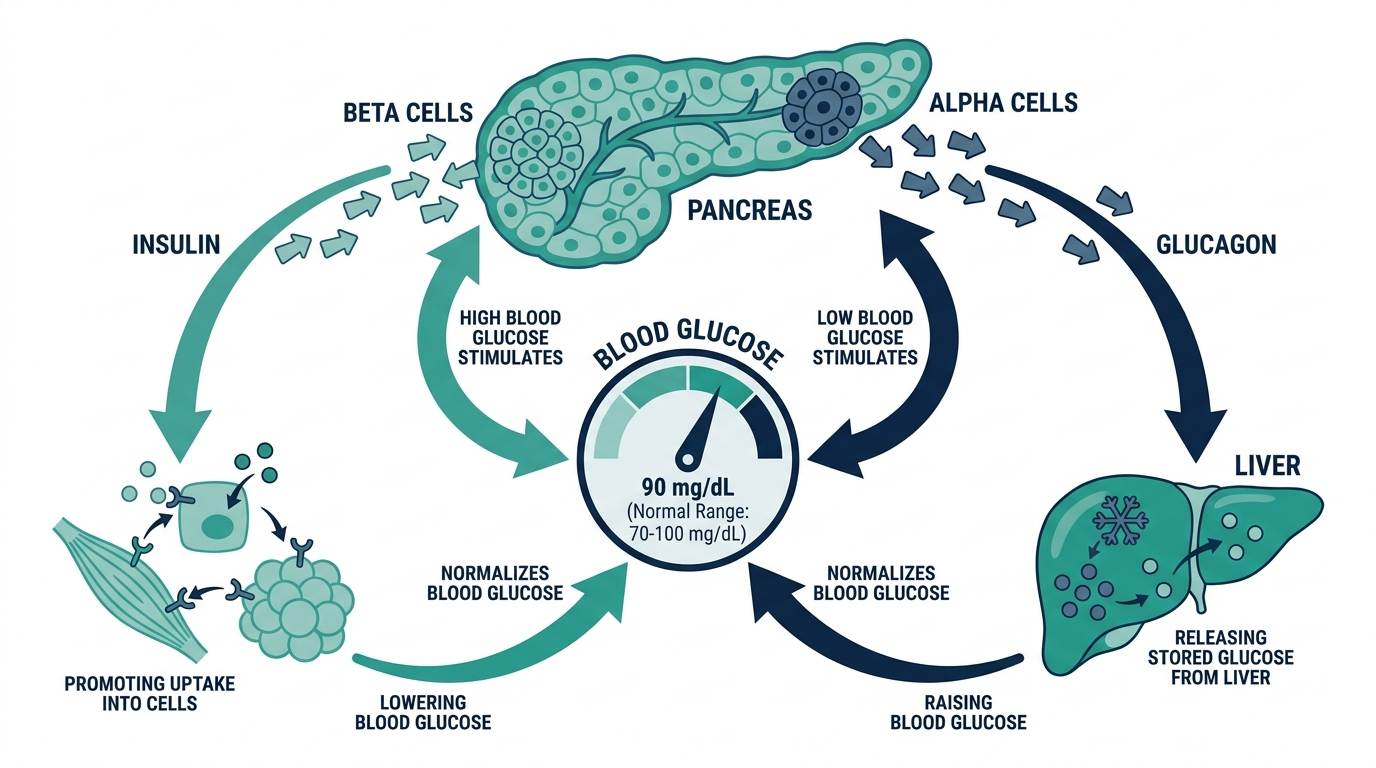
A normal fasting blood glucose level for a person without diabetes is 70 to 99 mg/dL (3.9 to 5.5 mmol/L), according to the Cleveland Clinic. Fasting means at least 8 hours without food or drink other than water. A reading of 100 to 125 mg/dL usually means prediabetes, and 126 mg/dL or higher on more than one occasion usually means diabetes. After eating, glucose rises and then settles, so a value under 140 mg/dL roughly 2 hours after a meal is considered normal for people without diabetes.
Curious exactly where your glucose falls between normal and prediabetic? See your full metabolic panel. One at-home Superpower draw checks 100+ biomarkers, physician-reviewed.
Blood sugar is the amount of glucose circulating in your blood, and it is the main fuel your cells burn for energy. Hormones, mostly insulin and glucagon, keep it inside a tight band throughout the day. A single number outside the range is not a diagnosis. Doctors confirm abnormal results with a repeat test or with an A1C, which reflects your average glucose over about 3 months.
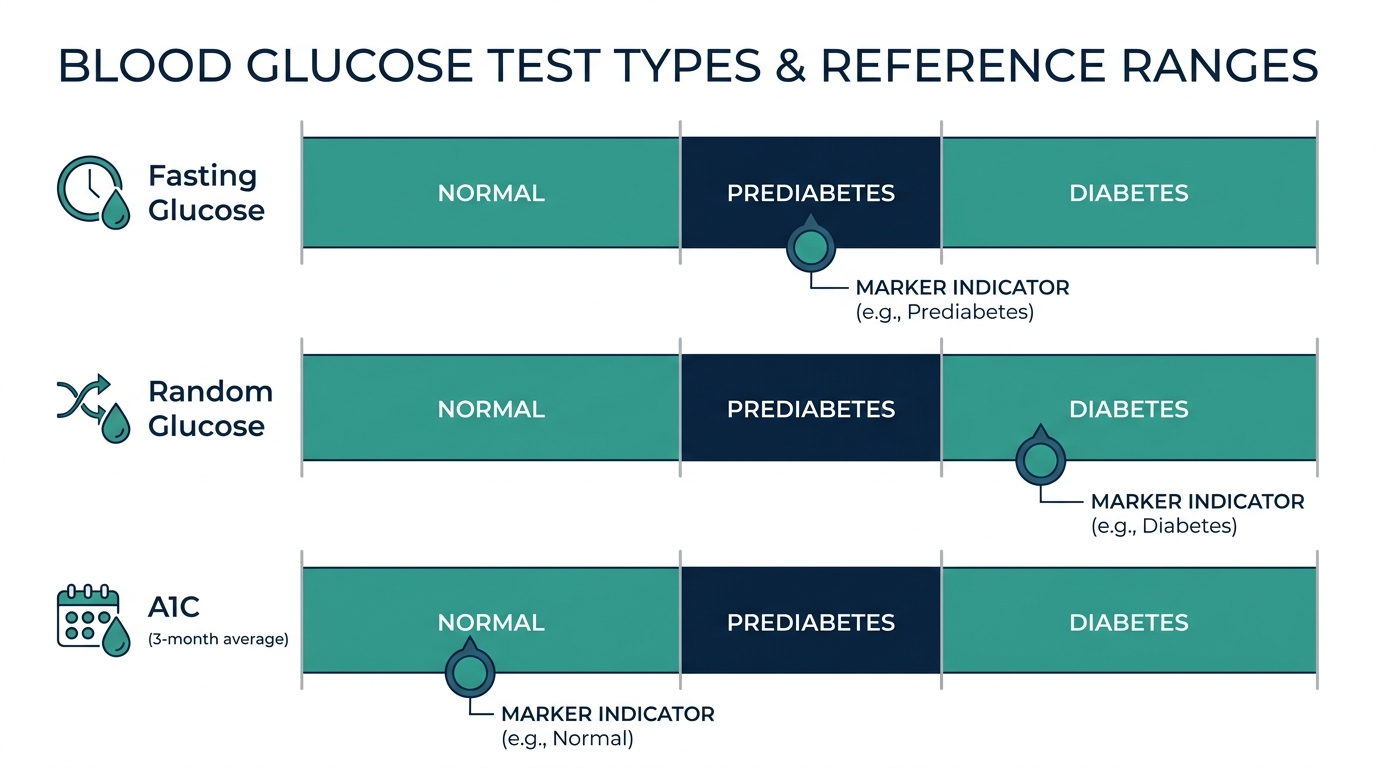
One point that trips people up: “your glucose” is not a single test. The number can come from a fasting draw, a random draw, an oral glucose tolerance test, or an A1C, and each answers a slightly different question. A fasting value catches your baseline, a postmeal or tolerance test shows how well you clear a sugar load, and A1C averages the past few months so a single bad breakfast cannot skew it. Knowing which test produced your number is the first step to reading it correctly.
Which glucose test produced your number?
The simplest way to actually get this done
Superpower is a full-body lab membership that runs 100+ biomarkers, has each result reviewed by a doctor, and tracks your numbers year over year (about $199/year). It is what we point readers to when they would rather get one clean, complete draw than chase single tests one at a time. Here is superpower reviewed in full.
Four tests dominate glucose screening, and their cutoffs are worth knowing because a lab may run any of them. All figures below are the standard diagnostic thresholds used for people without a prior diabetes diagnosis (Cleveland Clinic; ADA Standards of Care 2026).
- Fasting plasma glucose: drawn after at least 8 hours without food. Normal is 70 to 99 mg/dL, prediabetes is 100 to 125 mg/dL, and 126 mg/dL or higher on two occasions indicates diabetes.
- Oral glucose tolerance test (OGTT): a fasting draw, then a sugary drink, then a draw 2 hours later. A 2-hour value under 140 mg/dL is normal, 140 to 199 mg/dL is prediabetes, and 200 mg/dL or higher indicates diabetes.
- A1C: a single draw that estimates your average glucose over roughly 3 months, so it needs no fasting. Below 5.7 percent is normal, 5.7 to 6.4 percent is prediabetes, and 6.5 percent or higher indicates diabetes.
- Random (casual) glucose: drawn at any time. A value of 200 mg/dL or higher together with classic symptoms such as heavy thirst and frequent urination points to diabetes and prompts a confirmatory test.
The tests translate into one another. An A1C of about 5.7 percent lines up with an average glucose near 117 mg/dL, and an A1C of 7 percent corresponds to an average of about 154 mg/dL (ADA). That is why your clinician may pick A1C for a stable overview and a fasting or tolerance test when they need to see a specific moment. If two tests disagree, the abnormal one is usually repeated rather than ignored.
If your report uses mmol/L instead of mg/dL, the conversion is simple: divide mg/dL by 18. A fasting 99 mg/dL is 5.5 mmol/L, and 126 mg/dL is 7.0 mmol/L. Same value, different unit.
Glucose normal range by age
The normal fasting glucose range of 70 to 99 mg/dL applies across ages for people without diabetes, because the diagnostic thresholds set by the diagnostic criteria do not shift with age (Cleveland Clinic). What shifts with age is the personalized target for people who already have diabetes, especially older adults, where the American Diabetes Association (ADA) allows more relaxed goals to avoid dangerous low blood sugar. The table below pairs the non-diabetes reference range with the ADA treatment targets so you can see both at a glance.
| Group | Fasting (no diabetes) | After meals (no diabetes) | A1C goal if diabetes |
|---|---|---|---|
| Children and teens (no diabetes) | 70 to 99 mg/dL | under 140 mg/dL at ~2 hours | under 7.0% (individualized) |
| Adults (no diabetes) | 70 to 99 mg/dL | under 140 mg/dL at ~2 hours | under 7.0% (ADA) |
| Healthy older adults with diabetes | 80 to 130 mg/dL (target) | peak under 180 mg/dL (target) | under 7.0 to 7.5% (ADA) |
| Complex or intermediate-health seniors with diabetes | 90 to 150 mg/dL (target) | bedtime 100 to 180 mg/dL (target) | under 8.0% (ADA) |
| Very complex or poor-health seniors with diabetes | 100 to 180 mg/dL (target) | bedtime 110 to 200 mg/dL (target) | avoid relying on A1C (ADA) |
Reading the table: The first two rows are screening reference values for people without diabetes (Cleveland Clinic). The lower three rows are management targets from the ADA Standards of Care in Diabetes 2026 for people who already have diabetes, where goals loosen as health complexity rises so that low blood sugar does not cause falls or confusion.
How does sex change the range?
Sex does not change the normal glucose cutoffs. A fasting value of 70 to 99 mg/dL is normal whether you are male or female (Cleveland Clinic). The one major exception is pregnancy, where targets are stricter: fasting glucose is generally kept at 95 mg/dL or below and 2-hour postmeal under 120 mg/dL to protect the pregnancy, per ADA guidance.
Researchers have observed small average differences between men and women, such as slightly different fasting values and responses on a glucose tolerance test, but these differences sit inside the same reference range and do not create separate diagnostic numbers. Body size, muscle mass, and hormones explain part of the variation. For everyday interpretation, you can use one set of cutoffs regardless of sex, and treat pregnancy as the special case that needs its own tighter goals and screening.
What makes glucose rise or fall with age?
Glucose control tends to drift slightly higher with age because the body becomes more insulin resistant and the pancreas releases insulin a little less efficiently. This is why the ADA permits higher targets, such as a fasting goal of 90 to 150 mg/dL, for older adults with several chronic conditions (ADA Standards of Care 2026). The reference range for screening still does not move; only personalized targets do.
Several factors push numbers up or down at any age:
- Up: large or high-carbohydrate meals, illness and infection, stress hormones, steroid medicines, inactivity, and weight gain.
- Down: skipping meals, heavy exercise, alcohol on an empty stomach, and too much diabetes medication or insulin.
- With age: reduced muscle mass, more medications, kidney changes, and slower hormone responses, all of which can widen daily swings.
For older adults, the bigger danger is often hypoglycemia, not high readings, which is why guidelines prioritize avoiding lows over chasing a perfect number.
How to prepare, and what can throw off your reading
A fasting glucose is only as good as the fast behind it, and several everyday things move the number without any change in your underlying health. Getting the prep right prevents a false alarm.
- Fast properly. Aim for 8 to 12 hours of nothing but water. Juice, coffee with sugar or cream, and even some medications taken with food can lift a fasting value.
- The dawn phenomenon. Blood sugar naturally rises in the early morning as the body releases cortisol and other hormones to wake you up, so an early draw can read a little higher than a late-morning one for this reason alone.
- Acute illness and stress. Infections, injuries, and even intense emotional stress trigger hormones that raise glucose, sometimes called stress hyperglycemia. A number drawn while you are sick is not a fair reading of your baseline.
- Poor sleep and recent hard exercise. A rough night or a very intense workout the day before can nudge a fasting value in either direction.
- Finger-stick versus lab. Home glucometers use capillary blood and can differ from a venous lab draw by a meaningful margin, so do not treat a meter reading as identical to a lab result.
A1C has its own blind spots. Because it depends on red blood cells, anything that shortens their lifespan can make A1C read falsely low, while some conditions read it falsely high. Recent blood loss, iron-deficiency anemia, pregnancy, and certain hemoglobin variants can all distort it, which is why a clinician cross-checks a surprising A1C against a fasting or tolerance test rather than trusting it alone.
When is an out-of-range result a concern?
A single high or low reading is rarely an emergency, but a repeated fasting value of 126 mg/dL or higher meets the threshold for diabetes and needs medical follow-up (Cleveland Clinic). Repeated fasting values of 100 to 125 mg/dL point to prediabetes, a stage where lifestyle changes can often return glucose to normal. On the low side, glucose under 70 mg/dL is generally considered low, and below 54 mg/dL is clinically significant hypoglycemia that should be treated promptly.
Seek prompt care if you have symptoms with an abnormal number. High glucose can cause heavy thirst, frequent urination, blurred vision, and fatigue. Low glucose can cause shakiness, sweating, confusion, a fast heartbeat, and in severe cases fainting or seizures. Context matters: a number that is fine for a healthy adult may be too low for a frail senior. Always interpret a result alongside how you feel, when you last ate, your medications, and your clinician’s personalized targets.
What to do next if your glucose is in the prediabetes range
A fasting value of 100 to 125 mg/dL, or an A1C of 5.7 to 6.4 percent, is a warning light rather than a diagnosis, and it is often reversible. The standard next steps are practical:
- Confirm it. A single borderline result is usually repeated, often with an A1C to average out day-to-day noise.
- Move after meals. A short walk after eating blunts the glucose spike, and regular activity improves how your cells respond to insulin.
- Look at the whole metabolic picture. High triglycerides, low HDL, rising blood pressure, and extra weight around the middle often travel with early insulin resistance, so glucose is rarely read in isolation.
- Recheck on a schedule. Prediabetes is typically monitored at least yearly, because catching the trend early is when lifestyle change has the most leverage.
Two real reading scenarios
Context decides what a glucose number means, so here are two everyday situations.
Scenario one: the fasting number that was not really fasting. A 45-year-old woman has a fasting glucose of 108, flagged as prediabetes. On questioning, she had a large coffee with sugar on the drive in because she forgot it counted. Redrawn after a true overnight fast, and cross-checked with an A1C of 5.4 percent, her glucose comes back at 91. The first number was a prep error, not prediabetes.
Scenario two: the normal fasting hiding a spike. A 60-year-old man has a fasting glucose of 96, comfortably normal, but he feels tired after meals. An A1C comes back at 6.1 percent and an oral tolerance test shows a 2-hour value of 165. His fasting number looked fine while his after-meal glucose was already in the prediabetes range. This is a classic pattern that a fasting test alone can miss, and it is why the test used matters as much as the result.
Curious what your own levels look like?
Baseline 100+ biomarkers today and retest as life changes, all in one membership with physician review.
Frequently asked questions
Is a fasting glucose of 100 mg/dL bad?
A fasting glucose of 100 mg/dL sits at the bottom edge of the prediabetes range, which is 100 to 125 mg/dL (Cleveland Clinic). It is not diabetes, but it is a signal to recheck, improve diet and activity, and talk with your clinician about prevention.
What is a normal blood sugar 2 hours after eating?
For a person without diabetes, blood sugar roughly 2 hours after the start of a meal is normally under 140 mg/dL. For many adults with diabetes, the ADA peak postmeal target is under 180 mg/dL, measured 1 to 2 hours after eating.
Does normal blood sugar change with age?
The normal screening range, 70 to 99 mg/dL fasting, does not change with age. What changes is the treatment target for people who already have diabetes. Older adults with complex health may have looser goals, such as fasting 90 to 150 mg/dL, to avoid low blood sugar (ADA).
What glucose level is dangerously low?
Glucose under 70 mg/dL is considered low, and below 54 mg/dL is clinically significant hypoglycemia. Symptoms include shaking, sweating, confusion, and a rapid heartbeat. Treat it quickly with fast-acting carbohydrate, and seek help if you cannot raise it or you lose consciousness.
Is normal glucose different for men and women?
No. The diagnostic cutoffs are the same for men and women. The main exception is pregnancy, where targets are tighter, generally fasting at or below 95 mg/dL and 2-hour postmeal under 120 mg/dL, to protect the pregnancy (ADA).
What is a normal A1C?
A normal A1C is below 5.7 percent. An A1C of 5.7 to 6.4 percent indicates prediabetes, and 6.5 percent or higher on repeat testing indicates diabetes (ADA). Because A1C reflects roughly 3 months of average glucose, it needs no fasting and is far less affected by a single meal than a spot glucose reading.
Does coffee affect a fasting glucose test?
Plain black coffee has little effect, but coffee with sugar, milk, or cream breaks your fast and can raise the reading. Caffeine can also modestly change glucose in some people. For a clean fasting result, stick to water only in the hours before the draw.
Can stress raise blood sugar?
Yes. Physical or emotional stress releases hormones like cortisol and adrenaline that raise glucose, an effect sometimes called stress hyperglycemia. This is why a value drawn during an illness, injury, or acutely stressful period may not reflect your true baseline and is often rechecked later.
How accurate is a home glucose meter?
Home meters are useful for tracking trends but are less precise than a lab draw. They use capillary blood from a finger-stick, which can differ from venous blood by a meaningful margin, so a meter reading should not be treated as identical to a laboratory result. A diagnosis is made on lab tests, not a home meter.
Sources
- Cleveland Clinic, Blood Glucose (Sugar) Test: Levels and What They Mean
- Cleveland Clinic, Fasting Blood Sugar: Testing, Levels and What They Mean
- American Diabetes Association, Glycemic Goals, Hypoglycemia, and Hyperglycemic Crises: Standards of Care in Diabetes 2026
- American Diabetes Association, Older Adults: Standards of Care in Diabetes 2026
- StatPearls (NCBI Bookshelf), Prediabetes
This article is for general educational purposes and is not medical advice. It cannot diagnose or treat you and does not replace your clinician. Always discuss your lab results and any health decisions with a qualified healthcare professional.
Related: best at-home biomarker tests of 2026.
Vital Signs Today may earn a commission if you buy through links on this page. It does not affect our editorial assessments.