
Last updated June 2026. Educational content only, not medical advice. Talk to a licensed clinician before starting any new supplement protocol.
Short answer: Yes, completely. Collagen is a structural protein in every human body, accounting for roughly 30 percent of total body protein, and men lose it at the same ~1 percent per year rate starting in the mid-20s as women do. The real question is not whether men can take it, but whether they are taking it in the form, dose, and timing that the actual research used, because most men are not.
Men lose collagen at the same rate as women. Have you checked what your own aging markers actually look like? One at-home Superpower draw checks 100+ biomarkers, physician-reviewed.
The perception that collagen is a “women’s supplement” is a marketing artifact, not a biological reality. The brands that first mass-marketed collagen went after a beauty and anti-aging audience because the category had an obvious hook. Gym culture, meanwhile, fixated on whey and creatine. That left a genuine performance tool sitting in the skincare aisle for a decade, mostly overlooked by the people who arguably need it most.
Several of the most-cited clinical trials on collagen and muscle were run specifically on men. A 2021 randomized controlled trial published in Nutrients on untrained middle-aged men who took 15 grams of specific bioactive collagen peptides for 12 weeks, combined with resistance training, showed significantly greater fat-free mass gains and muscle strength compared to the placebo group. That study did not include women. The subjects were men, the results were real, and the collagen was a key variable.
Full-body lab membership: 100+ biomarkers, doctor-reviewed, tracked over time.
Is collagen really a protein men should care about?
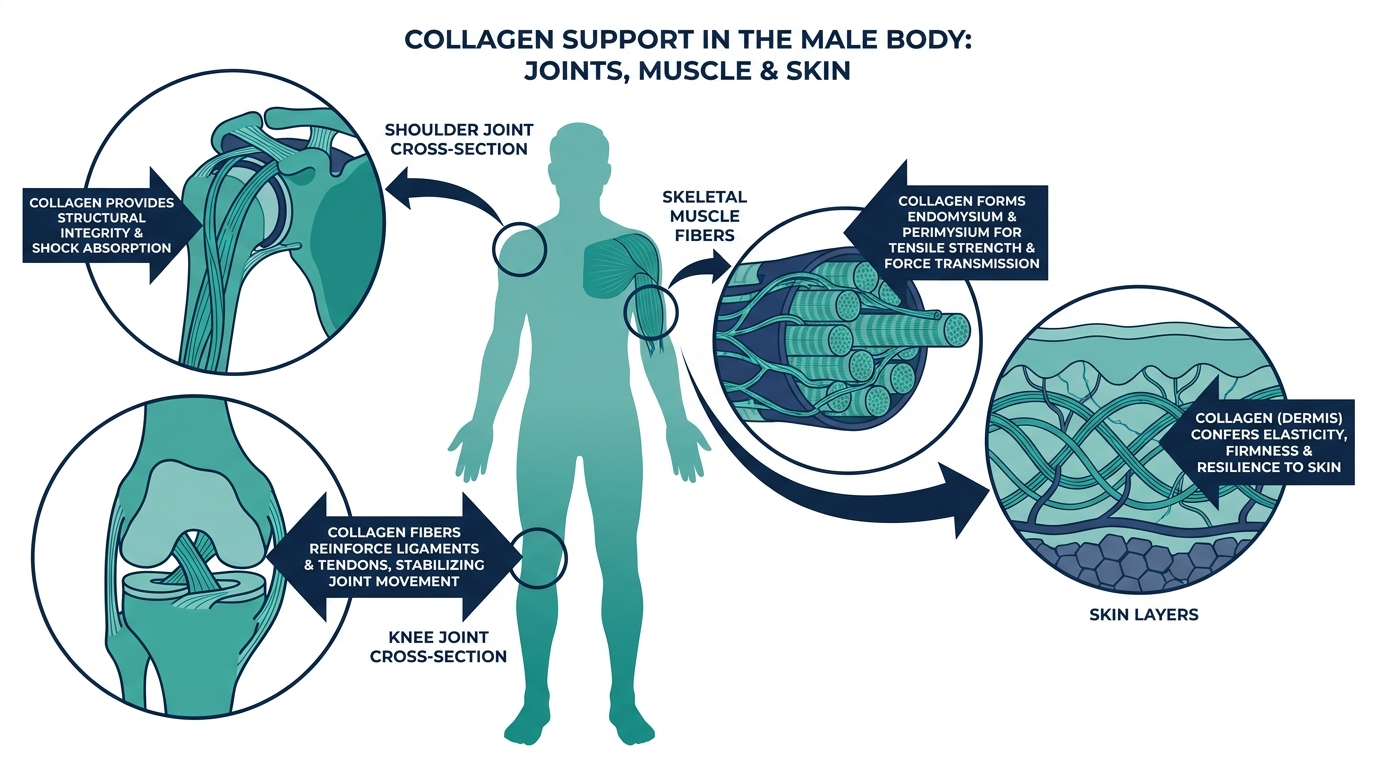
Collagen is not a beauty compound that happens to be in the body. It is the most abundant protein in the human body, forming the structural scaffold of tendons, ligaments, cartilage, bone matrix, skin, and the walls of blood vessels. Think of it as the industrial-grade cable running through every tissue. Muscles contract, but the tendons and connective tissue around them transmit that force. When collagen degrades faster than the body can replace it, that transmission system starts to fray.
Men produce collagen naturally throughout life, but production starts declining at roughly 1 percent per year from the mid-20s onward. By 80, skin collagen synthesis in sun-protected skin has dropped by approximately 75 percent relative to a young adult baseline. Joints follow a similar arc. For an active man in his 30s or 40s, that creeping deficit shows up as slower recovery, nagging tendon tightness, and joints that hurt after heavy training sessions in ways they never used to.
Testosterone does give men a modest advantage in collagen synthesis rates when young. But that advantage does not cancel the decline; it only delays when the symptoms become noticeable. By age 40, most men are behind on collagen production whether or not they feel it yet.
What does the research actually show for men specifically?
The simplest way to actually get this done
Superpower is a full-body lab membership that runs 100+ biomarkers, has each result reviewed by a doctor, and tracks your numbers year over year (about $199/year). It is what we point readers to when they would rather get one clean, complete draw than chase single tests one at a time. Here is superpower reviewed in full.
The clinical literature on collagen for men is stronger than most people realize. Here are the studies worth knowing by name:
A 2021 RCT (Nutrients, Shaw et al.) studied 57 untrained middle-aged men who supplemented 15 g of specific bioactive collagen peptides per day alongside a 12-week resistance training program. The collagen group gained significantly more fat-free mass and muscle strength than the placebo group. The authors attributed part of the effect to intramuscular connective tissue reinforcement.
A 2022 Cambridge Core study, published in the British Journal of Nutrition, focused on elderly sarcopenic men. Subjects receiving collagen peptides plus resistance training showed a 4.2 kg gain in fat-free mass. That is, as the authors noted, “unrivalled by any study of protein supplementation” in this population.
A 2025 randomized controlled trial (PubMed) randomized 50 healthy young sedentary males to 16 weeks of collagen peptide supplementation or placebo and assessed muscle-tendon stiffness and explosive strength. The collagen group showed measurably greater tendon stiffness and explosive power output.
A 2026 Frontiers in Physiology RCT found that specific collagen peptides supplementation increased collagen type I content in skeletal muscle after 12 weeks of high-load resistance training.
None of these are weak observational studies. They are randomized controlled trials, and several were conducted entirely in male subjects.
Why do joints respond so well to collagen supplementation?
This is where collagen diverges from whey protein and most other supplements, and it matters for men who train or have had previous injuries. Collagen has an unusual amino acid profile. It is extremely high in glycine, proline, and hydroxyproline, which are the exact amino acids used to synthesize new collagen in tendon and cartilage tissue. Whey protein has almost none of these; its advantage lies in leucine for muscle protein synthesis.
The implication is that collagen and whey are targeting different tissues. Whey feeds muscle fibers. Collagen feeds the surrounding connective tissue: the tendons, ligaments, and extracellular matrix that anchor muscle to bone. A man who is serious about training needs both.
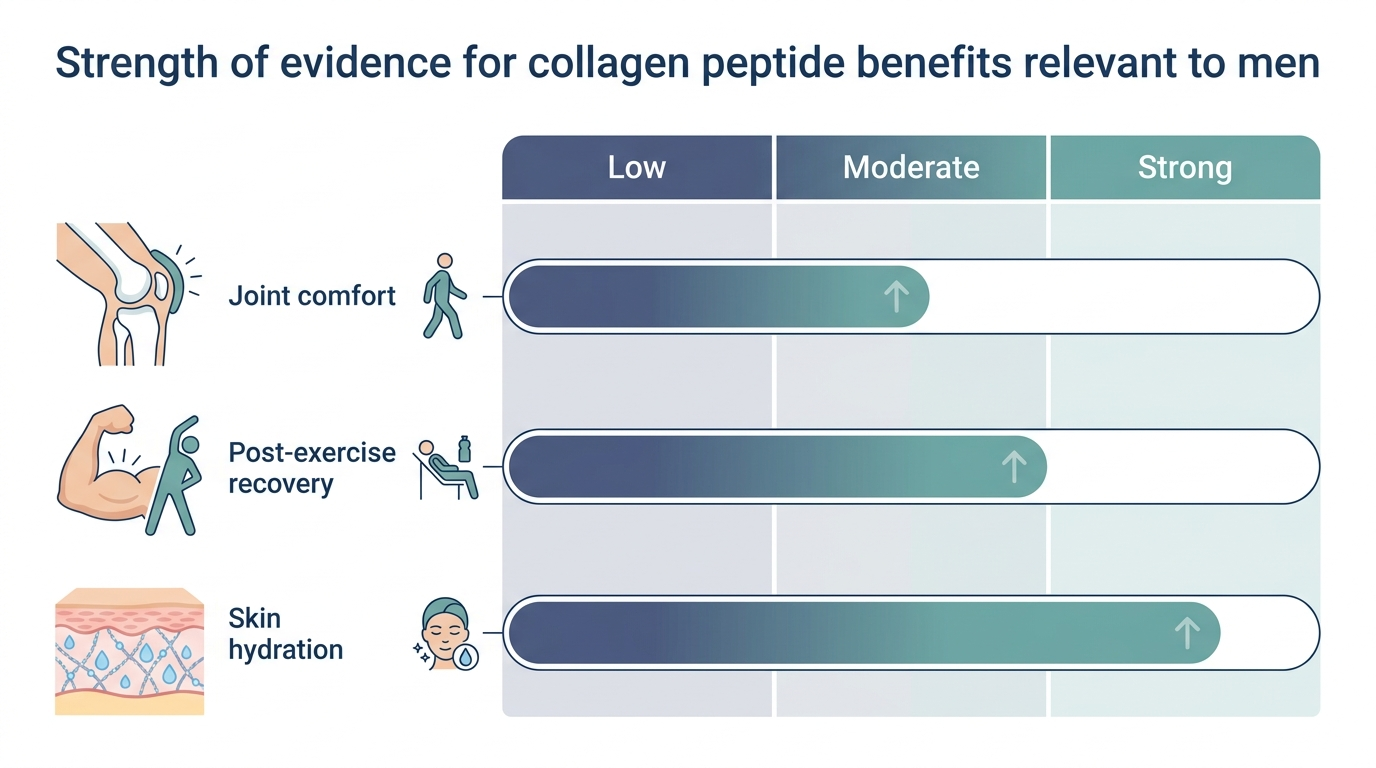
The 2021 systematic review in Nutrients (PMC8521576) reviewed collagen’s effects on recovery from joint injury and exercise and found that collagen peptides reduced joint pain and improved functional outcomes in multiple tendinopathy studies, with positive effects on knee and ankle stability. A 2024 narrative review in the Journal of Education, Health and Sport found that collagen significantly enhances joint stability and accelerates recovery from Achilles tendon injuries in athletes.
Personally, the joint argument is the most compelling one for men who lift heavy or play contact sports. You can rebuild muscle mass relatively quickly after a layoff. Chronic tendon damage is far harder to reverse.
Collagen vs. whey: do men have to choose?
A common mistake is treating this as a competition. Whey protein outperforms collagen for direct muscle protein synthesis, and the data on that is consistent. Whey delivers roughly 2.5 grams of leucine per 25-gram serving and drives muscle fiber growth. Collagen has minimal leucine and does not trigger the same anabolic signaling.
But comparing them head-to-head misses the point. They work on different targets. The smart protocol is not collagen instead of whey. It is collagen for connective tissue support, taken with vitamin C before training, while keeping whey as the post-workout muscle-building driver.
Do not believe the marketing copy that positions collagen powder as a complete protein replacement for training athletes. It is not. Its amino acid profile is specialized, not broad-spectrum. Take it for what it actually does.
| Factor | Collagen Peptides | Whey Protein |
|---|---|---|
| Primary target tissue | Tendons, ligaments, cartilage, skin | Skeletal muscle fibers |
| Key amino acids | Glycine, proline, hydroxyproline | Leucine, isoleucine, valine (BCAAs) |
| Muscle protein synthesis | Low | High |
| Joint/tendon support | High | Low |
| Best timing | 30-60 min before training (with vitamin C) | Post-workout |
| Calories per 15 g serving | ~55 | ~60-65 |
| Complete protein? | No (low in tryptophan) | Yes |
| Typical cost | $0.70-$1.20/serving | $0.80-$1.50/serving |
The bottom line: use both. An active man in his 30s or 40s who is handling only one of these is leaving the other half of his connective-tissue health unaddressed.
Can men get enough collagen from food instead?
You can pull the raw materials from food, but hitting a therapeutic dose that way is genuinely hard. Bone broth, slow-cooked cuts with plenty of connective tissue, skin-on chicken, and gelatin-rich stocks all supply collagen precursors. The problem is quantity and consistency. A homemade broth varies wildly in collagen content depending on the bones and the simmer time, and you would need to drink a large, steady volume every day to match the 15 grams the trials used. Glycine, the dominant amino acid in collagen, also shows up in gelatin desserts, but the sugar and additives make that a poor daily vehicle.
The body does build its own collagen from vitamin C, glycine, and the general amino acid pool, so a man eating adequate protein and produce is not starting from zero. Food-first is a reasonable philosophy. But for a man specifically trying to reproduce the training and joint results seen in the RCTs, a measured scoop of hydrolyzed peptides is the only reliable way to know he is hitting the studied dose every single day. Whole-food protein still carries overall intake; collagen is the targeted add-on, not the foundation.
What dose works, and does timing matter?
The dosing research gives a reasonably clear picture once you separate goals:
For joint and tendon support, most positive trials used 10 to 15 grams per day. The 2021 systematic review (PMC8521576) notes that 15 g per day was more effective than 5 g for elevating collagen synthesis markers.
For muscle and body composition, the well-cited RCTs used 15 grams daily alongside resistance training. The Cambridge Core sarcopenic men study used the same figure.
For exercise recovery and soreness, a 2023 double-blind crossover RCT (PMC10158542) found that collagen peptides alleviated exercise-induced muscle soreness in healthy middle-aged males.
For collagen synthesis specifically timed to exercise, a key finding from a study published in PubMed (PMC11282471) found that blood amino acid levels peaked approximately 1 hour after consuming 15 grams of hydrolyzed collagen. That suggests taking collagen 45 to 60 minutes before training aligns the amino acid peak with the mechanical loading signal that triggers collagen synthesis in connective tissue.
This timing angle is the piece most men miss entirely. Taking collagen with your post-workout shake is convenient but suboptimal. The connective tissue response to mechanical loading is greatest during and immediately after exercise. You want the collagen-derived amino acids circulating during the workout, not after it.
Pairing it with vitamin C matters too. Vitamin C is a required cofactor for the enzyme that converts proline to hydroxyproline, the amino acid that gives collagen its tensile strength. Without adequate vitamin C, the synthesis pathway stalls. A few hundred milligrams of vitamin C with your pre-workout collagen is not supplement stacking for its own sake. It is the actual mechanism working correctly.
Which collagen types are most relevant for men?
Not all collagen is the same. The human body has at least 28 types, but five matter most for supplementation decisions:
Type I is the most abundant, found in tendons, ligaments, bone, and skin. It is the structural workhorse and what most bovine collagen supplements provide. Vital Proteins Collagen Peptides, for example, delivers 20 grams of grass-fed bovine Type I and Type III per serving.
Type II is the primary collagen in cartilage. Studies on joint health, particularly for osteoarthritis and knee pain, often use Type II specifically. Standard bovine collagen powders are mostly Type I and III. If knee cartilage is the primary concern, look for products with undenatured Type II collagen or marine collagen specifically labeled for cartilage.
Type III is found alongside Type I in blood vessel walls and skin. The proportion of Type III relative to Type I decreases with age, which partly explains why older skin loses elasticity even when collagen is present.
For an active man focused on tendons, ligaments, and muscle support, Type I from bovine or porcine collagen is well-supported. For a man with cartilage-specific knee or hip concerns, Type II deserves specific attention.
Does collagen help men’s skin and hair? (the honest answer)
Yes, with caveats that the industry tends to gloss over.
The skin evidence is reasonably solid. WebMD’s clinical summary notes that taking collagen peptides orally improves skin hydration and elasticity in older people, with the evidence strongest for ages 35 and up. This matters for men even if they never use a skincare product. Skin that heals more slowly, scars more readily, or loses structural integrity is a downstream effect of declining collagen, not a cosmetic vanity concern.
The hair evidence is weaker and more theoretical. Collagen provides the amino acids needed for keratin synthesis, and a 2025 study reported improvements in hair cuticle structure after 24 weeks. But hair loss driven by genetics or DHT is not meaningfully affected by collagen supplementation. Do not expect collagen to substitute for finasteride or minoxidil if androgenetic alopecia is the actual problem.
A January 2026 ScienceDaily piece summarized dermatologist consensus: collagen supplements are not the skin fix they are often marketed to be, but they do have measurable effects on hydration and elasticity at doses used in clinical trials, specifically 2.5 to 10 grams per day for skin endpoints.
What to look for in a collagen supplement
Collagen peptides are food supplements regulated by the FDA under DSHEA, not drug-grade products. The FDA does not pre-approve supplements. That puts the quality screening on you.
Three things that actually matter on the label:
Hydrolyzed collagen peptides, not gelatin. Hydrolysis breaks the protein into smaller peptides with much higher bioavailability. Gelatin from grocery stores is barely absorbed compared to hydrolyzed collagen peptides.
Grass-fed, pasture-raised source for bovine collagen. This is not just a marketing phrase. Grass-fed bovine hides have cleaner heavy metal profiles, and several independent reviews have confirmed that premium-sourced products (Vital Proteins, Bubs Naturals, Ancient Nutrition) show lower contamination risk than commodity products.
Third-party testing. NSF Certified for Sport or Informed Sport certification means the batch was independently tested. For men who are subject to sports drug testing, this matters. Collagen itself is not a banned substance, but cross-contamination from unregulated production lines is a real risk.
Hydrolyzed type I & III collagen peptides, third-party tested, unflavored.
Are there downsides, or men who should be cautious?
Collagen peptides have one of the cleaner safety profiles in the supplement aisle, which is part of why the trials ran for months without dropouts tied to the supplement itself. Most men notice nothing beyond the taste. When side effects do appear they are mild and digestive: a feeling of fullness, mild bloating, or a faint aftertaste, usually solved by splitting the dose or mixing it into a flavored drink.
A few groups should clear it with a clinician first. Men with chronic kidney disease handle protein loads differently, and any concentrated protein, collagen included, is worth checking with the doctor managing that condition. Men with a diagnosed fish allergy should avoid marine collagen and stick to bovine or porcine sources. Anyone with a history of kidney stones should keep hydration up while supplementing.
There is also an honest nutritional caveat the labels rarely print. Collagen is not a complete protein. It is low in tryptophan and does not trigger muscle protein synthesis the way whey does. If a man is counting protein to build muscle, those collagen grams should not be counted toward his leucine-driven anabolic target. Treat the 15 grams as connective-tissue support sitting on top of his real protein intake, not as part of it. The men who quietly swap a whey shake for a collagen scoop and expect the same muscle result are the ones who end up disappointed.
How long does it take to work?
Connective tissue has a slow turnover rate compared to muscle. Do not evaluate collagen by whether you notice something in two weeks. The major RCTs showing significant results used 12 to 16 week durations. A realistic timeline for a man starting collagen supplementation:
Weeks 1 to 4: no dramatic change; amino acid availability is building in connective tissue. Possible mild improvement in skin hydration.
Weeks 4 to 8: some men report reduced joint discomfort during training, particularly in the knees, shoulders, and elbows. This is the period where tendon-repair effects start accumulating.
Weeks 8 to 16: the 2021 Nutrients RCT found statistically significant changes in fat-free mass and muscle strength at week 12. Joint and tendon benefits are most measurable here.
Beyond 16 weeks: ongoing maintenance. There is no strong evidence that stopping collagen at week 16 retains all the benefit. The studies that show continued improvement used ongoing daily supplementation.
A concrete example makes the timeline real. Picture a 42-year-old recreational lifter with a cranky right shoulder and knees that ache on leg day. He starts 15 grams of hydrolyzed collagen with vitamin C, taken 45 minutes before training. For the first month he notices nothing and nearly quits. Around week six the shoulder stops barking during overhead presses. By week twelve the knee ache on descending stairs is clearly reduced and his strength numbers are up, though he cannot cleanly separate the collagen from the consistent training itself. That pattern, nothing and then quietly better, is exactly what the trial timelines predict. The men who bail at week three never reach the part where it works.
Don’t just read about your health, track it.
A single result is a snapshot. Superpower re-tests 100+ markers over time so you can watch them move as you change sleep, food, and training.
Frequently asked questions
Is collagen a masculine supplement?
The masculine/feminine framing is entirely a marketing artifact. Collagen is a structural protein found in identical concentrations in male and female bodies. The clinical trials showing muscle, tendon, and joint benefits were largely conducted on male subjects. The “it’s for women” perception comes from how it was initially marketed, not from biology.
Will collagen raise or lower testosterone?
No credible evidence links collagen supplementation to changes in testosterone levels in either direction. Collagen provides structural amino acids; it does not interact with the HPG axis or androgen pathways.
Can men take collagen and creatine together?
Yes. They work on entirely different mechanisms and there is no known interaction. Creatine drives ATP regeneration in muscle fibers; collagen supports the connective tissue around those fibers. Many sports performance protocols use both.
Do men need a different collagen formula than women?
No. The amino acid profile and dosing research applies to both sexes. Some products are labeled “for men” but they typically differ only in flavoring or minor additions like zinc or biotin. The core collagen peptides are identical.
What is the best time of day for men to take collagen?
For training-related goals: 45 to 60 minutes before your workout, with 200 to 300 mg of vitamin C. For general joint and skin support: consistency matters more than clock time. Morning in coffee or a shake is the easiest habit for most men.
Can men take collagen if they are lactose intolerant or dairy-free?
Yes. Bovine and marine collagen peptides contain no lactose. They are derived from hide, bones, or fish skin, not from dairy. Check formulas that add whey or milk-derived ingredients, but plain collagen peptide powders are inherently dairy-free.
How much collagen should a man take per day?
The research-supported range is 10 to 15 grams per day for joint and muscle support. Some trials used up to 20 grams without adverse effects. A 2024 collagen synthesis response study (PMC11282471) found that 30 grams produced a greater collagen synthesis response than 15 grams in resistance-trained young men, though 15 grams is the most-studied dose.
Does hot coffee destroy collagen peptides?
No. Hydrolyzed collagen peptides are already broken into small fragments and stay stable at normal coffee and tea temperatures. Stirring a scoop into a hot drink does not meaningfully degrade them. The only thing to avoid is prolonged hard boiling, which never happens in a coffee mug.
Is collagen worth it for a man in his 20s?
The decline starts in the mid-20s, so a younger man is not too early, but the return is smaller because his natural synthesis is still high. The strongest case in the 20s is injury recovery and tendon support for heavy training, not anti-aging. If budget is tight, a man in his 20s gets more from nailing total protein, sleep, and training than from a collagen scoop.
Powder or capsules: which is better?
Powder, for one simple reason: dose. The effective range is 10 to 15 grams per day, and matching that with capsules means swallowing a dozen or more pills. Powder lets a man hit the studied dose in a single scoop. Capsules are fine for convenience but rarely deliver a therapeutic amount.
Can collagen help if I already have arthritis?
It may ease symptoms, not cure the disease. Trials on undenatured type II collagen and on hydrolyzed peptides have shown reduced joint pain and better function in people with knee osteoarthritis, but collagen does not regrow lost cartilage or reverse structural joint damage. Treat it as one tool for comfort and function alongside, not instead of, care from a clinician.
Hydrolyzed type I & III collagen peptides, third-party tested, unflavored.
Author: Vital Signs Today Editorial Team, [credential]”]. Educational content, not medical advice. Sources linked inline.
Primary sources:
- Nutrients RCT on untrained middle-aged men (2021): https://www.ncbi.nlm.nih.gov/pmc/articles/PMC8125453/
- British Journal of Nutrition, sarcopenic men RCT: https://www.cambridge.org/core/journals/british-journal-of-nutrition/article/exceptional-body-composition-changes-attributed-to-collagen-peptide-supplementation-and-resistance-training-in-older-sarcopenic-men/7DB10E371EDDC45642688278BCEFC6DF
- Frontiers in Physiology 2026 RCT, collagen type I in skeletal muscle: https://www.frontiersin.org/journals/physiology/articles/10.3389/fphys.2026.1839695/full
- PubMed 2025, tendon stiffness and explosive strength RCT: https://pubmed.ncbi.nlm.nih.gov/40623147/
- PMC systematic review, body composition, collagen synthesis, joint recovery: https://www.ncbi.nlm.nih.gov/pmc/articles/PMC8521576/
- PMC, exercise-induced muscle soreness in middle-aged males: https://www.ncbi.nlm.nih.gov/pmc/articles/PMC10158542/
- PMC, collagen synthesis response 15 g vs 30 g in resistance-trained men: https://www.ncbi.nlm.nih.gov/pmc/articles/PMC11282471/
- PubMed, age-related changes in proportion of types I and III collagen: https://pubmed.ncbi.nlm.nih.gov/3266279/
- ScienceDaily (January 2026), dermatologists on collagen supplement realism: https://www.sciencedaily.com/releases/2026/01/260129080443.htm
- BarBend, whey vs collagen for muscle building: https://barbend.com/whey-protein-better-than-collagen/
Related reading
Vital Signs Today may earn a commission if you buy through links on this page. It does not affect our editorial assessments.