Disclosure: Vital Signs Today may earn a commission if you buy through links on this page, at no extra cost to you. This does not influence our evidence-based assessments. We are not a medical provider; talk to a clinician before acting on test results.
Related: eGFR normal range by age (kidney function chart) · Creatinine levels by age: chart
Quick answer: A microalbumin test measures the amount of albumin protein leaking into your urine, which is a sensitive early signal of kidney damage. Normal is below 30 mg per gram of creatinine on the urine albumin-to-creatinine ratio (ACR). Values between 30 and 300 mg/g indicate early kidney stress (microalbuminuria), and above 300 mg/g points to established kidney disease. The test is most commonly ordered for people with diabetes or high blood pressure, because the kidneys begin leaking albumin well before standard creatinine and eGFR tests show any problem.
What Is a Microalbumin Test and Why Do Doctors Order It?
A microalbumin test checks for tiny amounts of the protein albumin in urine that would not show up on a standard urinalysis dipstick. Healthy kidney filters keep albumin inside the bloodstream. When the glomeruli (the microscopic filtering units) get damaged by high blood sugar, chronic high pressure, or inflammation, albumin starts slipping through into the urine years before kidney function measurably declines on standard labs.
The test is most often reported as the urine albumin-to-creatinine ratio (ACR), which corrects for how dilute or concentrated the urine sample is at that moment. That makes a random, single-void urine specimen reliable enough to use clinically, so you do not need a 24-hour urine collection for screening purposes. Quest Diagnostics and Labcorp both run it on a spot urine sample collected in a standard cup.
Doctors order it annually for every patient with type 1 or type 2 diabetes and for anyone with hypertension plus one additional kidney risk factor such as obesity, a family history of kidney disease, or African American ancestry. The American Diabetes Association recommends starting microalbumin screening at diabetes diagnosis for type 2 patients and five years after diagnosis for type 1. The reason: the earlier kidney leakage is caught, the easier it is to slow or reverse.
A complete blood panel often accompanies a microalbumin urine test in an annual workup, though the blood and urine specimens are collected separately.
Microalbumin Normal Range: What the Numbers Actually Mean
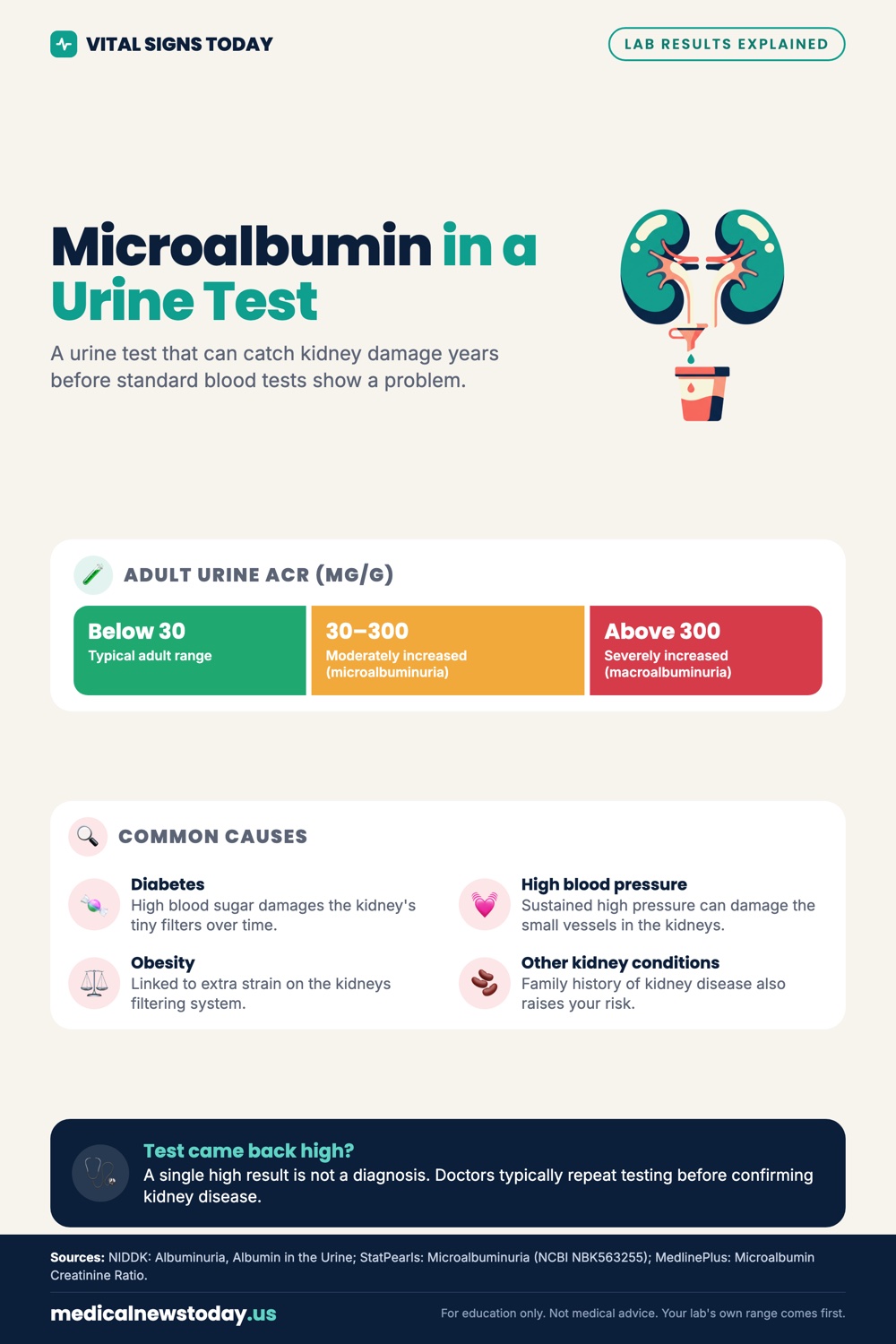
The ACR has three clinically recognized zones, and the category boundaries are the same across major US labs.
| ACR Result (mg albumin per g creatinine) | Category | What It Suggests |
|---|---|---|
| Less than 30 | Normal | Kidney filtration barrier intact |
| 30 to 300 | Moderately increased (microalbuminuria) | Early glomerular stress; cardiovascular risk elevated |
| Greater than 300 | Severely increased (macroalbuminuria) | Significant nephropathy; requires nephrology referral |
Want to check your urine albumin?
Three ways to get it measured. Pick whichever fits you.
Affiliate links: we may earn a commission at no extra cost to you. A lab test does not replace a visit with your clinician.
One abnormal result does not confirm kidney disease on its own. Standard practice is to confirm microalbuminuria with two out of three positive samples collected over three to six months. Strenuous exercise the day before, a urinary tract infection, fever, heavy menstrual bleeding, or extreme dehydration can all temporarily push albumin excretion above the cutoff. If your first result is elevated, rule those out before repeating.
A separate way the lab may report results is as a raw 24-hour albumin excretion rate in milligrams per day. The diagnostic cutoffs mirror the ACR: less than 30 mg/day is normal, 30 to 300 mg/day is microalbuminuria, and above 300 mg/day is macroalbuminuria.
Worth knowing: the ACR is more sensitive than the dipstick test on a standard urinalysis, which only reliably detects protein concentrations above roughly 300 mg/L. By the time a dipstick turns positive, you have already passed the microalbuminuria window into overt proteinuria. That is exactly the gap the microalbumin test exists to fill.
High Microalbumin Causes: What Can Push Your ACR Above 30?
The most common causes of persistently high microalbumin in US adults are diabetes (both type 1 and type 2) and hypertension, but several other conditions and even transient factors can raise the ACR.
Chronic causes worth investigating
- Diabetic nephropathy: Elevated blood glucose damages the glomerular basement membrane over time, making it porous to albumin. Even pre-diabetes is associated with higher ACR readings in population studies.
- Hypertensive nephrosclerosis: Sustained high blood pressure hardens the small arteries feeding the glomeruli, raising filtration pressure and allowing protein leakage.
- Obesity-related glomerulopathy: Excess weight drives hyperfiltration, a state where the kidneys are overworking and filtering at too high a rate, which gradually stresses the glomerular barrier.
- Lupus nephritis and IgA nephropathy: Autoimmune and inflammatory kidney diseases can cause microalbuminuria before symptoms appear.
- Preeclampsia: New-onset proteinuria in the second half of pregnancy is a diagnostic criterion; microalbumin testing is used to detect it early.
- Chronic kidney disease (CKD) from any cause: The ACR is one of two pillars (alongside eGFR) used to stage CKD severity under the KDIGO guidelines.
Transient causes that can mimic kidney disease
- Intense aerobic exercise within 24 hours of collection
- Active urinary tract infection
- Fever or acute illness
- Heavy menstrual flow contaminating the sample
- A very high-protein diet eaten the day before
If your doctor suspects a transient cause, they will ask you to recollect under controlled conditions. The clinical diagnosis of microalbuminuria requires persistence, not a single high reading after a half-marathon.
Microalbumin and Diabetes: The Window You Cannot Afford to Miss
For people with diabetes, the microalbumin test is arguably the most important single biomarker for preserving long-term kidney function. Diabetic kidney disease follows a well-documented progression: years of normal ACR, then microalbuminuria, then macroalbuminuria, then declining eGFR, then end-stage renal disease. Catching it at the microalbuminuria stage gives a substantial intervention window.
What the evidence shows: intensive blood pressure control using ACE inhibitors or ARBs (the drug classes most protective for diabetic kidneys) reduces the rate of progression from microalbuminuria to macroalbuminuria by roughly 50 percent in clinical trials. That means detecting the leak early literally changes the treatment decision. If ACR is normal, standard blood pressure targets apply. If ACR is elevated, target blood pressure drops and a kidney-protective medication gets added.
The Hemoglobin A1c is the better-known diabetes monitoring test, and for good reason. But A1c tells you about average glucose control over the past three months; it does not tell you whether the kidneys are already paying the price. A person can have an A1c of 7.2 percent and still have early nephropathy showing on the ACR. Running both tests gives a more complete picture.
Reviewing the best biomarkers to test for metabolic health regularly shows that ACR and eGFR together are the standard two-marker kidney panel recommended by major guidelines for anyone with diabetes or chronic hypertension.
One practical note: people with type 1 diabetes rarely develop nephropathy within the first five years of diagnosis, which is why ADA guidelines delay the first ACR screen until year five. For type 2, however, nephropathy can be present at the time of diagnosis because type 2 often goes undetected for years. Screen at diagnosis, then annually.
What Is Microalbuminuria and How Is It Different from Proteinuria?
Microalbuminuria is the clinical term for an ACR between 30 and 300 mg/g, representing a small but detectable and pathologically significant leak of albumin across the kidney filter. The prefix "micro" refers to the quantity being below what a traditional urine dipstick can reliably detect, not that the damage is minor.
Standard urinalysis dipsticks measure total protein and typically only flag positive at concentrations above roughly 300 mg/L. Since albumin makes up the vast majority of urine protein in kidney disease, the dipstick turning positive roughly corresponds to the macroalbuminuria threshold, which is the ACR above 300 mg/g zone. By that stage, kidney pathology is often more advanced.
Here is why the distinction matters practically: a clinician who only ever orders a urine dipstick will miss the entire microalbuminuria window. A patient with a 150 mg/g ACR and a dipstick showing "trace protein" or even "negative" could appear fine on the chart while kidney filtering units are sustaining real damage. This is one reason guidelines specifically recommend the ACR test rather than relying on the dipstick for diabetes or hypertension monitoring.
Proteinuria (the broader term) encompasses any protein in urine above normal. Microalbuminuria is a specific sub-type characterized by albumin being the dominant protein and the quantity being in a range that is too small for older detection methods. The shift from calling it "microalbuminuria" to "moderately increased albuminuria" in updated KDIGO guidelines reflects a desire to stop implying the damage is trivial.
How the Test Is Done: Spot Urine vs. 24-Hour Collection
The vast majority of clinical microalbumin testing today uses a random spot urine specimen collected in a standard cup at any time of day. The lab then measures both albumin and creatinine concentrations in that same sample and divides albumin by creatinine to produce the ACR. This corrects for urine concentration so a person who drank a lot of water before collecting does not get a falsely low result.
The 24-hour urine collection, where you save every drop of urine over a full day in a large container, is still used in research and for complex nephrology cases where a precise albumin excretion rate in mg/day is needed. For routine diabetes and hypertension screening, the first-morning void spot urine gives the most consistent results because overnight urine tends to be more concentrated and more stable. The ACR from a first-morning void has the best agreement with 24-hour measurements.
Collection technique: avoid strenuous exercise the evening before. Collect the midstream portion of the void to avoid contamination from the urethra. Men with prostate issues and women should note that urethral discharge or vaginal secretions can contaminate a sample and artificially raise protein readings.
Some labs also offer a timed 4-hour or 8-hour overnight collection as a middle-ground approach. But in everyday US primary care practice, the random ACR is standard because the logistics of 24-hour collection are burdensome and compliance is poor.
Urine Albumin-to-Creatinine Ratio: Why This Ratio Matters More Than Raw Albumin Alone
If you measured albumin concentration in urine without correcting for concentration, the result would vary wildly based on how much water a person drank. A dehydrated patient could have an albumin reading three times higher than normal simply because their urine is very concentrated. The creatinine correction solves this.
Creatinine is a waste product that muscles release into the bloodstream at a roughly constant rate throughout the day. Healthy kidneys filter it out continuously into urine. Because creatinine excretion rate is relatively stable per unit of body muscle mass, dividing the albumin concentration by the creatinine concentration in the same sample cancels out urine concentration effects.
The ACR is also useful because muscle mass affects creatinine output. A 200-pound muscular man and a 110-pound elderly woman both produce creatinine but at different absolute rates. This means that for a given ACR, the underlying albumin excretion rate in mg/day may differ between them. For most screening and monitoring purposes this is acceptable. When staging CKD for treatment decisions, some nephrologists prefer a timed collection to get the absolute rate, but for the overwhelming majority of primary care screenings, the ACR is the right test.
One pitfall: people with very low muscle mass (sarcopenic elderly patients, those on dialysis, or those who exercise minimally) have lower creatinine excretion, which can artificially inflate the ACR even if albumin excretion is normal. A nephrologist interpreting a surprising ACR in a frail elderly patient will factor this in. Talk to a clinician about your results if your muscle mass is unusually low or you have lost significant weight recently.
Microalbumin Test Cost: What to Expect in 2026
The microalbumin test (CPT code 82043 for urine albumin, often paired with 82570 for creatinine to produce the ACR) is one of the more affordable lab tests you can order.
| Setting | Typical Cash Price Range | Notes |
|---|---|---|
| Quest Diagnostics (self-pay) | $20 to $55 | QuestDirect online ordering available without a doctor's order in most states |
| Labcorp (self-pay) | $25 to $60 | Labcorp OnDemand portal allows direct ordering |
| Primary care office (billed to insurance) | Copay or applies to deductible | Usually covered under preventive care for diabetes/HTN patients |
| Hospital lab outpatient draw | $80 to $200 before insurance adjustments | Facility fees inflate the cost substantially vs. freestanding lab |
| CVS MinuteClinic / urgent care | $40 to $90 cash | Varies by location; call ahead to confirm they collect urine specimens |
HSA and FSA funds cover the microalbumin test. For Medicare beneficiaries, the ACR is covered under Medicare Part B when ordered by a physician for diabetes or hypertension monitoring, meaning the out-of-pocket cost after the Part B coinsurance is typically $0 to $15. Medicaid coverage varies by state but is generally covered when medically indicated.
If your primary care doctor already has a standing order for annual diabetes labs, the microalbumin test is often bundled alongside a basic metabolic panel, A1c, and lipid panel at no additional draw visit. The most common scenario where patients pay out of pocket is when they are ordering proactively before their scheduled annual visit, which is entirely reasonable.
The simplest way to actually get this done
Superpower is a full-body lab membership that runs 100+ biomarkers, has each result reviewed by a doctor, and tracks your numbers year over year (about $199/year). It is what we point readers to when they would rather get one clean, complete draw than chase single tests one at a time. Here is superpower blood test reviewed in full.
How to Interpret a High Result and What Happens Next
A single elevated ACR puts you in the "investigate further" zone, not the "you have kidney disease" zone. The clinical decision tree works like this:
- Rule out transient causes. Did you run a 10K yesterday? Do you have burning with urination? Are you fighting a viral illness? If yes, repeat the test in four to six weeks under better conditions.
- Confirm with two out of three samples. If the first repeat is also elevated, one more collection confirms a true pattern. Three samples over three to six months gives the most reliable diagnosis.
- Pair with eGFR and blood pressure data. An elevated ACR combined with a declining eGFR means more advanced nephropathy than an elevated ACR alone. Blood pressure control becomes the immediate treatment target.
- Consider medication changes. For people with diabetes and confirmed microalbuminuria, guidelines recommend starting or intensifying an ACE inhibitor or ARB regardless of blood pressure level, because these drugs reduce intraglomerular pressure independently of their systemic antihypertensive effect.
- Increase monitoring frequency. A confirmed elevated ACR moves monitoring from annual to every three to six months until the values stabilize or improve.
The good news: microalbuminuria is often reversible. With optimal blood pressure control (usually targeting below 130/80 in diabetes), tight glucose management, and in some cases weight loss, ACR can return to the normal range. This is not a life sentence, it is an early warning with a real opportunity to act. The adiponectin test is another emerging metabolic marker that, when low, predicts the same insulin resistance driving diabetic nephropathy, and some clinicians order both together for a fuller picture of cardiometabolic risk.
Microalbumin vs. Serum Albumin: These Are Not the Same Test
This confusion shows up often enough in clinical practice to be worth addressing directly. The microalbumin test measures albumin in urine and looks for excess leakage from the kidneys. The serum or blood albumin test measures albumin circulating in the bloodstream and evaluates nutritional status and liver synthetic function. Low blood albumin is a marker of malnutrition, liver cirrhosis, or chronic inflammation. High urine albumin is a marker of kidney filtration failure. They are measuring the same protein in completely different fluids for completely different clinical reasons.
A comprehensive metabolic panel that your doctor orders with routine blood work includes serum albumin. The microalbumin test requires a separate urine specimen. Make sure you know which one your doctor is ordering, and if a urine cup is not handed to you alongside the blood draw requisition, ask.
Similarly, the alkaline phosphatase test sometimes gets drawn at the same visit when a metabolic workup covers liver and kidney function together. These three tests, serum albumin, urine microalbumin, and alkaline phosphatase, come from two different specimen types and serve different organ systems, though they frequently appear on the same order.
FAQ
What is a microalbumin test used for?
It is used primarily to detect early kidney damage in people with diabetes, high blood pressure, or chronic kidney disease risk. It identifies albumin leaking into the urine at quantities too small for a standard urinalysis to catch, giving clinicians a window to intervene before eGFR declines. It also serves as a cardiovascular risk marker, since microalbuminuria independently predicts heart attack risk even in people without full kidney disease.
What is the normal range for a microalbumin test?
On the urine ACR, below 30 mg of albumin per gram of creatinine is considered normal. Between 30 and 300 mg/g is classified as moderately increased (historically called microalbuminuria). Above 300 mg/g is classified as severely increased or macroalbuminuria. These cutoffs are consistent across Quest, Labcorp, and major health system labs in the US.
What does it mean if my microalbumin is high?
A single elevated result most likely means either kidney stress from a chronic condition (diabetes, hypertension, obesity) or a temporary cause like intense exercise or a urinary tract infection. Your clinician will typically repeat the test two more times over three to six months before making a diagnosis. Two out of three elevated results confirm persistent microalbuminuria and usually trigger changes in blood pressure medications and closer monitoring.
Can I have a microalbumin test done without a doctor's order?
In most US states, yes. Quest Diagnostics and Labcorp both offer direct-to-consumer urine microalbumin testing through their online portals (QuestDirect and Labcorp OnDemand). You order online, print a requisition, walk into a nearby patient service center, provide a urine specimen, and results are available in the portal within one to two business days. Prices typically run $20 to $60 cash. Some states with stricter lab regulations (New York, New Jersey, Rhode Island) require a physician co-signature even for direct-to-consumer tests.
How do I prepare for a microalbumin urine test?
Avoid heavy exercise for at least 24 hours before collection. First-morning urine (the first void of the day) gives the most reproducible results, though a random specimen is acceptable for routine screening. If you have symptoms of a UTI, inform your doctor before collecting, as active infection will artificially elevate the result. There is no fasting requirement for a urine microalbumin test.
What is the urine albumin-to-creatinine ratio (ACR)?
The ACR is the standard way to report microalbumin results from a spot urine sample. The lab measures albumin concentration and creatinine concentration in the same urine sample, then divides albumin by creatinine. This corrects for urine dilution, making a random void specimen clinically valid without requiring a 24-hour collection. The result is expressed in milligrams of albumin per gram of creatinine.
Does microalbuminuria go away?
In many cases, yes, especially if the underlying cause (elevated blood pressure, high blood sugar, obesity) is adequately controlled. Clinical trials in diabetic nephropathy show that ACE inhibitors and ARBs can normalize the ACR in a meaningful percentage of patients who have microalbuminuria but not yet macroalbuminuria. The earlier the intervention, the better the likelihood of regression. Patients who reach macroalbuminuria have lower rates of full reversal, though progression can still be slowed substantially.
Is microalbumin testing covered by Medicare?
Yes. Medicare Part B covers the ACR test once per year for patients with diabetes or chronic kidney disease when ordered by a physician. The standard Part B coinsurance applies (typically 20 percent after the deductible), though at an outpatient clinical lab the allowed amount is low enough that the out-of-pocket cost is usually under $15. Some Medicare Advantage plans cover it as a zero-cost preventive test.
Should I be concerned if my microalbumin is slightly above 30?
An ACR between 30 and 50 mg/g in someone with no known kidney risk factors and no obvious transient cause warrants a repeat test, but not alarm. Context matters: age, blood pressure, blood glucose trend, weight, and family history all factor into how aggressively a clinician will pursue a borderline result. In a 45-year-old with type 2 diabetes and a systolic blood pressure of 140, an ACR of 35 mg/g is clinically significant. In a 30-year-old with no metabolic risk factors who just ran a marathon and collected urine the next morning, the same result probably needs nothing more than a calm repeat test in a few weeks.