Disclosure: Vital Signs Today may earn a commission if you buy through links on this page, at no extra cost to you. This does not influence our evidence-based assessments. We are not a medical provider; talk to a clinician before acting on test results.
Related: What a high magnesium result means · What a low magnesium result means
Quick answer: A magnesium blood test measures the magnesium concentration in your blood to screen for deficiency or excess. The standard serum magnesium test is widely available and cheap, but it catches only the most severe depletions because the body tightly defends serum levels at the expense of tissue stores. A normal serum result does not rule out functional deficiency. An RBC magnesium test, which measures magnesium inside red blood cells, is a better proxy for cellular status and is worth adding if you have symptoms that fit.
What Does a Magnesium Blood Test Actually Measure?
The routine magnesium blood test measures total magnesium dissolved in serum, the liquid part of blood after clotting factors and cells are removed. That number reflects circulating magnesium, roughly 0.3 percent of the body’s total magnesium pool. The other 99.7 percent sits inside cells (mostly muscle and bone), completely invisible to the serum test.
Why does that matter? The kidneys and bones act as a buffer. When dietary intake drops, the body pulls magnesium out of bone and muscle to keep serum levels in range. You can be months into a depletion trend and still read 1.9 mg/dL on a basic metabolic panel. Serum magnesium is an insensitive early warning; it is a reliable detector of severe or acute deficiency, not subclinical depletion.
The test is ordered as part of a complete blood panel, a basic metabolic panel (BMP), a comprehensive metabolic panel (CMP), or as a standalone order. Fasting is not required, though some labs prefer it to avoid minor postprandial fluctuations.
There is also a third form worth knowing about: ionized magnesium, the physiologically active fraction that is not bound to protein or other molecules. It is analogous to ionized calcium and arguably reflects functional status better than total serum magnesium, but it requires special handling and is mostly confined to research and intensive care settings. For practical outpatient purposes the real choice is between serum and RBC magnesium, but if you ever see an ionized magnesium result on a report, that is what it is measuring.
Why Magnesium Matters: What the Mineral Actually Does
Magnesium is not a minor electrolyte. It is a required cofactor for more than 300 enzymatic reactions, and the body’s main energy currency, ATP, is biologically active only when bound to magnesium as Mg-ATP. That single fact explains why depletion shows up as fatigue, cramps, and poor sleep all at once: every process that spends energy depends on magnesium being present. It stabilizes the electrical excitability of nerve and muscle membranes, which is why low levels produce twitching, palpitations, and heightened anxiety. It also gates calcium entry into cells, acting as a natural counterbalance, so a magnesium shortfall tends to leave calcium-driven contraction unopposed.
Magnesium also sits upstream of other electrolytes in ways that catch clinicians off guard. It is required for the pump that returns potassium to the inside of cells and for a normal parathyroid hormone response that regulates calcium. This is why a potassium level that will not stay corrected, or a calcium that stays stubbornly low, is often a magnesium problem in disguise. Repleting the magnesium first is sometimes the only thing that lets the other two normalize.
Magnesium Normal Range: What the Numbers Mean
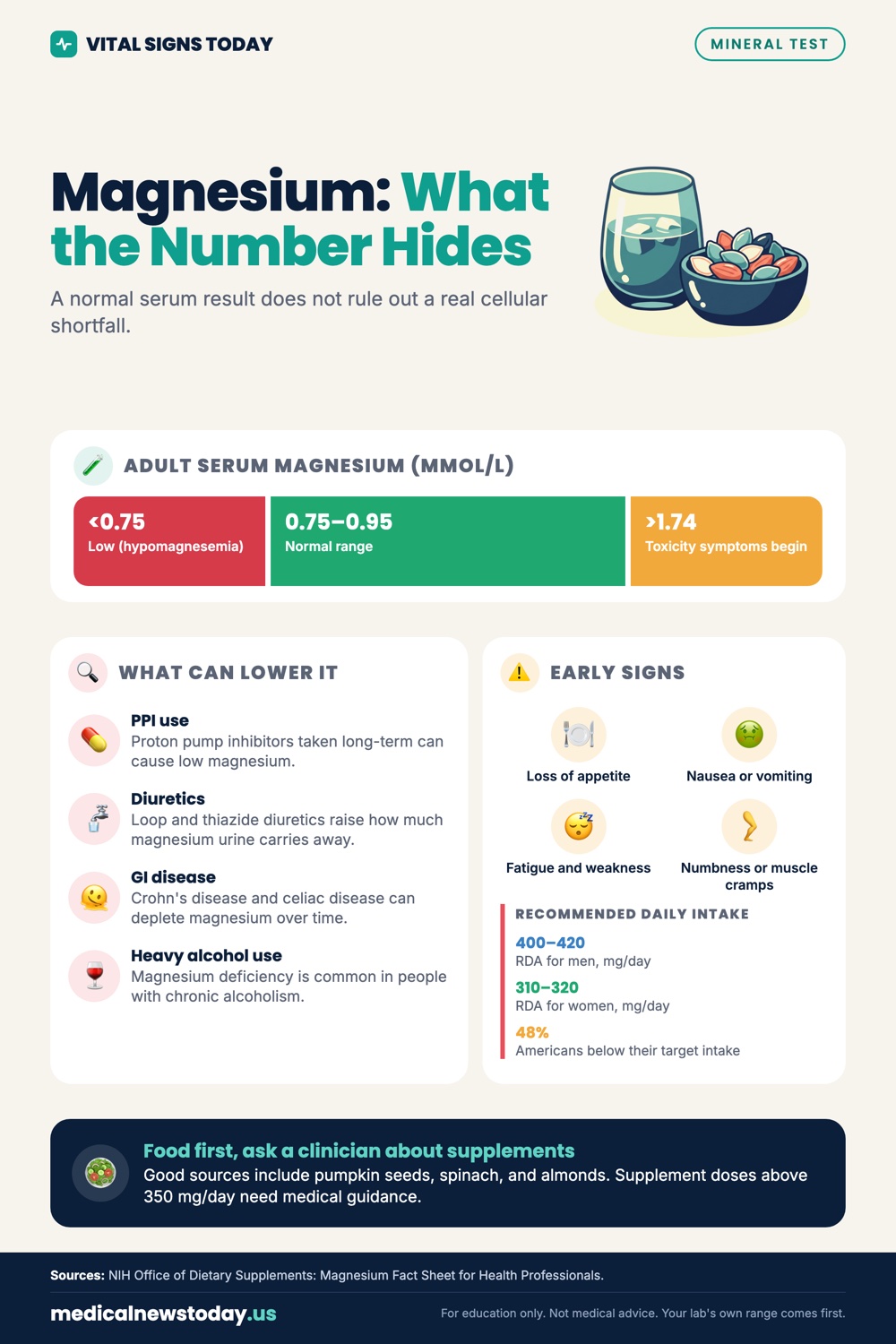
Most US laboratories report a serum magnesium reference range of 1.7 to 2.3 mg/dL (equivalent to 0.70 to 0.95 mmol/L). A result below 1.7 mg/dL is hypomagnesemia; above 2.3 mg/dL is hypermagnesemia.
| Category | Serum Mg (mg/dL) | Clinical significance |
|---|---|---|
| Low (hypomagnesemia) | <1.7 | Clinically significant; often symptomatic below 1.2 |
| Low-normal (gray zone) | 1.7 to 1.9 | Borderline; cellular stores may already be depleted |
| Optimal | 2.0 to 2.2 | Well-buffered; adequate dietary intake likely |
| High-normal | 2.2 to 2.3 | Usually benign; review supplement load |
| Elevated (hypermagnesemia) | >2.3 | Rare in healthy kidneys; most common with supplements or antacid overuse |
Want to check your magnesium?
Three ways to get it measured. Pick whichever fits you.
Affiliate links: we may earn a commission at no extra cost to you. A lab test does not replace a visit with your clinician.
An insider detail most patients miss: a serum result of 1.75 mg/dL technically sits inside the reference range, but a growing body of functional medicine evidence suggests that values below 2.0 mg/dL combined with classic symptoms warrant further investigation. The reference range was built to exclude the bottom and top 2.5 percent of a population, not to identify optimal function.
If you are reviewing your labs alongside other micronutrients, the best biomarkers to test guide puts magnesium in context with zinc, vitamin D, and other electrolytes that frequently co-deplete.
RBC Magnesium vs Serum Magnesium: Which Test Is Actually Useful?
RBC magnesium measures magnesium inside red blood cells and gives a 90 to 120 day average of intracellular magnesium status, the same logic as hemoglobin A1c for glucose. Because RBCs do not have mitochondria and are metabolically simpler than muscle cells, even this is an imperfect proxy for true tissue stores, but it is substantially more sensitive to depletion than serum alone.
Here is how the two tests compare in practice:
| Feature | Serum Magnesium | RBC Magnesium |
|---|---|---|
| What it measures | Circulating dissolved Mg | Intracellular Mg in red blood cells |
| Time window | Point-in-time | Roughly 90 to 120 day average |
| Sensitivity to depletion | Low (buffered by bone/kidneys) | Higher; detects subclinical deficiency earlier |
| Normal range | 1.7 to 2.3 mg/dL | 4.2 to 6.8 mg/dL (lab-dependent) |
| Availability | Every lab, every BMP/CMP | Specialty labs; Quest and LabCorp offer it |
| Cost (cash, uninsured) | $10 to $40 | $30 to $90 |
| Insurance coverage | Routine; usually covered | Often not covered; patient pays out of pocket |
The clinical scenario where RBC magnesium matters most: you have persistent muscle cramps, poor sleep, or anxiety, your serum magnesium is 1.9 mg/dL (technically normal), and you want to know whether cellular replenishment is warranted. A low RBC magnesium in that context gives you a concrete basis for a therapeutic trial of supplementation and a baseline to retest after 90 days.
For context: most conventional internists order serum only. Functional medicine physicians, sports medicine doctors, and some cardiologists routinely add RBC magnesium, especially for patients on diuretics, proton pump inhibitors (PPIs), or alcohol.
Low Magnesium Symptoms: When to Suspect Deficiency Even With a Normal Test
Low magnesium symptoms cover a wide and often misattributed range, which is why deficiency gets overlooked for months. The classic presentation involves neuromuscular irritability, but the full picture is broader.
Common symptoms that warrant a magnesium deficiency test:
- Muscle cramps, twitches, or fasciculations, especially at night or after exercise
- Restless legs that disrupt sleep
- Trouble falling or staying asleep despite normal sleep hygiene
- Palpitations or a sensation of skipped heartbeats
- Anxiety, irritability, or low-grade depression not explained by life circumstances
- Constipation or sluggish gut motility
- Frequent migraines (magnesium depletion lowers the cortical spreading depression threshold)
- Fatigue that does not resolve with rest
More severe depletion adds clinical signs: numbness and tingling, Chvostek sign (facial twitch with cheek tap), Trousseau sign (carpopedal spasm with blood pressure cuff), and in extreme cases ventricular arrhythmias. Those are emergency findings, not outpatient lab curiosities.
Who is at highest risk of functional deficiency even with normal serum results:
- People taking proton pump inhibitors for more than a year (PPIs impair intestinal magnesium absorption)
- Those on loop diuretics (furosemide) or thiazides (both cause renal magnesium wasting)
- Type 2 diabetics (osmotic diuresis from hyperglycemia depletes magnesium renally)
- Heavy alcohol users (alcohol increases urinary magnesium excretion)
- Anyone with Crohn disease, celiac, or short bowel syndrome
- High-intensity athletes with heavy sweat losses
- Older adults eating a processed food diet (refined grains and ultra-processed foods have essentially zero magnesium)
High Magnesium Causes: Hypermagnesemia in Clinical Practice
Hypermagnesemia, a serum level above 2.3 mg/dL, is far less common than deficiency and almost always has an identifiable cause. Healthy kidneys excrete excess magnesium efficiently, so sustained elevation typically means impaired renal clearance or a large exogenous load.
The most common causes in outpatients:
- Overuse of magnesium-containing antacids or laxatives (Milk of Magnesia, Maalox) in someone with reduced kidney function
- High-dose supplementation (glycinate, citrate, oxide) exceeding 600 to 800 mg elemental magnesium daily, especially in older adults
- Chronic kidney disease stage 3b or higher, where filtration cannot keep up with dietary intake
- Preeclampsia treatment with IV magnesium sulfate (iatrogenic; monitored in hospital)
Mild hypermagnesemia (2.3 to 3.0 mg/dL) is usually asymptomatic and resolves by stopping the offending supplement. Above 4.0 mg/dL, patients experience nausea, flushing, and hypotension. Above 6.0 mg/dL, deep tendon reflexes are lost and cardiac conduction slows, which is a medical emergency. In outpatient labs, values that high almost always reflect an error in the sample (EDTA contamination, hemolysis) or a patient with advanced CKD who was not previously identified.
The simplest way to actually get this done
Superpower is a full-body lab membership that runs 100+ biomarkers, has each result reviewed by a doctor, and tracks your numbers year over year (about $199/year). It is what we point readers to when they would rather get one clean, complete draw than chase single tests one at a time. Here is superpower blood test reviewed in full.
Where to Get a Magnesium Blood Test and What It Costs
Ordering a magnesium blood test is straightforward. The harder question is deciding which test to order and where to get it at a price that makes sense for your situation.
Options in the US:
- Through your doctor or urgent care: Serum magnesium is almost always included in a CMP, ordered during routine physicals or when symptoms prompt it. If your insurance covers preventive labs, there may be no out-of-pocket cost. Ask specifically for the CMP, not just a lipid panel.
- Direct-to-consumer labs (Quest, LabCorp patient portals, Walk-In Lab, Any Lab Test Now): Serum magnesium cash prices run $10 to $40. RBC magnesium adds $30 to $80. You order online, go to a draw center, and get results in 24 to 72 hours. No physician order needed in most states.
- CVS MinuteClinic and similar retail health clinics: Can order basic metabolic labs including serum magnesium. Useful for insured patients; less price-competitive for cash payers than direct lab portals.
- Comprehensive membership panels: Services like Superpower include magnesium as part of a broader metabolic and micronutrient panel, with physician review of flagged results. The value proposition is not the single test; it is getting magnesium alongside 100-plus other markers so you see patterns across electrolytes, kidney function, and inflammation at once. See the superpower blood test review for what the panel covers.
HSA and FSA funds cover blood tests ordered with a clinical purpose. If you are ordering direct-to-consumer, a letter of medical necessity from your primary care physician or a platform physician makes the expense HSA-eligible.
Medicare Part B covers serum magnesium when medically necessary (a qualifying diagnosis on the order). It does not routinely cover RBC magnesium as a standalone test, though coverage may apply as part of a panel under specific diagnosis codes.
How to Interpret Your Magnesium Test Results
Getting the number is the easy part. Interpreting it accurately requires context the lab printout does not supply.
Step through your result this way:
- Check where in the range you fall, not just in or out. A result of 1.85 mg/dL is technically normal but sits in the low-normal gray zone. If you have symptoms, do not accept “your magnesium is fine” without discussing RBC magnesium or a trial of supplementation.
- Look at kidney function simultaneously. Creatinine, eGFR, and BUN on the same panel tell you whether the kidneys are excreting magnesium properly. Low magnesium plus impaired kidneys requires different management than low magnesium with normal kidney function. The albumin test on the same panel also matters because low albumin (seen in liver disease or malnutrition) can mildly lower total magnesium even when ionized magnesium is adequate.
- Review your medications. If you are on a PPI, diuretic, or aminoglycoside antibiotic, low serum magnesium is the expected result, not a surprise finding. The fix often requires either switching the offending medication or maintaining higher oral magnesium intake indefinitely.
- Correlate with calcium and potassium. Magnesium deficiency impairs the PTH response and renal potassium reabsorption, so low magnesium frequently co-presents with hypocalcemia and hypokalemia. If your potassium keeps drifting low despite supplementation, check magnesium; it is a common missed cause of refractory hypokalemia.
- If you supplemented recently, time matters. Taking 400 mg of magnesium the night before a test can temporarily raise serum levels 0.1 to 0.2 mg/dL without changing cellular stores. For the most accurate assessment of true baseline, hold supplements 24 to 48 hours before the draw.
Here is how this plays out in practice. A 44-year-old woman on a PPI for reflux comes in with nightly calf cramps, restless legs, and a potassium that keeps drifting to the low end despite a supplement. Her serum magnesium reads 1.8 mg/dL, and her previous clinician called it normal. Reading the range rather than the cutoff, adding an RBC magnesium that comes back frankly low, and connecting it to years of PPI use reframes the whole picture: the reflux drug has been quietly wasting magnesium, and the low potassium is downstream of that. The fix is not another potassium pill. It is repleting magnesium, then re-evaluating whether the PPI is still needed. Within a few months of consistent magnesium glycinate, both the cramps and the refractory potassium resolve.
Talk to a clinician about your results if you are also seeing abnormalities in calcium, phosphate, or kidney function, or if your symptoms do not resolve after a 90-day supplementation trial.
Magnesium intersects with bone metabolism through alkaline phosphatase, an enzyme that rises when bone turnover is elevated. If your ALP is flagged on the same panel, see the alkaline phosphatase test explainer for what that combination suggests.
Magnesium Deficiency Test: Choosing the Right Approach for Your Situation
There is no single perfect magnesium deficiency test, and clinicians who tell you otherwise are oversimplifying. The right approach depends on what you are trying to answer.
For population-level screening or acute inpatient management, serum magnesium is appropriate. It is cheap, fast, and catches severe deficiency reliably. For an otherwise healthy adult with persistent cramps, poor sleep, or anxiety who wants to know whether subclinical magnesium depletion is a factor, running serum plus RBC magnesium together gives a more complete picture.
For athletes or anyone under high physiological stress, some sports medicine physicians also use a 24-hour urine magnesium collection. That test measures how much magnesium the kidneys are wasting. A low serum magnesium with high 24-hour urine output points to a renal leak (medication, genetic tubular defect); low serum with low urine output points to inadequate intake or intestinal malabsorption.
A practical magnesium deficiency test protocol for a motivated adult:
- Order serum magnesium and RBC magnesium together (most direct-to-consumer labs offer a bundle).
- Hold supplements 48 hours before the draw.
- If both are low or low-normal with symptoms present, start magnesium glycinate or bisglycinate at 200 to 400 mg elemental magnesium daily for 90 days.
- Recheck RBC magnesium at 90 days. Normalization alongside symptom improvement is meaningful confirmation.
Magnesium supplements are broadly safe at those doses, but in anyone with known CKD or a GFR below 45, oral magnesium should be used cautiously and checked more frequently.
The adiponectin test is an example of another metabolic marker that sits in a similar blind spot for conventional screening. Read the adiponectin test page to see how insulin sensitivity and inflammation interact with magnesium metabolism at the cellular level.
FAQ
What does a magnesium blood test show?
It shows the concentration of magnesium in your serum (standard test) or inside your red blood cells (RBC test). Serum magnesium screens for severe deficiency or excess and appears on every basic and comprehensive metabolic panel. RBC magnesium gives a better estimate of cellular magnesium stores over the prior 90 to 120 days. Neither test directly measures magnesium in muscle or bone, which is where 99 percent of the body’s total magnesium resides.
What is the normal magnesium range on a blood test?
For serum magnesium, most US labs use 1.7 to 2.3 mg/dL as the reference interval. For RBC magnesium, ranges vary by laboratory but commonly fall between 4.2 and 6.8 mg/dL. Because lab-specific ranges differ, always interpret your result against the reference interval printed on your own lab report rather than against a number you found online.
Can my magnesium be low even if my blood test is normal?
Yes, and this is the central limitation of serum testing. Because the kidneys and bones defend serum levels, you can have substantial cellular depletion while serum magnesium reads in the normal range. RBC magnesium is more sensitive to this subclinical state. Symptoms like nocturnal cramps, palpitations, and anxiety in the presence of a low-normal serum result (1.7 to 1.9 mg/dL) are clinically meaningful even when the number technically clears the cutoff.
How do I prepare for a magnesium blood test?
No fasting is required for serum magnesium alone. If you take magnesium supplements, holding them for 24 to 48 hours before the draw gives a truer baseline; otherwise the result reflects recent intake rather than your ongoing status. If the magnesium is part of a CMP or lipid panel, follow fasting instructions for those tests (usually 8 to 12 hours).
What causes high magnesium on a blood test?
Hypermagnesemia in outpatients is almost always from overuse of magnesium-containing antacids or supplements combined with reduced kidney clearance. Less common causes include lithium therapy, hypothyroidism, and Addison disease. A single mildly elevated result (2.4 to 2.8 mg/dL) in an otherwise healthy person often warrants a repeat test with supplement discontinuation before assuming a pathological cause.
Is an RBC magnesium test covered by insurance?
Most major insurers do not cover RBC magnesium as a standalone routine test. It may be covered under specific ICD-10 diagnosis codes related to hypomagnesemia or arrhythmia investigation, but coverage is inconsistent. Cash prices through Quest or LabCorp direct portals typically run $30 to $90. HSA and FSA funds can be used if you have documentation of clinical purpose.
How long does it take to correct magnesium deficiency?
Serum magnesium can normalize within days of starting oral supplementation, which is misleading because cellular stores take much longer to replenish. Most clinicians recommend 90 to 120 days of consistent daily supplementation before rechecking RBC magnesium to confirm intracellular repletion. Magnesium glycinate and bisglycinate have better absorption and fewer GI side effects than oxide forms at equivalent doses.
Which foods are highest in magnesium?
Dark leafy greens (spinach, Swiss chard), pumpkin seeds, almonds, black beans, and dark chocolate are among the richest dietary sources, each providing 50 to 150 mg of elemental magnesium per serving. Whole grains retain magnesium that is stripped during refining. A diet built substantially on processed foods and refined grains is a reliable route to chronically inadequate magnesium intake, which is likely why dietary surveys estimate that roughly half of Americans fall below the RDA.
Does magnesium really affect sleep and anxiety, or is that a supplement myth?
There is a real mechanism behind it, not just marketing. Magnesium supports the calming GABA system, helps regulate the stress hormone axis, and stabilizes the electrical excitability of nerve cells. People who are genuinely depleted often report better sleep and lower baseline anxiety once they are repleted. The caveat is that supplementing does the most for people who are actually low. If your cellular magnesium is already adequate, adding more is unlikely to sedate you, and very high doses of the oxide form mostly produce a laxative effect rather than calm.
Which form of magnesium supplement is best?
For correcting a deficiency with the fewest side effects, chelated forms like magnesium glycinate or bisglycinate are the usual first choice because they absorb well and rarely cause loose stools. Magnesium citrate is well absorbed but more laxative, which some people want and others do not. Magnesium oxide is cheap and common but poorly absorbed, so a large fraction passes through the gut, which is exactly why it is often sold as a laxative rather than a repletion agent. Match the form to your goal instead of buying on price alone.
Should I get a magnesium test if I take a magnesium supplement?
Testing is useful in two situations: before you start, to confirm that deficiency is actually present, and after 90 days of supplementation, to confirm you have reached an adequate cellular level. Supplementing without testing is not dangerous at standard doses, but testing removes the guesswork and lets you stop if your levels are already sufficient, avoiding unnecessary expense and the laxative effect that comes with high magnesium oxide doses.