
Educational content, not medical advice. Talk to a licensed clinician before changing any supplement regimen.
Short answer: Collagen peptides can contribute to constipation in some people, but collagen itself is not the direct cause. The mechanism is indirect: collagen powder is pure protein with zero dietary fiber, and adding a 10-20 gram protein load without adjusting fluids or fiber intake slows colon transit in a predictable, correctable way. The good news is that a 2022 clinical study published in JMIR Formative Research found that 93% of participants who completed an 8-week collagen peptide protocol actually reported improved digestive symptoms, including relief from constipation, not the other way around.
Collagen without enough fiber can slow digestion. Want to see your full nutrient and digestive-related markers? One at-home Superpower draw checks 100+ biomarkers, physician-reviewed.
Does collagen actually cause constipation, or is something else going on?
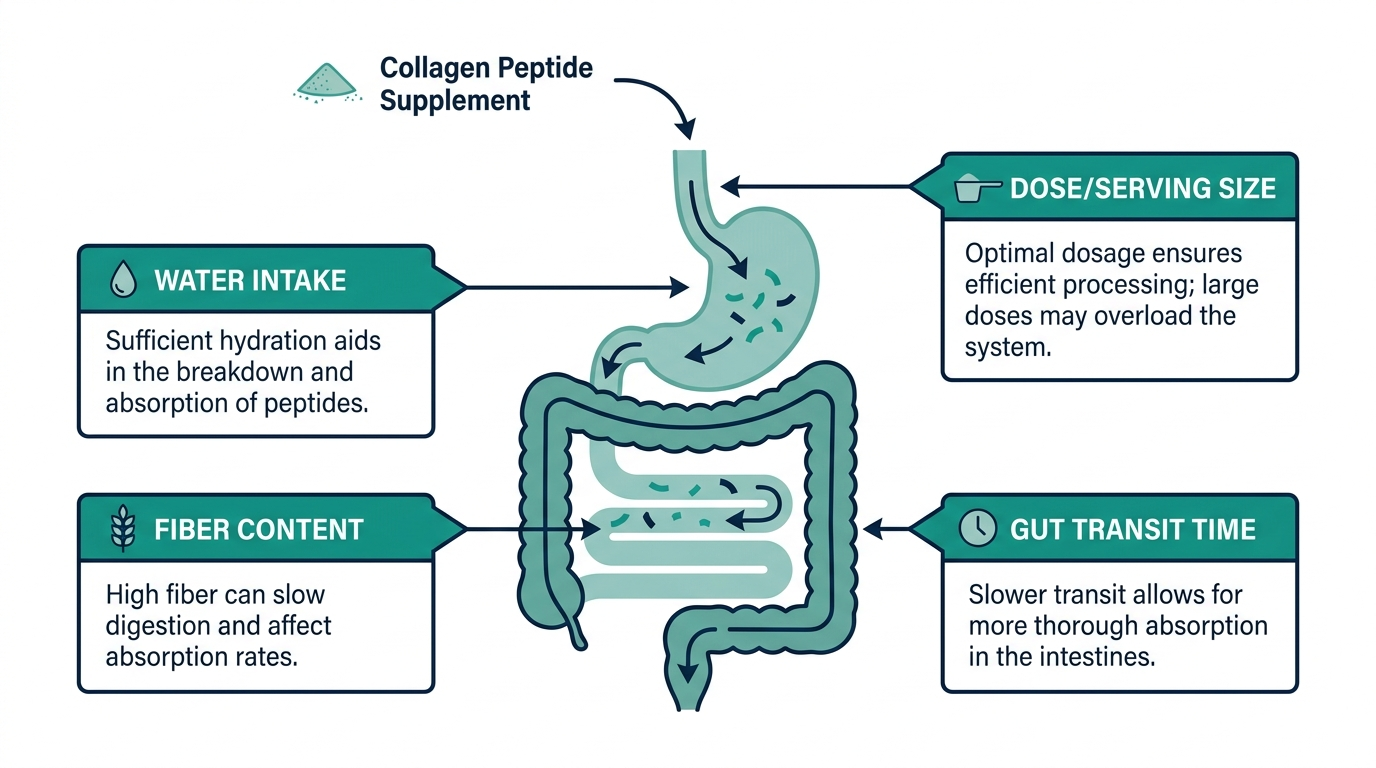
This is the real question, and the honest answer is: both can be true at the same time, depending on what else you are eating and drinking.
Collagen peptides are hydrolyzed proteins, broken down into short amino acid chains of roughly 3 to 10 amino acids each, with an average molecular weight under 5 kDa. Your gut absorbs the majority of those chains in the small intestine. What is not absorbed continues into the colon, where it undergoes fermentation by gut bacteria, producing short-chain fatty acids (SCFAs) and colonic gases. Those SCFAs, particularly butyrate, actually stimulate colon muscle contractions and support stool motility. So at the biochemical level, collagen has a mildly pro-motility profile.
The problem is not the collagen molecule. The problem is displacement: most people who add a collagen supplement do not add anything else. They are substituting a fiber-free protein powder for something that used to have fiber in it, or they are adding protein to a diet that was already short on fluids. That is the setup for constipation, and it has nothing to do with glycine, proline, or hydroxyproline.
Think of it like adding a new brick to a wall without adding mortar. The brick is not the problem. The missing mortar is.
What is the actual mechanism behind collagen-related constipation?
Three separate mechanisms can operate independently or compound each other.
Mechanism 1: protein pulls water from the colon. Digesting protein requires more water than digesting carbohydrates. When you add 10-20 grams of collagen daily without proportionally increasing fluid intake, your body draws water from colon contents to support the extra digestive workload. The result is harder, drier stool and slower transit. This is the most common scenario and is purely a hydration math problem.
Mechanism 2: no fiber means no bulk, no SCFA boost. Dietary fiber, both soluble and insoluble, does two things that collagen cannot do: it adds physical bulk to stool, and soluble fiber feeds the colonic bacteria that produce butyrate and other SCFAs. Collagen powder contains no fiber. If you are not eating roughly 25 grams of dietary fiber per day alongside your collagen, you are not giving your colon the mechanical or microbial stimulus it needs to move things along.
Mechanism 3: calcium overload from certain product sources. Some marine collagen supplements, particularly those sourced from fish bones rather than fish skin, carry elevated calcium levels. Excess calcium slows bowel motility directly by reducing smooth-muscle contractility in the colon. This one is product-specific, not universal, but it explains why some users who switch from bovine to marine collagen (or vice versa) suddenly notice a change in regularity. Bovine collagen typically carries less calcium than bone-derived marine products.
Personally, I think the calcium angle is the most underreported factor. It rarely comes up in the “drink more water” advice columns, yet a simple swap from one product to another can resolve the problem in two or three days without any other change.
Who is actually at risk?
Not everyone who takes collagen will experience any digestive change at all. The JMIR Formative Research study found net improvement, not worsening, in digestive symptoms across its cohort. But specific situations do raise the risk.
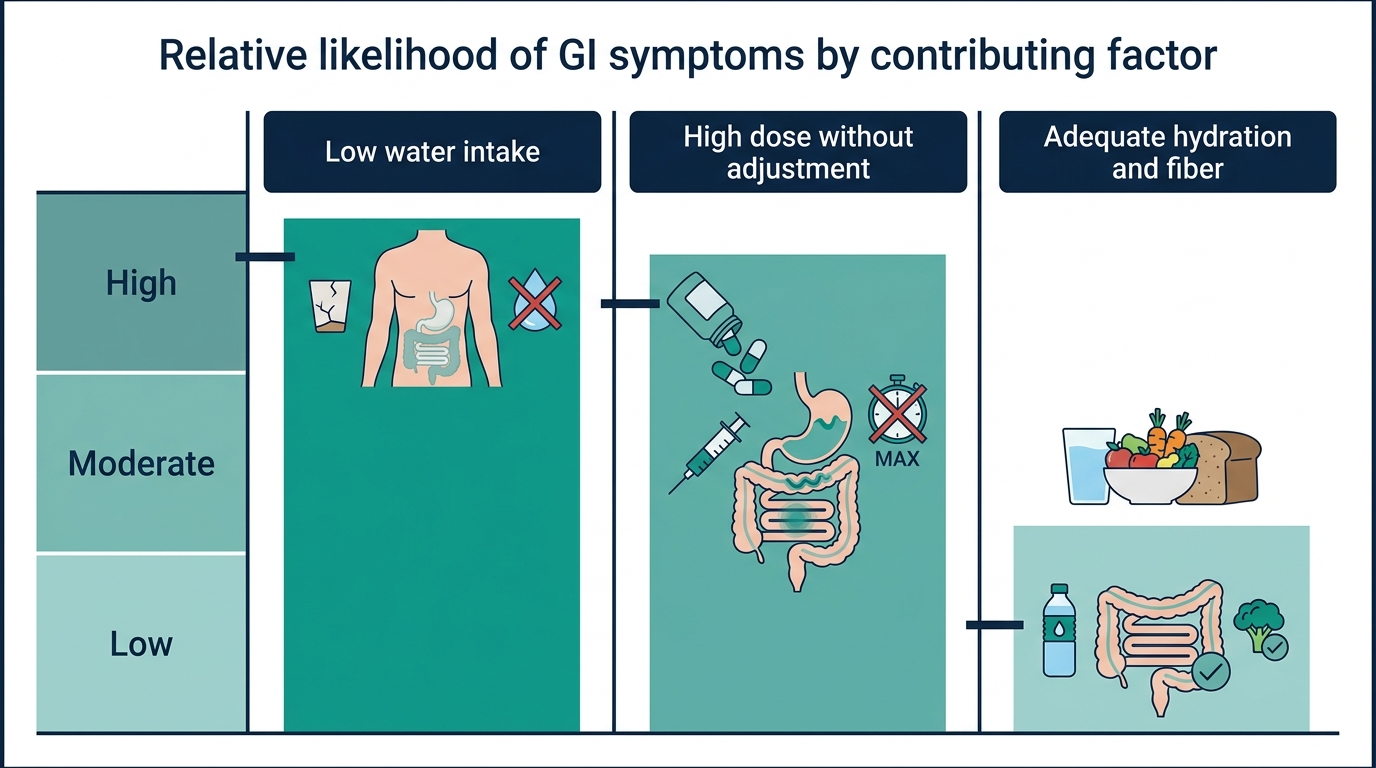
| Risk factor | Why it matters | Who it hits |
|---|---|---|
| Starting dose too high (20 g on day 1) | Sudden protein load the gut bacteria have not adapted to | Beginners without supplement history |
| Low baseline fiber intake (under 15 g/day) | No bulk, no SCFA signal for motility | Common on low-carb or high-protein diets |
| Drinking under 1.5 L of water daily | Colon reabsorbs water from stool | People who drink mostly coffee or soda |
| Marine collagen from fish bone sources | Elevated calcium load slowing smooth muscle | Anyone who switched product and noticed change |
| Non-hydrolyzed collagen (gelatin, whole collagen) | Larger molecular fragments, slower digestion | People using cooking-grade gelatin rather than hydrolyzed powder |
| Pre-existing IBS-C or slow-transit constipation | Gut already prone to slow motility | Older adults, sedentary individuals |
The category of people who will not notice anything: those already eating high-fiber diets with adequate hydration, taking 5-10 grams rather than 20 grams, and sourcing from hydrolyzed bovine collagen with low calcium additives.
Full-body lab membership: 100+ biomarkers, doctor-reviewed, tracked over time.
Bovine collagen vs marine collagen: which is easier on your gut?
This is a genuinely contested question with conflicting claims in marketing materials, and the science does not give a clean winner.
Marine collagen peptides, typically Type I sourced from fish skin, have a lower average molecular weight than bovine collagen. Smaller peptides absorb more rapidly and may produce less fermentation residue in the colon, which is the argument for marine being “gentler.” In practice, many users with sensitive stomachs do find marine collagen produces less bloating.
However, marine collagen sourced from fish bones, rather than skin, contains significantly more calcium. And fish-bone-derived products sometimes show total calcium content 3-5 times higher per serving than equivalent bovine products. That calcium load, rather than the peptide size, may be why some people experience constipation when switching to marine.
Bovine collagen, primarily Types I and III from grass-fed cattle hide, has a slightly larger peptide size on average but carries a more predictable, lower-calcium mineral profile. For most people, bovine is the more neutral starting point.
The real split is not source, it is formulation. Check whether your marine collagen specifies “fish skin” or “fish bone” as the raw material. Skin-derived marine collagen avoids the calcium problem. Bone-derived versions are cheaper to manufacture and are the ones most likely to cause calcium-related motility slowdown.
Do not believe the marketing claim that marine collagen is universally gentler. The bone-derived versions are not. Read the source disclosure, not the front-of-label copy.
What are the fixes? (specifics, not platitudes)
Three adjustments cover nearly every case of collagen-associated constipation, and most people resolve the issue within 48-72 hours of making all three.
Fix 1: cut the dose and ramp slowly. If you started at 20 grams per day, drop to 5 grams for one week, then 10 grams for week two, then 15 grams for week three, then your target. This gives colonic bacteria time to adapt to an increased protein fermentation load without generating excess gas and disrupting motility. The Cleveland Clinic recommends 10-20 grams per day as the effective range, but starting near the bottom of that range is the sensible approach for anyone with a history of digestive sensitivity.
Fix 2: drink water specifically when you take your collagen. The target for general health is roughly 2 liters of water per day, but the collagen-specific fix is timing. Take your collagen with 300-400 mL of water, not in a small sip of coffee. The protein digestion load hits within 60-90 minutes of ingestion; having the water already in your system when digestion peaks avoids the colon water-draw mechanism.
Fix 3: pair with a fiber source at the same meal. Chia seeds (10 grams of fiber per 28-gram serving), ground flaxseed (8 grams per 28 grams), or a handful of berries (4-8 grams) mixed into your collagen drink provides both soluble and insoluble fiber in the same ingestion window. This is not optional if your overall diet runs below 20 grams of fiber per day. You do not need a supplement; whole food fiber at the same meal is sufficient.
If you have checked all three and still see no change after one week, consider switching from bone-derived marine collagen to skin-derived or bovine, and verify there are no added calcium supplements in your collagen blend, which some brands include for bone health positioning.
Does collagen actually help with gut health, or is that marketing?
The gut-health claim for collagen is more grounded than most supplement positioning, but it needs a narrower framing to be accurate.
Glycine and glutamine, two amino acids present in high concentrations in collagen peptides (glycine alone makes up roughly 33% of the total amino acid profile), have well-documented roles in maintaining intestinal epithelial integrity. Glycine supports tight-junction proteins in the gut lining, and glutamine is the preferred fuel source for enterocytes, the cells lining the small intestine. When the gut lining is intact, inflammatory permeability (“leaky gut”) is reduced, and overall digestive symptoms tend to improve.
The ScienceDirect study on high-collagen peptide diets and gut microbiota found that collagen peptide fermentation in the colon increased production of beneficial short-chain fatty acids, including butyrate, which feeds colonocytes (colon lining cells) and supports peristalsis. The mechanism for improved bowel habits, then, is not magic: it is the downstream effect of microbiome-level fermentation producing butyrate, which physically stimulates the colon to contract and move contents.
The caveat: these benefits are observed in adequately hydrated participants eating sufficient dietary fiber. Strip those out and you are left with protein fermentation that produces gas and, potentially, slower transit. The supplement does not override diet. It works with it.
Hydrolyzed type I & III collagen peptides, third-party tested, unflavored.
The myth-busting take on popular advice
The standard advice you will find on supplement brand blogs is: “drink more water, take less collagen, add fiber.” That advice is correct, but it misses two things that practitioners who work with collagen-heavy protocols would tell you.
Myth: collagen causes constipation in most users. The data says the opposite for most people. In the JMIR 2022 study, 93% of completers saw improvement in digestive symptoms, including constipation relief. The people who report constipation online are a self-selected group who had a problem. The majority who take collagen without issue never post about their bowel movements.
Myth: marine collagen is always gentler than bovine. As covered above, bone-derived marine collagen can carry 3-5x the calcium load of bovine. The peptide-size advantage of marine is real but is sometimes outweighed by the calcium disadvantage in the wrong formulation.
Myth: taking collagen on an empty stomach is better for absorption. This is often repeated without evidence. What the empty-stomach protocol actually does is concentrate the protein digestion episode in your gut without any food matrix to buffer it, which increases the likelihood of a gas and transit response. A 2019 review in the European Journal of Clinical Nutrition found no absorption advantage for peptide supplements taken fasted versus with a meal, but noted more GI symptoms in fasted protocols. Taking collagen with food is not worse for absorption. It is better for your gut.
What does the 2022 clinical study actually prove?
The JMIR Formative Research 2022 study (PMC9198822) is worth reading past the headline number. It was an 8-week digital study, the “Gutme!” app trial, conducted in healthy US women with a BMI over 25. Participants tracked digestive symptoms, mood, stool characteristics, and lifestyle for 2 weeks at baseline, then for 8 weeks while taking 20 grams of collagen peptides per day, split into two 10-gram doses.
Of the 40 recruited participants, 14 (35%) completed the full protocol, and 13 of those 14 reported reduced digestive symptoms. That completion rate is a real limitation: 35% is low, and we do not know why the other 65% dropped out. Some likely dropped due to GI issues they were not willing to complete. So the 93% headline applies to completers, not the full cohort.
Still, the direction of effect is meaningful: among people who tolerated the regimen for the full 8 weeks, net digestive outcomes moved positive. The researchers noted that the mechanism for improved bowel frequency was likely “a shift in microbiome composition because of the increased protein load, or simply because of an increase in water consumption” driven by the protocol. Both of those are instructive: the study itself was not controlling for hydration, which means the benefit may partly reflect the extra water participants were drinking with their collagen servings.
The practical implication: collagen is not constipating for most people who dose and hydrate correctly. It may mildly improve bowel regularity over 6-8 weeks if the rest of the diet is otherwise in order.
Turn what you just learned into action.
Superpower lets you test 100+ biomarkers from home, then re-check them over time so you can actually see progress, physician-reviewed at every step.
Frequently asked questions
Will collagen constipation go away on its own?
In most cases, yes. Collagen-associated constipation is typically transient and resolves within 3-7 days once the body adapts to the higher protein load, provided you are adequately hydrated and not dramatically under-eating fiber. If it persists beyond two weeks without improvement after adjusting dose, water intake, and fiber, speak to a clinician to rule out an underlying cause.
How much water should I drink when taking collagen?
The general recommendation is 2 liters (about 8 cups) of water per day for adults. The collagen-specific version of that is to take each dose with at least 300-400 mL of water, not dissolved in a small amount of coffee or a single sip. Protein digestion peaks 60-90 minutes after ingestion; having the fluid already in your system matters more than the total daily number.
Is there a collagen supplement less likely to cause constipation?
Yes, three factors reduce the risk: (1) bovine or fish-skin-derived marine collagen rather than fish-bone marine, since bone-derived marine carries significantly more calcium; (2) a plain hydrolyzed collagen powder without added calcium, magnesium oxide, or prebiotics that could interact with motility; and (3) a dose starting at 5-10 grams rather than the full 20-gram serving. Vital Proteins unflavored bovine collagen and Sports Research USDA Organic collagen are both formulations that avoid the calcium-additive issue.
Can I take collagen if I already have constipation?
Yes, with adjustments. If you have pre-existing slow-transit constipation or IBS-C, start at 5 grams per day with a high-fiber meal and increase weekly. Monitor stool frequency and hardness for the first two weeks. The data from the JMIR study suggests collagen can actually improve symptoms over 6-8 weeks in people with mild baseline digestive issues, but the ramp period matters more for anyone whose gut is already sensitive.
Does the type of collagen (Type I, II, or III) affect constipation risk?
The collagen type is less relevant than the source and formulation. Type II collagen, primarily found in cartilage and joint supplements, is often derived from chicken sternum and formulated differently from the hydrolyzed powders used for skin and gut. But the protein-fiber-fluid mechanism applies regardless of type. The source (bovine, marine, porcine, chicken) and what is added to the formula matter more than whether the collagen is labeled Type I, II, or III.
What else can cause constipation that looks like a collagen reaction?
Several things can coincide with starting a new supplement. The most common confounders are: travel or schedule disruption (reduced activity slows transit); starting a low-carbohydrate or keto diet around the same time (which drastically cuts fiber); prescription medications with constipating effects (opioids, certain antihypertensives, iron supplements); and inadequate thyroid function, which reduces gut motility systematically. If you are unsure whether collagen is the cause, stop for two weeks and monitor, then restart. A clearcut response in either direction tells you what you need to know.
Is constipation a sign I am taking too much collagen?
It can be, but it is also a sign of inadequate fluids or fiber regardless of dose. A 20-gram serving is at the high end of the effective range, and the same benefits for skin, joint, and gut markers are achievable at 10-15 grams for most people. If you are constipated at 20 grams and symptom-free at 10 grams, the lower dose is the right dose for your gut.
Author: Vital Signs Today Editorial Team, [credential]”]. Educational content, not medical advice. Sources linked inline.
Hydrolyzed type I & III collagen peptides, third-party tested, unflavored.
Primary sources
- Effect of a Daily Collagen Peptide Supplement on Digestive Symptoms in Healthy Women: 2-Phase Mixed Methods Study, JMIR Formative Research 2022 (PMC9198822)
- Effect of a high-collagen peptide diet on the gut microbiota and short-chain fatty acid metabolism, Journal of Functional Foods 2020 (ScienceDirect)
- Gastrointestinal Digestion Model Assessment of Peptide Diversity and Microbial Fermentation Products of Collagen Hydrolysates, PMC 2021 (PMC8401164)
- Can Collagen Cause Constipation? Symptoms, Fixes and Safer Use, Fallbrook Medical Center
- Collagen and Constipation: Is There a Link?, Enemeez
- Can Eating Too Much Protein Cause Constipation?, GoodRx
- Collagen Peptides Side Effects, WebMD
- Collagen Side Effects: What They Are and How to Avoid Them, ProT Gold
- Collagen Peptides and Gut Health: The Digestive Connection, Zenwise
Related reading
Vital Signs Today may earn a commission if you buy through links on this page. It does not affect our editorial assessments.