
Last updated 18 June 2026. Educational content, not medical advice. Laws and FDA classifications change frequently. Talk to a licensed clinician before using any peptide therapeutically.
Short answer: Most peptides are not illegal to possess in the US, but “not illegal” covers at least four legally distinct situations, and standing in the wrong one carries real consequences. FDA-approved peptide drugs (semaglutide, tirzepatide, sermorelin) are fully legal with a prescription. Twelve popular therapy peptides including BPC-157 and TB-500 were removed from the FDA’s “do not compound” Category 2 list on April 23, 2026, and are heading toward licensed compounding status. Selling any peptide for human use without FDA approval is illegal at the commercial level. And five peptides including Melanotan II remain restricted with no path to compounding until at least early 2027. The word “peptide” covers all of these simultaneously.
Peptide legality is a maze of gray areas. Before you start anything, see what your body’s baseline actually is. One at-home Superpower draw checks 100+ biomarkers, physician-reviewed.
Why does this question have so many conflicting answers?
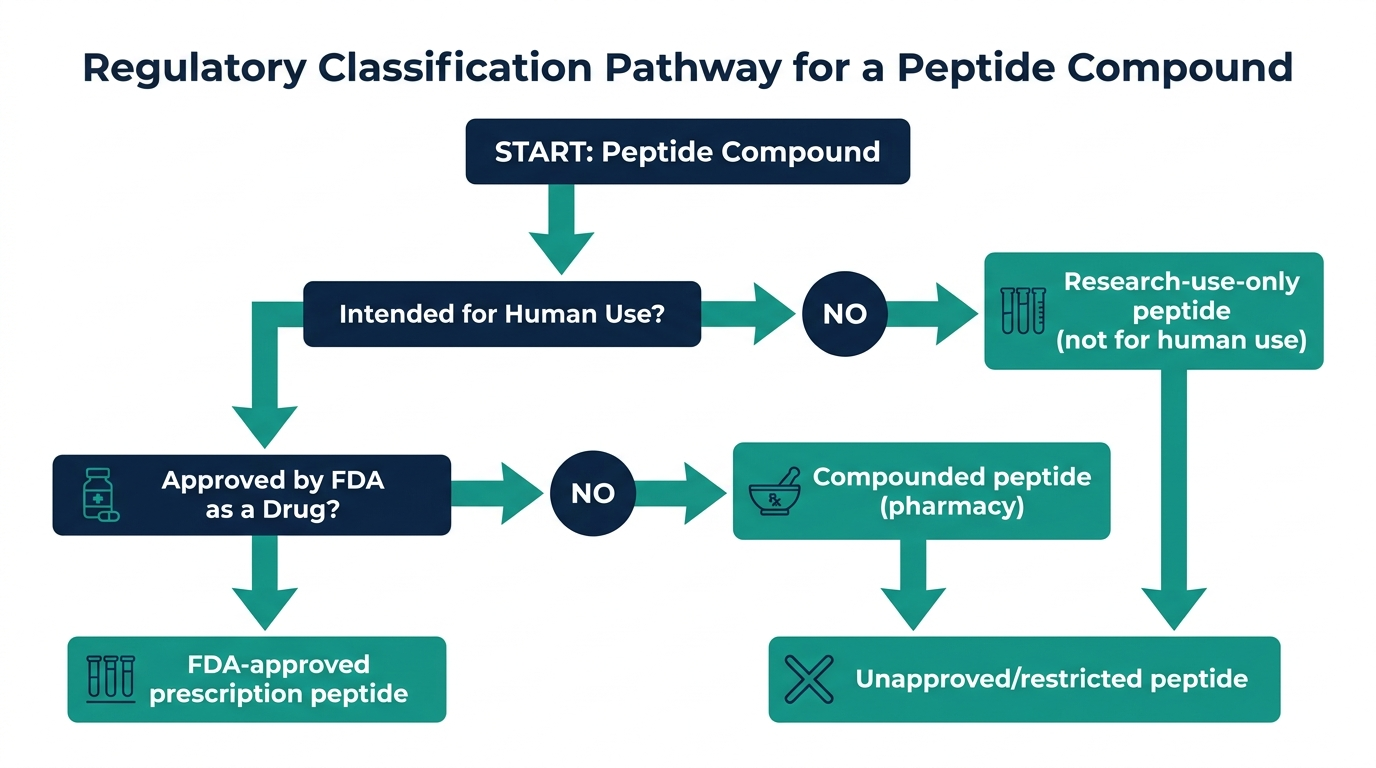
Because the same word covers wildly different molecules and completely different regulatory lanes. Collagen peptides in your morning smoothie powder are a dietary supplement regulated under DSHEA. GHK-Cu in your face serum is a cosmetic ingredient. Semaglutide (Ozempic) is a Schedule IV prescription drug. BPC-157 in a vial from a research vendor is legally a research chemical that no one has approved for human use. Melanotan II is a flat-out restricted substance with documented links to melanoma progression.
A reporter asking “are peptides illegal?” is like asking “are cars fast?” The question only makes sense once you name the specific thing.
When you type “are peptides illegal” into a search engine, you usually want one of three answers: Can I be arrested for having this? Will my online order get seized? Can I get this through a doctor? Each of those has a different answer, and none of them is simply “yes” or “no.”
Full-body lab membership: 100+ biomarkers, doctor-reviewed, tracked over time.
What does “illegal” actually mean in the peptide context?
The word gets used loosely in this space, and the imprecision causes real harm. In the US, three different things are called “illegal” when people discuss peptides, and they operate under completely different legal mechanisms.
Criminal illegality (you can be prosecuted): No common peptide is a DEA-scheduled controlled substance the way anabolic steroids are under Schedule III. As of June 2026, no peptide commonly discussed in wellness communities has been placed on the DEA’s controlled substance schedules, though the agency has reviewed certain growth hormone secretagogues for potential scheduling. Personal possession of a research peptide is not a federal crime.
Regulatory illegality (you, or more likely a vendor, violates FDA rules): This is where most of the real risk sits. The FDA regulates peptides primarily through misbranding and unapproved new drug statutes under 21 CFR Part 312. Selling a peptide with therapeutic claims for human use, without an approved New Drug Application, violates those statutes. The FDA has continued to open misbranding and unapproved-drug enforcement actions against peptide sellers, including warning letters and, in some cases, criminal referrals. The enforcement target is almost always the seller, not the individual buyer.
Contractual and sports-organization illegality: WADA’s 2026 Prohibited List bans a long list of peptides outright for competitive athletes. GLP-1 receptor agonists such as semaglutide and tirzepatide are not currently prohibited; they sit on WADA’s 2026 Monitoring Program, where their use is tracked but not sanctioned. The Prohibited List is reviewed annually, so that status can change. TB-500 is explicitly banned. BPC-157 is not listed by name but falls under S2.3’s catch-all language banning growth factors affecting tendon and ligament regeneration. None of this is federal law, but a positive test ends careers.
The four-lane map: where each peptide sits
This is the framework that makes the legal question answerable. Every peptide you are likely to encounter falls into one of four lanes.
| Lane | Examples | Regulated how | Can you get it legally? |
|---|---|---|---|
| FDA-approved drugs | Semaglutide (Ozempic/Wegovy), tirzepatide (Mounjaro/Zepbound), sermorelin, tesamorelin (Egrifta), oxytocin | Full drug approval, prescription required | Yes, with a valid prescription |
| Compounding-eligible (pending July 2026 PCAC) | BPC-157, TB-500, KPV, MOTs-C, Semax, Epitalon, DSIP | Removed from Category 2 April 23, 2026; awaiting Category 1 decision | Grey zone clearing; licensed pharmacies increasingly willing |
| Research-use-only grey market | CJC-1295, Ipamorelin, retatrutide (investigational, in Lilly trials), GHRP-6 | FDA’s Final Guidance (enforceable Jan 2026) requires strict RUO labeling, no consumer marketing | Legal to buy labeled “research only,” not approved for human use |
| Restricted / not eligible for compounding | Melanotan II, LL-37 (Cathelicidin), Dihexa, GHK-Cu injectable, PEG-MGF | Remain on restricted list pending separate PCAC review by Feb 2027 | No legal compounding path currently; research label only |
The most important move in that table happened on April 15, 2026, when the FDA announced the removal of 12 peptides from its 503A Category 2 “do not compound” list, effective April 23, following withdrawal of the nominations that originally placed them there. The Frier Levitt analysis of the FDA action makes clear that removal from Category 2 is not approval for compounding; it means they are no longer explicitly restricted. BPC-157, TB-500, KPV, MOTs-C, Semax, Epitalon, DSIP, LL-37, Dihexa, GHK-Cu injectable, PEG-MGF, and Melanotan II were the twelve removed. A subset of those, specifically BPC-157, TB-500, KPV, MOTs-C, Semax, Epitalon, and DSIP, are scheduled for the Pharmacy Compounding Advisory Committee meeting July 23 to 24, 2026, where a positive committee vote would allow licensed compounding pharmacies to use them as bulk drug substances for the first time since 2023.
That meeting is the most consequential date on the peptide calendar this year.
Is BPC-157 legal now?
BPC-157 is in the most interesting legal position of any peptide right now, and the answer changes depending on which week you are asking. The FDA removed BPC-157 from Category 2 effective April 23, 2026, ending the explicit ban on compounding. But it was not simultaneously placed on the Category 1 “permitted for compounding” list, because that requires a PCAC review the committee has not yet conducted. The state from April 23, 2026 onward: BPC-157 is not explicitly prohibited, but also not explicitly authorized, for compounding. Legally, it occupies a narrow strip between two defined zones.
Practically, what this means is that some licensed compounding pharmacies are now willing to prepare BPC-157 under physician supervision, banking on the expected positive PCAC outcome in July. Others are waiting for formal Category 1 placement before touching it. If you are working with a telehealth clinic right now and they are offering compounded BPC-157, they are operating in that strip, not outside the law, but ahead of the formal clearance.
Personally, I think the July PCAC vote will go the way HHS has signaled, and within six months BPC-157 will be clearly Category 1. The smarter move is to establish a clinical relationship now and get it through a licensed compounding pharmacy when the formal path clears, rather than buying grey vials under a deadline that keeps moving.
What about the “research use only” label? Is that a legal shield?
This is the most misunderstood concept in the entire market, and it deserves a direct answer: the “research use only” label protects the vendor from certain FDA misbranding actions, not you from anything.
“Research use only” labeling is a long-standing convention in the lab-reagent market: the phrase “For Research Use Only, Not for Human Consumption” signals that a product is not intended or approved for people. But if a vendor markets a peptide with human wellness claims on a website full of “recovery” and “optimization” language, that label on the vial does not change what regulators see. An RUO label is not a shield against FDA enforcement when the consumer-facing marketing clearly has human therapeutic intent.
Do not believe anyone who tells you that buying from a “research” vendor with an RUO label puts you in a protected legal category. It does not. It puts the theoretical enforcement target on the vendor rather than you, which is a practical difference worth understanding, but it is not a legal endorsement of what you are doing with the vial.
Are peptides illegal for athletes?
Yes, a substantial list of them, at all times, in or out of competition. WADA’s S2 category (Peptide Hormones, Growth Factors, Related Substances and Mimetics) bans a wide range of peptides for any athlete subject to anti-doping rules.
Key 2026 additions and clarifications:
- GLP-1 receptor agonists (semaglutide, tirzepatide) are on WADA’s 2026 Monitoring Program, not the Prohibited List. They are tracked, not banned, for now; WADA cites concern about misuse in endurance and weight-class sports as the reason for monitoring.
- TB-500 remains explicitly prohibited by name.
- BPC-157 is not named on the list but WADA’s S2.3 catch-all language banning “growth factors affecting muscle, tendon, or ligament” is broadly interpreted to cover it by most anti-doping authorities.
- GHRPs and GH secretagogues (GHRP-2, GHRP-6, CJC-1295, Ipamorelin) are all prohibited.
The penalty tier for S2 substances is the strictest available: four-year bans for first offenses, and substances are classified as “non-specified,” meaning no reduced sanction for contamination claims. An athlete who takes BPC-157 from a grey-market vendor with an impure batch cannot argue their way to a reduced ban.
Which peptides are actually FDA-approved drugs?
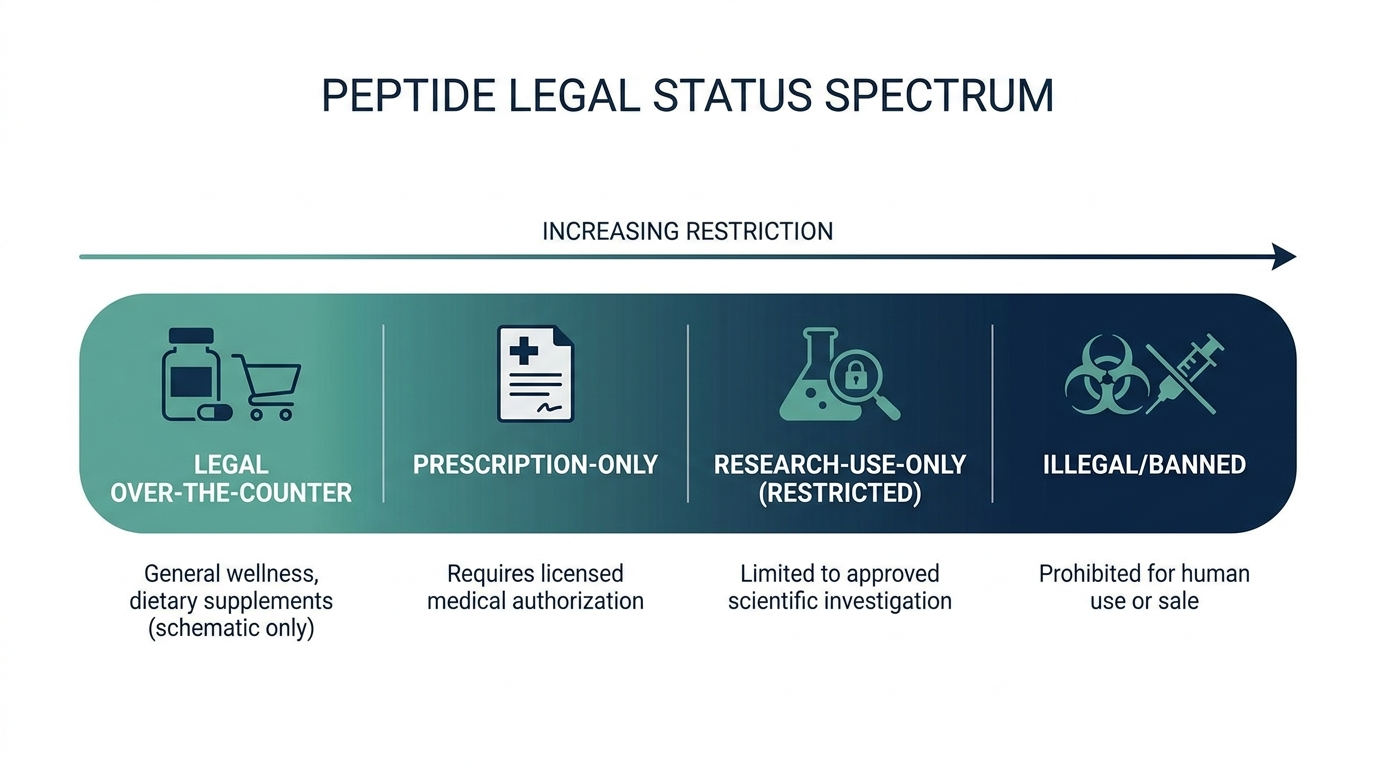
Around 130 peptide drugs have received FDA approval, spanning metabolic disease, oncology, hormone replacement, and rare disease indications. The wellness-community list is shorter.
The peptides people commonly want for longevity or body composition that have full drug approval include:
- Semaglutide (Ozempic for diabetes, Wegovy for obesity, Rybelsus oral): FDA-approved, prescription required, fully legal.
- Tirzepatide (Mounjaro, Zepbound): FDA-approved, prescription required, achieved 22.5% mean body-weight reduction in the SURMOUNT-1 trial.
- Sermorelin: FDA-approved for growth hormone deficiency, now widely available via telehealth for $175 to $225 per month.
- Tesamorelin (Egrifta): FDA-approved for HIV-associated lipodystrophy, available via prescription.
- Octreotide (Sandostatin): FDA-approved for acromegaly and neuroendocrine tumors.
The key distinction: once the GLP-1 drug shortages were declared resolved (tirzepatide on October 2, 2024; semaglutide on February 21, 2025), the window for compounding pharmacies to sell low-cost copies closed. Compounding of FDA-approved drugs is generally prohibited once the shortage ends. That is why Pharmacy Times’ pharmacist analysis distinguishes so carefully between the GLP-1 situation and the therapy peptide reclassification: they are on different legal tracks.
Full-body lab membership: 100+ biomarkers, doctor-reviewed, tracked over time.
What is genuinely illegal in this space right now?
Let me be precise, because vagueness here is unhelpful.
Illegal for sellers:
– Selling any peptide with human therapeutic claims without an FDA-approved New Drug Application (21 CFR Part 312 violation).
– Selling an unapproved drug for human use under any label, including “supplement” or “research.”
– Compounding a Category 2 substance (before April 23, 2026) or any substance not on an approved bulk list after that date, without following PCAC-reviewed protocols.
– Marketing a peptide online with recovery, optimization, or body-recomposition claims directed at consumers, even with RUO labeling.
The FDA actively pursues these statutes against peptide sellers through warning letters, seizures, and, in some cases, criminal referrals. These are not hypothetical risks.
Illegal for athletes (under sports rules):
– Using any substance on the WADA S2, S3, or S4 prohibited lists. (GLP-1 agonists are monitored, not prohibited, as of 2026.)
Not illegal for individual buyers (federal level):
– Purchasing a non-scheduled peptide labeled RUO from a US vendor, for personal use.
– Possessing a small quantity of a research peptide. No US state has criminalized personal possession of non-DEA-scheduled research peptides.
The enforcement pattern has been consistent: commercial sellers making therapeutic claims are the target. Individual buyers purchasing small quantities for personal use have not been the subject of federal enforcement. That does not make the grey-market safe, because the risk for individual buyers is not legal prosecution, it is injecting an unverified product with no dose accuracy, no identity confirmation, and no accountability if it goes wrong.
Myth-busting: “peptides are natural so they cannot be illegal”
This one circulates constantly and it is completely wrong. Insulin is a peptide and is a prescription drug. Oxytocin is a peptide and is a prescription drug. GLP-1 is a peptide hormone your body makes, and synthetic semaglutide, a GLP-1 analog, is a Schedule IV prescription drug in several states. The “natural” argument has no legal standing whatsoever under FDA statute, which regulates the drug approval pathway regardless of whether a molecule has an endogenous equivalent.
The same logic applies to the “it is just an amino acid chain” claim. Amino acid chains can be highly biologically active, they can modulate receptor pathways, alter endogenous hormone secretion, and interact with tissue repair mechanisms in ways that carry real risk. The FDA does not grant exemptions for structural classification. If a molecule has drug-like biological activity and is marketed with therapeutic intent, the NDA pathway applies.
The five peptides that remain most restricted
While BPC-157 and most of the popular therapy peptides are clearing their legal status, five of the twelve removed from Category 2 are not scheduled for the July 2026 PCAC meeting and will not have a compounding path until a separate review concludes by February 2027:
- Melanotan II (MT-II): Linked in published case reports to melanoma progression, ischemic priapism, rhabdomyolysis, and posterior reversible encephalopathy syndrome. The FDA has issued warning letters to Melanotan II distributors going back to 2007. Not scheduled for July review.
- LL-37 (Cathelicidin): An antimicrobial peptide with immune-modulating effects; the safety profile in non-clinical populations is not established.
- Dihexa: A nootropic peptide with potent HGF pathway activity; long-term safety data is essentially absent.
- GHK-Cu (injectable routes): Topical GHK-Cu in skincare is widely sold as a cosmetic ingredient and is not restricted. Injectable GHK-Cu is a different risk class and is not scheduled for July review.
- PEG-MGF (Pegylated Mechano Growth Factor): Used in bodybuilding for muscle hypertrophy; significant safety concerns around uncontrolled IGF-1 pathway activation.
Melanotan II in particular is worth naming directly: it is the most searched peptide among people who do not know it is also among the most medically concerning. The tanning and libido effects people want from MT-II come with a mechanism that can accelerate existing melanocytes, which is not a small trade-off.
How to get peptides through legal channels in 2026
The practical path depends on what you actually want.
For GLP-1s (weight loss, metabolic health): A licensed telehealth physician can prescribe brand-name semaglutide or tirzepatide. (For a breakdown of how legitimate prescribing platforms compare, see our guide to the best GLP-1 telehealth providers.) The compounded generic window closed with the shortage resolution in early 2025, so expect brand pricing or telehealth platform pricing rather than compounding-pharmacy discounts.
For therapy peptides (sermorelin, and soon BPC-157): Platforms like Defy Medical, Marek Health, Hone Health, and newer entrants like OneTwenty provide clinician consultations, required baseline labs, and pharmacy-grade product. An initial consultation runs around $250, monthly protocols $150 to $400 depending on what is prescribed. None of this is covered by insurance; these are elective optimization protocols.
For topical and supplement peptides (collagen, GHK-Cu serum, copper peptide skincare): Fully OTC, widely available, regulated as foods and cosmetics. No prescription, no legal ambiguity.
Hormone- and peptide-focused telehealth clinics that require baseline hormone and lab testing before prescribing fall into this legitimate, clinician-supervised category. A legitimate provider, regardless of peptide, will have five things a grey-market vendor cannot offer: a licensed clinician actually prescribing, medication from a named verifiable 503A or 503B compounding pharmacy, baseline labs required before the first dose, structured follow-up tied to bloodwork, and transparent pricing that makes sense for what is included.
Full-body lab membership: 100+ biomarkers, doctor-reviewed, tracked over time.
Don’t just read about your health, track it.
A single result is a snapshot. Superpower re-tests 100+ markers over time so you can watch them move as you change sleep, food, and training.
Frequently asked questions
Are peptides a controlled substance in the US?
No. As of June 2026, no peptide commonly used in the wellness community is listed on the DEA’s controlled substance schedules. That is different from being FDA-approved or legally usable for human therapy, those are separate regulatory tracks. “Not a controlled substance” means you cannot be criminally prosecuted for possession the way you could for a Schedule I or III drug. It does not mean you can legally buy and inject a peptide marketed for human use.
Is BPC-157 legal to buy in 2026?
The FDA removed BPC-157 from its Category 2 “do not compound” list on April 23, 2026, ending the explicit prohibition on compounding. It is not yet on the Category 1 permitted list; that decision depends on the PCAC review scheduled for July 23 to 24, 2026. Buying an RUO-labeled vial is not federally criminal. Using it as a human therapeutic outside a licensed clinical context remains unapproved. The clearest legal path is through a telehealth clinic working with a compliant compounding pharmacy.
Is Melanotan II illegal?
Melanotan II has never received FDA approval for any indication, is not eligible for compounding under current rules, and is not scheduled for PCAC review until before February 2027. Selling it with human use claims is illegal. Possessing it for personal use is not federally criminal. Published case reports link it to melanoma, rhabdomyolysis, and other serious adverse events. This is one of the few peptides where I would say the legal grey zone is the least of the reasons to avoid it.
Can peptides be bought over the counter?
Collagen peptides as a dietary supplement and copper peptide (GHK-Cu) in skincare products are legally sold OTC. Therapeutic or research peptides in injectable form are not legitimate OTC products. Any site selling injectable peptides for human use “no prescription needed” is operating in violation of FDA misbranding rules, whether or not they label it a “research” product.
What happens if my research peptide package is seized by customs?
For international purchases, US Customs and Border Protection can seize unapproved drug products. The FDA has jurisdiction over imports of unapproved new drugs. The practical risk depends on quantity: small personal-use quantities from a domestic seller rarely trigger action, while international shipments at volume are higher-risk. Criminal prosecution of individual buyers for possession has not been the enforcement pattern, but seized packages are lost orders with no recourse.
Are peptides tested on standard drug tests?
Standard employment drug screens (5-panel, 10-panel) test for controlled substances: amphetamines, opiates, cannabinoids, cocaine, PCP, and sometimes benzodiazepines and opioids. Research peptides are not on those panels. WADA-style sports anti-doping tests are a completely different protocol and screen for many peptides including TB-500, EPO, and GH-releasing peptides. GLP-1 agonists are on WADA’s 2026 monitoring program, so markers may be tracked, but they are not a prohibited substance at this time.
Will the July 2026 PCAC vote make BPC-157 fully legal?
A positive PCAC vote would recommend placing BPC-157 on the 503A bulk drug substances list, which means licensed 503A compounding pharmacies could compound it legally when a physician prescribes it. That is meaningfully different from full FDA approval: BPC-157 would still not be an FDA-approved finished drug, it would not be covered by insurance, and it could only be prescribed within the clinical compounding framework. Think of it as moving from “explicitly forbidden through licensed channels” to “accessible through licensed channels,” which is the same status sermorelin has enjoyed for years.
Reviewed by the VST Editorial Board. Educational content, not medical or legal advice. Laws and FDA classifications change frequently; verify current status with a licensed clinician.
Primary sources:
- FDA Announces Removal of 12 Peptides from Category 2 (Orrick, April 2026)
- FDA Removes 12 Peptides from 503A Category 2 (Newtropin, April 2026)
- Frier Levitt: FDA Peptide Do Not Compound List Update 2026
- Research Peptides Legal 2026: Current FDA Rules Explained (RealPeptides)
- WADA 2026 Prohibited List (World Anti-Doping Agency)
- WADA Peptide Ban Status 2026 (RealPeptides)
- Pharmacist Take on RFK Peptide Reclassification (Pharmacy Times)
- BPC-157 Legal Status 2026 (Loti Labs)
- Are Peptides Legal? State-by-State Guide (PeptideJournal)
- What Peptides Are Legal in the US 2026 (PeptideFinder)
- Defy Medical vs Marek Health Comparison (FormBlends)
- FDA Approved Peptides List 2026 (PeptideStack)
- PCAC July 2026 Meeting Explained (Nootroholic)
Related reading
Vital Signs Today may earn a commission if you buy through links on this page. It does not affect our editorial assessments.