Disclosure: Vital Signs Today may earn a commission if you buy through links on this page, at no extra cost to you. This does not influence our evidence-based assessments. We are not a medical provider; talk to a clinician before acting on test results.
Related: What a high sodium result means · What a low sodium result means
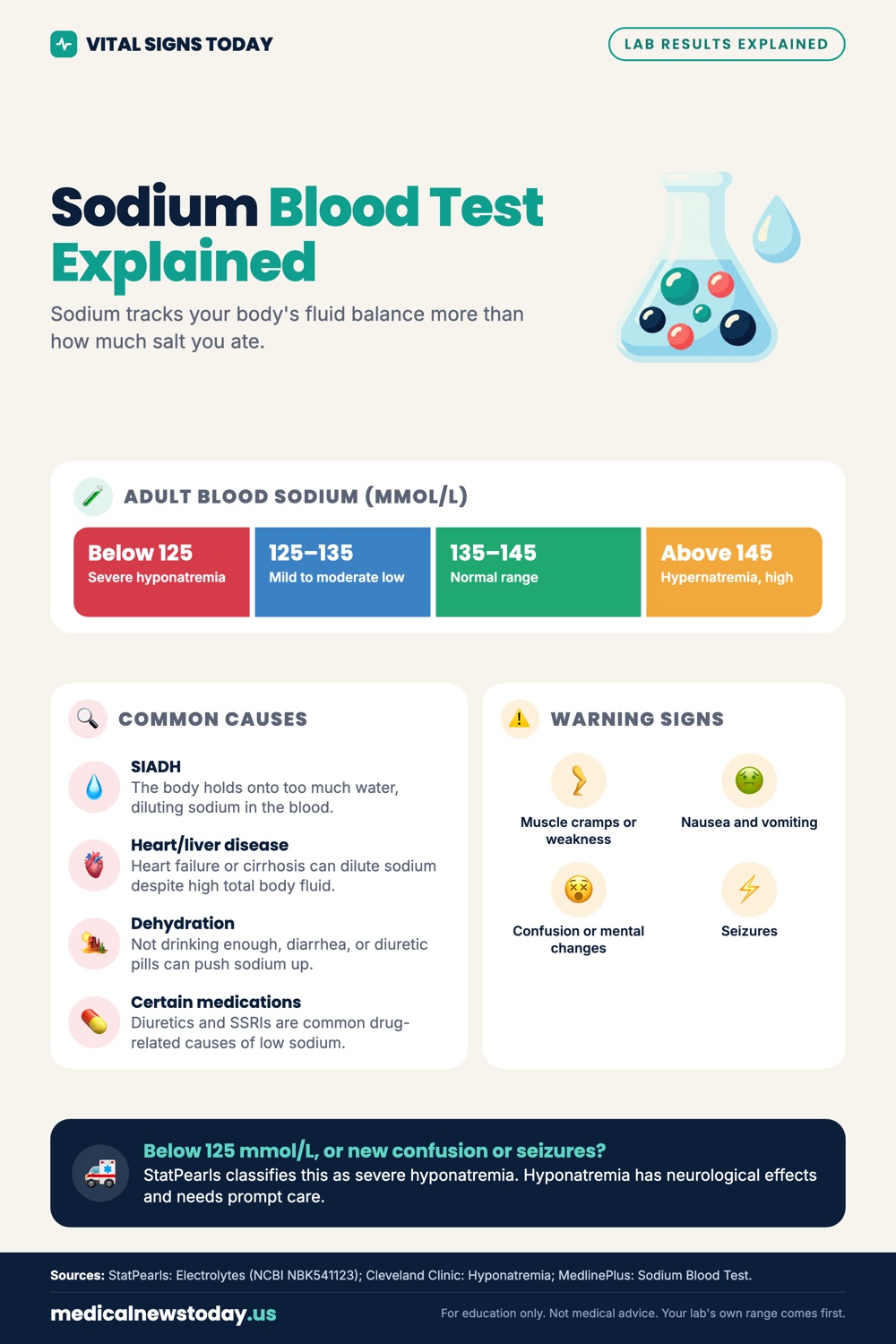
Quick answer: A sodium blood test measures the concentration of sodium ions in your bloodstream, reported in milliequivalents per liter (mEq/L). The normal range for adults is 135 to 145 mEq/L. Levels below 135 indicate hyponatremia (too little sodium relative to water), while levels above 145 indicate hypernatremia (too much sodium relative to water). Both directions reflect fluid balance problems as much as sodium intake problems, and both can become dangerous faster than most people expect.
What does a sodium blood test actually measure?
The sodium test does not measure how much salt you ate yesterday. It measures the ratio of sodium to water in your plasma, which is your body’s real-time report on fluid regulation. Sodium is the dominant positively charged ion in extracellular fluid, meaning it governs how water moves in and out of cells. When that ratio shifts, cells either shrink or swell, and the brain is the organ that shows symptoms first.
The test is part of the basic metabolic panel (BMP) and the comprehensive metabolic panel (CMP). Virtually every hospital admission includes it. It is also ordered standalone when a clinician suspects dehydration, overhydration, kidney dysfunction, heart failure, or adrenal disease. The complete blood panel almost always includes sodium alongside potassium, chloride, and bicarbonate, forming the electrolyte subset that together describe acid-base and fluid status.
The test itself is simple: a standard venous blood draw, processed in a chemistry analyzer. Results return in hours at a commercial lab or in minutes on a point-of-care device. No fasting is required, though IV fluids running at the time of the draw can dilute or concentrate the result, a detail clinicians sometimes forget to document.
Sodium normal range: what the numbers mean at each threshold
The accepted reference range is 135 to 145 mEq/L, but context matters at every boundary.
| Result (mEq/L) | Classification | Common clinical meaning |
|---|---|---|
| Below 120 | Severe hyponatremia | Seizure risk, often requires ICU admission |
| 120 to 129 | Moderate hyponatremia | Nausea, confusion, hospital evaluation needed |
| 130 to 134 | Mild hyponatremia | Often asymptomatic; chronic cases common in elderly |
| 135 to 145 | Normal | Fluid and electrolyte balance intact |
| 146 to 149 | Mild hypernatremia | Usually dehydration; corrects with fluids |
| 150 to 159 | Moderate hypernatremia | Thirst impairment or ongoing water loss |
| 160 and above | Severe hypernatremia | Neurological symptoms, high mortality risk |
Want to check your sodium?
Three ways to get it measured. Pick whichever fits you.
Affiliate links: we may earn a commission at no extra cost to you. A lab test does not replace a visit with your clinician.
One number that surprises people: a sodium of 134 in a 25-year-old marathon runner is almost never dangerous, while a sodium of 134 in an 80-year-old on a thiazide diuretic for six months carries a real fracture and fall risk. Chronic mild hyponatremia at 130 to 134 causes subtle gait instability and cognitive slowing that is routinely attributed to age rather than electrolytes. Checking sodium is cheap; missing it for years is not.
Optimal versus normal: why the middle of the range is the goal
The reference range flags disease, not optimal physiology. Most healthy, well-hydrated adults sit between 138 and 142 mEq/L, and a stable number in that band is what you want to see year over year. A result of 136 is technically normal, but if your last three draws read 141 and you suddenly land at 136, that downward drift is the real signal, not the single value. Trend beats snapshot with sodium more than with almost any other electrolyte, because the body defends serum sodium tightly and a persistent shift usually means a genuine change in fluid handling, medication, or hormones.
Labs also differ. One analyzer may report a healthy adult at 140 and another at 138 for the same blood, so compare results from the same lab whenever you can, and treat a two-point difference across different labs with caution. How often to retest depends on why the number moved. A one-off mild low during a stomach bug needs a single recheck once you are eating and drinking normally again, usually within a week or two. A new thiazide or SSRI prescription justifies a sodium check at two to four weeks, because drug-induced hyponatremia typically appears in that window. A stable chronic low in an older adult on no new medication is worth rechecking every few months alongside the rest of the metabolic panel, often enough to catch a slow slide before it reaches symptomatic territory.
Low sodium causes: why hyponatremia happens and who is at risk
Hyponatremia almost always means too much water relative to sodium, not too little salt in the diet. The body accumulates excess water through several distinct mechanisms, each requiring a different fix.
- SIADH (syndrome of inappropriate antidiuretic hormone): The most common cause in hospitalized patients. ADH tells the kidneys to retain water; when it fires inappropriately (from lung cancer, pneumonia, head injury, or dozens of common medications), sodium dilutes. SSRIs, carbamazepine, and cyclophosphamide are frequent drug culprits.
- Thiazide diuretics: Hydrochlorothiazide and chlorthalidone block sodium reabsorption in the distal tubule while leaving ADH intact, so water stays but sodium leaves. This is the leading drug-induced cause in outpatients, especially women over 60.
- Heart failure and cirrhosis: The body perceives low effective circulating volume even when total body water is high, triggering ADH release. Sodium drops despite fluid overload.
- Hypothyroidism and adrenal insufficiency: Both impair free-water excretion. A sodium of 128 with fatigue and cold intolerance in someone who has never had thyroid labs drawn is a classic missed presentation.
- Psychogenic polydipsia: Drinking four or more liters of plain water daily can overwhelm the kidneys’ ability to excrete free water, diluting sodium even in people with completely normal kidneys and hormones. Common in people with schizophrenia on older antipsychotics.
- Exercise-associated hyponatremia: Endurance athletes who replace sweat losses with plain water rather than electrolyte drinks can drop sodium to dangerous levels. This has killed marathon runners who were well-hydrated by every visible metric.
The workup for unexplained hyponatremia typically adds urine sodium, urine osmolality, and serum osmolality to figure out which mechanism is driving it. A low sodium with low urine sodium and low urine osmolality points toward primary polydipsia. A low sodium with high urine osmolality and euvolemic status points toward SIADH. Without those paired tests, treatment can go in the wrong direction.
High sodium symptoms and causes: hypernatremia explained
Hypernatremia (sodium above 145 mEq/L) almost always means free water deficit, meaning the body has lost more water than sodium. It is less common than hyponatremia but often more dangerous in acute presentations.
The three main mechanisms are:
- Inadequate water intake: Seen in infants who cannot signal thirst, elderly people with impaired thirst perception, and anyone with altered consciousness. A nursing home resident with a urinary tract infection who stops drinking for 48 hours can present with a sodium of 158.
- Excessive water loss without replacement: Profuse sweating, osmotic diarrhea, or hyperglycemia (which pulls water into the urine via glucosuria) all raise sodium. Diabetic ketoacidosis commonly presents with hypernatremia or, if insulin deficiency is severe enough and fluids have been replaced with salt-free liquids, hyponatremia. The glucose correction formula matters here: for every 100 mg/dL glucose above 100, add 1.6 to 2.4 mEq/L to the measured sodium to get the corrected value.
- Diabetes insipidus (DI): Central DI (ADH deficiency from pituitary disease or trauma) and nephrogenic DI (kidneys unable to respond to ADH) both cause massive dilute urine output and rapid sodium rise if water intake cannot keep pace. A urine osmolality under 300 mOsm/kg in the setting of hypernatremia is a strong signal for DI.
Symptoms of hypernatremia track the severity and speed of onset. Mild elevations (146 to 149) often produce only thirst and slightly concentrated urine. Above 155, neurological symptoms appear: irritability, lethargy, muscle twitching. Above 160, obtundation and seizures occur. The brain adapts to slow sodium rises by generating intracellular osmoles to keep cells hydrated, which is why chronic hypernatremia can exist with fewer symptoms than the number suggests, but correcting it too fast causes cerebral edema by the same mechanism in reverse.
How do you prepare for a sodium blood test, and what can skew the result?
Sodium is one of the least preparation-dependent labs on the panel, which is exactly why the errors that do occur tend to be procedural rather than dietary. You do not need to fast, you do not need to skip your morning coffee, and a salty dinner the night before will not move a healthy person’s serum sodium in any meaningful way, because the kidneys and ADH correct that load within hours. What actually distorts the number happens in the draw and the handling, not in your kitchen.
The artifacts worth knowing about:
- Drawing above a running IV: Blood pulled from an arm with fluids running upstream is the single most common cause of a bizarre sodium result. A drip of normal saline can push the number up, a drip of dextrose in water can dilute it down. The fix is drawing from the opposite arm and documenting which arm was used.
- Pseudohyponatremia: Very high triglycerides or very high protein, as in some cases of multiple myeloma, can falsely lower sodium on older assays by crowding out plasma water. Modern direct ion-selective electrode methods largely correct this, but a sodium of 128 in someone who feels completely well and has milky-looking blood should prompt a question about which method the lab used.
- Hemolysis and rough handling: A badly drawn or shaken sample that breaks red cells affects potassium far more than sodium, but it often triggers a redraw that delays your real result. A clean, single-stick draw is worth the extra minute.
- High glucose on the day: If your blood sugar is elevated when blood is taken, your true sodium is higher than the printed number. This is real dilution, not a lab error, and the correction factor described earlier tells you where the sodium actually sits once glucose is accounted for.
The one preparation instruction that genuinely matters: do not load up on plain water in the hour before your appointment to make the vein easier to find. Normal hydration is fine and helpful. Drinking a liter or more can shave a point or two off an otherwise normal sodium and start an investigation you did not need.
How to read your sodium result alongside other electrolytes
Sodium does not stand alone on a chemistry panel, and reading it in isolation misses the clinical picture. Here is how the electrolyte quartet interacts:
- Sodium and potassium together: Both drop with prolonged vomiting (losing hydrochloric acid), but sodium drops while potassium spikes in adrenal insufficiency. A simultaneous low sodium and high potassium should prompt ACTH stimulation testing.
- Sodium and the anion gap: The anion gap (sodium minus chloride minus bicarbonate, normal 8 to 12) is a downstream calculation that depends on accurate sodium. An elevated gap with a low sodium can mask the true gap magnitude if you do not correct for the sodium abnormality first.
- Sodium and albumin: Very low albumin (below 2 g/dL) can create pseudo-hyponatremia on older colorimetric assays, though modern direct ion-selective electrode methods largely eliminate this. Still, checking the albumin test is useful when sodium looks unexpectedly low in someone with liver disease or malnutrition.
- Sodium and glucose: Hyperglycemia causes true dilutional hyponatremia by pulling water from cells into plasma. Apply the correction factor (1.6 mEq/L per 100 mg/dL glucose over 100) before interpreting the sodium result in anyone with elevated glucose.
This is exactly why ordering sodium as a single-marker test rarely makes sense outside of a specific follow-up scenario. If you are getting blood drawn to assess fluid balance, kidney function, or metabolic health, a full panel gives you the context to interpret what the sodium number actually means. If you are getting blood drawn anyway, it is often smarter to capture a full baseline at once. Here is how a full-body panel compares to cherry-picking single markers.
Where to get a sodium blood test and what it costs
A standalone sodium test ordered by a clinician is covered by virtually every insurance plan with no prior authorization. The cash-pay cost varies by setting.
| Setting | Typical cash cost (2026) | Notes |
|---|---|---|
| Quest Diagnostics (direct access) | $29 to $45 | Includes electrolyte panel (Na, K, Cl, CO2) |
| Labcorp Patient (self-pay) | $30 to $50 | BMP includes sodium; same-day results next business day |
| CVS MinuteClinic or urgent care | $50 to $120 | Includes clinician review; point-of-care device |
| Hospital lab (cash self-pay) | $80 to $200+ | Facility fees inflate cost; use only if ordered same visit |
| Comprehensive panel (e.g., full-body baseline service) | $99 to $299 | Sodium bundled with 50+ biomarkers; better value per insight |
HSA and FSA dollars cover blood tests ordered for diagnosing or monitoring a medical condition with no additional documentation required in most plans. Over-the-counter sodium tests do not exist in a clinically meaningful form, so there is no at-home shortcut here.
Medicare Part B covers sodium as part of a BMP or CMP when ordered by a treating physician for a covered indication. It is one of the most routinely covered lab tests in the US system. If you are uninsured, Quest and Labcorp both offer patient-direct pricing without a physician order in most states, which undercuts hospital pricing significantly.
What do abnormal sodium results look like in real life?
Numbers make more sense attached to people. Two composite scenarios show how the same result carries different weight depending on context.
The runner at 133. A 34-year-old finishes a hot half-marathon, feels nauseated and foggy, and a medical-tent draw shows sodium 133. He drank steadily the whole race, all of it plain water. This is dilutional, not depletion. The correct move is not more fluid but salt, plus a pause on drinking until he urinates. Pushing plain water here is what turns a mild case into a dangerous one. He recovers within hours once the ratio corrects.
The 78-year-old at 132 for a year. A retiree started hydrochlorothiazide for blood pressure last spring. Her sodium has read 131 to 133 on every draw since, and her family notices she is a little unsteady and repeats herself. Nobody connected the two, because 132 looks almost normal. Stopping or switching the diuretic, with clinician guidance, often lifts the number back into the high 130s, and the gait and cognition improve with it. The lesson is that a mildly low sodium that persists is a finding to act on, not a rounding error to ignore.
What conditions cause chronically abnormal sodium levels
A one-time abnormal sodium during an acute illness is usually corrected and forgotten. Persistently abnormal sodium on repeat testing points toward a structural problem worth investigating systematically.
Persistent hyponatremia below 134 on multiple draws warrants evaluation for:
- Chronic SIADH from an occult malignancy (small cell lung cancer is the classic association; a chest CT is standard)
- Medication effect that has not been recognized (review the full medication list including over-the-counter NSAIDs, which can cause mild SIADH)
- Subclinical hypothyroidism or adrenal insufficiency, both treatable causes that are commonly missed
- Cirrhosis with early portal hypertension before ascites becomes obvious
Persistent hypernatremia is less common as an outpatient finding but when present usually signals either inadequate fluid intake (common in cognitively impaired older adults) or unrecognized diabetes insipidus. A 24-hour urine collection with osmolality and a water deprivation test can distinguish central from nephrogenic DI.
Understanding which biomarkers to track for long-term health is worth reading about separately. A review of the best biomarkers to test for a proactive health baseline puts sodium in context alongside markers that predict cardiovascular and metabolic risk over decades.
Sodium and kidney function: the connection most people miss
The kidneys process roughly 25,000 mEq of sodium per day and reabsorb 99.5 percent of it. This is not a passive process. The renin-angiotensin-aldosterone system (RAAS) is the primary regulator, and it adjusts sodium reabsorption minute-to-minute based on blood pressure, volume status, and potassium. When the kidneys fail, sodium regulation deteriorates, but not always in a predictable direction.
Acute kidney injury (AKI) can cause either hyponatremia (if the patient has received excess hypotonic fluids) or hypernatremia (if urine output has shut down and insensible losses continue). Chronic kidney disease (CKD) at stages 3 and above increasingly impairs the ability to concentrate urine, which means the kidneys cannot conserve water efficiently, pushing toward hypernatremia in patients who are not drinking enough. By CKD stage 5 (GFR below 15), the kidneys also lose the ability to excrete sodium loads, which causes fluid retention and dilutional hyponatremia in the setting of fluid overload.
The sodium-to-creatinine relationship matters for interpreting the fractional excretion of sodium (FENa). A FENa below 1 percent in the setting of AKI suggests prerenal azotemia (not enough blood reaching the kidneys, often from dehydration) and predicts responsiveness to fluids. A FENa above 2 percent suggests intrinsic renal damage. This calculation requires both sodium values: serum sodium from the blood draw and urine sodium from a spot urine sample collected at the same time.
Metabolic markers like the alkaline phosphatase test and the adiponectin test provide a fuller metabolic picture when kidney and fluid markers are being evaluated together, since liver and fat-tissue function both influence fluid homeostasis in ways a single sodium result cannot capture.
FAQ
What is the sodium normal range for adults?
The accepted reference range for serum sodium in adults is 135 to 145 mEq/L. Some labs use 136 to 145 mEq/L, a minor variation between analyzers. The critical values that trigger immediate clinical action are below 120 mEq/L or above 160 mEq/L. Talk to a clinician about results outside the normal range, particularly if symptoms are present.
Can drinking too much water cause low sodium?
Yes, this is called exercise-associated hyponatremia or psychogenic polydipsia depending on the context. Drinking more water than your kidneys can excrete (roughly one liter per hour in a healthy adult) dilutes serum sodium. Marathon runners and ultraendurance athletes face this risk when they drink aggressively with plain water rather than electrolyte solutions. The fix is sodium replacement, not fluid restriction alone in acute settings.
What are the symptoms of hyponatremia?
Mild chronic hyponatremia (130 to 134 mEq/L) often produces no obvious symptoms, but research consistently documents subtle gait instability, increased fall risk, and reduced concentration that patients attribute to aging. Moderate hyponatremia (120 to 129) causes nausea, headache, and fatigue. Severe hyponatremia below 120 causes confusion, seizures, and respiratory arrest in extreme cases. Rapid onset is more dangerous than a gradual decline to the same number.
What are the symptoms of high sodium (hypernatremia)?
Mild hypernatremia produces intense thirst and reduced urine output. At levels above 155 mEq/L, patients often show irritability, muscle weakness, and twitching. Severe hypernatremia above 160 mEq/L causes lethargy, high fever, respiratory failure, and coma. The elderly are disproportionately affected because thirst perception diminishes with age, removing the normal physiological warning signal.
Does a sodium blood test require fasting?
No. Sodium levels are not meaningfully affected by a recent meal in healthy individuals. You can eat and drink normally before the draw. The one exception is if you are drinking extremely large amounts of fluid in the hours before the test, which could slightly dilute the result. Routine hydration does not change the number clinically.
How does hyponatremia differ from hypernatremia in treatment?
Hyponatremia is treated by restricting water intake, correcting the underlying cause (stopping a drug, treating SIADH, replacing cortisol in adrenal insufficiency), or in severe acute cases, infusing hypertonic saline (3 percent NaCl) at a controlled rate. Hypernatremia is treated by replacing free water, either orally if the patient is alert and swallowing, or with intravenous hypotonic fluids. Both conditions require slow correction, ideally no faster than 8 to 10 mEq/L per 24 hours, to avoid osmotic demyelination syndrome (in hyponatremia) or cerebral edema (in hypernatremia).
Is a sodium blood test the same as a urine sodium test?
No. A serum sodium test uses a blood sample and reports the concentration in plasma. A urine sodium test uses a spot urine or 24-hour urine collection and tells you how much sodium your kidneys are excreting. The two are complementary: low serum sodium with high urine sodium means the kidneys are wasting sodium and points toward SIADH or diuretic use. Low serum sodium with low urine sodium means the kidneys are appropriately conserving sodium and the problem is external fluid loss or water excess.
Can medications affect my sodium blood test result?
Yes, and this is one of the most common reasons for unexpected abnormal sodium results in outpatients. Thiazide diuretics, SSRIs, tricyclic antidepressants, carbamazepine, oxcarbazepine, antipsychotics, proton pump inhibitors at high doses, and NSAIDs are all associated with hyponatremia. Lithium and demeclocycline can cause hypernatremia by inducing nephrogenic diabetes insipidus. Always bring a complete medication list including supplements to any appointment where labs are being reviewed.
What does it mean if my sodium is low but I feel fine?
Chronic mild hyponatremia (130 to 135 mEq/L) can persist for months or years without obvious symptoms because the brain adapts by reducing its intracellular solute content. This does not mean the abnormality is safe. Studies show that people with chronic mild hyponatremia have significantly higher fall rates, poorer cognitive performance, and lower bone density compared to controls with normal sodium. The absence of dramatic symptoms does not mean no action is needed, especially if the level is stable at 132 or below.
How often should I retest my sodium level?
It depends on the reason for the abnormality. A single mild low during an acute illness needs one recheck after you have recovered, usually within one to two weeks. A newly started thiazide, SSRI, or carbamazepine warrants a check at two to four weeks, the window when drug-induced hyponatremia usually appears. A stable chronic mild low in an older adult is reasonable to monitor every few months as part of a routine metabolic panel. Let the underlying cause set the interval rather than testing on a fixed calendar for its own sake.
Can I fix low sodium by eating more salt?
Usually not, because most hyponatremia is a water problem, not a salt-deficiency problem. Adding salt to the diet does little when the issue is that ADH is holding onto too much water or a diuretic is forcing sodium out. The exception is the endurance athlete who has genuinely lost sodium in sweat and replaced it with plain water, where salt and electrolyte replacement is exactly right. For everyone else, the fix is treating the cause, whether that is adjusting a medication, restricting fluid, or correcting a hormone deficiency. Do not self-treat a low sodium with salt tablets before knowing the mechanism.
Why does my sodium reading change between different labs?
Small differences of one or two points between labs are normal and reflect calibration and analyzer differences rather than a real change in your body. Serum sodium is defended within a narrow band, so a shift of five or more points across draws is far more likely to be biological than technical. The practical rule is to compare results from the same lab whenever you can, and to treat the trend across several same-lab draws as more trustworthy than any single number from a lab you have not used before.