
Educational content, not medical advice. Talk to a licensed clinician before changing any supplement protocol.
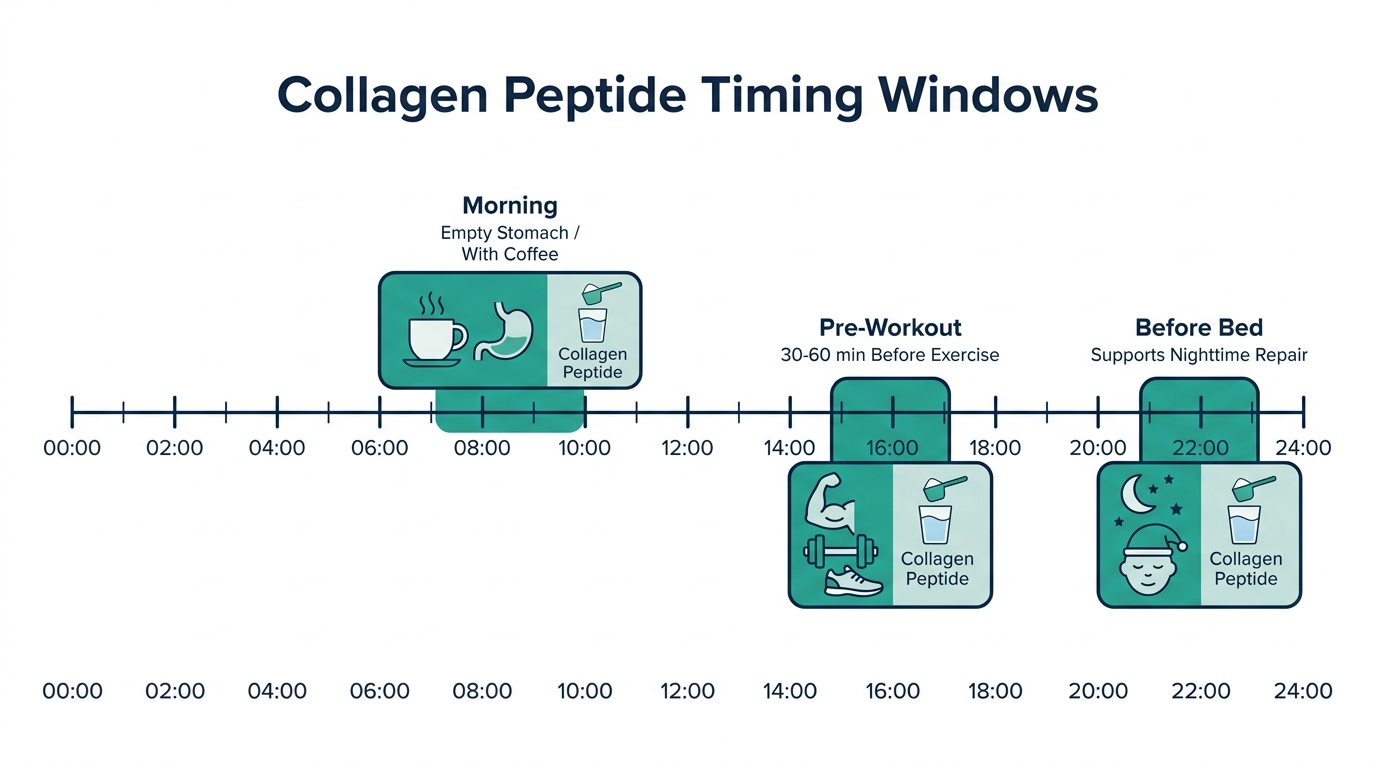
Short answer: For joint and tendon support, take 15 g of collagen peptides with 50 mg of vitamin C roughly one hour before exercise. For sleep quality, take 15 g about one hour before bed. For skin and general use, consistency across any fixed time beats optimizing the clock by a wide margin.
Timing your collagen dose is a small tweak. Knowing your own protein and joint biomarkers is the bigger picture. One at-home Superpower draw checks 100+ biomarkers, physician-reviewed.
That is not vague hedging. Those two windows have actual published human-trial data behind them, while most other timing claims, including the popular idea that empty-stomach absorption in the morning is meaningfully superior, do not. The rest of this article walks through what the evidence says, what it does not say, and how to make a simple decision that matches your goal.
Does timing really matter, or is this marketing?
Both, depending on which claim you are evaluating.
The claims that timing does not matter: no randomized controlled trial has compared morning versus evening collagen dosing in a head-to-head design for skin or joint outcomes. The improvements in elasticity, hydration, and joint comfort consistently documented across the published literature show up at 8 to 12 weeks regardless of the time of day subjects took their supplements. A 2024 randomized trial published in Dermatology Research and Practice found significant skin collagen, hydration, and elasticity gains after 12 weeks of daily hydrolyzed collagen, with no time-of-day protocol at all. A meta-analysis published in The American Journal of Medicine in 2025, covering 26 randomized controlled trials, confirmed that oral collagen consistently improved skin hydration and elasticity. None of the included trials tested time-of-day as a variable.
The claims that timing does matter: two specific goals, connective-tissue repair and sleep quality, have published trial data supporting specific timing windows. Those windows are real and worth knowing.
The lesson here is not that all timing advice is equal. It is that you should ask which specific outcome a timing claim is tied to, and whether a clinical study actually tested it.
What is the one timing window with real data behind it?
The simplest way to actually get this done
Superpower is a full-body lab membership that runs 100+ biomarkers, has each result reviewed by a doctor, and tracks your numbers year over year (about $199/year). It is what we point readers to when they would rather get one clean, complete draw than chase single tests one at a time. Here is superpower reviewed in full.
The strongest case for a specific timing window comes from connective-tissue synthesis.
A 2017 study by Shaw and colleagues, published in the American Journal of Clinical Nutrition, tested 8 healthy males in a randomized, double-blind, crossover design. Subjects consumed 0 g, 5 g, or 15 g of vitamin C-enriched gelatin one hour before six minutes of rope-skipping, repeated three times daily with at least six hours between bouts.
The 15 g dose taken one hour before exercise produced approximately double the blood concentration of PINP (amino-terminal propeptide of collagen I, a direct marker of collagen synthesis), compared to placebo. Specifically, PINP baseline was 27.9 ng/mL across all groups; the 15 g group saw roughly 153% above baseline at four hours post-exercise, versus 54% for placebo. That doubling of the area under the PINP curve persisted throughout the full 72-hour study period.
The engineered-ligament portion of the same study went further: serum drawn from subjects who had taken 15 g gelatin produced ligaments with higher collagen content, greater collagen percentage of dry mass, and improved tensile mechanical properties compared to placebo serum. The 5 g dose also outperformed placebo, but by a smaller margin.
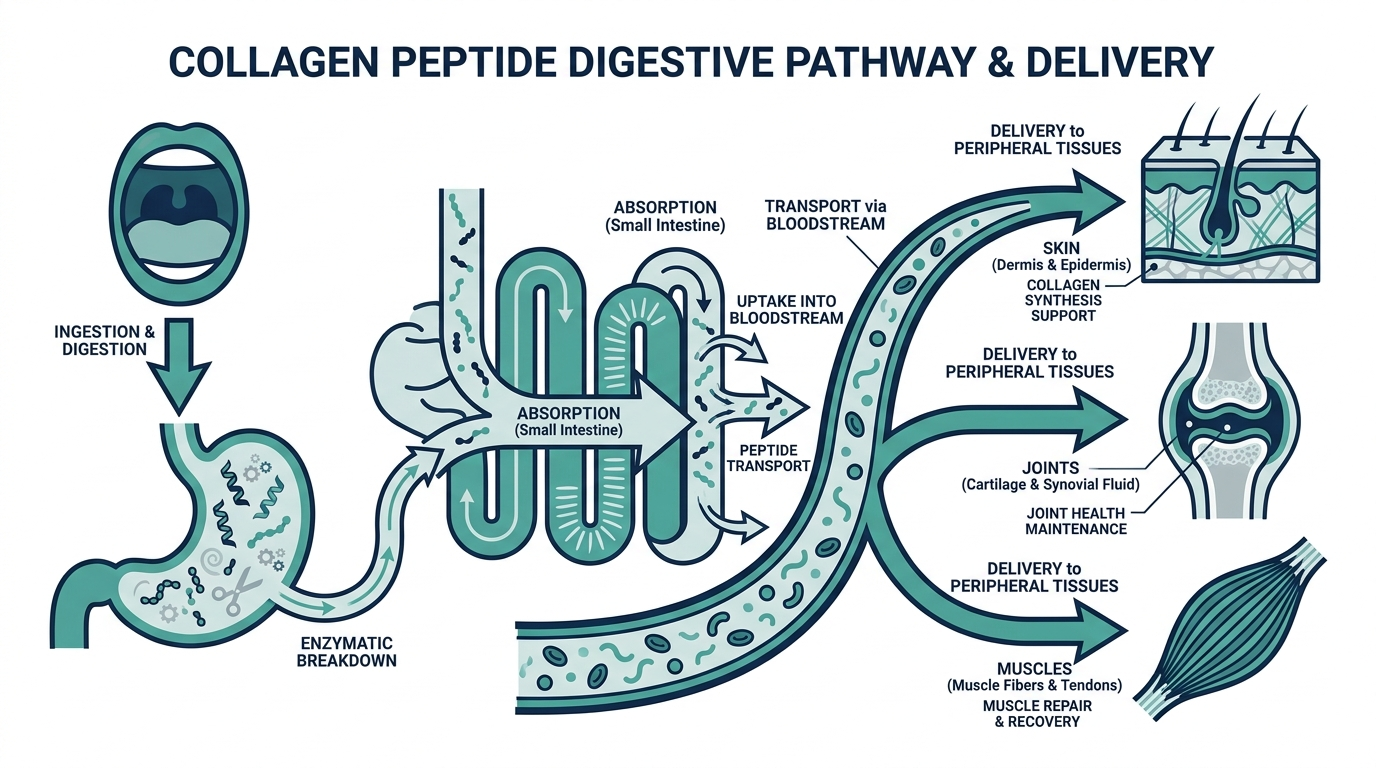
Why one hour before, not immediately before? Collagen peptides need time to digest and peak in the bloodstream. A 2019 study in Amino Acids measured plasma collagen peptide concentrations after a 15 g oral dose and found peak levels around 60 minutes post-ingestion. Taking the supplement right before you begin your warm-up and then doing a light connective-tissue loading warm-up (jump rope, band pull-aparts, eccentric calf raises) follows the same logic: prime the bloodstream, then stimulate the target tissue while the raw materials are circulating.
The practical rule: if your goal is tendons, ligaments, cartilage, or connective-tissue recovery from training, take 10 to 15 g of hydrolyzed collagen peptides with a vitamin C source, 50 mg or more, about one hour before the session. Black currant juice or a plain vitamin C tablet both work. This is the single most evidence-supported timing recommendation in the collagen literature.
Full-body lab membership: 100+ biomarkers, doctor-reviewed, tracked over time.
Does taking collagen before bed actually help sleep?
This is newer and more specific than most timing guides acknowledge.
A 2023 randomized, double-blind crossover trial published in the European Journal of Nutrition enrolled 13 athletic males who reported sleep complaints. Subjects consumed either 15 g of collagen peptides or placebo in a 200 mL drink approximately one hour before bed, for seven consecutive nights, then crossed over after a washout of at least seven days.
The results from polysomnography were specific. The collagen group averaged 21.3 nighttime awakenings per night versus 29.3 in the placebo group (P = 0.028). Subjective diary awakenings across the seven-day period were also lower: 1.3 versus 1.9 (P = 0.023). Next-day cognitive performance on the Stroop test showed higher accuracy in the collagen condition (P = 0.009).
The proposed mechanism is glycine. A 15 g dose of collagen peptides contains approximately 3.5 g of glycine. Glycine has been shown in standalone human trials to lower core body temperature, which is a known trigger for sleep onset, and to reduce daytime sleepiness and fatigue after poor sleep. The dose of glycine in a 15 g collagen serving is consistent with the 3 g dose used in the standalone glycine sleep studies.
What the study did not show: no effect on sleep onset latency, sleep efficiency, or subjective sleep quality ratings on validated scales. This was a small study (13 participants), all male, all physically active, all with pre-existing sleep complaints. The evidence is promising, not definitive.
Still, for someone already taking collagen daily, the question of when becomes easy: before bed gives you a plausible sleep benefit with no downside. The 15 g dose, dissolved in water or a warm drink, fits neatly into a wind-down routine.
What about the morning empty-stomach argument?
This is the most repeated collagen timing claim and the least supported by clinical evidence.
The argument goes: taking collagen on an empty stomach reduces competition from other dietary amino acids, boosting absorption. Theoretically reasonable. In practice, collagen peptides are hydrolyzed into di- and tripeptides during manufacturing, which are small enough to be absorbed via the paracellular route regardless of what else is in the gut. No published human trial has demonstrated a clinically meaningful difference in collagen outcomes, skin hydration, joint pain scores, PINP levels, between subjects who took their collagen fasted versus fed.
Personally, I find the “empty stomach” framing more useful as a habit anchor than as biochemistry. If taking collagen before breakfast means you actually take it every morning without forgetting, that empty-stomach context is doing real work for you, just not the pharmacokinetic work the marketing implies.
One timing situation where morning does make sense: if your primary goal is skin outcomes and you want to avoid any theoretical interference, taking collagen 30 minutes before your first meal is a reasonable low-friction choice. There is no harm and possibly a small advantage. Just do not expect it to outperform a consistent evening dose by a measurable margin.
Does hot coffee or cooking destroy collagen peptides?
No, and this is another myth that keeps people from a habit that would otherwise stick. Hydrolyzed collagen is already broken into short peptides, so stirring it into hot coffee or tea does not “denature” it in any way that matters for absorption. Denaturing changes the shape of a large intact protein, but these peptides are already past that stage. The only real cautions are practical. Very hot liquid can make unflavored collagen clump if you dump it in fast, so add the powder first and pour the liquid over it, or use a frother. And if you dislike the slightly altered taste, keep it out of very acidic drinks. The peptide itself survives your morning coffee just fine.
How does timing compare by goal?
| Goal | Best timing | Dose | Key co-factor |
|---|---|---|---|
| Tendon / ligament repair | 1 hour before exercise | 10 to 15 g | 50 mg vitamin C |
| Post-workout connective tissue | Within 60 min after training | 10 to 15 g | Vitamin C helps |
| Sleep quality | 1 hour before bed | 15 g | None required |
| Skin hydration and elasticity | Any consistent time, daily | 10 to 20 g | Vitamin C supports synthesis |
| Joint comfort | Any consistent time, daily | 10 to 15 g | None required |
| Gut lining support | Morning, fasted or with food | 10 g | None established |
The pattern in that table is not subtle: for the two goals with specific timing evidence, exercise and sleep, the timing matters. For every other goal, the clinical trials that demonstrate results are built on daily consistency, not clock precision.
How much and which type?
Dose matters more than timing for most people. The range supported across the published literature runs from 10 g to 20 g per day.
Hydrolyzed collagen peptides (also called collagen hydrolysate) are the form used in virtually all the clinical trials. They have a low molecular weight, typically 3,000 to 5,000 daltons, which allows rapid absorption. Gelatin is the non-hydrolyzed form and works in the connective-tissue synthesis context (the Shaw 2017 study used gelatin), but it does not dissolve easily in cold liquid.
Type I collagen, sourced from bovine hide or marine skin, is the most studied for skin and tendon applications. Type II undenatured collagen (UC-II) uses a different mechanism, oral tolerance, and is studied specifically for joint cartilage at a much lower dose (40 mg per day). These are not interchangeable.
Vital Proteins Collagen Peptides Advanced provides 20 g of grass-fed bovine collagen per 4-tablespoon serving, with added vitamin C and hyaluronic acid, at approximately $50 for 28 servings on Amazon. That is a practical option for the pre-workout or before-bed use case because the vitamin C is already in the formula. Generic unflavored bovine collagen peptides from Costco or Amazon Basics run closer to $0.60 to $0.80 per 10 g serving.
Marine collagen is typically Type I, often lower molecular weight than bovine, and preferred by people avoiding mammalian sources. The evidence base for marine versus bovine is equivalent for skin outcomes; for tendon and connective tissue, the majority of trials used bovine.
Hydrolyzed type I & III collagen peptides, third-party tested, unflavored.
What is the myth worth busting here?
The most consequential myth in collagen timing is the idea that you need to take collagen in the morning, fasted, to “avoid amino acid competition” because collagen’s amino acid profile is so different from complete proteins that your body will not absorb it properly if other amino acids are present.
This misunderstands how peptide absorption works. Hydrolyzed collagen is absorbed primarily as intact di- and tripeptides via specific peptide transporters (PEPT1 in the small intestine), not as free amino acids competing with other proteins. The competition concern applies more to free amino acid supplements than to hydrolyzed peptides. Multiple studies showing significant plasma PINP increases, skin elasticity gains, and joint score improvements fed their subjects collagen in protocols that did not require a fasted state.
Do not avoid taking collagen with food based on this claim. If convenience means taking it with breakfast or dinner, take it with breakfast or dinner. The evidence says it will work.
Who should be cautious with collagen?
Collagen is well tolerated for most people, but a few groups should pause. If you have chronic kidney disease, any concentrated protein supplement is worth clearing with your clinician first, because your kidneys handle the nitrogen load. If you have a known allergy to the source, marine collagen in particular can trigger reactions in people with fish or shellfish allergies, so match the source to your history and read the label. People prone to kidney stones sometimes ask about the hydroxyproline in collagen, which the body can convert toward oxalate. The amounts are modest, but if you have a stone history it is a reasonable thing to raise with your doctor. None of this makes collagen dangerous for the average person. It just means “natural supplement” is not the same as “no considerations for anyone”.
One more honest point: collagen is not a complete protein and should not replace your overall protein target. It is low in the essential amino acids that drive muscle building, so treat the 10 to 15 g as an add-on for connective tissue and skin, not as a substitute for the protein in your meals. If your total daily protein is low, fixing that will do more for your skin, joints, and recovery than any timing tweak on the collagen scoop.
How long before you see results?
This is the more important timeline question for most people, and the answer is specific.
For skin hydration, the 2024 randomized trial published in Cosmetics found significant improvements in skin wrinkle volume (down 46%), wrinkle area (down 44%), and skin moisturization (up 34%) after six weeks of low-molecular-weight collagen peptides. Elasticity improvements in the same category of studies typically require 8 to 12 weeks.
For joint comfort, a 2019 systematic review and meta-analysis in British Journal of Sports Medicine found consistent improvements in joint pain scores beginning around 12 weeks of daily collagen supplementation in participants with osteoarthritis or activity-related joint pain.
For connective-tissue synthesis markers (PINP), the Shaw 2017 study showed acute elevation within one hour of a single dose. For structural tendon and ligament benefit, the timeline is weeks to months, matching the slow turnover rate of connective tissue.
The practical implication: give any collagen protocol at least 8 weeks before judging whether it is working. Most people who report “collagen did nothing for me” tried it for two to three weeks.
Curious what your own levels look like?
Baseline 100+ biomarkers today and retest as life changes, all in one membership with physician review.
FAQ
When is the best time to take collagen peptides?
It depends on your goal. For connective-tissue repair, take 10 to 15 g with vitamin C about one hour before exercise. For sleep quality, take 15 g about one hour before bed. For skin or general joint support, pick any consistent daily time; no trial has shown morning beats evening for those outcomes.
Should I take collagen in the morning or at night?
Either works for skin and joint goals. The one specific case with trial evidence for nighttime timing is sleep quality: a 2023 randomized crossover trial (13 participants, European Journal of Nutrition) found that 15 g of collagen one hour before bed reduced nighttime awakenings from 29.3 to 21.3 and improved next-day cognitive performance. The glycine content (about 3.5 g per 15 g dose) is the likely mechanism.
Does collagen need to be taken on an empty stomach?
No. The “empty stomach for better absorption” claim is not supported by any published human clinical trial comparing fasted versus fed dosing. Hydrolyzed collagen peptides are absorbed via di- and tripeptide transporters that are not significantly blocked by other food. Take it whenever fits your routine.
How long does collagen need to be taken before results show?
Skin hydration and wrinkle improvements begin appearing around 6 weeks in published trials. Elasticity gains and joint comfort typically require 8 to 12 weeks. Structural connective-tissue changes take even longer. Commit to at least 8 weeks before evaluating.
How much collagen should I take per day?
The dose range across published trials runs from 2.5 g (some joint trials) to 20 g (skin and connective-tissue trials). For most goals, 10 to 15 g per day covers the range where studies see consistent effects. The pre-exercise collagen synthesis studies used 15 g.
Does the type of collagen matter?
Yes. Type I hydrolyzed collagen (bovine or marine) is supported for skin, tendons, and ligaments. Type II undenatured collagen (UC-II) works by a different mechanism, oral tolerance, and is used specifically for joint cartilage at 40 mg per day, not grams. They are not interchangeable.
Does collagen work better with vitamin C?
For connective-tissue synthesis specifically, yes. The Shaw 2017 trial used vitamin C as part of the protocol, and vitamin C is a required cofactor for hydroxylation of proline and lysine residues in collagen formation. The effect is most meaningful for the pre-exercise tendon/ligament use case. For skin hydration outcomes, the evidence is less clear, though vitamin C supports collagen gene expression broadly.
Can I take collagen every day long term?
Yes. The trials that show benefit dosed collagen daily for 8 to 12 weeks or longer, and no consistent safety signal has emerged at the 10 to 20 g range in healthy adults. Because the benefits fade if you stop, daily use over months is exactly the pattern the evidence supports. Consistency is the active ingredient here, not any single perfectly timed dose.
Can I stack collagen with my regular protein powder?
Yes, though think of them as doing different jobs. Whey or another complete protein drives muscle repair with its full essential amino acid profile, while collagen supplies the specific building blocks for connective tissue and skin. For the pre-exercise tendon protocol, the collagen plus vitamin C is the piece with trial data, so take that on its own about an hour before, then use your regular protein around training as usual.
Hydrolyzed type I & III collagen peptides, third-party tested, unflavored.
Author: Vital Signs Today Editorial Team, [credential]”]. Educational content, not medical advice. Sources linked inline.
Primary sources:
- Shaw G, et al. “Vitamin C-enriched gelatin supplementation before intermittent activity augments collagen synthesis.” Am J Clin Nutr. 2017;105(1):136-143. https://pmc.ncbi.nlm.nih.gov/articles/PMC5183725/
- Lim C, et al. “Collagen peptide supplementation before bedtime reduces sleep fragmentation and improves cognitive function in physically active males with sleep complaints.” Eur J Nutr. 2024;63(1):93-104. https://pmc.ncbi.nlm.nih.gov/articles/PMC10799148/
- Reilly DM, et al. “A Clinical Trial Shows Improvement in Skin Collagen, Hydration, Elasticity, Wrinkles, Scalp, and Hair following 12-Week Oral Intake of a Supplement Containing Hydrolysed Collagen.” Dermatol Res Pract. 2024. https://onlinelibrary.wiley.com/doi/10.1155/2024/8752787
- De Miranda RB, et al. “Anti-Aging Effects of Low-Molecular-Weight Collagen Peptide Supplementation on Facial Wrinkles and Skin Hydration.” Cosmetics. 2024;11(4):137. https://www.mdpi.com/2079-9284/11/4/137
- Khatri M, et al. “The effects of collagen peptide supplementation on body composition, collagen synthesis, and recovery from joint injury and exercise: a systematic review.” Br J Sports Med. 2021;55(18):1060-1068. https://pmc.ncbi.nlm.nih.gov/articles/PMC8521576/
- Frontiers in Medicine. “Oral and topical peptides for skin aging: systematic review and meta-analysis of randomized controlled trials.” 2026. https://www.frontiersin.org/journals/medicine/articles/10.3389/fmed.2026.1618306/full
- Vital Proteins product page (accessed June 2026). https://www.vitalproteins.com/products/collagen-peptides
Related reading
Vital Signs Today may earn a commission if you buy through links on this page. It does not affect our editorial assessments.