
Educational content, not medical advice. Speak with a licensed clinician before starting any new supplement.
Short answer: Collagen peptides are made from animal connective tissue, most commonly bovine (cow) hide or fish skin, broken down by enzymes and heat into short protein fragments averaging 2,000 to 5,000 daltons. Those fragments are dominated by three amino acids: glycine, proline, and hydroxyproline, a pattern found almost nowhere else in the food supply.
Collagen peptides are built from glycine and proline, so does your body actually have enough of the raw materials? One at-home Superpower draw checks 100+ biomarkers, physician-reviewed.
If you have read as far as the ingredients list on your collagen tub, you have probably seen “hydrolyzed bovine collagen peptides” and moved on. That single phrase encodes a manufacturing decision, a sourcing choice, a specific amino acid profile, and a chain of biological events that begins the moment the powder hits your stomach. Understanding what is actually in the scoop explains why dose, source, and processing method matter far more than most product pages admit.
What raw material does collagen actually start from?
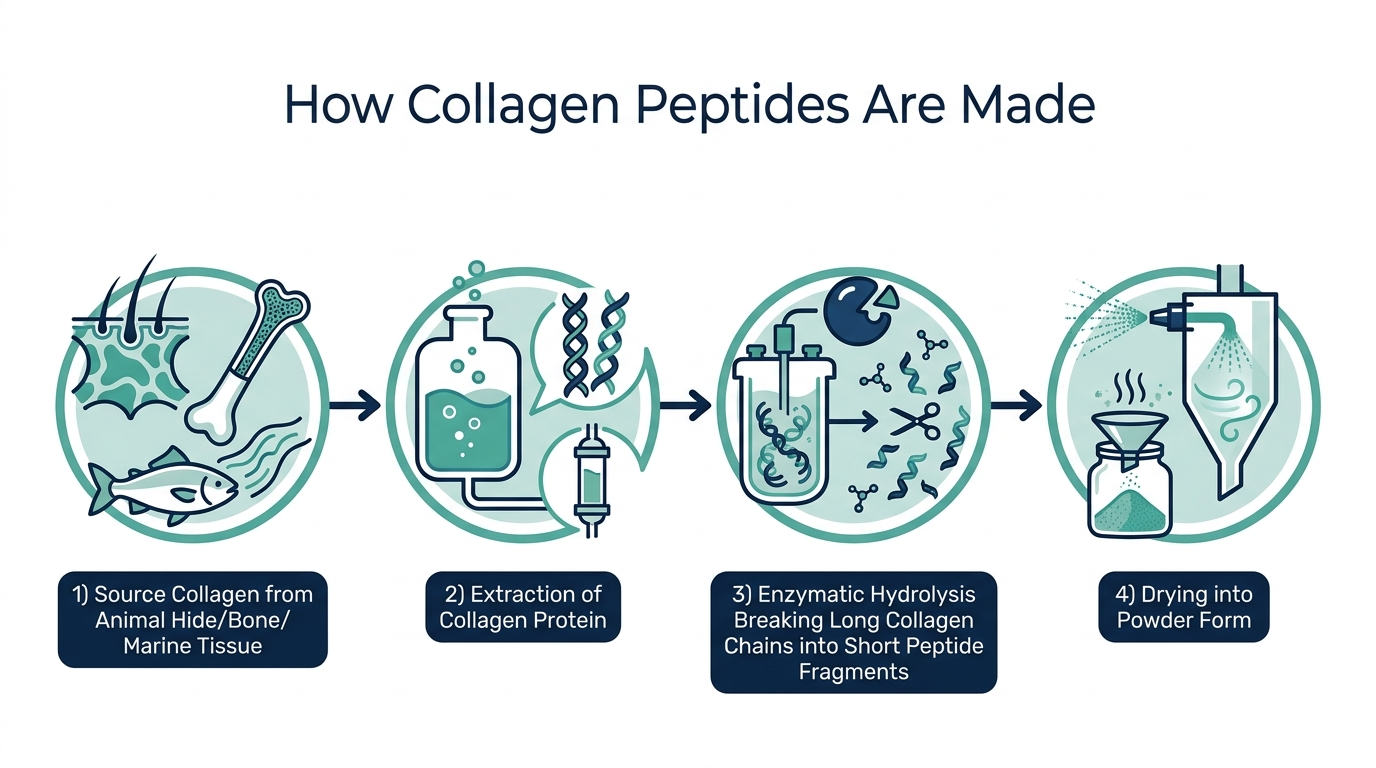
The finished white powder in your shaker bottle began as something much less glamorous. Collagen is the most abundant structural protein in mammals, making up roughly 30% of total body protein. In cattle, it is concentrated in the hide, bones, and tendons. In fish, it is packed into the skin and scales. Those byproduct streams from the food industry are the raw material that collagen manufacturers start with.
The four main source animals are bovine (cattle), marine (fish, usually tilapia, cod, or snapper), porcine (pig), and avian (chicken, mainly for cartilage). Each delivers a different mix of collagen types, and that mix decides what the finished supplement is most useful for, a point almost all marketing copy glosses over.
The phrase “grass-fed bovine” on a label is meaningful, not just marketing. Pasture-raised hides have measurably lower contamination risk from antibiotic residues, and multiple brands including Vital Proteins source exclusively from pasture-raised cattle for that reason.
How is raw hide or fish skin turned into a powder?
The simplest way to actually get this done
Superpower is a full-body lab membership that runs 100+ biomarkers, has each result reviewed by a doctor, and tracks your numbers year over year (about $199/year). It is what we point readers to when they would rather get one clean, complete draw than chase single tests one at a time. Here is superpower reviewed in full.
The transformation from hide to peptide powder involves three main steps, and the details of each step change the bioavailability of the final product.
Step 1: Cleaning and demineralization. The raw material is washed, stripped of fat and non-collagen tissue, and, in the case of bones, treated with dilute acid to remove mineral content. What remains is nearly pure collagen protein in its native triple-helix form, with a molecular weight around 300,000 daltons, far too large for meaningful intestinal absorption.
Step 2: Hydrolysis. This is the critical step that distinguishes collagen peptides from plain gelatin. The cleaned collagen is exposed to a combination of heat, water, and specific proteolytic enzymes, commonly papain, pepsin, or bromelain, over a controlled time and temperature. The enzyme-driven hydrolysis cleaves the peptide bonds holding the triple helix together, releasing short fragments. The target is a molecular weight range of 2,000 to 5,000 daltons, with research showing peptides at 2,000 to 3,500 Da offering the highest bioavailability by passing through the intestinal wall via passive diffusion.
Step 3: Purification and drying. The hydrolyzed solution is filtered, pasteurized, and spray-dried into a fine powder. Reputable manufacturers at this stage do heavy metal testing (lead, cadmium, arsenic) and microbial testing, because both hides and fish skin can accumulate contaminants if sourcing controls are loose.
The key difference from gelatin: gelatin is only partially hydrolyzed, producing fragments that still gel in cold water. Collagen peptides are fully hydrolyzed, dissolving in hot or cold liquid and delivering more consistently sized fragments for absorption.
What amino acids actually make up collagen peptides?
This is where collagen gets genuinely unusual compared to any other protein supplement. The amino acid profile is lopsided by design, because native collagen is lopsided.
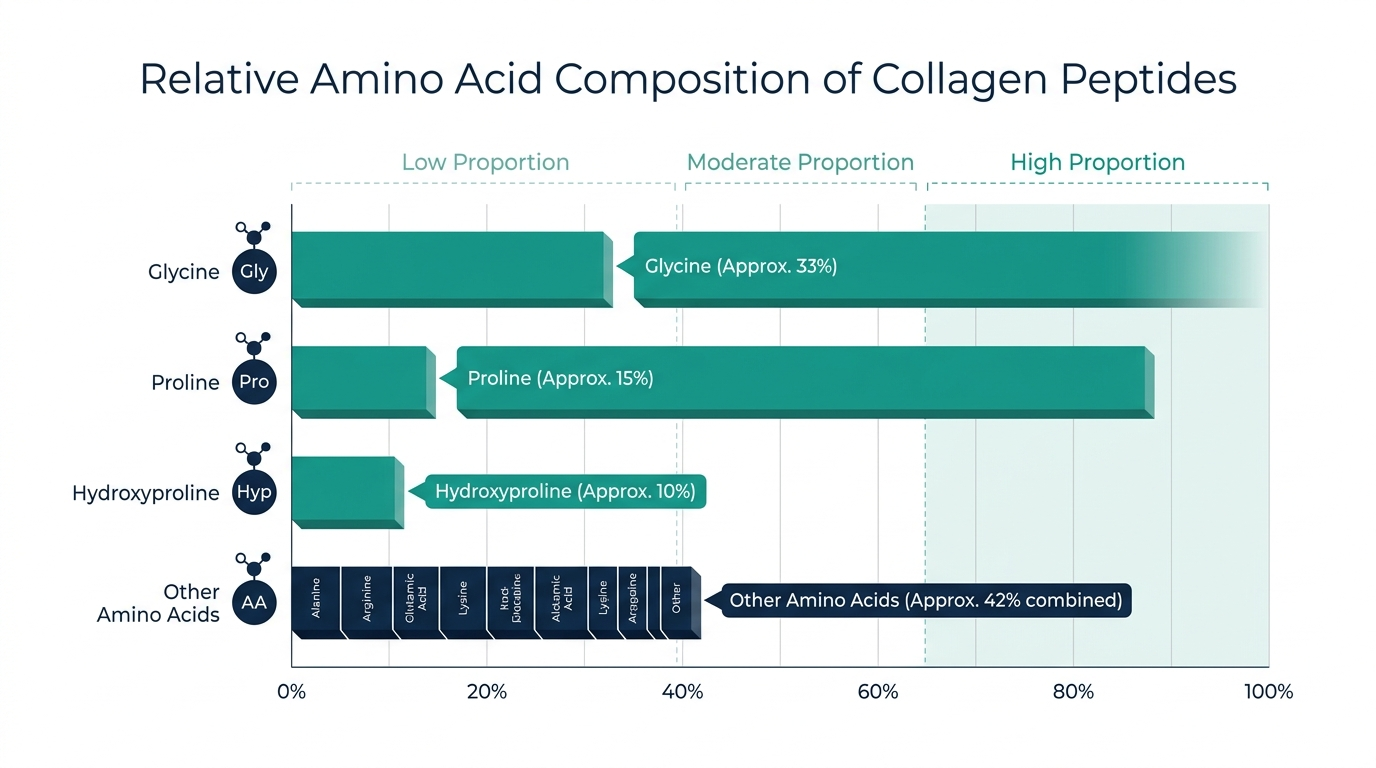
Collagen is built on a repeating sequence: glycine-proline-X, where X is often hydroxyproline. Glycine alone makes up roughly one-third of all amino acids in the collagen protein. Proline and hydroxyproline together account for another 20 to 25%. This trio is responsible for the triple-helix structure that gives connective tissue its tensile strength.
Here is what that means practically. When you ingest collagen peptides, your circulating levels of glycine, proline, and hydroxyproline rise sharply, peptide fragments that signal fibroblasts (the cells that synthesize collagen in skin and tendons) to upregulate collagen production. A 2021 study in PMC found that 15 g per day paired with vitamin C increased the collagen synthesis marker PINP by 153% above baseline, compared with just 59% for a 5 g dose and a lower response without vitamin C.
What collagen peptides are notably low in is leucine, the branched-chain amino acid most responsible for muscle protein synthesis. Compared head-to-head with whey protein, collagen produces 87% lower plasma leucine concentrations. Personally, I think the supplement industry created a false contest here: collagen is not competing with whey for muscle. It is doing something whey cannot, rebuilding connective tissue matrices, which is a different job.
What collagen types do different sources provide?
Not all “collagen” is the same protein. Researchers have identified at least 28 distinct collagen types in the body. The five types that appear in supplements have different tissue locations and different manufacturing origins.
| Collagen Type | Primary location in the body | Main supplement source | Best use case |
|---|---|---|---|
| Type I | Skin, tendons, bones, teeth (90%+ of body’s collagen) | Bovine hide, fish skin | Skin elasticity, wound healing, bone density |
| Type II | Articular cartilage (up to 90% of cartilage collagen) | Chicken sternum/cartilage | Joint pain, osteoarthritis support |
| Type III | Blood vessel walls, muscles, gut lining, liver | Bovine hide (alongside Type I) | Gut integrity, cardiovascular, skin support |
| Type V | Hair, cell surfaces, placenta | Eggshell membrane | Hair texture, complementary to Type I |
| Type X | Growth plates, calcified cartilage | Eggshell membrane, chicken | Bone development, joint support |
A few non-obvious points worth knowing. First, marine collagen (fish-derived) provides almost exclusively Type I, which is why it often markets itself specifically for skin. Bovine hide delivers Types I and III together, while bovine bone broth delivers I, II, and III. Second, Type II collagen works through a different mechanism than Types I and III: instead of supplying raw amino acids for fibroblasts, native Type II collagen taken in small doses (10 to 40 mg, far below the 10 g in most skin products) is thought to work through oral tolerance, training the immune system not to attack cartilage. The dose and form are completely different; mixing them up is a common and consequential error.
Full-body lab membership: 100+ biomarkers, doctor-reviewed, tracked over time.
Does the source animal change the amino acid profile?
Materially, no. Bovine, marine, and porcine collagen all share the same glycine-proline-hydroxyproline backbone because that sequence is structurally required for the triple helix to form. What differs is the proportion of each collagen type, the molecular weight after hydrolysis, and practical considerations like allergen profile.
Marine collagen hydrolyzed to very low molecular weights (under 1,000 Da, sometimes called “nano-hydrolyzed”) absorbs faster in early studies, though whether that speed of absorption translates to meaningfully different clinical outcomes at standard doses is still being investigated. What is more robustly established is that marine collagen is the better choice for anyone avoiding beef or pork for religious, ethical, or dietary reasons.
Do not believe the claim that “marine collagen is biologically closer to human collagen.” Human skin collagen is predominantly Type I, and so is bovine hide collagen. The homology argument does not hold up to scrutiny. Both deliver the same glycine-proline-hydroxyproline units your fibroblasts are waiting for.
Is there a vegan version, and is it real collagen?
This is one of the more interesting corners of the market in 2026. Most products marketed as “vegan collagen boosters” are not collagen at all; they are a cocktail of vitamin C, silica, zinc, and sometimes glycine and proline that theoretically supports collagen synthesis. That is a supplement for your body to make its own collagen, not a source of exogenous collagen peptides.
Actual biofermented collagen is a different category. In October 2025, the FDA issued a “no questions” GRAS letter to Geltor for its PrimaColl product, a precision-fermentation collagen polypeptide produced by engineered E. coli, making it the first new collagen cleared by the FDA since 1999 and the first ever that is 100% animal-free. PrimaColl replicates the amino acid sequence of avian Type 21 collagen, a rare signaling type. Tosla launched a commercial supplement using PrimaColl in April 2026. It is real collagen at the molecular level, though at this stage clinical data on efficacy in humans is limited compared with the decades of research behind bovine and marine hydrolysates.
What does the science actually say about benefits?
The honest answer is: the evidence is strongest for skin hydration, elasticity, and joint pain at specific doses, and considerably thinner for hair, nails, and gut health.
The clearest dataset is for skin. A 2025 meta-analysis in The American Journal of Medicine of 23 randomized controlled trials found that collagen supplements significantly improved skin hydration, elasticity, and wrinkle depth. Studies typically use 5 to 10 g per day for 8 to 16 weeks. A 2025 randomized trial of CollaSel Pro hydrolyzed collagen at 10 g per day in adult women showed significant improvements in elasticity, hydration, and skin roughness versus placebo after 8 weeks.
For joints, the PMC systematic review (Morton 2021) summarized 5 randomized studies and found approximately 27 to 38% reductions in joint pain scores at 5 to 10 g per day over 3 to 6 months. Participants using collagen also reduced reliance on other pain medications by 59% compared with placebo in one of those studies.
Body composition shows mixed results: 15 g per day for 12 weeks helped elderly sarcopenic men gain over 5 kg of fat-free mass alongside resistance training, but effects were much smaller in young athletes and pre-menopausal women.
What most brands will not tell you: the vitamin C co-factor is not optional. The 153% vs. 59% PINP increase in the synthesis study came from the vitamin C group. If your collagen product has no vitamin C and you are not adding a separate source, you are running the mechanism at half speed.
How does it compare to just eating more protein?
Collagen peptides are not a complete protein. They are missing or severely low in tryptophan and are low in leucine, which means they do not register as highly anabolic as whey, egg, or meat protein. If “building muscle” is the goal, collagen is the wrong primary tool.
Where collagen wins is in two niches: first, supplying the specific precursors (glycine, hydroxyproline) that your body uses to synthesize connective tissue proteins, amino acids that are rare in most modern diets because we no longer eat nose-to-tail; second, delivering pre-formed proline-hydroxyproline dipeptides that may directly signal fibroblast activity. A study in PMC (Shigemura 2020) confirmed that collagen peptides increase expression of collagen, elastin, and versican genes in cultured human dermal fibroblasts, a mechanism that eating chicken breast protein does not replicate.
Hydrolyzed type I & III collagen peptides, third-party tested, unflavored.
What are the real-world dosing ranges?
Clinical trials use a wide range depending on target outcome:
- Skin hydration and elasticity: 2.5 to 10 g per day, 8 to 16 weeks minimum
- Joint pain reduction: 5 to 10 g per day, 3 to 6 months minimum
- Connective tissue synthesis (with exercise): 15 g per day taken 60 minutes before training, with vitamin C
- Muscle support in sarcopenia: 15 g per day paired with resistance exercise
Most retail products are designed around 10 to 20 g servings. Vital Proteins, for instance, delivers 18 g of protein from a 20 g serving. That lands in the range where most skin and joint studies show signal. What the product pages rarely say: results at the low end of dose (2.5 to 5 g) may take 12 to 16 weeks to become visible to the consumer. People who “tried collagen and felt nothing” often used it for four to six weeks, half the minimum study window.
Are collagen peptides safe, and who should be cautious?
For most healthy adults, hydrolyzed collagen is one of the better-tolerated supplements on the shelf. The most common complaints are mild and digestive: a feeling of fullness, mild bloating, or an aftertaste, most often reported with marine collagen. Because the powder is essentially a purified protein, true allergic reactions are uncommon, with one clear exception. Anyone with a fish or shellfish allergy should avoid marine collagen entirely, and anyone with a beef or egg sensitivity should check the source animal on the label.
A few groups have specific reasons to be careful. People with chronic kidney disease are usually advised to watch total protein intake, and a 10 to 20 g scoop of collagen counts toward that total. Some marine and eggshell-derived products carry meaningful calcium, which matters for anyone already supplementing calcium or managing high blood calcium. And because collagen is an animal byproduct, the sourcing and testing controls discussed earlier are the real safety story. A reputable product will publish third-party testing for heavy metals like lead, cadmium, and arsenic, which can concentrate in hides and fish skin when sourcing controls are loose.
The practical rule: the safety of a collagen supplement is mostly decided upstream, at the sourcing and testing stage, not by the amino acids themselves. Buy from a brand that shows its testing, and the residual risk for a healthy adult is low.
How should you actually take collagen for it to work?
Three practical details decide whether a collagen habit does anything.
First, it is heat stable. The peptide fragments are already broken down, so stirring the powder into hot coffee, tea, or soup does not destroy them. That makes a morning coffee the easiest place to build a daily habit, and habit is what matters, because the studies that show results run for 8 to 16 weeks of daily use, not a scattered week here and there.
Second, pair it with vitamin C. This is the single most overlooked step. Vitamin C is a required cofactor for the enzymes that assemble collagen, and the synthesis data shows a much larger response when the two are taken together. If your product does not already include it, take the collagen with a food or drink that contains vitamin C.
Third, timing matters most for connective tissue and training goals. For skin and general use, the time of day is not critical, consistency is. For tendon and ligament support around exercise, the trial protocols take collagen with vitamin C roughly 60 minutes before training, on the theory that circulating amino acids peak as blood flow to connective tissue rises during the session.
A realistic picture: someone taking 10 g of collagen in their morning coffee with a vitamin C source, every day, should not expect to notice anything for the first month. Skin hydration and elasticity changes in the trials typically become measurable around the 8 week mark and clearer by 12 to 16 weeks. The people who report that collagen did nothing almost always stopped inside that window.
Curious what your own levels look like?
Baseline 100+ biomarkers today and retest as life changes, all in one membership with physician review.
Frequently asked questions
What is collagen peptides made of?
Collagen peptides are made from the connective tissue of animals, most commonly bovine (cow) hide or fish skin. The raw material is cleaned, then broken down by enzymes and heat in a process called hydrolysis, producing short protein fragments called peptides. The powder is dominated by the amino acids glycine, proline, and hydroxyproline.
Is collagen peptides the same as hydrolyzed collagen?
Yes. “Collagen peptides” and “hydrolyzed collagen” describe the same product: collagen that has been fully broken down into small peptide fragments via enzymatic hydrolysis. Both terms appear on labels. “Collagen hydrolysate” is a third synonym. Gelatin, by contrast, is only partially hydrolyzed and behaves differently in liquids.
What is the difference between bovine and marine collagen peptides?
Bovine collagen provides Types I and III, making it useful for both skin and muscle/gut support. Marine collagen provides primarily Type I, and is the preferred option for those avoiding red meat. Both share the same core amino acid profile. Marine collagen is sometimes hydrolyzed to a smaller molecular size, which may improve absorption speed, though clinical outcomes at standard doses appear comparable.
How much collagen peptides should I take per day?
Evidence-based ranges are 2.5 to 10 g per day for skin benefits and 5 to 10 g per day for joints, both requiring at least 8 to 12 weeks of consistent use. For connective tissue synthesis paired with exercise, studies use 15 g taken 60 minutes before training, with vitamin C. Daily doses up to 10 g have been used safely in studies lasting up to 6 months.
Are collagen peptides FDA approved?
Collagen peptides are regulated as dietary supplements, not drugs, so they do not go through pre-market FDA drug approval. Hydrolyzed collagen is classified as Generally Recognized As Safe (GRAS) as a food ingredient. In October 2025, the FDA issued a GRAS “no questions” letter for Geltor’s biofermented PrimaColl, the first new collagen cleared by the FDA since 1999.
Do collagen peptides actually work, or is it marketing?
For specific outcomes, yes, with caveats. The evidence for skin hydration, elasticity, and wrinkle reduction is solid across multiple randomized controlled trials and a 2025 meta-analysis of 23 studies. Joint pain data from 5 RCTs is also positive at 5 to 10 g per day over 3 to 6 months. Hair, nail, and gut claims have thinner clinical backing. Collagen is not a complete protein and should not replace a high-protein diet.
Can vegans take collagen peptides?
Standard collagen peptides are always animal-derived. As of April 2026, Tosla launched the first commercial supplement using Geltor’s PrimaColl, a precision-fermented vegan collagen that received FDA GRAS clearance in October 2025. Availability in mainstream retail is limited as of mid-2026. Most “vegan collagen” products are amino acid and cofactor blends designed to support the body’s own collagen synthesis, not actual exogenous collagen peptides.
Author: Vital Signs Today Editorial Team, [credential]”]. Educational content, not medical advice. Sources linked inline.
Hydrolyzed type I & III collagen peptides, third-party tested, unflavored.
Primary sources:
- Morton RW et al. “The effects of collagen peptide supplementation on body composition, collagen synthesis, and recovery from joint injury and exercise: a systematic review.” PMC8521576. https://pmc.ncbi.nlm.nih.gov/articles/PMC8521576/
- American Journal of Medicine meta-analysis (2025): “Effects of Collagen Supplements on Skin Aging.” https://www.amjmed.com/article/S0002-9343(25)00283-9/abstract
- Collagen molecular weight and daltons guide (Natu.care): https://natu.care/uk/collagen/collagen-molecular-weight
- Nutrabytes: Does the Molecular Size of Collagen Matter? https://www.nutrabytes.com/blogs/news/does-the-molecular-size-of-collagen-matter
- FormBlends: Collagen peptide amino acid FAQ. https://formblends.com/articles/peptide-hub/peptides-collagen-peptides-faq-what-amino-acids-are-in-collagen-peptide
- Vital Proteins product page: https://www.vitalproteins.com/products/collagen-peptides
- FoodNavigator-USA on Geltor FDA GRAS (October 2025): https://www.foodnavigator-usa.com/Article/2025/10/16/fda-greenlights-in-demand-vegan-collagen-from-geltor/
- Collagen Stewardship Alliance, Science Update February 2026: https://collagenalliance.org/collagen-science-update-february-2026/
- PMC fibroblast gene expression study: https://pmc.ncbi.nlm.nih.gov/articles/PMC11094247/
- NCBI hydrolyzed collagen sources overview (PMC6891674): https://www.ncbi.nlm.nih.gov/pmc/articles/PMC6891674/
Related reading
Vital Signs Today may earn a commission if you buy through links on this page. It does not affect our editorial assessments.