
Last updated June 2026. Educational content, not medical advice. Talk to a licensed clinician before starting any supplement protocol.
Short answer: A collagen peptide is a short chain of amino acids produced by breaking down whole collagen protein through hydrolysis. Unlike intact collagen, which is too large to absorb intact, collagen peptides are small enough to pass through the gut wall, appear in the bloodstream as hydroxyproline-containing dipeptides within 30 to 60 minutes, and reach tissues like skin and cartilage where they stimulate fresh collagen production.
Everyone’s taking collagen peptides, so how do you know if yours is actually moving the needle for you? One at-home Superpower draw checks 100+ biomarkers, physician-reviewed.
Why does everyone suddenly care about collagen peptides?
The US collagen peptides market was valued at $333.26 million in 2025 and is projected to reach $2.2 billion by 2033, growing at roughly 7% a year. More than 35 million Americans already use collagen-based products for skin health and roughly 21 million use them for bone and joint support, according to recent consumer data. That is not a niche trend. That is a mainstream supplement category.
The growth makes sense when you understand the biology. Collagen is the most abundant protein in the human body, making up roughly 30% of total protein mass and forming the structural scaffold of skin, tendons, ligaments, cartilage, and bone. Starting around age 25, the body produces about 1% less collagen every year. By the time most people notice it, in the form of creeping wrinkles, stiffer joints, or slower injury recovery, the decline has been running for a decade or more.
The frustrating part: you cannot eat collagen and have it automatically become new collagen in your skin. The original molecule is too big and too rigid to survive digestion intact. That is the entire premise of collagen peptides.
Full-body lab membership: 100+ biomarkers, doctor-reviewed, tracked over time.
What exactly is the difference between collagen and collagen peptides?
Whole collagen is a triple-helix protein made of three polypeptide chains, each thousands of amino acids long, wound tightly around each other. It is exceptionally strong mechanically, which is exactly why it works so well as a structural material in tendons and skin. It is also why it cannot pass intact through the intestinal wall and get to the tissues that need it.
Collagen peptides, also called hydrolyzed collagen or collagen hydrolysate, are produced by taking whole collagen (usually from bovine hide, bovine bone, marine fish skin, or eggshell membrane) and breaking it down with enzymes or heat and acid into much shorter chains, typically 2 to 20 amino acids long. The average molecular weight of the resulting peptides is around 3,000 to 5,000 Daltons, compared to roughly 300,000 Daltons for the intact triple-helix.
The terms “collagen peptides” and “hydrolyzed collagen” are functionally interchangeable in the supplement industry. “Bioactive collagen peptides” is a more specific term referring to peptides that have been optimized through controlled enzymatic hydrolysis to generate particular short sequences with specific biological activity, and are sometimes proprietary (Verisol from GELITA, Fortigel, and Peptan are examples). The distinction matters because not all hydrolysates produce the same downstream effect.
The collagen type in the source material also matters:
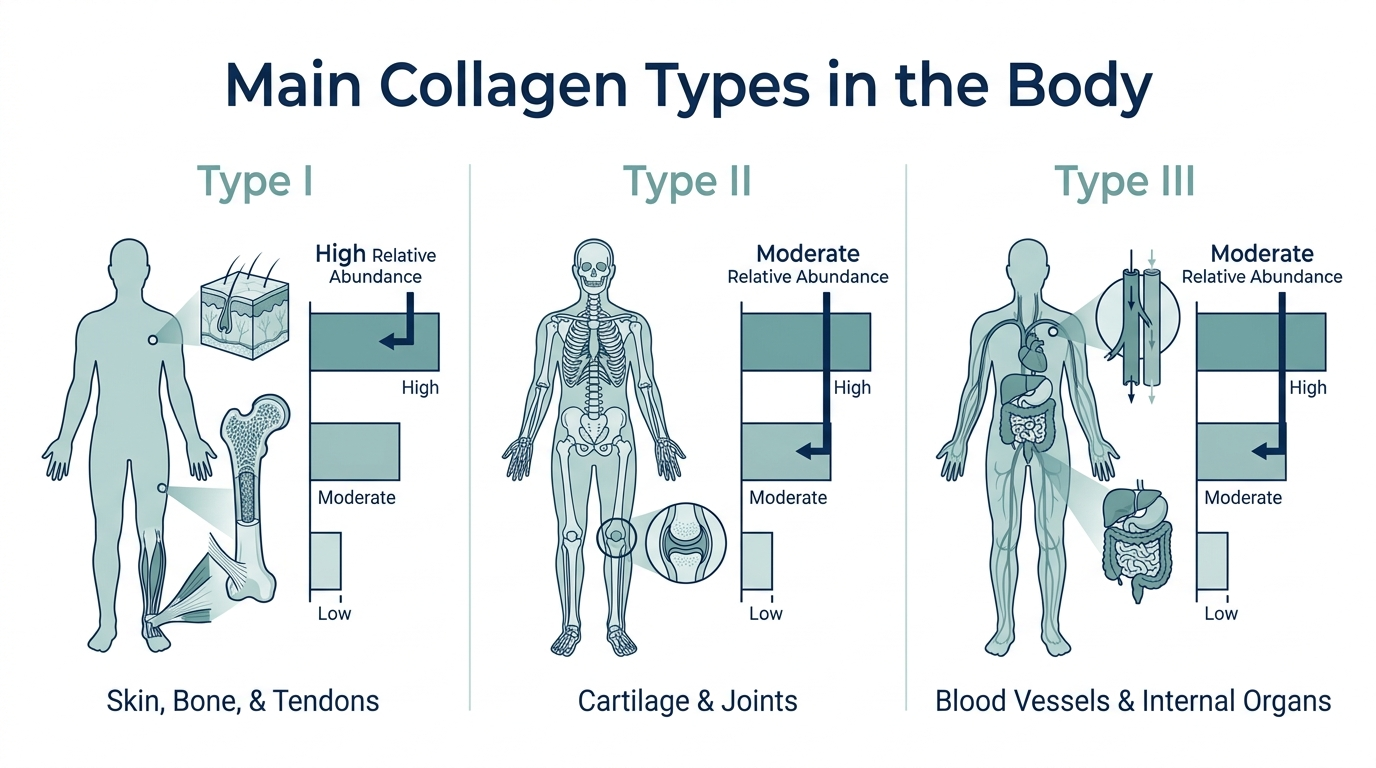
– Type I collagen is the most abundant type in the body, dominant in skin, tendons, ligaments, and bone. Bovine hide and marine fish are both predominantly Type I.
– Type II collagen is the primary structural protein in cartilage and is more relevant for joint health.
– Type III collagen is found alongside Type I in skin and blood vessels and is often co-present in bovine sources.
How do collagen peptides actually get absorbed?
This is the part most product labels skip over, and understanding it separates informed buyers from people spending money on something that mostly ends up in the toilet.
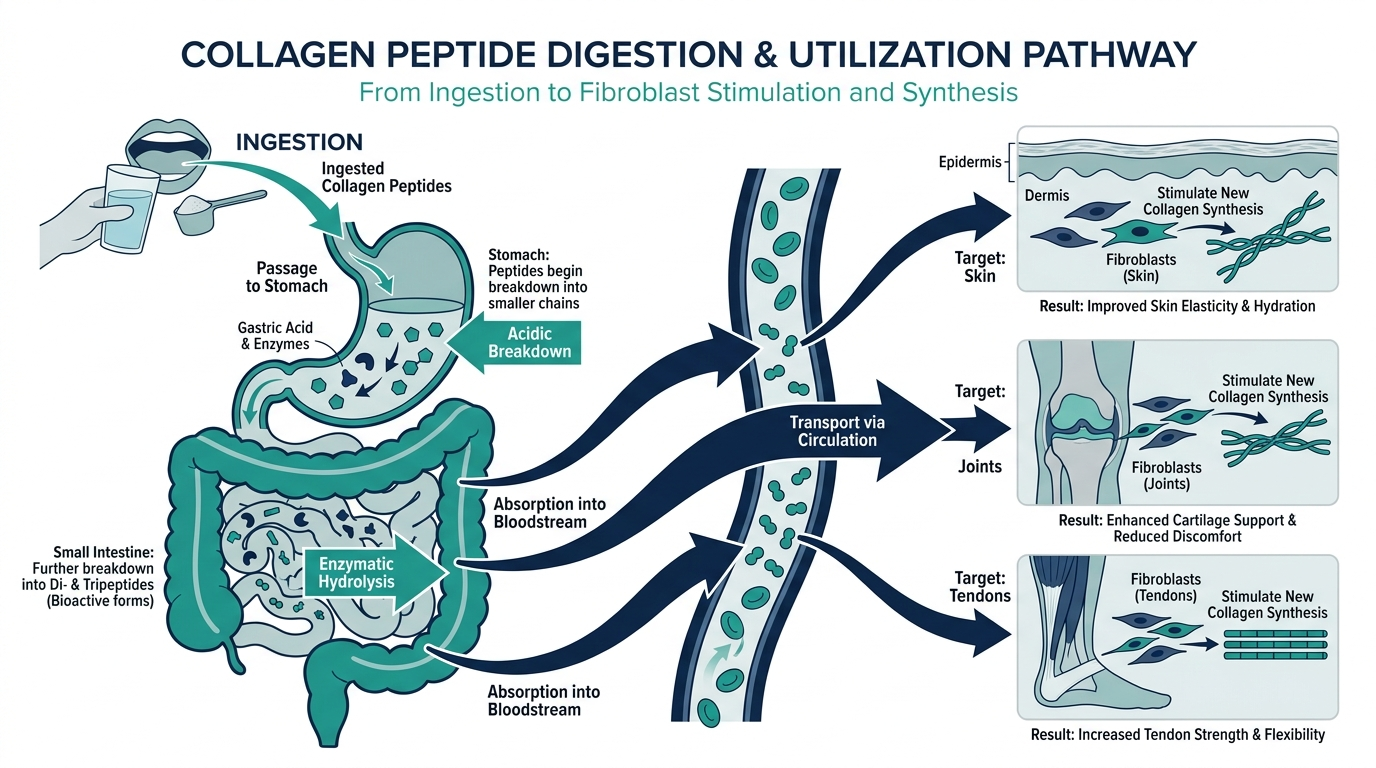
After ingestion, collagen peptides are further broken down in the stomach and small intestine. The critical finding from recent absorption research is that a significant fraction does NOT get fully broken down into single amino acids. Instead, the gut efficiently transports small di- and tripeptides, especially hydroxyproline-containing sequences, across the intestinal epithelium intact.
A 2024 randomized, double-blind crossover study published in Frontiers in Nutrition confirmed that multiple bioactive peptides appear in the blood after collagen hydrolysate ingestion. The dominant blood-borne species is Pro-4Hyp (prolyl-4-hydroxyproline), followed by 4Hyp-Gly. Blood concentrations of these collagen-derived oligopeptides reach micromolar levels, significantly higher than those of other food-derived peptides.
Why does this matter? Hydroxyproline is almost exclusive to collagen among dietary proteins. Its presence in blood is a reliable biological marker confirming you are actually absorbing collagen-derived peptides, not just generic amino acids. Those peptides reach fibroblasts in skin and chondrocytes in cartilage, where they act as signaling molecules, essentially telling cells to ramp up their own collagen synthesis.
This is the insider detail that undermines the old “collagen supplements are just expensive gelatin” dismissal. The signal is the point, not the raw amino acid supply.
What does the clinical research actually show?
This is where I need to be precise, because marketing and science are not the same language.
Skin: the strongest evidence
A 2025 meta-analysis of 23 randomized controlled trials published in the American Journal of Medicine found collagen supplements significantly improved skin hydration, elasticity, and reduced wrinkle appearance. Type I collagen improved skin elasticity by approximately 18% in pooled analysis. A separate 2026 systematic review and meta-analysis in Frontiers in Medicine covering oral and topical peptides for skin aging confirmed the effect across multiple RCTs.
One mechanism that gets less attention: a 2023 randomized, double-blind, placebo-controlled study in Bioscience, Biotechnology, and Biochemistry found that a collagen peptide containing high concentrations of Pro-Hyp and Hyp-Gly reduced advanced glycation end product (AGE) levels in the skin and subcutaneous blood vessel walls. AGEs are the crosslinked, stiff collagen fibers that make older skin look dull and leathery. Reducing them is a separate mechanism from simply adding new collagen.
Typical effective dose for skin outcomes: 2.5 to 5 grams per day, with measurable improvements observed at 8 to 12 weeks in most trials.
Joints: good evidence at higher doses
The PMC systematic review of collagen peptide supplementation found consistent evidence of benefit for joint comfort in people with osteoarthritis and activity-related joint pain. Knee osteoarthritis, where collagen plays a key role in cartilage extracellular matrix homeostasis, shows the most robust data.
Effective doses for joint outcomes tend to be higher: 8 to 10 grams per day for hydrolyzed collagen, or as little as 10 to 40 mg per day for undenatured Type II collagen (which works by a different immune-tolerance mechanism, not by providing raw building blocks).
Muscle: emerging and interesting
A 2026 RCT published in Frontiers in Physiology by Jerger, Nielsen, Centner, and colleagues found that specific collagen peptide supplementation increased collagen Type I content in skeletal muscle after 12 weeks of high-load resistance training. Although collagen represents only a small fraction of total skeletal muscle protein, supplementation appears to enhance the extracellular matrix at a structural level, which may explain why earlier research found greater fat-free mass gains in collagen groups versus placebo.
This is not a replacement for whey or casein for muscle protein synthesis. Collagen is low in branched-chain amino acids. But for the connective tissue scaffolding around muscle, the effect appears real.
Does it matter when you take collagen peptides?
Yes, and this is one of those details that most buyers never learn.
The gelatin and collagen synthesis research from the Shaw Lab at UC Davis established that taking collagen peptides with vitamin C, 60 minutes before exercise, maximizes the boost to collagen synthesis markers (measured by PINP, a blood marker for new collagen production). Vitamin C is a required cofactor for the hydroxylation of proline and lysine, the two steps that allow collagen’s triple helix to form and crosslink properly. Without adequate vitamin C, newly synthesized collagen is structurally weak.
A 2024 dose-response study found that 30 g of hydrolyzed collagen taken 1 hour before resistance exercise produced a greater collagen synthesis response than 15 g or 0 g in resistance-trained men. For joint and skin outcomes, 2.5 to 5 g is adequate. For connective tissue and muscle-support goals combined with exercise, the evidence points toward 15 to 30 g pre-workout.
Practical timing recommendations based on the data:
– Skin / general use: 2.5 to 10 g at any consistent time, ideally with a vitamin C source.
– Joint and connective tissue repair: 8 to 15 g with 48 to 50 mg vitamin C, 30 to 60 minutes before exercise or physical activity.
– Post-exercise recovery: 15 to 30 g with vitamin C taken around exercise sessions.
Collagen peptide comparison: what to look for when buying
| Feature | What to look for | What to avoid |
|---|---|---|
| Source | Grass-fed bovine (Type I/III), wild-caught marine (Type I), or cage-free chicken (Type II for joints) | “Collagen blend” with no type/source disclosure |
| Molecular weight | 3,000 to 5,000 Daltons (hydrolyzed) | “Collagen protein powder” that is just gelatin |
| Third-party testing | NSF Certified, Informed Sport, or independent COA | No testing certification at all |
| Vitamin C co-factor | Included in formulation OR you take separately | Not mentioned anywhere |
| Additives | Minimal: collagen, vitamin C, natural flavor at most | Artificial sweeteners, fillers, proprietary “blends” that obscure dose |
| Dose per serving | 10 to 20 g for sports/joint goals, 2.5 to 5 g for skin | Under 2 g per serving (you would need 5 to 8 scoops) |
Named products that consistently rank in independent testing: Vital Proteins Collagen Peptides (bovine hide, 18 amino acids including glycine, hydroxyproline, and proline, now also available in a sparkling water format with Verisol peptides launched in 2026), Sports Research Organic Collagen Peptides (first USDA-certified organic collagen powder, grass-fed Brazilian cattle), and Transparent Labs Grass-Fed Collagen (high single-dose content, ingredient transparency).
Personally, I would not buy a collagen product that lacks third-party testing and clear type disclosure. The category is not well-regulated, and “collagen” on a label tells you very little about what molecular form is inside.
Hydrolyzed type I & III collagen peptides, third-party tested, unflavored.
The myth collagen supplement brands will not correct
“Taking collagen peptides directly rebuilds your collagen.”
This oversimplification is everywhere, and it is half true at best. Here is the more accurate mechanism: you ingest collagen peptides, they absorb as bioactive dipeptides and tripeptides (especially Pro-Hyp and Hyp-Gly), those peptides reach fibroblasts and chondrocytes, and those cells respond by synthesizing new collagen of their own. The peptides are a biological signal, not a brick you slot directly into your skin matrix.
This matters because it explains why dose timing with vitamin C and exercise matters more than the label emphasizes, why the effect takes weeks to months (cells need time to synthesize and deposit new collagen), and why no single serving is going to produce overnight results. The expectation mismatch is the main reason people stop supplementing too early.
Do not believe any brand claiming visible skin results in less than 4 weeks from collagen peptides alone. The mechanistic timeline does not support it.
How do marine and bovine collagen peptides differ?
Both are predominantly Type I collagen and both produce measurable benefits for skin and connective tissue. The practical differences come down to absorption kinetics and consumer preference.
Marine collagen (from fish skin and scales) tends to have a slightly lower average molecular weight than bovine collagen, which some researchers argue translates to marginally faster absorption. The amino acid profile is similar, though marine collagen is particularly rich in hydroxyproline. It is also the preferred option for people avoiding beef products.
Bovine collagen (from cattle hide or bone) provides both Type I and Type III collagen and is the most studied form in muscle and joint research. It is less expensive to produce at scale and the format most common in the evidence base for joint outcomes.
Neither source is clearly superior across all outcomes. Matching source to goal: marine for skin-forward use cases; bovine for broad connective tissue, joint, and muscle goals.
How long does it take for collagen peptides to actually work?
This is the question nobody asks directly and nobody answers honestly.
Based on the clinical trial timelines:
– Skin hydration: some improvement measurable at 4 weeks, significant and consistent at 8 to 12 weeks.
– Skin elasticity and wrinkle depth: 12 weeks is the standard trial duration where effects are clearest.
– Joint comfort: 12 to 24 weeks in most osteoarthritis trials, with some subjects requiring 6 months of consistent use.
– Muscle collagen content: the 2026 Frontiers RCT measured significant change at 12 weeks of concurrent high-load resistance training.
One variable that routinely gets ignored in popular media: results depend heavily on your starting state. A 55-year-old with measurable skin elasticity decline and early cartilage degradation is likely to see more noticeable benefit than a 28-year-old taking it for “prevention.” Age-related collagen decline is the clinical context most of the evidence was generated in.
Don’t just read about your health, track it.
A single result is a snapshot. Superpower re-tests 100+ markers over time so you can watch them move as you change sleep, food, and training.
FAQ: What is a collagen peptide?
What is the difference between collagen and collagen peptides?
Whole collagen is a large triple-helix protein (roughly 300,000 Daltons) that does not absorb intact from the gut. Collagen peptides are short chains of amino acids (3,000 to 5,000 Daltons) produced by enzymatic hydrolysis of whole collagen. The smaller size allows them to be transported across the gut wall as bioactive dipeptides and tripeptides, particularly Pro-Hyp and Hyp-Gly, which enter the bloodstream and signal cells to produce new collagen.
How many grams of collagen peptides per day should I take?
For skin-focused outcomes, 2.5 to 5 g per day is supported by multiple RCTs. For joint support, 8 to 10 g per day is more typical in the evidence. For exercise recovery and muscle connective tissue, 15 to 30 g taken around exercise sessions, with vitamin C, shows the strongest collagen synthesis response in current research.
Is hydrolyzed collagen the same as collagen peptides?
Yes, functionally. Both terms describe collagen that has been broken down through hydrolysis into shorter peptide chains. “Bioactive collagen peptides” is a more specific term for proprietary hydrolysates optimized to produce particular short-chain sequences with defined biological activity.
Do collagen peptides actually work for skin?
The 2025 meta-analysis of 23 RCTs in the American Journal of Medicine found significant improvements in skin hydration, elasticity, and wrinkle appearance. A 2026 systematic review in Frontiers in Medicine confirmed the effect. Type I collagen improved skin elasticity by approximately 18% in pooled analysis. Results are most consistent at 2.5 to 5 g per day over 8 to 12 weeks.
What is the best collagen peptide for joints?
For osteoarthritis and cartilage-related joint pain, Type II collagen (undenatured, 10 to 40 mg per day) or hydrolyzed collagen from bovine sources (8 to 10 g per day) both have clinical support. Undenatured Type II works through an immune-tolerance pathway and is effective at much lower doses. Hydrolyzed collagen provides raw building blocks and bioactive signaling peptides.
Can you take collagen peptides every day?
Most clinical trials run 12 to 24 weeks of daily supplementation with no serious adverse events reported. Collagen peptides are generally well-tolerated. The main practical issue is consistency: the effects require sustained supplementation to accumulate, and stopping supplementation reverses the benefit over time.
Does the source of collagen peptides matter (bovine vs. marine)?
Both are predominantly Type I collagen and both produce measurable benefits in clinical trials. Marine collagen has a slightly lower average molecular weight and is preferred for skin-focused use. Bovine collagen provides Type I and III and is more common in joint and muscle research. Choose based on your primary goal and dietary preferences.
Author: Vital Signs Today Editorial Team, [credential]”]. Educational content, not medical advice. Sources linked inline.
Hydrolyzed type I & III collagen peptides, third-party tested, unflavored.
Primary sources
- Frontiers in Physiology, 2026: Specific collagen peptides increase skeletal muscle collagen Type I after 12-week resistance training RCT
- Frontiers in Medicine, 2026: Systematic review and meta-analysis, oral and topical peptides for skin aging
- American Journal of Medicine, 2025: Meta-analysis of 23 RCTs on collagen supplements for skin
- Frontiers in Nutrition, 2024: Absorption of bioactive peptides following collagen hydrolysate intake, randomized crossover study
- PMC, 2021: Collagen peptide supplementation for body composition, collagen synthesis, joint injury and exercise, systematic review
- Bioscience, Biotechnology, and Biochemistry, 2023: Collagen peptide reduces AGE levels in skin and blood vessel walls (RCT)
- PMC, 2024: Collagen synthesis response comparing 30 g vs 15 g vs 0 g hydrolyzed collagen with resistance exercise
- Collagen Stewardship Alliance, February 2026: Collagen science update
- Polaris Market Research: Collagen Peptides Market Size projection to 2030
- Vital Proteins product page: ingredient and formulation details
Related reading
Vital Signs Today may earn a commission if you buy through links on this page. It does not affect our editorial assessments.