
Last updated 18 June 2026. Educational content, not medical advice. CJC-1295 is not FDA-approved as a finished drug. Talk to a licensed clinician before considering any peptide therapy.
Short answer: CJC peptide (properly, CJC-1295) is a synthetic 30-amino-acid analog of growth hormone-releasing hormone (GHRH) developed by ConjuChem Biotechnologies. A single injection at 30-60 mcg/kg raises mean plasma growth hormone 2- to 10-fold for six days or more, and elevates IGF-1 levels 1.5- to 3-fold for 9 to 11 days, according to the published Phase I/II randomized controlled trial in healthy adults aged 21-61 (JCEM 2006). It is the most widely used growth hormone secretagogue stack ingredient in clinical and grey-market settings, almost always paired with ipamorelin.
CJC-1295 is designed to spike your own growth hormone, so where does your GH and IGF-1 stand before you try it? One at-home Superpower draw checks 100+ biomarkers, physician-reviewed.
Why does everyone suddenly know the name “CJC”?
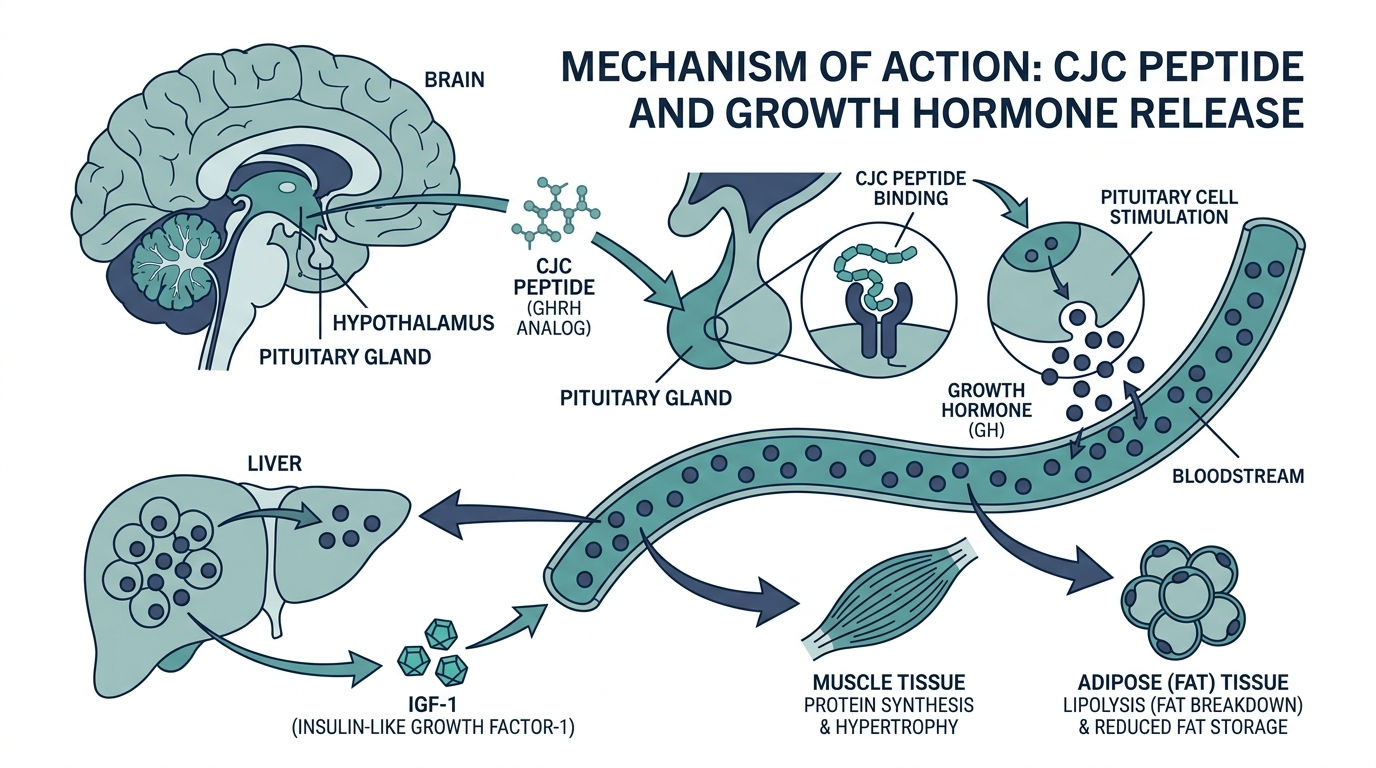
The phrase “CJC peptide” has migrated from forum threads into telehealth intake forms over the past three years, and the reason is straightforward: it is the central ingredient in the most prescribed growth-hormone-optimization stack among anti-aging and longevity clinics. Search interest in “CJC-1295 ipamorelin” consistently outpaces interest in sermorelin on Google Trends, and as of early 2026 it sits on the list of approximately 14 peptides that the U.S. Department of Health and Human Services has flagged for potential return to legal compounding status (Pharmacy Times, 2026).
In other words, you are hearing about CJC-1295 right now because the regulation is moving and the clinical access is expanding.
Full-body lab membership: 100+ biomarkers, doctor-reviewed, tracked over time.
What exactly is CJC-1295 and how does it work?
CJC-1295 is a 30-amino-acid synthetic peptide that mimics the natural growth hormone-releasing hormone (GHRH) produced by your hypothalamus. Endogenous GHRH is fragile: dipeptidyl peptidase-4 (DPP-4) enzymes in the bloodstream degrade it within two to five minutes of secretion. CJC-1295 incorporates strategic amino acid substitutions that block DPP-4 cleavage, extending its active half-life from minutes to somewhere between 30 minutes (without the DAC modification) and 5.8 to 8.1 days (with DAC), as reported in the Phase I human trial (JCEM 2006).
The mechanism is receptor-driven. CJC-1295 binds the GHRH receptor (GHRHR) on somatotroph cells in your anterior pituitary gland, triggering a cAMP cascade that leads to GH gene transcription and GH secretion. Critically, it works with your pituitary’s own pulse architecture rather than bypassing it, which is the core pharmacological distinction from injecting synthetic human growth hormone directly.
Think of it this way: native GHRH is like a text message that autocorrects to gibberish before it arrives. CJC-1295 sends the same message with a protective case on the phone.
What is the difference between CJC-1295 with DAC and without DAC?
This is the single most important distinction for anyone trying to decode forum discussions, and most “what is CJC” articles skip it.
DAC stands for Drug Affinity Complex, a maleimidoproprionic acid moiety added to the peptide’s C-terminus that allows CJC-1295 to bind reversibly to circulating serum albumin. Albumin acts as a carrier protein, slowly releasing the peptide back into circulation, which is why the DAC version has a half-life of nearly eight days versus roughly 30 minutes for the version without it.
| Feature | CJC-1295 with DAC | CJC-1295 without DAC (Mod GRF 1-29) |
|---|---|---|
| Half-life | 5.8 to 8.1 days (JCEM 2006) | 30 to 60 minutes |
| Injection frequency | 1 to 2 times per week | Daily (up to 3x/day in clinical protocols) |
| GH pattern produced | Sustained plateau (“GH bleed”) | Pulsatile spike, troughs between doses |
| Stacks with ipamorelin | Less commonly in current clinic protocols | Yes, the dominant stack in telehealth |
| GHRH receptor desensitization risk | Higher with extended use beyond 12 weeks | Lower due to pulsatile pattern |
| Water retention reported | More common due to sustained GH elevation | Less common |
| Best suited for | Convenience-focused anti-aging use | Athletes, optimizers, anyone wanting pulse control |
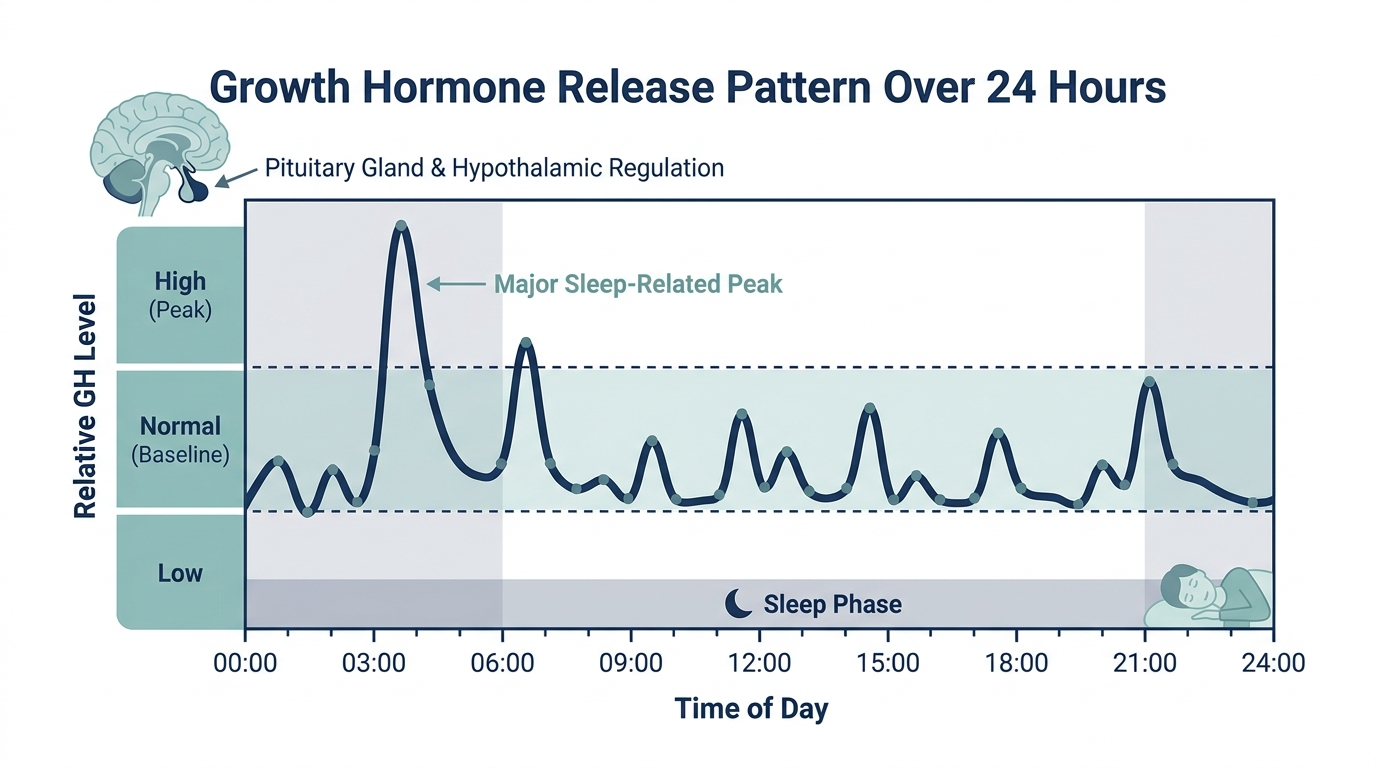
The no-DAC version is also called Mod GRF (1-29) or Modified GRF 1-29, which adds another layer of naming confusion in forums and vendor catalogs. When a telehealth clinic prescribes “CJC-1295 / ipamorelin,” they are almost always prescribing the no-DAC formulation at nightly doses, timed to amplify the body’s natural nocturnal GH pulse.
Personally, the no-DAC version interests me more clinically precisely because it preserves receptor sensitivity over a full cycle. The DAC version produces higher trough levels, but the plateau it creates is pharmacologically artificial. Your pituitary did not evolve to receive a constant GHRH signal.
Why is CJC-1295 almost always stacked with ipamorelin?
GHRH analogs like CJC-1295 work on one receptor pathway. Ipamorelin works on a completely different one: it is a selective ghrelin receptor agonist (GHS-R1a), meaning it mimics ghrelin to trigger GH secretion through a second, independent pathway. Combining both produces a GH pulse significantly larger than either peptide alone, because you are simultaneously pressing two independent buttons that both ring the same bell.
There is a second, equally practical reason. Ipamorelin is considered the “cleanest” ghrelin mimetic available because it does not meaningfully raise cortisol or prolactin at standard doses, unlike older secretagogues such as GHRP-6 or GHRP-2. Pairing CJC-1295 no-DAC with ipamorelin gives you amplified GH output without the cortisol spike that would partially undercut the metabolic benefits of the GH increase.
The fasting requirement is worth calling out explicitly, because it catches a lot of first-time users. GH release is blunted by elevated insulin. An injection taken with food or within two hours of a meal will produce a materially smaller GH pulse because circulating insulin competes with the secretagogue signal. The pre-sleep injection window, at least two hours after the last meal, is not optional if you want the stack to perform the way the clinical data suggests.
What does the published research actually show?
The foundational human trial was published in the Journal of Clinical Endocrinology and Metabolism in 2006 by Teichman and colleagues at ConjuChem. It was a two-part, randomized, double-blind, placebo-controlled study in healthy adults aged 21-61:
- A single injection at 30-60 mcg/kg produced 2- to 10-fold increases in mean plasma GH lasting six days or longer.
- Mean IGF-1 concentrations rose 1.5- to 3-fold and remained elevated for 9 to 11 days.
- After multiple weekly doses, mean IGF-1 remained above baseline for up to 28 days, with evidence of cumulative effect.
- The estimated half-life was 5.8 to 8.1 days.
- No serious adverse reactions were reported at doses of 30 or 60 mcg/kg (JCEM 2006).
A subsequent ScienceDirect paper confirmed that CJC-1295-induced GH/IGF-1 axis activation produced measurable changes in serum protein profiles, consistent with anabolic downstream effects (Achermann et al., Growth Hormone and IGF Research, 2009).
Here is something most coverage omits: the Phase II trial for CJC-1295, which was studying HIV-related lipodystrophy in 192 participants, was discontinued following a fatal myocardial infarction in one participant (Aidsmap 2006). The attending physician concluded the death was most likely due to pre-existing, asymptomatic coronary artery disease rather than the study drug, but ConjuChem halted the program as a precaution. The molecule never reached FDA approval as a finished drug. That history sits behind every mention of “well-tolerated” in peptide marketing, and it matters.
Do not believe anyone who describes CJC-1295 as “fully studied and proven safe for long-term human use.” Two trials, one discontinued, is not that bar.
What are the reported benefits of CJC-1295?
Based on the published human trial data and clinical observations from licensed telehealth programs, the reported effects fall into four categories:
Body composition. GH stimulates lipolysis (fat breakdown) and lean mass preservation. The two mechanisms are most active with the pulsatile release pattern associated with no-DAC formulations stacked with ipamorelin, and results are most visible after two to three months of consistent use with resistance training (Innerbody Research, 2026).
Sleep quality. GHRH activity is closely linked to slow-wave (deep) sleep; the hypothalamus releases its natural GHRH pulse during the early hours of sleep precisely because GH is secreted preferentially during deep sleep. Many clinical users report improved sleep depth and next-day recovery within the first two to four weeks. Sleep improvement is among the earliest effects reported in telehealth program data.
Recovery and tissue repair. IGF-1, elevated for up to 28 days after a multi-dose protocol, promotes collagen synthesis and cellular regeneration. This is the mechanism behind the interest in CJC-1295 for tendon and connective tissue recovery, though direct clinical data on injury-specific endpoints is limited.
Anti-aging and metabolic markers. Older adults experience a natural decline in GH pulse amplitude starting in the third decade. Sarcopenia (age-related muscle loss) affects an estimated 10-16% of the global population and accelerates as GH output declines (Innerbody Research, 2026). CJC-1295 protocols are primarily marketed for this demographic.
What are the side effects and risks?
The side effects reported in human research and clinical settings, roughly in order of frequency:
- Injection site reactions: Redness, itching, mild swelling at the subcutaneous injection point. Common and transient.
- Water retention and joint stiffness: Particularly associated with the DAC version, due to the more sustained GH elevation. Transient sodium and water retention from GH is well-documented; it typically resolves by the second or third week.
- Flushing and transient blood pressure fluctuation: Brief vasodilatory reaction following injection, lasting minutes.
- Headache: Reported at higher doses, usually mild.
- Immunogenicity: Any peptide can trigger antibody formation. The CJC-1295 JCEM trial did not report clinically significant immune reactions, but this risk exists for any biologic compound.
The most important contraindication is active cancer or a history of hormone-sensitive malignancy. GH and IGF-1 stimulate cellular replication, which is desirable in healthy tissue and dangerous in malignant tissue. Any clinician running a legitimate CJC-1295 protocol should screen for this before prescribing.
The Phase II trial’s fatal cardiac event, while attributed to pre-existing disease rather than the drug, is a reminder that thorough baseline cardiovascular screening is appropriate before starting any compound that substantially raises GH and IGF-1 in older or metabolically compromised patients.
Myth: CJC-1295 is “just like HGH but safer”
This comparison is everywhere, and it oversimplifies in a way that matters.
Synthetic HGH (recombinant human growth hormone, or rhGH) replaces the hormone directly, producing supraphysiological levels that are continuous rather than pulsatile. CJC-1295 instead amplifies the pulsatile signal your pituitary already produces, working within the feedback loop rather than bypassing it. Your body’s own somatostatin (GH-inhibiting hormone) can still pump the brakes. That is a genuinely meaningful difference in mechanism.
What it does NOT mean is that CJC-1295 is free of GH-related risks. Elevated IGF-1 at supraphysiological levels carries the same downstream concerns regardless of whether you got there via synthetic HGH or a secretagogue. The “it is natural because the pituitary does the secreting” framing, common in peptide marketing, is a partial truth used to avoid an uncomfortable whole.
What is the legal status of CJC-1295 in 2026?
This is genuinely complicated as of mid-2026, and anyone telling you it is simple is either oversimplifying or selling something.
CJC-1295 has never been FDA-approved as a finished drug product. ConjuChem discontinued development after the Phase II trial event in 2006. The compound has been in regulatory purgatory since then, living primarily in compounding pharmacy and grey-market research-chemical channels.
The recent timeline:
- November 2023: FDA placed CJC-1295 on the 503A Category 2 list, meaning compounding pharmacies could not legally use it as a bulk drug substance.
- February 27, 2026: HHS Secretary Robert F. Kennedy Jr. announced that approximately 14 of the 19 peptides on the Category 2 list, including CJC-1295, would be moved to a reclassification pathway (Pharmacy Times, 2026).
- April 15, 2026: The FDA reorganized the bulk drug substance lists. CJC-1295 was removed from Category 2. It was not placed on Category 1. It now sits in a classification gap: no longer explicitly prohibited from 503A compounding, but not formally permitted either.
- July 23-24, 2026: The FDA’s Pharmacy Compounding Advisory Committee (PCAC) is scheduled to review the remaining reclassification candidates. The formal determination on CJC-1295 is expected from this meeting (PepScribe, 2026).
The practical consequence: some 503A compounding pharmacies have started compounding CJC-1295 on the interpretation that removal from Category 2 lifts the prohibition. Some licensed telehealth clinics are prescribing it. The interpretation is legally plausible. It is also not formally settled, and clinics operating on that interpretation are taking a regulatory risk that may or may not resolve favorably at the July PCAC meeting.
For buyers: if a telehealth clinic prescribes CJC-1295 from a named 503A compounding pharmacy with full clinical oversight in June or July 2026, that is the most defensible route available. If you are buying “research use only” CJC-1295 vials from a grey-market vendor, you are in a different lane entirely, with no pharmacy accountability, no confirmed purity, and no clinical supervision.
Telehealth GLP-1 program with provider visits and pharmacy coordination.
How does CJC-1295 compare to sermorelin?
Sermorelin is the other major GHRH analog available through licensed clinical channels, and comparing the two is the fastest way to understand what CJC-1295 actually adds.
Sermorelin is the first 29 amino acids of the native 44-amino-acid GHRH sequence. It is FDA-approved for pediatric growth hormone deficiency and widely available through compounding pharmacies for adult GH optimization. Its plasma half-life is approximately 2-3 minutes, meaning it produces a brief, sharp GH pulse and is eliminated very quickly. Dosing must be daily or more frequent to maintain consistent effect.
CJC-1295 (no DAC) contains 30 amino acids with DPP-4-resistant modifications, producing a half-life of 30-60 minutes and a longer, more substantial GH pulse per injection. CJC-1295 with DAC extends to 5-8 days as described above.
| Sermorelin | CJC-1295 no DAC | CJC-1295 with DAC | |
|---|---|---|---|
| Amino acids | 29 | 30 | 30 + DAC moiety |
| Half-life | 2-3 minutes | 30-60 minutes | 5.8-8.1 days |
| GH pulse amplitude | Lower | Higher per injection | Continuous plateau |
| FDA status | Approved (pediatric GHD) | Not approved | Not approved |
| Compounding status | 503A permitted (Cat 1) | Regulatory gap (post April 2026) | Regulatory gap |
| Monthly cost (telehealth) | $175-$225 | $250-$445 | Varies by protocol |
| Preferred stack | Standalone or with ipamorelin | Ipamorelin (dominant clinical stack) | Typically standalone |
The modern telehealth consensus has largely moved from sermorelin alone toward the CJC-1295 no-DAC/ipamorelin stack because the dual-pathway mechanism produces a more substantial GH pulse at comparable doses. Sermorelin remains the cleaner regulatory choice for 2026 because it sits on Category 1 without ambiguity.
Who is a reasonable candidate for CJC-1295 therapy?
Clinics that run legitimate programs tend to describe the ideal candidate in terms of what the therapy is trying to correct. The profile: adults over 35 with documented decline in GH secretion, elevated morning cortisol, poor sleep architecture, or beginning signs of body composition shift (muscle loss, visceral fat gain) that are not fully explained by diet and exercise alone. Baseline IGF-1 below the mid-normal range for age is the most consistent objective criterion.
The profile that should NOT be starting a CJC-1295 protocol, regardless of what a quick telehealth intake allows: anyone with active cancer, untreated sleep apnea (GH secretagogues can worsen apnea), a recent history of cardiac events, or elevated IGF-1 already at the high end of the normal range. None of those require a specialist to catch; they require a clinician who actually reviews labs before prescribing.
The marker worth tracking before you begin, and at 90 days: IGF-1 (ng/mL). A licensed program will draw this. If the clinic you are evaluating does not require a baseline IGF-1 before starting you on CJC-1295, that is a process problem worth flagging before you begin.
Turn what you just learned into action.
Superpower lets you test 100+ biomarkers from home, then re-check them over time so you can actually see progress, physician-reviewed at every step.
Frequently asked questions
What does CJC stand for in CJC-1295?
CJC stands for ConjuChem, the Montreal-based biotechnology company that developed the peptide and conducted the original Phase I/II human trials. The “1295” is the compound number. You will also see CJC-1295 without DAC referred to as Mod GRF (1-29) or Modified GRF 1-29 in research catalogs, which refers to the same underlying 30-amino-acid molecule without the albumin-binding modification.
Is CJC-1295 the same as growth hormone?
No. CJC-1295 stimulates your pituitary gland to produce and secrete its own growth hormone. It does not contain human growth hormone and does not introduce synthetic GH into the body. This is the key mechanistic distinction from recombinant HGH injections, which bypass the pituitary entirely and produce non-pulsatile GH levels.
How long does CJC-1295 stay in your system?
The DAC version has a measured half-life of 5.8 to 8.1 days per the published JCEM trial. At that elimination rate, it takes roughly 30 to 40 days to clear fully after the last dose. The no-DAC version clears within hours. However, the elevated IGF-1 levels that result from a completed multi-dose protocol can persist above baseline for up to 28 days even after stopping.
Can you get CJC-1295 without a prescription?
Legally, for human use: no. CJC-1295 is not sold over the counter as a human drug product. Grey-market vendors sell it labeled “for research use only,” but that label does not confer safety, purity assurance, or dosing guidance. The legal route for human therapeutic use is a licensed clinician’s prescription filled at a compounding pharmacy.
What results should I expect from CJC-1295?
Based on clinical observations from telehealth programs and the published literature, the rough timeline is: improved sleep depth and energy within weeks one to four, visible body composition changes (lean mass increase, abdominal fat reduction) by months two to three, and longer-term skin and collagen effects at months four to six and beyond. Results are significantly amplified by consistent resistance training and are not visible in sedentary individuals. These observations are clinic-reported, not from controlled efficacy trials in optimization populations.
What is the difference between CJC-1295 and ipamorelin?
CJC-1295 is a GHRH analog: it mimics the signal your hypothalamus sends to your pituitary to release GH. Ipamorelin is a ghrelin receptor agonist: it mimics a completely different signal that also triggers GH release. Combining them activates two independent receptor pathways simultaneously, producing a larger GH pulse than either peptide alone. Ipamorelin also does not raise cortisol or prolactin at standard doses, making it the preferred GH secretagogue partner in clinical settings.
How much does CJC-1295 ipamorelin therapy cost?
From telehealth providers in 2026: Protocole prices the stack at $325 for a five-week supply; ConciergeMD starts at $399 per month; clinic-based programs like Perfect B start at $445 for a three-month cycle inclusive of protocol and follow-up. Lab work and initial consultation are typically billed separately. None of it is covered by insurance, as compounded peptide optimization is classified as elective.
Telehealth GLP-1 program with provider visits and pharmacy coordination.
Author: Vital Signs Today Editorial Team, [credential]”]. Educational content, not medical advice. Sources linked inline.
Primary sources:
– Teichman SL et al. “Prolonged Stimulation of Growth Hormone (GH) and Insulin-Like Growth Factor I Secretion by CJC-1295, a Long-Acting Analog of GH-Releasing Hormone, in Healthy Adults.” Journal of Clinical Endocrinology and Metabolism, 2006. https://academic.oup.com/jcem/article-abstract/91/3/799/2843281
– Achermann A et al. “Activation of the GH/IGF-1 axis by CJC-1295 results in serum protein profile changes in normal adult subjects.” Growth Hormone and IGF Research, 2009. https://pmc.ncbi.nlm.nih.gov/articles/PMC2787983/
– PubMed: https://pubmed.ncbi.nlm.nih.gov/16352683/
– Aidsmap, “Lipodystrophy study halted after patient death,” July 2006. https://www.aidsmap.com/news/jul-2006/lipodystrophy-study-halted-after-patient-death
– Pharmacy Times, “The Peptide Reclassification Everyone’s Talking About,” 2026. https://www.pharmacytimes.com/view/the-peptide-reclassification-everyone-s-talking-about-a-pharmacist-s-take-on-what-rfk-jr-s-announcement-actually-means
– PepScribe, “Is CJC-1295 Legal? FDA Status, Regulatory Risks and 2026 Update.” https://pepscribe.com/learn/cjc-1295/legal-status
– Innerbody Research, “CJC-1295 and Ipamorelin: Benefits, Safety and Buying Advice,” 2026. https://www.innerbody.com/cjc-1295-and-ipamorelin
– Perfect B, “CJC-1295 / Ipamorelin Cost.” https://www.perfectb.com/cjc-1295-ipamorelin-cost/
– Telehealthally, “Ipamorelin and CJC-1295 Stack Guide 2026.” https://telehealthally.com/guides/ipamorelin-cjc-1295-stack-guide
Related reading
Vital Signs Today may earn a commission if you buy through links on this page. It does not affect our editorial assessments.