
Educational content only, not medical advice. Sermorelin is a prescription compound in the US. Talk to a licensed clinician before starting any hormone-related therapy.
Short answer: Yes, sermorelin is a synthetic peptide, specifically the first 29 amino acids of natural growth hormone-releasing hormone (GHRH), with a molecular weight of 3,357 daltons and a C-terminal amide group that extends its receptor binding. It is one of the few peptides that began with FDA approval (brand name Geref, 1997), lost commercial availability when the manufacturer voluntarily withdrew it in 2008, and survived to become one of the most widely compounded peptides legally available through US telehealth clinics today.
Sermorelin mimics the hormone that tells your body to release growth hormone. Curious what your own hormone panel actually shows? One at-home Superpower draw checks 100+ biomarkers, physician-reviewed.
That story alone separates sermorelin from most of what gets called a “peptide” online.
What exactly is a peptide, and does sermorelin qualify?
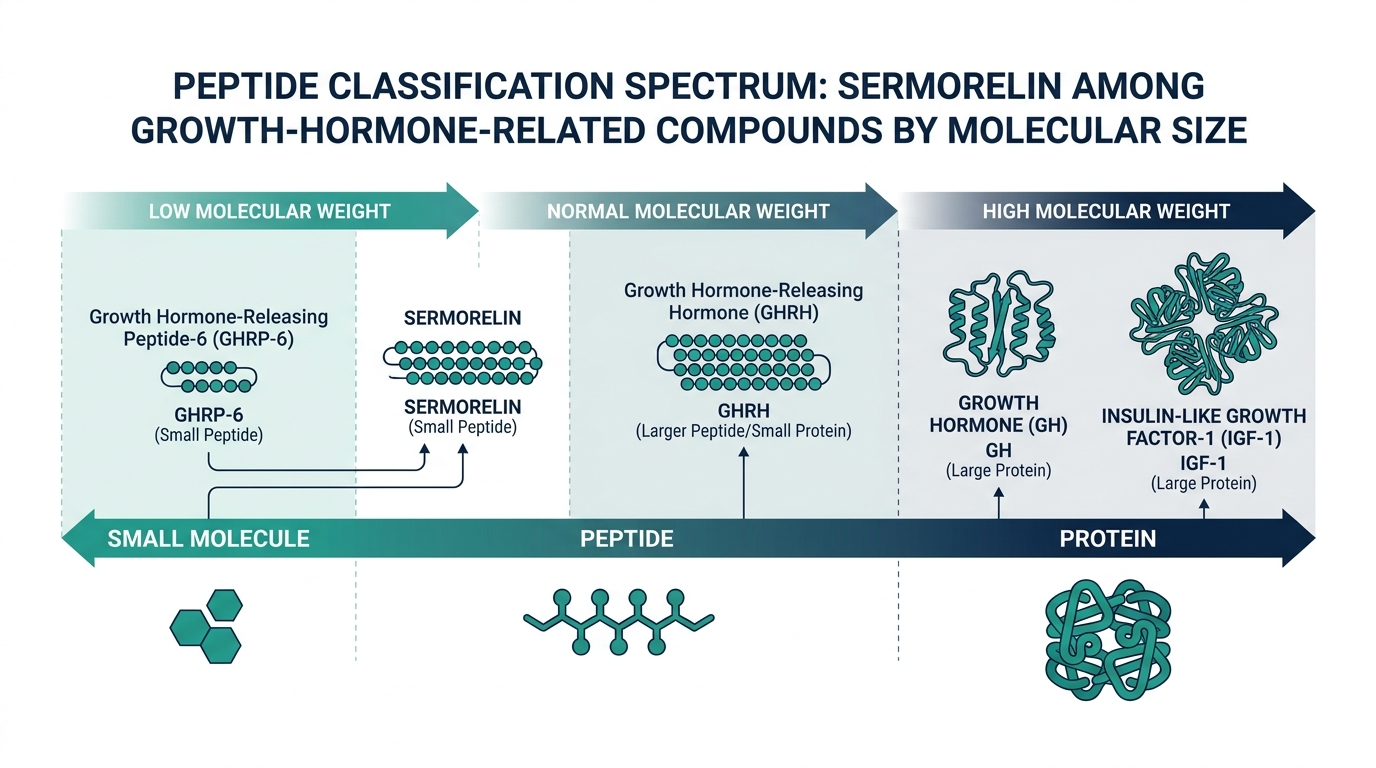
A peptide is a short chain of amino acids, typically under 50 residues, connected by peptide bonds. The line between a peptide and a protein is not perfectly agreed upon, but most biochemists draw it at roughly 50 amino acids, with shorter chains being peptides and longer chains being proteins.
Sermorelin, at 29 amino acids, is squarely in peptide territory. Its full chemical name is [GRF(1-29)-NH2], also written GHRH(1-29), referring to the first 29 of the 44 amino acid residues in full-length endogenous GHRH. The sequence is: Tyr-Ala-Asp-Ala-Ile-Phe-Thr-Asn-Ser-Tyr-Arg-Lys-Val-Leu-Gly-Gln-Leu-Ser-Ala-Arg-Lys-Leu-Leu-Gln-Asp-Ile-Met-Ser-Arg-NH2. That trailing NH2 (an amide group) at the C-terminus is not cosmetic. It enhances receptor-binding stability and is one reason sermorelin was selected as the shortest fragment of GHRH that retains full biological activity at the GHRH receptor (Wikipedia/Sermorelin).
So: yes, sermorelin is a peptide by every standard biochemical definition. What makes it unusual is the path it traveled from synthetic lab compound to FDA-approved drug to discontinued commercial product to heavily prescribed compounded therapy.
Full-body lab membership: 100+ biomarkers, doctor-reviewed, tracked over time.
How does sermorelin work inside the body?
The simplest way to actually get this done
Superpower is a full-body lab membership that runs 100+ biomarkers, has each result reviewed by a doctor, and tracks your numbers year over year (about $199/year). It is what we point readers to when they would rather get one clean, complete draw than chase single tests one at a time. Here is superpower reviewed in full.
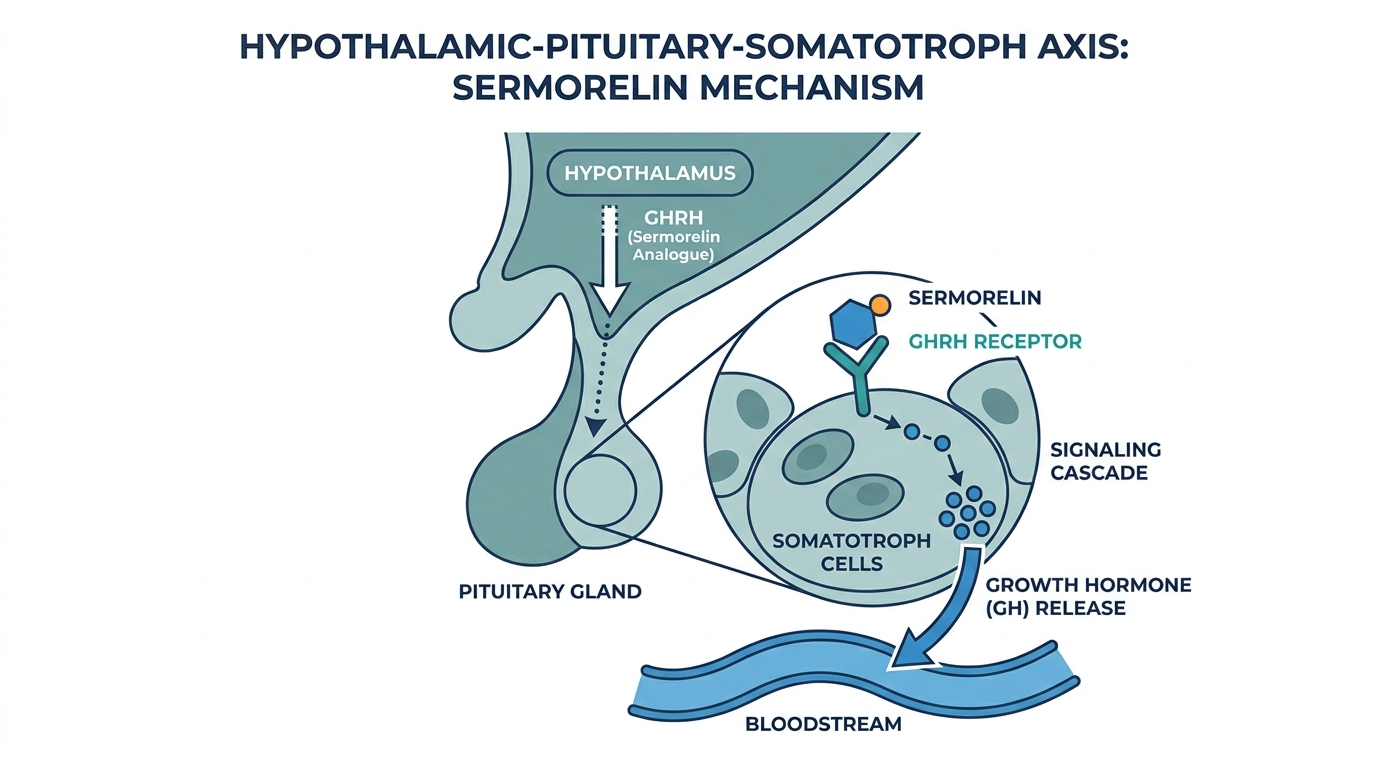
Sermorelin binds to the GHRH receptor on somatotroph cells in the anterior pituitary, triggering the synthesis and release of endogenous growth hormone (GH). That GH then travels to the liver, where it stimulates production of insulin-like growth factor 1 (IGF-1). IGF-1 is what researchers use as a proxy marker to measure the downstream effect of GH-axis therapy.
The critical detail that most popular health content glosses over: sermorelin does not deliver growth hormone. It signals your pituitary to produce it.
That distinction has a practical consequence. When GH levels rise because of sermorelin, the body’s natural somatostatin feedback loop kicks in, releasing somatostatin to brake further GH release. This self-limiting mechanism is why sermorelin carries a substantially lower risk of pushing IGF-1 into supraphysiologic ranges compared to injecting exogenous HGH directly (PeakedLabs, sermorelin vs HGH). The ceiling is built in. Direct HGH has no such ceiling, which is why its prescribing is restricted to documented deficiency states.
Here is an insider detail that rarely appears in brand copy: sermorelin’s half-life after subcutaneous injection is only 11 to 12 minutes. The peptide itself is cleared by dipeptidyl peptidase-4 (DPP-4) and neutral endopeptidase before a first round of blood testing would even start. But the GH pulse it triggers peaks 30 to 90 minutes post-injection and persists for two to four hours. The peptide acts as a key, turns the lock, and disappears. The door stays open far longer than the key exists (RxList pharmacokinetics).
What is the FDA history of sermorelin?
Sermorelin was approved by the FDA in 1997 under the brand name Geref (manufactured by EMD Serono) for two indications: diagnosing growth hormone secretory capacity in children suspected of GH deficiency, and treating children with confirmed GH deficiency causing growth failure. It was a legitimate, studied pharmaceutical product, not a grey-market compound.
In 2008, EMD Serono voluntarily discontinued Geref for commercial reasons, not safety or efficacy concerns. That detail matters more than most sources acknowledge. A voluntary market withdrawal by the manufacturer does not strip a compound of its compounding-pharmacy eligibility the way a safety-driven withdrawal would. Because the discontinuation was commercial, sermorelin remained on the FDA’s list of bulk substances eligible for 503A compounding, meaning state-licensed pharmacies can compound it for individual patients with a valid prescription (FDA 503A bulk substances).
As of mid-2026, sermorelin acetate is one of the most widely compounded peptides in the United States. In January 2026, updated FDA guidance added documentation requirements for prescribers: physicians must now provide a written attestation confirming that FDA-approved GH alternatives (tesamorelin for lipodystrophy, somatropin for diagnosed GHD) are clinically inappropriate or inaccessible for the specific patient before a compliant pharmacy fills the order (TrimRX, Sermorelin News 2026). This raised the paperwork bar, but it did not close the door.
Is sermorelin the same as HGH?
No, and confusing the two is one of the most common mistakes people make when researching this category.
Human growth hormone (somatropin, rhGH) is the 191-amino-acid hormone itself, injected directly. It bypasses the pituitary entirely. Whatever dose you inject is the dose you get, your body’s own feedback loop does not modify it, and over time exogenous HGH suppresses the pituitary’s endogenous production.
Sermorelin is 29 amino acids that tell the pituitary to produce GH. Your pituitary determines how much GH actually gets released, bounded by somatostatin feedback. The table below captures the key split:
| Feature | Sermorelin | Pharmaceutical HGH |
|---|---|---|
| Mechanism | Stimulates pituitary to release GH | Delivers synthetic GH directly |
| Amino acids | 29 | 191 |
| Feedback loop | Preserved (somatostatin limits excess) | Bypassed |
| IGF-1 overshoot risk | Low | Real risk at aggressive dosing |
| Pituitary function long-term | Maintained | Suppressed with chronic use |
| FDA approval status | Discontinued (Geref, 1997); compoundable | Approved (somatropin) for diagnosed GHD |
| Typical monthly cost (2026) | $150 to $300 via telehealth | $500 to $2,000+ brand; $300 to $700 compounded |
| Works if pituitary is damaged | No | Yes |
That last row is the clinical decision point. If the pituitary has been compromised by a tumor, radiation, surgery, or traumatic brain injury, it cannot respond to sermorelin’s signal, and direct HGH is the only pharmacological option. For everyone else where the pituitary is functional but GH secretion has declined with age, sermorelin addresses the problem without the supraphysiologic risk profile that keeps rhGH off-limits outside of confirmed deficiency (Walker RF, Clinical Interventions in Aging, 2006).
What do people actually use sermorelin for?
Most prescriptions today fall into three practical use cases, none of which match the original pediatric indication.
Age-related GH decline. Growth hormone secretion drops roughly 14 to 15 percent per decade after age 30. Sermorelin does not reverse that decline at the source (the hypothalamus produces less GHRH as you age), but it amplifies the signal remaining, partially restoring pulsatile GH output. Patients typically report improved sleep quality within three to six weeks, which is the most consistent early marker, because GH secretion is heavily concentrated in slow-wave sleep. Objective IGF-1 changes take four to twelve weeks to register on a lab panel.
Body composition and recovery. GH plays a role in lipolysis (fat metabolism) and protein synthesis. The body composition changes from sermorelin in published research are modest but real. The Walker et al. 2006 study in the Journal of Clinical Endocrinology and Metabolism showed significant IGF-1 elevation, improved sleep quality, and favorable body composition changes compared to placebo. Those are not dramatic numbers by anabolic standards, which is part of why sermorelin is rarely the compound someone turns to if their goal is pure mass gain. What it does is preserve lean mass and improve fat distribution over a sustained program, which is a different goal entirely.
GH stimulation testing. This is the original clinical indication, now rarely performed as a standalone test. Sermorelin injection can provoke a GH surge used to evaluate pituitary reserve in patients with suspected growth hormone deficiency. In this context it is diagnostic, not therapeutic.
Do not believe the influencer narrative that sermorelin is a shortcut to the physique of a pharmaceutical HGH user at a lower price. The mechanism prevents that. Because the pituitary caps the response, you cannot overdrive IGF-1 the way you can with direct HGH. That safety feature is also a ceiling on the physique response.
What does sermorelin therapy actually involve in 2026?
Standard dosing runs 200 to 300 mcg per day, administered as a subcutaneous injection, typically at bedtime. The bedtime timing is not arbitrary. The largest natural GH pulse of the day occurs in the first few hours of deep sleep, and timing the sermorelin dose to precede that pulse amplifies it rather than competing with daytime activity rhythms. Some protocols use five days on, two days off (weekends) to reduce tachyphylaxis and monthly medication cost simultaneously. A 250 mcg nightly protocol with a weekend break uses approximately 5 mg per month rather than 7.5 mg, dropping the medication cost from roughly $210 to $300 down to $140 to $200 per month (Real Peptides, sermorelin budget guide).
A compliant telehealth program includes more than the vial. Baseline labs (at minimum: IGF-1, fasting glucose, CBC, comprehensive metabolic panel) are required before dosing begins. A 90-day follow-up IGF-1 is the first real signal that the program is working, and a 6-month review adjusts the dose if needed. The total monthly cost through established telehealth providers (Defy Medical, Marek Health, Hone Health) runs $150 to $300, inclusive of medication, clinical oversight, and follow-up labs. Full six-month programs run $1,150 to $3,700 depending on the platform and what ancillary testing is bundled (PeakedLabs, 2026).
For reference, pharmaceutical HGH for confirmed adult growth hormone deficiency runs $500 to $2,000 or more per month for brand versions. Sermorelin costs five to ten times less for comparable optimization goals in patients whose pituitary is still functional.
Telehealth GLP-1 program with provider visits and pharmacy coordination.
How do you know if sermorelin is actually working?
This is where a monitored program separates itself from a vial bought off a website. Sermorelin gives you two kinds of feedback, and they arrive on different schedules. The first is subjective and early: deeper, more restorative sleep, usually within three to six weeks. Because the largest natural growth hormone pulse happens in early deep sleep, an improvement there is the most consistent sign the signal is landing. If nothing changes about your sleep after six weeks, that is worth flagging to your prescriber rather than quietly assuming it will kick in later.
The second kind of feedback is objective and slower: IGF-1 on a blood panel. IGF-1 is the downstream proxy for growth hormone activity, and a sensible program checks it at baseline, again around 90 days, and periodically after that. A modest rise from a low-normal starting point into a healthier mid-range, paired with better sleep and body composition, is the response you want. A flat IGF-1 despite consistent dosing points to one of a few things: a dose that is too low, poor injection technique or timing, an underlying issue like untreated hypothyroidism, or a pituitary that simply is not responding. That is information, not failure, and it is exactly why the baseline draw matters.
One caution on interpretation. Do not chase a high IGF-1 number as if bigger is automatically better. The entire safety case for sermorelin over direct growth hormone rests on keeping IGF-1 within physiologic range through the body’s own feedback loop. A number pushed to the top of the range, or above it, erases the margin that made the peptide the safer choice in the first place.
What are the common side effects?
Sermorelin’s side effect profile is generally mild, partly because the feedback loop prevents supraphysiologic GH levels. The most commonly reported issues are injection-site redness or discomfort (expected with any subcutaneous injection), transient flushing, headache, and nausea in the first few weeks.
Carpal tunnel syndrome and fluid retention are the side effects most associated with GH-axis therapies broadly. They occur far less frequently with sermorelin than with direct HGH, precisely because IGF-1 levels do not climb as steeply. When they do appear, they usually resolve with a dose reduction or brief hold rather than requiring discontinuation.
The cancer question comes up because IGF-1 has a proliferative role in some cell types. A high-IGF-1 environment is a plausible theoretical concern. In practice, sermorelin’s self-limiting mechanism means that IGF-1 rises modestly and stays within physiologic range for the vast majority of patients on monitored programs. The risk picture differs materially from direct HGH, where supraphysiologic IGF-1 is the reason the FDA restricts HGH to diagnosed deficiency and why oncologists take a conservative view of it in cancer survivors. Patients with active malignancy, personal or family history of hormone-sensitive cancers, or confirmed insulin resistance should have a detailed conversation with their physician before any GH-axis intervention, not just sermorelin.
Personally, the detail I find most underappreciated in the consent conversation is the 11-to-12-minute half-life. Patients sometimes worry about timing and compounding; the reassuring clinical fact is that a missed dose or a delayed injection by a few hours does not leave a residual compound circulating. The peptide is gone in roughly one hour. The downstream GH effect lingers, but the molecule does not.
Who is not a good candidate?
Sermorelin requires a functional pituitary. If the pituitary has been damaged, sermorelin will not produce a meaningful GH response, and continuing a program on a non-responsive pituitary is both ineffective and avoidable waste. A GH stimulation test, either insulin tolerance test or GHRH-arginine test, can confirm pituitary reserve before starting.
Beyond that structural contraindication, there are several situational ones:
- Active malignancy: any condition where cell growth promotion is potentially harmful.
- Untreated hypothyroidism: thyroid hormone is required for normal GH signaling; sermorelin will underperform and potentially stress an already-taxed metabolic system.
- Uncontrolled diabetes: GH has insulin-antagonist properties; sermorelin can worsen insulin resistance in patients who are already metabolically compromised.
- Pregnancy: no safety data exists for any compounded peptide in pregnancy.
The people who see the strongest response from sermorelin are adults over 35 with documented low-normal IGF-1, functional pituitary, normal thyroid, reasonable insulin sensitivity, and poor sleep quality as a primary complaint. Sleep is the fastest and most reliable early marker of response, and it is the one that most patients notice before any lab panel confirms what is happening.
A realistic example: a 46-year-old man with low-normal IGF-1, normal thyroid, and a year of light, unrefreshing sleep starts 250 mcg nightly. By week four he is sleeping through the night and waking clearer. His 90-day IGF-1 has moved up into the mid-range, his waist is down a little, and his clinician holds the dose steady rather than pushing higher. Nothing about that story is dramatic, and that is the point. Sermorelin is a slow, ceilinged nudge to a system that has drifted with age, not a lever you crank.
Turn what you just learned into action.
Superpower lets you test 100+ biomarkers from home, then re-check them over time so you can actually see progress, physician-reviewed at every step.
FAQ
Is sermorelin a peptide or a hormone?
It is a peptide, specifically a 29-amino-acid synthetic fragment of growth hormone-releasing hormone (GHRH). It is not a hormone itself. It stimulates the pituitary to release a hormone (growth hormone). The distinction matters clinically because sermorelin is subject to feedback regulation in a way that exogenous hormones are not.
Is sermorelin FDA-approved?
It was FDA-approved under the brand name Geref in 1997. EMD Serono voluntarily discontinued Geref in 2008 for commercial reasons, not safety concerns. Sermorelin is no longer available as a branded FDA-approved product, but it remains legally compoundable under Section 503A by licensed pharmacies in the US, with a prescription.
How long does sermorelin take to work?
Subjective improvements in sleep quality often appear within three to six weeks. Measurable IGF-1 changes typically take four to twelve weeks. Body composition shifts, the harder endpoint, take three to six months of consistent use. Any program promising visible results in two to three weeks is overstating the evidence.
Can I get sermorelin without a prescription?
No, not legally for human use. It is a prescription compound in the US. Any site offering injectable sermorelin without a prescription and physician oversight is operating outside the rules. The telehealth pathway now handles this routinely: an online intake, bloodwork, and a physician review typically clear in two to four weeks.
How does sermorelin compare to CJC-1295 + Ipamorelin?
CJC-1295 is a modified GHRH analog engineered for a much longer half-life (up to 8 days with DAC modification) and is frequently combined with Ipamorelin, a selective GH secretagogue. The CJC/Ipamorelin stack produces a stronger and longer GH pulse than sermorelin alone. Sermorelin’s advantage is its shorter, more physiological pulse pattern, its longer clinical and regulatory track record, and its cleaner legal standing as the only GHRH-class peptide with a historical FDA approval. CJC-1295 and Ipamorelin are currently in the regulatory grey zone that is expected to resolve at the July 2026 Pharmacy Compounding Advisory Committee meeting.
Is sermorelin the same as tesamorelin?
No. Both are GHRH analogs, but tesamorelin is a modified version with a trans-3-hexenoic acid group added at the N-terminus. It holds current FDA approval (brand name Egrifta) specifically for HIV-associated lipodystrophy and has completed Phase 3 randomized controlled trials. Sermorelin does not. Tesamorelin is pharmacologically more potent and its evidence base is stronger, but it is narrower in its approved indication.
Does sermorelin increase testosterone?
Not directly. GH and testosterone are distinct axes. However, low GH and low testosterone often coexist in aging men, and restoring one can indirectly improve markers on the other through shared downstream effects (better sleep, reduced visceral fat, improved insulin sensitivity). A prescriber who is serious about optimization typically evaluates both axes rather than addressing one in isolation.
What time of day should I inject sermorelin?
At bedtime, on a relatively empty stomach. The goal is to have the peptide present just as your largest natural growth hormone pulse begins in early deep sleep, so it amplifies that pulse instead of competing with it. A large meal, and especially a high-carbohydrate one, right before the injection blunts the growth hormone release, which is why most protocols pair the dose with an overnight fast of a couple of hours.
Do I need to cycle sermorelin or take breaks?
Some protocols use a five-days-on, two-days-off pattern, partly to limit any drop in responsiveness over time and partly to reduce monthly cost. Whether you need it depends on your response and your prescriber’s approach, and there is no universal rule. What is not optional is periodic lab monitoring, because that is how you and your clinician decide whether to hold, adjust, or stop.
Author: Vital Signs Today Editorial Team, [credential]”]. Educational content, not medical advice. Sources linked inline.
Primary sources:
– Wikipedia: Sermorelin
– RxList: Sermorelin Acetate pharmacokinetics
– FDA 503A Bulk Drug Substances
– Walker RF. Sermorelin: a better approach to management of adult-onset growth hormone insufficiency? Clinical Interventions in Aging. 2006.
– PeakedLabs: Sermorelin vs HGH 2026
– TrimRX: Sermorelin News 2026, FDA Updates
– Real Peptides: Sermorelin cost per month budget
– HHS/FDA: 503A compounding guidance
Related reading
Vital Signs Today may earn a commission if you buy through links on this page. It does not affect our editorial assessments.