
Educational content, not medical advice. Talk to a dermatologist or licensed skincare professional if you have persistent irritation or a suspected allergic reaction.
Short answer: A well-formulated peptide lip treatment should not sting. A brief, mild warmth fading within 60 to 90 seconds can be normal, but the sharp burning associated with classic lip plumpers comes from irritant ingredients like capsicum or cinnamal, not from peptides themselves. If your “peptide” product stings intensely, read the full ingredient list because peptides are almost certainly not the culprit.
Peptide lip treatments shouldn’t sting for long. If irritation lingers, it might be worth seeing what else is going on internally. One at-home Superpower draw checks 100+ biomarkers, physician-reviewed.
Why does any lip product sting in the first place?
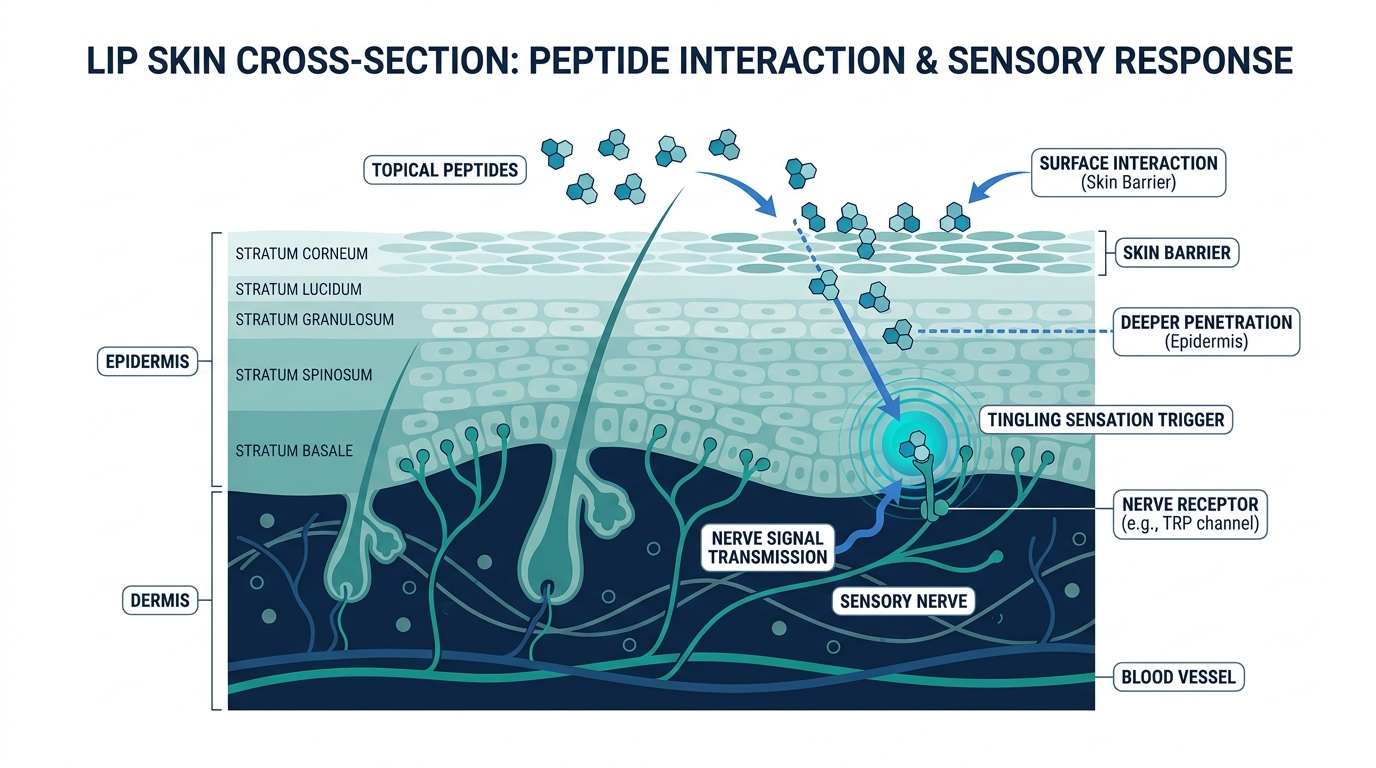
The lips are the most nerve-dense surface on the human body. They contain over 1 million nerve endings and, unlike the skin on your cheek or forehead, they lack a true stratum corneum, the outermost protective layer that normally buffers topical ingredients from reaching sensory nerves so quickly. The result is that anything you put on your lips reaches active nerve endings faster and at a higher effective concentration than the same formula would on cheek skin.
This anatomy is also why chapped lips sting when you eat salsa and why a menthol balm feels far colder on your lips than on your wrist. It is not a design flaw. Lips evolved to be extremely sensitive because they are part of the body’s primary feeding and communication surfaces.
Understanding this sets the baseline for every product comparison below. The lips are an unusually reactive test environment, and what barely registers on your arm can feel significant on your lips, even when the ingredient load is modest.
What causes the classic burning sting in traditional lip plumpers?
Before peptide lip treatments, the category was dominated by what the industry politely calls “sensory-active” ingredients. These are intentional irritants that work by triggering a mild inflammatory response, dilating blood vessels, and causing localized swelling. The swelling is real and temporary, usually lasting one to two hours, and it does create a plumper look. The burn is not a side effect of the plumping mechanism. It is the plumping mechanism.
The three most common culprits, according to formulation experts at Adore Eyes:
- Capsicum Frutescens Fruit Extract (chili pepper): Contains capsaicin, which binds to TRPV1 receptors on sensory nerve endings, triggering the classic burning heat. TRPV1 is the same receptor activated by actual heat above 43 degrees Celsius, which is why capsaicin literally feels hot.
- Cinnamal (cinnamon aldehyde): The main fragrant compound in cinnamon oil, responsible for its spicy warmth. It is also a well-documented contact allergen that causes perioral allergic contact dermatitis in a subset of users. Sensitivity to fragrance products in the general population is estimated at 1 to 16%.
- Menthol: Creates a cooling sensation via cold-sensitive TRP channels, which masks underlying inflammation rather than eliminating it. The lip swelling from menthol is milder than capsaicin but the same vasodilatory mechanism drives it.
This matters because none of these ingredients are peptides. If your product stings like a classic plumper and the label says “peptide lip,” there is a very good chance the peptides are the supporting cast and one of these three is doing the actual work.
What do peptides actually do on the lips?
Peptides are short chains of amino acids that signal skin cells rather than irritate them. The ones used in lip formulations fall into three functional groups, each with a different mechanism and a very different sensory profile.
Matrix-stimulating peptides encourage the skin’s own collagen and elastin production. The best-studied example for the perioral area is palmitoyl pentapeptide-4 (Matrixyl), which was tested in a 60-subject split-face trial (Creidi et al., 2005) and showed statistically significant improvement in perioral wrinkle depth versus a vehicle over 12 weeks. This peptide does not cause stinging. It has no mechanism that would stimulate TRPV1 or vasodilatory pathways.
Neurotransmitter-modulating peptides relax the orbicularis oris, the muscle that creates vertical lip lines. Acetyl hexapeptide-3 (Argireline) competes with the SNARE protein complex, blunting acetylcholine-triggered contractions at 5 to 10% concentrations. This is the topical equivalent of a very localized, very mild mechanism borrowed from botulinum toxin. No stinging reported; in fact, the Cosmetic Ingredient Review’s safety assessment of acetyl hexapeptide-8 amide classifies it as non-irritating.
Plumping peptides via neural inhibition are newer. Tridecapeptide-1, the active in BGT TDP-Lip from Deveraux Specialties, works by competitive inhibition at acetylcholine receptor sites in lip musculature. In clinical testing using PRIMOS CR 3D imaging, a 5% concentration delivered 20% measurable increase in lip volume at 30 minutes and 25% at 24 hours, with wrinkle depth reduced 12% over 24 hours. The Deveraux documentation explicitly positions this as a “neutral-to-pleasant” sensory experience, contrasting it with the irritant route. The plumping result comes from neural relaxation allowing the lip to expand naturally, not from induced swelling.
Personally, this is the distinction most product marketing glosses over. The best peptide formulas are competing on a completely different playing field than capsaicin-based plumpers. They are not a gentler version of the same thing. They are a different mechanism entirely.
The sensation decision tree: what you actually feel and what it means
Quick decision guide: Use this table before panicking or before ignoring a real signal.
| What you feel | Duration | Likely cause | Action |
|---|---|---|---|
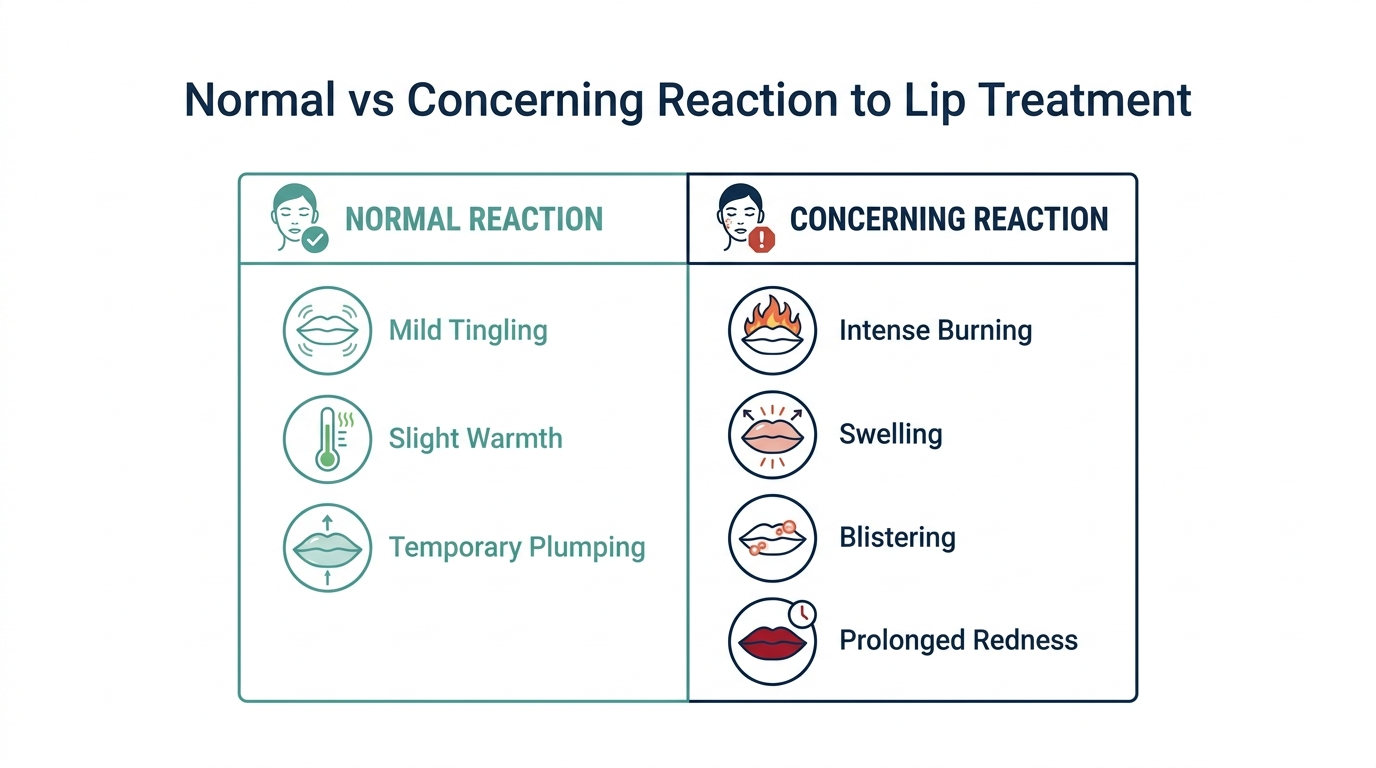
| Mild warmth, no redness | Under 90 seconds | Normal microcirculation response or low-dose sensory actives | Continue, monitor |
| Slight tingle fading quickly | Under 60 seconds | Formulation pH, low menthol, or light botanical extracts | Usually fine; check ingredient list |
| Noticeable sting or burn | 2 to 5 minutes | Capsicum, cinnamal, or high-dose menthol intentionally present | Normal for that product type; decide if you want irritant-based plumping |
| Persistent burning beyond 5 minutes | Does not fade | Allergic contact reaction or barrier disruption | Stop use; apply barrier cream; see dermatologist if symptoms persist |
| Itching, spreading redness, swelling beyond lip border | Any duration | Contact dermatitis or allergic reaction | Stop use immediately; cool compress; consult a clinician |
| Blistering or crusting | Develops over hours | Severe allergic reaction | Seek medical attention |
BUXOM, a brand that explicitly avoids capsaicin and peppermint oil in its plumping formulas, describes the safe threshold as “a gentle buzz, not a burn,” and explicitly states that stronger sensation does not equal better plumping.
Why “it’s supposed to tingle” is sometimes true and sometimes a marketing deflection
This is the myth worth busting plainly.
For irritant-based plumpers, tingling is literally the product working. The sensation is proof that capsaicin has bound to your TRPV1 receptors and your blood vessels are dilating. If you choose a capsicum-based formula knowing what it is, the tingle is expected and the product is doing what it says.
For a pure peptide formula, tingling is not the signal of efficacy. Research confirms that peptides work at a cellular signaling level over four to twelve weeks, and sensation during application has no relationship to bioactivity. An Argireline product working correctly feels like applying any moisturizer. A Matrixyl product improving perioral wrinkles gives you no real-time signal at all. This is actually one of the hardest consumer education problems in the category, because people are trained by decades of “tingle means working” marketing to distrust gentle products.
Do not believe any peptide lip brand that implies a sting means the product is penetrating better or working harder. Penetration of a peptide depends on molecular weight, vehicle formulation, and skin condition, not on whether it hurts going on.
The formulation detail most buyers never check
Even a product marketed as “peptide-forward” can sting for reasons unrelated to the peptides themselves. Two formulation scenarios are worth knowing.
pH mismatch: Lips have a slightly lower surface pH than facial skin, typically around 4.5 to 6. Many peptide formulas are buffered to pH 5.5, which is compatible. But a product that also contains a high concentration of L-ascorbic acid (vitamin C in its most acidic form) is formulated to a pH below 3.5, which can cause transient stinging on the sensitive lip surface. Crucially, this low pH also degrades the peptide content, since peptide bonds hydrolyze at pH below 4. You get both the sting and the ineffective peptides in the same product.
The label order tell: The EU and US both require cosmetic ingredients to be listed in descending order of concentration. If a peptide appears after fragrance on the ingredient list, it is present at a concentration too low to have a biologically plausible effect. The formulation might sting because of the fragrance blend while the peptide amount is essentially decorative. Always find the peptide’s position in the list before attributing either the sensation or the results to it.
How to patch test a lip product correctly
Most people patch test by applying a product to their inner arm, waiting 24 hours, and calling it done. For the lips, that protocol is insufficient for two reasons: lip skin is not arm skin, and contact allergy often develops over repeated exposures rather than a single first contact.
A more useful protocol:
- Apply a small amount behind one ear, not the inner arm. The behind-ear skin is thinner, closer in barrier function to lip skin, and a more sensitive allergen detector for facial cosmetics.
- Wait 48 hours, not 24. Delayed-type hypersensitivity reactions (Type IV) from contact allergens like cinnamal can take 24 to 48 hours to manifest.
- If the behind-ear site is clear, apply to the vermillion border of one side of the lips only, and leave the other side untreated. Use this split-lip method for 3 to 5 days. Any asymmetric reaction points clearly to the product.
- If you have a known fragrance sensitivity, read for cinnamal, cinnamic alcohol, benzyl cinnamate, and eugenol before applying any lip product with “natural” or “botanical” in its marketing.
Specific ingredients to scan for before you apply
A quick cheat sheet for the ingredient list, organized by what you might feel:
Sting expected (intentional irritants):
– Capsicum Frutescens Fruit Extract
– Capsaicin
– Cinnamal / Cinnamic Aldehyde
– Menthol (at high concentration, above 1%)
– Ginger root extract (Zingiber officinale)
Sting possible (formulation-dependent):
– L-Ascorbic Acid (if high concentration)
– Niacinamide above 5% in sensitive individuals
– AHAs (glycolic, lactic) above 5%
No sting expected from peptides themselves:
– Palmitoyl Pentapeptide-4 (Matrixyl)
– Palmitoyl Tripeptide-1
– Palmitoyl Tripeptide-38 (Matrixyl Synthe’6)
– Acetyl Hexapeptide-3 / Acetyl Hexapeptide-8 (Argireline)
– Tridecapeptide-1
– GHK-Cu (copper peptide)
Anti-sting peptides (they actively reduce stinging):
– Acetyl Hexapeptide-49: in a clinical evaluation, this peptide reduced lactic acid-induced stinging by 32% after seven days in a controlled application setting
– Palmitoyl Tripeptide-8: modulates inflammatory pathways involved in sensory nerve activation
Full-body lab membership: 100+ biomarkers, doctor-reviewed, tracked over time.
What the research actually supports at the perioral area
The honest state of the evidence in 2026 is “modest but real for the right peptides, almost nonexistent for others.”
The strongest human data is the Creidi et al. 2005 split-face trial, which randomized 60 subjects and found statistically significant perioral wrinkle improvement with palmitoyl pentapeptide-4 versus vehicle over 12 weeks. Independent replication of this specific trial has not been published, which is a limitation worth noting. Most other peptide lip studies are manufacturer-funded cosmetic trials with 20 to 40 subjects and no blinding.
For Tridecapeptide-1 specifically, the PRIMOS CR imaging data from Deveraux is the most rigorous data set for any plumping peptide with a rapid-acting mechanism. A 25% reduction in lower-lip wrinkle appearance at 1 hour measured by objective 3D surface imaging is a meaningful result for a cosmetic ingredient.
The honest comparison:
| Approach | Effect size | Timeline | Sting? | Evidence quality |
|---|---|---|---|---|
| Irritant plumper (capsaicin) | Moderate (temporary swelling) | Immediate, 1-2 hr | Yes, by design | Low (mechanism is inflammation) |
| Peptide plumper (Tridecapeptide-1) | Moderate (measurable volume increase) | 15 min to 24 hr | No | Low-moderate (single-company trials) |
| Matrix peptides (Matrixyl/palmitoyl) | Small (wrinkle depth improvement) | 8-12 weeks | No | Low-moderate (some independent data) |
| Injectable filler (HA) | Large, structural | Immediate | Procedure pain | High |
| Topical tretinoin (perioral) | Moderate to large | 12-24 weeks | No | High |
The table makes the honest case for peptide lip products: not the fastest, not the most dramatic, but the safest sensory profile and a cumulative benefit that genuinely compounds with consistent use, unlike the repeated inflammation cycle of irritant plumpers.
Full-body lab membership: 100+ biomarkers, doctor-reviewed, tracked over time.
When to stop and see a dermatologist
Most lip product reactions are irritant reactions that clear within 48 hours of stopping the product. They do not require medical attention. Allergic contact cheilitis, true contact allergy mediated by the immune system, is different and does require professional guidance because it tends to worsen with each re-exposure.
See a dermatologist if:
– Symptoms (redness, itching, swelling, crusting) persist more than 72 hours after stopping all lip products
– You develop swelling that extends beyond the lip border
– You notice a pattern of worsening reactions to multiple lip products, even ones marketed as gentle
– Any breathing difficulty or throat tightening follows lip product use (this warrants emergency care, not a scheduled appointment)
A dermatologist can perform patch testing with the European or North American baseline series, which includes cinnamal, fragrance mix I and II, balsam of Peru, and other common cosmetic allergens. This is the only way to identify the specific trigger rather than guessing by elimination.
Turn what you just learned into action.
Superpower lets you test 100+ biomarkers from home, then re-check them over time so you can actually see progress, physician-reviewed at every step.
Frequently asked questions
Should a peptide lip treatment sting?
No. Pure peptides like palmitoyl pentapeptide-4, Argireline, or Tridecapeptide-1 have no mechanism that would cause stinging. A brief, mild warmth under 90 seconds from microcirculation stimulation is within normal range. Sharp, persistent burning means the formula contains an intentional irritant like capsicum or cinnamal, which are not peptides.
Why does my lip treatment burn but the label says peptides?
Check the full ingredient list, not just the front-of-pack claims. Products routinely combine peptides with capsicum, menthol, or cinnamal for the immediate visual effect, then market the peptides as the hero ingredient. The peptides may genuinely be present and working on a collagen-building timeline of weeks, while the irritant delivers the same-session plumping your brain registers as proof the product works.
Does tingling mean my lip product is working?
For irritant-based plumpers, yes, the tingle confirms the inflammatory vasodilation is happening. For peptide formulas, no, sensation has no relationship to bioactivity. Peptides work by cellular signaling over four to twelve weeks, completely independently of any sensation during application.
Can peptides cause an allergic reaction on lips?
It is possible but uncommon. The more frequent cause of contact allergy from lip products is fragrance (especially cinnamal), preservatives like methylisothiazolinone, or dye components. If you suspect an allergy, the relevant professional test is patch testing by a dermatologist, not elimination by trial and error.
How long should a lip treatment sensation last?
Under 90 seconds for anything mild. Two to five minutes of moderate sensation is acceptable for products that intentionally include irritants and you are knowingly using them. Anything beyond five minutes that is not clearly fading, or any sensation that is spreading beyond the lip line, is a signal to stop and assess.
Is it safe to use a stinging lip plumper every day?
Dermatologists generally advise against daily use of capsaicin or cinnamal-based plumpers because repeated low-grade inflammation disrupts the lip barrier, increases sensitivity over time, and can worsen dryness between applications. Peptide-only formulas with stable pH 4.5 to 6 are safe for daily use.
What is the best peptide for lip lines?
The best-evidenced option for perioral wrinkle depth is palmitoyl pentapeptide-4 (Matrixyl), supported by a 60-subject split-face RCT over 12 weeks. For a faster plumping effect measured by objective imaging, Tridecapeptide-1 at 5% shows measurable volume and wrinkle results within 30 minutes. For smoother dynamic lines at the lip border, acetyl hexapeptide-3 (Argireline) at 5 to 10% is the best-studied option.
Full-body lab membership: 100+ biomarkers, doctor-reviewed, tracked over time.
Author: Vital Signs Today Editorial Team, [credential]”]. Educational content, not medical advice. Sources linked inline.
Primary sources:
– Adore Eyes: Why Your Lip Plumper Burns: https://adoreyes.com/blogs/news/why-your-lip-plumper-burns-the-truth-about-tingling-ingredients-and-safer-alternatives
– BUXOM Lip Plumper Safety Guide: https://buxomcosmetics.com/blogs/the-glam-guide/buxom-lip-plumper-safety-guide
– Deveraux Specialties: Tridecapeptide-1 TDP-Lip clinical data: https://www.deverauxspecialties.com/blog/the-next-gen-peptide-for-lip-augmentation/
– PMC: Usage of Synthetic Peptides in Cosmetics for Sensitive Skin (2021): https://pmc.ncbi.nlm.nih.gov/articles/PMC8400021/
– PubMed: Intraoral allergy to cinnamic aldehyde: https://pubmed.ncbi.nlm.nih.gov/25984687/
– DermApproved: Matrixyl (Palmitoyl Pentapeptide-4): https://dermapproved.com/ingredients/matrixyl/
– CIR Safety Assessment: Acetyl Hexapeptide-8 Amide: https://www.cir-safety.org/sites/default/files/Acetyl%20Hexapeptide-8%20Amide_0.pdf
– FormBlends: Best Peptide Lip Treatment Evidence-Ranked Guide: https://formblends.com/articles/peptide-hub/best-best-peptide-lip-treatment
– PeptideInsight: Matrixyl / Palmitoyl Pentapeptide-4: https://peptideinsight.com/en/peptides/matrixyl
– Frontiers in Public Health: Factors influencing sensitive skin / TRPV1: https://www.frontiersin.org/journals/public-health/articles/10.3389/fpubh.2023.1269314/full
Related reading
Vital Signs Today may earn a commission if you buy through links on this page. It does not affect our editorial assessments.