
Last updated June 2026. Educational content, not medical advice. Consult a licensed clinician before adding any supplement to a health protocol.
Short answer: For most healthy adults, yes, collagen peptides have a real evidence base, particularly for skin hydration and elasticity at 2.5 to 10 grams per day, and for joint comfort at 5 to 15 grams daily. The catch is that not all collagen products deliver clinically meaningful doses, the source and processing matter more than the marketing, and a handful of populations should avoid them entirely.
Collagen peptides show real evidence for skin and joints at the right dose. Want to see your own joint and inflammation markers? One at-home Superpower draw checks 100+ biomarkers, physician-reviewed.
Collagen peptides became a $1.5 billion supplement category without a lot of scrutiny. Now the scrutiny has arrived, and it largely, if not unanimously, vindicates them, with some important asterisks the brand packaging will never mention.
Here is what two decades of clinical research and a fresh wave of 2025 to 2026 meta-analyses actually show, including the parts most collagen articles skip.
Full-body lab membership: 100+ biomarkers, doctor-reviewed, tracked over time.
What exactly are collagen peptides, and why does “hydrolyzed” matter?
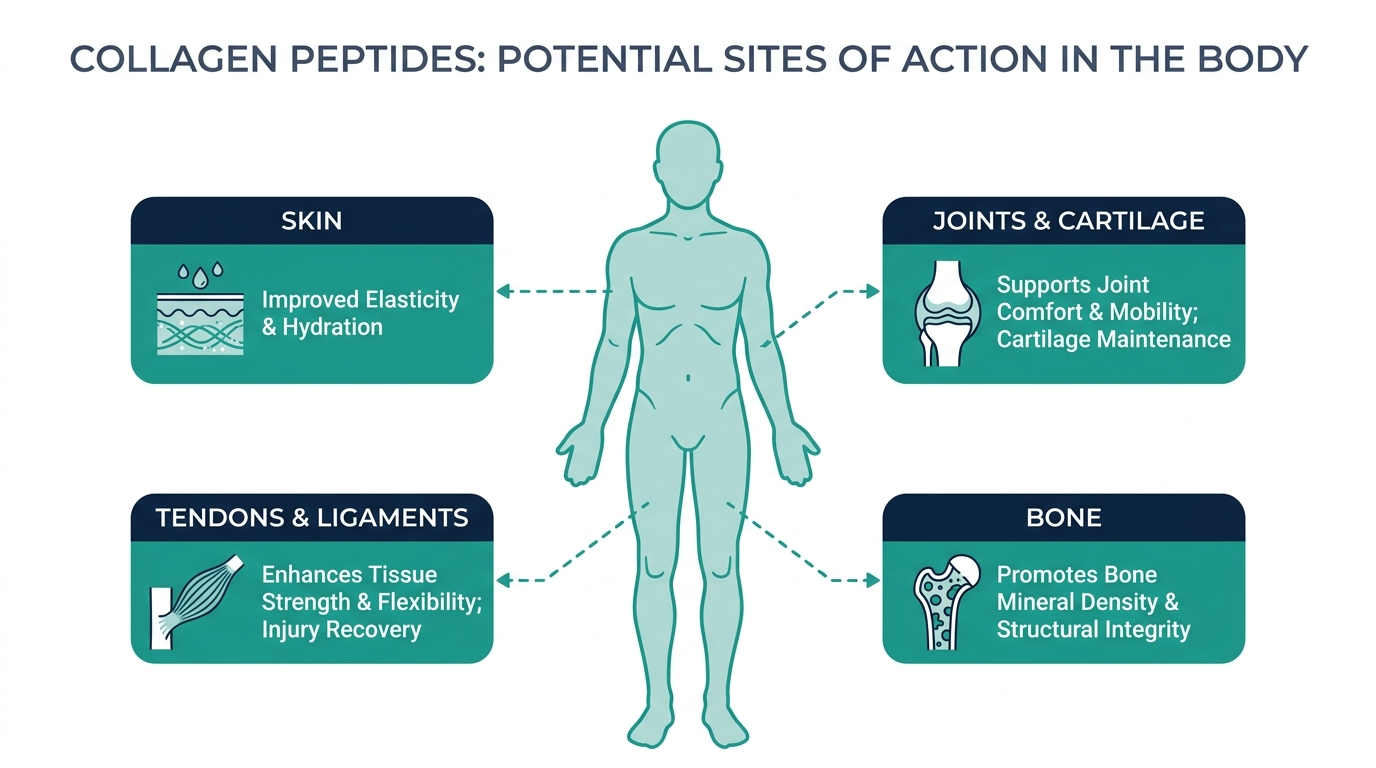
Collagen is the most abundant structural protein in the human body, making up roughly 30% of total protein and the bulk of skin, tendons, ligaments, cartilage, and bone. It is built from long triple-helix chains rich in glycine, proline, and hydroxyproline, three amino acids found in almost no other dietary protein in meaningful amounts.
“Hydrolyzed collagen peptides” means the long chains have been broken down by enzymes into short fragments, typically 3,000 to 5,000 Daltons. That size matters mechanically: a 2024 randomized crossover study in Frontiers in Nutrition confirmed that specific collagen-derived dipeptides, primarily prolyl-4-hydroxyproline (Pro-Hyp) and hydroxyproline-glycine (Hyp-Gly), are detectable in human blood within 60 minutes of ingestion, reaching micromolar concentrations significantly higher than those of other food-derived peptides. In other words, these fragments survive digestion and circulate systemically, which is the biological prerequisite for any of the downstream effects on skin or joints.
Whole gelatin (cooked collagen) is not the same thing. Gelatin gels at room temperature, does not dissolve cold, and is not absorbed with the same efficiency. The “hydrolyzed” step is not marketing, it is chemistry.
This also explains why bone broth enthusiasts and collagen supplement users are sometimes disappointed when they swap one for the other: a cup of bone broth yields roughly 6 to 12 grams of collagen, but in gelatin form, not as pre-hydrolyzed peptides, so the absorption kinetics are genuinely different.
What does the clinical evidence actually say?
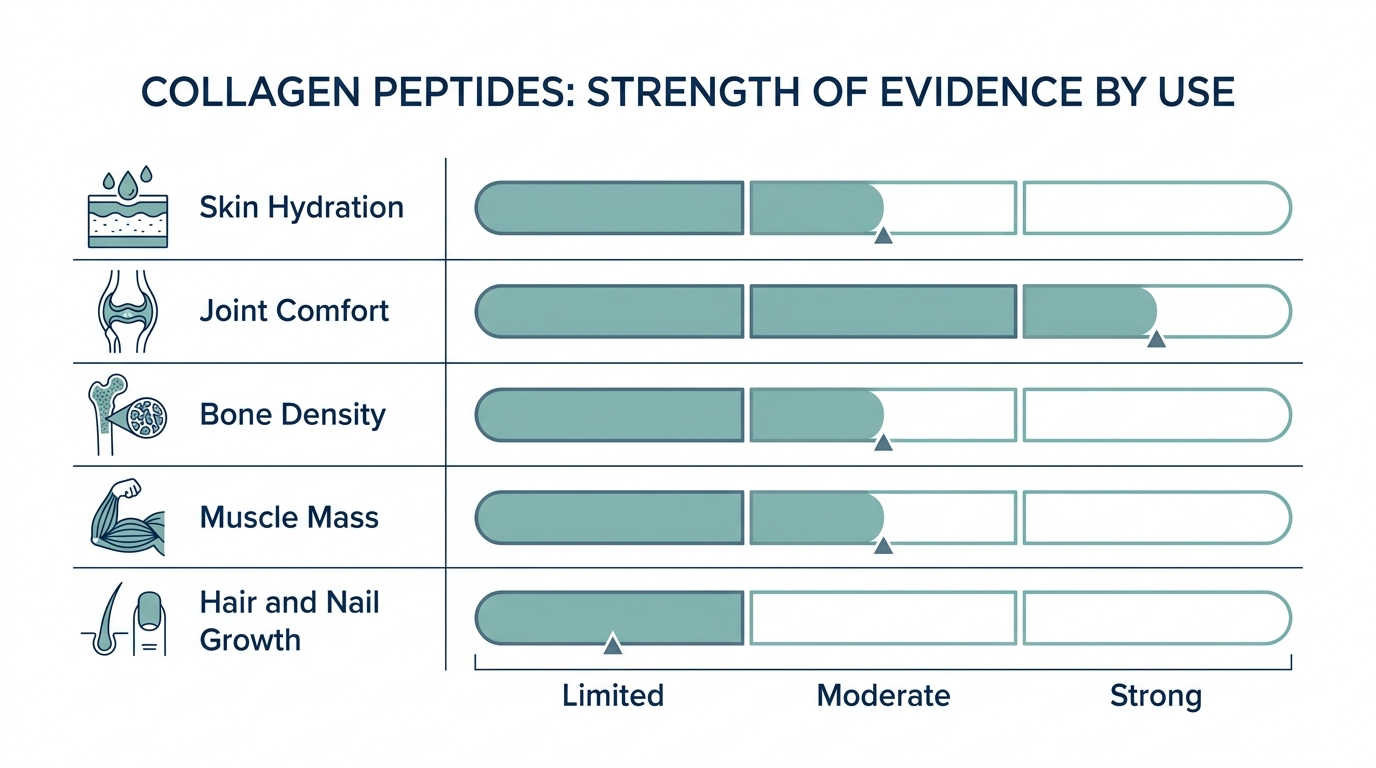
The evidence is not uniform across every claimed benefit. Here is where it is strong, where it is moderate, and where it is thin.
Skin: the strongest evidence base
A 2025 meta-analysis in the American Journal of Medicine pooling data from 23 randomized controlled trials found that collagen supplementation significantly improved skin hydration, elasticity, and wrinkle depth versus placebo. A separate 2026 systematic review and meta-analysis published in Frontiers in Medicine reviewed oral and topical peptide interventions across all randomized controlled trials and confirmed statistically significant improvements in skin elasticity and hydration in the supplementation arms.
The mechanism is not what most brands explain. Orally ingested collagen peptides do not travel to the dermis and slot back into skin. They act as signaling molecules: the Pro-Hyp and Hyp-Gly dipeptides stimulate dermal fibroblasts to upregulate synthesis of Type I collagen, elastin, and hyaluronic acid through the TGF-beta/Smad and MAPK pathways. Your skin is producing more collagen, not absorbing the supplement’s collagen directly.
A clinical observational trial published in npj Aging (2025) found that a collagen amino acid composition supplementation protocol reduced participants’ biological age by a mean of 1.4 years within 6 months, using multi-biomarker aging clocks as the outcome. That is a single trial, and biological age scores carry their own methodological debates, but it points to systemic effects beyond cosmetic endpoints.
Joints: moderate to strong, with a type distinction that matters
For joint health, the collagen type matters in a way the general supplement aisle ignores. Most powdered collagen products deliver hydrolyzed Type I and III collagen from bovine or marine sources. These have reasonable evidence for reducing joint pain intensity by inhibiting glycine-mediated cytokine release and supporting the extracellular matrix around cartilage, particularly at 10 grams per day over 6 to 24 weeks.
Undenatured Type II collagen (UC-II), sold at 40 mg daily, works through a completely different pathway: small intact molecules interact with gut-associated lymphoid tissue, triggering regulatory T cells that suppress the immune attack on cartilage. The Arthritis Foundation notes that UC-II may be specifically useful for immune-mediated joint inflammation in ways that Type I peptides do not replicate.
Do not believe the brand claim that “more collagen protein = better joints.” A 40 mg UC-II capsule outperforms a 10-gram Type I powder for certain osteoarthritis presentations precisely because the mechanism is immunological, not structural. If joint support is your primary goal, the collagen type is not a detail, it is the whole decision.
Muscle: promising but context-dependent
A 2025 meta-analysis published in Frontiers in Nutrition found that collagen peptide supplementation, when combined with resistance training, produced significant increases in body mass, muscle mass, and muscle strength over placebo-plus-training groups. The effect appears strongest in sarcopenic older adults and in athletes performing eccentric exercise.
Personally, I would not position collagen peptides as a primary muscle-building supplement for healthy young adults. Leucine content is low, and leucine is the amino acid that triggers mTOR-driven muscle protein synthesis most directly. Collagen’s value in muscle context is more about the connective tissue and fascia quality around the muscle than the contractile fiber itself. Stack it with, not instead of, a complete protein source.
Gut health: early data, genuine mechanistic rationale
The gut evidence is earlier-stage but not implausible. Glycine, which makes up roughly 33% of collagen by amino acid composition, has direct anti-inflammatory effects on gut-associated macrophages, and Type I and III collagen is a structural component of the intestinal extracellular matrix. A 2025 ClinicalTrials.gov-registered study is enrolling healthy adults with perceived gastrointestinal symptoms to evaluate collagen versus placebo specifically on GI endpoints, which signals the research community sees enough preliminary signal to justify a proper RCT.
Do not buy collagen primarily for gut health in 2026. The mechanism exists, the observational data is suggestive, but the controlled trial evidence has not landed yet.
How much collagen should you take per day?
Dose ranges vary by goal, and this is the single most consistent failure point in the collagen market. Brands routinely sell 5-gram servings for “comprehensive joint and skin support,” a dose that falls below what most skin trials used and well below what joint trials required.
| Goal | Evidence-based daily dose | Notes |
|---|---|---|
| Skin hydration and elasticity | 2.5 to 10 g hydrolyzed Type I/III | As little as 2.5 g showed effect in some trials at 12 weeks |
| Joint pain and cartilage support | 5 to 15 g hydrolyzed Type I, or 40 mg UC-II | Type distinction matters; see joint section above |
| Muscle support with resistance training | 15 to 20 g within 1 hour post-workout | Take with vitamin C to support collagen synthesis |
| Gut health | 10 to 20 g | Evidence still preliminary; 20 g linked to reduced bloating in one trial |
| General connective tissue maintenance | 5 to 10 g | Minimum effective signal from most trials |
The safety window is wide. Studies report no significant adverse events at doses up to 10 grams daily for 6 months, and the general safe range is considered 2.5 to 15 grams by most clinical dietitians.
Does timing matter, and should you pair it with vitamin C?
On timing: no head-to-head RCT has demonstrated a clinically significant difference between morning and evening collagen intake for any outcome. The honest answer is that consistency across days outweighs the time of day completely.
Vitamin C is different. Collagen synthesis requires vitamin C as a cofactor for the hydroxylation of proline and lysine residues in the collagen molecule. Without sufficient vitamin C, your fibroblasts cannot form stable collagen triple helices regardless of substrate. One trial combining collagen with vitamin C reported skin elasticity improvement of 20.6% at 6 weeks, compared to more modest outcomes in collagen-only arms. You do not need to ingest them simultaneously, but making sure your vitamin C intake is adequate while supplementing collagen is not optional, it is the basic biochemistry.
Pre-workout is a legitimate timing strategy specifically for joint protection: a 2017 study by Shaw et al. found that consuming hydrolyzed collagen 60 minutes before exercise significantly increased collagen synthesis markers in tendons versus placebo-plus-exercise. The window here is functional, not cosmetic.
Who should NOT take collagen peptides?
Most people tolerate collagen peptides easily. The contraindications are real but narrow:
Allergy to the source animal. Bovine-derived collagen is problematic for those with beef allergies. Marine-derived collagen (fish skin and scales) carries a risk for fish allergy sufferers. Egg shell membrane collagen is an option, but it carries its own allergen profile. Read the source on the label, not just “collagen peptides.”
Kidney disease. Collagen is a dense protein load. At 15 to 20 grams per day, the additional nitrogen burden is significant for individuals with compromised renal function. People with chronic kidney disease should consult a nephrologist before adding any high-protein supplement.
Hypercalcemia. Some collagen products include calcium or are bone-derived and carry a meaningful calcium load. In individuals with elevated serum calcium, already common in certain cancers and hyperparathyroidism, additional supplemental calcium is contraindicated.
Pregnancy and breastfeeding. Not because collagen peptides are inherently dangerous, but because clinical trials have not enrolled pregnant or breastfeeding participants, so the safety profile in those populations is simply unknown. Absence of evidence is not evidence of safety when the population is this vulnerable.
Phenylketonuria (PKU). Collagen contains phenylalanine. Individuals with PKU must count all dietary phenylalanine carefully, and a 15-gram collagen dose adds a non-trivial amount.
The myth that collagen “just gets digested like any other protein”
This is the most common dismissal and it is partly wrong. The skeptical argument goes: “You eat collagen, your gut breaks it into amino acids, your body uses them for whatever it needs, there is nothing special happening.” That argument was reasonable before we had blood-fraction analysis. It is less defensible now.
The 2024 Frontiers in Nutrition crossover study measured specific collagen-derived dipeptides in participants’ blood after oral ingestion, confirming that Pro-Hyp and Hyp-Gly reach systemic circulation as intact fragments, not as free amino acids. These specific dipeptides are not found in any significant quantity in other food proteins because hydroxyproline itself is unique to collagen. Once in circulation, they act on fibroblast receptors to upregulate collagen production. That is not the same biological pathway as “eating protein and hoping for the best.”
The skeptics are right that you cannot direct the effect to a specific location. Your body will allocate the signaling molecules and amino acids based on its own repair priorities. But the signal exists, the receptor interaction has been demonstrated in vitro and in human tissue, and the RCT outcomes confirm the downstream effect. The mechanism is unusual; it is not imaginary.
Collagen peptides vs. bone broth: which one is actually better?
Neither is universally better. They are different products serving overlapping but distinct purposes.
A cup of homemade bone broth contains roughly 6 to 12 grams of collagen, but in gelatin form rather than hydrolyzed peptides. It also delivers electrolytes, trace minerals, glycosaminoglycans like glucosamine and chondroitin, and a range of conditional amino acids in a whole-food matrix. The nutrient density is broader but the collagen bioavailability is lower.
Hydrolyzed collagen peptides deliver a precise, standardized dose of pre-digested fragments with confirmed absorption, but without the broader micronutrient matrix of broth. They are convenient, dose-controlled, and flavorless in coffee or a smoothie.
For general connective tissue support in someone who eats well and cooks frequently, high-quality bone broth is a reasonable whole-food strategy. For anyone trying to hit the 10-gram daily threshold consistently, or who wants a dose-controlled intervention they can measure and adjust, the powder is more practical.
How to choose a quality collagen supplement
The collagen supplement market has a quality problem. Because these products are classified as dietary supplements in the US, not drugs, there is no FDA pre-market approval. Third-party testing is the only independent quality signal, and most brands do not publish it transparently.
Four things to check before you buy:
- Source and type are declared clearly. Grass-fed bovine, wild-caught marine, or free-range chicken, with the collagen type (I, II, III) specified. “Proprietary blend” language without type disclosure is a red flag.
- Third-party tested. Look for NSF Certified for Sport, Informed Sport, or USP verification marks. These certifications test for contaminants, heavy metals, and label accuracy.
- Dose is clinical. Verify the per-serving collagen gram count against your goal using the table above. A product with 5 grams per serving for “complete joint support” is undershooting the evidence base.
- Vitamin C is included or you are supplying it yourself. Some premium products co-formulate with 50 to 100 mg vitamin C per serving; others rely on you to have adequate dietary vitamin C. Either is fine, but know which situation you are in.
Vital Proteins Collagen Peptides is the category’s best-known brand, with 20 grams of hydrolyzed Type I and III bovine collagen per serving and a BarBend 2026 review confirming strong mixability and clean ingredient profile. At approximately $47 for 20 oz (~28 servings at 20 g each), it sits at the mid-premium price point. The brand updated packaging in 2026 to use 90% less plastic. It does not include vitamin C in the base formula, so supplement your own.
Hydrolyzed type I & III collagen peptides, third-party tested, unflavored.
Curious what your own levels look like?
Baseline 100+ biomarkers today and retest as life changes, all in one membership with physician review.
Frequently asked questions
Should I take collagen peptides every day?
Yes, daily consistency is what the clinical trials demonstrate. Most studies showing significant skin, joint, or muscle benefits ran 8 to 24 weeks of daily supplementation. Taking it intermittently will not replicate those outcomes. Think of it as a cumulative signaling intervention, not a one-dose acute effect.
Does collagen peptides actually work for skin?
The evidence is stronger here than for almost any other benefit. A 2025 meta-analysis of 23 RCTs confirmed statistically significant improvements in skin hydration, elasticity, and wrinkle depth. The mechanism, Pro-Hyp dipeptides stimulating dermal fibroblast activity via TGF-beta signaling, is mechanistically validated in cell culture and in human tissue biopsies.
What is the best time to take collagen peptides?
No RCT has shown a meaningful difference between morning and evening intake for skin or joint outcomes. Pre-exercise (60 minutes before) has specific evidence for tendon collagen synthesis. The honest answer is: take it consistently at whatever time you will actually remember.
Should I take collagen with vitamin C?
Yes, or at minimum ensure you have adequate dietary vitamin C. Vitamin C is a required cofactor for collagen hydroxylation at the synthesis step. Without it, the fibroblast stimulation from collagen peptides cannot be fully converted into stable new collagen. Co-ingestion is not required at the exact same moment, but chronic vitamin C inadequacy will blunt the response.
Are collagen peptides safe?
For most healthy adults, yes. Clinical trials report no serious adverse events at doses up to 10 grams daily for 6 months. The main contraindications are animal-source allergies, kidney disease, hypercalcemia, pregnancy or breastfeeding (insufficient data), and phenylketonuria. Mild GI symptoms like bloating can occur, especially when starting at high doses on an empty stomach.
How long does collagen take to work?
Skin hydration improvements have been detected in some trials within 4 weeks. Elasticity changes typically reach significance by 8 to 12 weeks. Joint pain outcomes are most consistently demonstrated at 12 to 24 weeks of daily use. There is no shortcut to timeline here. The mechanism is incremental biological remodeling, not an acute pharmacological response.
Can I get enough collagen from food instead of supplements?
Possibly, if you eat skin-on poultry, bone-in fish, or make proper bone broth several times per week. A cup of quality bone broth delivers 6 to 12 grams of collagen, though in gelatin rather than hydrolyzed form. If you cook this way regularly, a targeted supplement may be redundant. If you eat a standard Western diet without these connective-tissue-rich foods, dietary collagen intake is likely near zero, and the gap is real.
Hydrolyzed type I & III collagen peptides, third-party tested, unflavored.
Author: Vital Signs Today Editorial Team, [credential]”]. Educational content, not medical advice. Sources linked inline.
Primary sources:
– Frontiers in Nutrition: Absorption of bioactive peptides following collagen hydrolysate intake (2024)
– American Journal of Medicine: Effects of Collagen Supplements on Skin Aging meta-analysis (2025)
– Frontiers in Medicine: Oral and topical peptides for skin aging systematic review and meta-analysis (2026)
– npj Aging: Collagen amino acid supplementation reduces biological age (2025)
– PMC: Collagen peptides affect collagen synthesis and gene expression in human dermal fibroblasts
– Frontiers in Nutrition: Efficacy of collagen peptide supplementation on bone and muscle health meta-analysis (2025)
– PMC: Collagen supplementation in skin and orthopedic diseases review
– Arthritis Foundation: Can Collagen Supplements Help Arthritis?
– BarBend: Vital Proteins Collagen Peptides Review 2026
– Bare Bones Broth: Bone Broth vs. Collagen comparison
– Healthline: How Much Collagen Per Day
– ClinicalTrials.gov NCT06937801: Effect of Collagen on Gastrointestinal Discomfort
– Metabolic Skincare: Best Time to Take Collagen
Related reading
Vital Signs Today may earn a commission if you buy through links on this page. It does not affect our editorial assessments.